FAC Intelligence vs Apollo.io: Which B2B Data Tool Wins?
One is a thinly documented niche intelligence vendor, the other is the loudest all-in-one sales platform on the market. Here is how FAC Intelligence and Apollo.io actually compare on data, pricing, and export rights.
FAC Intelligence vs Apollo.io comes down to one choice. You can buy a niche data vendor you have to test yourself, or a broad sales platform you pay for by the seat. Here is how the two compare on data, price, and export rights.
TL;DR
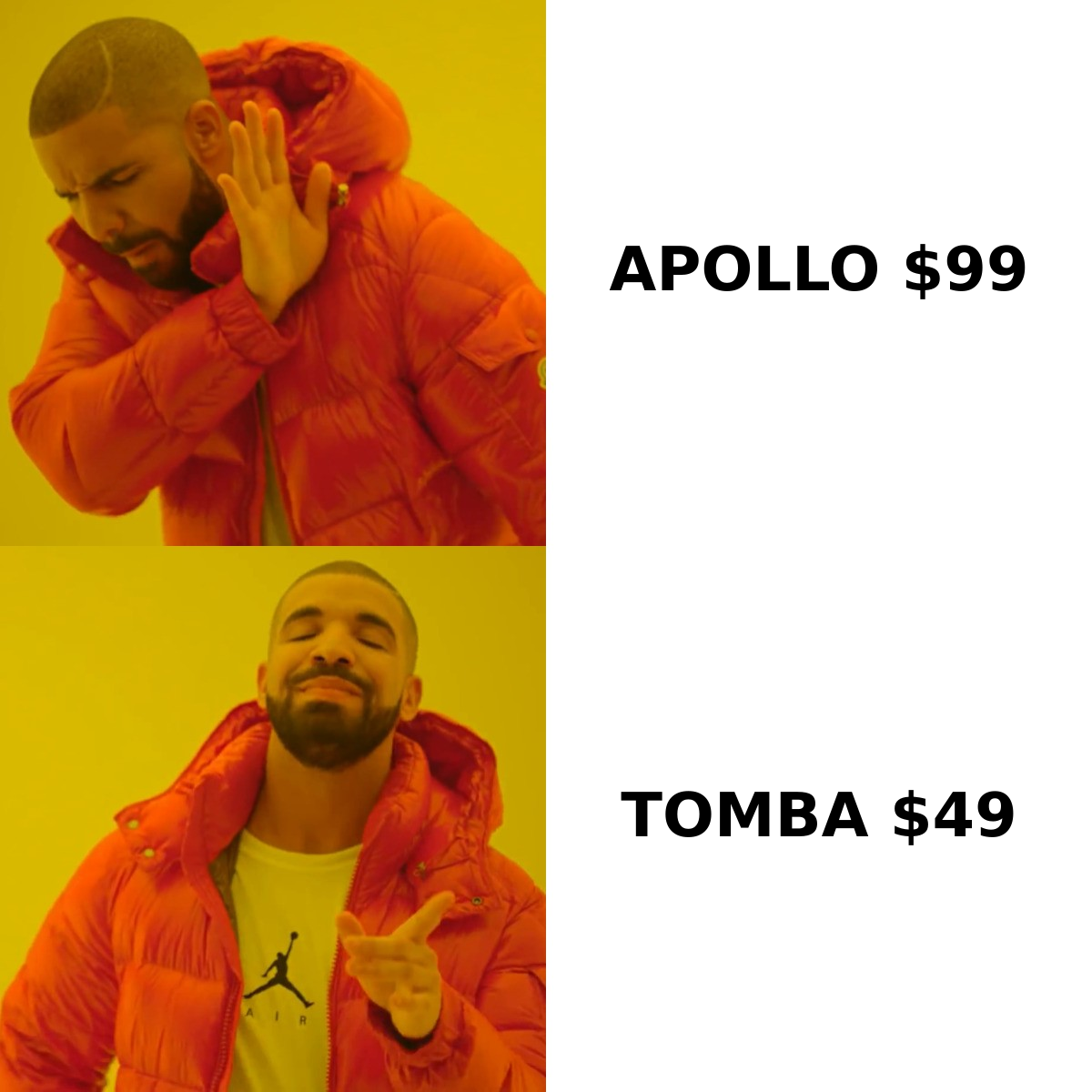
- Apollo.io is the safer default. It bundles contact data, sequencing, and dialing in one tool. Paid plans start near $49 per user per month, billed yearly.
- FAC Intelligence is harder to check. Public pricing, match-rate numbers, and review volume are all thin. That is not proof it is bad. It does mean you should test it first.
- Neither one is a pure email finder. Say you have 4,000 names and no emails. A dedicated email finder plus an email verifier will beat both on cost per usable contact.
Cost is where the two split hardest:
- Seats drive the gap, not credits. Apollo charges per user. Five reps on Apollo Professional run about $4,700–$6,000 a year before overages. API-first tools charge for lookups, not chairs.
- Ask both vendors the same four questions. Where does the data come from? What is the verified-email match rate on your ICP? Are exports yours to keep? What happens to your list if you downgrade?
What is FAC Intelligence, and what does it do?#
FAC Intelligence sells B2B data and market intelligence. Think company records, contact records, and firmographic signals. The pitch aims at sales and research teams more than at pure outbound teams.
Here is the honest part. Next to Apollo.io, there is very little public information you can verify. No widely cited pricing page. No large body of G2 reviews. No published match-rate method. I am not going to invent numbers to fill that gap.
That gap is useful buying information on its own. When a vendor hides pricing, match rates, and sourcing, it wants the sales call to come first. Sometimes that is a normal enterprise motion. Sometimes the numbers just do not survive a public comparison. Either way, your job is the same. Get the evidence in writing before money moves.
Treat FAC Intelligence like any other specialist data provider:
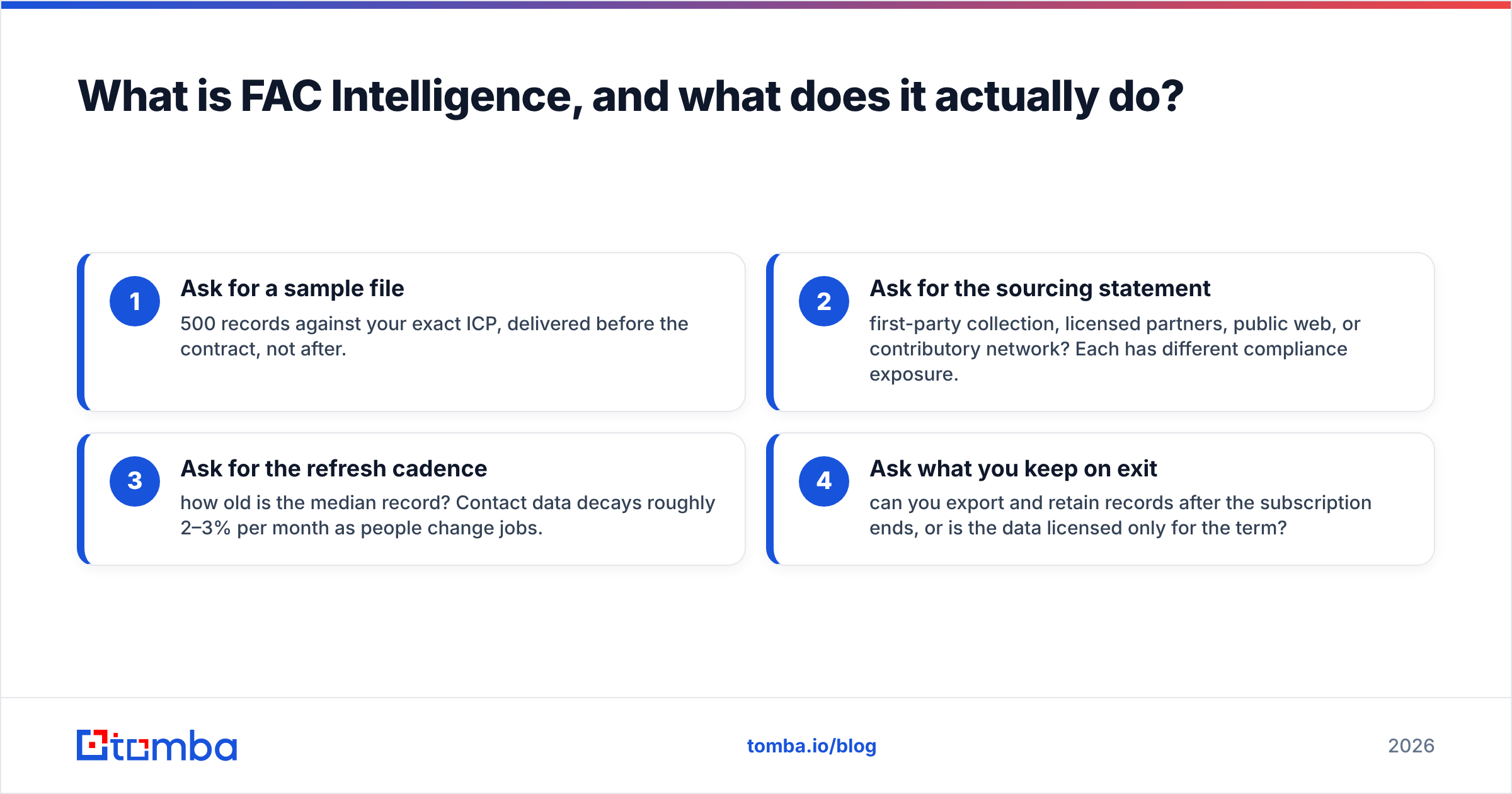
- Ask for a sample file. 500 records against your exact ICP, sent before the contract, not after.
- Ask where the data comes from. First-party, licensed partners, public web, or a contributory network? Each carries different risk.
- Ask how often it refreshes. How old is the median record? Contact data decays about 2–3% per month as people change jobs.
- Ask what you keep on exit. Can you export and keep records after the subscription ends? Or is the data licensed only for the term?
What is Apollo.io in 2026?#
Apollo.io sits at the all-in-one end of the market. It pairs a large contact and company database with a sales engagement layer. That layer covers sequences, email sending, a dialer, a LinkedIn extension, CRM sync, and AI writing help. Apollo claims hundreds of millions of contacts. It also runs one of the largest free tiers in the category. That is why it shows up in almost every stack audit.
The trade-offs are well known by now:
- Breadth over depth. Coverage of North American tech is strong. It thins out for smaller EU and APAC firms, non-tech verticals, and companies with no LinkedIn footprint.
- Verified vs unverified. A large share of the database is guessed from patterns. Apollo labels confidence levels. Even so, many teams export "likely" emails and learn the bounce rate at the mailbox.
- Seat pricing punishes teams. Credits are the headline. Seats are the invoice. Two more SDRs means two more full subscriptions, even if they never touch sequencing.
- Lock-in. Data, sequences, and reporting live in one place. That is handy until you want to move. It hurts if a sending problem inside the platform touches your whole domain.
Apollo is not a bad product. It is a broad one. Broad products are always weaker at any single job than the tool built for that job alone.
FAC Intelligence vs Apollo.io: how do they compare head-to-head?#
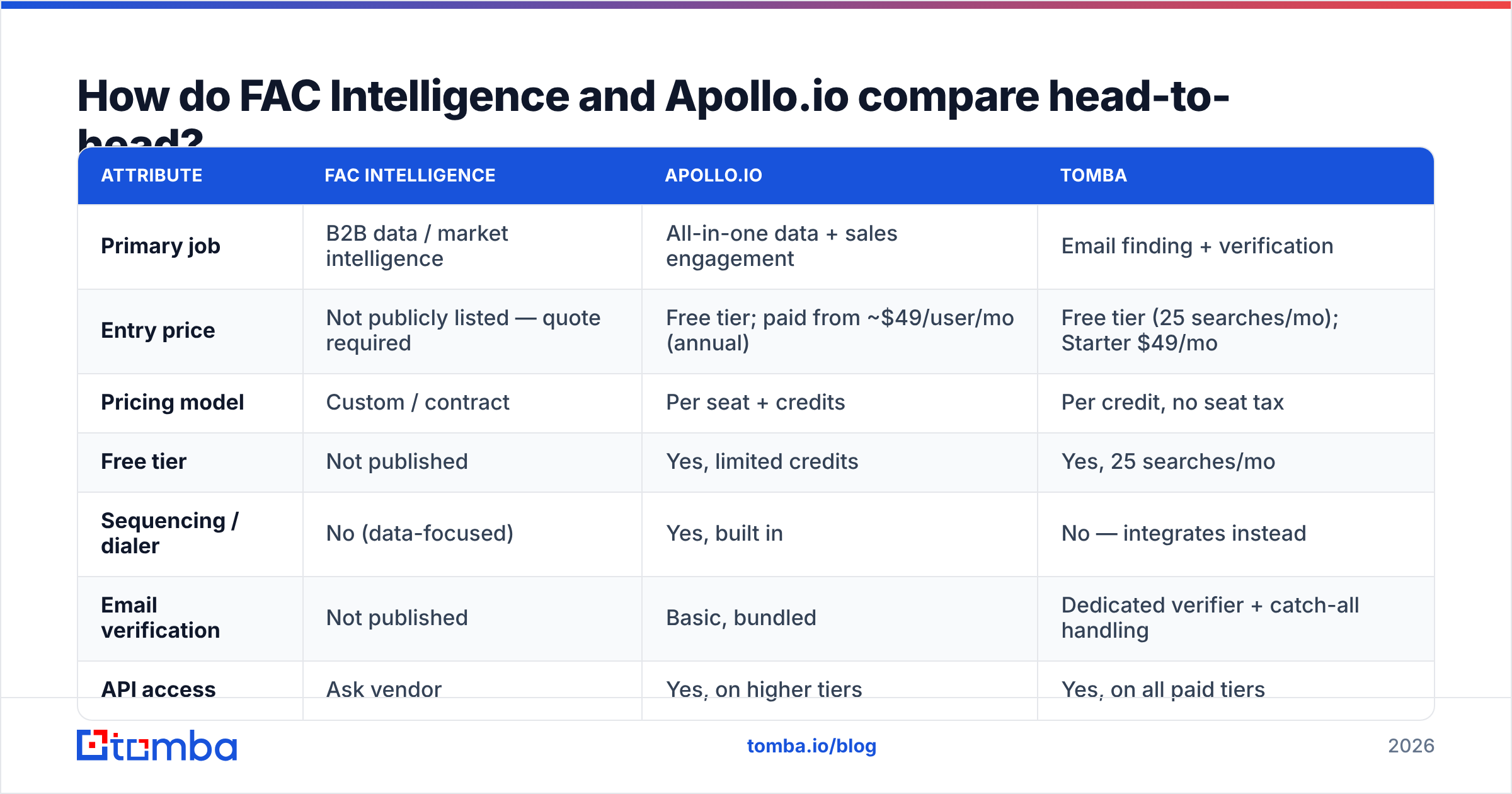
| Attribute | FAC Intelligence | Apollo.io | Tomba |
|---|---|---|---|
| Primary job | B2B data / market intelligence | All-in-one data + sales engagement | Email finding + verification |
| Entry price | Not publicly listed — quote required | Free tier; paid from ~$49/user/mo (annual) | Free tier (25 searches/mo); Starter $49/mo |
| Pricing model | Custom / contract | Per seat + credits | Per credit, no seat tax |
| Free tier | Not published | Yes, limited credits | Yes, 25 searches/mo |
| Sequencing / dialer | No (data-focused) | Yes, built in | No — integrates instead |
| Email verification | Not published | Basic, bundled | Dedicated verifier + catch-all handling |
| API access | Ask vendor | Yes, on higher tiers | Yes, on all paid tiers |
| Export rights | Confirm in contract | Credit-gated exports | Exports included |
| Best for | Buyers who need a specific regional/vertical dataset | Teams wanting one tool for everything | Teams that need verified addresses at volume |
Read that table as a shape, not a scoreboard. The Apollo column comes straight from public pricing pages. The FAC Intelligence column has holes because the vendor left them there. So the FAC Intelligence vs Apollo.io gap is partly a data gap and partly a transparency gap. Ask a rep to fill it in writing before you compare seriously.
Which one has better data accuracy?#
Accuracy is the only metric that still matters a quarter later. It is also the one every vendor defines its own way.
Three terms get mixed up in sales decks. They are not the same thing:
- Coverage. The share of your target list that returns any record. Easy to inflate with guesses.
- Match rate. The share that returns the field you asked for. It still says nothing about correctness.
- Verified accuracy. The share of returned emails that actually accept mail. This is the number that maps to your bounce rate.
A vendor who quotes "95% accuracy" without naming one of the three has told you nothing. Ask for the third number. Ask for it on your own ICP sample, with the method attached.

One pattern holds across every benchmark I have run. Broad platforms win on coverage and lose on verified accuracy. Specialist finders return fewer records, but more of those records deliver. If you send cold email, verified accuracy decides whether your domain survives. A 12% bounce rate costs more in sender reputation than any subscription saves.
So many teams run a hybrid. They use Apollo for discovery and firmographic filtering. Then they run a dedicated finder and verifier before anything hits a sequence. It costs two line items and saves the domain.
How does the pricing really work?#

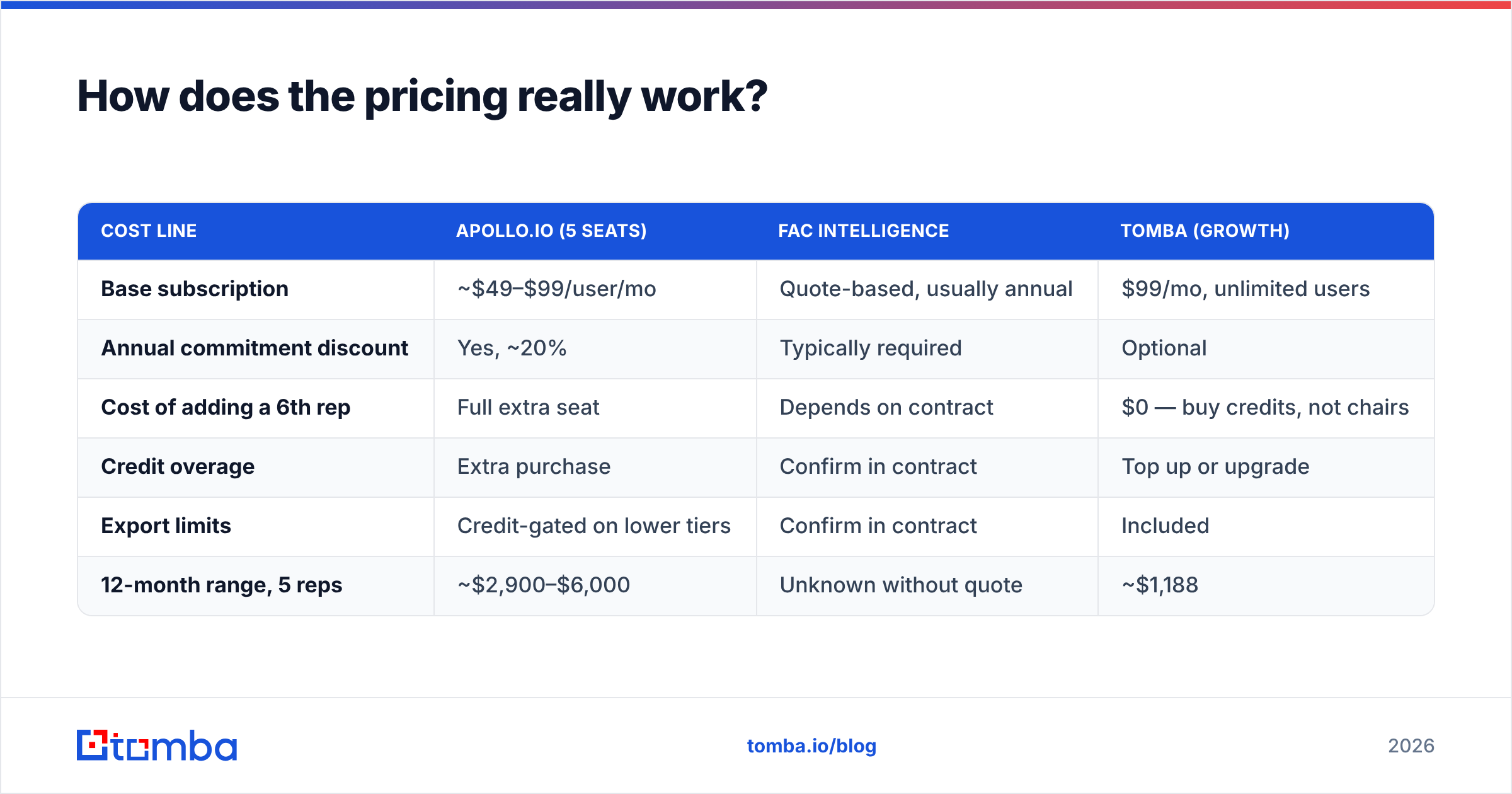
The sticker price is rarely the price. Here is the real math for a five-person outbound team over twelve months.
| Cost line | Apollo.io (5 seats) | FAC Intelligence | Tomba (Growth) |
|---|---|---|---|
| Base subscription | ~$49–$99/user/mo | Quote-based, usually annual | $99/mo, unlimited users |
| Annual commitment discount | Yes, ~20% | Typically required | Optional |
| Cost of adding a 6th rep | Full extra seat | Depends on contract | $0 — buy credits, not chairs |
| Credit overage | Extra purchase | Confirm in contract | Top up or upgrade |
| Export limits | Credit-gated on lower tiers | Confirm in contract | Included |
| 12-month range, 5 reps | ~$2,900–$6,000 | Unknown without quote | ~$1,188 |
Two things fall out of this.
First, seats are the tax. Most teams do not need five people holding a full data license. Two researchers build the lists. Four reps work them. That shape is cheaper, but only if your data tool prices on lookups instead of logins. Compare Tomba pricing against a per-seat quote for the headcount you expect in 12 months, not the headcount you have today.
Second, a hidden price is a negotiating position. On cost, FAC Intelligence vs Apollo.io is not a fair fight yet, because only one side publishes numbers. If FAC Intelligence quotes you, get it in writing. Include the overage rate, the auto-renewal clause, and the export-on-exit terms. Vendors who hide pricing usually discount it. They only do so when you have a real alternative on the table.

Who should choose which?#
- Choose Apollo.io if you run a team under 50 people and want data, sequencing, and dialing on one invoice. It fits best if you sell mostly into North American tech. The free tier lets you test before you pay.
- Choose FAC Intelligence only if its dataset covers a region, vertical, or signal the big platforms miss. Make a sample file prove it. Specialist data is worth paying for when it is truly specialist.
The other three options are easy to overlook:
- Choose a dedicated finder and verifier if your real problem is turning names and domains into addresses that deliver, and you already sequence elsewhere (Instantly, Smartlead, HubSpot, your CRM).
- Choose two tools if you run real outbound volume. Discovery and verification fail in different ways. One weak vendor should not break both jobs.
- Choose none of them yet if you cannot write a 500-row test list. No data vendor fixes a targeting problem.
Already on Apollo and the seat math has stopped working? The Apollo alternative breakdown covers the migration path, including what you give up when you split sequencing from data.
What about compliance and data sourcing?#
Every B2B data vendor sits somewhere between "licensed and auditable" and "scraped and hoped for the best." Under GDPR and CCPA, the buyer carries real risk. So the sourcing question is not a formality.
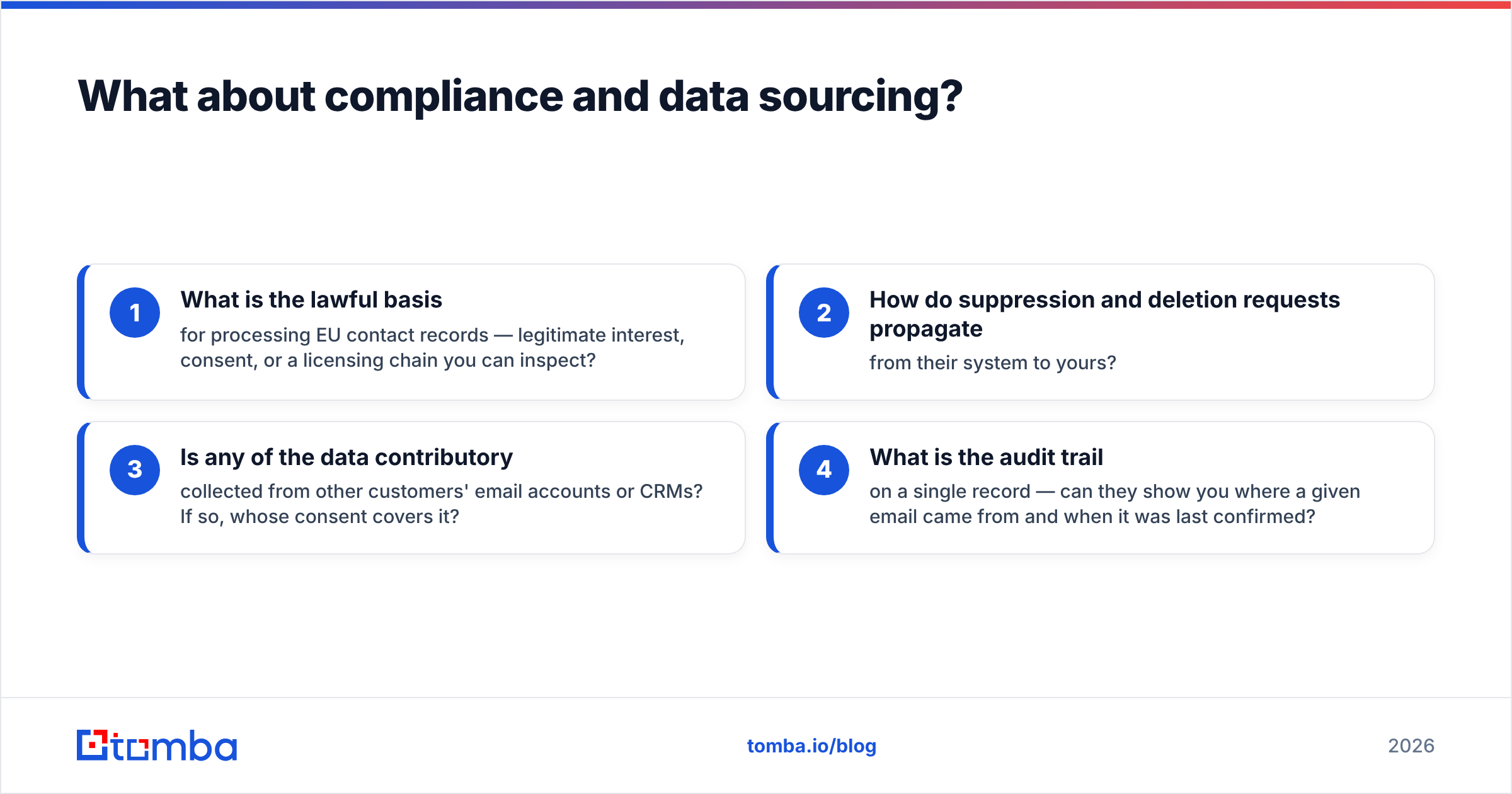
Ask each vendor, in writing:
- What is the lawful basis for processing EU contact records? Legitimate interest, consent, or a licensing chain you can inspect?
- How do suppression and deletion requests move from their system to yours?
- Is any data contributory? Was it pulled from other customers' inboxes or CRMs? If so, whose consent covers it?
- What is the audit trail on one record? Can they show where an email came from and when it was last confirmed?
Apollo publishes a compliance posture and a privacy center. Large vendors usually do, because enterprise buyers demand it. Ask any smaller vendor, FAC Intelligence included, for the same answers before your first export. Tomba documents its own data sources for that reason. A sourcing statement you can hand to legal is part of the product.
For a neutral primer on the category, sales intelligence on Wikipedia is a fine place to start before you read vendor material.
How do you run a fair 30-day test?#
Do not judge either tool on its demo data. Judge it on yours.
- Build one control list. 500 real target accounts with named contacts, exported to CSV. Use the same list for every vendor.
- Run each vendor against it. Record three numbers: records returned, emails returned, and emails marked verified.
- Verify with a third tool so no vendor grades its own homework. Count how many "verified" addresses survive.
- Send a small warm test. 100 addresses per source, from a domain you can risk. Log hard bounces at 48 hours.
- Divide total cost by deliverable contacts. That is your real cost per usable lead. It is almost never the sticker price.
- Repeat for phones if you dial. Coverage on B2B phone numbers varies far more between vendors than email coverage does.
Teams that run this test tend to land in the same place. The cheapest sticker price is rarely the cheapest cost per deliverable contact. The biggest database is rarely the most accurate one for their slice of the market.
The bottom line#
The short answer on FAC Intelligence vs Apollo.io: Apollo is the defensible default. It is mature, broad, and transparent, and it gets expensive once you add seats. FAC Intelligence is an unknown in public, so the burden of proof sits with the vendor. Ask for the sample file, the sourcing statement, written pricing, and export rights. If it clears that bar for your niche, the contract may be worth it. If it does not, walk.
And if your real need is a reliable pipe from names and domains to addresses that deliver, buy that job directly. Tomba's Email Finder finds professional addresses by domain, name, or company. It verifies them before they reach your sequence. It prices on credits instead of seats: a free tier at 25 searches a month, Starter at $49 a month, and a Tomba API on every paid plan. Test it against your control list this week. Compare cost per deliverable contact, not cost per login.
Related guides#
Ready to find emails that actually work?
Join 150,000+ professionals who stopped guessing and started sending. Free credits on signup — no credit card required.
Get the Tomba newsletter
Practical outbound tactics and product updates — once every two weeks.
About the author