Farmer Sales: The Complete 2026 Guide to Account Growth
Hunters win logos. Farmers decide whether those logos are still paying you in year three. Here's how the farmer sales model actually works, what to pay for it, and when it quietly stops working.
TL;DR
- Farmer sales is the discipline of expanding revenue inside accounts you already closed: renewals, upsells, cross-sells, and multi-threading into new departments.
- Farmers typically carry 20–60 accounts, run on 6–12 month cycles, and are measured on net revenue retention (NRR) rather than new logos.
- The math favors farming more than most teams admit: expanding an existing account usually costs a fraction of acquiring a comparable new one, and NRR compounds while new-logo growth resets every quarter.
- The model breaks in three predictable places — comp plans that reward passivity, farmers who never prospect inside the account, and stale contact data that hides the champion who just left.
- You still need prospecting infrastructure on the farming side. Expansion means finding new buyers at a company you already sell to, which is a data problem before it's a relationship problem.
What is farmer sales?#
Farmer sales is the half of the revenue org that grows what's already planted. A farmer owns a book of existing customers and is responsible for keeping them, expanding them, and turning a single-department deal into a company-wide one.
The analogy is doing real work here. A hunter walks into unfamiliar territory, finds something, kills it, and moves on — high variance, high adrenaline, no obligation to the ground they leave behind. A farmer works the same field for years. The return in year one is modest. The return in year four, if the soil was managed, is far larger than anything a hunter brings back in a single trip.
In modern org charts, farmer sales shows up under a few different titles:
- Account Manager (AM) — owns the commercial relationship, drives renewals and upsells, usually quota-carrying.
- Customer Success Manager (CSM) — owns adoption and outcomes; in some orgs carries an expansion number, in others deliberately doesn't.
- Account Executive, Expansion — a full AE seat that only sells into the installed base, common in companies past $30M ARR.
- Strategic / Enterprise Account Director — a farmer with a hunter's compensation, working 5–15 named accounts with six-figure expansion targets.
- Renewals Manager — a narrow farmer role focused purely on contract continuation, often in high-volume SMB books.
The titles differ. The job doesn't: find revenue that already trusts you, and go get more of it.
How do farmer and hunter roles actually differ?#
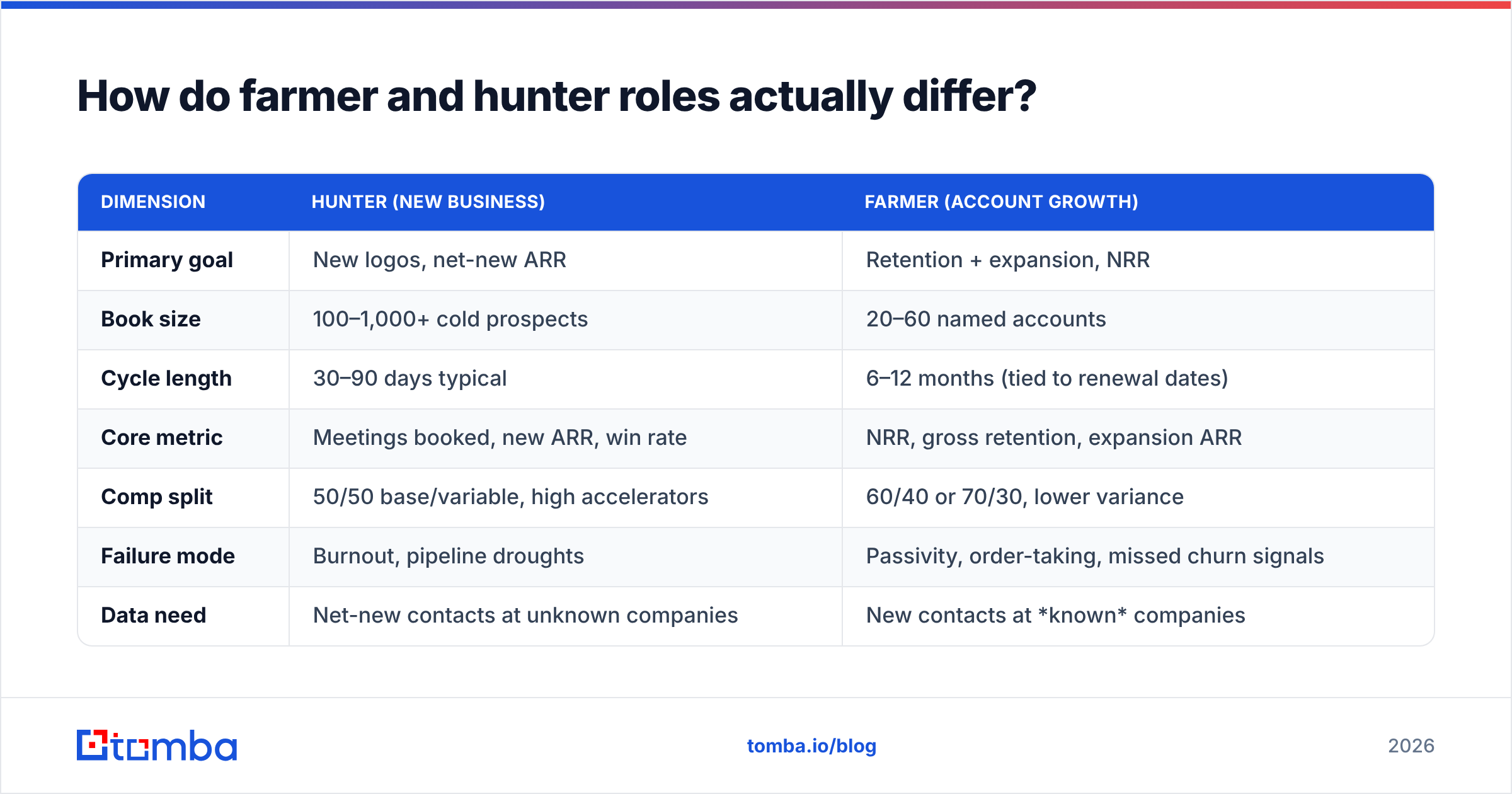
Most teams describe the difference in personality terms ("hunters are aggressive, farmers are patient"), which is a bad way to staff a revenue org. The real differences are structural — different cycles, different metrics, different tooling, different failure modes.
| Dimension | Hunter (New Business) | Farmer (Account Growth) |
|---|---|---|
| Primary goal | New logos, net-new ARR | Retention + expansion, NRR |
| Book size | 100–1,000+ cold prospects | 20–60 named accounts |
| Cycle length | 30–90 days typical | 6–12 months (tied to renewal dates) |
| Core metric | Meetings booked, new ARR, win rate | NRR, gross retention, expansion ARR |
| Comp split | 50/50 base/variable, high accelerators | 60/40 or 70/30, lower variance |
| Failure mode | Burnout, pipeline droughts | Passivity, order-taking, missed churn signals |
| Data need | Net-new contacts at unknown companies | New contacts at known companies |
| Ramp time | 3–4 months | 5–7 months (relationship transfer) |
| Cost per dollar of ARR | Highest in the org | Typically 3–5x cheaper |
That last row is why CFOs like farmers and why boards keep asking about NRR. Acquiring a new customer requires paying for awareness, outbound volume, demos, security review, and procurement — all of it from zero. Expanding an existing one skips most of that stack. Gartner's sales research has been pointing at the same conclusion for years: the growth lever with the shortest path to revenue is usually the one already inside your customer base.
What does a farmer sales rep actually do all week?#
The weak version of this job is "check in quarterly and send the renewal paperwork." That rep will be replaced by an automated invoice within two years. The strong version looks like this:
- Maps the account org chart continuously. Not once at onboarding. Buying committees churn constantly; your champion's replacement has no memory of why they bought you.
- Runs internal prospecting. A farmer at a 4,000-person customer is doing outbound — it just happens to be aimed at the marketing VP three floors from the ops director who already signed.
- Tracks usage and outcome data. Seat activation, feature depth, support ticket sentiment, and executive turnover are the leading indicators. Revenue is the lagging one.
- Builds the expansion business case. Not "want more seats?" but "your Berlin team is running 3x the volume of your Paris team on half the licenses; here's the ROI of closing that gap."
- Owns the renewal 120 days out. Renewal conversations that start 30 days out are negotiations. Ones that start 120 days out are reviews.
- Escalates risk early and unemotionally. The best farmers report bad news faster than good news, because bad news has a shorter half-life.
Point 2 is the one most organizations get wrong. They treat farming as pure relationship management and strip the rep of the prospecting tooling hunters get. Then they wonder why expansion stalls at the boundary of the original department.
Is farmer sales better than hunter sales?#
No — but it is more defensible, and in 2026 it's the side most teams are underinvested in.
Here's the honest framing. New logos are the only source of new territory. If you stop hunting, your farmable surface area shrinks to whatever you already own, and every churned account is permanent. Companies that fired their hunters during the 2023–2024 efficiency wave learned this on a two-year delay.
But hunting alone has a ceiling that arrives fast. If your NRR sits at 90%, you're refilling a leaking bucket before you grow an inch. At 120% NRR, your existing base grows the company even if you close nothing new for a quarter. That's not a personality preference. That's arithmetic.
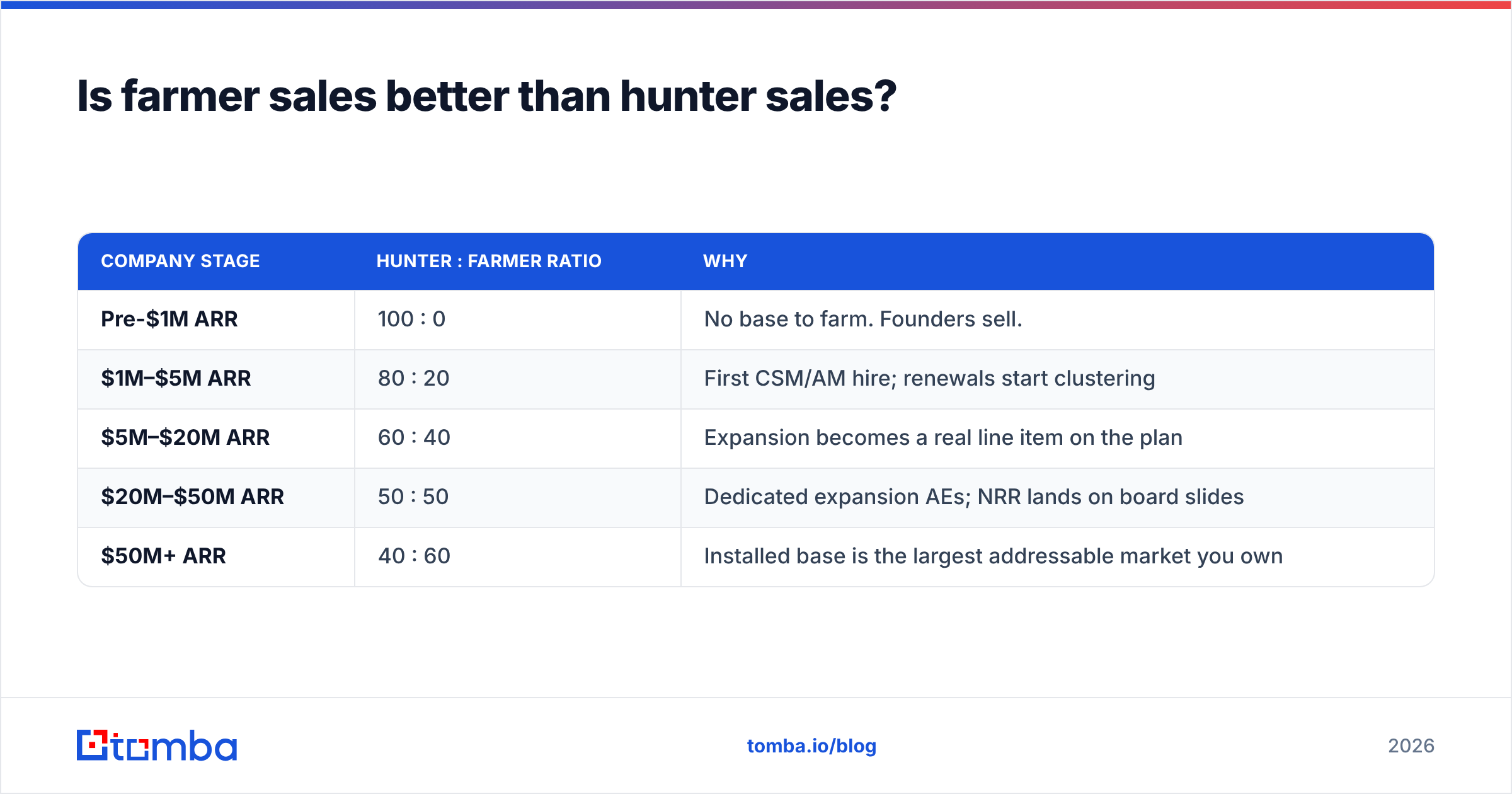
The practical answer for most B2B teams:
| Company stage | Hunter : Farmer ratio | Why |
|---|---|---|
| Pre-$1M ARR | 100 : 0 | No base to farm. Founders sell. |
| $1M–$5M ARR | 80 : 20 | First CSM/AM hire; renewals start clustering |
| $5M–$20M ARR | 60 : 40 | Expansion becomes a real line item on the plan |
| $20M–$50M ARR | 50 : 50 | Dedicated expansion AEs; NRR lands on board slides |
| $50M+ ARR | 40 : 60 | Installed base is the largest addressable market you own |
Look at where the ratio flips. Somewhere around $20M ARR, the biggest untapped market a company has is its own customer list. Most orgs realize this two years late.
How should you compensate farmer sales reps?#
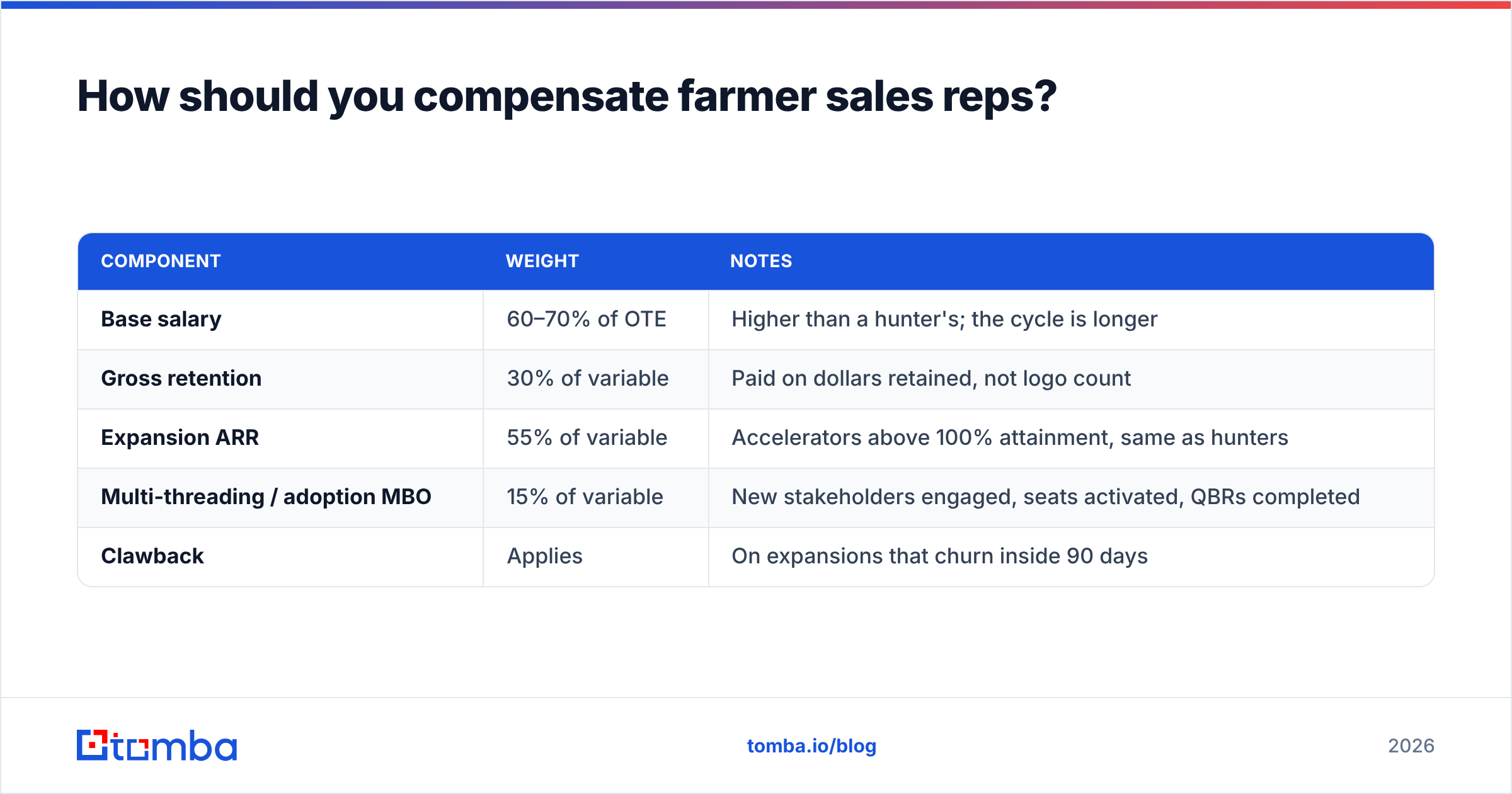
Comp design is where the farmer model most often dies. Pay a farmer purely on retention and you have created an incentive to do nothing risky. Pay them purely on expansion and they'll ignore the accounts quietly heading for the exit.
A workable structure:
| Component | Weight | Notes |
|---|---|---|
| Base salary | 60–70% of OTE | Higher than a hunter's; the cycle is longer |
| Gross retention | 30% of variable | Paid on dollars retained, not logo count |
| Expansion ARR | 55% of variable | Accelerators above 100% attainment, same as hunters |
| Multi-threading / adoption MBO | 15% of variable | New stakeholders engaged, seats activated, QBRs completed |
| Clawback | Applies | On expansions that churn inside 90 days |
Two details matter more than the percentages. First, pay expansion on incremental ARR, not total contract value at renewal — otherwise a flat renewal reads as a win. Second, put a real accelerator on expansion. If a farmer's upside caps at 110% of OTE while a hunter's runs to 250%, your best sellers will never take the farming seat, and the role becomes a demotion in disguise. HubSpot's sales compensation research has consistently found that quota structure predicts rep behavior more reliably than training does.
What data does a farmer sales team actually need?#
This is the part that gets skipped, and it's the part that determines whether expansion is a strategy or a hope.
Farming is a data problem before it's a relationship problem, for one blunt reason: your champion will leave. B2B buyer turnover runs high enough that a two-year contract will typically outlive at least one key stakeholder. When your main contact leaves, the account goes dark unless you already know who else matters.
What a farmer needs on hand at all times:
- A live org map of every account. Names, titles, departments, and — critically — working email addresses for people you have not yet met inside a company you already sell to.
- Trigger alerts on job changes. Champion leaves for a new company? That's simultaneously a churn risk at account A and the warmest new-logo lead your hunters will ever get.
- Verified contact data at the department level. Selling into a new business unit means cold outreach with a warm reference. You still need the address, and it still needs to be deliverable.
- Enriched firmographics. Headcount growth in a division is the single best predictor of seat expansion.
- Clean CRM hygiene. Everything above is worthless if it isn't in the system your CRM reports run on.
In practice, teams solve this by pairing their CRM with an enrichment layer. A domain search across a customer's domain surfaces contacts across departments you've never engaged, and data enrichment keeps titles and emails current as people move. It's mundane infrastructure. It's also the difference between a farmer who expands into three new departments and one who renews the same 40 seats forever.
Where does the farmer model break down?#
Four failure modes, in rough order of frequency.
1. The order-taker drift. The rep becomes a friendly point of contact who processes requests. Symptom: expansion revenue arrives only when the customer asks for it. Fix: require a documented expansion hypothesis per account, reviewed monthly. If the rep can't name the next department and the next buyer, they aren't farming.
2. Single-threaded accounts. One relationship, one signature, one point of failure. Symptom: an account is "healthy" right up until it churns in a single email. Fix: track stakeholders-per-account as a hard metric. Below three engaged contacts at any account over $25K ARR, the account is at risk regardless of how the QBR went.
3. The CS/AM boundary war. Nobody knows who owns expansion, so both parties assume the other has it. Symptom: renewal conversations start 21 days out. Fix: one name on the number, written down, per account.
4. Data decay. Contact records rot at roughly 2–3% per month in typical B2B datasets, which compounds to a badly degraded database inside a year. Symptom: outreach to new stakeholders bounces, and the rep concludes the account is unresponsive when the problem is the address. Fix: scheduled re-verification of the installed-base contact list, not just the prospecting list. Running your customer contacts through an email verifier quarterly costs almost nothing and prevents a category of silent failure that looks exactly like disinterest.
How do you turn a hunter into a farmer (or vice versa)?#
Cautiously, and rarely.
The transition that usually works is hunter → farmer at the enterprise level, because a strategic account director job is genuinely a hunting job conducted inside one logo. The rep keeps the prospecting muscle and applies it to a warmer target set. Ramp is 5–7 months, mostly spent on relationship transfer and product depth.
The transition that usually fails is farmer → hunter. Cold outbound has a rejection rate and a cadence discipline that a rep who's spent four years in warm relationships often can't rebuild. Not a character flaw — just a different job.
Practical hiring signals for a farmer seat:
- Can they explain a customer's business model without mentioning your product? (Business acumen over pitch fluency.)
- Have they ever delivered bad news to a customer early and kept the account? (Escalation courage.)
- Do they ask about the product roadmap in the interview? (Farmers sell the future; hunters sell the demo.)
- Have they run a multi-stakeholder deal where the original champion left mid-cycle? (Resilience to org churn.)
For a broader breakdown of how these seats fit into a modern revenue org, G2's category research is a reasonable starting point for benchmarking tooling per role, and it's worth reading alongside your own revenue operations definitions so you're not comparing job titles that mean different things at different companies.
What should you do this quarter?#
Start with three concrete moves.
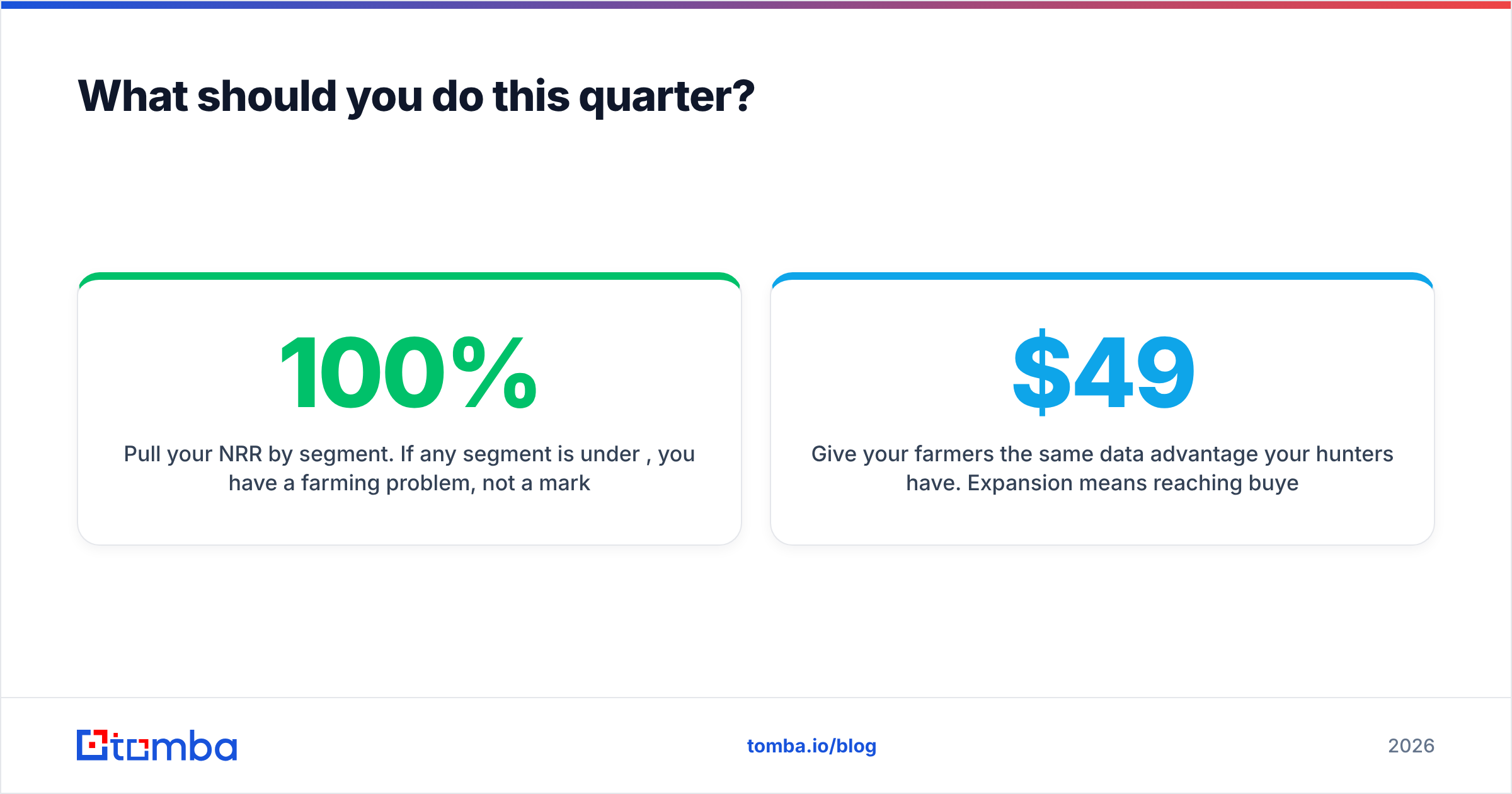
Pull your NRR by segment. If any segment is under 100%, you have a farming problem, not a marketing problem. Then count engaged stakeholders per account across your top 20 customers — if the median is under three, single-threading is your largest unpriced risk. Finally, audit the contact data on your installed base. Not your prospect list. Your customers. Most teams have never done this and are surprised by the bounce rate.
Farming isn't the passive half of sales. It's the half where the compounding happens, and it fails quietly rather than loudly, which is exactly why it goes unmanaged for so long.
Give your farmers the same data advantage your hunters have. Expansion means reaching buyers inside accounts you already own — new departments, new regions, replacement champions. Tomba Email Finder surfaces verified professional email addresses across an entire customer domain, so your account managers can multi-thread before the renewal window opens instead of after it closes. Start free with 25 searches a month, or check Tomba pricing — Starter runs $49/mo and scales through Growth at $99/mo for teams working a full book.
Related guides#
Ready to find emails that actually work?
Join 150,000+ professionals who stopped guessing and started sending. Free credits on signup — no credit card required.
Get the Tomba newsletter
Practical outbound tactics and product updates — once every two weeks.
About the author