Feedback Culture in Sales: The 2026 Coaching Playbook
Most sales teams confuse annual reviews with coaching. Here's how high-performing orgs build a feedback culture that actually moves win rates, ramp time, and rep retention.
TL;DR
- A feedback culture in sales is not a review cycle. It's a repeatable cadence where reps get specific, behavior-level input within days of the behavior — not quarters later.
- The single biggest lever is frequency plus specificity. Weekly 30-minute coaching on one skill beats a two-hour quarterly review on everything.
- Teams that formalize coaching see faster ramp and measurably better win rates; the mechanism is behavioral repetition, not motivation.
- Feedback fails for three predictable reasons: it's vague, it's late, and it's one-directional. Fix those three and most of the problem disappears.
- Coaching quality depends on data quality. If your reps are working bad contact data, you'll coach the wrong thing — you'll blame messaging when the real issue is the list.
What Is a Feedback Culture in Sales?#
A feedback culture in sales is an operating norm where evaluative and developmental input flows continuously — manager to rep, rep to manager, and peer to peer — attached to specific observable behaviors, on a cadence short enough that the rep can still remember the call.
That definition rules out a lot of what teams currently call feedback.
The annual performance review is not feedback culture. Neither is a Monday pipeline meeting where a manager asks "why did that deal slip?" and the rep improvises a reason. Neither is a Slack message saying "great job on the Acme close."
Real feedback culture has four properties:
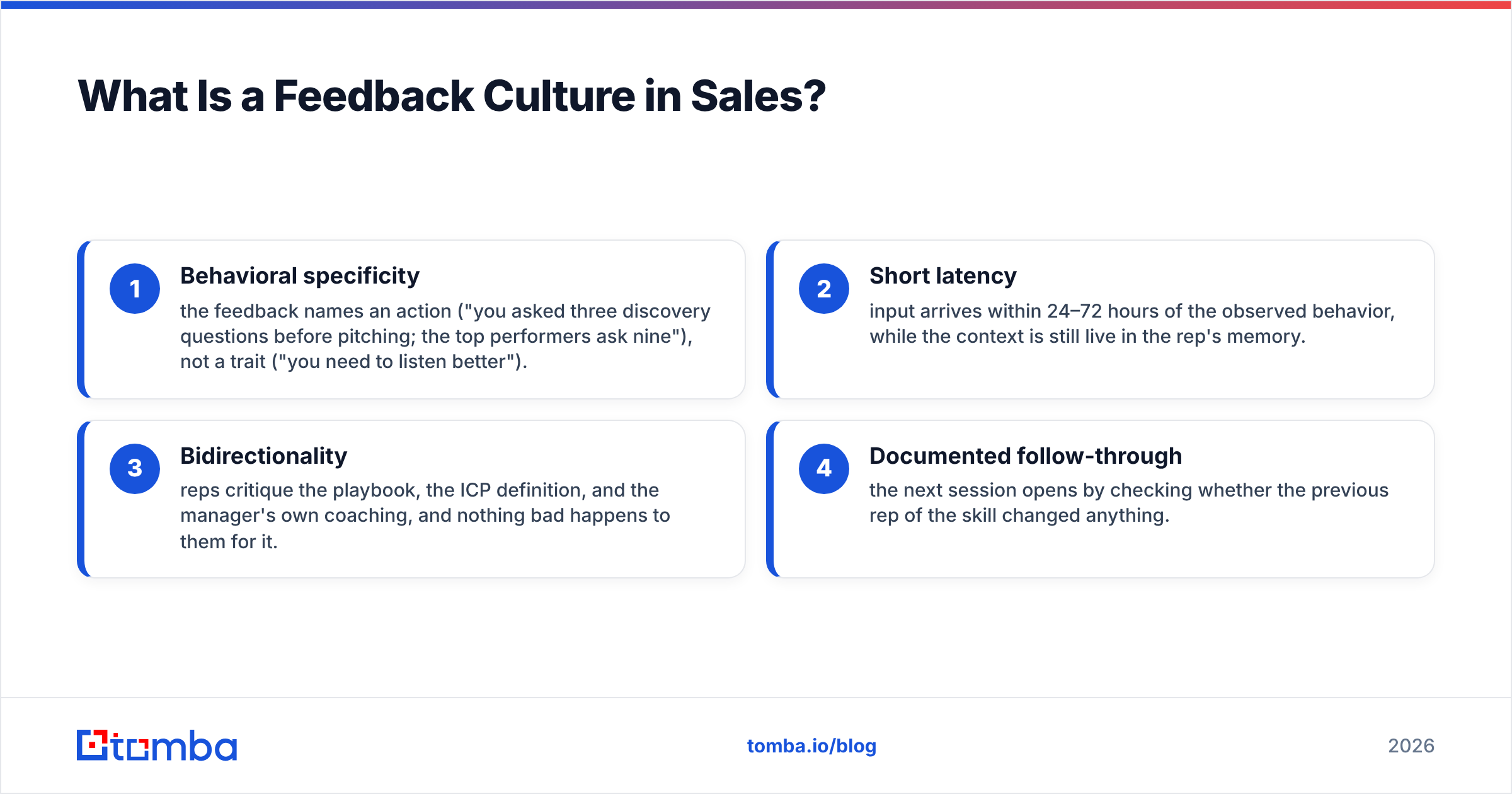
- Behavioral specificity — the feedback names an action ("you asked three discovery questions before pitching; the top performers ask nine"), not a trait ("you need to listen better").
- Short latency — input arrives within 24–72 hours of the observed behavior, while the context is still live in the rep's memory.
- Bidirectionality — reps critique the playbook, the ICP definition, and the manager's own coaching, and nothing bad happens to them for it.
- Documented follow-through — the next session opens by checking whether the previous rep of the skill changed anything.
Most orgs have zero of the four. A few have one. The ones that compound revenue have all four.
Why Does Most Sales Feedback Fail?#
Because it's designed for the manager's calendar, not the rep's learning curve.
Here is the failure pattern, in order of how often it shows up:
Failure 1: Feedback is a verdict, not a diagnosis. "That call went badly" tells the rep nothing actionable. A diagnosis sounds different: "You handled pricing well. You lost control at minute 14 when they asked about the integration and you started explaining features instead of asking what they'd tried before." One of those changes behavior next week. The other creates anxiety.
Failure 2: Feedback is quarterly. Skill acquisition needs tight loops. If a rep runs 40 discovery calls between coaching sessions, they've spent 40 reps hardening a bad habit before anyone corrected it. Frequency isn't a nice-to-have — it's the mechanism.
Failure 3: It only goes downhill. When reps can't safely say "the ICP we're targeting doesn't have this problem" or "this sequence is getting us blocked at the gate," managers optimize a strategy that the field already knows is broken. Amy Edmondson's research on psychological safety, summarized well on Harvard Business School's site, is the canonical work here: teams that report more errors aren't worse, they're more honest.
Failure 4: Feedback targets the wrong variable. A rep gets coached on objection handling for six weeks when the actual problem is that 30% of their prospect emails bounce and another 25% go to people who left the company. You cannot coach your way out of a data problem. Before you diagnose a skills gap, check whether the rep is even reaching humans — running the list through an email verifier takes minutes and eliminates the most common false diagnosis in sales coaching.
Failure 5: No one tracks whether coaching worked. If you can't say what a rep's discovery-question count was in January versus April, you're not coaching. You're chatting.
What Are the Main Feedback Models, and Which Fits Sales?#
Different frameworks solve different problems. Most teams pick one and use it for everything, which is why coaching feels stale by month three.
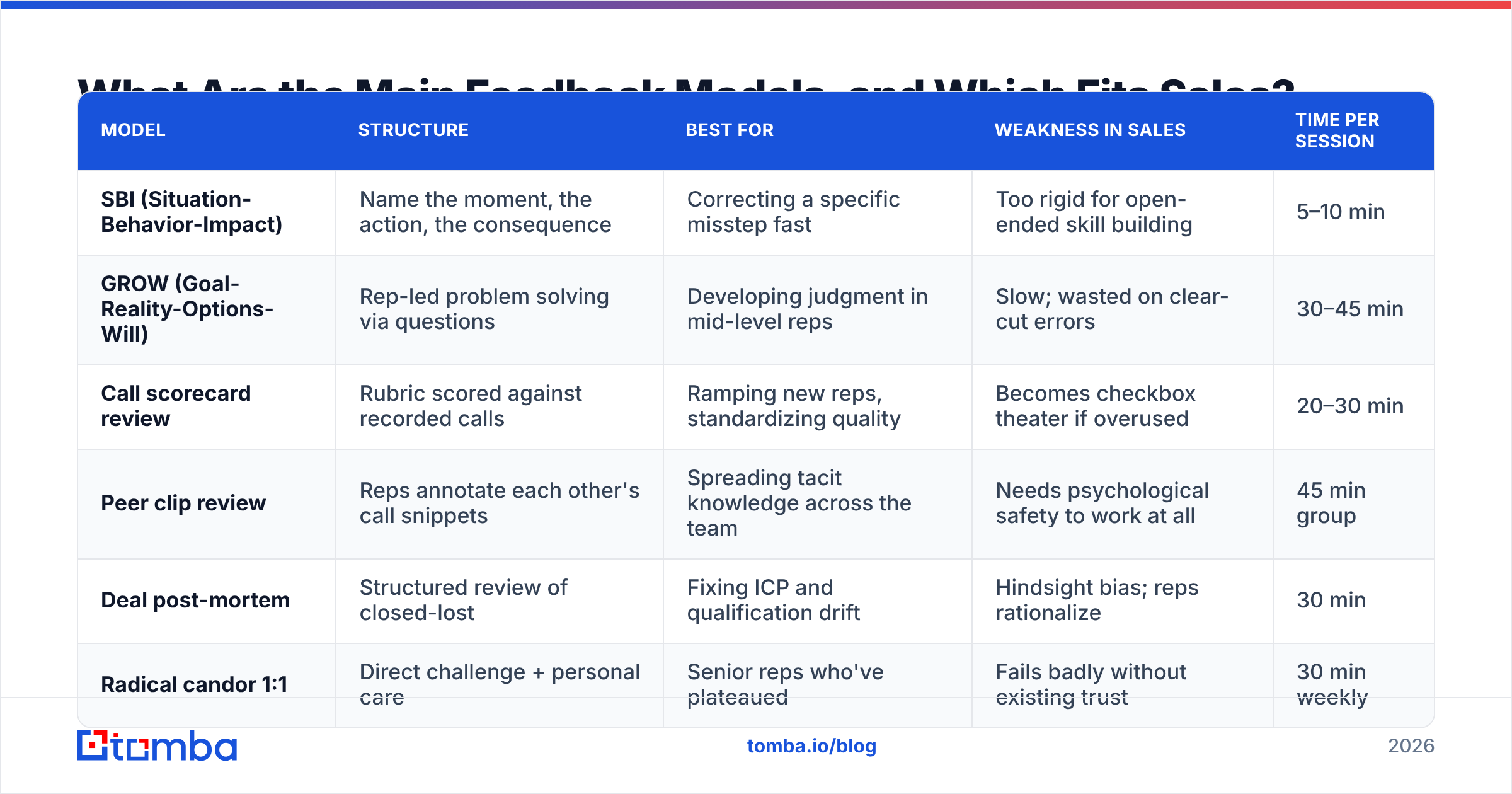
| Model | Structure | Best for | Weakness in sales | Time per session |
|---|---|---|---|---|
| SBI (Situation-Behavior-Impact) | Name the moment, the action, the consequence | Correcting a specific misstep fast | Too rigid for open-ended skill building | 5–10 min |
| GROW (Goal-Reality-Options-Will) | Rep-led problem solving via questions | Developing judgment in mid-level reps | Slow; wasted on clear-cut errors | 30–45 min |
| Call scorecard review | Rubric scored against recorded calls | Ramping new reps, standardizing quality | Becomes checkbox theater if overused | 20–30 min |
| Peer clip review | Reps annotate each other's call snippets | Spreading tacit knowledge across the team | Needs psychological safety to work at all | 45 min group |
| Deal post-mortem | Structured review of closed-lost | Fixing ICP and qualification drift | Hindsight bias; reps rationalize | 30 min |
| Radical candor 1:1 | Direct challenge + personal care | Senior reps who've plateaued | Fails badly without existing trust | 30 min weekly |
The practical answer: use SBI for in-the-moment correction, scorecard reviews for ramping reps in weeks 1–12, GROW for reps past month six, and deal post-mortems monthly at team level. Don't run all four every week — you'll burn 6 hours of manager time per rep and the reps will start managing the process instead of learning.
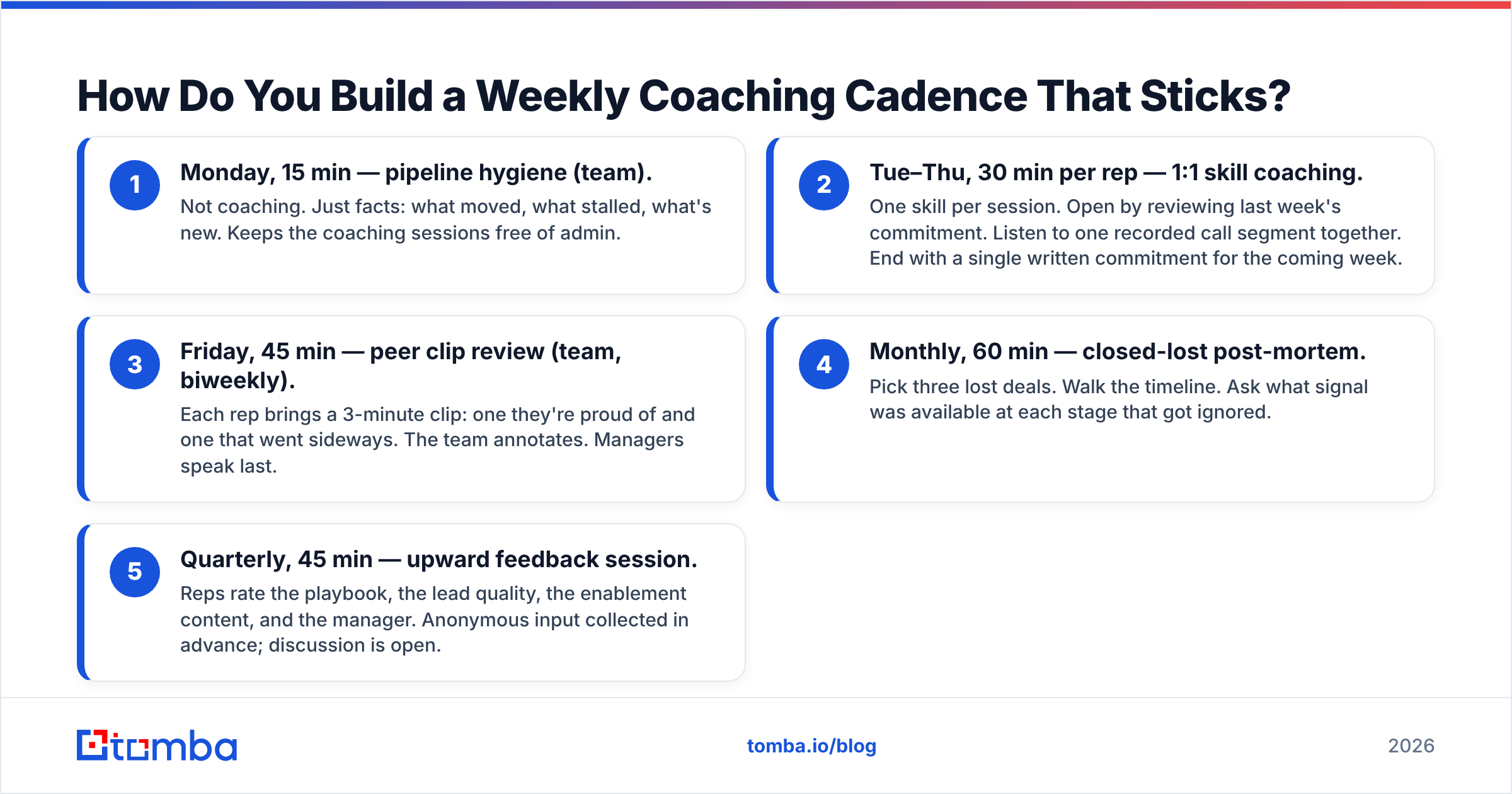
How Do You Build a Weekly Coaching Cadence That Sticks?#
Start with one 30-minute block per rep per week and protect it like a customer meeting.
Here's a cadence that works for a team of 6–10 reps under one manager:
- Monday, 15 min — pipeline hygiene (team). Not coaching. Just facts: what moved, what stalled, what's new. Keeps the coaching sessions free of admin.
- Tue–Thu, 30 min per rep — 1:1 skill coaching. One skill per session. Open by reviewing last week's commitment. Listen to one recorded call segment together. End with a single written commitment for the coming week.
- Friday, 45 min — peer clip review (team, biweekly). Each rep brings a 3-minute clip: one they're proud of and one that went sideways. The team annotates. Managers speak last.
- Monthly, 60 min — closed-lost post-mortem. Pick three lost deals. Walk the timeline. Ask what signal was available at each stage that got ignored.
- Quarterly, 45 min — upward feedback session. Reps rate the playbook, the lead quality, the enablement content, and the manager. Anonymous input collected in advance; discussion is open.
Two rules make or break this. First, the manager speaks second. Ask the rep to self-assess before you assess. Reps who diagnose their own call self-correct at a much higher rate than reps who receive a verdict. Second, one skill per session. Piling five observations into 30 minutes guarantees the rep works on none of them.
What Should You Actually Measure?#
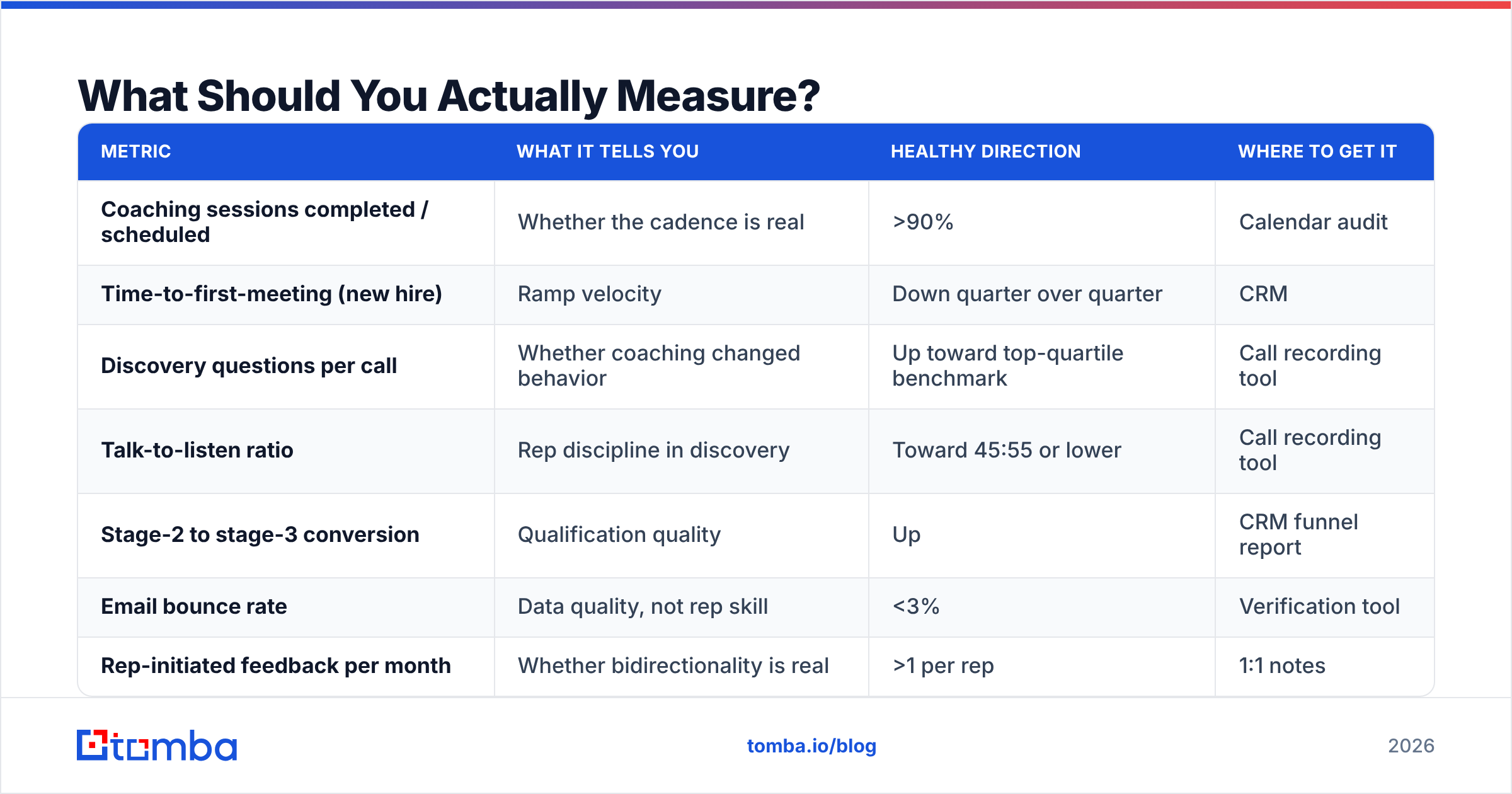
Measure behaviors upstream of revenue, not just revenue. Revenue is a lagging indicator, and by the time it moves, the coaching window has closed.
| Metric | What it tells you | Healthy direction | Where to get it |
|---|---|---|---|
| Coaching sessions completed / scheduled | Whether the cadence is real | >90% | Calendar audit |
| Time-to-first-meeting (new hire) | Ramp velocity | Down quarter over quarter | CRM |
| Discovery questions per call | Whether coaching changed behavior | Up toward top-quartile benchmark | Call recording tool |
| Talk-to-listen ratio | Rep discipline in discovery | Toward 45:55 or lower | Call recording tool |
| Stage-2 to stage-3 conversion | Qualification quality | Up | CRM funnel report |
| Email bounce rate | Data quality, not rep skill | <3% | Verification tool |
| Rep-initiated feedback per month | Whether bidirectionality is real | >1 per rep | 1:1 notes |
| Voluntary attrition (reps) | Whether the culture is punitive | Down | HR |
Notice that bounce rate sits in a coaching dashboard. That's deliberate. A rep with a 22% bounce rate looks like a low-activity rep in every CRM report, and managers routinely coach them on effort when the actual fix is a cleaner list. Tomba's own data sources page walks through how verification status is assigned, which is worth understanding before you treat a deliverability number as a performance number.
Track the response rate alongside these. If response rate is flat while discovery-question counts climb, your coaching is improving the wrong stage of the funnel.
How Do You Give Feedback That Reps Actually Use?#
Use a four-part structure and keep it under four minutes.
Ask first. "How do you think that call went? What would you change?" Roughly half the time the rep names the exact issue you were going to raise, and now they own it instead of defending against it.
Name the situation and the behavior, not the person. "In the pricing conversation at minute 14, you gave the discount before they asked for one." Compare to: "You're too quick to discount." The first is a fact. The second is an identity claim, and identity claims trigger defense.
State the impact concretely. "That anchored the deal 15% below where the last three similar accounts landed." Impact makes the behavior worth changing without you having to argue for it.
Get one written commitment. "Next week, on any deal under $50k, you hold price until they raise it twice." Written, specific, single. Then open next week's session with it.
What to avoid: the compliment sandwich. Reps decode it within two sessions, and after that every piece of praise you give reads as setup for a criticism. That destroys your ability to reinforce good behavior — the most valuable coaching tool you have.
How Do You Get Upward and Peer Feedback Flowing?#
Make it structurally safe and structurally scheduled. Culture change doesn't come from telling people to speak up.
Structural safety means the manager visibly acts on critical input. The first time a rep says "our outbound list quality is the problem, not our messaging," and the manager audits the list and reports back publicly, you've bought more candor than any values poster ever will. The first time a rep says it and gets a defensive answer, you've closed the channel for a year.
Structural scheduling means upward feedback has a slot on the calendar with a defined format. Ask narrow questions — "which part of the current sequence do you skip, and why?" gets real answers; "any feedback for me?" gets silence.
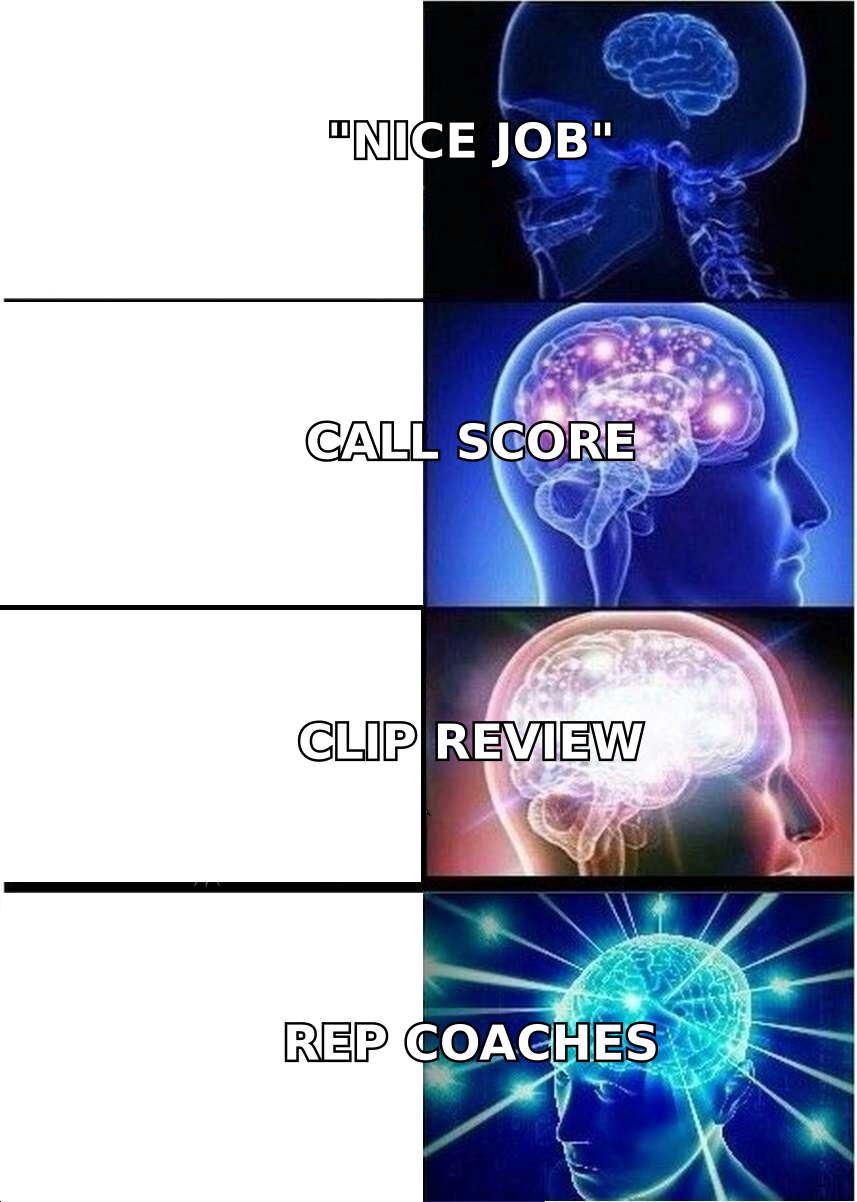
For peer feedback, clip review is the highest-leverage format available. Each rep brings a short recorded segment. The team responds to two prompts only: what worked, and what one thing they'd try differently. Manager speaks last, or not at all. This spreads tacit knowledge — the phrasing that lands, the reframe that unsticks a stalled deal — faster than any enablement doc, and it builds the habit of giving feedback without hierarchy attached.
One caution: peer review fails hard on teams with stack-ranked compensation. If reps compete directly for a bonus pool, they have a rational incentive to withhold what works. Fix the comp structure before you blame the culture.
What Tooling Do You Need?#
Less than vendors would like you to believe, but the pieces are non-negotiable.
- Call recording with timestamped clips. Coaching without recordings is coaching from memory, and memory is unreliable and biased toward the last thing that happened. Gong and Chorus dominate here; smaller teams get most of the value from recording plus manual clipping.
- CRM stage discipline. If stages are defined loosely, funnel conversion metrics are noise, and you can't tell whether coaching worked. Both HubSpot and Salesforce ship reasonable default stage definitions worth adopting before inventing your own.
- A scorecard document. A shared rubric with 6–10 criteria. It doesn't need software. A spreadsheet works.
- Contact data you trust. Coaching sessions get poisoned by data noise. When a rep's numbers look bad, you need to eliminate list quality as a cause in under ten minutes. A bulk email finder and verification pass gives you that answer immediately.
- A shared clip library. The best 20 call moments from your team, organized by skill. This becomes your real onboarding curriculum inside two quarters.
Peer platforms like BookYourData solve the list-building side well for teams that prefer buying prebuilt contact lists over building them from domain-level research; the right choice depends on whether your ICP is well covered by an existing database or needs discovery from scratch. Either way, the coaching principle holds: verify before you diagnose.
How Do You Roll This Out Without Losing the Team?#
Announce it as a manager commitment, not a rep requirement.
Reps have seen coaching initiatives before. Most died in six weeks. The way to signal this one is different is for the manager to make the visible sacrifice first: block the calendar, cancel a recurring status meeting to make room, and never reschedule a 1:1 for a pipeline emergency.
A realistic 90-day rollout:
- Days 1–14: Manager runs sessions with no scorecard, no rubric. Just listen to calls together and talk. Build the habit before adding structure.
- Days 15–45: Introduce the scorecard. Reps self-score first, manager scores second, and you discuss the gaps between the two scores. The gaps are the coaching content.
- Days 46–75: Add peer clip review. Start with the two most senior reps modeling how to give a critique that isn't soft.
- Days 76–90: Add the upward feedback session and the first closed-lost post-mortem. Publish what changed as a result of rep input.
The failure mode is front-loading structure. Rubrics, dashboards, and 360 surveys in week one produce compliance, not candor. Habit first, instrumentation second.
The Bottom Line#
Feedback culture in sales is a scheduling problem disguised as a people problem. The frameworks are simple, well-documented, and mostly free. What's scarce is a manager who protects 30 minutes per rep per week for two consecutive quarters and refuses to fill it with pipeline review.
Do that, add one written commitment per session, keep peer review honest, and let reps critique the playbook without consequences. The metrics — ramp time, stage conversion, attrition — move within two quarters. Not because reps become more motivated, but because they get more corrected repetitions per month than your competitors' reps do.
And before you coach a rep on their outreach performance, verify the list. Bad data produces bad diagnoses, and a bad diagnosis costs you a quarter of coaching aimed at the wrong skill. Tomba's Email Finder gives you verified, source-attributed contact data so the numbers in your coaching dashboard reflect rep behavior instead of list decay. The free tier covers 25 searches a month if you just want to spot-check a rep's list; paid plans start at $49/mo when you're ready to run the whole team's prospecting on verified data.
Related guides#
Ready to find emails that actually work?
Join 150,000+ professionals who stopped guessing and started sending. Free credits on signup — no credit card required.
Get the Tomba newsletter
Practical outbound tactics and product updates — once every two weeks.
About the author