Field Sales Training in 2026: Build Reps Who Actually Close
Most field sales training fails because it teaches product, not territory math. Here's the 2026 playbook: ride-along coaching, certification gates, and the data stack that makes it stick.

TL;DR
- Field sales training fails when it front-loads product knowledge and back-loads territory reality. Flip the order: territory math and account selection in week one, deep product certification by week six.
- The single highest-ROI activity is the structured ride-along with a written debrief — not the offsite, not the slide deck, not the annual kickoff.
- Ramp time is a measurable number. Track days-to-first-meeting, days-to-first-deal, and 90-day pipeline coverage per cohort, or you're guessing.
- Field reps waste 20-40% of their week on bad addresses, dead phone numbers, and gatekeeper roulette. Fixing data quality is training infrastructure, not an IT line item.
- Certification gates beat completion rates. "Watched the module" means nothing; "passed a live objection drill scored by a manager" means something.
What is field sales training, and how is it different from inside sales training?#
Field sales training prepares reps who sell face-to-face in an assigned geography — territory planning, in-person discovery, on-site demos, route efficiency, and relationship depth over transaction volume. Inside sales training optimizes for call volume, sequence adherence, and screen-shared demos.
The difference is not "outside vs. inside." It's the cost of a wasted touch.
Think of it like a delivery driver versus a call center agent. The agent who dials a disconnected number loses 15 seconds. The driver who arrives at the wrong warehouse loses 90 minutes and a fuel tank. That asymmetry drives every design decision in a field program.
Concretely, field sales training has to cover four things inside sales training mostly skips:
- Territory economics — how many accounts can one rep physically service per quarter at a realistic call frequency, and what's the revenue ceiling of the patch.
- Route and sequence planning — clustering visits so drive time doesn't eat selling time, and building a repeatable weekly rhythm (prospecting block, visit block, admin block).
- In-person discovery mechanics — reading a room, working a facility walk, handling the unplanned second stakeholder who joins mid-meeting.
- Pre-visit intelligence — knowing who's on site, what they bought last, who the economic buyer is, and having a verified mobile number before you leave the parking lot.
That fourth point is where most programs quietly collapse. You can coach discovery questions beautifully and still watch a rep burn a Tuesday because the contact list said "Operations Manager" with a role that changed 14 months ago.

Why do most field sales training programs fail?#
They fail for four repeatable reasons, and none of them are "the content was bad."
1. Training is an event, not a system. A three-day onsite in January produces a measurable spike in confidence and near-zero change in behavior by March. Research on sales enablement consistently shows reinforcement cadence matters more than initial instruction quality.
2. The manager isn't trained. You certify 20 reps and zero front-line managers. The manager is the delivery mechanism for everything that happens after the offsite. If your district managers can't run a structured debrief, your program has no distribution.
3. Product knowledge crowds out buyer knowledge. New field reps can recite spec sheets and cannot articulate what a plant manager's Q3 looks like. Buyers notice within 90 seconds.
4. Bad data makes good training look useless. A rep who follows your discovery framework perfectly, with the wrong person, in the wrong building, produces a failure that gets blamed on the framework.
That last one is worth quantifying. If a field rep does 12 in-person touches per week and 3 of them are misrouted because of stale contact data, you've deleted 25% of the training's surface area before it can compound.
What does a 90-day field sales ramp actually look like?#
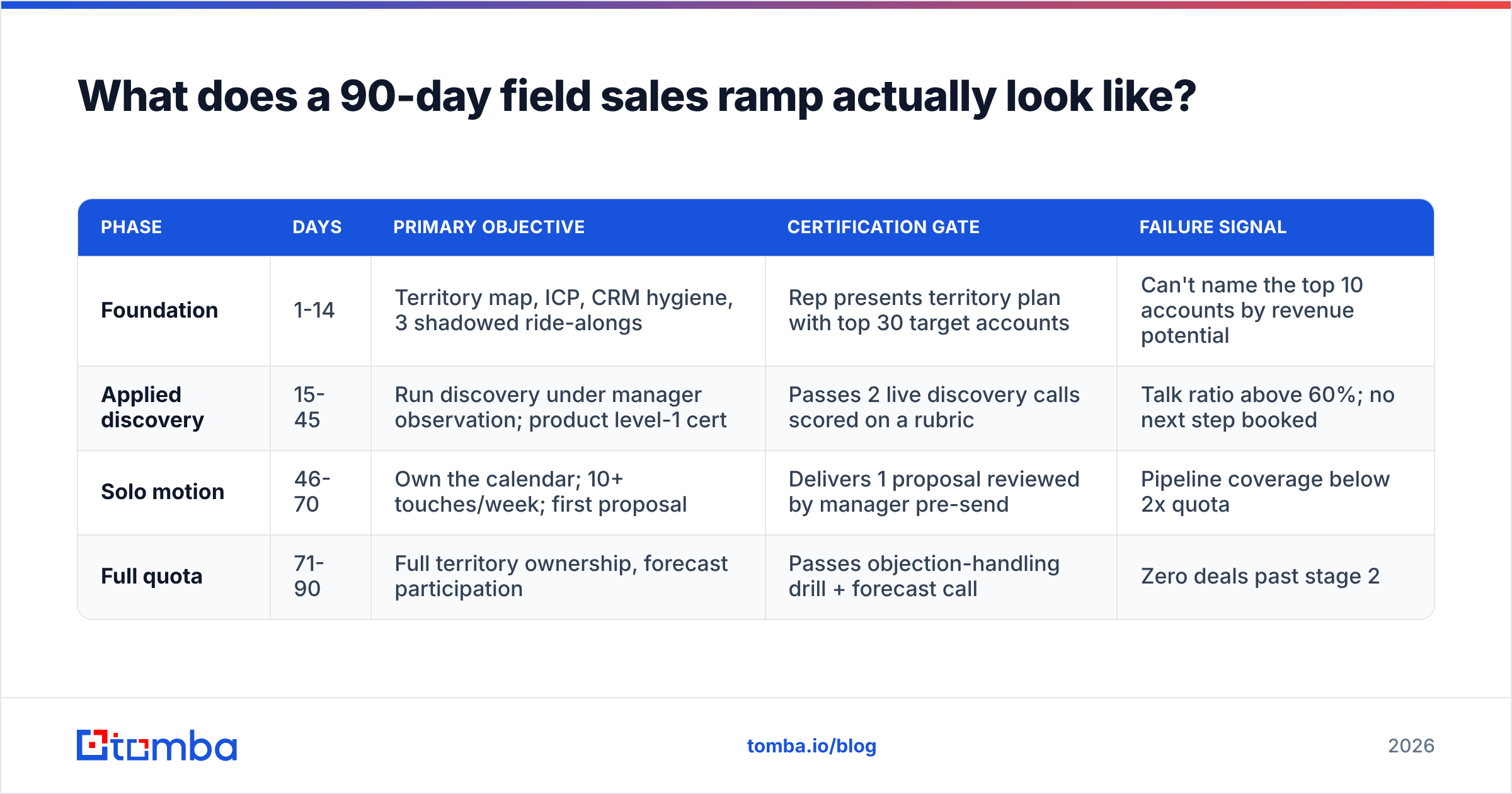
Here's a structure that survives contact with a real territory. Adjust the timing to your average sales cycle, but keep the sequence.
| Phase | Days | Primary objective | Certification gate | Failure signal |
|---|---|---|---|---|
| Foundation | 1-14 | Territory map, ICP, CRM hygiene, 3 shadowed ride-alongs | Rep presents territory plan with top 30 target accounts | Can't name the top 10 accounts by revenue potential |
| Applied discovery | 15-45 | Run discovery under manager observation; product level-1 cert | Passes 2 live discovery calls scored on a rubric | Talk ratio above 60%; no next step booked |
| Solo motion | 46-70 | Own the calendar; 10+ touches/week; first proposal | Delivers 1 proposal reviewed by manager pre-send | Pipeline coverage below 2x quota |
| Full quota | 71-90 | Full territory ownership, forecast participation | Passes objection-handling drill + forecast call | Zero deals past stage 2 |
Three details make or break this table.
Ride-alongs are structured, not social. Every ride-along has a pre-brief (what are we testing today), an observation sheet (one skill focus, not six), and a written debrief within 24 hours. If the manager's feedback is "good job, tighten your close," the ride-along didn't happen.
Certification is a gate, not a badge. A rep who fails the day-45 discovery cert gets two additional weeks and a specific remediation plan — not a pass because the pipeline is thin.
The territory plan is a living document. Reviewed monthly, not filed. It should name accounts, the buying committee inside each, and the next physical touch.
How do you coach field reps who you almost never see?#
Field management is remote management with a windshield. Use a fixed cadence so coaching doesn't collapse into deal inspection:
- Weekly 1:1 (30 min) — 10 minutes pipeline, 20 minutes skill. If you spend 30 minutes on pipeline, you're forecasting, not coaching.
- Bi-weekly ride-along (half day) — 3-4 joint visits with a single skill focus.
- Monthly territory review (60 min) — Are the right accounts getting the right frequency? Which accounts should be demoted?
- Quarterly certification refresh — One new competency per quarter (pricing negotiation, multi-threading, competitive displacement).
The skill focus rule matters more than it sounds. Managers who give feedback on six things per visit produce reps who change nothing. Pick one: opening, discovery depth, stakeholder mapping, or the close. Score it. Move on next visit.
Record what you can. Even a phone-recorded voice memo of the rep's own post-visit recap ("who was in the room, what did they say, what's the next step") builds self-diagnostic muscle faster than manager commentary alone. Tools like Gong do this for calls; field teams often improvise with voice notes and structured CRM fields.
What should a field sales training curriculum actually contain?#
Skip the 40-module LMS. Build around six competencies and certify each one:
- Territory and account selection — Scoring accounts by revenue potential, competitive vulnerability, and physical accessibility. The rep should be able to defend why account #31 is not in the top 30.
- Pre-call research and contact accuracy — Finding the real decision maker, the current title, and a working mobile. This is a hard skill with a tool stack behind it, not a soft "do your homework" instruction.
- In-person discovery — Question sequencing, silence tolerance, facility-walk observation, handling the surprise stakeholder.
- Multi-threading in the field — Getting from your champion to procurement, finance, and ops without going around your champion's back.
- Objection handling under pressure — Live drills, scored, repeated. Price, timing, incumbent vendor, "we tried something like this."
- Forecast discipline — What stage 3 means, what evidence moves a deal, why happy ears cost the whole team.
Competency 2 is the one most programs treat as an afterthought and it's the one with the clearest ROI. A rep who can independently find and verify a decision maker's contact details before a visit runs a fundamentally different week than one who calls the main switchboard.
How much does field sales training cost, and what are the delivery options?#
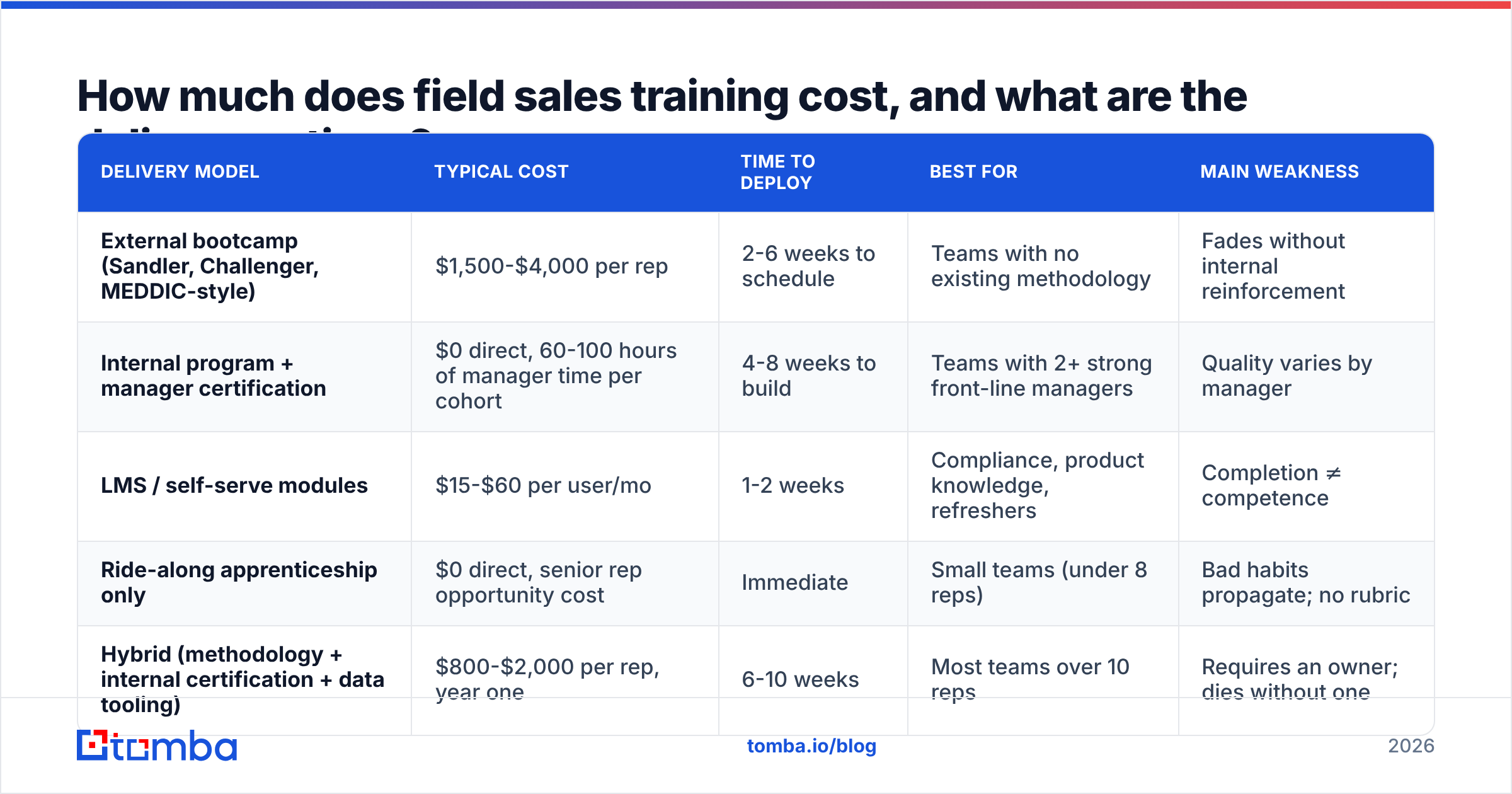
| Delivery model | Typical cost | Time to deploy | Best for | Main weakness |
|---|---|---|---|---|
| External bootcamp (Sandler, Challenger, MEDDIC-style) | $1,500-$4,000 per rep | 2-6 weeks to schedule | Teams with no existing methodology | Fades without internal reinforcement |
| Internal program + manager certification | $0 direct, 60-100 hours of manager time per cohort | 4-8 weeks to build | Teams with 2+ strong front-line managers | Quality varies by manager |
| LMS / self-serve modules | $15-$60 per user/mo | 1-2 weeks | Compliance, product knowledge, refreshers | Completion ≠ competence |
| Ride-along apprenticeship only | $0 direct, senior rep opportunity cost | Immediate | Small teams (under 8 reps) | Bad habits propagate; no rubric |
| Hybrid (methodology + internal certification + data tooling) | $800-$2,000 per rep, year one | 6-10 weeks | Most teams over 10 reps | Requires an owner; dies without one |
The hybrid model wins in practice because it separates the two things training must do: install a shared language (external methodology) and enforce it against real deals (internal certification). Buying one without the other is why so many teams have a methodology poster on the wall and no behavior change on the ground.
One budget line people forget: the data layer. If reps spend six hours a week researching contacts manually, at a $90k OTE that's roughly $13,000 per rep per year in fully-loaded time — often more than the training itself. Comparison platforms like G2's sales training category are useful for vendor shortlists, but they won't tell you where your time is actually leaking. Your CRM activity logs will.

How does data quality change field sales training outcomes?#
Direct answer: bad data turns a good rep into a bad-looking rep, and it turns training into a scapegoat.
Here's the failure chain. A rep is trained to multi-thread. She identifies three stakeholders she needs to reach at a target manufacturer. Two of the three contacts in the CRM are from a list purchased in 2023. One has left the company; the other's direct line routes to a shared desk. She sends two emails that bounce, which nicks the domain's sender reputation, and she shows up on-site with one contact instead of three. The deal stalls at a single-threaded champion. In the QBR, that reads as "weak multi-threading."
Fixing this is unglamorous and cheap relative to the payoff:
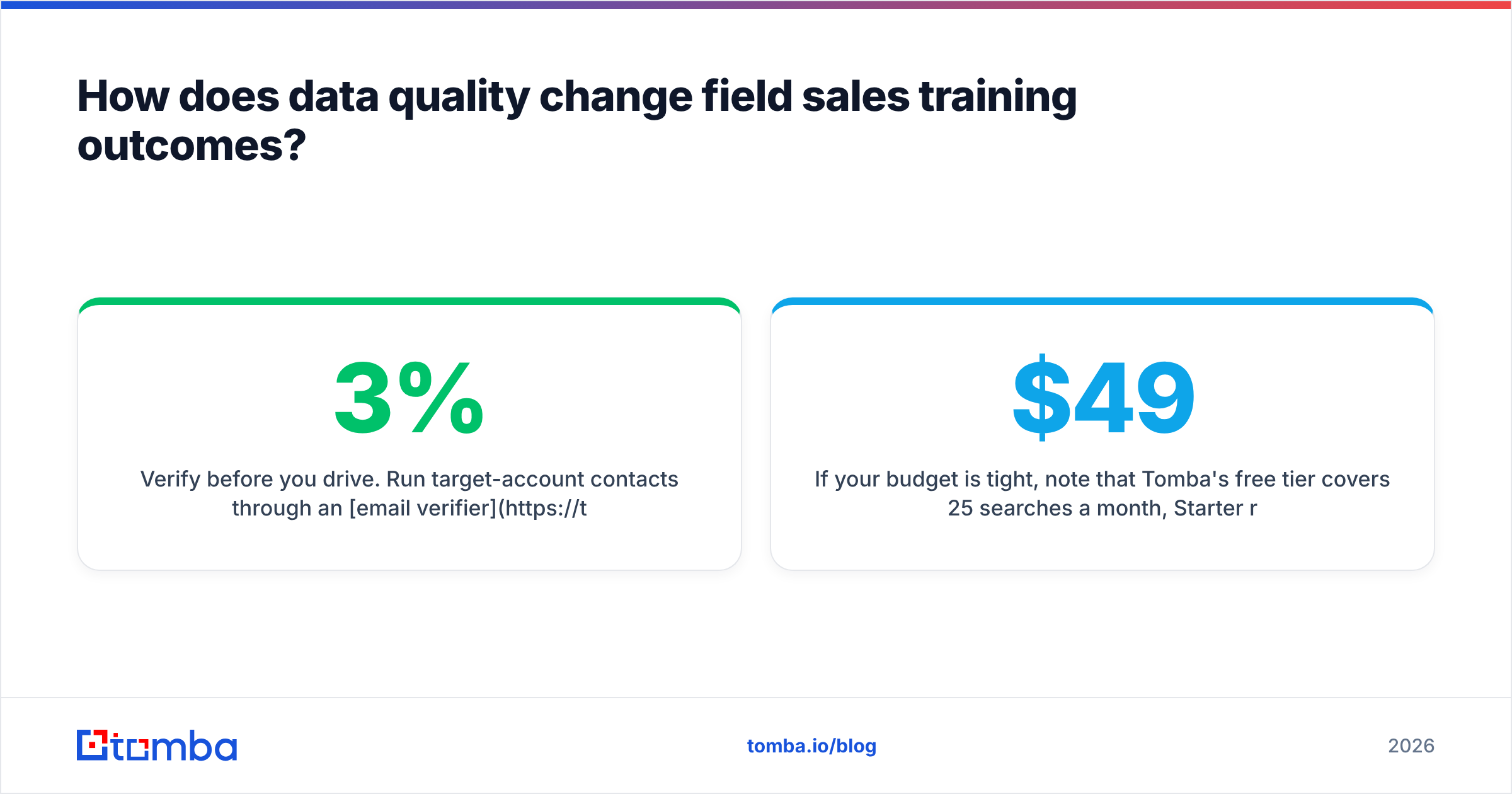
- Verify before you drive. Run target-account contacts through an email verifier before any campaign or visit sequence. Bounce rates above 3% are a data problem, not a copy problem.
- Build the buying committee from the domain, not from memory. A domain search surfaces the people at an account you didn't know existed — the plant engineer, the regional ops lead, the procurement analyst.
- Get a working number before the visit. A phone finder beats the switchboard-and-hope routine, especially for follow-ups after the initial meeting.
- Make it a habit, not a project. Add "contacts verified" as a required field on any account entering stage 2. Reps do what's inspected.
For teams running large territory refreshes, batch processing beats one-off lookups — a bulk email finder run against a list of target accounts turns a two-week research slog into an afternoon. Pair that with your CRM through the HubSpot integration or Salesforce integration so verified records land where reps actually work.
If your budget is tight, note that Tomba's free tier covers 25 searches a month, Starter runs $49/mo, and Growth is $99/mo — see the full Tomba pricing breakdown. For a five-rep field team, the data cost is a rounding error next to one wasted week of windshield time.
How do you measure whether field sales training worked?#
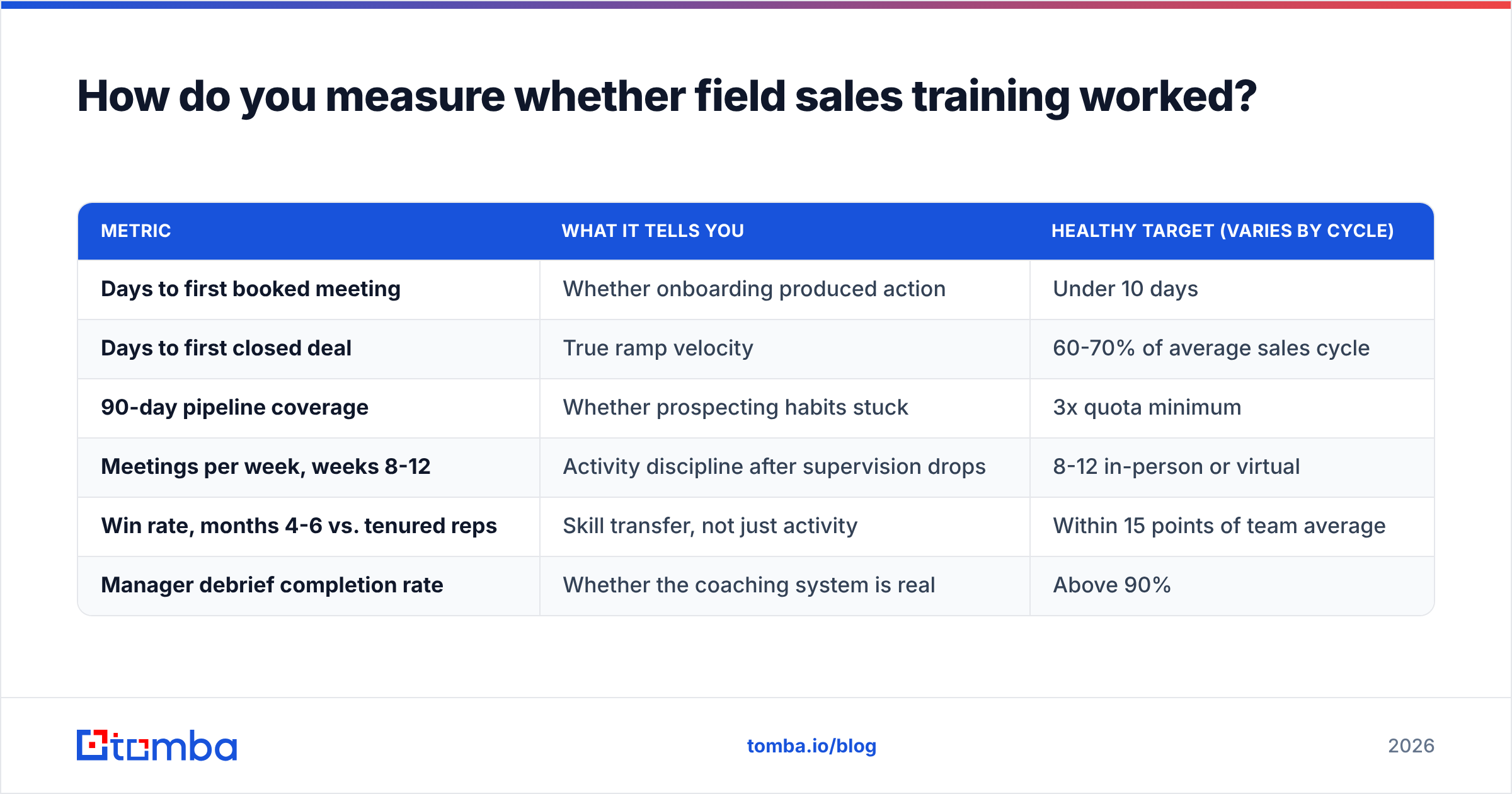
Completion rates and satisfaction scores are vanity. Track these instead, per cohort:
| Metric | What it tells you | Healthy target (varies by cycle) |
|---|---|---|
| Days to first booked meeting | Whether onboarding produced action | Under 10 days |
| Days to first closed deal | True ramp velocity | 60-70% of average sales cycle |
| 90-day pipeline coverage | Whether prospecting habits stuck | 3x quota minimum |
| Meetings per week, weeks 8-12 | Activity discipline after supervision drops | 8-12 in-person or virtual |
| Win rate, months 4-6 vs. tenured reps | Skill transfer, not just activity | Within 15 points of team average |
| Manager debrief completion rate | Whether the coaching system is real | Above 90% |
That last row is the leading indicator nobody tracks. If managers complete fewer than 90% of scheduled ride-along debriefs, the program is decaying regardless of what the rep-facing metrics say. Measure the coaches, not just the coached.
Also segment by cohort, not by individual. One rep missing quota is a person problem. A whole cohort missing the day-45 discovery cert is a curriculum problem.
What tools should support a field sales training program?#
Keep the stack small enough that reps actually use it:
- CRM with enforced stage definitions — Salesforce, HubSpot, or Pipedrive. Stages without exit criteria are decoration.
- Contact data and verification — for pre-visit intelligence and clean outreach.
- Call/meeting capture — for coaching artifacts. Even voice memos work at small scale.
- A single scorecard doc — one rubric per competency, shared across managers so "good discovery" means the same thing in two districts.
- Route/territory mapping — Badger Maps or similar for anything above 40 accounts per rep.
Resist adding a seventh tool. Every additional login is a reason to fall back to a spreadsheet.
Where should you start if you're building this from scratch?#
Start narrow. Pick one cohort of three to five reps, run the 90-day structure above, and instrument it. Certify your managers on ride-along debriefs before you certify a single rep on discovery. Then fix the data layer so the training has clean ground to land on.
If the pre-visit research step is where your reps are bleeding hours, that's the cheapest thing to fix first. The Tomba Email Finder gives field reps verified contact details for the decision makers inside their target accounts — by name, by company, or by domain — so the buying committee gets mapped before anyone gets in a car. Free tier is 25 searches a month if you want to test it against one territory before rolling it out. Clean contacts don't close deals on their own, but they stop your best-trained reps from spending Tuesday in the wrong lobby.
Related guides#
Ready to find emails that actually work?
Join 150,000+ professionals who stopped guessing and started sending. Free credits on signup — no credit card required.
Get the Tomba newsletter
Practical outbound tactics and product updates — once every two weeks.
About the author