FinalScout vs Getro: Which Tool Fits Your 2026 Workflow?
FinalScout finds emails on LinkedIn. Getro runs job boards and talent networks for VC portfolios. They get compared constantly and solve almost nothing in common — here is the honest breakdown, plus what to use when you need contact data that actually lands.
TL;DR
- They are not real competitors. FinalScout is a LinkedIn-based email finder and AI outreach writer. Getro is job board and talent network infrastructure for VC firms, accelerators, and communities.
- Pick FinalScout if your job is to turn LinkedIn profiles into contactable emails at speed — recruiting sourcing, founder-led sales, agency prospecting.
- Pick Getro if your job is to run a portfolio job board, keep a talent pool warm, and route candidates to member companies. It does not find emails for cold outreach.
- Pricing models are opposite. FinalScout is self-serve credits (free tier, then monthly plans). Getro is a quoted annual contract — no public price list.
- If contact data is the actual bottleneck, neither tool is the ceiling. A dedicated finder plus verification layer (Tomba, at $49/mo starter) beats a browser extension for volume, API access, and bounce control.
Why does anyone compare FinalScout vs Getro?#
Because both show up when you search for "talent sourcing tools" and both touch the recruiting funnel — from opposite ends.
FinalScout sits at the contact layer: you find a person on LinkedIn, and it hands you an email address. Getro sits at the inbound layer: you publish a job board, candidates opt in, and companies in your network get matched.
The analogy: FinalScout is a phone book plus a stamp. Getro is the noticeboard in a members-only club. If you compare them attribute for attribute you get a nonsense scoreboard. What you actually need to decide is which motion you're running — outbound push or inbound network — and then buy for that.
This post gives you the honest split, a full feature table, cost realities, and the case where you'd skip both.

What is FinalScout?#
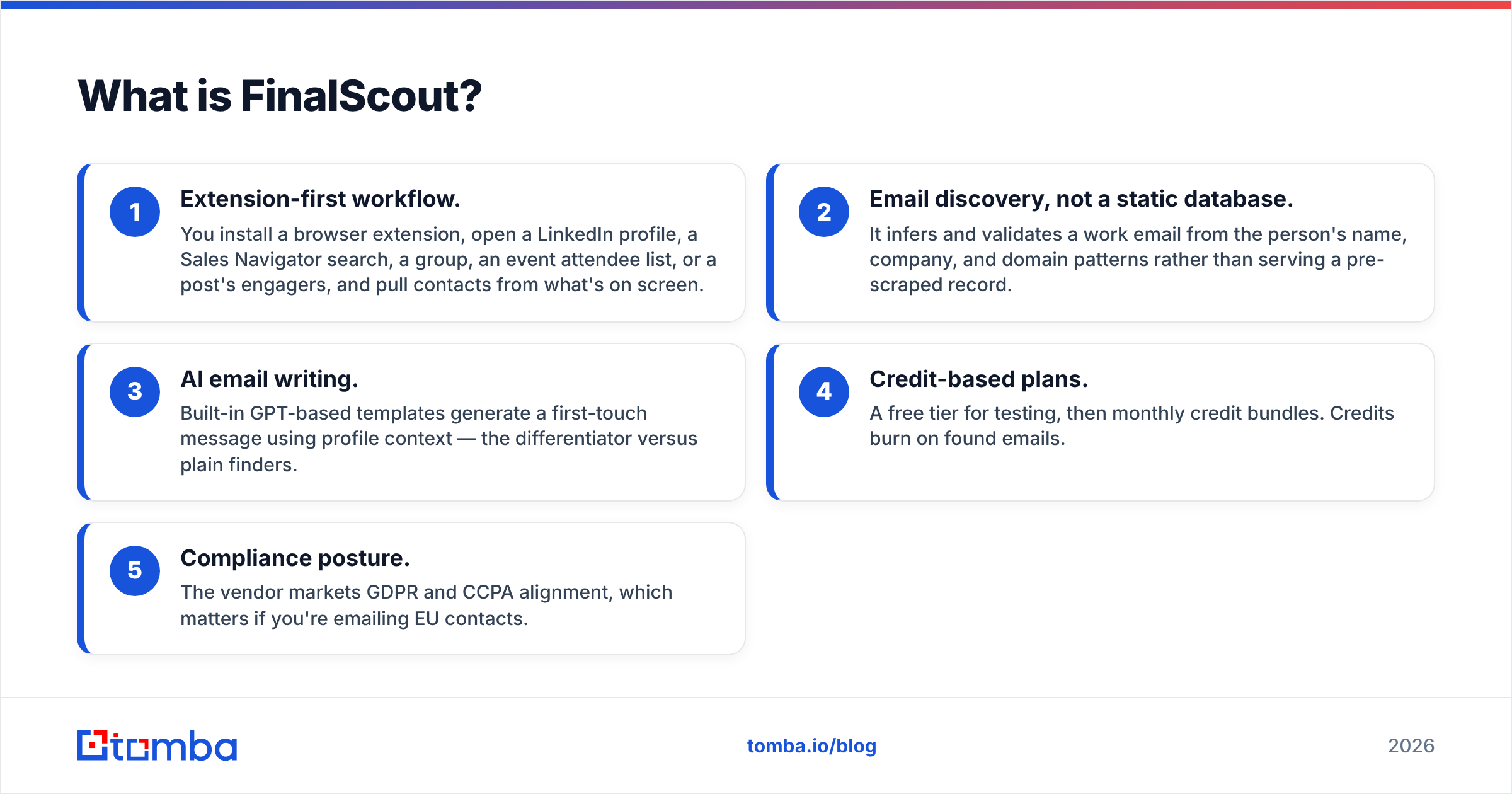
FinalScout is a Chrome extension and web app that extracts professional email addresses from LinkedIn and writes outreach copy with AI.
Core mechanics:
- Extension-first workflow. You install a browser extension, open a LinkedIn profile, a Sales Navigator search, a group, an event attendee list, or a post's engagers, and pull contacts from what's on screen.
- Email discovery, not a static database. It infers and validates a work email from the person's name, company, and domain patterns rather than serving a pre-scraped record.
- AI email writing. Built-in GPT-based templates generate a first-touch message using profile context — the differentiator versus plain finders.
- Credit-based plans. A free tier for testing, then monthly credit bundles. Credits burn on found emails.
- Compliance posture. The vendor markets GDPR and CCPA alignment, which matters if you're emailing EU contacts.
The honest limitation: because discovery is anchored to LinkedIn sessions, throughput is tied to how much LinkedIn browsing you can do without tripping activity limits. That is fine for 50 contacts a day and painful for 5,000 a week.
What is Getro?#
Getro is talent network software. Its customers are venture capital firms, accelerators, private equity groups, and professional communities that want to help their portfolio companies hire.
The product family breaks down roughly like this:
- A job board product that aggregates open roles from every portfolio company's careers page automatically, so the VC's "Jobs" page never goes stale.
- A talent network product that captures candidate opt-ins, tags them by function and seniority, and lets portfolio hiring managers search that pool.
- Network and introduction tooling that maps who in your community can make a warm intro.
- Analytics on board traffic, applications, and placements — the numbers a platform lead reports to partners.
Getro is not a prospecting tool. There is no "find this person's email" button, no cold outreach sequencer, and no LinkedIn extraction. Its entire value is aggregating supply (jobs) and demand (candidates) inside a closed network.
Do FinalScout and Getro solve the same problem?#
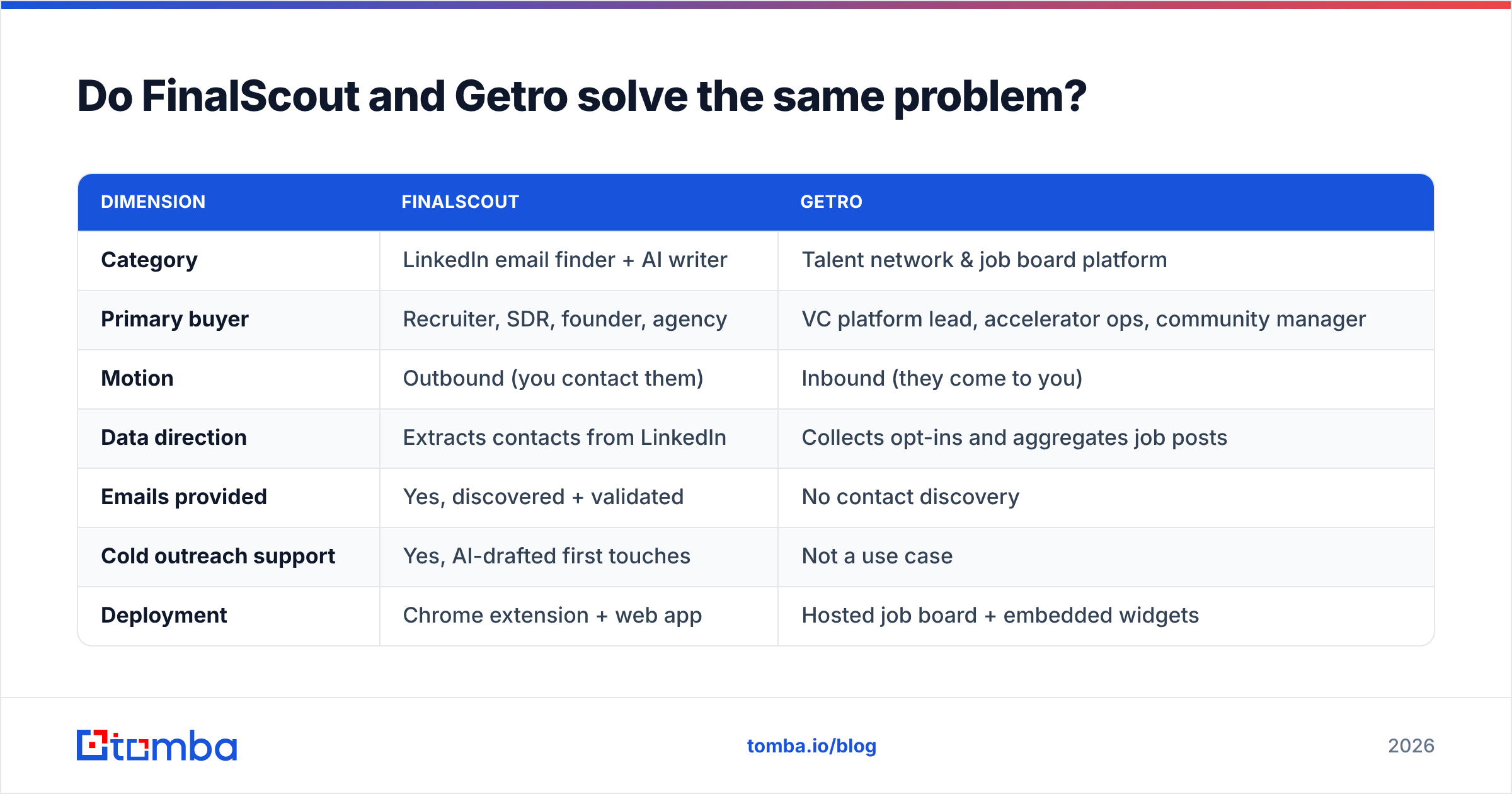
No — and this table is the clearest way to see it.
| Dimension | FinalScout | Getro |
|---|---|---|
| Category | LinkedIn email finder + AI writer | Talent network & job board platform |
| Primary buyer | Recruiter, SDR, founder, agency | VC platform lead, accelerator ops, community manager |
| Motion | Outbound (you contact them) | Inbound (they come to you) |
| Data direction | Extracts contacts from LinkedIn | Collects opt-ins and aggregates job posts |
| Emails provided | Yes, discovered + validated | No contact discovery |
| Cold outreach support | Yes, AI-drafted first touches | Not a use case |
| Deployment | Chrome extension + web app | Hosted job board + embedded widgets |
| Pricing model | Self-serve credits, monthly | Quoted annual contract |
| Time to value | Minutes | Weeks (board setup, integrations) |
| Fails at | High-volume, API-driven enrichment | Anything outbound |
If your shortlist genuinely contains both, one of them is on it by mistake. The useful question is which column describes your week.
Which one should you buy for outbound sourcing?#
FinalScout — with caveats.
For a recruiter running 30 to 80 personalized touches a day off LinkedIn searches, an extension-based finder is the shortest path. You're already in LinkedIn. The context you need for personalization is on the screen. The AI drafting step removes the blank-page tax, and the credits are cheap enough that a single placement pays for a year.
Where it strains:
- Volume ceilings. Extension-driven extraction is bounded by LinkedIn's own rate limits and your session. If you need 10,000 contacts for a campaign, you're going to be clicking for days.
- Verification depth. Finder tools generally report a confidence score. That is not the same as an SMTP-level check against a catch-all-aware verifier, and the gap shows up as bounces.
- No enrichment beyond email. You get an address. You often don't get phone, headcount refresh, or firmographics for scoring.
- Workflow lock-in. If your team lives in a CRM or a spreadsheet rather than LinkedIn, the browser-first flow is friction, not speed.
For team-scale outbound, most orgs end up pairing or replacing the extension with an API-driven email finder that runs on a list of domains and names instead of on tabs.
Which one should you buy for a portfolio talent network?#
Getro, and it isn't close — nothing on the email-finder side does what it does.
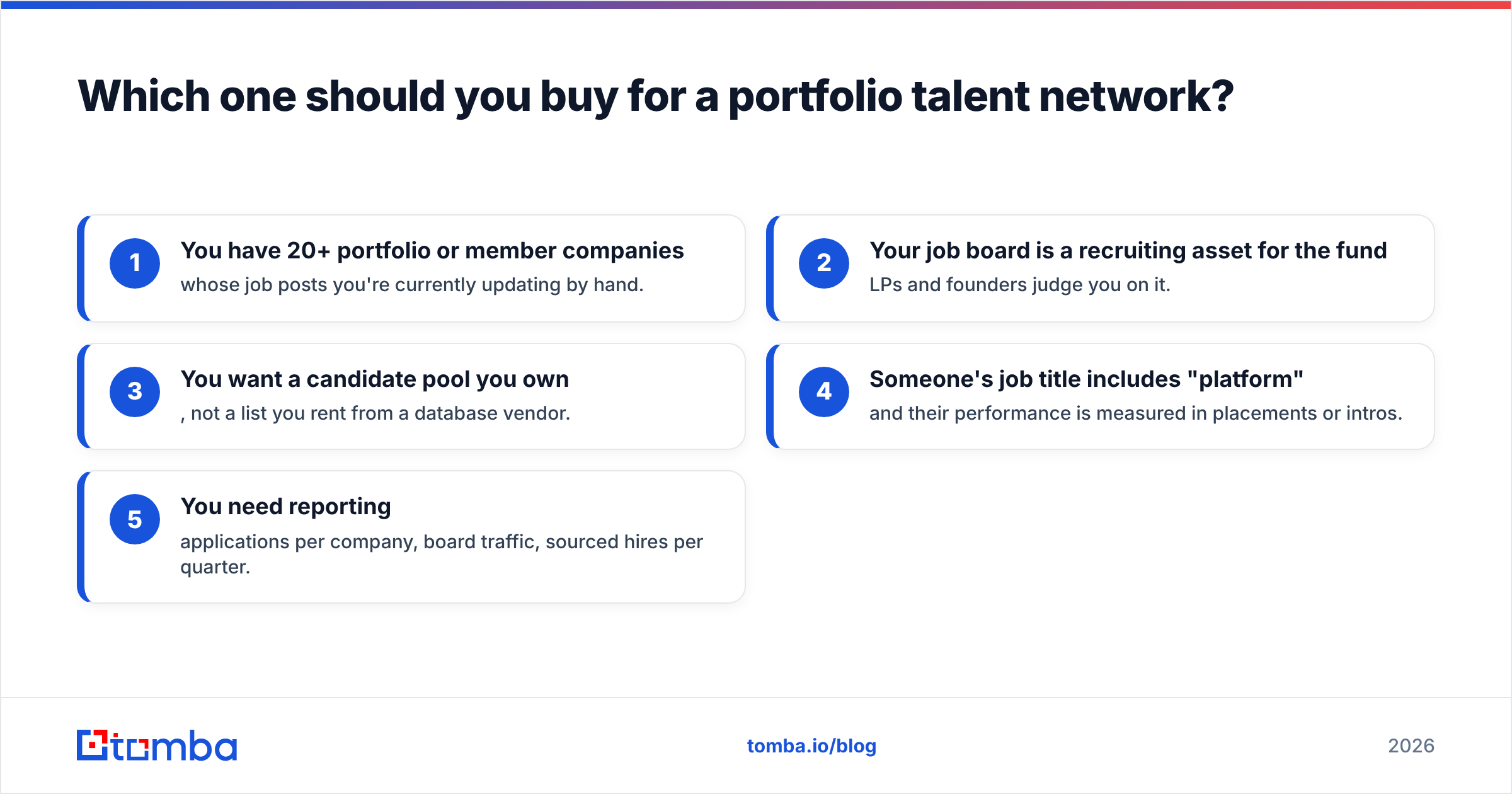
Buy Getro when you can answer yes to at least three of these:
- You have 20+ portfolio or member companies whose job posts you're currently updating by hand.
- Your job board is a recruiting asset for the fund — LPs and founders judge you on it.
- You want a candidate pool you own, not a list you rent from a database vendor.
- Someone's job title includes "platform" and their performance is measured in placements or intros.
- You need reporting — applications per company, board traffic, sourced hires per quarter.
Getro's cost is justified by removing manual board maintenance and by producing a defensible network asset. It is not justified if you're a 5-person startup that wants a careers page; a hosted job board template does that for a fraction of the price.
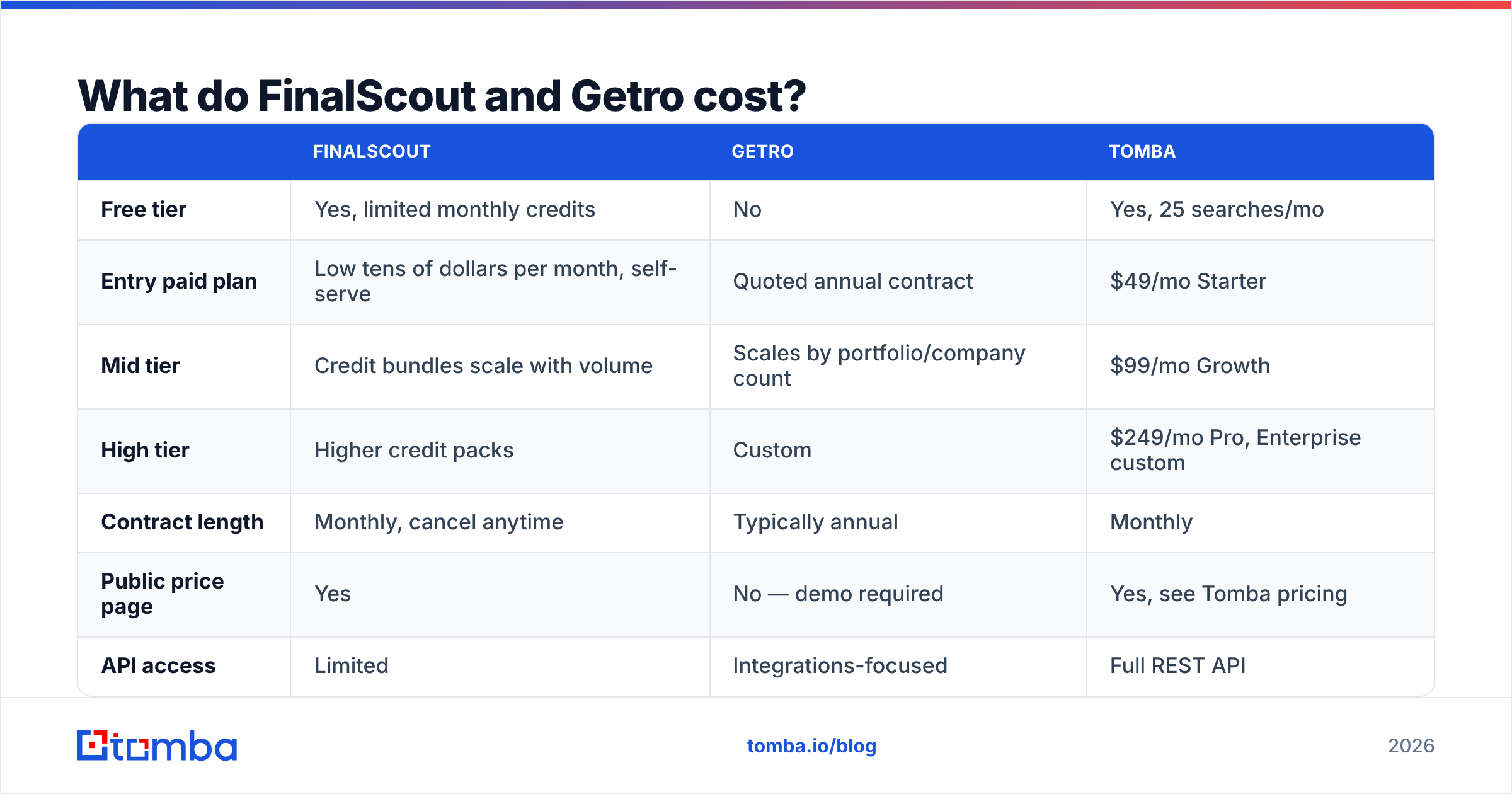
What do FinalScout and Getro cost?#
Two different worlds. Vendor pricing changes often — confirm both on their own sites before you budget.
| FinalScout | Getro | Tomba | |
|---|---|---|---|
| Free tier | Yes, limited monthly credits | No | Yes, 25 searches/mo |
| Entry paid plan | Low tens of dollars per month, self-serve | Quoted annual contract | $49/mo Starter |
| Mid tier | Credit bundles scale with volume | Scales by portfolio/company count | $99/mo Growth |
| High tier | Higher credit packs | Custom | $249/mo Pro, Enterprise custom |
| Contract length | Monthly, cancel anytime | Typically annual | Monthly |
| Public price page | Yes | No — demo required | Yes, see Tomba pricing |
| API access | Limited | Integrations-focused | Full REST API |
The practical read: FinalScout is a card-on-file expense a single rep can approve. Getro is a procurement conversation with a demo, a scoping call, and a signature. Neither is wrong — but if you're comparing them on price alone, you've already confirmed they're not the same product.

How accurate is the contact data in each?#
Only one of them makes an accuracy claim, because only one of them serves contact data.
FinalScout advertises high email validity — the marketing number is in the high nineties. Treat any vendor-published accuracy figure as a ceiling measured under favorable conditions, not a guarantee on your list. Real-world hit rates depend on:
- Company size. Sub-20-employee startups and personal-domain founders are the hardest segment for every finder on the market.
- Region. North American and Western European coverage is consistently better than APAC and LATAM.
- Catch-all domains. A domain that accepts everything can't be verified by SMTP alone. You need a dedicated catch-all verifier or a probabilistic scoring layer, or you're shipping unknowns straight into your sequencer.
- Data age. Anything sourced from a static database decays around 2–3% per month as people change jobs.
Getro has no equivalent metric because it never guesses an address — candidates hand over their own, which is the highest-quality contact data that exists and also the slowest to accumulate.
The takeaway for anyone doing outbound: no single finder wins on every domain. Run any tool's output through an independent email verifier before it touches your sending domain. A 4% bounce rate will damage your sender reputation faster than any subject line can repair it.
What are the better alternatives to each?#
Instead of FinalScout, if you need volume, API access, or CRM-native enrichment:
- Tomba — email finder plus verifier, domain search, catch-all handling, and a documented API. $49/mo starter, free tier for testing. Best when you want contact discovery as infrastructure, not a browser habit.
- BookYourData — a solid option when you'd rather buy a pre-built, filterable B2B list with pay-as-you-go credits than discover contacts one at a time. Different model, genuinely useful for well-defined ICPs.
- Apollo — bundles data with sequencing; heavier and pricier, but one login. See the Apollo alternative breakdown if you're weighing that tradeoff.
- ContactOut / Wiza — closest direct substitutes for the LinkedIn-extension motion if you like that workflow but want different coverage.
Instead of Getro, if the quote comes back too high:
- A hosted job board tool plus a manual talent spreadsheet, for networks under about 15 companies.
- An ATS with a community/CRM module if your portfolio companies already share one.
- Nothing — if your board gets 200 visits a month, the automation isn't paying for itself yet.
Read real customer reviews on G2 before committing to either category; the deltas between vendor claims and admin reality show up there first.
What does a sane 2026 stack look like?#
Most teams that come to this comparison end up with a split answer.
If you run a fund or accelerator, you probably need both layers, not both tools: Getro (or an equivalent) for the inbound talent network, and a data provider with an API for the outbound side — sourcing candidates who never opt in, enriching founder contacts, and finding decision-maker emails at target companies for BD.
If you're a recruiter or seller with no network to run, skip Getro entirely and spend the budget on data quality. A workable stack:
- Discovery — a finder that works from names and domains, not just open tabs, so you can process a list of 500 companies overnight.
- Verification — a separate validation pass, with catch-all logic, before anything enters your sequencer.
- Enrichment — contact enrichment to backfill titles, phone numbers, and firmographics for scoring.
- Sequencing — whatever sender you already trust, warmed properly.
Keep the layers separate and you can swap any one of them without rebuilding the pipeline. Buy one monolith and you'll be renewing it for the two features you actually use.
Frequently asked questions#
Does Getro find email addresses? No. Getro aggregates jobs and collects candidate opt-ins. Contact discovery is out of scope.
Is FinalScout good for high-volume outbound? It's fine for individual-rep volumes. Past a few thousand contacts a month, an API-based finder is faster and cheaper per record.
Can I use both together? Yes, and it's a reasonable setup for a VC platform team — Getro for inbound talent, a finder for outbound sourcing and BD.
Which is cheaper? FinalScout, by an order of magnitude, but they buy different things. Comparing them on price is like comparing a taxi fare to a fleet lease.
Do I still need a verifier if my finder says the email is valid? Yes, if you care about your domain. Independent verification catches the catch-all and role-account cases most finders score optimistically.
The verdict#
FinalScout and Getro should almost never be on the same shortlist. FinalScout wins the outbound contact question for solo operators and small teams working inside LinkedIn. Getro wins the talent-network question for funds and communities with a portfolio to serve. Neither one wins the other's category, at any price.
If the real problem behind your search is "I need reliable work emails at scale, without babysitting a browser tab," start with the layer that's actually failing you. The Tomba Email Finder resolves emails from a name and domain, verifies them before they leave the system, handles catch-all domains explicitly, and exposes the whole thing through an API you can wire into your CRM or run in bulk. Test it free with 25 searches a month; Starter is $49/mo when you're ready to run real volume.
Related guides#
Ready to find emails that actually work?
Join 150,000+ professionals who stopped guessing and started sending. Free credits on signup — no credit card required.
Get the Tomba newsletter
Practical outbound tactics and product updates — once every two weeks.
About the author