How to Find Phone Numbers for B2B Sales Prospects in 2026
Direct dials still close deals faster than email — but most B2B phone data is stale, mislabeled, or a switchboard. Here's how to find phone numbers that actually connect, and what each method really costs.
TL;DR
- Most "phone numbers" in B2B databases are company switchboards or long-dead desk lines. The number you actually want is a mobile direct dial, and vendors rarely separate the two clearly.
- Realistic accuracy for B2B mobile data sits between 45% and 75% depending on region and seniority — not the 95%+ that pricing pages imply.
- The cheapest reliable stack is: enrich from a contact database, validate the line type before dialing, then log outcomes so you can fire bad sources.
- Phone data decays faster than email. Budget for re-verification every 90 days, not once a year.
- Cost per connected conversation, not cost per record, is the only metric that matters when you compare providers.
Why is it so hard to find phone numbers for B2B contacts?#
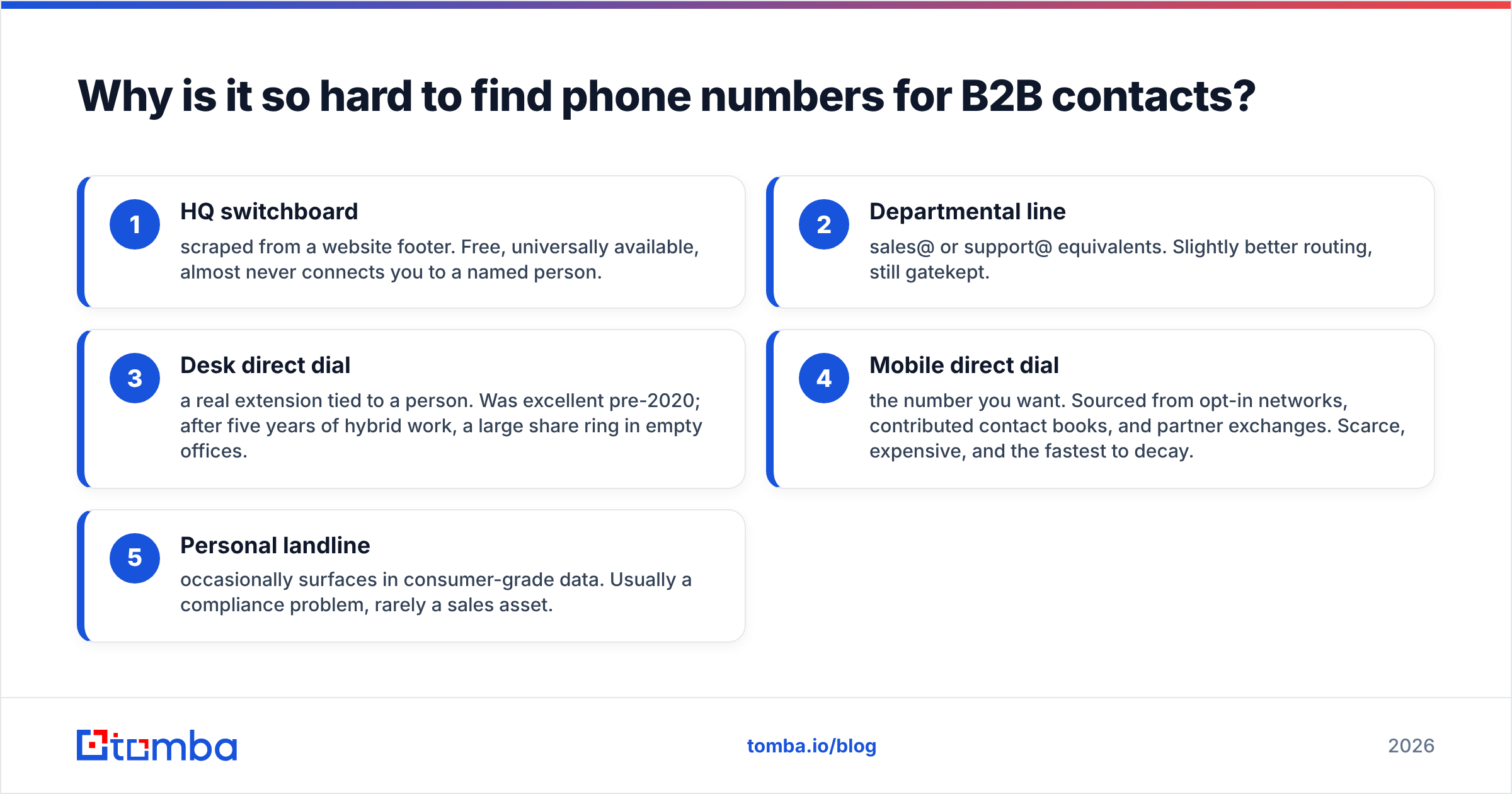
Because a phone number is not one thing. When a vendor says it has "phone coverage" for a contact, that claim can mean any of five very different data points, and only one of them gets you a live conversation.
Think of it like being given an address for someone. "United States" is technically correct. "Suite 400, 1200 Market St" is useful. Most B2B phone data is closer to the first than the second — a main line that routes you to an IVR menu you will never escape.
Here's what actually sits behind the word "phone" in a typical export:
- HQ switchboard — scraped from a website footer. Free, universally available, almost never connects you to a named person.
- Departmental line — sales@ or support@ equivalents. Slightly better routing, still gatekept.
- Desk direct dial — a real extension tied to a person. Was excellent pre-2020; after five years of hybrid work, a large share ring in empty offices.
- Mobile direct dial — the number you want. Sourced from opt-in networks, contributed contact books, and partner exchanges. Scarce, expensive, and the fastest to decay.
- Personal landline — occasionally surfaces in consumer-grade data. Usually a compliance problem, rarely a sales asset.
The gap between category 1 and category 4 is where every "our data is 95% accurate" claim goes to die. A vendor can be honestly reporting 95% accuracy — on switchboards.
The second structural problem is decay. Email addresses break when someone changes jobs. Mobile numbers usually survive a job change but become mislabeled — you now have a valid, reachable number attached to the wrong company, wrong title, and wrong pitch. That's arguably worse than a hard bounce, because it looks like a win in your dashboard while wasting a rep's time.
What are the actual methods to find phone numbers?#
There are six that work at any meaningful scale. Everything else is a variation on one of them.
1. Contact database lookup. You supply a name plus company (or a LinkedIn URL, or an email), the provider returns known numbers with a line-type label. This is the default path for most teams and where a dedicated phone finder earns its keep. Speed: seconds. Coverage: highly variable by geography.
2. Enrichment from an existing record. You already have an email or domain and want to append a number. This is the cheapest per-record method because you're not paying for discovery — just the append. Running data enrichment across a CRM export typically fills 30-50% of blank phone fields on a well-maintained US B2B list.
3. Website and public-source mining. Team pages, press releases, PDF media kits, conference speaker bios, and SEC filings all leak direct numbers. Slow, but free and often produces senior-contact numbers that databases miss entirely.
4. Switchboard plus internal transfer. Call the main line, ask for the person by name, get transferred. Unfashionable and surprisingly effective for mid-market and enterprise accounts where reception still routes calls. Zero data cost.
5. Signature and out-of-office harvesting. Reply-based sequences surface signatures containing mobile numbers. This is a downstream benefit of a functioning email motion — one more reason to keep your email verifier running before you send.
6. Warm-intro and community sourcing. Slack groups, alumni networks, portfolio-company intros. Lowest volume, highest connect rate, doesn't scale.
Most teams that complain phone prospecting "doesn't work" are running method 1 alone, on a single vendor, with no validation step.
How do the main sourcing methods compare on cost and accuracy?#
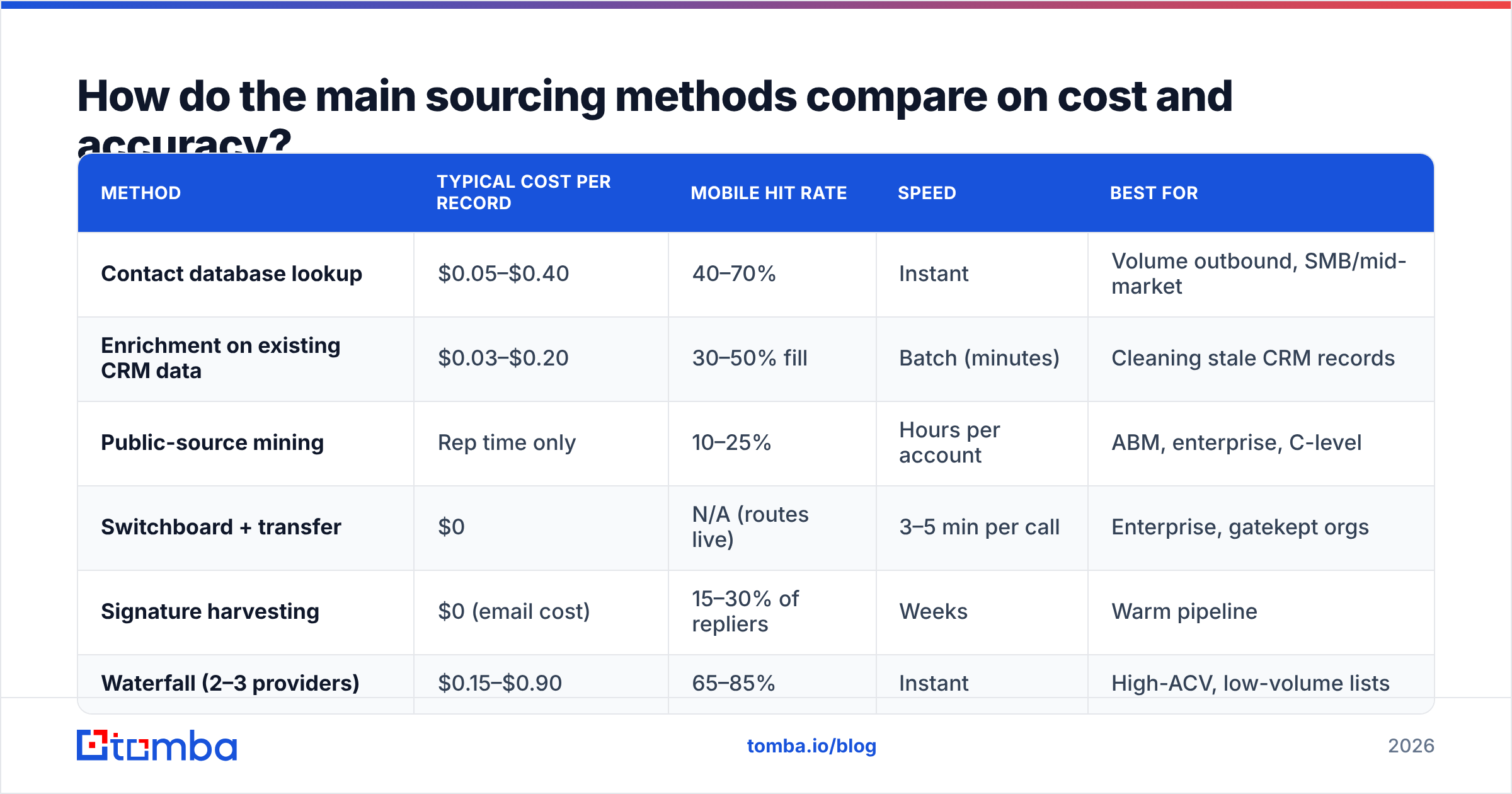
The table below reflects what teams running US and Western European B2B outbound typically report. Treat the ranges as directional — your industry and target seniority will move them significantly.
| Method | Typical cost per record | Mobile hit rate | Speed | Best for |
|---|---|---|---|---|
| Contact database lookup | $0.05–$0.40 | 40–70% | Instant | Volume outbound, SMB/mid-market |
| Enrichment on existing CRM data | $0.03–$0.20 | 30–50% fill | Batch (minutes) | Cleaning stale CRM records |
| Public-source mining | Rep time only | 10–25% | Hours per account | ABM, enterprise, C-level |
| Switchboard + transfer | $0 | N/A (routes live) | 3–5 min per call | Enterprise, gatekept orgs |
| Signature harvesting | $0 (email cost) | 15–30% of repliers | Weeks | Warm pipeline |
| Waterfall (2–3 providers) | $0.15–$0.90 | 65–85% | Instant | High-ACV, low-volume lists |
The waterfall row is the one worth staring at. Chaining providers — query A, fall through to B when A returns nothing — is the single biggest lever on coverage, and it costs less than you'd expect because you only pay the second provider on misses. The catch is orchestration overhead, which is why most teams cap it at two or three sources.
What accuracy should you actually expect?#
Assume 50-70% for US mobile direct dials on mid-market titles, and adjust down from there. Adjust down hard for:
- Non-US geography. German and French mobile coverage in most B2B databases is materially thinner than US, partly for structural reasons and partly because GDPR raised the bar on lawful sourcing. APAC outside Singapore and Australia is thinner still.
- Very junior or very senior titles. Individual contributors under two years' tenure and C-suite at large enterprises are both under-covered, for opposite reasons.
- Regulated industries. Healthcare, defense, and financial services suppress personal contact data aggressively.
- Companies under 20 employees. Often no switchboard, no scraped desk lines, and the founder's mobile is the only number that exists.
Two practices separate teams that get value from phone data from those that burn budget on it.
First, validate line type before you dial. A phone validator check tells you whether a number is mobile, landline, VoIP, or unallocated, and whether it's currently in service. Unallocated numbers are pure waste; VoIP numbers on a B2B record are often abandoned Google Voice forwards. Filtering these out before a dialer touches them lifts connect rate without adding a single new record.
Second, track outcomes back to source. Tag every number with the provider that supplied it. After 500 dials you'll have a real per-source connect rate, which is the only accuracy number that means anything. Vendors' published figures are marketing; your dial log is evidence.
Which providers should you consider?#
The market splits into three groups, and the mistake is buying from the wrong group for your motion.
All-in-one sales platforms (Apollo, ZoomInfo, Seamless.AI) bundle phone data with sequencing, dialers, and intent signals. Good if you want one contract and one UI. The trade-off is that phone data is a feature, not the product, and you're paying platform pricing for it. If you're evaluating this tier, our breakdown of Apollo alternatives covers where the bundle pricing stops making sense.
Specialist contact-data providers (Tomba, Lusha, Cognism, RocketReach) sell finding and verification as the core product, usually with a real API and credit-based pricing. Better unit economics if you already have a dialer and CRM you like.
Curated B2B list vendors (BookYourData and similar) sell pre-built, filterable contact lists — including direct dials — as a one-time purchase rather than a subscription. This is a genuinely different buying model, and for teams that need 5,000 verified contacts in a specific vertical once a quarter rather than continuous access, it can be far cheaper than a seat-based platform. Worth a look before you assume subscription is the only option.
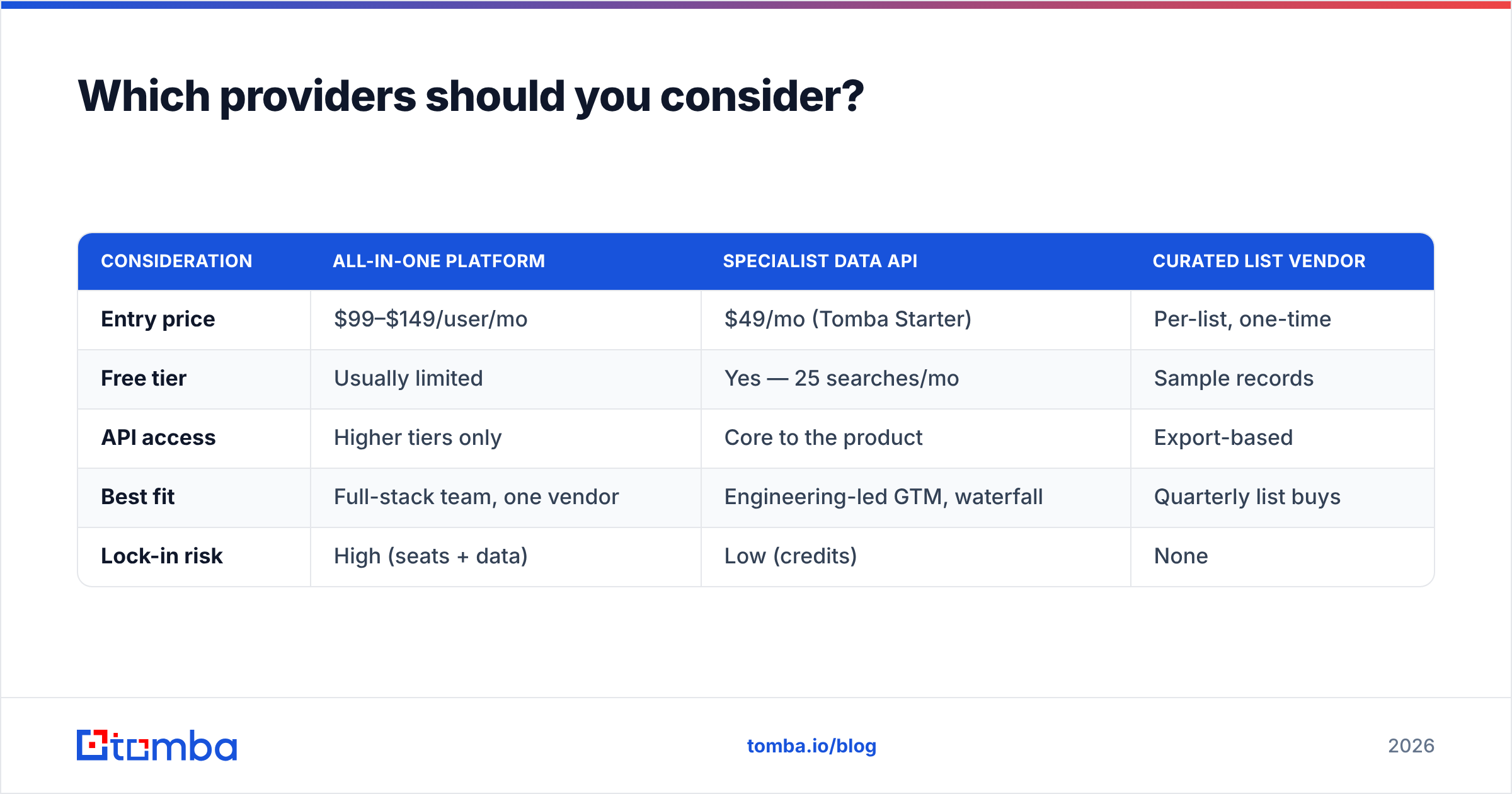
Here's how the economics compare on a like-for-like basis:
| Consideration | All-in-one platform | Specialist data API | Curated list vendor |
|---|---|---|---|
| Entry price | $99–$149/user/mo | $49/mo (Tomba Starter) | Per-list, one-time |
| Free tier | Usually limited | Yes — 25 searches/mo | Sample records |
| API access | Higher tiers only | Core to the product | Export-based |
| Best fit | Full-stack team, one vendor | Engineering-led GTM, waterfall | Quarterly list buys |
| Lock-in risk | High (seats + data) | Low (credits) | None |
Tomba sits in the middle column. Tomba pricing runs Free (25 searches/mo), Starter $49/mo, Growth $99/mo, Pro $249/mo, and Enterprise custom — with the same credit pool covering email finding, verification, phone lookup, and enrichment, which matters when your list-building is multi-channel rather than phone-only.
For an independent read on any of these, G2's sales intelligence category has enough recent reviews to spot patterns that vendor pages won't tell you.
How do you build a repeatable phone-finding workflow?#
Five steps. Run them in order; skipping step 4 is the most common failure.
- Define the account list first, contacts second. Phone prospecting only pays off on accounts worth a five-minute conversation. Pull 100-300 target accounts before you look up a single number.
- Enrich in bulk, not one at a time. Push the list through a bulk email finder and enrichment pass together. One job, one credit spend, one clean file back.
- Waterfall on misses only. Take the records that came back empty and re-query a second source. Do not re-query records you already filled — that's how credit budgets evaporate.
- Validate line type and status. Strip unallocated, disconnected, and obvious VoIP-forward numbers. Expect to drop 10-20% of the file here. This step feels like losing data; it's actually removing the records that would have wasted the most rep time.
- Log every outcome against its source. Connect, voicemail, wrong person, disconnected. Review monthly and cut the worst-performing source.
On the compliance side: US B2B calling is governed by TCPA and the Do Not Call registry, with business-to-business exemptions that are narrower than most reps assume — the FTC's telemarketing rules are the primary source, not a vendor's blog post. In the EU and UK, GDPR legitimate-interest reasoning applies to phone outreach the same way it does to email, and you need to be able to document where a number came from. Ask any provider for their sourcing documentation before you sign; a vendor that can't explain it is a vendor that will become your problem.
Should you use phone at all, or just email harder?#
Use both, sequenced — but let the economics decide the ratio.
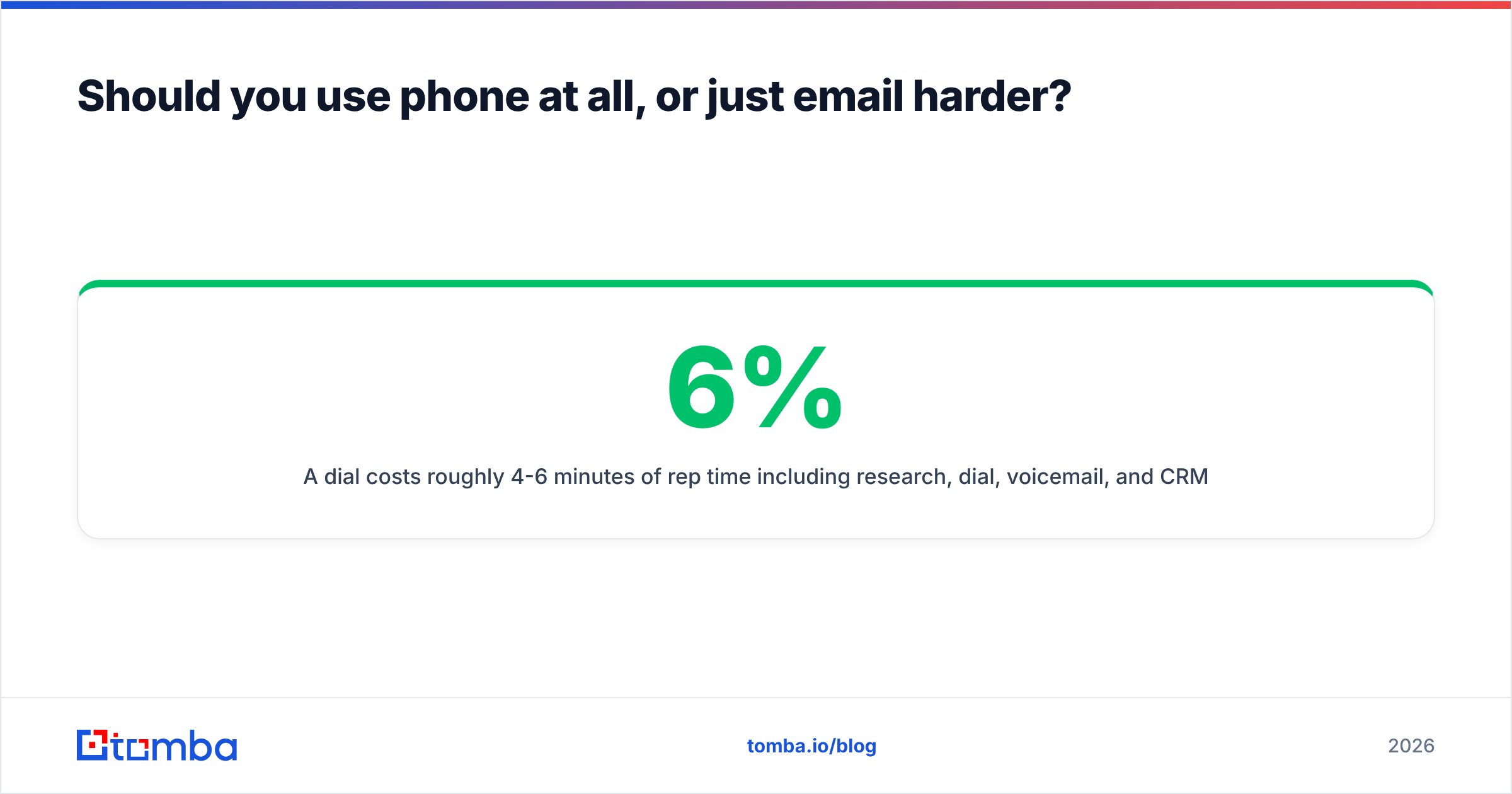
A dial costs roughly 4-6 minutes of rep time including research, dial, voicemail, and CRM logging. At a 6% connect rate, that's around 80 minutes of rep time per conversation. An email costs a few cents and near-zero rep time at scale, but converts a small fraction as well per touch. The crossover point is deal size: below roughly $10K ACV, email-first with phone reserved for engaged prospects almost always wins. Above $30K, phone-first on a tight account list wins.
The practical answer for most teams: build the list once with email and phone together, run email as the volume channel, and reserve dials for accounts showing engagement — opens, replies, site visits, or a reverse email lookup match on an inbound form fill. That way you're never dialing cold into a list you haven't qualified.
One more thing worth saying plainly: the number of dials is not the goal. Teams that instrument connect rate per source, per geography, and per title band find their cost per conversation drops by half within a quarter — without buying a single additional record. The data you already have is usually underperforming because nobody validated it, not because there isn't enough of it.
Where should you start?#
Start with the list you already have. Export 200 contacts from your CRM, run them through enrichment to fill blank phone fields, validate line types, and dial 50. You'll learn more about your real coverage and connect rates in two days than from any vendor demo.
When you're ready to build lists from scratch, the Tomba Email Finder is the fastest entry point — search by domain, name, or company, get verified emails alongside phone data from the same credit pool, and export straight into your CRM or sequencer. The free tier gives you 25 searches a month, which is enough to benchmark coverage against whatever you're using today before you commit to anything. Test it against your own account list, not a curated demo file, and let the connect rate decide.
Related guides#
Ready to find emails that actually work?
Join 150,000+ professionals who stopped guessing and started sending. Free credits on signup — no credit card required.
Get the Tomba newsletter
Practical outbound tactics and product updates — once every two weeks.
About the author