Finder.io vs Apollo.io (2026): Which B2B Data Tool Wins?
Finder.io bundles email lookup into a 50-app suite. Apollo.io sells a 200M+ contact database with sequencing on top. We compare accuracy, credits, pricing, and API depth to find which one actually belongs in your stack.
Finder.io vs Apollo.io is not a like-for-like fight. One is a cheap app inside a big bundle. The other is a full sales platform with its own contact database. This guide shows where each one wins, and where both leave money on the table.
TL;DR
- Finder.io is one app inside the 500apps bundle. You pay a flat per-user price and get email lookup plus ~50 unrelated tools. Cheap on paper, shallow on data depth and API tooling.
- Apollo.io is a full go-to-market platform — a 200M+ contact database, filters, sequencing, dialer, and CRM sync. Powerful, but per-seat pricing and export credit caps punish teams that need volume, not seats.
- Neither tool is optimised for the narrow job most teams actually have: find a verified email for a known person or domain, at scale, through an API.
- If your bottleneck is sequencing and territory planning, Apollo wins. If it's raw enrichment throughput and cost-per-verified-email, a specialist finder beats both.
- Run the same 100-contact test list through all three before you sign anything. Match rate and bounce rate on your ICP is the only benchmark that matters.
What are Finder.io and Apollo.io, exactly?#
They are not the same category of product, even though both show up when you search "email finder."
Finder.io is a lead intelligence app published by 500apps. Its pitch is bundling: you subscribe to the 500apps suite and Finder.io arrives alongside a CRM, a helpdesk, a project tracker, an email marketing tool, and dozens more. The email side does what you'd expect — domain search, single email lookup, verification, and a Chrome extension.
Apollo.io is a go-to-market platform built around its own contact database. You filter a large B2B dataset by title, headcount, tech stack, funding, and intent signals. Then you push that list into a sequence. You work it with email, calls, and LinkedIn tasks in one place. The Apollo.io product surface is much wider — sequencing, a dialer, conversation intelligence, deal management.
The practical difference: Finder.io answers "what is this person's email?" Apollo answers "who should I be emailing, and how do I run the whole campaign?"
That distinction drives almost every trade-off below.
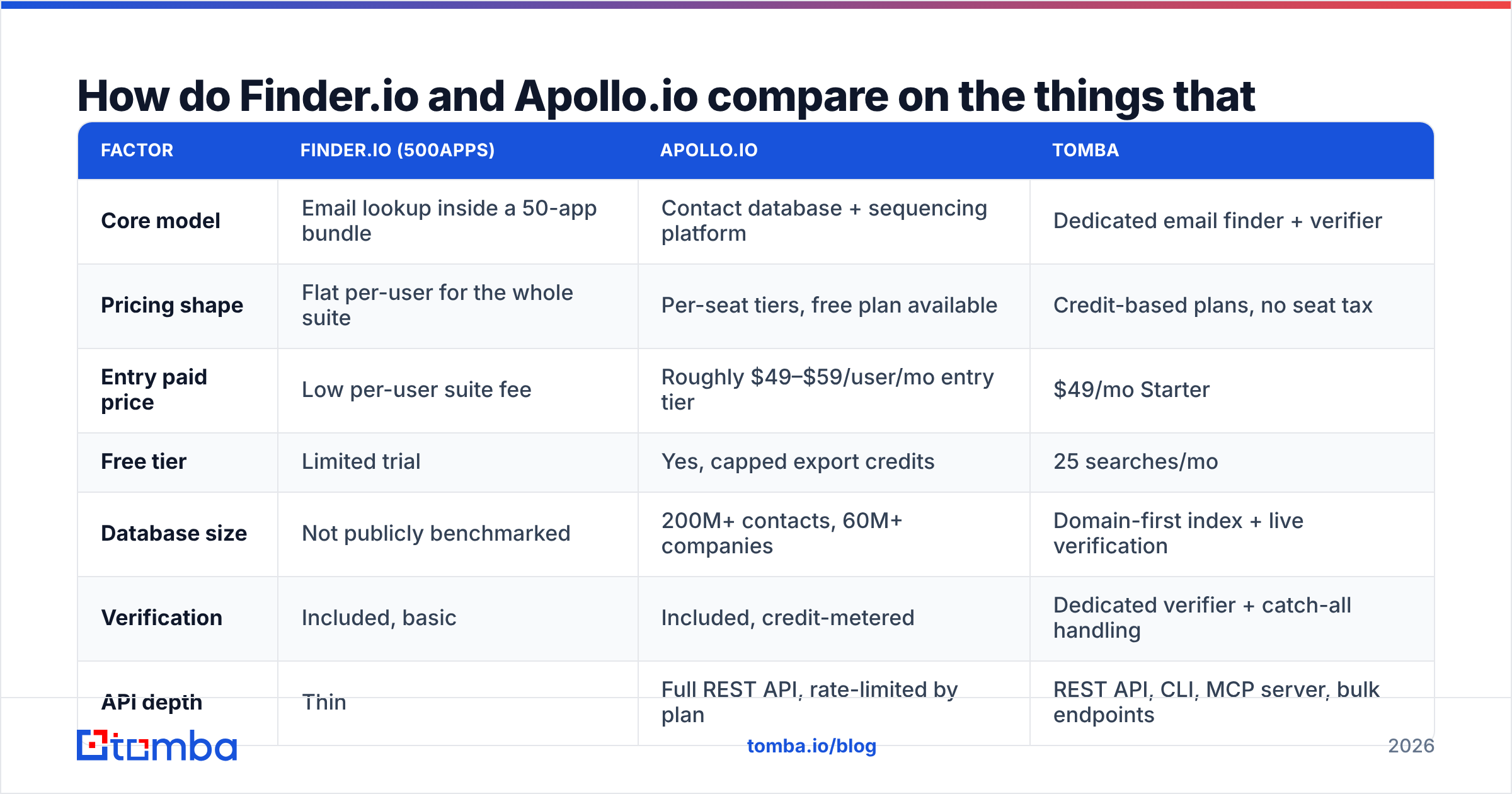
Finder.io vs Apollo.io: how do they compare on the things that matter?#
| Factor | Finder.io (500apps) | Apollo.io | Tomba |
|---|---|---|---|
| Core model | Email lookup inside a 50-app bundle | Contact database + sequencing platform | Dedicated email finder + verifier |
| Pricing shape | Flat per-user for the whole suite | Per-seat tiers, free plan available | Credit-based plans, no seat tax |
| Entry paid price | Low per-user suite fee | Roughly $49–$59/user/mo entry tier | $49/mo Starter |
| Free tier | Limited trial | Yes, capped export credits | 25 searches/mo |
| Database size | Not publicly benchmarked | 200M+ contacts, 60M+ companies | Domain-first index + live verification |
| Verification | Included, basic | Included, credit-metered | Dedicated verifier + catch-all handling |
| API depth | Thin | Full REST API, rate-limited by plan | REST API, CLI, MCP server, bulk endpoints |
| Best for | Small teams who want one bill for many tools | Full-cycle SDR teams needing sequencing | Enrichment volume, dev-driven workflows |
| Weak spot | Data depth, support, suite lock-in | Seat cost + export credit caps | No built-in sequencer |
Two honest caveats about that table. First, vendor pricing changes constantly — check Apollo's pricing page and finder.io before you budget. Second, "database size" is the single most misleading metric in this category. A 200M-record database means nothing if 40% of the records for your specific vertical are three years stale.

Which one has better data accuracy?#
On raw data, Finder.io vs Apollo.io is not close. Apollo has the bigger and more actively maintained dataset. Finder.io does not publish accuracy benchmarks, and independent testing on it is thin — that alone is a signal.
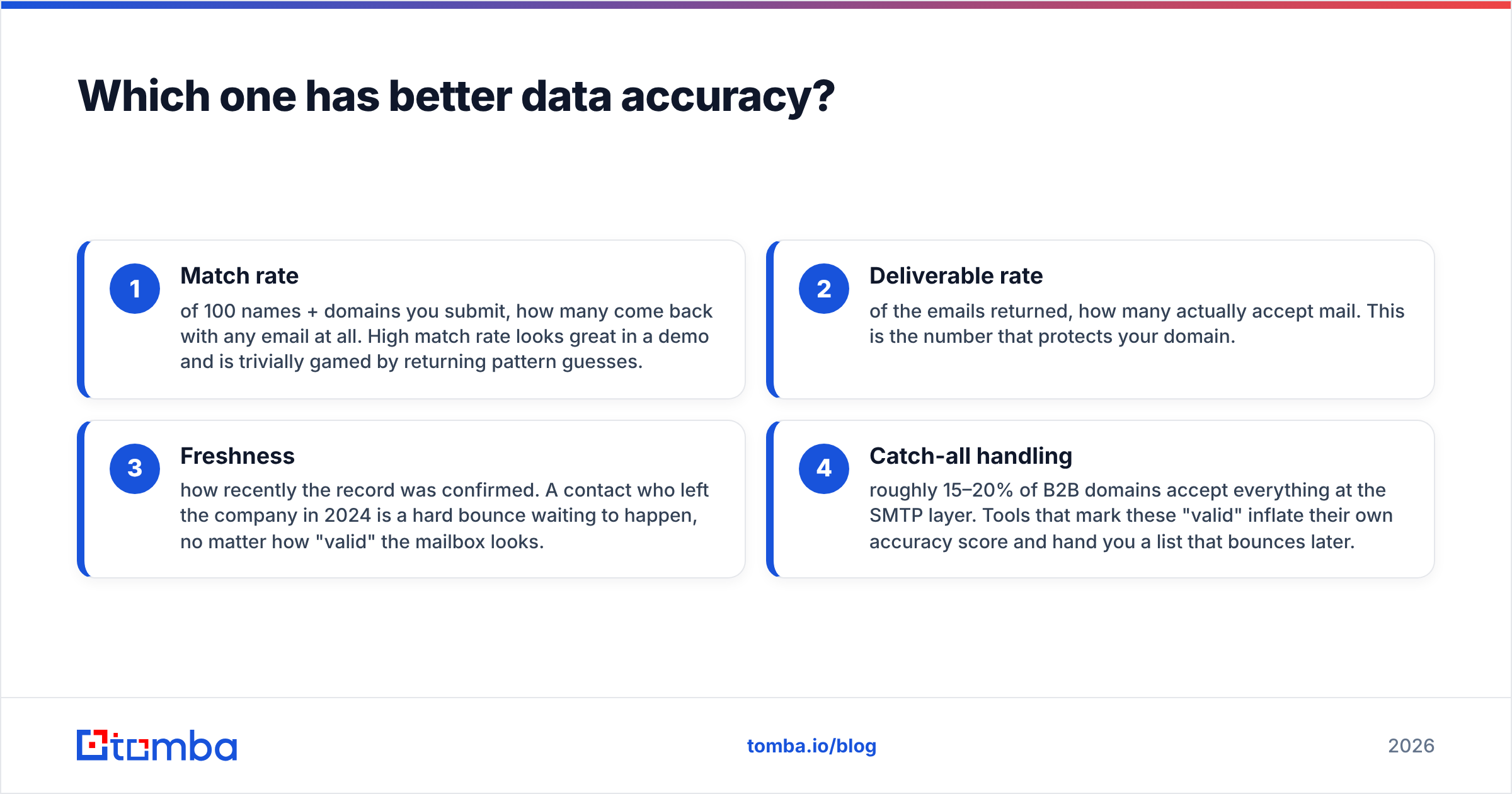
But accuracy is not a single number, and here's where most comparison posts go wrong. There are four distinct things people call "accuracy":
- Match rate — of 100 names + domains you submit, how many come back with any email at all. High match rate looks great in a demo and is trivially gamed by returning pattern guesses.
- Deliverable rate — of the emails returned, how many actually accept mail. This is the number that protects your domain.
- Freshness — how recently the record was confirmed. A contact who left the company in 2024 is a hard bounce waiting to happen, no matter how "valid" the mailbox looks.
- Catch-all handling — roughly 15–20% of B2B domains accept everything at the SMTP layer. Tools that mark these "valid" inflate their own accuracy score and hand you a list that bounces later.
Apollo scores reasonably on 1 and 2 for well-covered segments — US tech, mid-market SaaS, sales and marketing titles. It gets noticeably thinner on European SMBs, non-English company names, and niche industrial verticals. Finder.io's coverage is narrower still, and its verification layer is a checkbox rather than a differentiated product.
If you routinely hit catch-all domains, neither tool gives you a confident answer. That's the gap a dedicated catch-all verifier exists to close. It separates "the server accepts everything" from "this mailbox exists."
Is Apollo.io worth the per-seat price?#
On price alone, Finder.io vs Apollo.io looks like a rout. It is not that simple. Apollo's cost depends entirely on whether you use the sequencer.
Apollo's value is bundled: database + sequencing + dialer + CRM sync in one subscription. If your SDRs live in Apollo all day — building lists in the morning, working sequences in the afternoon, logging calls to the dialer — the per-seat price is defensible. You'd otherwise pay separately for a data provider and a sequencing tool, and the combined bill would be higher.
The math breaks in three scenarios:
- You already own a sequencer. If you're committed to Outreach, Salesloft, Smartlead, or Instantly, you're buying Apollo purely for data — and paying for a sequencer you'll never open. Check the Apollo alternative comparison if this is you.
- Your enrichment is programmatic. RevOps teams enriching inbound signups, doing CRM hygiene runs, or building an internal lead router need API calls, not seats. Apollo's export credits and rate limits become the constraint, and adding seats to raise credits is an expensive workaround.
- Only two people prospect but ten people need lookups. Marketing wants to enrich a webinar list. Support wants to identify an anonymous account. Finance wants a contact at a vendor. Under per-seat pricing, each of those occasional users costs the same as a full-time SDR.
That third case is the quiet killer. Per-seat pricing assumes everyone who touches the tool is a daily power user. In most companies, that's simply false.
Where does Finder.io actually make sense?#
Finder.io wins the Finder.io vs Apollo.io matchup in exactly one situation: you genuinely want the whole 500apps suite.
Say you're a five-person startup. You need a CRM, a helpdesk, a form builder, a project tracker, and an email finder. You'd rather have one vendor and one invoice than six. The bundle is a fair deal. Nobody gets fired for consolidating six $20/month subscriptions into one.
The problem is what bundling does to product depth. A suite with ~50 apps cannot invest deeply in all of them. Email finding is a hard, ongoing infrastructure problem — you need crawling, pattern inference, SMTP probing at scale, IP reputation management, and constant re-verification. Vendors that do only that ship changes weekly. Vendors that do that plus 49 other things ship changes to it occasionally.
So the honest read: Finder.io is a reasonable included feature and a weak primary data source. If email discovery is a side quest for you — a few dozen lookups a month — it's fine. If it's the input to your revenue engine, you'll outgrow it fast.
What about the third option nobody frames properly?#
Most Finder.io vs Apollo.io posts assume you must pick one. In practice, the highest-performing outbound stacks split the job:
- Sequencing and workflow — one tool (Apollo, Instantly, Smartlead, your CRM's native cadences)
- Data discovery and verification — a specialist, priced by credits rather than seats
That split exists because the two jobs scale differently. Sequencing scales with headcount — more reps, more seats, fair. Data scales with volume — 50,000 enrichments a month costs the same whether one person or twenty triggers them. Paying seat prices for volume work is the most common overspend in this category.
A specialist finder like Tomba is built for the second half. The email finder handles name-plus-domain lookups. Domain search pulls every address at a company. The email verifier checks each one before you send. The Tomba API exposes all of it, plus a CLI and an MCP server. Your AI agents and internal scripts call the same endpoints your reps use in the browser extension.
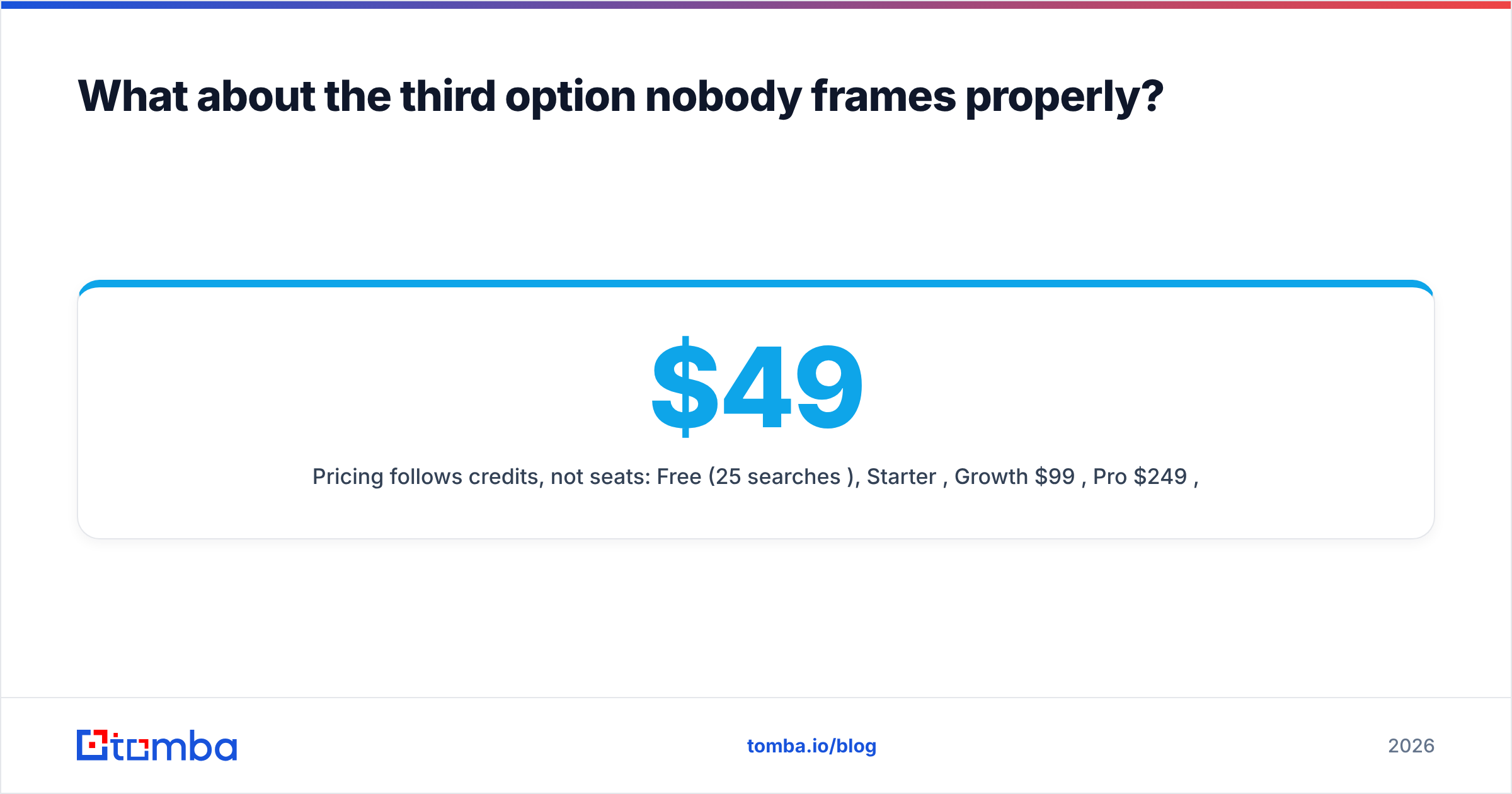
Pricing follows credits, not seats: Free (25 searches/mo), Starter $49/mo, Growth $99/mo, Pro $249/mo, Enterprise custom. Full details on the Tomba pricing page. Ten occasional users cost the same as one — which is the point.
For context on where the broader market sits, G2's data category is a useful sanity check on how buyers rate each vendor on data quality specifically, rather than on overall platform breadth.

How should you run the Finder.io vs Apollo.io comparison?#
Do not trust anyone's published accuracy number, including this post. Run your own Finder.io vs Apollo.io test. It takes about ninety minutes.
Build a 100-row ground-truth list. Pull real prospects from your ICP — same industries, same company sizes, same seniority you'd actually target. Include at least 20 rows from your hardest segment (non-US, SMB, or a niche vertical). Include first name, last name, company domain.
Run the same list through each tool. Free tiers and trials are usually enough. Record what each returns: email, confidence score, verification status, and whether it flagged catch-all.
Verify with a neutral third party. Never let a tool grade its own homework. Run every returned address through a separate verifier so the pass/fail judgment is independent.
Send a small, warmed test batch. Fifty emails from a warmed domain. Measure hard bounces. This is the only number that reflects reality — everything before it is a proxy.
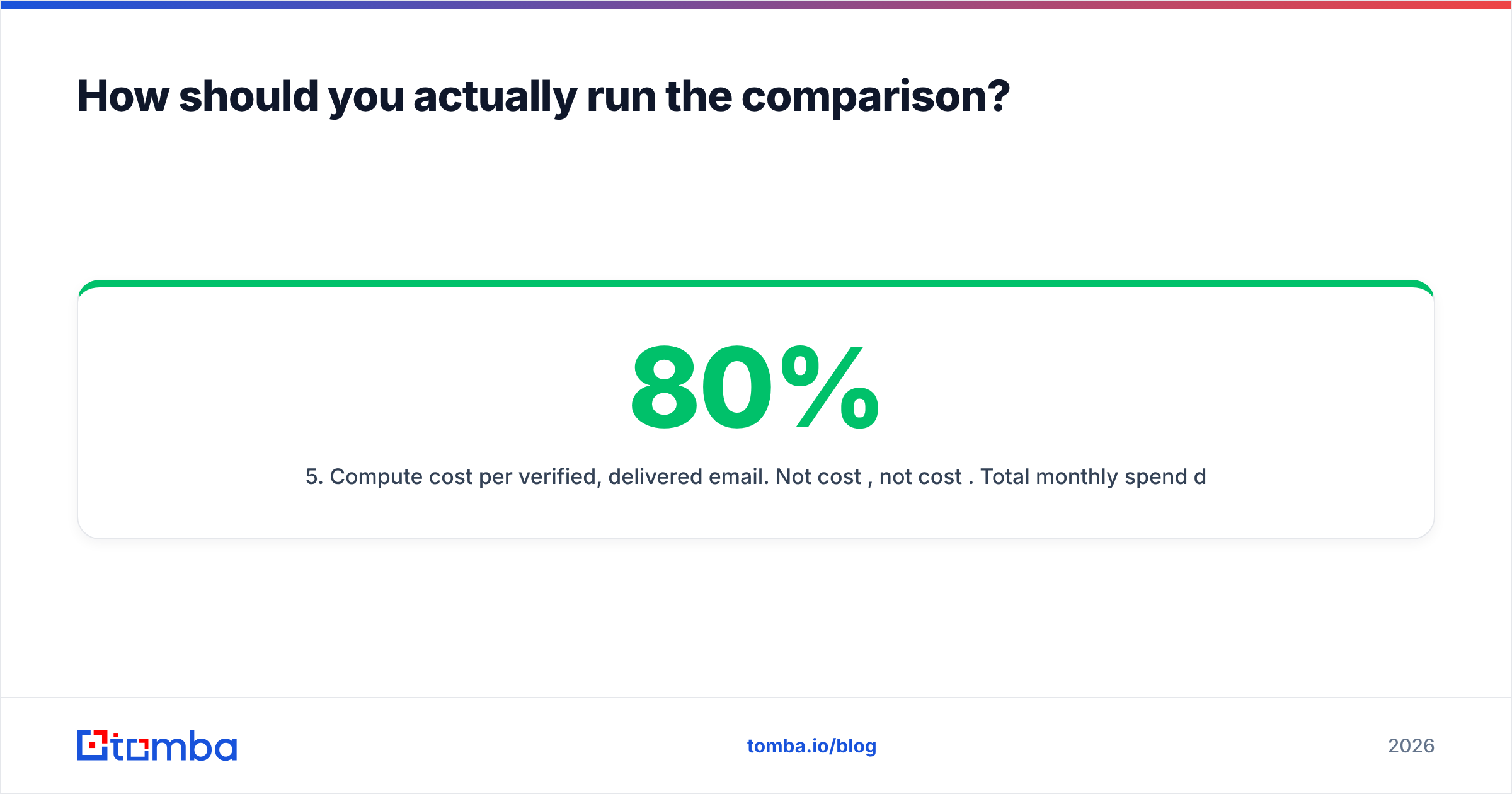
Compute cost per verified, delivered email. Not cost per credit, not cost per seat. Total monthly spend divided by emails that actually landed. A tool with an 80% match rate at $0.02 each beats a 95% match rate at $0.09 every time.
Score the workflow, not just the data. How many clicks from list to CRM? Does the API do bulk, or only one record per call? Is there a rate limit that breaks your nightly job?
Step 5 is where most evaluations reverse themselves. Teams walk in convinced they need the biggest database and walk out realising they were paying three times market rate for records they never touched.
Finder.io vs Apollo.io: which should you choose?#
Choose Apollo.io if you're building or scaling an SDR team that needs list-building, sequencing, dialing, and reporting in a single system, your ICP sits in Apollo's strong coverage zone (US and Western Europe tech and services), and you have enough seats for the per-seat model to feel like a platform fee rather than a tax.
Choose Finder.io if you were already going to buy the 500apps suite for other reasons, your lookup volume is genuinely low, and email discovery is a convenience rather than a revenue input.
Choose a dedicated finder if your bottleneck is volume rather than workflow — programmatic enrichment, CRM hygiene, bulk list building, or an internal tool that needs a clean API. Also choose it if you've already standardised on a sequencer and refuse to pay twice for one.
So the honest Finder.io vs Apollo.io verdict is a split one. Most mid-market teams land in the same place after a year of iterating. They keep a sequencer they like, put a specialist data source underneath it, and add a hard rule: nothing gets sent without verification first. It is cheaper than the all-in-one, and it bounces less.
Ready to benchmark it yourself? Start with the Tomba Email Finder. The free tier gives you 25 searches a month. That is enough to run the 100-row test above on your own ICP, and to see match rate and bounce rate from your data instead of ours.
Related guides#
Ready to find emails that actually work?
Join 150,000+ professionals who stopped guessing and started sending. Free credits on signup — no credit card required.
Get the Tomba newsletter
Practical outbound tactics and product updates — once every two weeks.
About the author