Finder.io vs VC-Backed Email Finders: 2026 Cost Showdown
Finder.io sells email lookup inside a $14.99 all-in-one suite. VC-backed platforms sell seats, contracts, and enterprise data. Here is what each one actually costs you in valid emails per dollar.
Finder.io vs VC-backed email finders is really one question: do you buy a cheap bundled feature, or a funded platform with a contract? Here is what each side costs per valid email.
TL;DR
- Finder.io is one app inside the 500apps bundle. You are not buying a specialized email-finding company — you are buying a feature that ships alongside 49 other tools.
- VC-backed platforms (Apollo, ZoomInfo, Clearbit) buy you database breadth, intent signals, and a sales motion that includes annual contracts, seat minimums, and renewal pressure.
- The metric that matters is not list price. It is cost per verified email that lands in an inbox — and both extremes lose on that number for different reasons.
- Bundled suites usually win on sticker price and lose on hit rate. Enterprise platforms usually win on coverage and lose on flexibility, credit rollover, and the ability to leave.
- If you send under 10,000 cold emails a month, a specialist finder with transparent per-credit pricing and a real verification layer beats both. That is where Tomba sits.
What is Finder.io, and who is actually behind it?#
Finder.io is the email-finding module in the 500apps suite. The bundle packs CRM, helpdesk, project management, form builders, and dozens of other tools into one subscription. At the time of writing, 500apps lists the whole catalog at roughly $14.99 per user per month. That price is why Finder.io shows up in "cheapest email finder" listicles.
That structure explains most of its strengths and all of its weaknesses. When email lookup is app #23 of 50, it does not get its own data team, a proprietary crawl, or a roadmap driven by bounce complaints. It gets maintenance. Check current plans on the vendor site before you commit. Suite pricing changes, and per-app limits often change with it.
The pitch is real, though: if you genuinely need a CRM, a form builder, and email lookup, paying once for all three is rational math. The trap is a different one. Suite data rarely matches the data from a company that goes broke when the data is wrong.
What does "VC-backed" actually change about an email finder?#
Venture funding changes four things, and only two of them help you.
It helps: more money goes into data acquisition. ZoomInfo, Apollo, and Clearbit (now part of HubSpot) fund big contributory networks, scraping infrastructure, and enrichment pipelines. A bootstrapped team cannot match that raw record count. Funding also buys breadth — intent data, technographics, org charts, sequencing, dialers.
It hurts: funded companies need net revenue retention above 110%. That math produces annual contracts, seat minimums, auto-renewal clauses, credit expiry, and an upsell conversation every quarter. It also produces aggressive feature bundling — you pay for a sequencer you already have because the data is locked to the platform tier.
Look at any G2 category page for sales intelligence and read the one-star reviews. They are rarely about data quality. They are about billing, cancellation, and credits that vanished at renewal.

Finder.io vs VC-backed platforms: how do they compare head to head?#
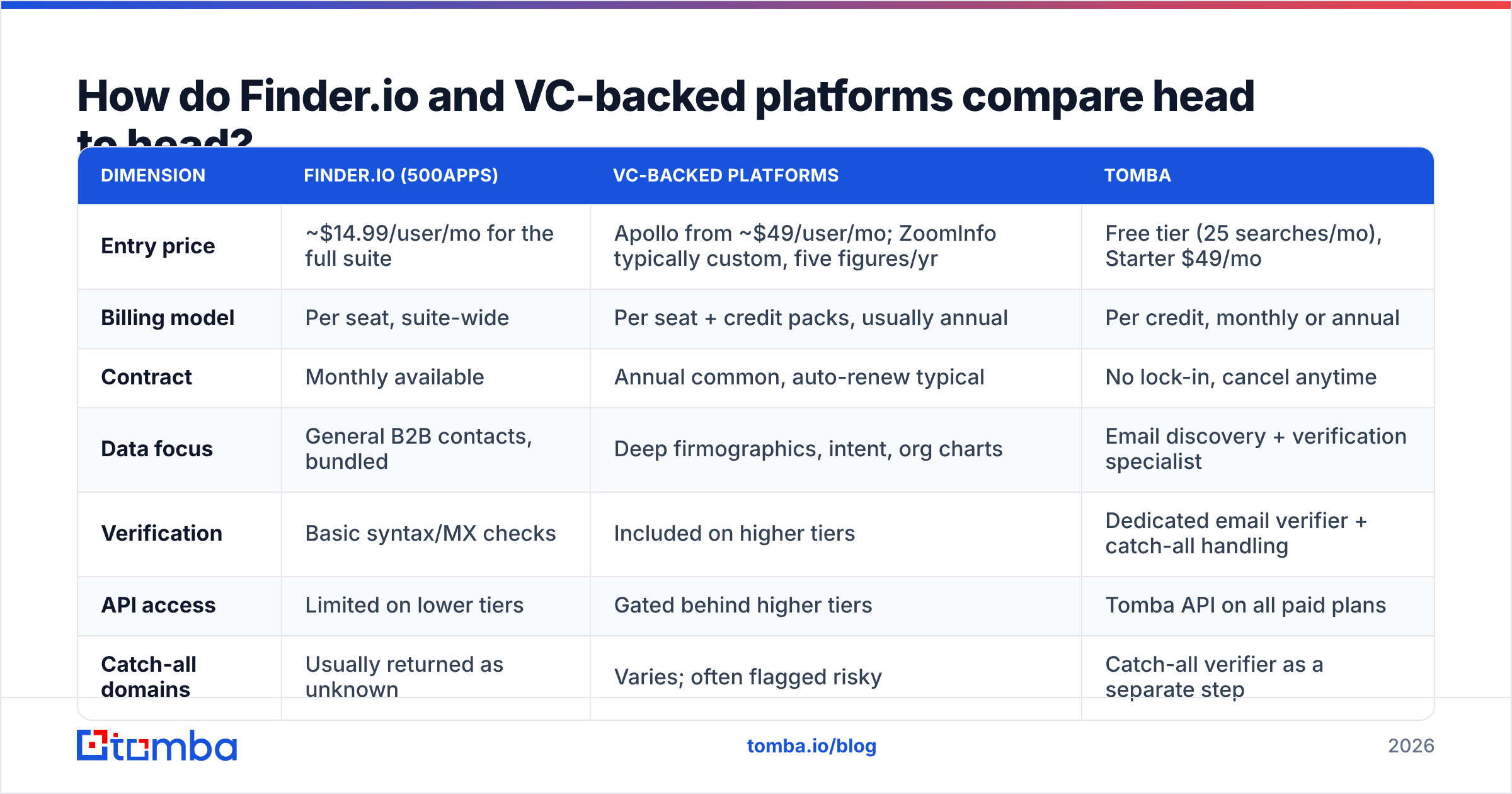
Here is the honest side-by-side. Pricing figures reflect published rates at the time of writing and should be verified before purchase.
| Dimension | Finder.io (500apps) | VC-backed platforms | Tomba |
|---|---|---|---|
| Entry price | ~$14.99/user/mo for the full suite | Apollo from ~$49/user/mo; ZoomInfo typically custom, five figures/yr | Free tier (25 searches/mo), Starter $49/mo |
| Billing model | Per seat, suite-wide | Per seat + credit packs, usually annual | Per credit, monthly or annual |
| Contract | Monthly available | Annual common, auto-renew typical | No lock-in, cancel anytime |
| Data focus | General B2B contacts, bundled | Deep firmographics, intent, org charts | Email discovery + verification specialist |
| Verification | Basic syntax/MX checks | Included on higher tiers | Dedicated email verifier + catch-all handling |
| API access | Limited on lower tiers | Gated behind higher tiers | Tomba API on all paid plans |
| Catch-all domains | Usually returned as unknown | Varies; often flagged risky | Catch-all verifier as a separate step |
| Best for | Teams already buying the suite | Enterprise ABM with budget | Lean outbound and dev teams |

The table hides the real decision, though. Almost nobody chooses an email finder on features. They choose on whether the emails bounce.
Which one actually finds more valid emails?#
Hit rate is the only number that converts to pipeline, and it splits into two sub-metrics people constantly conflate:
- Coverage — of 1,000 target contacts, how many come back with any email at all?
- Accuracy — of the emails returned, how many are genuinely deliverable?
A tool can post 85% coverage and still be worthless. If a third of those addresses are pattern guesses, they were never confirmed. Bundled suites tend to lean on permutation logic: take first name, last name, and the company email pattern, then generate first.last@domain.com. The result comes back with confidence styling that implies verification happened. It did not.
Enterprise platforms have the opposite failure mode. Coverage is genuinely high, but a large database ages. Contacts churn at roughly 2-3% per month in tech roles. A record last confirmed 18 months ago often points at someone who left.

Run your own test before you buy anything. Take 100 contacts you already have confirmed emails for — past customers, current pipeline, people who replied to you. Feed the names and domains into each tool's free tier. Score three columns: found, matched your known address, and bounced on send. Ten minutes of that beats every comparison post on the internet, including this one.
What are the hidden costs of VC-backed platforms?#
The list price is the beginning of the conversation, not the end. Budget for these:
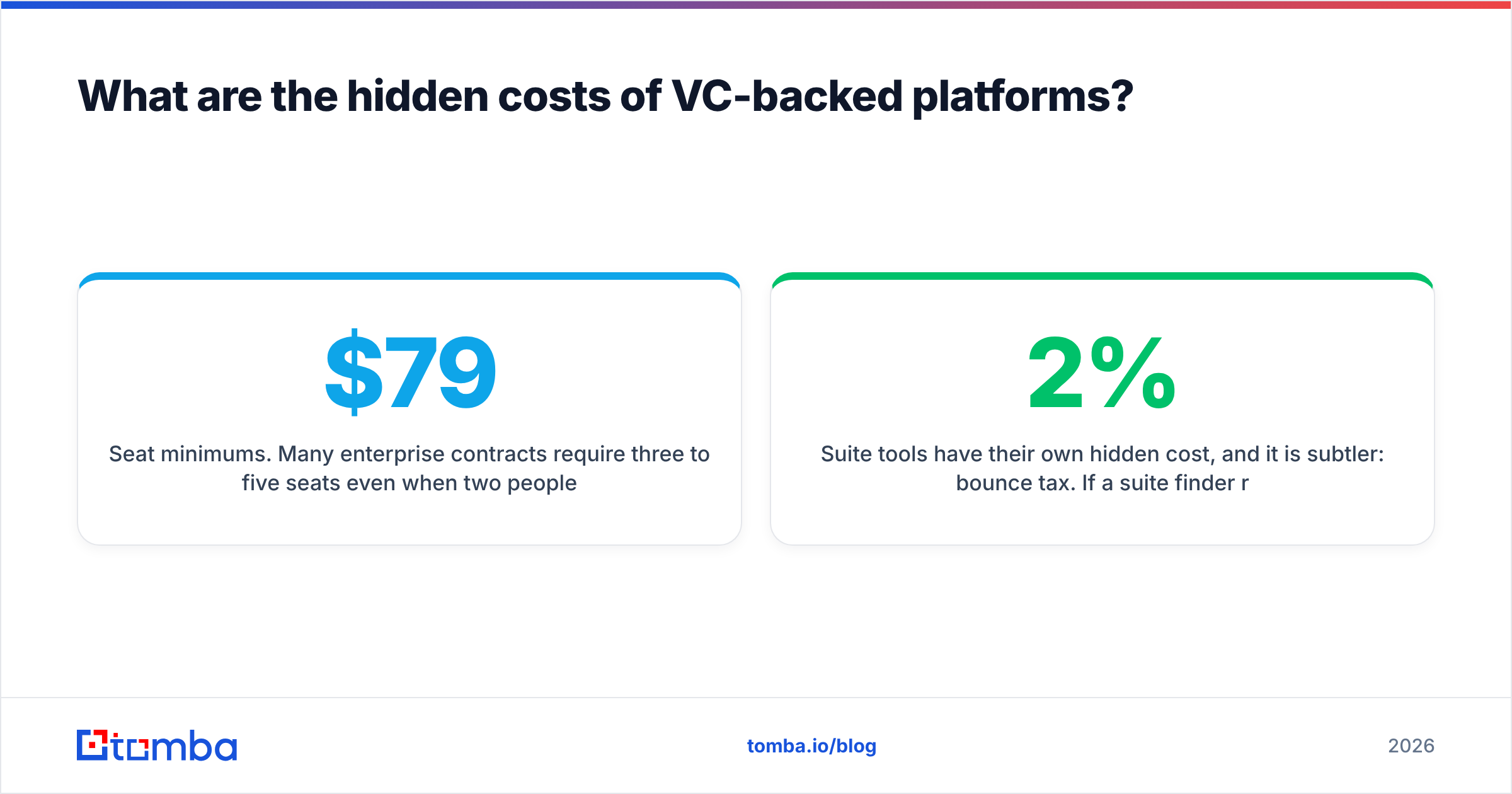
- Seat minimums. Many enterprise contracts require three to five seats even when two people do outbound. That turns a "$79/user" plan into a $4,700 annual line item.
- Credit expiry. Monthly credit pools that reset instead of rolling over mean you pay for capacity you never used. Ask explicitly whether unused credits roll and for how long.
- Export limits. Some platforms cap how many records you can export per month independently of your credit balance — you can see the contact but not take it with you.
- Data portability at churn. Read the clause about what happens to exported records if you cancel. Some contracts assert continued rights over the data.
- Auto-renewal windows. A 30-day cancellation window on an annual contract means missing one calendar reminder costs you another full year.
None of this is unique to any one vendor, and none of it is fraud. It is standard enterprise SaaS commercial design. It just makes the effective price two to four times the headline number for a small team.
Suite tools have their own hidden cost, and it is subtler: bounce tax. Send unverified guesses and your bounce rate climbs. Your sender reputation then degrades, and every campaign from that domain lands worse. A "cheap" tool that pushes your bounce rate from 2% to 7% costs you far more than the $35/month you saved.

Where does Finder.io genuinely win?#
Neutrality demands this section. There are three real scenarios where the bundled suite is the correct call:
You already need four or more apps in the bundle. If Finder.io replaces a line item you were going to pay for anyway alongside CRM and helpdesk, the marginal cost of the email finder is close to zero. Zero is hard to beat.
Your volume is genuinely tiny. Fifty lookups a month for a founder-led sales motion does not justify a specialist stack. Any tool that returns a plausible address is fine when you check each one by hand before sending.
You value one vendor, one invoice, one login. Procurement friction is a real cost in some organizations. Consolidation has value that does not show up in a feature matrix.
What Finder.io is not good for: high-volume outbound, API-driven enrichment inside your own product, catch-all-heavy industries (finance, legal, healthcare), or any workflow where a bounce has a real cost.
Is there a middle path between a bundle and a contract?#
Yes, and it is the category most buyers should be shopping in: specialist finders with transparent per-credit pricing and no lock-in. This is where Tomba, Findymail, Icypeas, and pay-as-you-go providers like BookYourData all compete. Different approaches, same promise: you pay for what you use, and you can leave whenever you want.
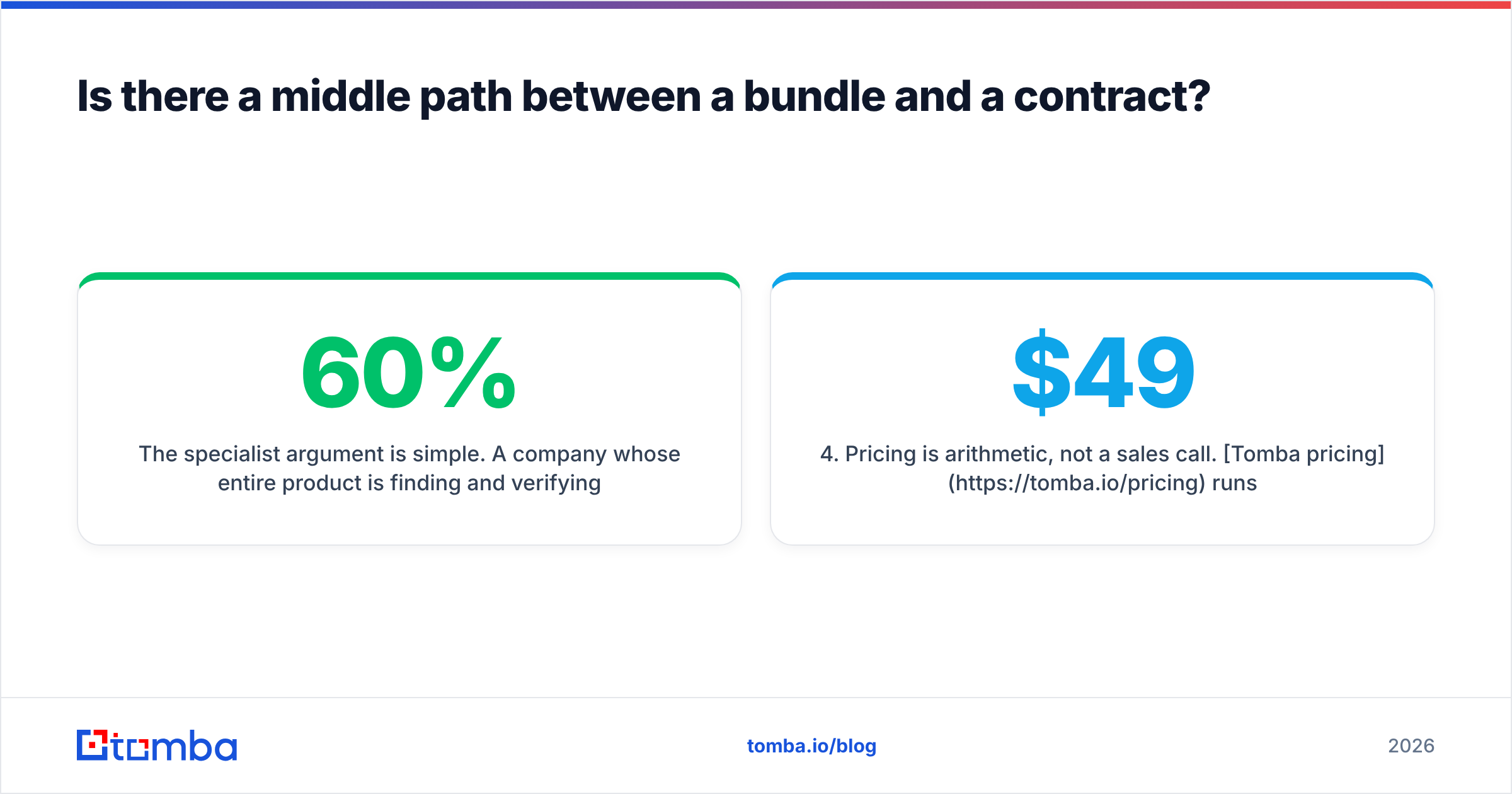
The specialist argument is simple. A company whose entire product is finding and verifying B2B email addresses cannot afford a 60% hit rate. There is no CRM upsell to hide behind and no sequencer to bundle the failure into.
Practically, here is what that buys you compared to the two extremes:
- Verification is not an upsell. Discovery and validation run as one workflow, so what you export has already been SMTP-checked rather than pattern-guessed.
- Catch-all domains get handled, not shrugged at. Roughly a fifth of B2B domains accept every address at the SMTP layer. A specialist runs extra signal checks instead of returning "unknown" and letting you gamble.
- The API is not tier-gated. If you enrich signups or build lead flow into your own product, an email finder API on the entry plan changes what you can build.
- Pricing is arithmetic, not a sales call. Tomba pricing runs Free (25 searches/mo), Starter $49/mo, Growth $99/mo, Pro $249/mo, Enterprise custom — published, monthly, cancellable.
- Bulk work is first-class. Bulk email finder jobs and CSV enrichment are core features, not a spreadsheet workaround.
If you are weighing the funded end of the market, the comparison pages for an Apollo alternative and a Clearbit alternative map the feature gaps in more detail than a general post can.
How should you actually choose in 2026?#
Work through this in order. Stop at the first line that matches you.
- Under 100 lookups/month and already on 500apps → keep Finder.io. Migrating costs more than it saves.
- Enterprise ABM, 20+ reps, need intent data and org charts → you need a funded platform. Negotiate hard on seat minimums and credit rollover, and put the cancellation date in three calendars.
- 1,000-20,000 lookups/month, small team, cold email is the channel → specialist finder with verification built in. This is the largest segment and the worst-served by both extremes.
- Building enrichment into a product → API-first specialist. Check rate limits, response latency, and whether webhooks exist before you look at price.
- Recovering from a deliverability problem → verification first, discovery second. Clean the list you have with an email verifier before you add a single new contact.
One rule holds on either side: never send to a list you have not verified in the last 30 days, no matter which vendor produced it. Data decays. The tool that found the address in March is not responsible for the person who resigned in July.
What should you test before you commit?#
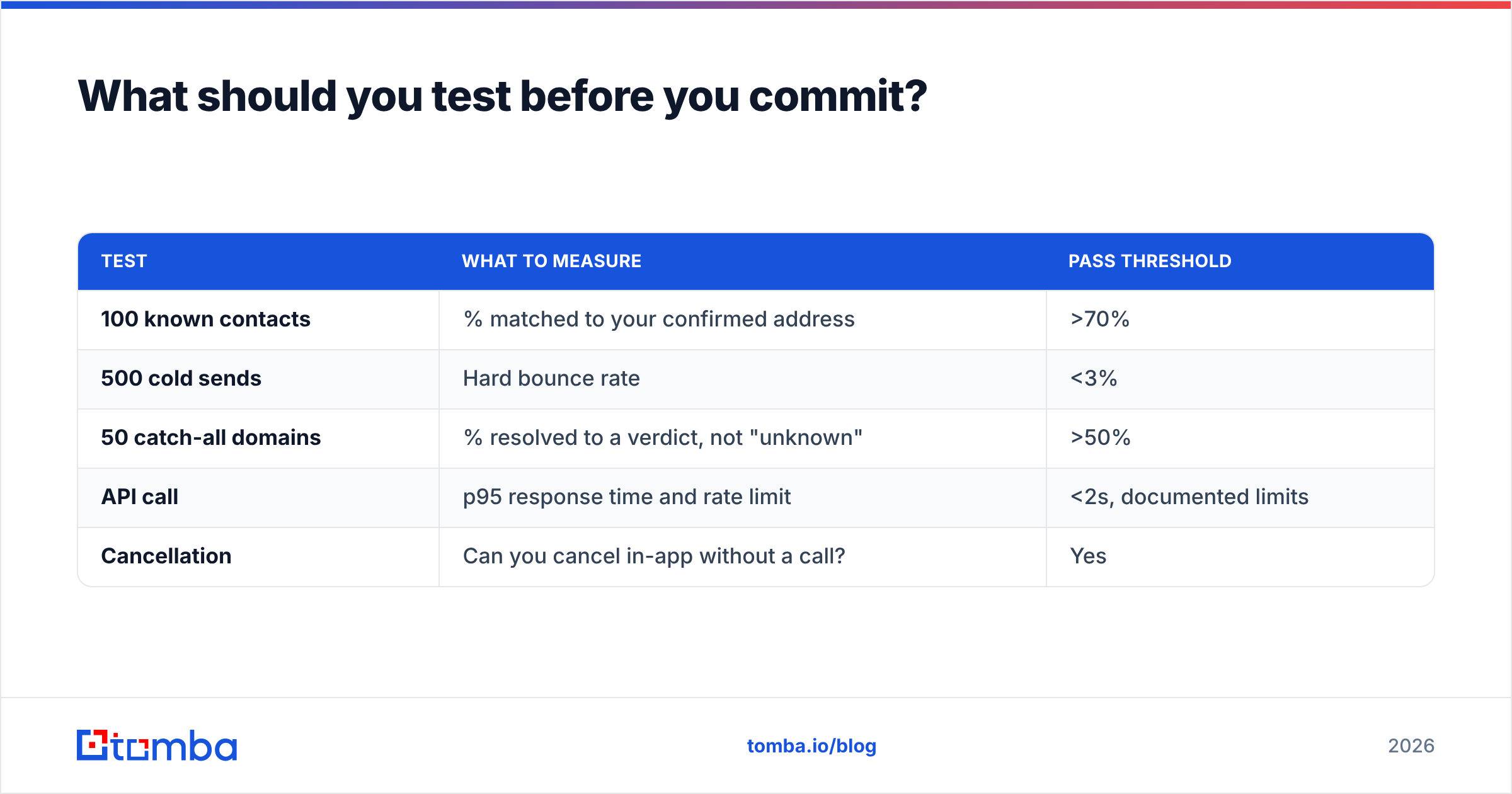
Give yourself a one-week evaluation with a fixed scorecard:
| Test | What to measure | Pass threshold |
|---|---|---|
| 100 known contacts | % matched to your confirmed address | >70% |
| 500 cold sends | Hard bounce rate | <3% |
| 50 catch-all domains | % resolved to a verdict, not "unknown" | >50% |
| API call | p95 response time and rate limit | <2s, documented limits |
| Cancellation | Can you cancel in-app without a call? | Yes |
That last row disqualifies more vendors than any data test. If canceling requires an email to an account manager, price the switching cost into your decision now.
The bottom line#
Finder.io vs VC-backed is a false binary for most buyers. Finder.io is a reasonable feature inside a reasonable bundle, and it is priced accordingly. VC-backed platforms buy genuine data depth and charge for it in ways that punish small teams. Neither is built for the buyer who needs a few thousand accurate, verified B2B emails a month without signing anything.
If that is you, start with the Tomba Email Finder. The free tier gives you 25 searches a month, enough to run the 100-contact test above against your own known-good data. No card, no call, no annual commitment. Verify the results, compare the bounce rate against whatever you use now, and let the numbers pick the winner instead of the pricing page.
Related guides#
Ready to find emails that actually work?
Join 150,000+ professionals who stopped guessing and started sending. Free credits on signup — no credit card required.
Get the Tomba newsletter
Practical outbound tactics and product updates — once every two weeks.
About the author