FindThatLead vs Apollo.io (2026): Which Tool Wins?
FindThatLead is a lean email finder with built-in sending. Apollo.io is a 275M-contact database with a full sales engagement layer. Here's which one actually fits your team — and where a cheaper third option beats both.
TL;DR
- FindThatLead is a lightweight email finder plus a basic cold-email sender. It suits solo founders and small agencies who want one cheap tool that finds and sends.
- Apollo.io is a full go-to-market platform: a ~275M-contact database, filters, sequences, dialer, and CRM sync. It suits SDR teams that need everything in one seat.
- Apollo's real cost is seat-based, not credit-based. Two SDRs on a paid tier will cost more than most teams estimate from the pricing page.
- FindThatLead's database is thinner than Apollo's, so enterprise and non-US coverage gets patchy fast.
- If you mainly need accurate emails and an API — not another inbox or CRM — a dedicated finder like Tomba Email Finder at $49/mo undercuts both on cost-per-verified-contact.
What is FindThatLead and who is it for?#
FindThatLead is a Spanish-built prospecting tool that has been around since 2015. Its core promise is simple: give it a domain, a name, or a LinkedIn URL, and it returns a business email. On top of that it bolts a "Scrab.in" LinkedIn automation add-on and a lightweight cold-email sender so you can run a campaign without buying a separate sending tool.
The product is deliberately narrow. You get:
- Domain search — enter a company domain, get the emails it has on file for that company.
- Lead search — filter by role, location, and industry to build a list.
- Email verifier — a validation pass to trim obvious bounces before sending.
- Prospector / social URL search — paste a LinkedIn profile and get an email guess.
- Built-in sender — schedule a basic sequence from a connected mailbox.
That bundle works well for one person running 200–500 emails a week. It stops working when you need firmographic depth, intent signals, or a dialer. FindThatLead never pretended to be a data platform, and you should not evaluate it as one. Check the official FindThatLead site for current plan names, since they reshuffle tiers periodically.
What is Apollo.io and who is it for?#
Apollo.io is the other end of the spectrum. It started as a contact database and turned into a full sales engagement suite. The pitch is that one login replaces ZoomInfo, Outreach, and a data-enrichment vendor.
What you actually get:
- A large contact database — Apollo markets roughly 275M contacts across 70M+ companies, with 65+ filter attributes.
- Sequences — multi-step email, call, and LinkedIn task cadences with A/B testing.
- A dialer — click-to-call with local presence and recording on higher tiers.
- Chrome extension — reveal contacts on LinkedIn and company sites.
- CRM sync — bidirectional with Salesforce and HubSpot on paid plans.
- Intent and scoring — buying-intent topics and AI lead scoring on upper tiers.
Apollo's model matters more than its feature list. You buy seats, and each seat carries credit allowances. Add SDRs and the bill scales linearly. That is fine when every seat is a quota-carrying rep. It is expensive when you have one operator running lists for a team of five.
FindThatLead vs Apollo.io: how do they compare head to head?#
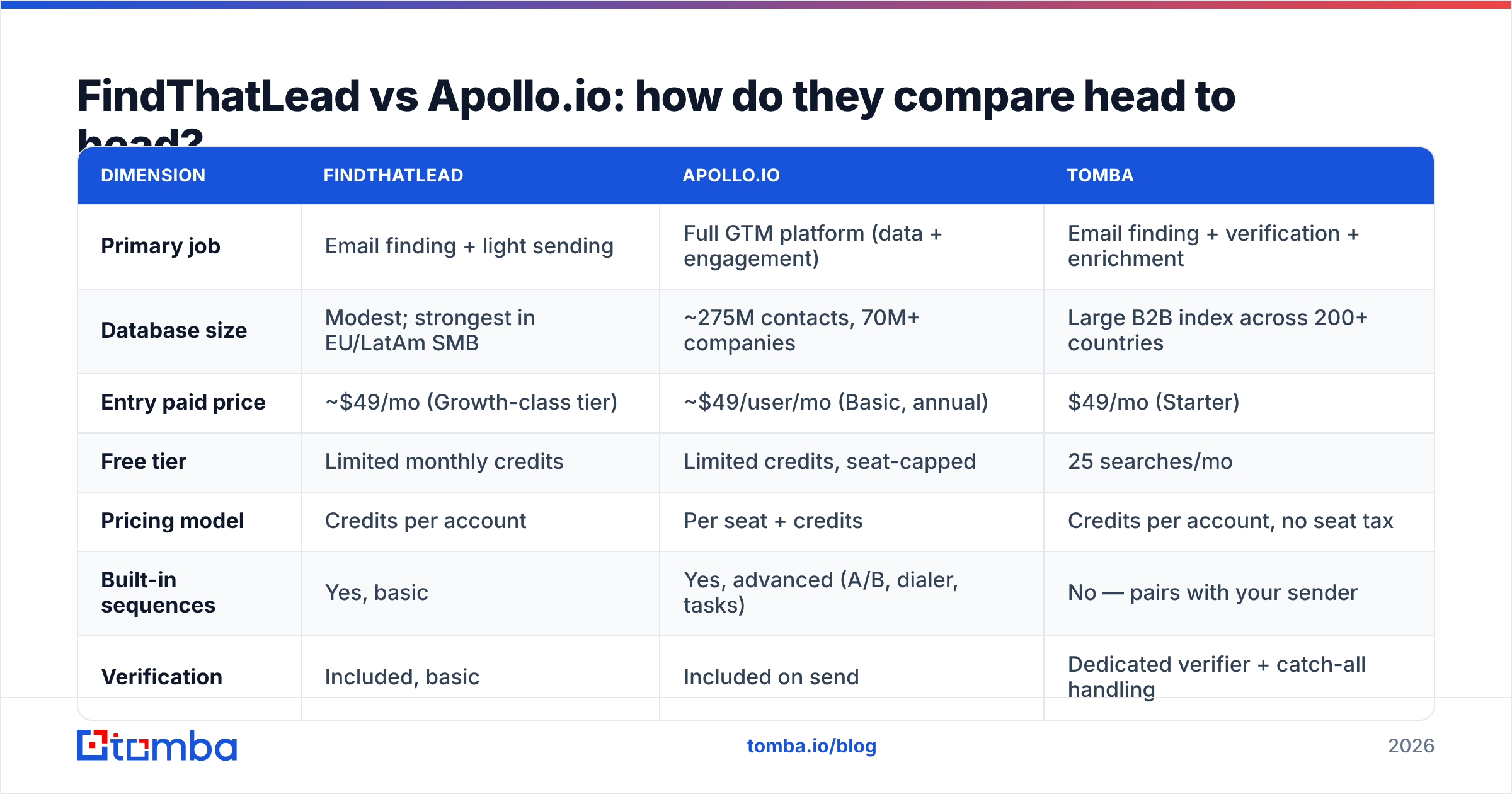
Here is the practical comparison. Treat pricing as directional — both vendors change tiers, and annual billing shifts the numbers meaningfully.
| Dimension | FindThatLead | Apollo.io | Tomba |
|---|---|---|---|
| Primary job | Email finding + light sending | Full GTM platform (data + engagement) | Email finding + verification + enrichment |
| Database size | Modest; strongest in EU/LatAm SMB | ~275M contacts, 70M+ companies | Large B2B index across 200+ countries |
| Entry paid price | ~$49/mo (Growth-class tier) | ~$49/user/mo (Basic, annual) | $49/mo (Starter) |
| Free tier | Limited monthly credits | Limited credits, seat-capped | 25 searches/mo |
| Pricing model | Credits per account | Per seat + credits | Credits per account, no seat tax |
| Built-in sequences | Yes, basic | Yes, advanced (A/B, dialer, tasks) | No — pairs with your sender |
| Verification | Included, basic | Included on send | Dedicated verifier + catch-all handling |
| API quality | Basic REST | Full REST API, higher tiers | Full REST API on all paid plans |
| CRM sync | Zapier / CSV mostly | Native Salesforce + HubSpot | Native HubSpot, Pipedrive, Salesforce, Zapier |
| Best for | Solo founders, small agencies | 3–20 rep SDR teams | Data-first teams, devs, agencies at scale |
The table exposes the real decision. You are not picking between two email finders. You are picking between a cheap all-in-one for one person and a per-seat platform for a team — with a third path where you buy data as a utility and keep your sending stack separate.
Which one has better data accuracy?#
Neither vendor publishes an independently audited accuracy figure, so ignore any blog that claims a precise percentage without a methodology. What you can evaluate is shape of coverage.
Apollo wins on breadth. With a database that size, you will almost always find a record for a mid-market or enterprise target. The catch is staleness: community-contributed and crawled data ages, and Apollo's own G2 reviews consistently mention outdated titles and job-changers. Verify before you send — do not trust a record just because the platform surfaced it.
FindThatLead wins on nothing structural, but it is competitive on specific segments — Spanish-speaking markets and European SMBs, where the bigger US-centric databases thin out. If your ICP is a 40-person agency in Madrid, FindThatLead may genuinely return a hit where Apollo returns nothing.
The failure mode both share: catch-all domains. When a company accepts every address at the MX level, an SMTP check cannot confirm a specific mailbox. Most tools either mark those "risky" and hand you the problem, or silently pass them as valid and inflate your bounce rate. This is where a dedicated catch-all verifier earns its keep — it applies pattern and reputation signals rather than shrugging.
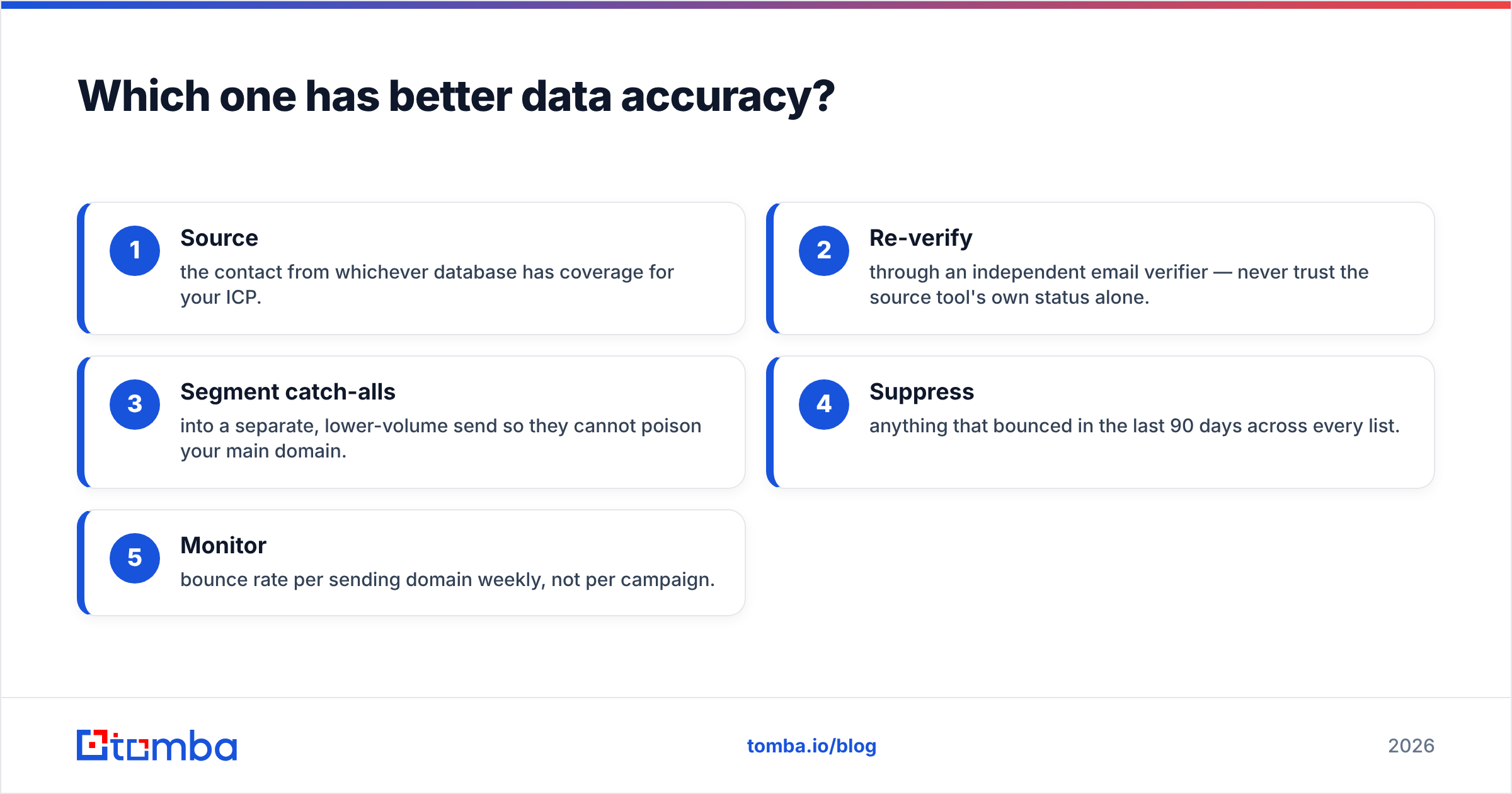
Practical workflow regardless of vendor:
- Source the contact from whichever database has coverage for your ICP.
- Re-verify through an independent email verifier — never trust the source tool's own status alone.
- Segment catch-alls into a separate, lower-volume send so they cannot poison your main domain.
- Suppress anything that bounced in the last 90 days across every list.
- Monitor bounce rate per sending domain weekly, not per campaign.
That fifth step is the one teams skip. A 4% bounce rate on one campaign is survivable; a 4% average across a domain for a month is a reputation problem.
What does each actually cost in practice?#
Run the arithmetic for a realistic team, not for one user on a trial.
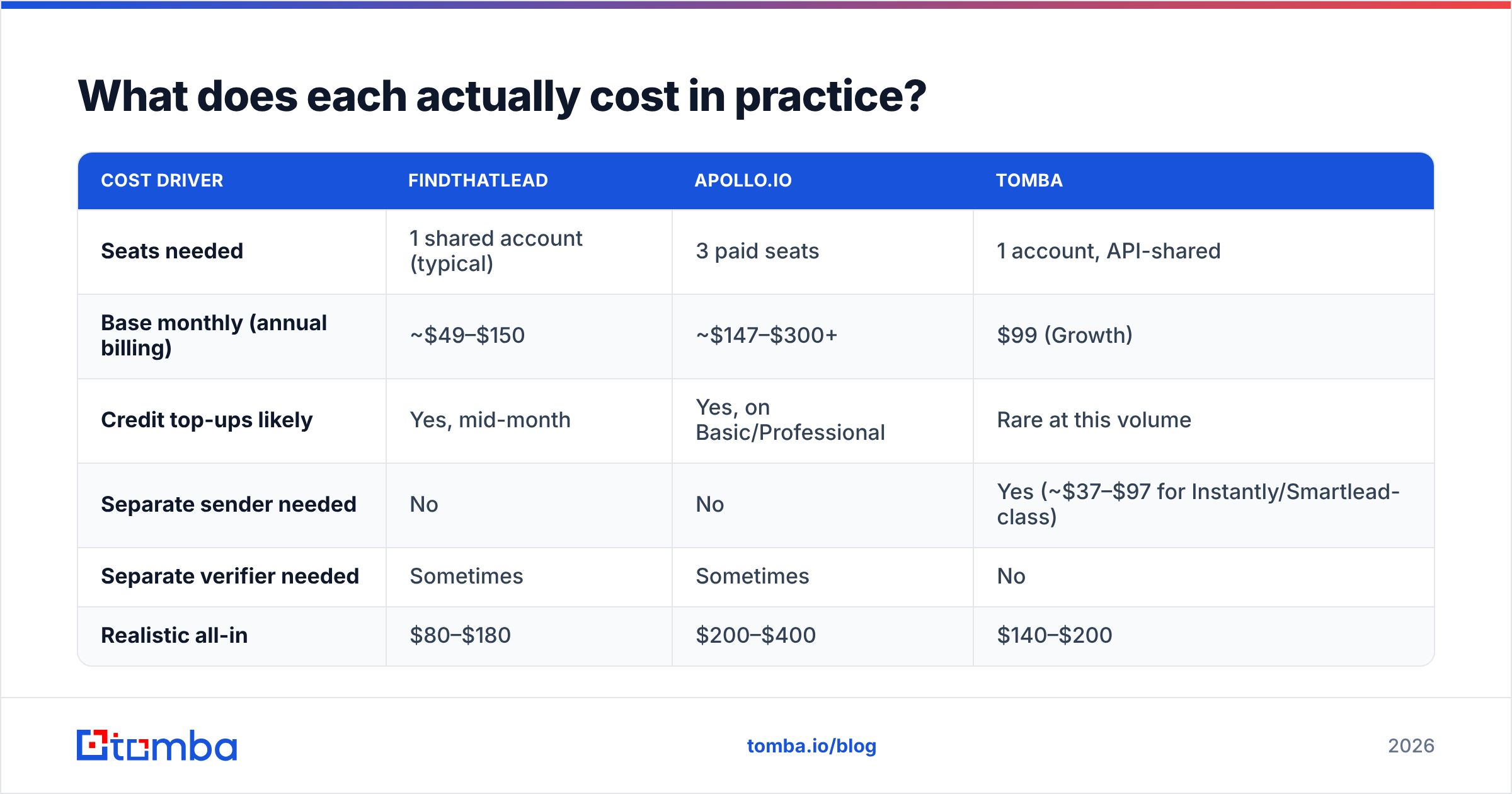
Scenario: 3 SDRs, 4,000 verified contacts per month.
| Cost driver | FindThatLead | Apollo.io | Tomba |
|---|---|---|---|
| Seats needed | 1 shared account (typical) | 3 paid seats | 1 account, API-shared |
| Base monthly (annual billing) | ~$49–$150 | ~$147–$300+ | $99 (Growth) |
| Credit top-ups likely | Yes, mid-month | Yes, on Basic/Professional | Rare at this volume |
| Separate sender needed | No | No | Yes (~$37–$97 for Instantly/Smartlead-class) |
| Separate verifier needed | Sometimes | Sometimes | No |
| Realistic all-in | $80–$180 | $200–$400 | $140–$200 |
Apollo is not badly priced for what it is — you are also buying sequences, a dialer, and CRM sync. But if your team already lives in HubSpot or Salesforce, and already pays for a sending tool, you are buying a second copy of both. That is the single most common source of Apollo bill-shock: overlap, not the sticker price.
FindThatLead's cost advantage is real but capped. Once you need 10,000+ contacts a month or non-trivial filtering, its credit tiers stop being cheap relative to the coverage you get.
There is a third pattern worth naming: buy data as infrastructure. You hit an email finder API from your own scripts or workflow tool, push results to your CRM, and send from whatever platform your team already knows. No seat tax, no second inbox, no duplicated sequence builder. See Tomba pricing for how the credit tiers map — Free at 25 searches/mo, Starter $49/mo, Growth $99/mo, Pro $249/mo.

Is Apollo.io worth it over FindThatLead for a small team?#
Short answer: only if you will use the engagement layer.
Apollo makes sense when at least three of these are true:
- You have 3+ reps who each need their own pipeline view and sending identity.
- You need a dialer and don't want a separate Aircall/Orum contract.
- Your ICP is US mid-market or enterprise, where Apollo's coverage is strongest.
- You want intent signals to prioritize accounts rather than blasting a static list.
- Your CRM sync must be native, not a Zapier hop that breaks silently.
Apollo is the wrong buy when you have one operator building lists for others, when your outbound is fewer than 1,000 contacts a month, or when your motion is inbound-led and you only need enrichment on form fills. In those cases you are paying platform prices for a lookup tool.
FindThatLead makes sense when:
- You are one or two people and want a single subscription.
- Your ICP skews European or Latin American SMB.
- You send modest volume and don't need branching sequences.
- You want to test outbound before committing to a platform contract.
FindThatLead is the wrong buy when you need enterprise coverage, reliable API throughput, or firmographic filtering beyond the basics.
If you are evaluating Apollo specifically because of the database and not the sequencer, look at an Apollo alternative built around data delivery. Buying a GTM platform to solve a data problem is how tool sprawl starts. Third-party review sites like G2 are useful here for reading the complaints rather than the ratings — patterns in one-star reviews tell you more than an aggregate score.
What are the honest downsides of each?#
FindThatLead's weak points:
- Coverage gaps on larger companies and technical roles. You will run "no result" on targets Apollo finds instantly.
- Basic sequencing. Fine for a linear 3-touch follow-up; not fine for conditional branching or reply-based routing.
- Deliverability tooling is thin. No meaningful warmup, limited inbox rotation, minimal reputation monitoring.
- API is functional but not built for volume. If you plan to enrich 50k records, look elsewhere.
Apollo.io's weak points:
- Seat economics punish shared use. Data-ops people who just build lists still consume a full seat.
- Data freshness varies wildly by segment. Job-changers and title drift are the most-cited complaint.
- Credit exports have limits that surprise teams mid-quarter, especially on Basic.
- Sending from Apollo ties your reputation to their infrastructure choices. Some teams prefer to keep sending independent for exactly this reason.
- Feature depth ≠ feature quality. The dialer, the CRM, and the sequencer are each adequate rather than best-in-class. If you already own a best-in-class version of any of them, Apollo's bundle value shrinks.
Neither is a bad product. Both are frequently bought for the wrong reason: FindThatLead by teams who will outgrow it in two quarters, Apollo by teams who only ever use 20% of it.
How should you actually decide?#
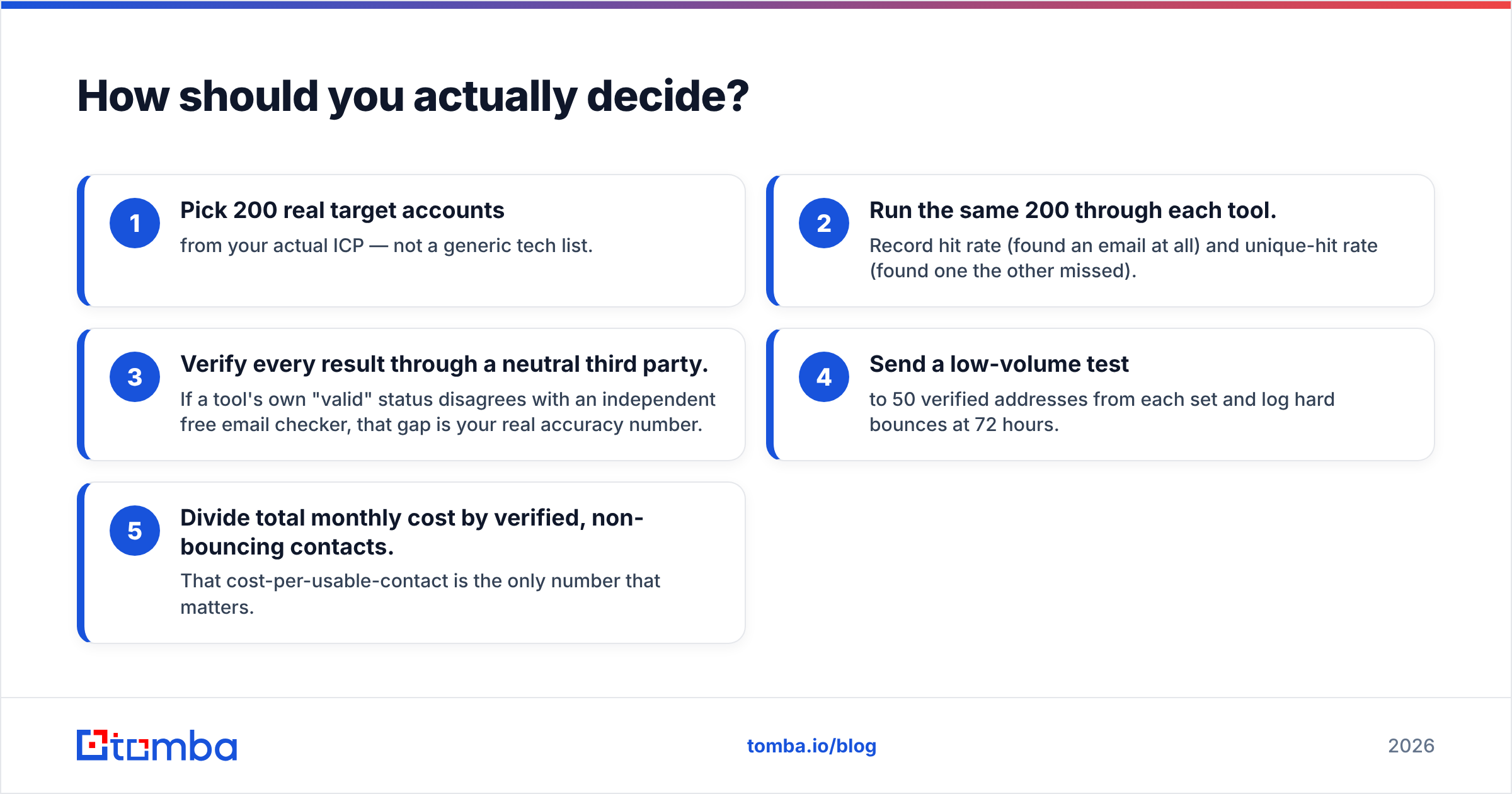
Run a 200-contact bake-off before you sign anything. It takes an afternoon and beats every comparison post, including this one.
- Pick 200 real target accounts from your actual ICP — not a generic tech list.
- Run the same 200 through each tool. Record hit rate (found an email at all) and unique-hit rate (found one the other missed).
- Verify every result through a neutral third party. If a tool's own "valid" status disagrees with an independent free email checker, that gap is your real accuracy number.
- Send a low-volume test to 50 verified addresses from each set and log hard bounces at 72 hours.
- Divide total monthly cost by verified, non-bouncing contacts. That cost-per-usable-contact is the only number that matters.
Teams that run this test are usually surprised twice: Apollo's raw hit rate is higher than expected, and its verified hit rate is closer to the cheaper tools than the pricing gap suggests. Meanwhile the winner on cost-per-usable-contact is often neither of the two you were comparing.
Also decide the architecture question before the vendor question. Do you want one platform that owns data, sending, and pipeline — accepting lock-in and seat costs — or composable pieces where data, sending, and CRM are independently swappable? Apollo is the first answer. FindThatLead is a small version of the first answer. A dedicated finder plus your existing sender is the second.
Peers worth including in your bake-off, depending on angle: BookYourData if you want pay-as-you-go verified B2B lists without a subscription commitment, and any provider whose data sources are documented rather than hand-waved.
Where does Tomba fit in this comparison?#
Tomba is not trying to be Apollo. There is no dialer, no CRM, no sequence builder — and that is the point.
What you get is the data layer done properly: find email addresses by domain, name, or company; verify them including catch-all domains; enrich leads with firmographics; pull B2B phone numbers; and do all of it through an API, CLI, Chrome extension, Google Sheets add-on, or bulk upload. No per-seat pricing, so your ops person and your five reps draw from the same credit pool.
For a team already committed to a sending tool and a CRM, that is usually the cheaper and more durable architecture. For a team that genuinely wants one login for everything, Apollo remains the more complete product — just go in knowing what the seats will cost at headcount +3.
Start with the data layer. Run your next 200 prospects through the Tomba Email Finder — the free tier gives you 25 searches a month with no card, and Starter is $49/mo when you're ready to scale. Compare the verified hit rate against whatever you're paying for today, then decide whether you need a platform or just better data.
Related guides#
Ready to find emails that actually work?
Join 150,000+ professionals who stopped guessing and started sending. Free credits on signup — no credit card required.
Get the Tomba newsletter
Practical outbound tactics and product updates — once every two weeks.
About the author