FindThatLead vs MailRushio: Which B2B Tool Wins in 2026?
FindThatLead finds and verifies B2B emails; MailRush.io sends them at scale over your own SMTP. Here is where each one actually earns its price, and where a dedicated finder beats both.
FindThatLead vs MailRushio is the wrong fight, and that is the short answer. One tool finds B2B emails. The other sends them. This guide covers what each one does well, what each costs in 2026, and how to choose.
TL;DR
- FindThatLead and MailRush.io are not really competitors. FindThatLead is a prospecting and email-finding tool; MailRush.io is a cold-email sending platform built around your own SMTP.
- If you need contact data, FindThatLead wins by default — MailRush.io does not find emails for you.
- If you need volume sending with deliverability control, MailRush.io wins — FindThatLead's sender is a lightweight add-on, not an infrastructure product.
- Most teams that buy one end up buying both, which is why a cleaner split is a dedicated finder (Tomba, Findymail, Hunter) plus a dedicated sender.
- Budget check: FindThatLead starts around $49/mo for 5,000 credits; MailRush.io starts around $29/mo for sending volume, before you pay for SMTP or a data source.
FindThatLead vs MailRushio: What Each Tool Actually Does#
FindThatLead is a Spanish-built B2B prospecting suite. You give it a domain, a name, or a LinkedIn URL, and it returns a business email address. It bundles a Chrome extension and a domain-level "Prospector" search. You can filter that search by industry, location, and job title. It also adds an email verifier and a basic drip-campaign sender.
MailRush.io is a cold-email sending platform. You connect your own SMTP accounts, or buy their managed SMTP. From there it handles sequencing, throttling, warm-up-style ramp schedules, reply detection, and deliverability reporting. It does not build lists. You import a CSV.
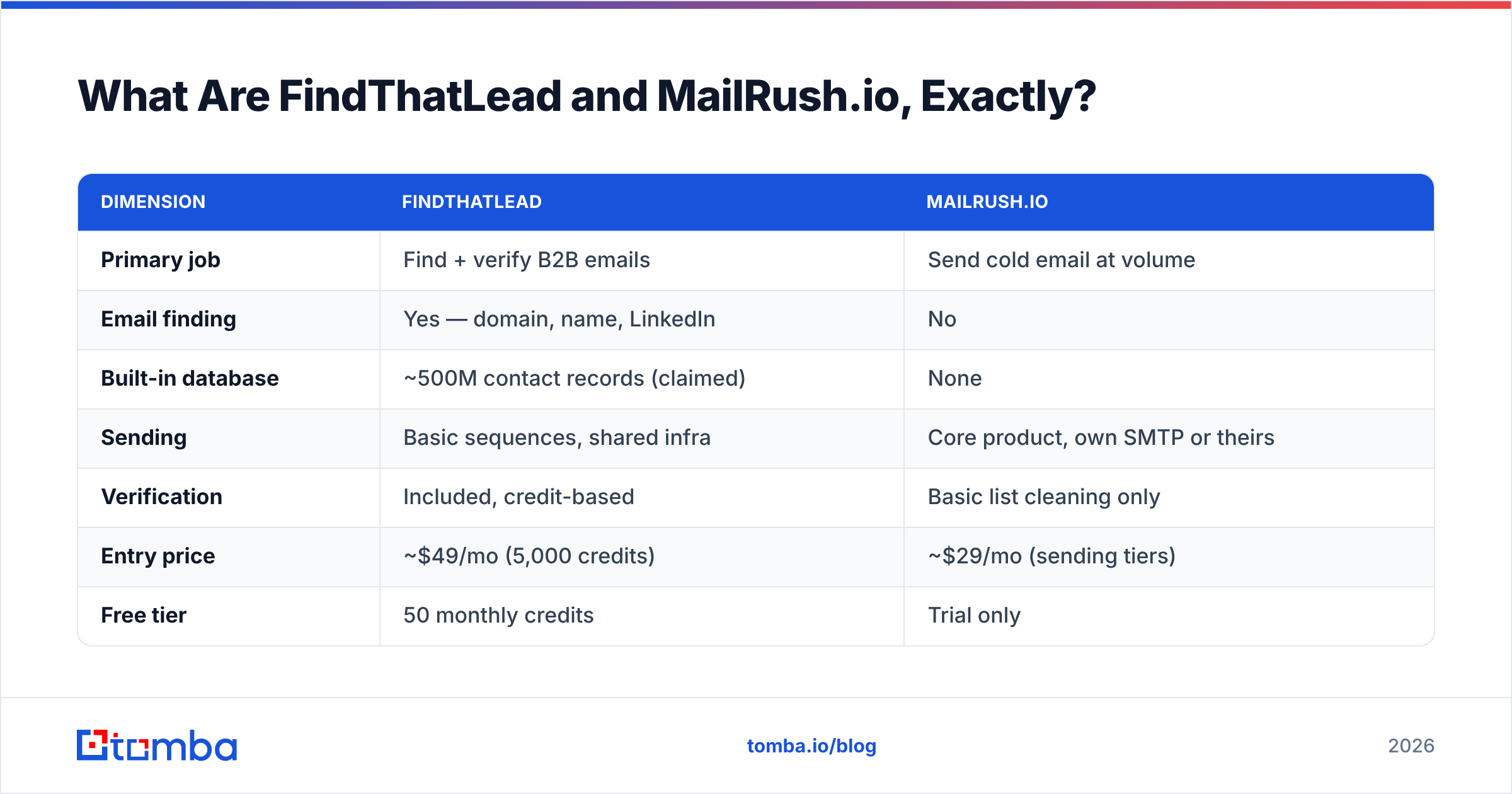
That single distinction drives every other difference. One tool answers who do I email. The other answers how do I get the email into the inbox.
| Dimension | FindThatLead | MailRush.io |
|---|---|---|
| Primary job | Find + verify B2B emails | Send cold email at volume |
| Email finding | Yes — domain, name, LinkedIn | No |
| Built-in database | ~500M contact records (claimed) | None |
| Sending | Basic sequences, shared infra | Core product, own SMTP or theirs |
| Verification | Included, credit-based | Basic list cleaning only |
| Entry price | ~$49/mo (5,000 credits) | ~$29/mo (sending tiers) |
| Free tier | 50 monthly credits | Trial only |
| API | Yes, credit-metered | Yes, sending-focused |
| Best for | Solo founders, small agencies | High-volume outbound teams |
Which One Finds Better Emails?#
FindThatLead, because MailRush.io doesn't compete here at all. The more useful question is: how good is FindThatLead's data compared to the category?
In practice, FindThatLead's hit rate on mid-market SaaS domains lands in the 55-70% range. Its confidence scoring is coarse. You get a green/amber/red style signal, not a granular score with the SMTP evidence behind it. That matters, because a "valid" flag from a finder that skipped the mailbox-level check is not the same as a verified address.
Three failure modes show up repeatedly with any credit-based finder:
- Catch-all domains burn credits. If a domain accepts everything, most finders return a guess and charge you for it. You need a real catch-all verifier to separate a plausible pattern from a deliverable mailbox.
- Stale records on job-hoppers. Sales and marketing titles churn fastest. A record cached 18 months ago is a bounce waiting to happen.
- Pattern guessing dressed up as data.
first.last@domain.comis a coin flip on companies that useflast@or a nickname convention. Check the real company email pattern before you trust a permutation.

If accuracy is the deciding factor, test on your own ICP instead of trusting a marketing page. Pull 100 target domains where you already know the correct contacts. Run them through each candidate's email finder. Then measure two things: coverage (what percent returned anything) and precision (what percent actually delivered). Tools that score well on one and badly on the other are common, and vendors quote whichever number flatters them.
Which One Sends Better?#
MailRush.io, by a wide margin. Its whole architecture assumes you care about email deliverability rather than just clicking send.
The key design decision is BYO-SMTP. FindThatLead's sender routes through shared infrastructure you don't control. That means your sender reputation is partly hostage to whoever else is on that pool. MailRush.io lets you attach your own Google Workspace, Microsoft 365, or dedicated SMTP accounts. It then rotates across them with per-account daily caps and randomized send intervals.
What you get with MailRush.io that FindThatLead doesn't offer:
- Per-account throttling and ramp schedules — start a fresh domain at 20/day, climb to 50 over three weeks.
- Reply and bounce classification — auto-pause a sequence on human reply, not on an autoresponder.
- Inbox rotation across unlimited connected accounts — spread 1,000 daily sends across 20 mailboxes instead of frying one.
- Deliverability diagnostics — SPF, DKIM, DMARC checks surfaced in-app before you launch.
- Unsubscribe and suppression handling at the account level, not per-campaign.
That last group is table stakes for anyone sending more than a few hundred emails a week. Before you send anything from a new domain, run an SPF checker and confirm your authentication chain is clean. Most "MailRush.io isn't delivering" complaints trace back to a missing DKIM record, not the platform.
What Do They Actually Cost in 2026?#
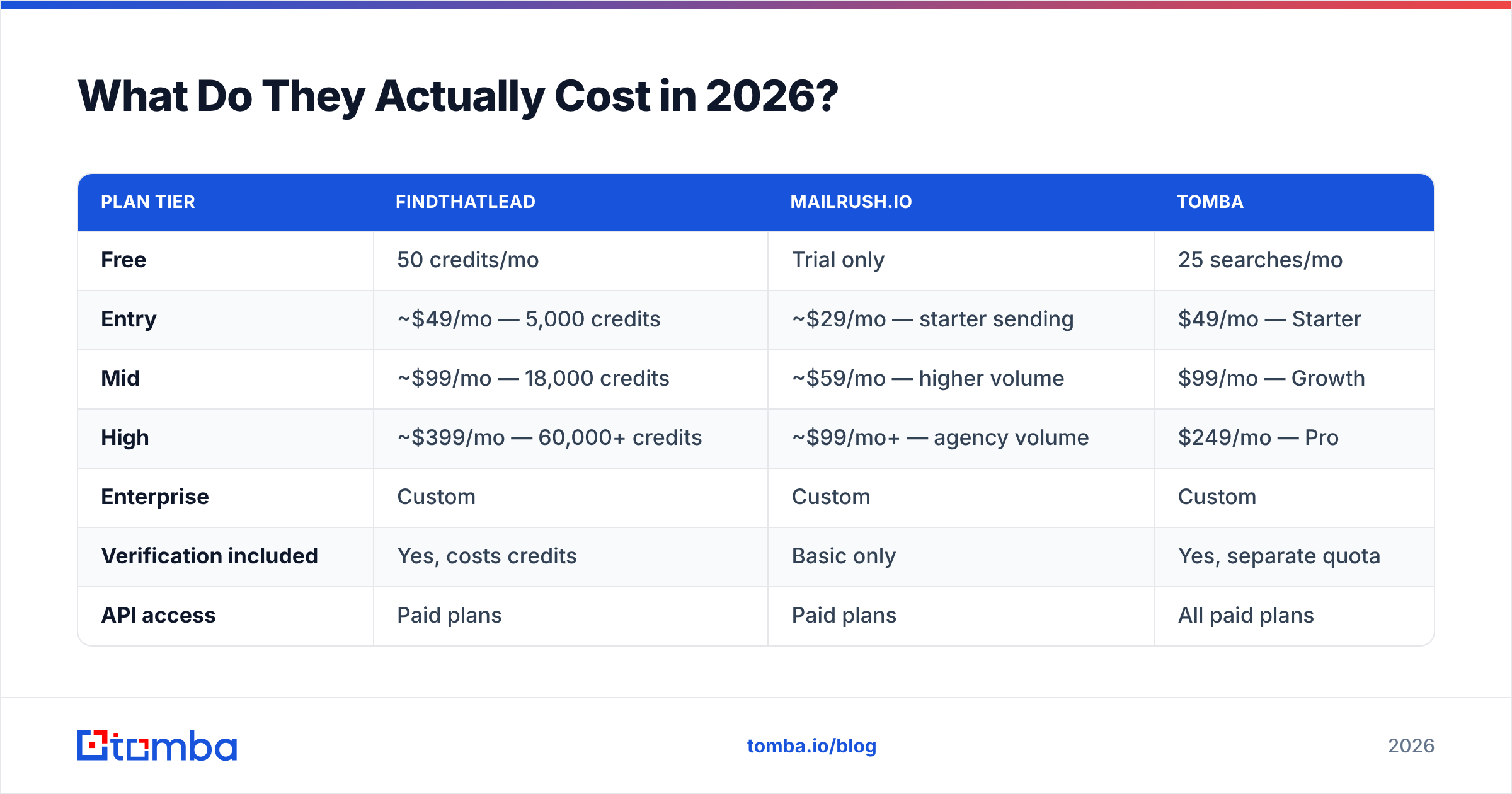
Here is where the "which is cheaper" question falls apart, because the two tools meter completely different units. FindThatLead sells credits (one lookup or verification). MailRush.io sells sending volume and connected accounts.
| Plan tier | FindThatLead | MailRush.io | Tomba |
|---|---|---|---|
| Free | 50 credits/mo | Trial only | 25 searches/mo |
| Entry | ~$49/mo — 5,000 credits | ~$29/mo — starter sending | $49/mo — Starter |
| Mid | ~$99/mo — 18,000 credits | ~$59/mo — higher volume | $99/mo — Growth |
| High | ~$399/mo — 60,000+ credits | ~$99/mo+ — agency volume | $249/mo — Pro |
| Enterprise | Custom | Custom | Custom |
| Verification included | Yes, costs credits | Basic only | Yes, separate quota |
| API access | Paid plans | Paid plans | All paid plans |
| Overage model | Buy credit packs | Upgrade tier | Buy credit packs |
Vendor pricing moves; check the live pages before you commit. The structural point holds regardless. Buy FindThatLead at $49 and MailRush.io at $29, and you're at $78/mo for a stack that still lacks a serious verification layer. Compare that to a dedicated finder plus a sender you may already own. Many teams already pay for Instantly, Smartlead, or Lemlist. In that case MailRush.io is redundant, and only the data gap is real. Current Tomba pricing starts at $49/mo for Starter with verification bundled, which is the more honest apples-to-apples line against FindThatLead.
Watch two hidden costs. First, credit burn on failed lookups. Some finders charge for a "not found" result and some don't, and the gap is 15-30% of your effective cost. Second, SMTP itself. If you don't already have warmed mailboxes, budget $6-12 per Google Workspace seat plus a secondary domain. Then give it three weeks before it's usable.
Is There a Better Split Than Buying Both?#
Usually, yes. The pattern that holds up across most outbound teams is: one tool for data, one tool for sending, and never let one vendor do both badly.
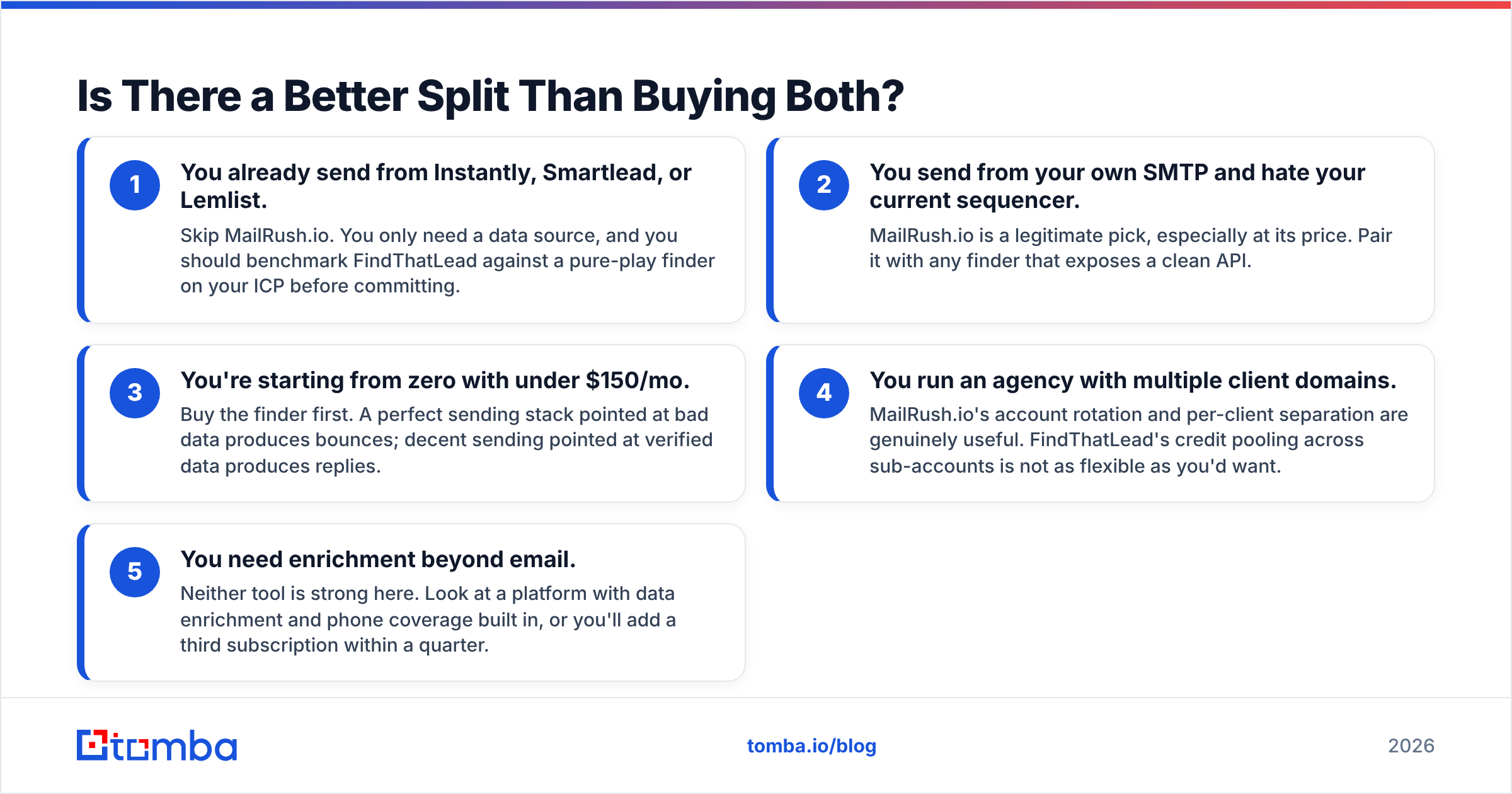
FindThatLead's sender is the weak half of the product. MailRush.io has no data half at all. So the real decision tree looks like this:
- You already send from Instantly, Smartlead, or Lemlist. Skip MailRush.io. You only need a data source, and you should benchmark FindThatLead against a pure-play finder on your ICP before committing.
- You send from your own SMTP and hate your current sequencer. MailRush.io is a legitimate pick, especially at its price. Pair it with any finder that exposes a clean API.
- You're starting from zero with under $150/mo. Buy the finder first. A perfect sending stack pointed at bad data produces bounces; decent sending pointed at verified data produces replies.
- You run an agency with multiple client domains. MailRush.io's account rotation and per-client separation are genuinely useful. FindThatLead's credit pooling across sub-accounts is not as flexible as you'd want.
- You need enrichment beyond email. Neither tool is strong here. Look at a platform with data enrichment and phone coverage built in, or you'll add a third subscription within a quarter.
Peers worth putting on the shortlist alongside these two: Hunter for straightforward domain search, Findymail for waterfall-style enrichment, and BookYourData for pay-as-you-go verified B2B lists when you'd rather buy a clean list outright than run lookups yourself. Each solves a slightly different shape of the same problem. G2's sales intelligence category is a reasonable place to check current user sentiment before you trial anything.
How Should You Run the Trial?#
Don't evaluate on feature lists. Run a controlled bake-off on a 200-row sample of your real target list.
Step 1 — build the control set. Pick 200 companies in your ICP. Get the correct contact for 30 of them manually (LinkedIn, company about pages, conference speaker lists). That's your ground truth.
Step 2 — measure the finder. Run all 200 through each candidate. Record: total returned, matches against your 30 known-good records, and credits consumed. Then push every returned address through an independent email verifier — not the finder's own verdict — and record the deliverable rate.
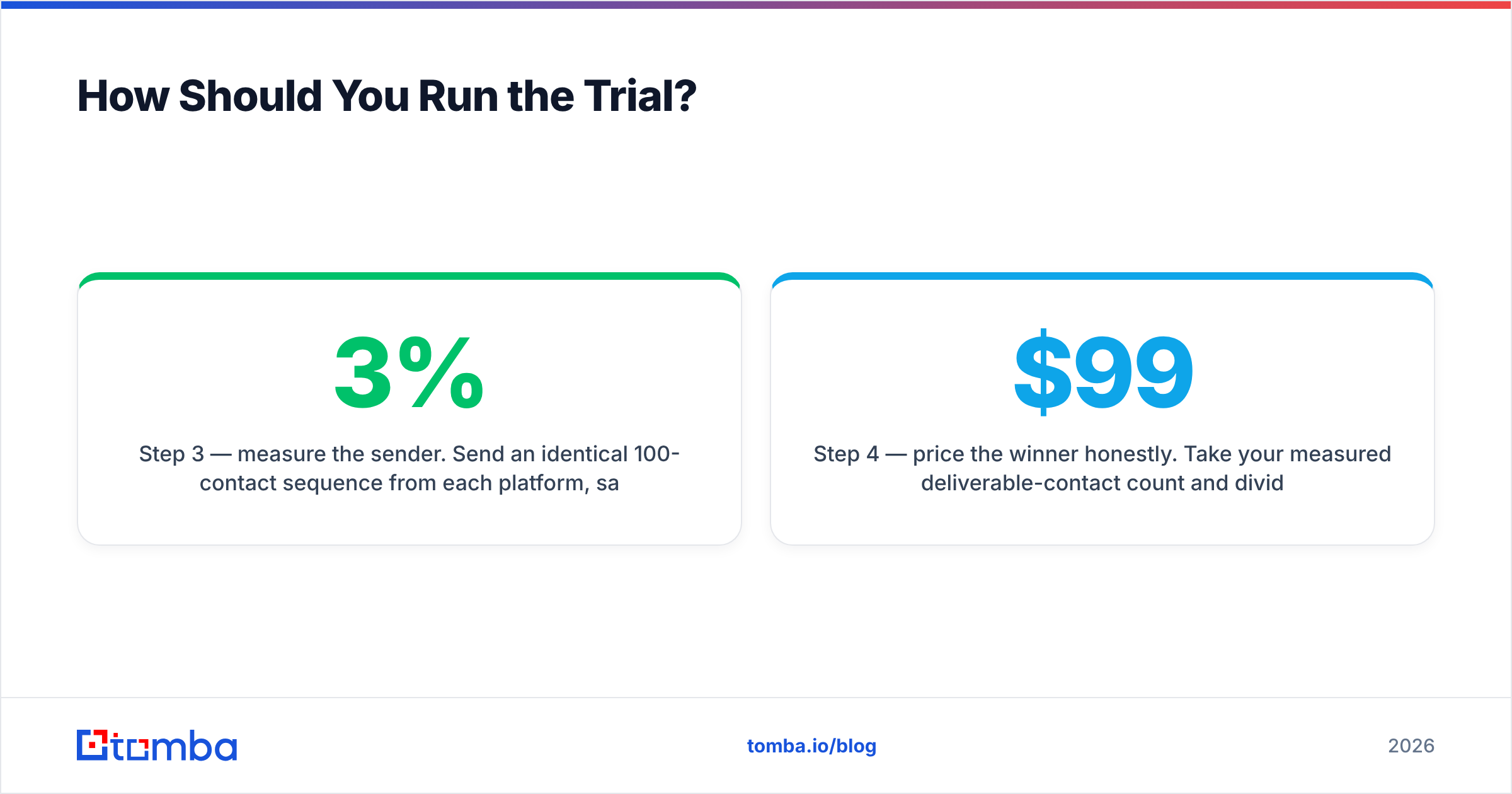
Step 3 — measure the sender. Send an identical 100-contact sequence from each platform, same copy, same domain, same time of day. Track inbox placement using seed accounts across Gmail, Outlook, and one corporate domain. Watch bounce rate in the first hour; a spike above 3% means your data layer failed, not your sending layer.
Step 4 — price the winner honestly. Take your measured deliverable-contact count and divide by monthly cost. A tool at $99 that returns 4,000 verified contacts beats a tool at $49 that returns 1,200. Cost per usable record is the only number that matters.
Most trials fail because people test on a list they can't grade. If you don't know the right answer for at least a subset, you're grading vibes.
What About Compliance and Data Sourcing?#
Both tools put the compliance burden on you, which is standard but worth stating plainly.
FindThatLead sources from public web crawling and user contributions, and offers GDPR-oriented data handling on request. MailRush.io processes whatever you upload; it isn't a data controller for your list. Under GDPR, B2B cold email in the EU usually relies on legitimate interest. That means a documented assessment, a working opt-out in every message, and deletion on request. CAN-SPAM in the US is lighter: accurate headers, a physical address, and honored unsubscribes.
The practical risk isn't a regulator knocking. It's the reputation damage from mailing stale, unverified records. Spam-trap hits from recycled addresses will tank a domain faster than any legal letter. That's another argument for verifying at send time rather than trusting a cached record. Check where a vendor's data sources come from before you sign, and treat "500M contacts" as a marketing number until you've measured coverage on your own segment.
The Verdict#
Buy FindThatLead if your bottleneck is finding contacts, you send modest volume, and you want one bill instead of two. Its sender is adequate for under 500 emails a week.
Buy MailRush.io if your bottleneck is deliverability, you already have a data source, and you want SMTP-level control at a price well below Outreach or Salesloft.
Buy neither if you're solving the data problem seriously. FindThatLead's accuracy is mid-pack and its verification is coarse, so you'll add a verifier anyway. At that point you're running three tools to do what a proper finder-plus-verifier handles in one.
That's the honest read on FindThatLead vs MailRushio. Neither tool is bad. They're just built for different halves of the same workflow, and the marketing on both sites blurs the line more than the products do.
If your real gap is contact data — not sending — start with the Tomba Email Finder. The free tier gives you 25 searches a month to test against your control list. Starter runs $49/mo with verification, domain search, and API access included. The same credits work across bulk lookups, catch-all verification, and enrichment. Run it against your 30 known-good records before you renew anything else, and let the deliverable rate decide.
Related guides#
Ready to find emails that actually work?
Join 150,000+ professionals who stopped guessing and started sending. Free credits on signup — no credit card required.
Get the Tomba newsletter
Practical outbound tactics and product updates — once every two weeks.
About the author