FindThatLead vs Pubrio: Which Email Finder Wins in 2026?
FindThatLead and Pubrio both promise verified B2B emails at a low monthly price. We compared credits, accuracy, enrichment depth, and API access to show which one actually fits your outbound motion.
TL;DR
- FindThatLead is the older, prospecting-first tool: domain search, a Chrome extension, and a built-in cold email sender bundled into one seat. Best if you want lead sourcing and sending under one login.
- Pubrio is the newer, AI-flavored GTM platform: contact database, intent-ish signals, and enrichment workflows aimed at teams that want a lightweight Apollo substitute.
- On raw email accuracy, neither publishes an audited bounce rate. Both lean on pattern inference plus SMTP checks, and both charge you for results they cannot confirm.
- Credits are the real price. FindThatLead burns credits on searches; Pubrio burns them on exports and enrichment. Compare cost-per-verified-email, not cost-per-credit.
- If you need a finder that separates confident results from guesses and exposes it all through a clean API, a dedicated tool like the Tomba Email Finder is the cheaper spine to build on.
What are FindThatLead and Pubrio?#
Different answers to the same question: "where do I get contact data for outbound?"
FindThatLead launched out of Barcelona and has been around long enough to be a known quantity in the SMB prospecting world. Its pitch is end-to-end: search a domain, pull the contacts, and push them into a cold email campaign without leaving the product. Prospector lets you filter by role, location, and industry; Scrab.in handles LinkedIn-side automation; the sender handles sequences.
Pubrio is newer and positions itself as an AI GTM platform rather than a lookup tool. You get a searchable B2B contact and company database, enrichment, and workflow features that nod toward buying signals and lookalike audiences. The framing is "replace three tools with one," which is the same framing Apollo, Clay, and a dozen others use.
The practical difference: FindThatLead sells you the motion (find and send). Pubrio sells you the dataset (find and enrich). Neither is primarily an accuracy company, and that matters more than either marketing page admits.

How do FindThatLead and Pubrio compare on features and pricing?#
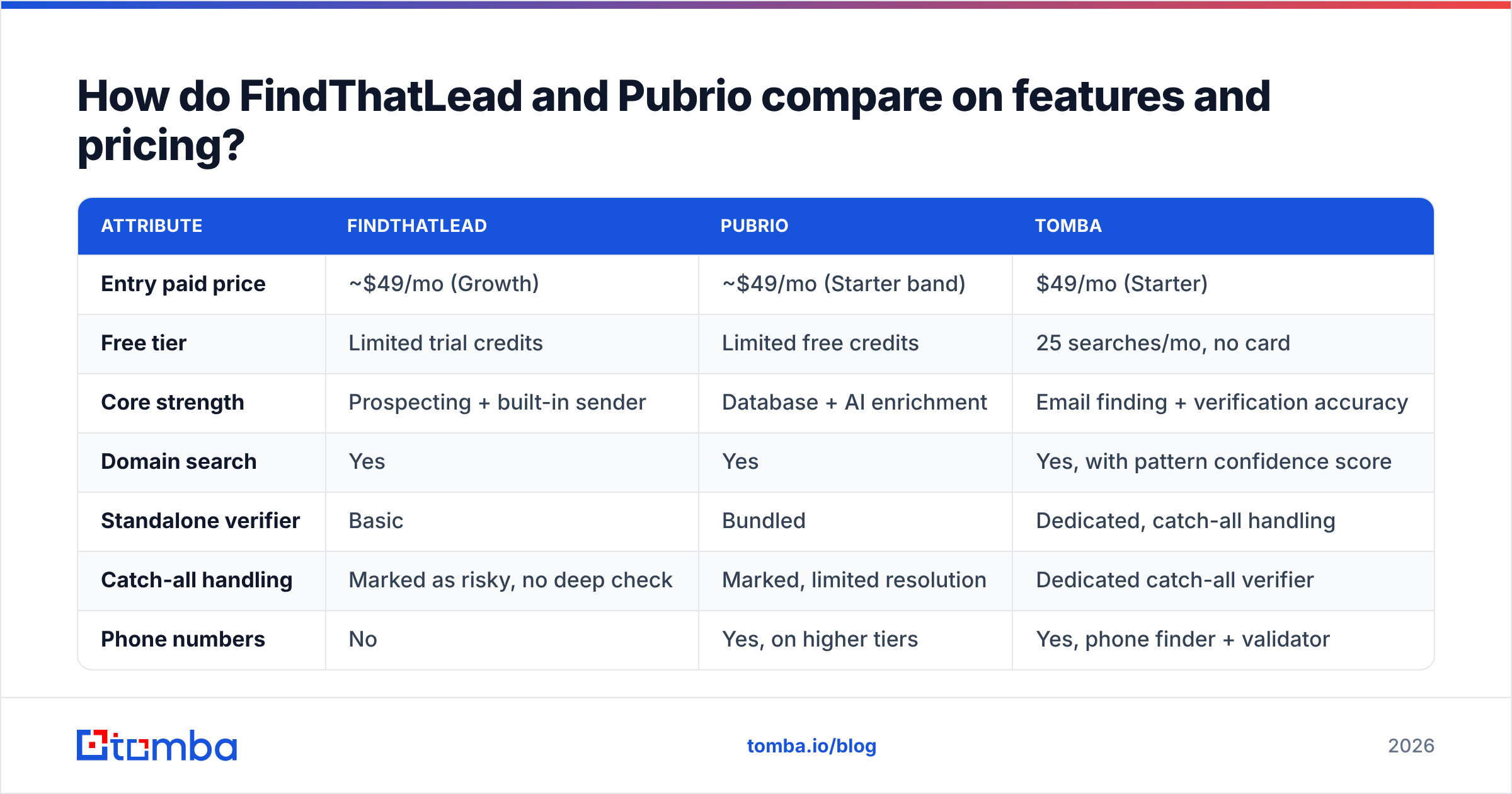
Here is the head-to-head on the attributes that actually change your cost per meeting. Prices reflect publicly listed entry tiers as of early 2026 and move around — check both vendors before you buy.
| Attribute | FindThatLead | Pubrio | Tomba |
|---|---|---|---|
| Entry paid price | ~$49/mo (Growth) | ~$49/mo (Starter band) | $49/mo (Starter) |
| Free tier | Limited trial credits | Limited free credits | 25 searches/mo, no card |
| Core strength | Prospecting + built-in sender | Database + AI enrichment | Email finding + verification accuracy |
| Domain search | Yes | Yes | Yes, with pattern confidence score |
| Standalone verifier | Basic | Bundled | Dedicated, catch-all handling |
| Catch-all handling | Marked as risky, no deep check | Marked, limited resolution | Dedicated catch-all verifier |
| Phone numbers | No | Yes, on higher tiers | Yes, phone finder + validator |
| API access | Yes, limited endpoints | Yes, tier-gated | Full REST API on all paid plans |
| Chrome extension | Yes | Yes | Yes |
| Built-in email sending | Yes | Partial / integrations | No — integrates with your sender |
| Bulk processing | Yes, CSV | Yes, CSV | Bulk finder + bulk verify |
| Best for | Solo founders and small agencies | Small GTM teams wanting one dashboard | Teams that need clean data feeding an existing stack |
Read that table with one question in mind: are you buying a workflow or a data source? If you already run Instantly, Smartlead, or Salesloft, FindThatLead's sender is dead weight you still pay for. If you already have a CRM and an enrichment layer, Pubrio's database duplicates what you own.
Which one finds more valid emails?#
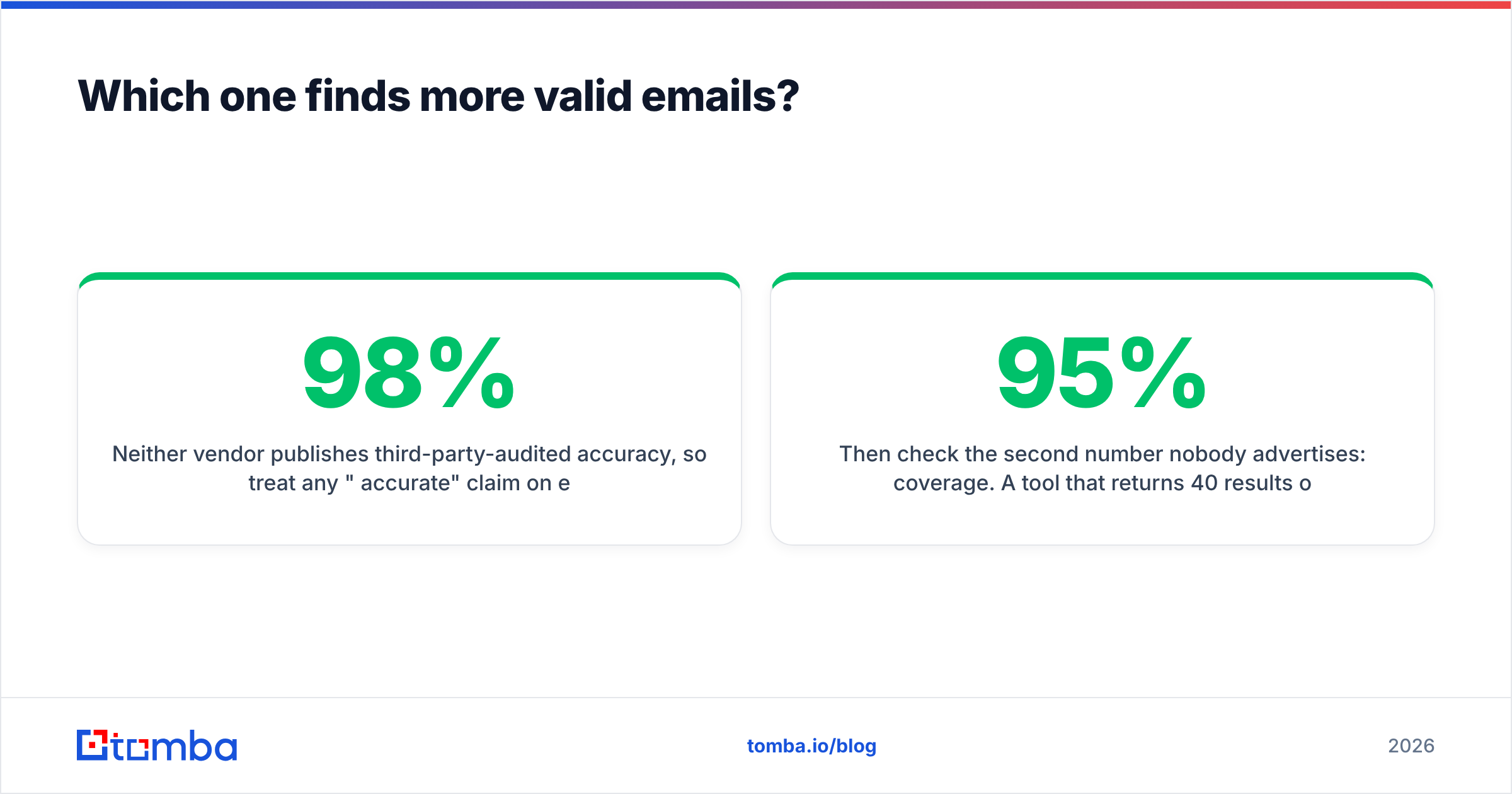
Neither vendor publishes third-party-audited accuracy, so treat any "98% accurate" claim on either site as marketing until you test it.
What you can evaluate is method. Email finders sit on a spectrum:
- Pure pattern guessing — infer
first.last@domain.comfrom a known company format, ship it, hope. Cheapest, highest bounce risk. - Pattern plus SMTP ping — generate candidates, then knock on the mail server to see which one answers. Better, but breaks on catch-all domains that answer yes to everything.
- Sourced records plus verification — the address was actually observed somewhere public, then re-verified at query time. Highest confidence, highest cost per record.
- Confidence-scored output — the tool tells you which bucket a result came from so you can route low-confidence contacts to a separate, slower warmup track.
FindThatLead and Pubrio both operate mostly in buckets 1–3 without exposing much of bucket 4 to you. You get a result and a vague status. That's the expensive part: an unverified "valid" that bounces costs you far more than the credit — it costs sender reputation, which takes weeks to rebuild.

The honest test is one you run yourself. Take 200 contacts you already have confirmed addresses for — past customers, webinar registrants, anyone in your CRM with a reply history. Strip the emails, feed name + domain into each tool, and score the returns against truth. Two hundred rows takes an hour and tells you more than every review site combined.
Then check the second number nobody advertises: coverage. A tool that returns 40 results out of 200 with 95% accuracy is worse for pipeline than one returning 150 at 88%, because you can verify the 150 and discard the bad ones. Score both dimensions or you'll optimize the wrong one.
How do the credit models actually price out?#
This is where head-to-head comparisons usually go wrong, because a "credit" means different things in each product.
- FindThatLead charges credits per search action. A domain search that returns twelve contacts can consume credits differently than twelve individual lookups, and Prospector list-building draws from the same pool as the sender's enrichment.
- Pubrio leans toward export-based consumption: browsing the database is cheap, revealing and exporting is what bills. Enrichment fields — phone, tech stack, firmographics — often draw extra.
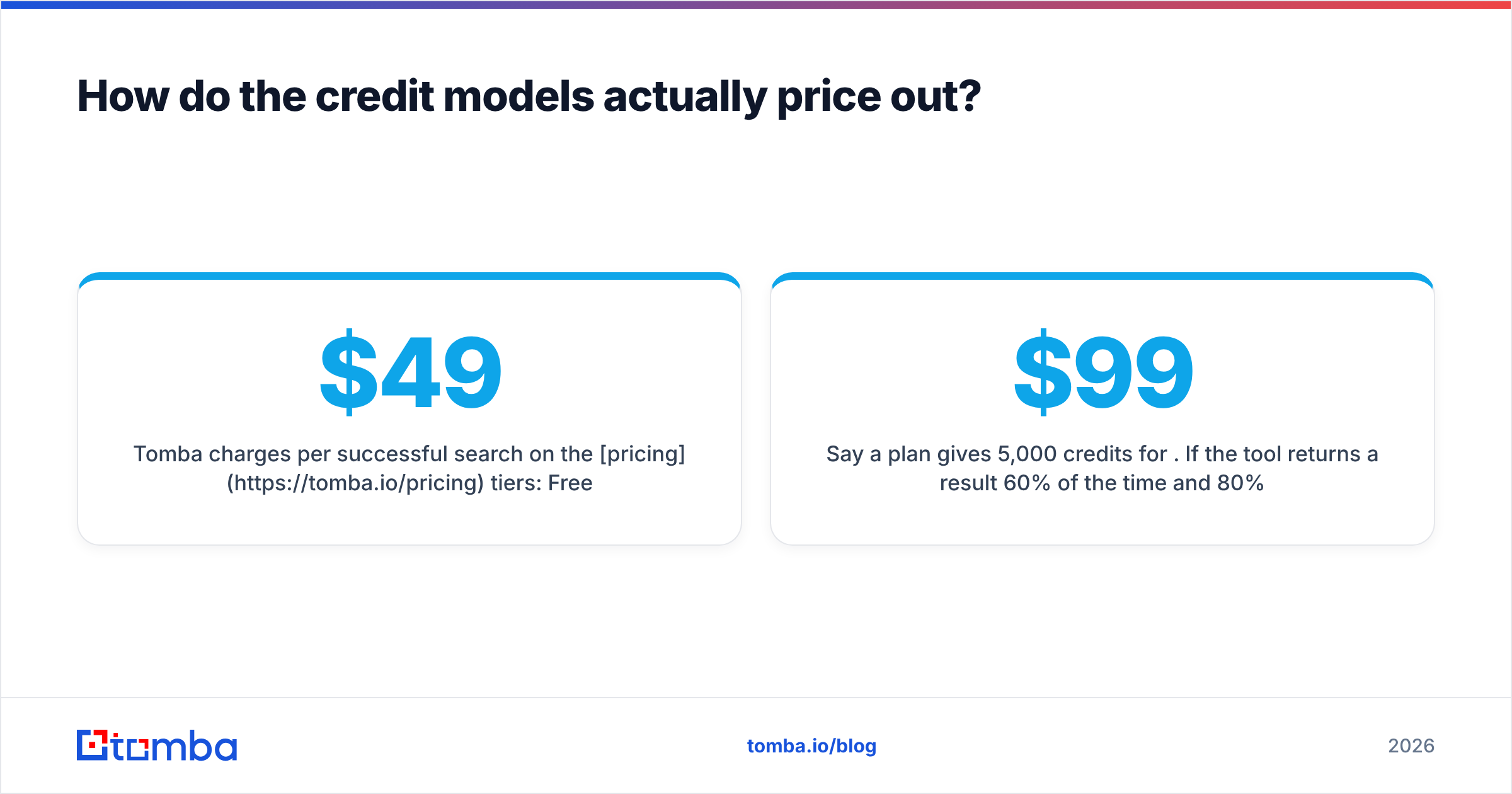
- Tomba charges per successful search on the pricing tiers: Free (25 searches/mo), Starter $49/mo, Growth $99/mo, Pro $249/mo, Enterprise custom, with verification available alongside so you're not paying twice for the same contact.
Compute the metric that matters:
Cost per verified email = (monthly price ÷ credits) ÷ (hit rate × verified rate)
Say a plan gives 5,000 credits for $99. If the tool returns a result 60% of the time and 80% of those survive verification, your effective cost is $99 ÷ (5,000 × 0.6 × 0.8) = roughly $0.041 per usable contact — more than double the $0.0198 headline rate. Run that math for both vendors with your target accounts, not their sample data. SMB SaaS domains behave nothing like enterprise manufacturing domains.

What about catch-all domains?#
Catch-all domains are the single biggest source of silent waste in both tools, and in most of the market.
A catch-all server accepts mail to any address at the domain — ceo@, asdkjh@, all of it. Standard SMTP verification can't distinguish real from fake there, so tools either mark the result "risky" and let you decide, or quietly count it as valid and let you eat the bounce later.
Depending on your ICP, catch-alls can be 20–35% of your list. Enterprise and security-conscious companies use them heavily, which means the accounts you most want to reach are the ones your finder is least sure about.
Three ways to handle them:
- Drop them. Safe, but you're deleting a third of your enterprise TAM.
- Send anyway on a burner domain. Protects your primary sending domain, adds cost and setup complexity.
- Resolve them with a dedicated check. A catch-all verifier uses signal beyond a single SMTP handshake to separate real mailboxes from the server's blanket "yes."
Neither FindThatLead nor Pubrio makes catch-all resolution a headline capability. If your list skews enterprise, that gap will hurt you more than any pricing difference between the two.
Which is better for developers and automated workflows?#
If a human is copying results into a spreadsheet, you don't have a data pipeline — you have a data hobby.
FindThatLead offers an API, but it's built around the product's own workflow and documentation is thin. Pubrio gates API access behind higher tiers, which is common but annoying when you want to prototype before committing budget.
For anything programmatic, evaluate on four things:
- Endpoint coverage — can you hit find, verify, domain search, and enrich separately, or is it one blunt endpoint?
- Rate limits and concurrency — enriching 50,000 CRM rows overnight is a very different load than 200 ad-hoc lookups.
- Response semantics — does the payload include a confidence score and source, or just a string?
- Tier gating — is the API available on the plan you can actually afford today?
The Tomba API is available across paid plans with separate endpoints for finding, verification, domain search, and enrichment, plus a CLI and an MCP server if you're wiring an AI agent into your prospecting. That separation matters: you can verify a contact you sourced elsewhere without paying to "find" it again.
Worth noting that neither FindThatLead nor Pubrio is a bad tool here — they're just built for operators clicking buttons, not engineers building pipelines. Pick based on which describes your team.
Are there better alternatives to both?#
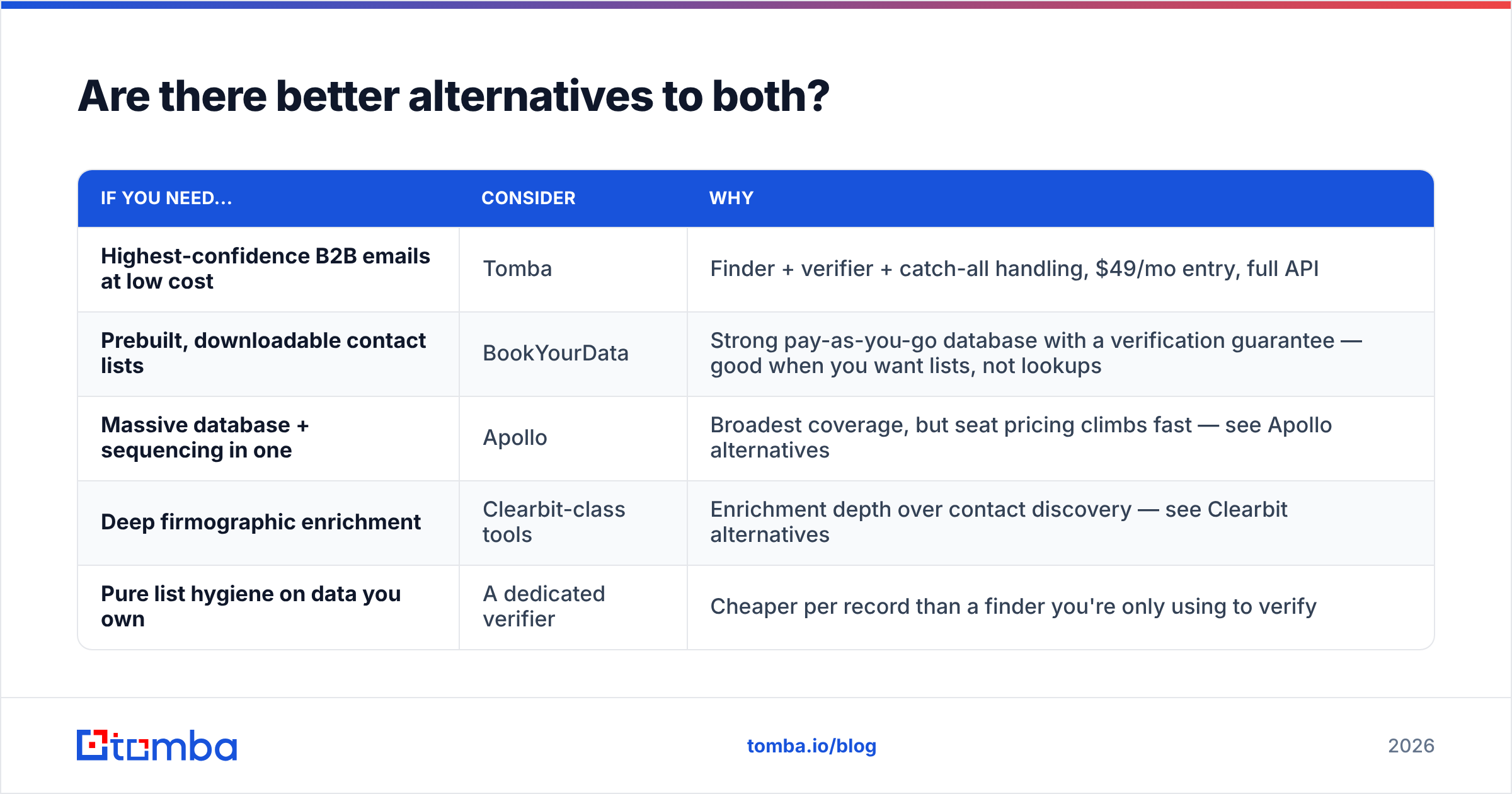
Yes, and the honest answer depends on what you're replacing.
| If you need... | Consider | Why |
|---|---|---|
| Highest-confidence B2B emails at low cost | Tomba | Finder + verifier + catch-all handling, $49/mo entry, full API |
| Prebuilt, downloadable contact lists | BookYourData | Strong pay-as-you-go database with a verification guarantee — good when you want lists, not lookups |
| Massive database + sequencing in one | Apollo | Broadest coverage, but seat pricing climbs fast — see Apollo alternatives |
| Deep firmographic enrichment | Clearbit-class tools | Enrichment depth over contact discovery — see Clearbit alternatives |
| Pure list hygiene on data you own | A dedicated verifier | Cheaper per record than a finder you're only using to verify |
The pattern most teams land on after a year of trial and error: one source of truth for finding and verifying, one tool for sending, one CRM. Bundled suites look cheaper on the invoice and cost more in bounced sends and dirty CRM records. Independent buyer reviews on G2 are useful for spotting churn patterns, though weight recent reviews heavily — data vendors' quality shifts fast as sources change.
How should you run the evaluation?#
A five-step test that takes an afternoon:
- Build a 200-row truth set from contacts you've already emailed successfully. Name, company, domain, known email.
- Strip the emails and run name + domain through each tool's free tier or trial.
- Score coverage and accuracy separately. Coverage = returns ÷ 200. Accuracy = exact matches ÷ returns.
- Push every returned address through a neutral email verifier — not the vendor's own — so you're not grading the homework with the same pencil.
- Compute cost per verified contact using the formula above and compare against your close rate.
Do this before you commit to an annual plan. Vendors discount annual hard because annual commitments outlive the point where you'd otherwise churn.
Verdict: FindThatLead or Pubrio?#
Pick FindThatLead if you're a solo founder or small agency who wants prospecting and sending in one seat, you're targeting SMB domains where catch-alls are rare, and you value fewer logins over data precision.
Pick Pubrio if you want a database-first experience with enrichment fields and you're building a lightweight GTM stack from scratch rather than plugging into an existing one.
Pick neither if you already own your sending and CRM layers. In that case you're paying for overlapping surface area, and you'd get more from a focused finder-and-verifier with a real API.
That last case is the most common one we see. If it's yours, start with the Tomba Email Finder — 25 free searches a month, no card, and Starter at $49/mo when you're ready to scale. Run it against your own 200-row truth set alongside FindThatLead and Pubrio, and let the bounce rate pick the winner instead of the pricing page.
Related guides#
Ready to find emails that actually work?
Join 150,000+ professionals who stopped guessing and started sending. Free credits on signup — no credit card required.
Get the Tomba newsletter
Practical outbound tactics and product updates — once every two weeks.
About the author