FindThatLead vs Skyp 2026: Which Email Tool Actually Wins
FindThatLead sells prospecting volume. Skyp sells clean lists. They solve different halves of the same problem — here is which one belongs in your stack, and when neither is enough.
TL;DR
- FindThatLead is a prospecting platform — domain search, LinkedIn extraction, bulk lead lists, and a built-in cold email sender. Skyp is a verification specialist — you bring the list, it tells you what will bounce.
- Comparing them head-to-head is slightly unfair, and that is exactly the point: most teams buying one of them actually need both halves.
- FindThatLead's weak spot is accuracy on smaller and non-US domains. Skyp's weak spot is that it cannot find a single address for you.
- Stacking two vendors typically lands you around $80–$130/mo before you have sent one email. A combined finder + verifier (Tomba starts at $49/mo) collapses that into one credit pool and one API.
- Whichever you pick: never mail an unverified catch-all domain, and never judge a tool on the demo of a 10,000-employee company.
What are FindThatLead and Skyp, exactly?#
They are not competitors in the way the search query implies. They are two adjacent products people compare because both promise "better email lists."
FindThatLead is a Barcelona-built B2B prospecting suite. Its core loop is: pick a domain or a LinkedIn profile, get a professional email address, push that into a list, and run a cold campaign from the same dashboard. It bundles a Chrome extension, a Prospector for filtered searches by role and location, and Scrab.in for LinkedIn automation. The pitch is "one tool from lead to first reply."
Skyp is narrower and cheaper by design. It is an email verification and list-cleaning service: upload a CSV, run syntax, DNS, MX, and SMTP checks, and get back a file segmented into valid, invalid, risky, and unknown. No finding, no sending, no CRM. The pitch is "protect your sender reputation for a few dollars per thousand."
So the honest framing of FindThatLead vs Skyp is: do you have a list problem or a list-quality problem? If your CSV is empty, Skyp cannot help you. If your CSV is full of guesses, FindThatLead's own verification will not save you from a 12% bounce rate.
How do FindThatLead and Skyp compare feature by feature?#
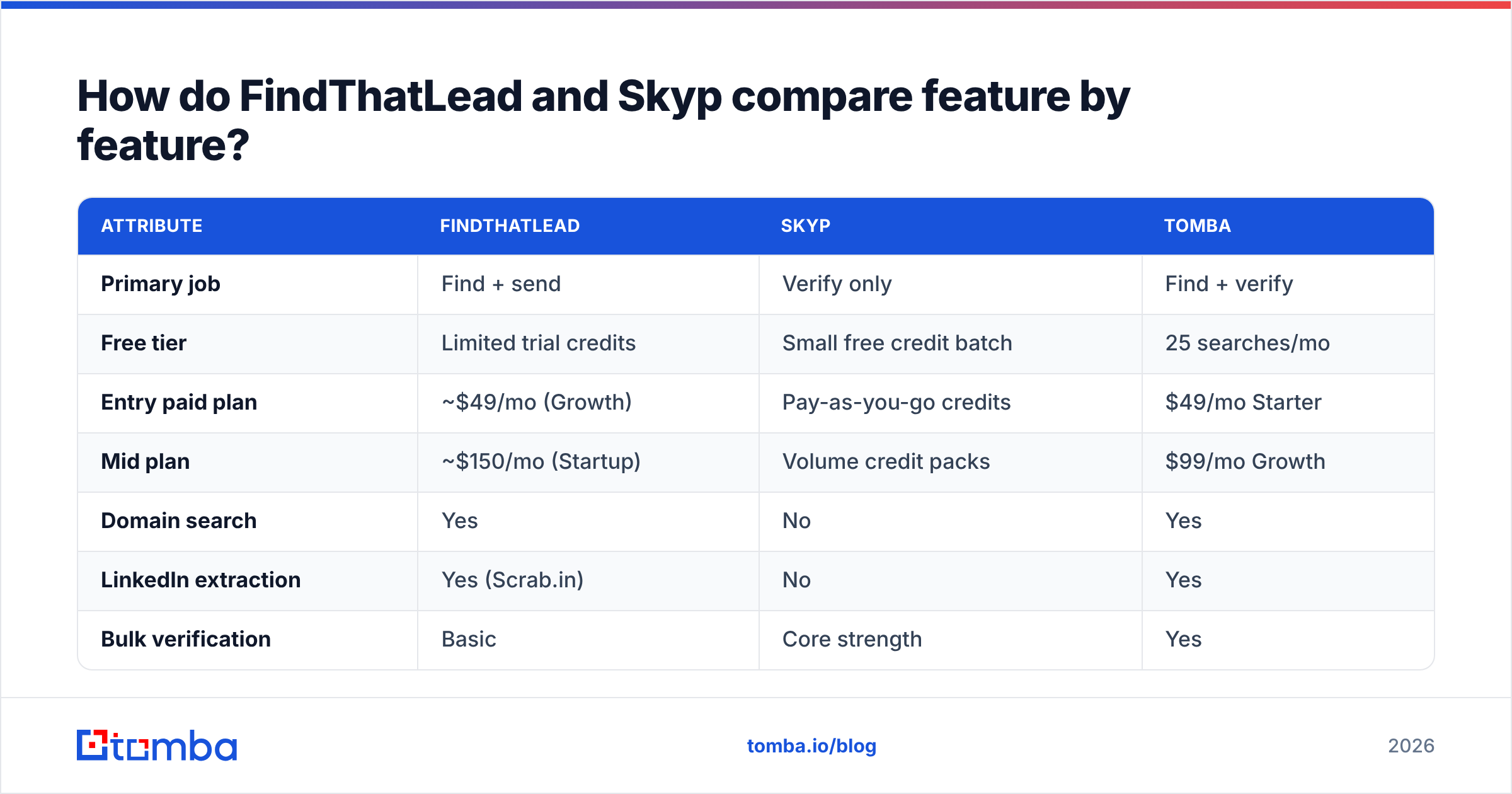
Here is the practical breakdown. Pricing reflects publicly listed plans at the time of writing — both vendors change tiers, so confirm on their own pricing pages before you commit annually.
| Attribute | FindThatLead | Skyp | Tomba |
|---|---|---|---|
| Primary job | Find + send | Verify only | Find + verify |
| Free tier | Limited trial credits | Small free credit batch | 25 searches/mo |
| Entry paid plan | ~$49/mo (Growth) | Pay-as-you-go credits | $49/mo Starter |
| Mid plan | ~$150/mo (Startup) | Volume credit packs | $99/mo Growth |
| Domain search | Yes | No | Yes |
| LinkedIn extraction | Yes (Scrab.in) | No | Yes |
| Bulk verification | Basic | Core strength | Yes |
| Catch-all handling | Marks as risky | Marks as risky/unknown | Dedicated catch-all resolution |
| Phone numbers | No | No | Yes |
| Built-in email sender | Yes | No | No (integrations instead) |
| Public API | Yes | Yes | Yes, documented + CLI + MCP |
| Best for | Solo founders wanting one dashboard | Cleaning lists you already own | Teams that want accuracy plus enrichment in one credit pool |
Two things jump out of that table.
First, FindThatLead is a breadth play. You get finding, LinkedIn scraping, and sending under one login, which is genuinely convenient for a solo founder doing 200 touches a month. The trade-off is that no single module is best-in-class — the sender is thinner than a dedicated sequencer, and the finder is mid-pack on accuracy.
Second, Skyp is a depth play at a very low price point. Per-verification cost is its selling point, and for a one-off list cleanup before a big send it is hard to argue with. But it is a utility, not a growth engine.
Which one is more accurate?#
Accuracy is where the money actually is, so define it properly before you compare vendors: accuracy is the percentage of delivered emails out of the addresses a tool marked as valid. Not coverage. Not database size. Delivered-over-claimed-valid.
Every finder looks great on microsoft.com. The differences appear on a 40-person logistics company in Lyon with a custom mail server and no public team page.

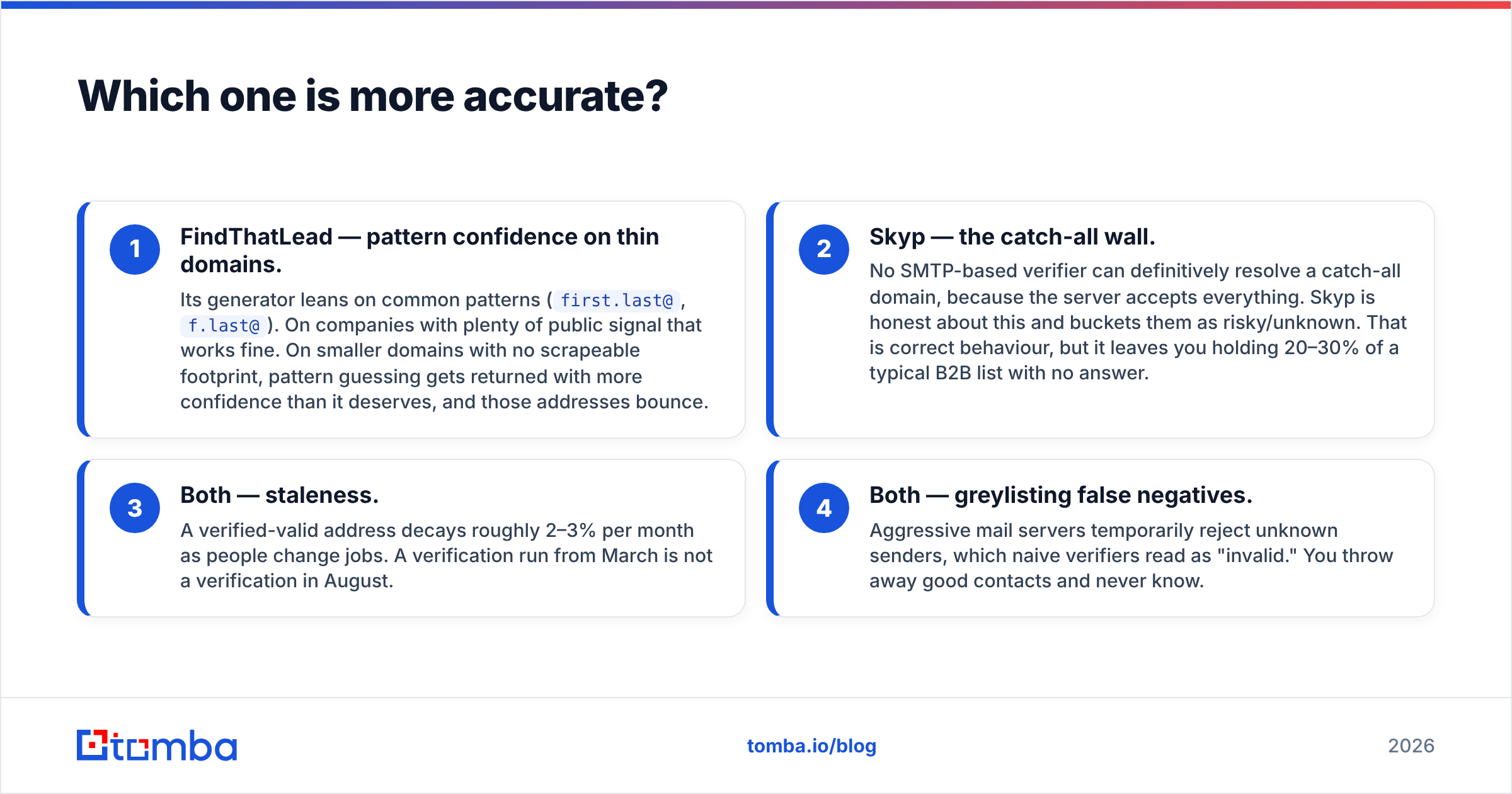
Where each tool tends to slip:
- FindThatLead — pattern confidence on thin domains. Its generator leans on common patterns (
first.last@,f.last@). On companies with plenty of public signal that works fine. On smaller domains with no scrapeable footprint, pattern guessing gets returned with more confidence than it deserves, and those addresses bounce. - Skyp — the catch-all wall. No SMTP-based verifier can definitively resolve a catch-all domain, because the server accepts everything. Skyp is honest about this and buckets them as risky/unknown. That is correct behaviour, but it leaves you holding 20–30% of a typical B2B list with no answer.
- Both — staleness. A verified-valid address decays roughly 2–3% per month as people change jobs. A verification run from March is not a verification in August.
- Both — greylisting false negatives. Aggressive mail servers temporarily reject unknown senders, which naive verifiers read as "invalid." You throw away good contacts and never know.
The catch-all issue is the one that quietly decides the winner. If a third of your target accounts run catch-all domains and your verifier just shrugs, you are choosing between skipping real buyers or gambling with your domain reputation. This is why a dedicated catch-all verifier matters more than another decimal point on a headline accuracy claim — resolving those addresses is the difference between a usable list and a half-usable one.
What does each one actually cost per usable contact?#
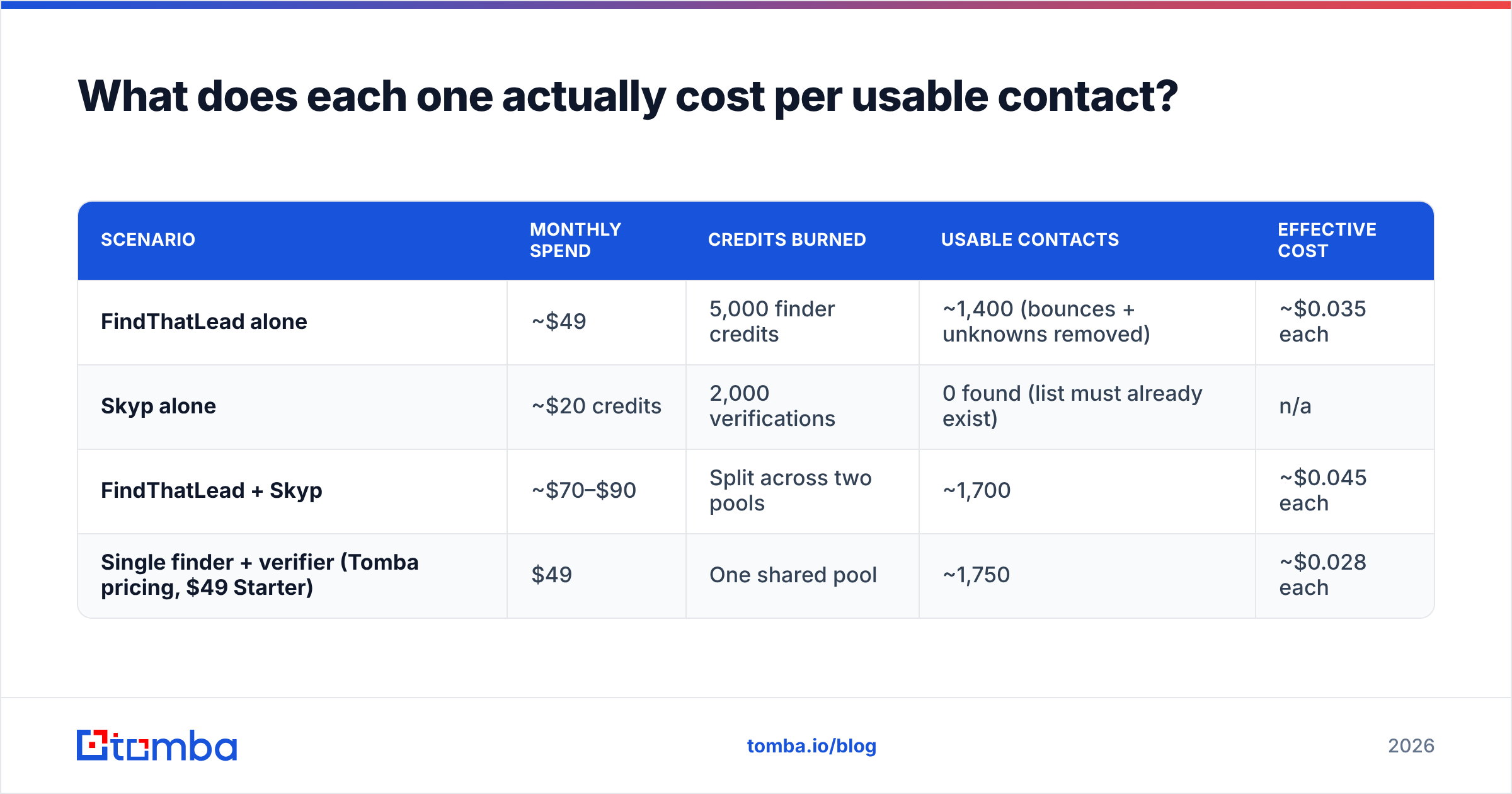
List price is marketing. Cost per usable contact is the number your CFO cares about. Run the arithmetic on a realistic month: you need 2,000 verified contacts.
| Scenario | Monthly spend | Credits burned | Usable contacts | Effective cost |
|---|---|---|---|---|
| FindThatLead alone | ~$49 | 5,000 finder credits | ~1,400 (bounces + unknowns removed) | ~$0.035 each |
| Skyp alone | ~$20 credits | 2,000 verifications | 0 found (list must already exist) | n/a |
| FindThatLead + Skyp | ~$70–$90 | Split across two pools | ~1,700 | ~$0.045 each |
| Single finder + verifier (Tomba pricing, $49 Starter) | $49 | One shared pool | ~1,750 | ~$0.028 each |
Three cost traps worth naming out loud:
- Credits burned on failures. Some vendors charge for a search that returns nothing or returns a guess. Read the credit policy before the pricing table — it moves effective cost more than the sticker price does.
- The two-vendor tax. Two subscriptions means two credit pools that expire separately, two APIs to wire, two rate limits, and two invoices. You almost always overbuy on one side.
- Annual lock-in on the wrong tier. Both vendors discount annual plans hard. Do not take that discount until you have run a 500-contact live test and measured your own bounce rate.
Which should you choose for your use case?#
Pick by workflow, not by feature count.
Choose FindThatLead if: you are a solo founder or a two-person team, you want finding and sending in one window, your targets are mostly mid-size companies with a public web presence, and you value "no integration work" above the last few points of accuracy. It is a reasonable first tool.
Choose Skyp if: you already have a list — from a conference, an old CRM export, a partner, a scraped source — and you need it cleaned before it touches your sending domain. As a cheap insurance policy against a reputation hit, it does the job. Pair it with a free email checker for spot-checks between bulk runs.
Choose neither if: you need programmatic enrichment at scale. Both tools were designed dashboard-first. When your workflow is "a lead lands in HubSpot, enrich it within 90 seconds, route it," you want an email finder API with predictable latency and a single credit ledger — not a dashboard you have to remember to open.


How do you test them properly before you pay?#
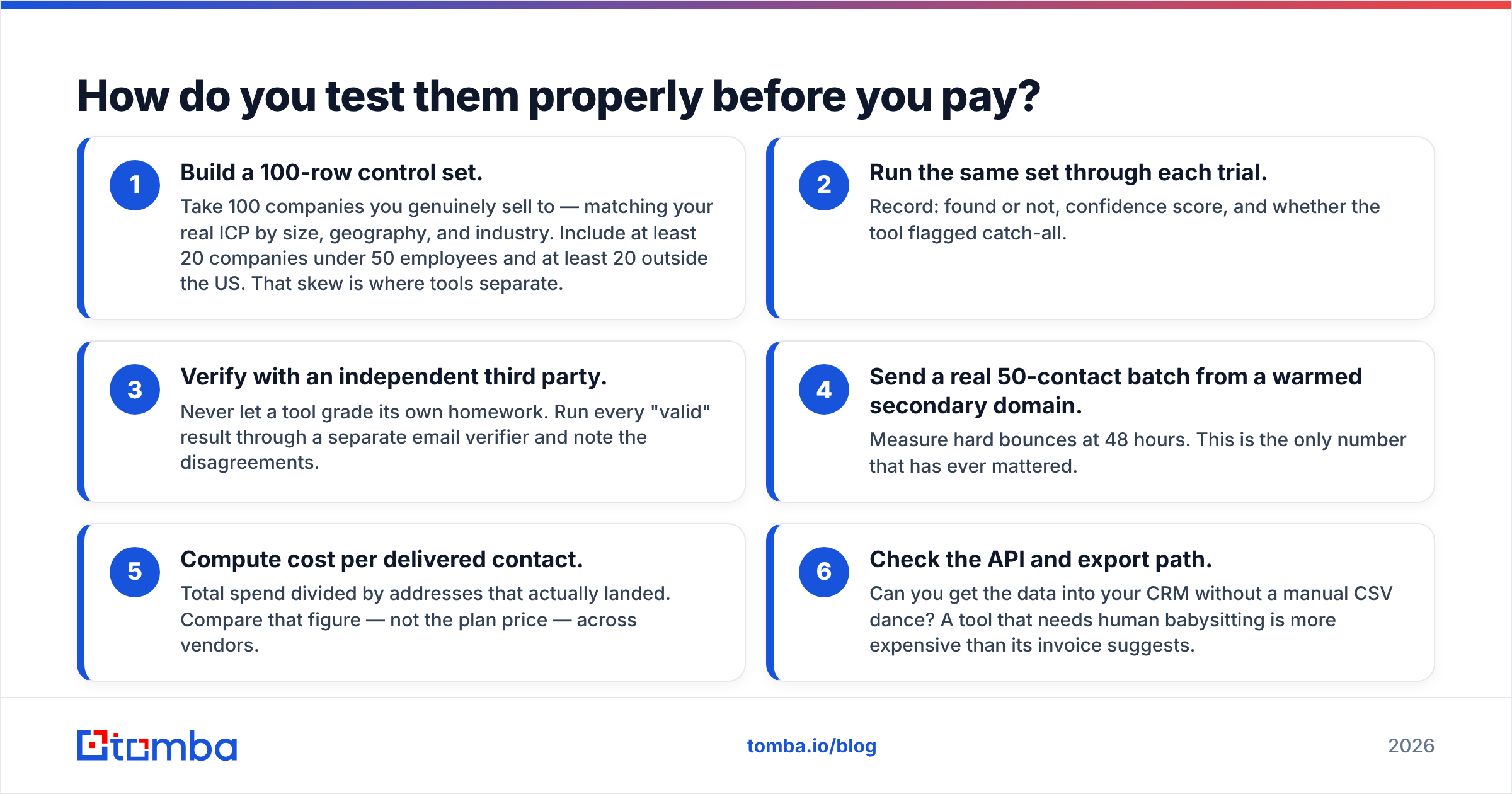
Vendor benchmarks are marketing artifacts, run on lists that flatter the vendor. Run your own in about an hour:
- Build a 100-row control set. Take 100 companies you genuinely sell to — matching your real ICP by size, geography, and industry. Include at least 20 companies under 50 employees and at least 20 outside the US. That skew is where tools separate.
- Run the same set through each trial. Record: found or not, confidence score, and whether the tool flagged catch-all.
- Verify with an independent third party. Never let a tool grade its own homework. Run every "valid" result through a separate email verifier and note the disagreements.
- Send a real 50-contact batch from a warmed secondary domain. Measure hard bounces at 48 hours. This is the only number that has ever mattered.
- Compute cost per delivered contact. Total spend divided by addresses that actually landed. Compare that figure — not the plan price — across vendors.
- Check the API and export path. Can you get the data into your CRM without a manual CSV dance? A tool that needs human babysitting is more expensive than its invoice suggests.
Keep the control set. Re-run it every six months, because vendor accuracy drifts as data sources change — the winner in 2024 is often not the winner in 2026. Independent review volume on G2 is a useful sanity check on whether a tool's quality is trending up or down, but it is no substitute for your own 100 rows.
What is the smarter stack in 2026?#
The pattern that keeps winning is consolidation, for a reason that has nothing to do with vendor loyalty: every handoff between tools is a place where data quality dies. Find in tool A, export CSV, verify in tool B, re-import, dedupe, discover 8% got mangled in the round trip — that is a Tuesday for most SDR teams.
A single pipeline where a found address is verified in the same call, catch-alls get resolved rather than shrugged at, and the whole thing runs over one API removes the handoff entirely. It also makes your unit economics legible: one credit pool, one number to divide by.
That is the practical case for a combined stack. Run finding and verification together with bulk lead generation so a 5,000-row list comes back already segmented, push the survivors straight into your CRM via integrations, and skip the CSV shuffle altogether. Neither FindThatLead nor Skyp is a bad product — they are just each half of the job, and you are paying twice for the seam between them.
One last non-negotiable, whichever way you go: protect the domain. Verification is necessary but not sufficient. Warm your sending domain, keep daily volume sane, monitor your sender reputation, and check your SPF record before the first send. A perfectly verified list sent from a cold domain still lands in spam.
The verdict#
FindThatLead wins on breadth; Skyp wins on price-per-verification; neither wins on accuracy at the edges of your ICP. If you are a solo founder who wants one dashboard and mostly targets recognisable mid-market companies, FindThatLead is a defensible starting point. If you already own the list and just need it clean, Skyp is cheap and does exactly what it says.
But if your bounce rate matters, if catch-all domains make up a real slice of your accounts, or if you need this running programmatically instead of by hand, two half-tools will keep costing you more than one complete one.
Run the 100-row test on your own ICP before you spend a cent on an annual plan. Then start free with the Tomba Email Finder — 25 searches a month at no cost, $49/mo when you outgrow it, with verification, catch-all resolution, and enrichment drawing from the same credit pool. Put it in your control set alongside the other two and let the delivered-contact number pick the winner.
Related guides#
Ready to find emails that actually work?
Join 150,000+ professionals who stopped guessing and started sending. Free credits on signup — no credit card required.
Get the Tomba newsletter
Practical outbound tactics and product updates — once every two weeks.
About the author