Findymail vs Apolloio (2026): Which Email Data Tool Wins?
Findymail sells verified emails. Apollo.io sells an entire outbound platform. We compared accuracy, pricing, credits and export limits to show which one actually fits your team in 2026.
Findymail vs Apolloio (Apollo.io) comes down to one trade: clean data or a full platform. Findymail returns fewer emails, but the ones it returns land. Apollo hands you a huge database plus a sequencer, a dialer, and CRM sync. Here is how the two compare on accuracy, credits, pricing, and export limits.
TL;DR
- Findymail is a narrow, high-accuracy email finder with a bounce guarantee and native Sales Navigator scraping. It does one job and does it cleanly.
- Apollo.io is a full go-to-market platform: a 275M+ contact database, sequencer, dialer, CRM sync, and intent signals bundled into one seat price.
- Apollo wins on breadth and price-per-contact. Findymail wins on data hygiene for lists you actually email.
- Apollo's real cost is hidden in export limits and per-seat pricing. Findymail's cost is the ceiling — no sequencer, no dialer, no CRM.
- If you want find + verify + enrich as an API layer under your own stack, a dedicated provider like Tomba at $49/mo starter is the cheaper third option.
What is Findymail and who is it for?#
Findymail is an email-finding and verification tool built around one promise: the emails it returns will not bounce. It launched as a reaction to the "database dump" model. In that model you pay for millions of records, and half of them are three years stale.
The core workflow looks like this:
- Import a list — CSV, LinkedIn Sales Navigator search, or a Chrome extension capture.
- Find the email — Findymail runs its own discovery and pattern matching against the company domain.
- Verify before delivery — every result passes verification; unverifiable results are not charged.
- Export — push to Lemlist, Instantly, Smartlead, HubSpot, or plain CSV.
- Bounce guarantee — Findymail publicly commits to a bounce ceiling and credits back failures.
That last point is the whole pitch. You are not buying a database. You are buying rows you can deliver to. Check Findymail's own site for the current guarantee wording — it has tightened over time.
Findymail is a strong fit if you already own your sequencer and your CRM, and the only broken link in the chain is contact data quality. It is a poor fit if you want one login to run the entire outbound motion.
What is Apollo.io and what does the platform actually include?#
Apollo.io is the opposite architecture. It bundles a contact database with everything you would normally buy separately:
- Database — 275M+ contacts and 70M+ companies, self-reported, with filters for title, headcount, tech stack, funding, and hiring signals.
- Sequencer — multi-step email + task + LinkedIn cadences with A/B testing.
- Dialer — click-to-call with local presence and recordings on higher tiers.
- Enrichment — CRM push/pull to keep Salesforce or HubSpot fields fresh.
- Intent and scoring — buying-intent topics plus AI lead scoring on paid tiers.
The strategic logic is bundling. If Apollo is your database and your sequencer, you cancel two other subscriptions. Their free tier is genuinely usable for solo founders. That is why Apollo shows up in almost every "best sales tools" list on G2 and Capterra.
The friction shows up in two places: data freshness on long-tail contacts, and export limits. Apollo's credits are not one currency. Email credits, mobile credits, and export caps all behave differently. Annual plans also meter exports separately from lookups. Read the plan page carefully before you assume "unlimited email credits" means unlimited anything.
Findymail vs Apolloio: how do they compare head to head?#
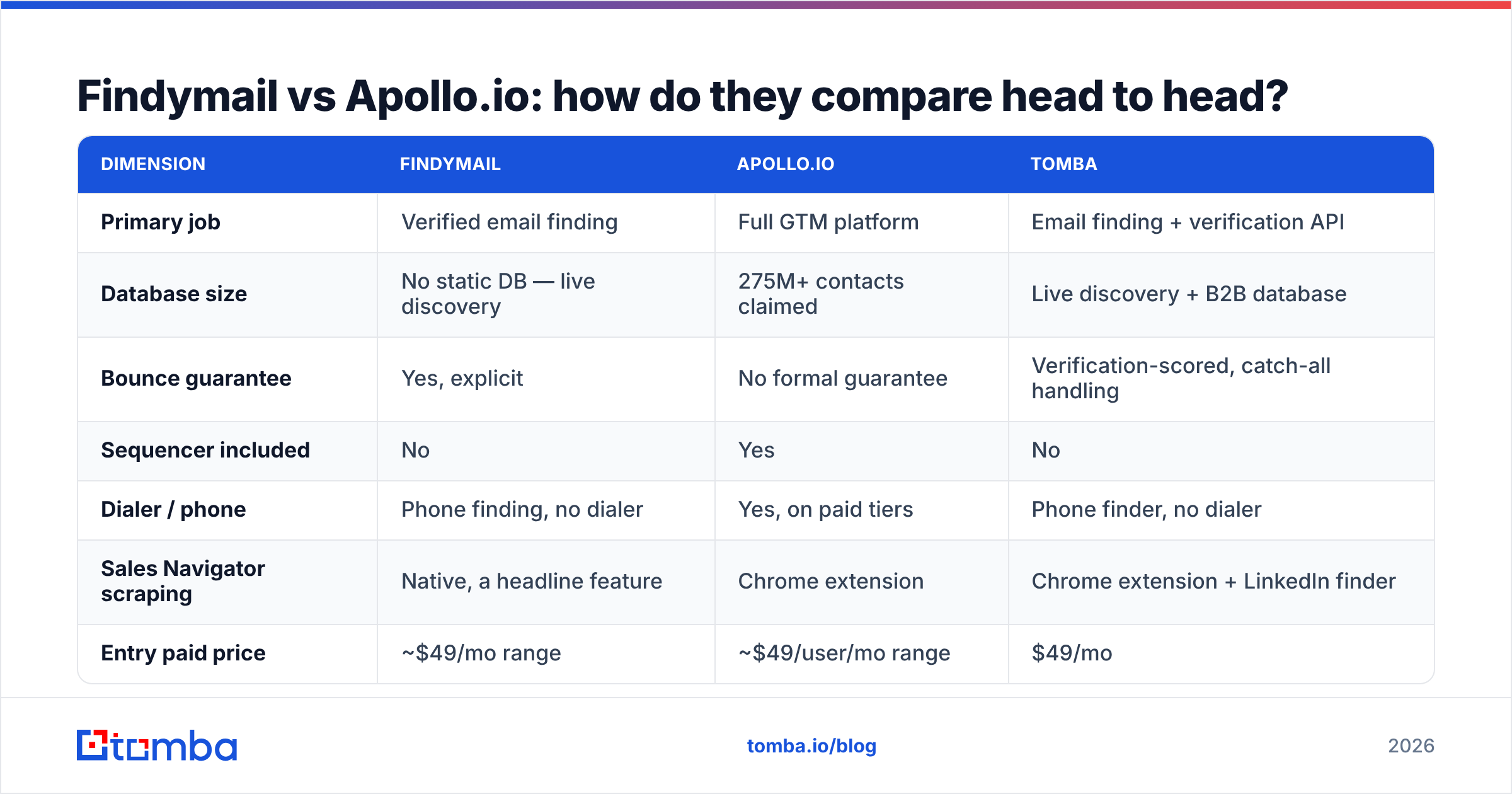
| Dimension | Findymail | Apollo.io | Tomba |
|---|---|---|---|
| Primary job | Verified email finding | Full GTM platform | Email finding + verification API |
| Database size | No static DB — live discovery | 275M+ contacts claimed | Live discovery + B2B database |
| Bounce guarantee | Yes, explicit | No formal guarantee | Verification-scored, catch-all handling |
| Sequencer included | No | Yes | No |
| Dialer / phone | Phone finding, no dialer | Yes, on paid tiers | Phone finder, no dialer |
| Sales Navigator scraping | Native, a headline feature | Chrome extension | Chrome extension + LinkedIn finder |
| Entry paid price | ~$49/mo range | ~$49/user/mo range | $49/mo |
| Free tier | Limited trial credits | Yes, generous | 25 searches/mo |
| API access | Yes | Yes, tier-gated | Yes, all paid plans |
| Best for | Clean lists for an existing stack | One-tool outbound teams | Developers + RevOps pipelines |
Three things fall out of that table.
First, they are not really competitors. Findymail competes with the data half of Apollo. Apollo's other half — sequencing, dialing, scoring — has no Findymail equivalent. Teams often run both. Apollo does discovery and filtering, and Findymail cleans the export before it touches a mailbox.
Second, per-seat versus per-workspace matters more than headline price. Apollo charges per user. Five reps on a mid-tier plan is five times the sticker. Findymail and Tomba pricing are workspace-credit models — one plan, shared pool. At three or more seats, that gap gets wide fast.
Third, "unlimited" needs a footnote. Apollo's marketing leans on unlimited email credits. But exports, mobile numbers, and API calls all carry their own ceilings. Findymail's limit is simply the credit count, which is easier to forecast.
Which one has better data accuracy?#
This is where Findymail vs Apolloio stops being a tie. Accuracy is the argument that decides it, so be precise about what you are measuring.
There are three separate numbers people mix up:
- Match rate — of 1,000 prospects submitted, how many returned any email at all.
- Accuracy / validity rate — of the emails returned, how many are real, deliverable mailboxes.
- Bounce rate in production — what your ESP reports after you send. That number includes spam traps, role accounts, and mailboxes that died between export and send.
Findymail optimises for #2 and #3 at the expense of #1. It will decline to return a guess. Apollo optimises for #1. A giant database returns something for almost every query. That is great for coverage, and dangerous if you send without verification.

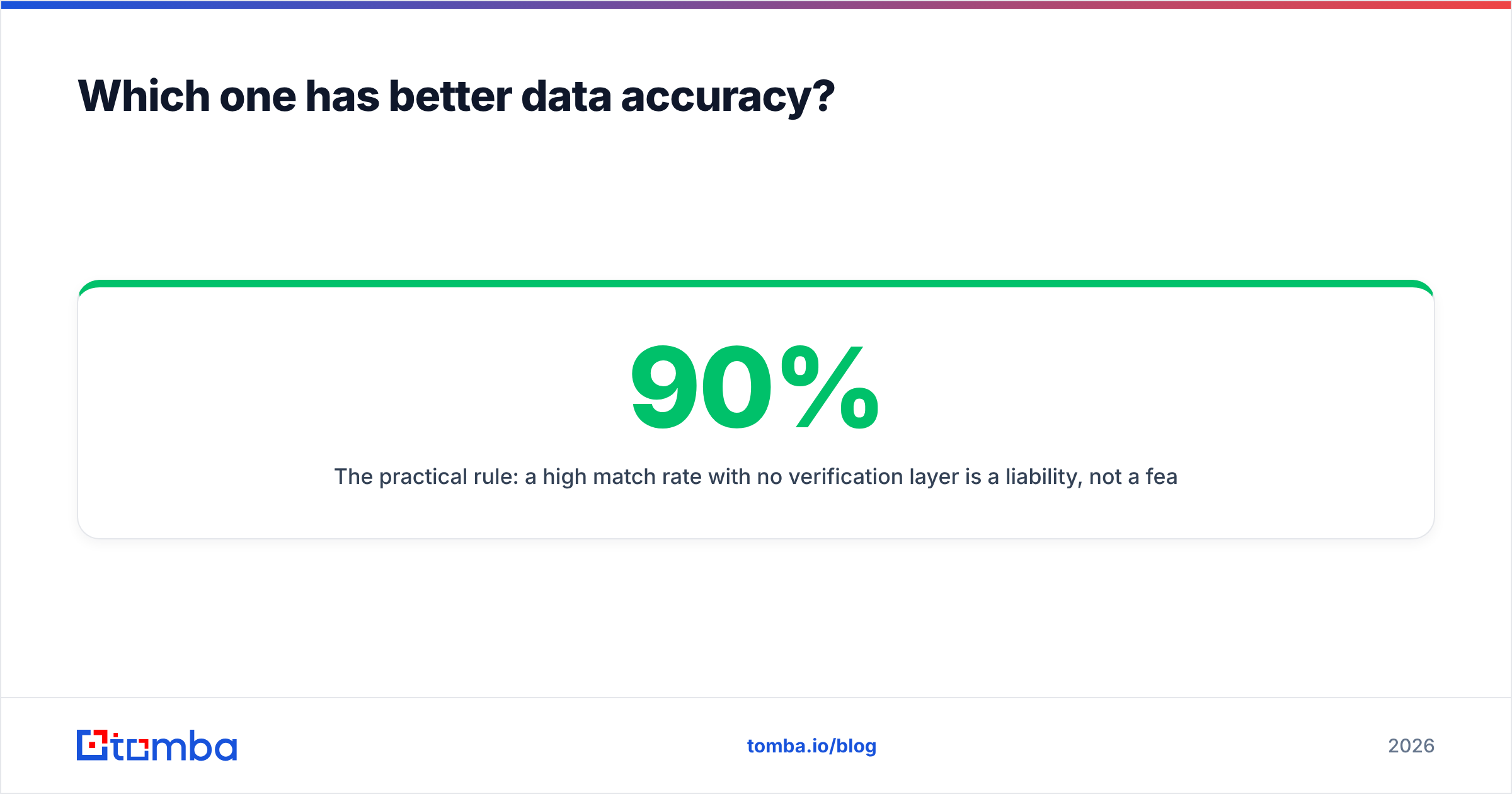
The practical rule: a high match rate with no verification layer is a liability, not a feature. A 90% match rate at 82% validity produces more bounces on a 5,000-row send than a 62% match rate at 97% validity. Bounces above roughly 3% start damaging sender reputation. Reputation damage costs more than the missing contacts ever earn.
If you pull from Apollo, run the export through a dedicated email verifier before it enters a sequence. That single step neutralises most of Apollo's data-quality gap. It also costs a fraction of switching platforms.
Catch-all domains are where all three tools diverge hardest. A catch-all accepts every address at SMTP time, so standard verification returns "unknown." Findymail is careful here and often drops those rows. Apollo returns them unflagged. A dedicated catch-all verifier resolves a good share of them with pattern confidence scoring instead of discarding the row. That matters, because catch-alls skew toward enterprise domains, and enterprise domains are usually where the money is.
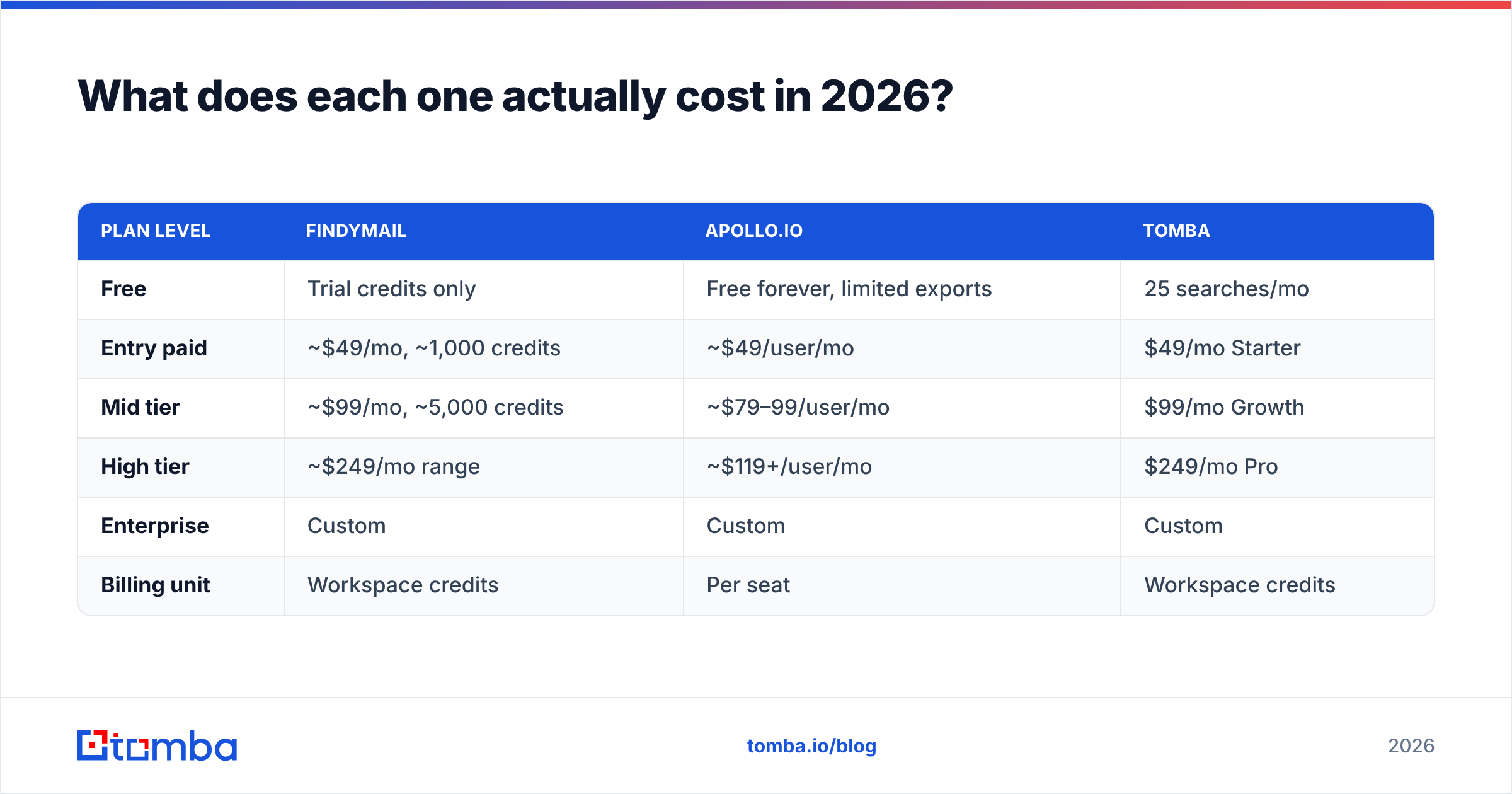
What does each one actually cost in 2026?#
| Plan level | Findymail | Apollo.io | Tomba |
|---|---|---|---|
| Free | Trial credits only | Free forever, limited exports | 25 searches/mo |
| Entry paid | ~$49/mo, ~1,000 credits | ~$49/user/mo | $49/mo Starter |
| Mid tier | ~$99/mo, ~5,000 credits | ~$79–99/user/mo | $99/mo Growth |
| High tier | ~$249/mo range | ~$119+/user/mo | $249/mo Pro |
| Enterprise | Custom | Custom | Custom |
| Billing unit | Workspace credits | Per seat | Workspace credits |
Vendor pricing moves. Treat these as shape, not gospel, and confirm on each vendor's page. The shape is what matters:
- Solo founder, low volume — Apollo's free tier is hard to beat. Take it.
- Two to three reps, existing sequencer — Findymail or Tomba on a workspace plan beats Apollo per-seat.
- Five-plus reps, no existing stack — Apollo's bundle wins on total cost of ownership, even at per-seat pricing. You are not also paying for a sequencer, dialer, and enrichment vendor.
- Engineering-led pipeline — neither. You want an email finder API you call from your own orchestration, priced on credits, not seats.

Should you use both together?#
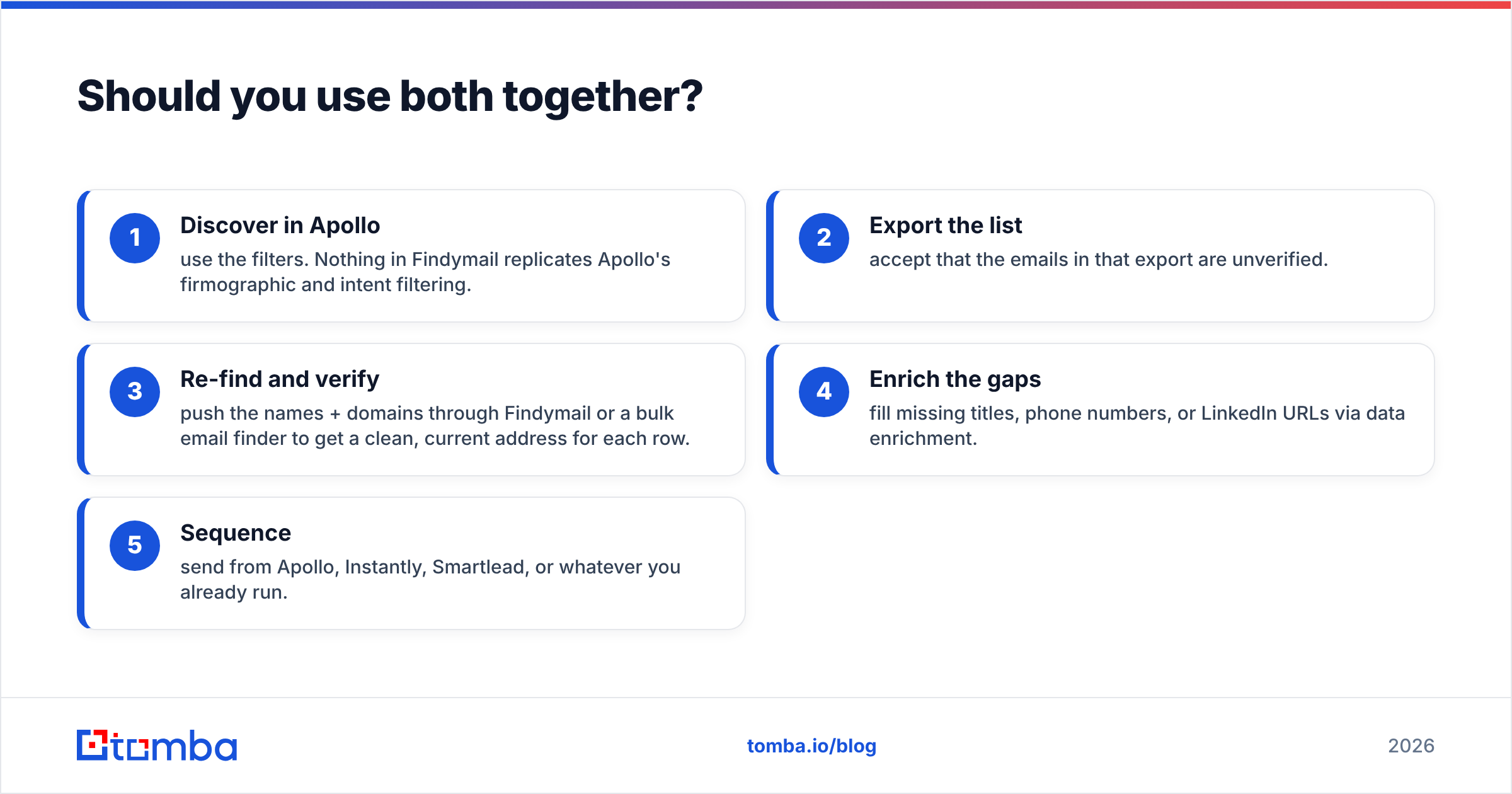
Yes, and a lot of teams already do. The stacking pattern is straightforward:
- Discover in Apollo — use the filters. Nothing in Findymail replicates Apollo's firmographic and intent filtering.
- Export the list — accept that the emails in that export are unverified.
- Re-find and verify — push the names + domains through Findymail or a bulk email finder to get a clean, current address for each row.
- Enrich the gaps — fill missing titles, phone numbers, or LinkedIn URLs via data enrichment.
- Sequence — send from Apollo, Instantly, Smartlead, or whatever you already run.
This costs more per contact than either tool alone. It is still the right call when your domain reputation is the constraint. Say you send 500 emails a month from a two-year-old domain. One bad list can cost you a quarter of recovery work. Compare that against a few hundred dollars of verification credits.
There is an alternative pattern for teams with an engineer: skip the UI entirely. Query a database like Apollo or BookYourData for discovery. Then run a find-and-verify API in your own pipeline, so every row entering the CRM is already scored. That keeps data quality as a system property instead of a manual step someone forgets on a Friday.
Which alternatives should you consider before deciding?#
Do not treat this as a binary. The realistic shortlist in 2026:
- Apollo.io — best for teams that want one tool and no integration work. Weakest on data hygiene. See Apollo alternatives if per-seat pricing is the blocker.
- Findymail — best for accuracy-first list building on top of an existing stack. See Findymail alternative options if credit costs scale badly for you.
- Tomba — best when you want find, verify, enrich, and catch-all handling as composable APIs at workspace pricing. Weak fit if you want a sequencer in the box.
- BookYourData — strong for pre-built, guaranteed-accuracy lists when you would rather buy a finished dataset than build one. It is a different purchase shape, and a good one when speed matters more than control.
- Clay / orchestration tools — worth it when you want to chain multiple data providers with waterfall logic. Higher setup cost, best-in-class coverage.
The decision tree is short. Do you already own a sequencer? If no, pick Apollo. If yes, is data quality your bottleneck? If yes, pick Findymail or Tomba. Are you calling this from code rather than a UI? Then choose on API quality and credit pricing, and ignore the platform features you will never open.

What's the verdict?#
The short answer on Findymail vs Apolloio: Apollo wins on breadth, Findymail wins on hygiene.
Apollo.io wins if you are building an outbound motion from zero. The bundle is genuinely good value. The free tier lets you test the channel before spending, and one vendor beats four for a small team. Just budget for a verification step you will run outside the platform.
Findymail wins if you already have the motion and the bottleneck is bounces. It returns fewer emails but stands behind them. That is the correct trade when your domain reputation is a real asset. Pair it with Apollo rather than replacing Apollo.
Neither wins if your pipeline is code. Per-seat pricing and UI-first workflows are friction here. The real consumer of the data is a script, a workflow automation, or a CRM trigger. That is a different product category.
Whichever way you go, the non-negotiable is verification before send. Every dollar you save on cheap, unverified data comes back as deliverability debt within two quarters.
Ready to build a cleaner list?#
Do you want the accuracy of a verification-first tool without per-seat pricing? Start with the Tomba Email Finder. Search by domain, name, or company. Verify every result before export, and handle catch-all domains instead of dropping them. The free tier gives you 25 searches a month to test against your own known-good contacts. Run it side by side with your Apollo or Findymail export and compare the bounce reports. That is the only benchmark that counts.
Related guides#
Ready to find emails that actually work?
Join 150,000+ professionals who stopped guessing and started sending. Free credits on signup — no credit card required.
Get the Tomba newsletter
Practical outbound tactics and product updates — once every two weeks.
About the author