Findymail vs Truemail: Which Email Tool Wins in 2026?
Findymail finds emails. Truemail verifies them. We compared credits, accuracy, bounce guarantees, and real cost per usable contact to show which one your outbound stack actually needs in 2026.
TL;DR
- They are not the same product. Findymail is an email finder (plus LinkedIn scraping and list cleaning). Truemail is an email verifier — it validates addresses you already have and does not source them.
- If you only buy one, buy the finder. A finder with built-in verification covers both jobs; a standalone verifier covers half.
- Price per usable contact is the only metric that matters. Findymail's entry plan runs about $49/mo for 1,000 finder credits; Truemail sells verification credits from roughly $0.001–$0.005 each with pay-as-you-go packs.
- Findymail's bounce guarantee is the strongest sales argument it has; Truemail's is speed and cheap bulk throughput on lists you already own.
- The consolidation play: a single platform like Tomba does finding, verifying, catch-all checks, and enrichment on one credit pool starting at $49/mo — which is why most teams stop paying two vendors after a quarter.
What are Findymail and Truemail, exactly?#
Findymail is a B2B contact-sourcing tool. You give it a name and a company (or a LinkedIn Sales Navigator export, or a domain) and it returns a professional email address. Its pitch is accuracy: it markets a bounce guarantee and positions itself against high-volume databases that sell you stale rows. Findymail also ships a list-cleaning feature, which is where people start confusing it with a verifier.
Truemail is a verification service. You upload a list — or hit its API — and it tells you whether each address is valid, invalid, risky, or unknown. It runs syntax checks, MX record lookups, disposable-domain detection, role-account flags, and SMTP handshakes. It does not find anything. If your CSV is empty, Truemail has nothing to do.
That distinction decides most of this comparison before you look at a single price. The question "findymail vs truemail" is really two questions:
- Do I have a sourcing problem or a hygiene problem?
- Can I solve both without paying two subscriptions?

How do the two tools actually differ?#
Here is the head-to-head on the attributes that change your monthly invoice.
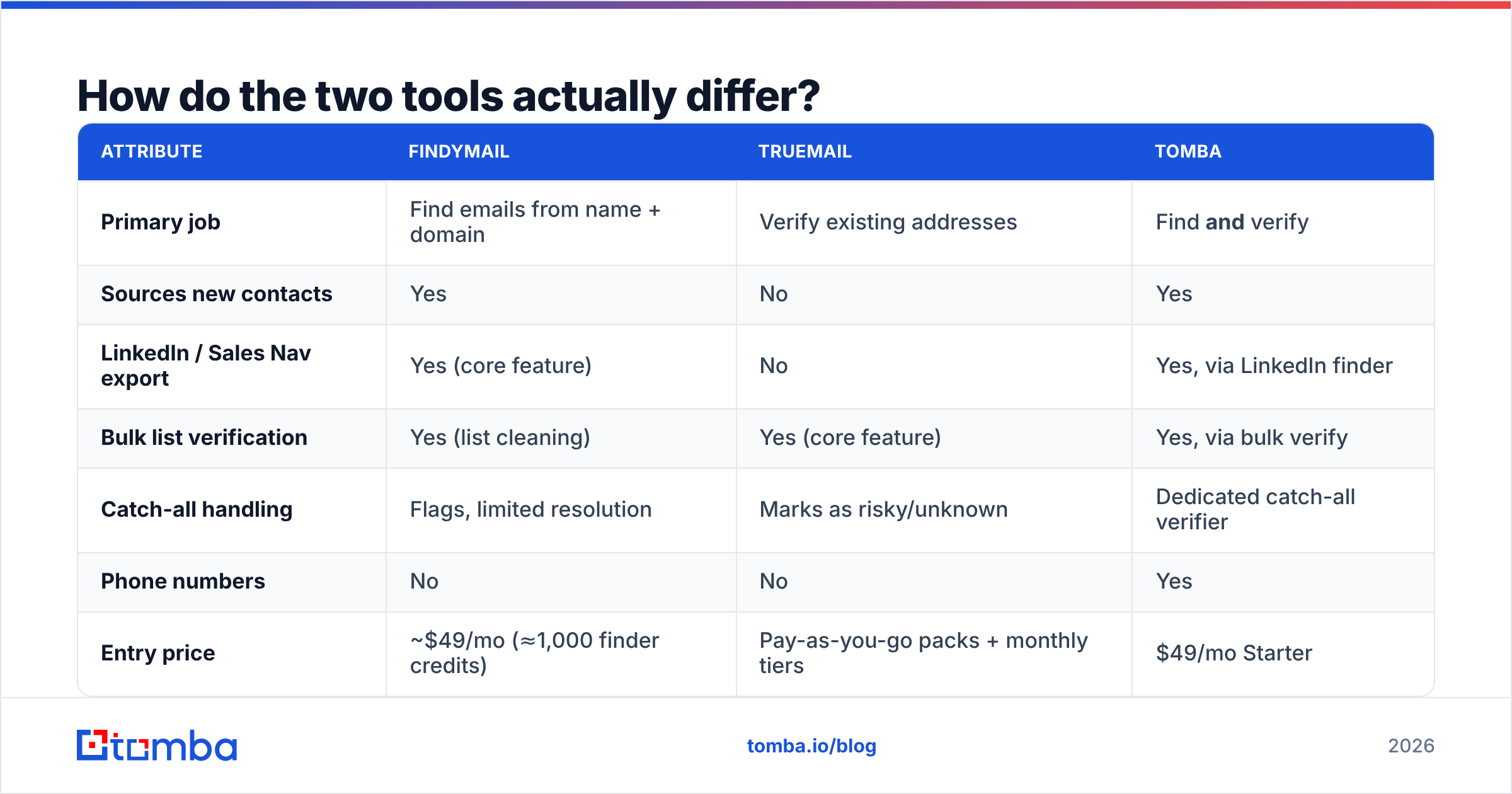
| Attribute | Findymail | Truemail | Tomba |
|---|---|---|---|
| Primary job | Find emails from name + domain | Verify existing addresses | Find and verify |
| Sources new contacts | Yes | No | Yes |
| LinkedIn / Sales Nav export | Yes (core feature) | No | Yes, via LinkedIn finder |
| Bulk list verification | Yes (list cleaning) | Yes (core feature) | Yes, via bulk verify |
| Catch-all handling | Flags, limited resolution | Marks as risky/unknown | Dedicated catch-all verifier |
| Phone numbers | No | No | Yes |
| Entry price | ~$49/mo (≈1,000 finder credits) | Pay-as-you-go packs + monthly tiers | $49/mo Starter |
| Free tier | Limited trial credits | Small free quota | 25 searches/mo, no card |
| API | Yes | Yes | Yes, documented REST API |
| Bounce guarantee | Yes, marketed | Accuracy claim, not a refund | Verified-only credits |
Pricing on all three moves; check Findymail, Truemail, and Tomba pricing before you commit budget. The structural differences above are stable — the dollar figures are not.
Where the credit math bites#
Finder credits and verification credits are not interchangeable, and vendors love this ambiguity.
- A finder credit is expensive because a search costs the vendor pattern inference, crawling, and an SMTP check. Expect $0.03–$0.08 per successful find at entry tiers.
- A verification credit is cheap — often $0.001–$0.005 — because it's a DNS lookup plus a handshake.
- Failed searches usually don't charge you at a good finder. Findymail and Tomba both only bill on results; confirm this in writing for whichever vendor you pick.
- Verifiers charge for every row, including the invalid ones you're paying to discover. A 40%-dead list still costs 100% of the credits.
- Two vendors means two minimums. A $49 finder plus a $30 verifier floor is $79/mo before you send a single email, and neither pool rolls into the other.
That fifth point is the whole argument for consolidation, and it is why so many teams searching for "Findymail vs Truemail" end up buying neither.
Is Findymail more accurate than Truemail?#
Wrong comparison — but here's the useful version of it.
Findymail's accuracy claim is about discovery accuracy: of the emails it returns, how many are real and deliverable. Truemail's accuracy claim is about classification accuracy: of the emails you hand it, how many does it label correctly.
You can have a great finder feeding a bad verifier and still bounce. You can have a great verifier and no leads at all. Judge them separately:
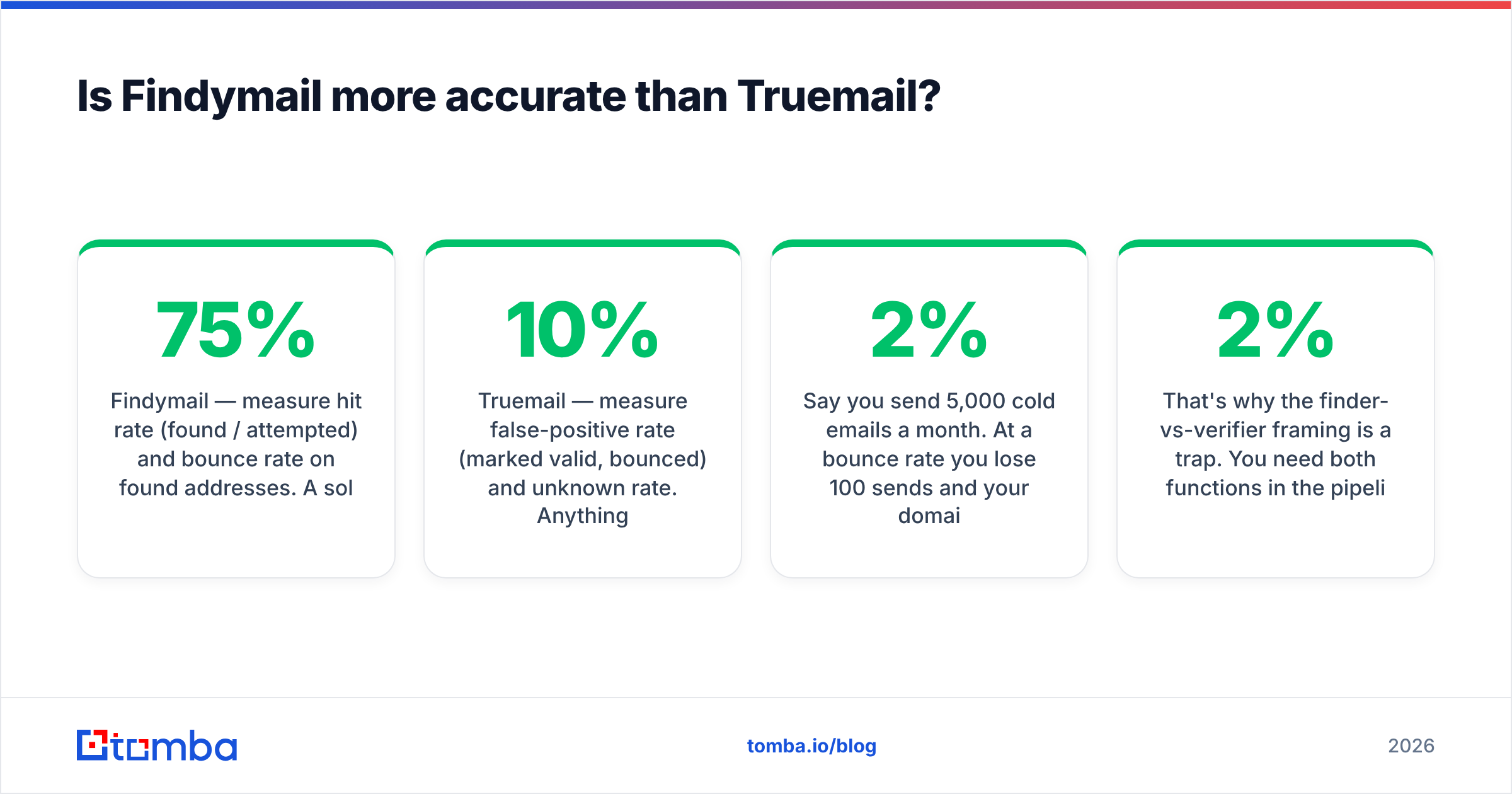
- Findymail — measure hit rate (found / attempted) and bounce rate on found addresses. A solid finder in 2026 lands 55–75% hit rate on mid-market B2B domains and under 3% bounce on what it returns.
- Truemail — measure false-positive rate (marked valid, bounced) and unknown rate. Anything over 10% "unknown" on a normal B2B list means you're paying to be told "we don't know," which is the least useful answer in email.
Catch-all domains are where both tools get exposed. A catch-all server accepts everything at the SMTP layer, so a standard handshake proves nothing. Truemail will typically return "risky" or "accept-all." Findymail flags them too. Resolving them takes a dedicated approach — see how a catch-all finder attacks the problem with pattern corroboration instead of a single SMTP ping.

The bounce math nobody runs#
Say you send 5,000 cold emails a month. At a 2% bounce rate you lose 100 sends and your domain stays healthy. At an 8% bounce rate you lose 400 sends and your sender reputation degrades, which quietly drops inbox placement on the 4,600 that did deliver. Google and Microsoft both tightened bulk-sender requirements in 2024, and enforcement has only hardened since — Google's bulk sender guidelines put the spam-complaint ceiling at 0.3% and expect authenticated, low-bounce sending.
That's why the finder-vs-verifier framing is a trap. You need both functions in the pipeline regardless of how many vendors you pay. Skipping verification on found emails is how a 2% tool becomes an 8% outcome.
Which one should you buy for your use case?#
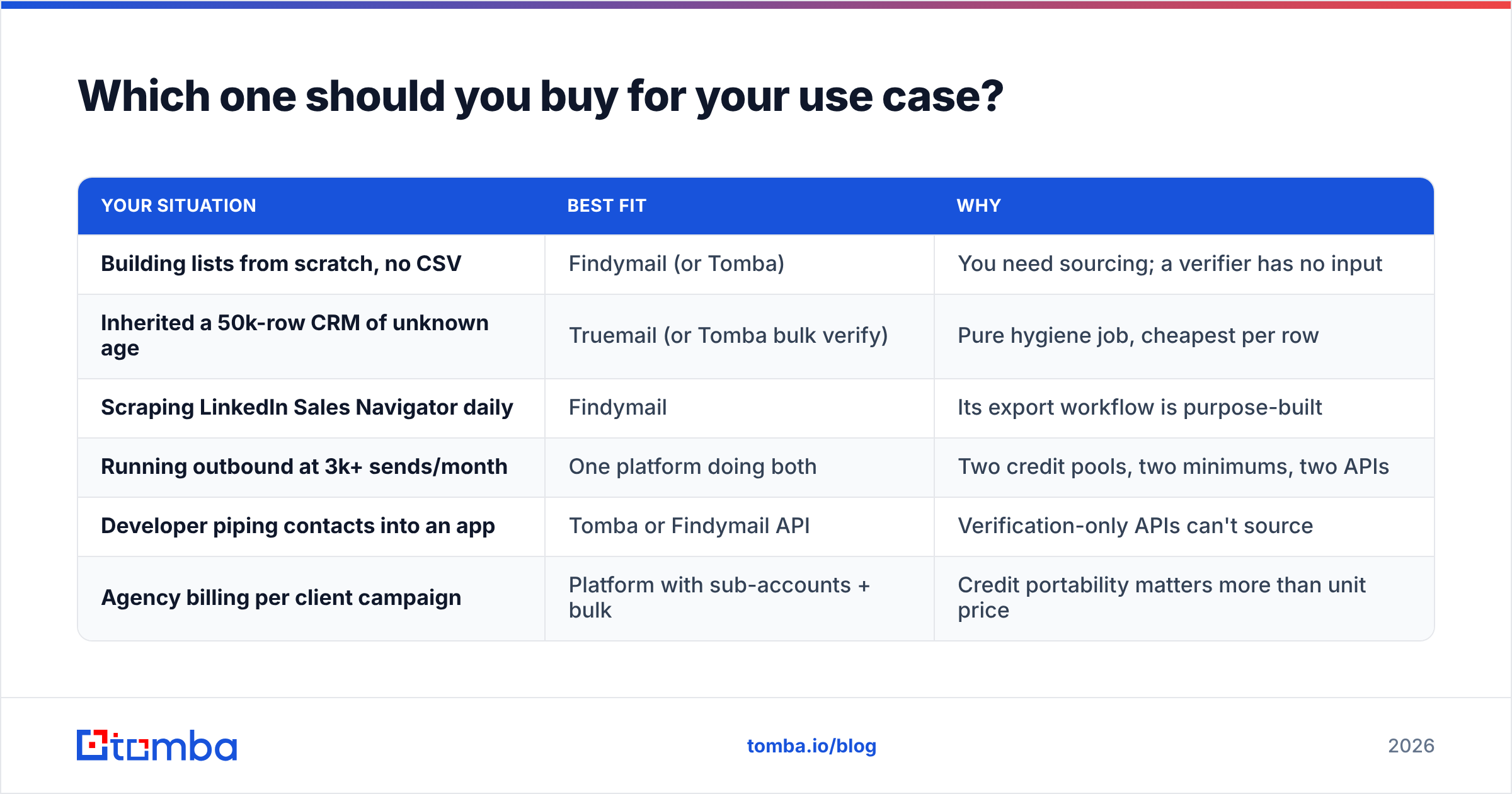
| Your situation | Best fit | Why |
|---|---|---|
| Building lists from scratch, no CSV | Findymail (or Tomba) | You need sourcing; a verifier has no input |
| Inherited a 50k-row CRM of unknown age | Truemail (or Tomba bulk verify) | Pure hygiene job, cheapest per row |
| Scraping LinkedIn Sales Navigator daily | Findymail | Its export workflow is purpose-built |
| Running outbound at 3k+ sends/month | One platform doing both | Two credit pools, two minimums, two APIs |
| Developer piping contacts into an app | Tomba or Findymail API | Verification-only APIs can't source |
| Agency billing per client campaign | Platform with sub-accounts + bulk | Credit portability matters more than unit price |
If your honest answer is "both, sometimes," stop optimizing the vendor comparison and optimize the stack. Running an email finder and an email verifier on the same credit pool removes the reconciliation work entirely: found addresses arrive pre-verified, and the ones that fail verification don't spend a credit.
What does the workflow look like in practice?#
Here's the sequence that actually produces deliverable lists, tool-agnostic:
- Define the account list first. Domains, not people. Pull them from your ICP filter, a B2B database, or a conference exhibitor page.
- Run domain-level discovery. Use domain search to see who's publicly reachable at each company and what the email pattern is. This is cheaper than name-by-name lookups and tells you the format for everyone else.
- Find the specific contacts. Name + domain → email. Only for the roles you actually want.
- Verify before export. Every address, no exceptions, including ones your finder already marked valid. Different infrastructure catches different failures.
- Segment by risk. Valid → main sequence. Catch-all/risky → separate low-volume sequence on a secondary domain. Invalid → discard, don't "try anyway."
- Re-verify anything older than 90 days. B2B data decays 25–30% annually per HubSpot's database-decay research; a list you verified in Q1 is not a verified list in Q4.
Step 6 is where standalone verifiers earn their keep, and it's the one legitimate case for keeping Truemail alongside a finder — if the finder's bulk verification is weak. Check that before you assume you need two vendors.

How do they compare on price at real volume?#
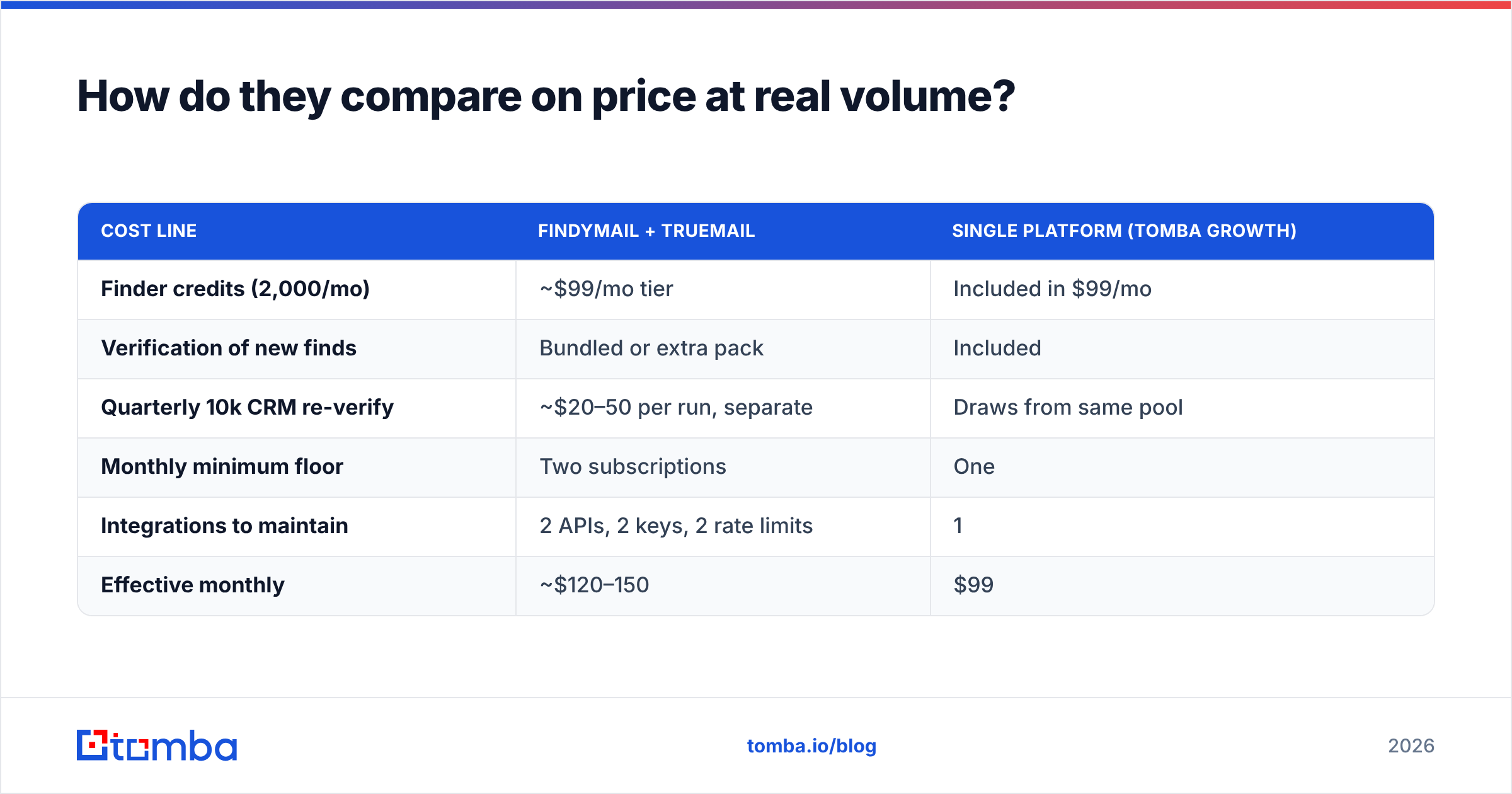
Let's model 2,000 new contacts per month, all of which need verifying, plus a quarterly re-verification of a 10,000-row CRM.
| Cost line | Findymail + Truemail | Single platform (Tomba Growth) |
|---|---|---|
| Finder credits (2,000/mo) | ~$99/mo tier | Included in $99/mo |
| Verification of new finds | Bundled or extra pack | Included |
| Quarterly 10k CRM re-verify | ~$20–50 per run, separate | Draws from same pool |
| Monthly minimum floor | Two subscriptions | One |
| Integrations to maintain | 2 APIs, 2 keys, 2 rate limits | 1 |
| Effective monthly | ~$120–150 | $99 |
The gap isn't dramatic in dollars. It's dramatic in operations. Two vendors means two rate limits to respect, two failure modes during a campaign launch, two invoices in procurement, and a manual join between "found" and "verified" states that someone on your team maintains in a spreadsheet.
For teams that want the join to disappear, data enrichment on the same platform closes the loop — job title, company size, and social profiles arrive with the verified address instead of requiring a third vendor.

What are the honest weaknesses of each?#
Findymail's limits:
- Coverage skews toward tech, SaaS, and North American mid-market. EMEA industrial and APAC coverage thins out.
- No phone numbers. If your motion includes calling, that's another vendor.
- Bounce guarantees are typically credit refunds, not revenue recovery. A refunded credit doesn't un-burn your domain reputation.
- Pricing is per-credit with plan minimums; light users overpay.
Truemail's limits:
- It cannot source. Full stop. It's an accessory, not a stack.
- Catch-all domains return ambiguous results — an industry-wide limitation, not a Truemail flaw, but it caps the value of verification-only tooling on enterprise domains where catch-all is common.
- Verification is a commodity. Dozens of vendors do it at similar unit economics, which makes vendor lock-in a bad trade. If you're weighing it against others, look at a ZeroBounce alternative or a Bouncer alternative before assuming you've found the floor price.
- No enrichment. You learn "valid" and nothing else about the person.
And the honest weakness of the consolidation argument: a single platform is a single point of failure. If you're running outbound at serious volume, keeping a cheap pay-as-you-go verifier as a second opinion on high-value lists is defensible. Just don't pay a monthly minimum for the privilege — use a PAYG pack.
What about the alternatives worth checking?#
Neither Findymail nor Truemail exists in a vacuum. If you're comparison-shopping in this category, these are the ones that come up repeatedly on G2's lead-intelligence category:
- Apollo — huge database, sequencing built in, but data freshness varies by segment and the platform pushes you toward its full sales-engagement suite. See the Apollo alternative breakdown.
- BookYourData — pay-as-you-go B2B contact lists with a strong accuracy guarantee and no subscription lock-in. Genuinely good if you want to buy a targeted list outright rather than run searches, and its credit model suits agencies with lumpy demand.
- Clearbit — enrichment-first, now inside HubSpot's orbit. Excellent firmographics, not a cold-outbound sourcing tool. See the Clearbit alternative comparison.
- Findymail itself — if you like the product but want a second finder for coverage gaps, running two finders beats running a finder plus a verifier.
The category has converged: nearly every serious vendor now bundles verification with finding. Paying separately for verification in 2026 is a choice, not a requirement.
So which wins: Findymail or Truemail?#
Findymail wins the direct matchup, because it does the harder job and includes a version of the easier one. A verifier without a finder cannot start a campaign; a finder without a verifier can — imperfectly, but it can.
That said, the real answer for most outbound teams is neither-exclusively. Pick based on the shape of your problem:
- Sourcing-heavy, list-light → Findymail, and use its list cleaning rather than adding a verifier.
- List-heavy, sourcing-light → Truemail, or any commodity verifier at the best unit price. Don't overpay for a brand here.
- Both, continuously → consolidate. One credit pool, one API, one invoice.
Before you commit, run the same 100 contacts through every tool on your shortlist and measure two numbers: hit rate and bounce rate on a real send. Vendor accuracy claims are marketing. Your 100-contact test is data.
Start with a real test, not a trial-length guess. Tomba's Email Finder gives you 25 searches per month free — no card — with verification built into the same credit, so you can benchmark hit rate and bounce rate side by side against whatever you're paying for now. If the numbers favor your current stack, keep it. If they don't, Starter is $49/mo and covers finding, verifying, catch-all resolution, and enrichment in one place instead of three.
Related guides#
Ready to find emails that actually work?
Join 150,000+ professionals who stopped guessing and started sending. Free credits on signup — no credit card required.
Get the Tomba newsletter
Practical outbound tactics and product updates — once every two weeks.
About the author