Flashlabs Reviews 2026: Features, Pricing, and Real Limits
Most Flashlabs reviews stop at the marketing page. This one walks through what the product actually does, where the data thins out, how the pricing works, and which alternatives beat it on cost per verified contact.
TL;DR
- Flashlabs sits in the crowded "AI-assisted B2B lead data and outbound" category, and most published Flashlabs reviews are thin because the vendor keeps a lot of its specifics behind a demo request.
- The decision that actually matters is not "is Flashlabs good" but "what is my cost per verified, deliverable contact" — a number almost no vendor advertises.
- Ask for a 200-row sample against your real ICP before you sign anything. Any vendor that refuses a blind sample is telling you something.
- If you mostly need accurate work emails at a predictable price, a dedicated finder plus verifier stack (Tomba at $49/mo Starter, or a prebuilt list vendor like BookYourData) usually lands cheaper per usable record than a bundled AI platform.
- Watch for the three cost traps: per-seat minimums, credits that burn on failed lookups, and annual-only contracts on unproven data quality.
What is Flashlabs and who is it for?#
Flashlabs is positioned as an AI-driven go-to-market tool for B2B teams — the broad category that includes lead sourcing, contact data, enrichment, and some layer of automated outbound assistance. That category exploded between 2023 and 2026, and the branding across it has converged so hard that the product pages are close to interchangeable: "AI agents", "signal-based prospecting", "on-demand data".
Here is the honest starting point for any Flashlabs review, including this one: the company publishes relatively little hard detail publicly. Feature lists, credit definitions, and pricing tiers are gated or change without a changelog. That is not automatically a red flag — plenty of good tools sell that way — but it does mean you should treat every specific claim you read online, including numbers quoted in third-party roundups, as something to re-verify on a call.
So instead of pretending to a precision nobody has, this review does something more useful: it gives you the evaluation frame that separates a real data vendor from a repackaged one, applies it to Flashlabs' category, and shows what the alternatives cost when you measure them the same way.
Who it's plausibly for:
- Small outbound teams who want sourcing, enrichment, and sending in one login and will accept less control for that.
- Founders running their first outbound motion who don't yet have opinions about waterfall enrichment.
Who it's probably not for:
- Teams with an existing sequencer (Instantly, Smartlead, Outreach) who only need better contact data.
- Anyone building programmatic enrichment into a product or CRM workflow, where an API with documented rate limits matters more than a UI.
How should you evaluate Flashlabs reviews you find online?#
Most reviews of tools in this category are useless for a predictable reason: they compare feature checklists instead of outputs. Every vendor has "email finder", "verification", and "enrichment" on the page. What differs by 3-5x is the hit rate and the bounce rate on your accounts.
Use these five checks on Flashlabs, or on any vendor in this space:
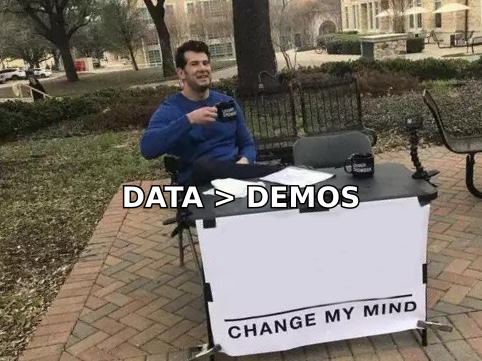
- Blind sample, your list. Send 200 companies from your actual ICP — not their demo list. Count how many rows come back with a work email, then verify those independently. A 60% match rate on your niche beats a claimed 95% on theirs.
- Bounce rate, measured after the fact. Match rate and accuracy are different numbers. A vendor can return an address for 90% of rows and still hand you 12% bounces. Run the returned addresses through a separate email verifier before your first send.
- Credit mechanics in writing. Ask exactly this: "Do I get charged for a lookup that returns nothing?" and "Do credits roll over?" The answers change effective price more than the sticker does.
- Catch-all handling. A huge share of B2B domains are catch-all, which accept everything at the SMTP layer and tell you nothing. Vendors that mark these as "valid" are inflating their own accuracy stats. A real catch-all verifier scores them separately instead of hiding them.
- Exit cost. Can you export everything you paid for as CSV, keep it after cancellation, and is that in the contract? Bundled platforms are where data gets rented rather than bought.
Point 5 is the one people skip and regret. If sourcing, enrichment, and sending all live in one vendor, churning means rebuilding all three at once.
Is Flashlabs accurate enough for cold outbound in 2026?#
Accuracy is the whole ballgame, and 2026 made it harder to fake. Google and Yahoo's bulk-sender rules — the ones that put a hard spam-complaint ceiling on senders — mean a list with a 10% bounce rate doesn't just waste credits, it degrades your sender reputation for months. Data quality became a deliverability problem, not a procurement one.
Two things to understand about how any vendor in this category gets to its accuracy number:
Pattern inference vs. verified sourcing. Guessing first.last@company.com from a known pattern is cheap and often right. It is also how you end up mailing addresses that were never provisioned. The question to ask is what percentage of returned emails were observed somewhere versus generated by pattern, and whether the vendor separates those in the response. Tools that expose a confidence score per record — and document how it's computed, the way Tomba does on its data sources page — let you set a threshold. Tools that return a bare string do not.
Recency. B2B contact data decays roughly 25-30% per year through job changes alone, and the 2024-2025 tech layoff cycles accelerated it. A database refreshed quarterly is meaningfully worse than one verified at query time. Ask when the record you're looking at was last confirmed.
If Flashlabs can't answer both questions on a call, price it as a pattern-generation tool and budget for a separate verification pass. That's not an insult — plenty of teams run exactly that stack deliberately.
How does Flashlabs compare to the alternatives?#
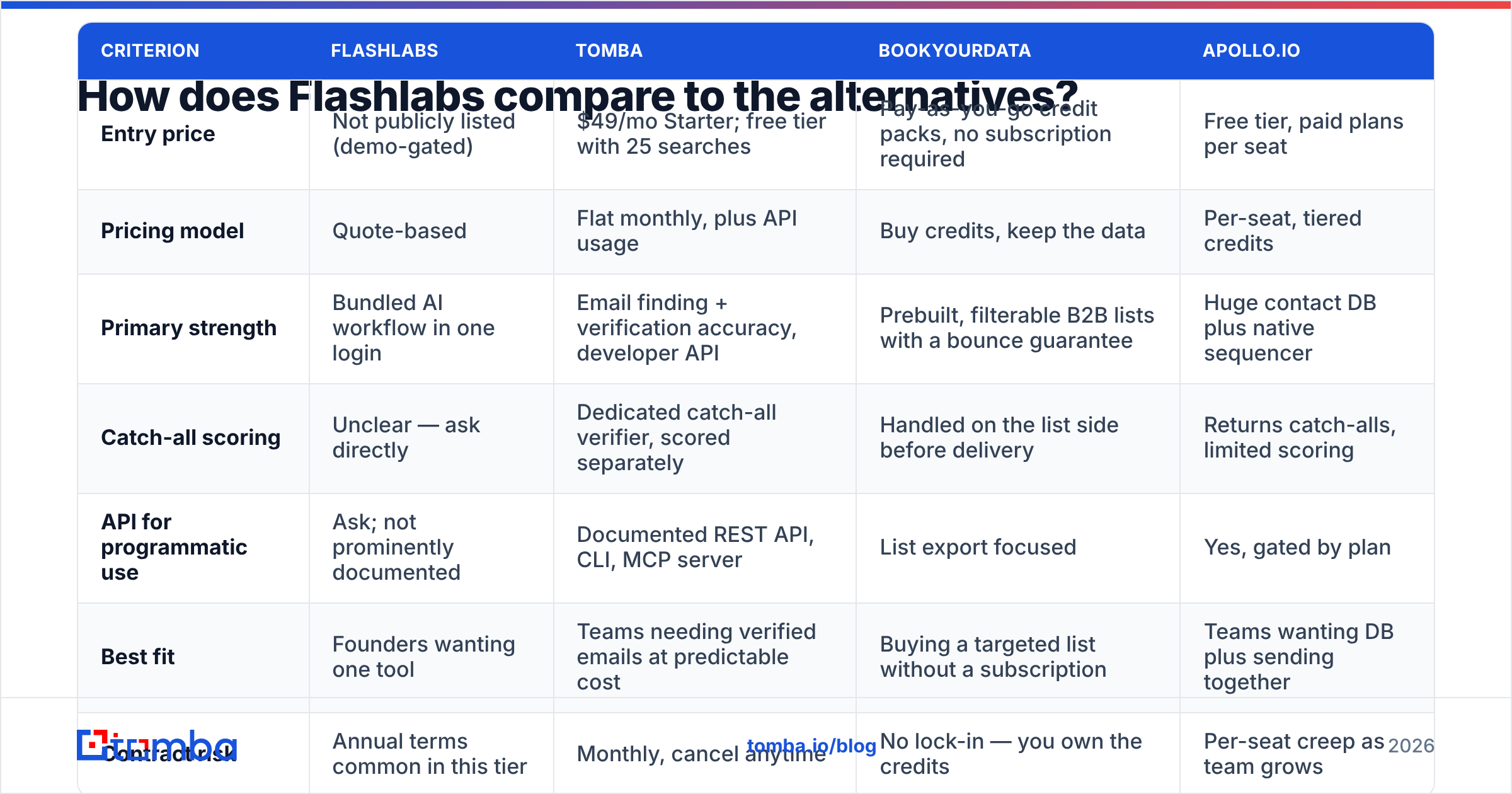
Here's the comparison that matters, normalized on the things buyers actually get burned by. Where a vendor doesn't publish a figure, this table says so rather than inventing one — check the current numbers on each vendor's own site before you buy.
| Criterion | Flashlabs | Tomba | BookYourData | Apollo.io |
|---|---|---|---|---|
| Entry price | Not publicly listed (demo-gated) | $49/mo Starter; free tier with 25 searches | Pay-as-you-go credit packs, no subscription required | Free tier, paid plans per seat |
| Pricing model | Quote-based | Flat monthly, plus API usage | Buy credits, keep the data | Per-seat, tiered credits |
| Primary strength | Bundled AI workflow in one login | Email finding + verification accuracy, developer API | Prebuilt, filterable B2B lists with a bounce guarantee | Huge contact DB plus native sequencer |
| Catch-all scoring | Unclear — ask directly | Dedicated catch-all verifier, scored separately | Handled on the list side before delivery | Returns catch-alls, limited scoring |
| API for programmatic use | Ask; not prominently documented | Documented REST API, CLI, MCP server | List export focused | Yes, gated by plan |
| Best fit | Founders wanting one tool | Teams needing verified emails at predictable cost | Buying a targeted list without a subscription | Teams wanting DB plus sending together |
| Contract risk | Annual terms common in this tier | Monthly, cancel anytime | No lock-in — you own the credits | Per-seat creep as team grows |
A few notes on that table, because a grid flattens nuance.
BookYourData deserves a fair hearing if your motion is "buy a targeted list, run a campaign, measure." It's a different purchase shape than a subscription — you pay for records and keep them, and it comes with a delivery guarantee on bounces. For a one-off ABM push into a defined segment, that's often cleaner than renting seats for twelve months.
Apollo wins on breadth and on having the sequencer built in, and loses on per-seat cost as the team grows and on data freshness in narrower verticals. If you're evaluating Flashlabs against it, read the Apollo alternative breakdown for where the per-seat math turns.
Tomba is narrower on purpose: find the email, verify the email, enrich the record, expose it all through an API. If you already have a sequencer you like, that narrowness is a feature — you replace one layer instead of your whole stack. Tomba pricing runs Free (25 searches), Starter $49/mo, Growth $99/mo, Pro $249/mo, Enterprise custom.
What do real users complain about in this category?#
Since vendor-published testimonials are worthless as evidence, go to the aggregators. G2 and Capterra both let you filter reviews to the last six months, which is the only window that matters in a category this fast-moving. Sort by lowest rating first and read those — the one-star reviews tell you about billing and support, which is where B2B tools actually fail. Gartner Peer Insights is thinner on early-stage vendors but stricter about verifying reviewers.
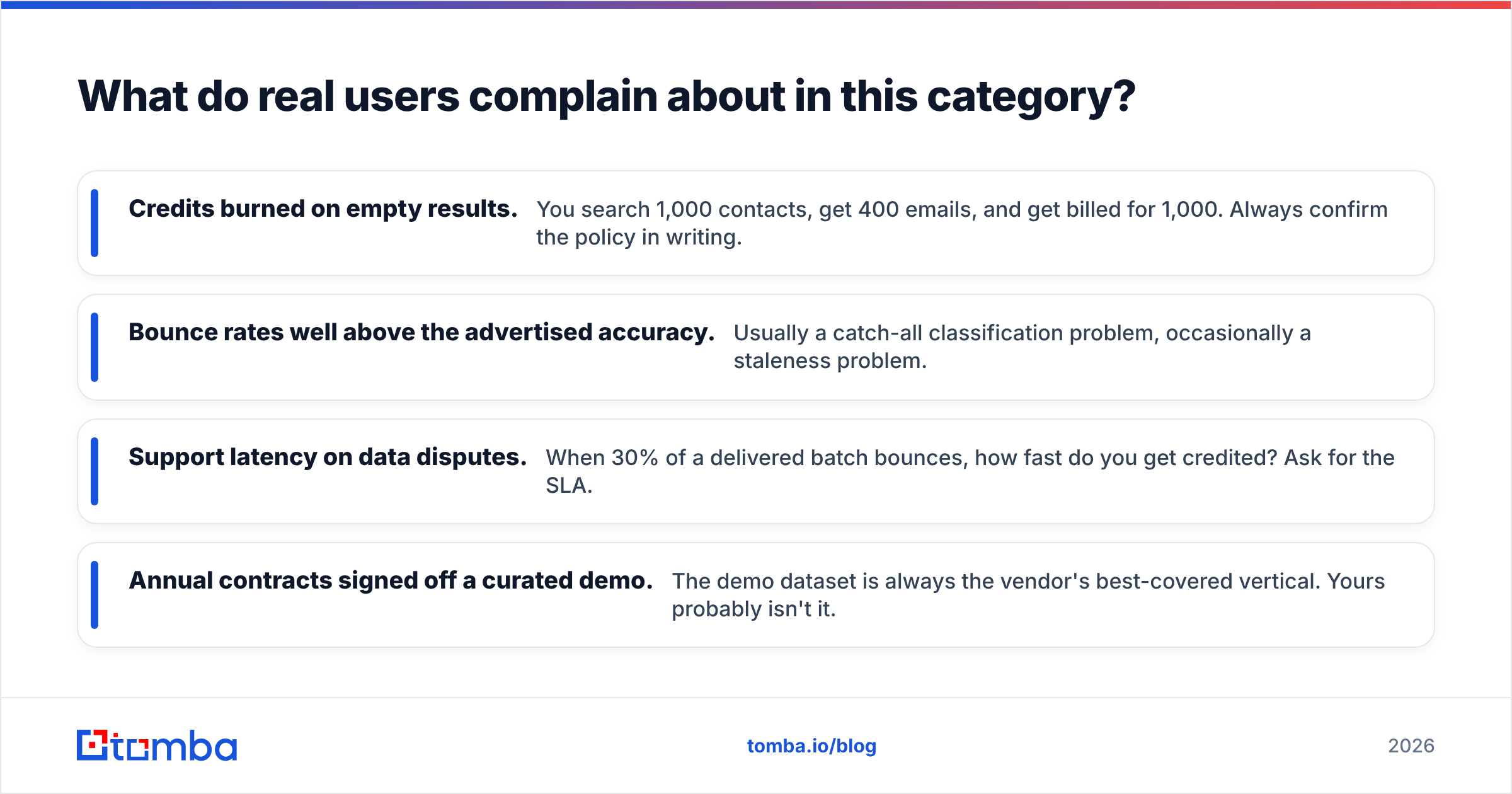
Across this whole category, the recurring complaints cluster in four places:
- Credits burned on empty results. You search 1,000 contacts, get 400 emails, and get billed for 1,000. Always confirm the policy in writing.
- Bounce rates well above the advertised accuracy. Usually a catch-all classification problem, occasionally a staleness problem.
- Support latency on data disputes. When 30% of a delivered batch bounces, how fast do you get credited? Ask for the SLA.
- Annual contracts signed off a curated demo. The demo dataset is always the vendor's best-covered vertical. Yours probably isn't it.
None of these are unique to Flashlabs. All of them are worth a direct question before you sign.
What's the smarter way to structure your stack?#
The pattern that holds up in 2026 is unbundling the data layer from the sending layer. Not because bundles are bad in principle, but because the two layers fail differently and you want to be able to swap one without touching the other.
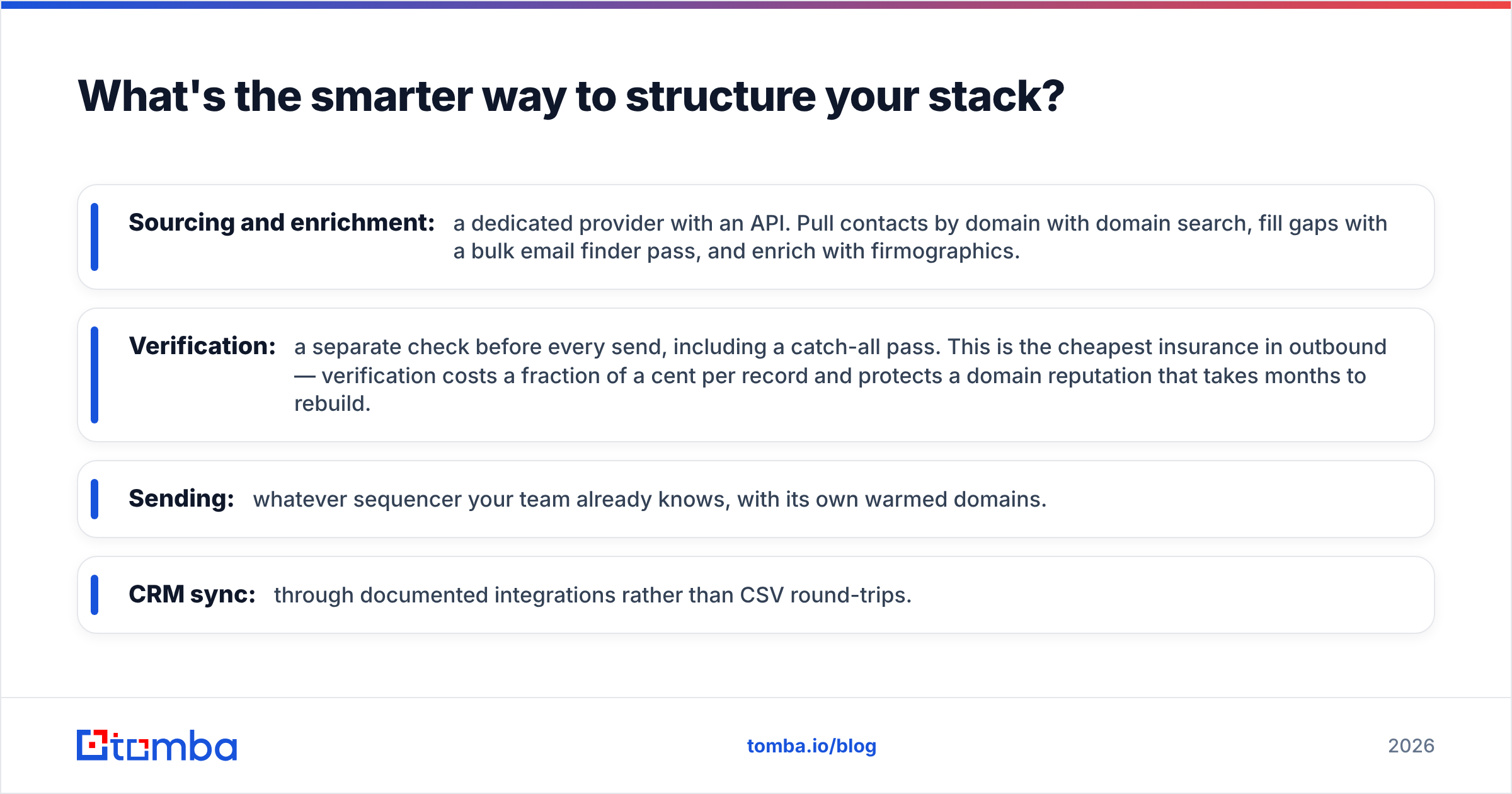
A stack that survives a vendor change:
- Sourcing and enrichment: a dedicated provider with an API. Pull contacts by domain with domain search, fill gaps with a bulk email finder pass, and enrich with firmographics.
- Verification: a separate check before every send, including a catch-all pass. This is the cheapest insurance in outbound — verification costs a fraction of a cent per record and protects a domain reputation that takes months to rebuild.
- Sending: whatever sequencer your team already knows, with its own warmed domains.
- CRM sync: through documented integrations rather than CSV round-trips.
If Flashlabs fits your sourcing layer after a blind sample test, use it there and keep the rest modular. If it only wins on convenience, weigh that against what convenience costs when the contract renews.
The verdict: is Flashlabs worth it?#
Conditional yes, with a hard prerequisite: run the blind sample. Flashlabs may well perform fine for your ICP, and the bundled-workflow pitch is genuinely valuable for small teams without ops support. But because pricing and coverage aren't publicly documented, you're being asked to buy on trust, and trust in this category should be earned by a test batch, not a demo.
Score it on the only metric that survives contact with reality: cost per verified, deliverable contact in your segment. Then run the same calculation against a dedicated finder-plus-verifier stack and a pay-as-you-go list vendor. Whichever number is lowest wins, regardless of which product page was prettiest.
If your answer is "I mainly need accurate work emails, not another platform to learn," start with the Tomba Email Finder. The free tier gives you 25 searches to run your own blind test — same 200-company list you'd send any vendor, same verification pass afterward — and Starter is $49/mo flat if the numbers hold up. Test it against whatever Flashlabs quotes you, measure bounces, and let the data pick.
Related guides#
Ready to find emails that actually work?
Join 150,000+ professionals who stopped guessing and started sending. Free credits on signup — no credit card required.
Get the Tomba newsletter
Practical outbound tactics and product updates — once every two weeks.
About the author