8 Best Flike Alternatives in 2026 for AI Sales Emails
Flike writes the email, but it can't tell you who to email or whether the address bounces. Here are 8 Flike alternatives ranked by what they actually fix — copy, data, or sending.
TL;DR
- Flike is an AI sales copilot that drafts cold emails, follow-ups and LinkedIn messages from your CRM history and past winning threads. It is a writing layer, not a data layer.
- Most teams shopping for Flike alternatives aren't unhappy with the copy — they're unhappy that great copy is landing on stale, unverified, or plain wrong contacts.
- Split your shortlist into three buckets: copy tools (Lavender, Regie.ai), sending platforms (Instantly, Apollo), and data layers (Tomba, BookYourData, Clay).
- Cheapest credible replacement stack in 2026: a verified data source plus a sending tool plus whatever AI writer you already pay for — usually under $150/month for a two-rep team.
- If your reply rate is stuck below 3%, fix the list before you fix the sentences. Bounce rates above 5% do more damage than any subject line ever will.
What is Flike, and what does it actually do?#
Flike is an AI sales copilot that lives in your browser and drafts outbound messages for you. You install the extension, connect your CRM and sales engagement tool, and it generates a first draft of a cold email, a follow-up, or a LinkedIn note using three inputs: the prospect's public footprint, your historical conversations, and the deals that previously closed.
The pitch is straightforward — reps waste 30 to 40 minutes a day rewriting the same four emails, and a model trained on your own winning threads can produce a draft in three seconds. In practice that's what it does. It sits inside Gmail, Outreach, Salesloft, HubSpot and LinkedIn, and it removes the blank-page problem.
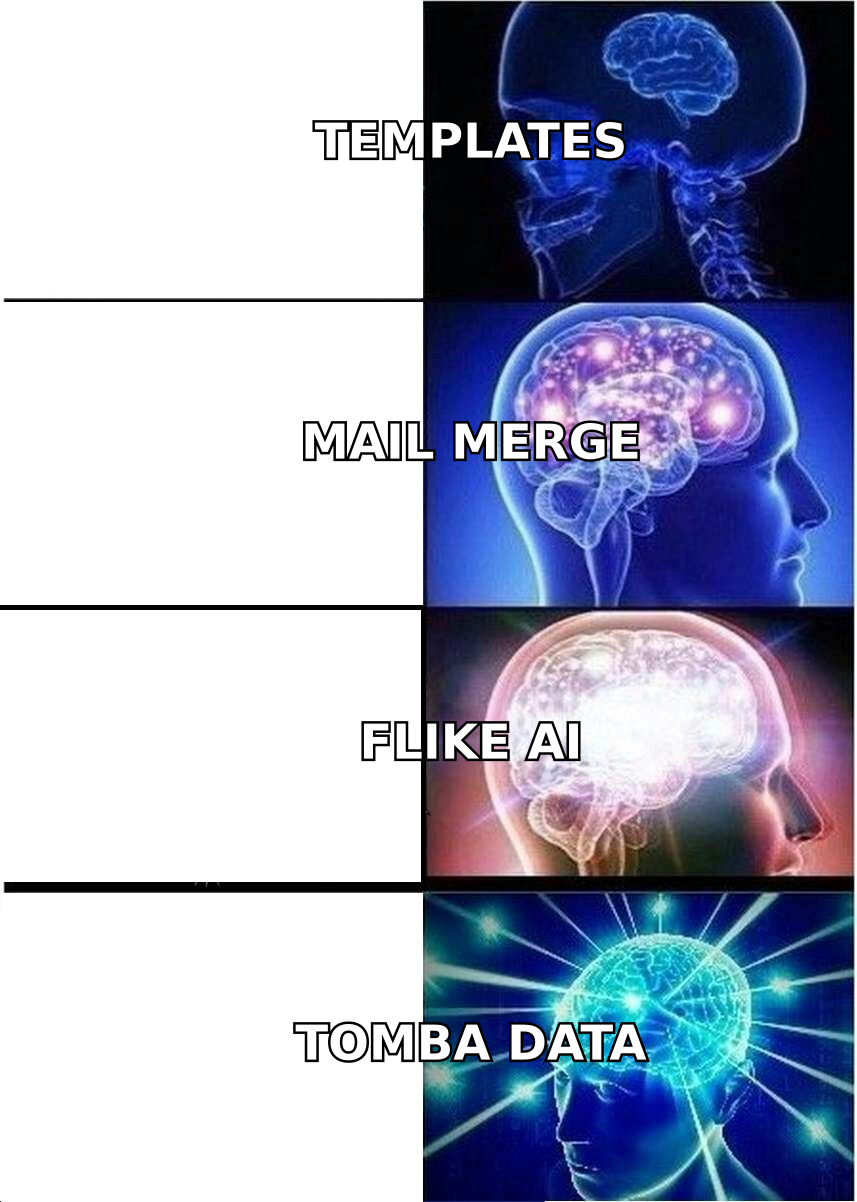
What Flike does not do is tell you who to write to. It doesn't find email addresses, it doesn't verify them, it doesn't tell you when someone changed jobs six weeks ago, and it doesn't warn you that the domain you're about to hit is a catch-all that will accept anything and deliver nothing. That gap is why "Flike alternatives" is a search with real intent behind it rather than idle tool tourism.
Why are teams looking for Flike alternatives in 2026?#
Five patterns show up again and again when teams start evaluating replacements:
- The copy was never the bottleneck. A team sending 2,000 emails a month at a 6% bounce rate has a deliverability problem, not a writing problem. Better prose on a bad list still gets filtered.
- Seat-based pricing scales badly. Copilot tools generally charge per rep. If you have eight SDRs and a data budget that's already thin, per-seat AI writing is the first line item finance questions.
- Stack consolidation. Buyers in 2026 are cutting point solutions. A tool that only writes drafts competes directly with the AI writer already bundled into Apollo, Instantly, HubSpot and Salesloft — usually at no extra cost.
- Personalization needs facts, not adjectives. An AI that riffs on a LinkedIn headline produces generic flattery. An AI fed real signals — funding round, tech stack, hiring pattern, verified job title — produces something a prospect actually answers.
- Compliance and data provenance. Legal teams increasingly ask where contact data came from. A writing tool has no answer to that question because it never sourced the contact in the first place.
If reasons 1, 4 or 5 describe you, a different AI writer will not help. You need a different layer of the stack.
What are the best Flike alternatives?#
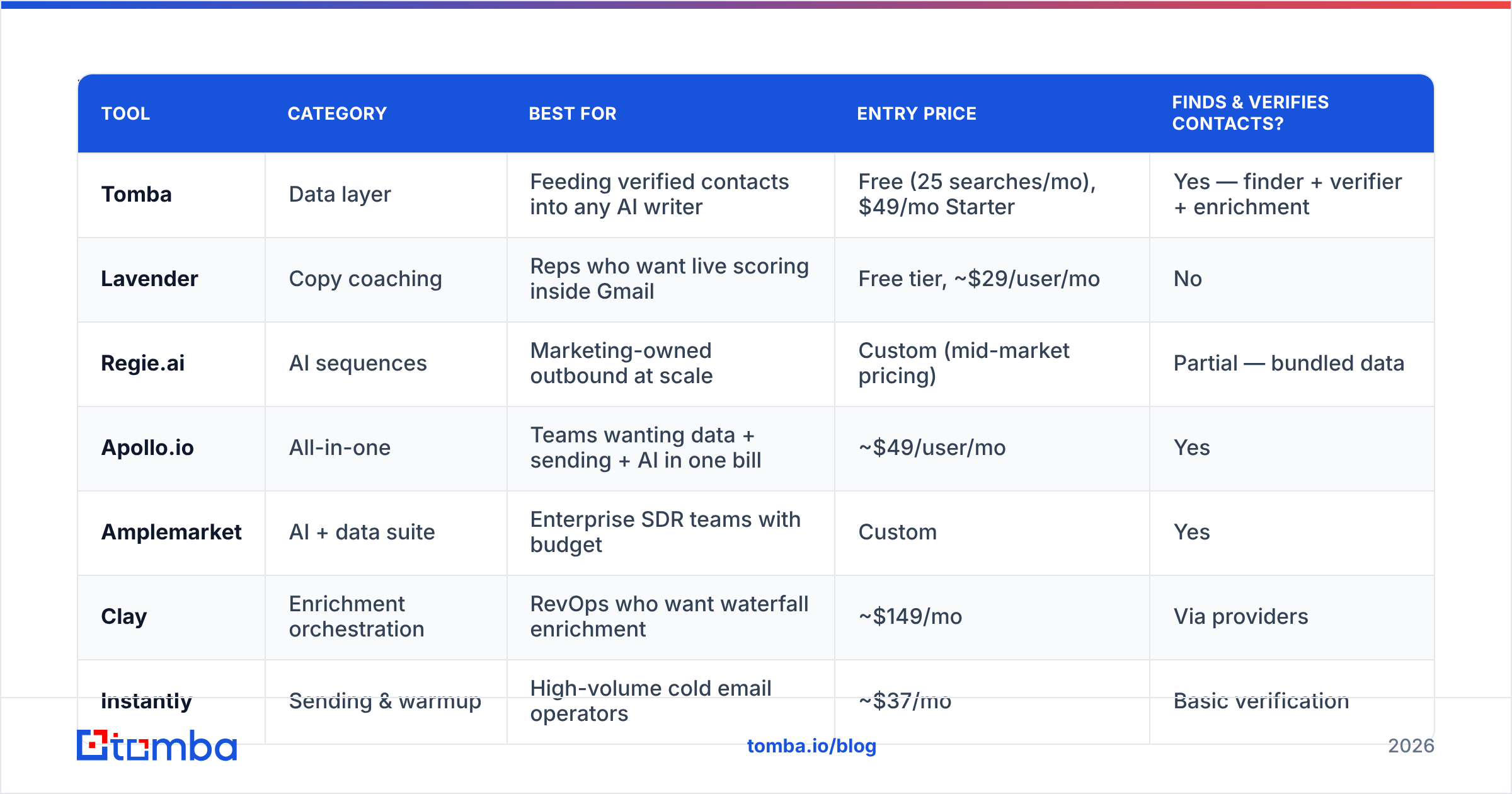
Here's the full shortlist with the honest positioning. Pricing is indicative at time of writing — always check the vendor's current page before you budget.
| Tool | Category | Best for | Entry price | Finds & verifies contacts? |
|---|---|---|---|---|
| Tomba | Data layer | Feeding verified contacts into any AI writer | Free (25 searches/mo), $49/mo Starter | Yes — finder + verifier + enrichment |
| Lavender | Copy coaching | Reps who want live scoring inside Gmail | Free tier, ~$29/user/mo | No |
| Regie.ai | AI sequences | Marketing-owned outbound at scale | Custom (mid-market pricing) | Partial — bundled data |
| Apollo.io | All-in-one | Teams wanting data + sending + AI in one bill | ~$49/user/mo | Yes |
| Amplemarket | AI + data suite | Enterprise SDR teams with budget | Custom | Yes |
| Clay | Enrichment orchestration | RevOps who want waterfall enrichment | ~$149/mo | Via providers |
| Instantly | Sending & warmup | High-volume cold email operators | ~$37/mo | Basic verification |
| BookYourData | Prepaid B2B lists | One-off campaigns without a subscription | Pay-as-you-go credits | Yes — verified lists |
Four of these are genuine Flike substitutes in the narrow sense (they write copy). The other four replace the reason you wanted better copy in the first place.
Which of these replaces Flike one-for-one?#
Lavender is the closest philosophical match. It scores your draft in real time — length, reading grade, question count, spam triggers — and nudges you toward emails that historically get replies. It's coaching rather than generation, which many managers prefer because reps actually learn something. See lavender.ai for current plans.
Regie.ai goes the other direction: full sequence generation, brand voice controls, and AI agents that work a list semi-autonomously. It's a bigger commitment and priced accordingly, but for a marketing team that owns outbound messaging across many reps, it centralizes voice in a way a per-rep copilot never will. Check regie.ai for details.
Apollo.io bundles an AI writing assistant into a platform that also holds the contact database and the sequencer. If you already pay for Apollo, you may be paying for a Flike substitute without knowing it. If Apollo's data coverage is what's letting you down, an Apollo alternative focused purely on accuracy is the better move.
Amplemarket is the enterprise answer — AI copy, buying-intent signals, and its own contact data in one contract. Strong product, but the price floor rules out most teams under 15 reps.
Does AI copy or contact data move reply rates more?#
Run the arithmetic before you buy anything.
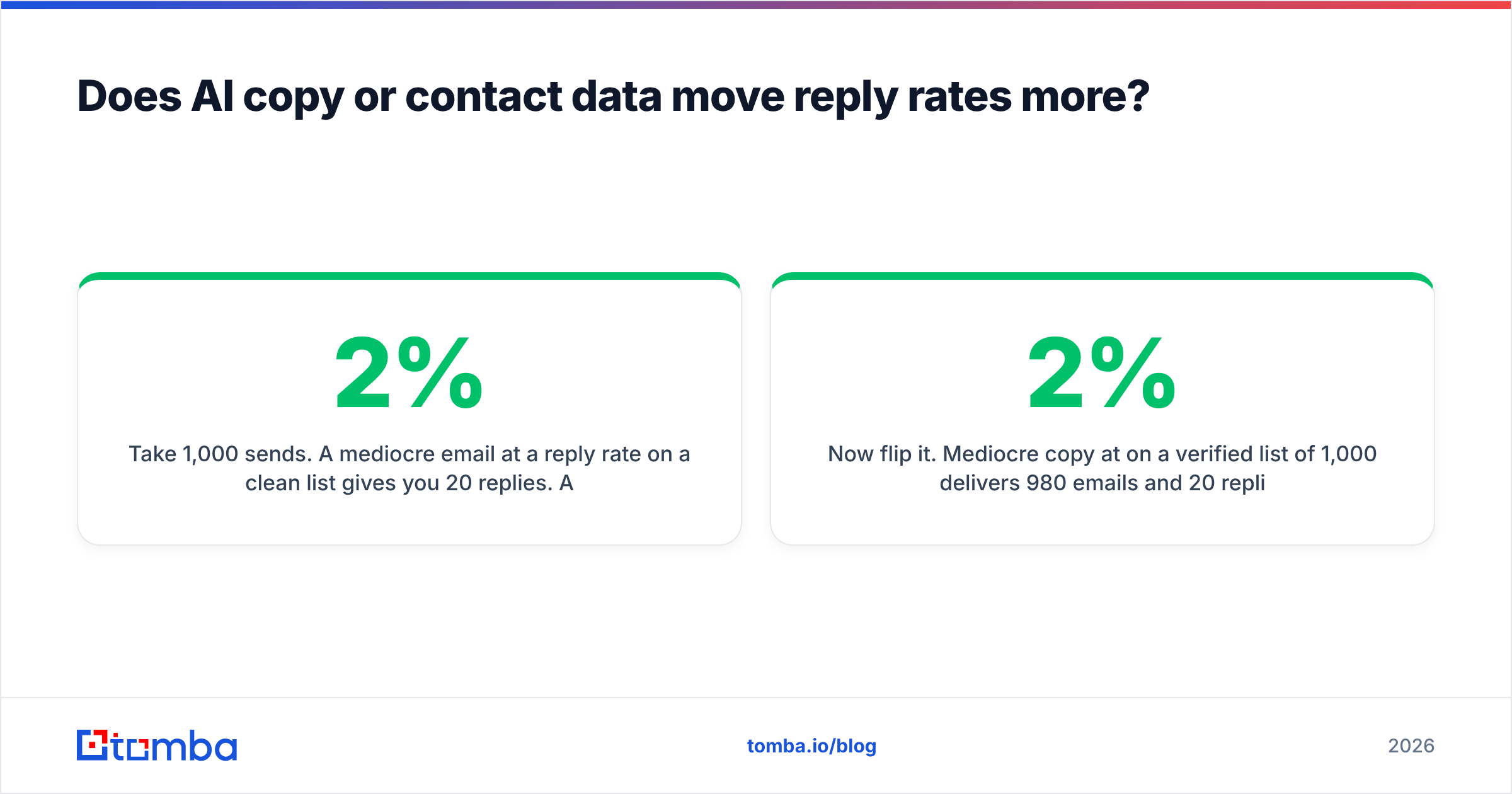
Take 1,000 sends. A mediocre email at a 2% reply rate on a clean list gives you 20 replies. A brilliant AI-written email at 4% reply rate on a list where 25% of addresses are dead or wrong gives you 750 delivered × 4% = 30 replies — better, but you also just burned your sender reputation with 250 bounces, and the next campaign performs worse.
Now flip it. Mediocre copy at 2% on a verified list of 1,000 delivers 980 emails and 20 replies with no reputation damage. Add decent AI copy on top and you're at 39 replies from the same list, indefinitely repeatable.
The multiplier compounds on the data side because bad addresses don't just fail once — they degrade the email deliverability of every campaign that follows. Google and Microsoft both tightened bulk-sender enforcement, and spam complaint thresholds are now a hard ceiling rather than a guideline. G2's sales engagement category reviews reflect this shift: the loudest complaints are about data decay, not copy quality.
This is the honest case against replacing Flike with another writing tool. If you keep the layer and change the vendor, you've changed the paint, not the foundation.
How do you build a replacement stack without overpaying?#
Five steps, in order:
- Audit what you already own. HubSpot, Salesloft, Outreach, Apollo and Instantly all ship AI drafting now. Cancel duplicate spend before you add anything.
- Source contacts from a dedicated provider. Use an email finder that returns a confidence score and a source, not just a string that looks like an address.
- Verify before every send, not once a quarter. B2B contact data decays roughly 2–3% a month as people change roles. A pre-send pass through an email verifier is the cheapest insurance in the stack.
- Enrich for personalization inputs. Job title, seniority, company size, tech stack and location are what turn a generic AI draft into a specific one. Push those fields into your writer via data enrichment rather than asking the model to guess.
- Keep the AI writer you like. Once steps 2–4 are solid, whichever writing tool you pick matters much less. That's the point.
What does each stack actually cost?#
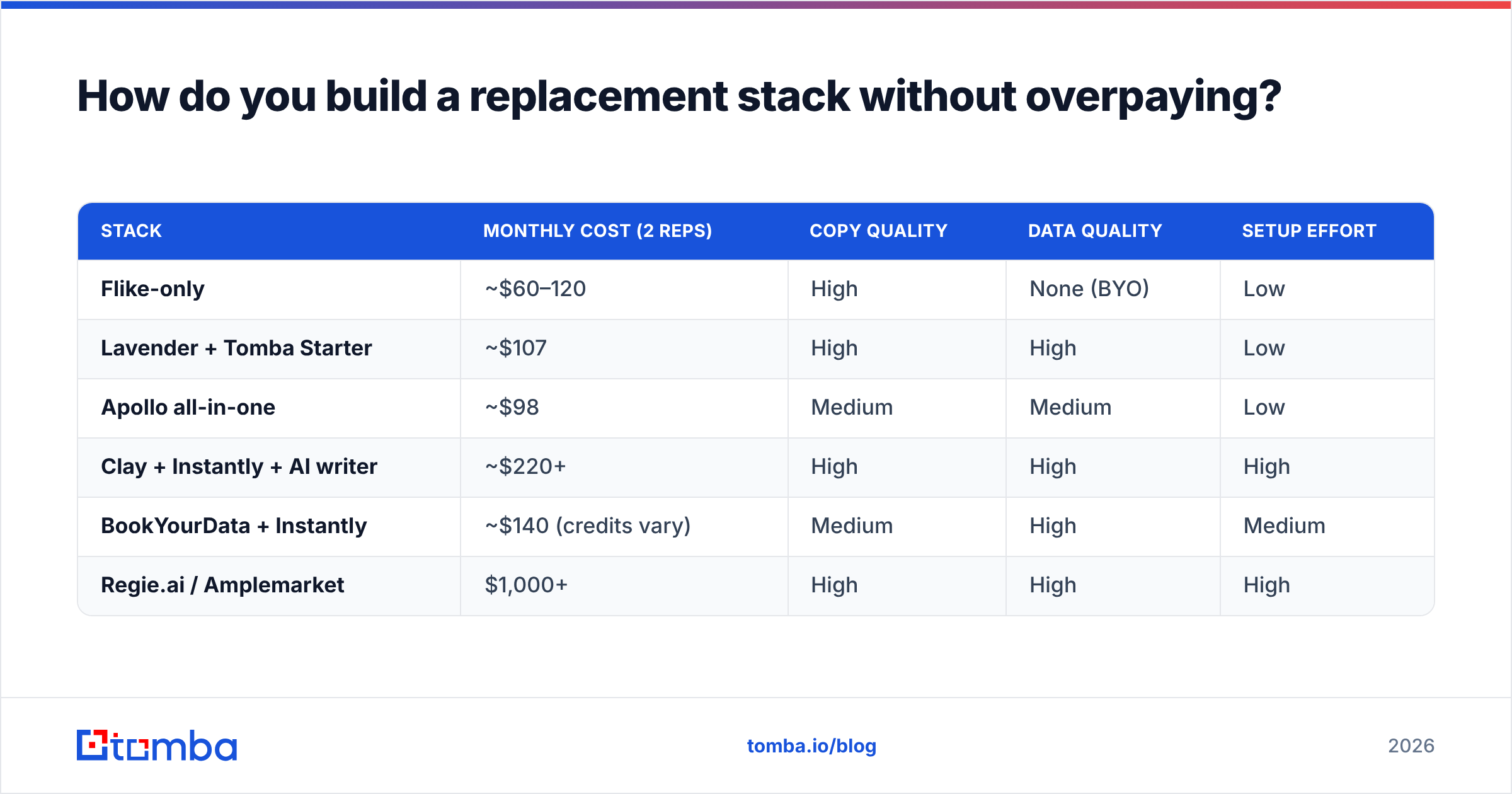
| Stack | Monthly cost (2 reps) | Copy quality | Data quality | Setup effort |
|---|---|---|---|---|
| Flike-only | ~$60–120 | High | None (BYO) | Low |
| Lavender + Tomba Starter | ~$107 | High | High | Low |
| Apollo all-in-one | ~$98 | Medium | Medium | Low |
| Clay + Instantly + AI writer | ~$220+ | High | High | High |
| BookYourData + Instantly | ~$140 (credits vary) | Medium | High | Medium |
| Regie.ai / Amplemarket | $1,000+ | High | High | High |
The Lavender-plus-data-layer combination is the pattern most sub-20-rep teams land on, because it splits the two jobs cleanly and neither vendor is trying to upsell you the other half badly.
When is a prepaid list the better answer?#
Not every team wants a subscription. If you run two or three campaigns a year — an event push, a product launch, a regional expansion test — credit-based providers make more sense than a monthly seat.
BookYourData is the well-known option here: prepaid contact credits, verified addresses, no recurring commitment, and filters for title, industry, geography and company size. It solves a genuinely different problem from Flike and does it well. The trade-off is that a list is a snapshot — accurate the day you buy it, decaying steadily after. For always-on outbound, a live API you can re-verify against wins on total cost; for a one-off burst, prepaid credits win on simplicity.
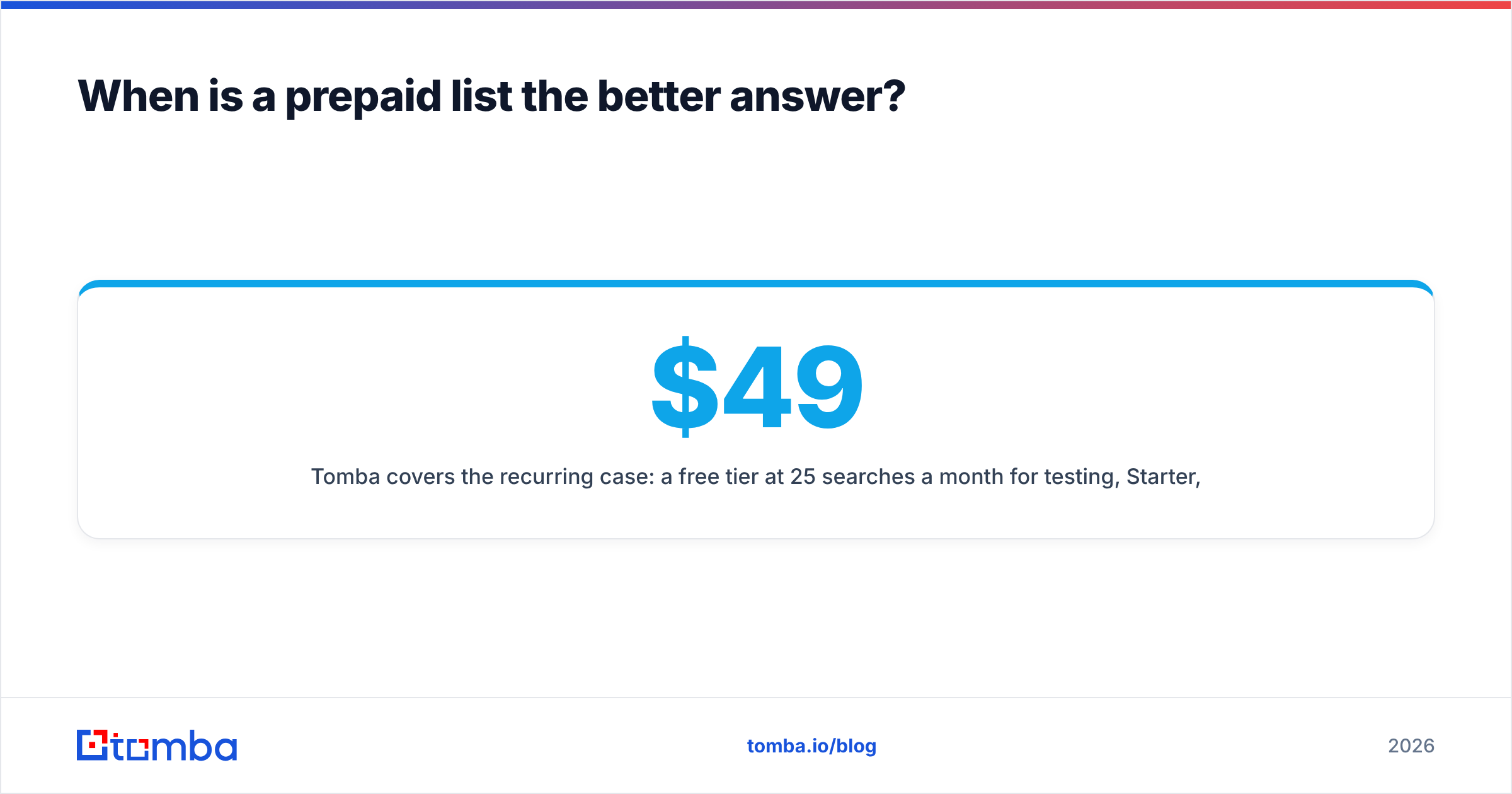
Tomba covers the recurring case: a free tier at 25 searches a month for testing, $49/month Starter, $99/month Growth, $249/month Pro, and custom Enterprise terms. Full Tomba pricing is public, and the same credits work across finder, verifier, domain search and enrichment rather than being siloed per product.
Which Flike alternative should you pick?#
Match the tool to the actual failure mode:
- Your reps write slowly → Lavender. Live scoring, low price, teaches skills that outlast the subscription.
- Your messaging is inconsistent across a big team → Regie.ai. Central brand voice, sequence-level control.
- You want one bill and can accept average data → Apollo.io. Convenient, rarely best-in-class at any single job.
- Your bounce rate is above 4% → a dedicated data layer. Tomba for continuous sourcing and verification, BookYourData for prepaid campaign lists.
- You have RevOps engineering time → Clay for waterfall enrichment, wired into whatever writer you already have.
- You send high volume and need inbox placement → Instantly for warmup and rotation, with verification upstream.
There's no universal winner, and any post claiming otherwise is selling something. What is universal: the sequencing. Data first, sending infrastructure second, copy third. Teams that invert that order buy three writing tools in eighteen months and never understand why their response rate never moved.
What's the fastest way to test this?#
Take your last 500-contact campaign list. Run it through verification and see what percentage comes back invalid, risky, or catch-all. If that number is under 3%, your data is fine and a better AI writer is a legitimate next purchase. If it's over 8% — which is typical for lists older than six months or scraped without verification — you found your problem, and no Flike alternative in the copy category will fix it.
Start with the Tomba Email Finder. The free tier gives you 25 searches a month to test coverage on your own target accounts before spending anything, and the Starter plan at $49/month covers a two-rep team's sourcing and verification with room to spare. Feed those verified, enriched contacts into whichever AI writer you already like — that's the stack that actually moves reply rates in 2026.
Related guides#
Ready to find emails that actually work?
Join 150,000+ professionals who stopped guessing and started sending. Free credits on signup — no credit card required.
Get the Tomba newsletter
Practical outbound tactics and product updates — once every two weeks.
About the author