9 Best Floworks AI Alternatives in 2026 (Tested & Ranked)
Floworks' Alisha AI SDR promises a fully autonomous outbound rep. Here are nine alternatives — AI SDR platforms, data providers, and API-first stacks — compared on price, data accuracy, and what actually books meetings.
TL;DR
- Floworks (and its AI SDR agent, Alisha) sells autonomous outbound: research, write, send, follow up, book. It works best when your ICP is broad and your data is already clean.
- Most teams that churn off AI SDR platforms don't leave because the AI writes badly. They leave because the underlying contact data was stale, and the agent sent 4,000 emails to addresses that bounced.
- The nine alternatives below split into three buckets: full AI SDR agents (Artisan, 11x, Regie.ai), all-in-one data + sequencing (Apollo, Amplemarket, Salesloft), and data-layer-first stacks (Tomba, BookYourData, Clay) where you own the orchestration.
- Pricing reality: AI SDR platforms typically land in the $1,000–$5,000/mo range with annual commits. A data-layer stack starts under $150/mo and scales linearly.
- If your bottleneck is finding and verifying the right contacts rather than writing the email, fix the data layer first. Everything downstream compounds off it.
What is Floworks AI, and what does it actually do?#
Floworks is an AI sales agent company. Its flagship product, Alisha, is marketed as an AI SDR: it takes an ICP definition, pulls prospect lists, researches accounts, drafts personalized emails, sends them through your connected mailboxes, handles replies, and pushes meetings into your calendar. You can read the current product positioning on the official Floworks site.
The pitch is headcount replacement. Instead of hiring two SDRs at roughly $70K base each, you rent an agent that runs 24/7 and never asks for PTO. That framing is why AI SDR tools raised so much money in 2024–2025, and why the category filled up fast — G2's AI sales assistant category now lists dozens of near-identical products.
Where Floworks-style tools struggle is the same place every outbound tool struggles: input quality. An AI agent that writes a beautiful, hyper-personalized email to j.smith@acmecorp.com — an address that was decommissioned fourteen months ago — has produced nothing except a bounce and a small dent in your sender reputation.
Sorry — that alt text belongs on the image below.
Why do teams look for Floworks AI alternatives?#
Five reasons come up repeatedly when teams evaluate switching:
- Pricing opacity. Floworks, like most AI SDR vendors, quotes rather than publishes. That makes budgeting hard and renewal negotiations harder. If your CFO wants a line item before a demo, you're already misaligned.
- Data you can't audit. Bundled contact data means you inherit whatever refresh cadence the vendor runs. You can't see the source, can't check the verification method, and can't swap providers without leaving the platform.
- Deliverability blast radius. One agent, many mailboxes, high volume. When accuracy slips, the damage lands on your domain, not the vendor's.
- ICP rigidity. Autonomous agents perform well on broad, high-volume ICPs (SMB SaaS, agencies, ecommerce). They perform poorly on narrow, technical, or committee-driven buying processes where a human needs to read the room.
- Ownership. If the agent leaves, your workflows leave with it. API-first stacks keep the logic in your systems.
None of these mean Floworks is a bad product. They mean the "one platform does everything" model has a cost, and for a lot of teams that cost shows up as a 30–40% bounce rate three weeks into a campaign.

What are the three types of Floworks AI alternatives?#
Before comparing tools, pick your architecture. The tools follow from the decision, not the other way around.
- Type 1 — Full AI SDR agents. You describe the ICP; the platform does everything else. Highest price, lowest control, fastest time-to-first-email. Best for teams with no SDR headcount and a broad ICP. Examples: Artisan, 11x, Regie.ai.
- Type 2 — All-in-one data plus sequencing. You get a contact database, a sequencer, and some AI assistance, but a human runs the campaign. Mid-price, mid-control. Best for teams with 2–10 reps. Examples: Apollo, Amplemarket, Salesloft.
- Type 3 — Data-layer-first stacks. You buy accurate contact discovery and verification via API or app, then plug it into whatever sequencer, CRM, or agent you already run. Lowest price per contact, highest control, requires someone who can wire two tools together. Examples: Tomba, BookYourData, Clay.
- Type 4 — Hybrid (what most teams end up on). A data layer feeding an agent. You keep provider choice, the agent keeps the automation. This is where the market is quietly settling.
The mistake is buying Type 1 when your actual problem is Type 3. AI writing is close to a commodity in 2026. Accurate, verified, deduplicated contact records are not.
How do the top Floworks AI alternatives compare?#
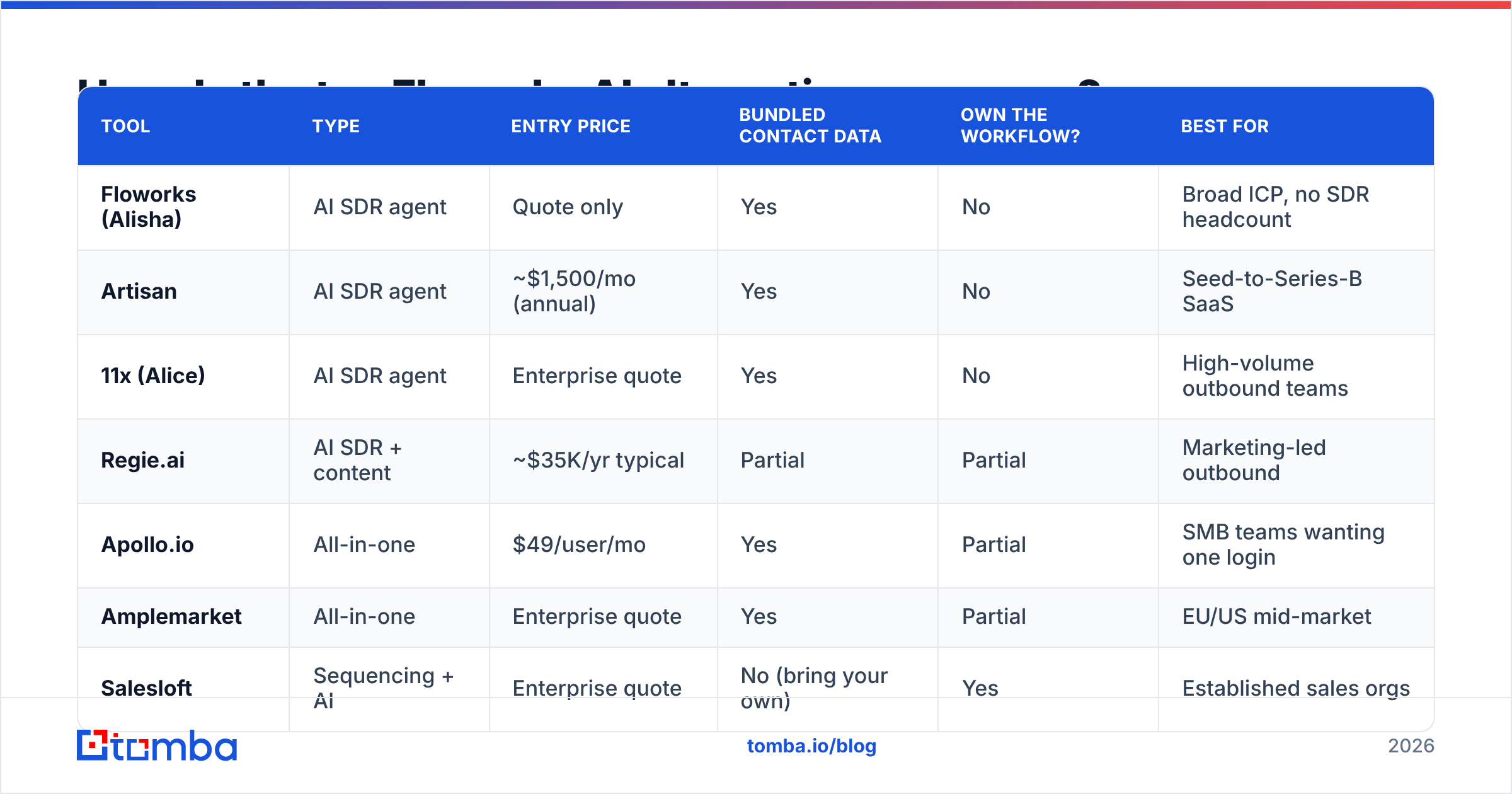
| Tool | Type | Entry price | Bundled contact data | Own the workflow? | Best for |
|---|---|---|---|---|---|
| Floworks (Alisha) | AI SDR agent | Quote only | Yes | No | Broad ICP, no SDR headcount |
| Artisan | AI SDR agent | ~$1,500/mo (annual) | Yes | No | Seed-to-Series-B SaaS |
| 11x (Alice) | AI SDR agent | Enterprise quote | Yes | No | High-volume outbound teams |
| Regie.ai | AI SDR + content | ~$35K/yr typical | Partial | Partial | Marketing-led outbound |
| Apollo.io | All-in-one | $49/user/mo | Yes | Partial | SMB teams wanting one login |
| Amplemarket | All-in-one | Enterprise quote | Yes | Partial | EU/US mid-market |
| Salesloft | Sequencing + AI | Enterprise quote | No (bring your own) | Yes | Established sales orgs |
| BookYourData | Data provider | Pay-as-you-go credits | Yes | Yes | Buying verified lists outright |
| Tomba | Data layer + API | Free tier, then $49/mo | Yes | Yes | Teams building their own stack |
Two notes on reading that table. First, "quote only" is not a red flag by itself — it usually means the vendor wants to size a seat count. It is a red flag if you're a five-person team, because you'll be sold an enterprise floor. Second, "own the workflow" matters more than it looks: it determines whether switching vendors next year costs you a weekend or a quarter.
Which alternative fits which team?#
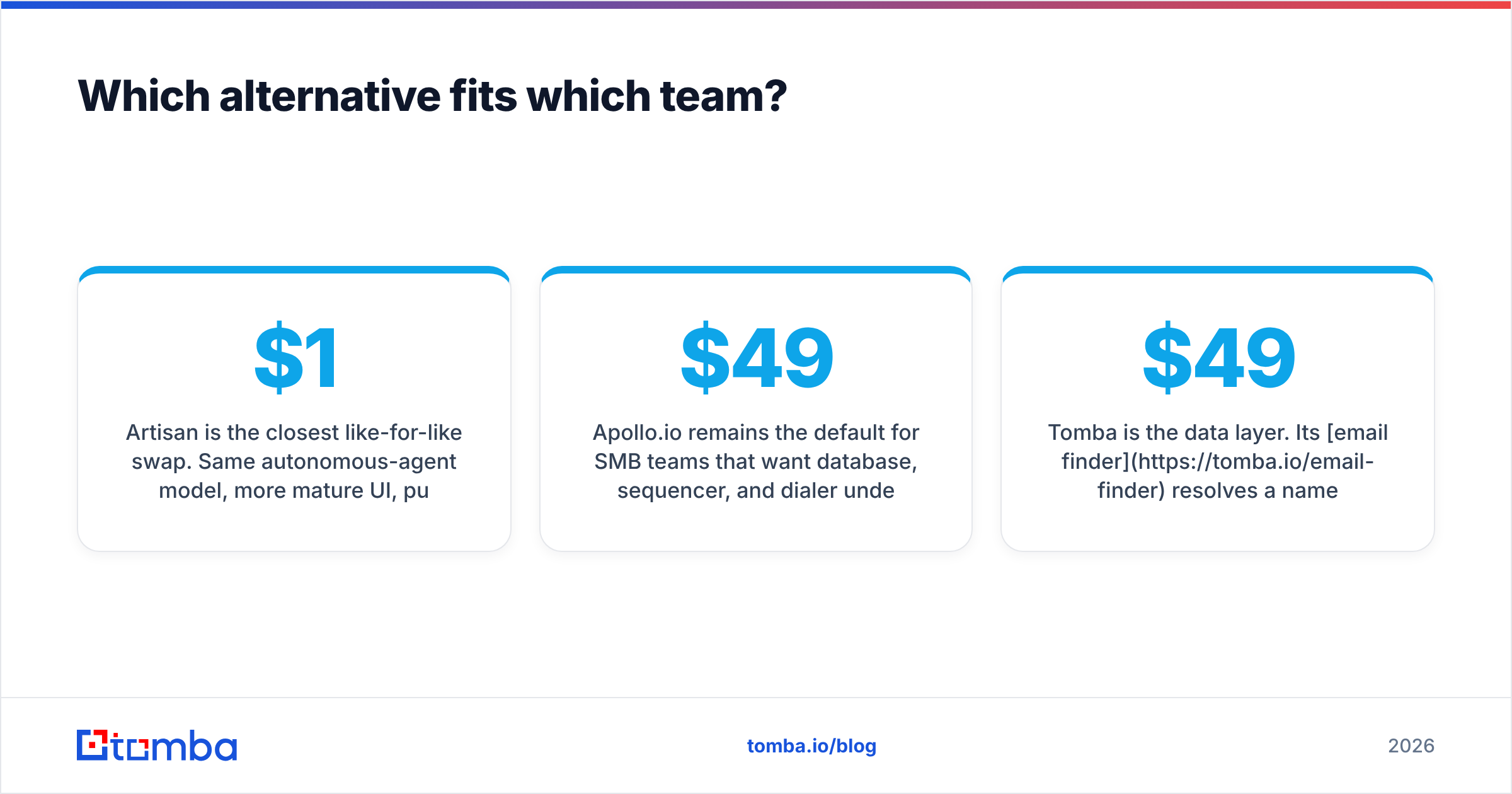
Artisan is the closest like-for-like swap. Same autonomous-agent model, more mature UI, published-ish pricing in the $1,500/mo range on annual terms. If you liked the Floworks demo but want a larger install base, start here.
11x targets higher volume and larger orgs. Its agent, Alice, handles multichannel sequencing. Expect enterprise procurement and an enterprise number.
Regie.ai sits between content generation and agent execution. If your outbound problem is that messaging is inconsistent across reps rather than that you lack reps, Regie solves the actual problem.
Apollo.io remains the default for SMB teams that want database, sequencer, and dialer under one login at $49/user/mo. The tradeoff is data freshness on niche verticals — Apollo's coverage is broad but thins out fast outside tech and North America. If you're evaluating it, our Apollo alternative breakdown goes deeper on where coverage drops off.
Amplemarket does well in European markets where Apollo's coverage is weaker, and its AI copy features are genuinely good. Enterprise pricing.
Salesloft is the grown-up option: sequencing, forecasting, conversation intelligence, and a real admin layer. It deliberately does not bundle contact data, which is a feature if you already have a data provider you trust.
BookYourData is a strong pick when you want to buy a verified list outright rather than rent a platform. Pay-as-you-go credits, a stated accuracy guarantee, and no seat minimum — useful for one-off campaigns, event follow-up lists, or testing a new segment before committing to a subscription.
Clay is the power-user choice for enrichment waterfalls. It's not an SDR agent; it's a spreadsheet that calls twenty APIs. Excellent if you have an ops person. Overkill if you don't.
Tomba is the data layer. Its email finder resolves a name plus a company domain into a verified professional address, and the email verifier runs SMTP-level checks — including catch-all handling — before anything enters a sequence. Free tier is 25 searches/mo; paid starts at $49/mo (Starter), $99/mo (Growth), $249/mo (Pro), with Enterprise on quote. Full Tomba pricing is public, which is the point.
Can you replace an AI SDR with a data-layer stack?#
Partly — and it depends on what the agent was actually doing for you.
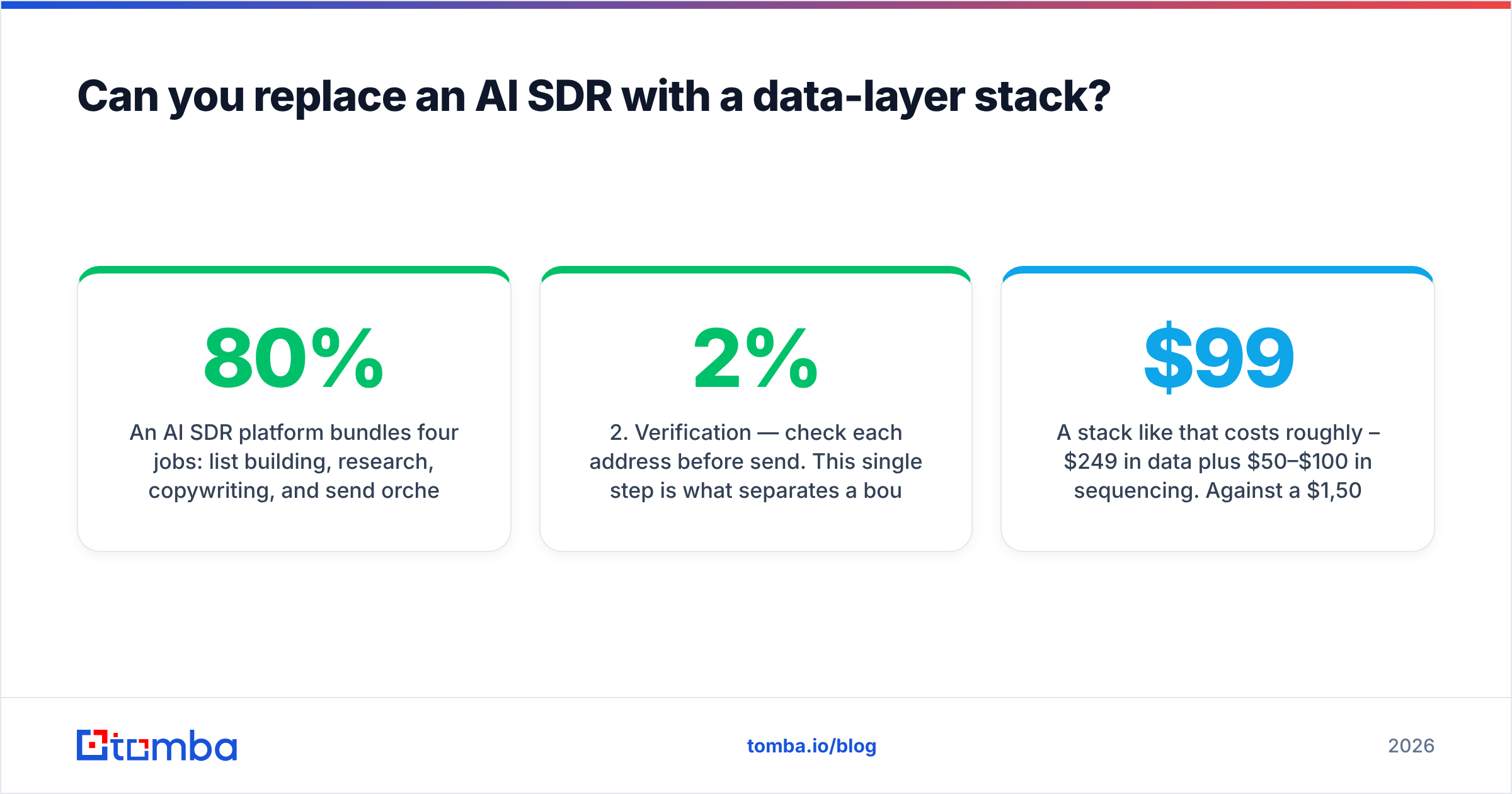
An AI SDR platform bundles four jobs: list building, research, copywriting, and send orchestration. Of those, copywriting is now the cheapest to replicate (any decent LLM plus a good prompt library gets you 80% of the way), and send orchestration is a solved commodity (Instantly, Smartlead, Saleshandy, lemlist all do it for $30–$100/mo).
The two jobs that are not commodities are list building and research. That's where a data layer earns its keep:
- Discovery — pull every relevant contact at a target company with domain search, filtered by department and seniority, instead of buying a static list.
- Verification — check each address before send. This single step is what separates a 2% bounce rate from a 25% one.
- Enrichment — attach role, seniority, company size, and social profiles so your copy has something concrete to reference. Contact enrichment turns a bare email into a personalization input.
- Automation — wire it together with the Tomba API, a Zapier flow, or a Sheets add-on so the pipeline runs without a human copy-pasting CSVs.
- Feedback loop — push bounce and reply data back into your filters so next month's list is better than this month's.
A stack like that costs roughly $99–$249/mo in data plus $50–$100/mo in sequencing. Against a $1,500–$4,000/mo agent, the delta funds a contractor to maintain it — and you keep the workflow when you switch vendors.
What you give up is the "type an ICP, walk away" experience. If nobody on your team will own the pipeline, buy the agent. Be honest about which situation you're in.
What should you actually check during an AI SDR evaluation?#
Run this checklist on Floworks and every alternative on your shortlist. It takes an afternoon and saves a quarter.
- Bounce test. Ask for 100 contacts in your exact ICP. Run them through an independent verifier. Anything above a 5% invalid rate is a data problem the AI cannot fix.
- Catch-all handling. Ask specifically how the vendor treats catch-all domains. "We mark them valid" is the wrong answer. Catch-all domains accept everything at the SMTP layer, so they need separate logic — a proper catch-all verifier returns a confidence score, not a green checkmark.
- Data provenance. Where does the data come from, and how often is it refreshed? Vendors that answer clearly tend to have better data. See how a public answer reads on Tomba's data sources page.
- Deliverability controls. Per-mailbox daily caps, warmup integration, SPF/DKIM/DMARC checks, and automatic pausing on reputation drops. Google and Yahoo's bulk sender requirements made these non-negotiable, and HubSpot's deliverability guidance is a decent baseline for what "compliant" means now.
- Exit cost. Can you export your sequences, contacts, and reply history? If the answer is "contact support," price that in.
- Contract shape. Monthly vs. annual, seat minimums, credit rollover, overage rates. AI SDR vendors often price on "meetings booked" or "contacts worked" — model both against your real volume.
Is Floworks worth keeping?#
Keep it if three things are true: your ICP is broad enough that volume beats precision, you have no SDR headcount and no plans to hire, and your independent bounce test came back under 5%. In that configuration, an autonomous agent genuinely outperforms a data-layer stack, because the marginal value of your ops time is higher than the marginal cost of the subscription.
Switch if any of these are true: you're paying enterprise pricing on a sub-10-person team, your bounce rate is above 8%, your ICP requires human judgment on fit, or you need the workflow to survive a vendor change. In those cases, a Type 3 or Type 4 stack wins on both cost and control.
And regardless of which way you go: verify before you send. Every comparison in this post collapses into that one habit. The best-written email in the world still bounces off a dead address, and every bounce is a small, permanent withdrawal from your domain's email deliverability balance.
Where should you start?#
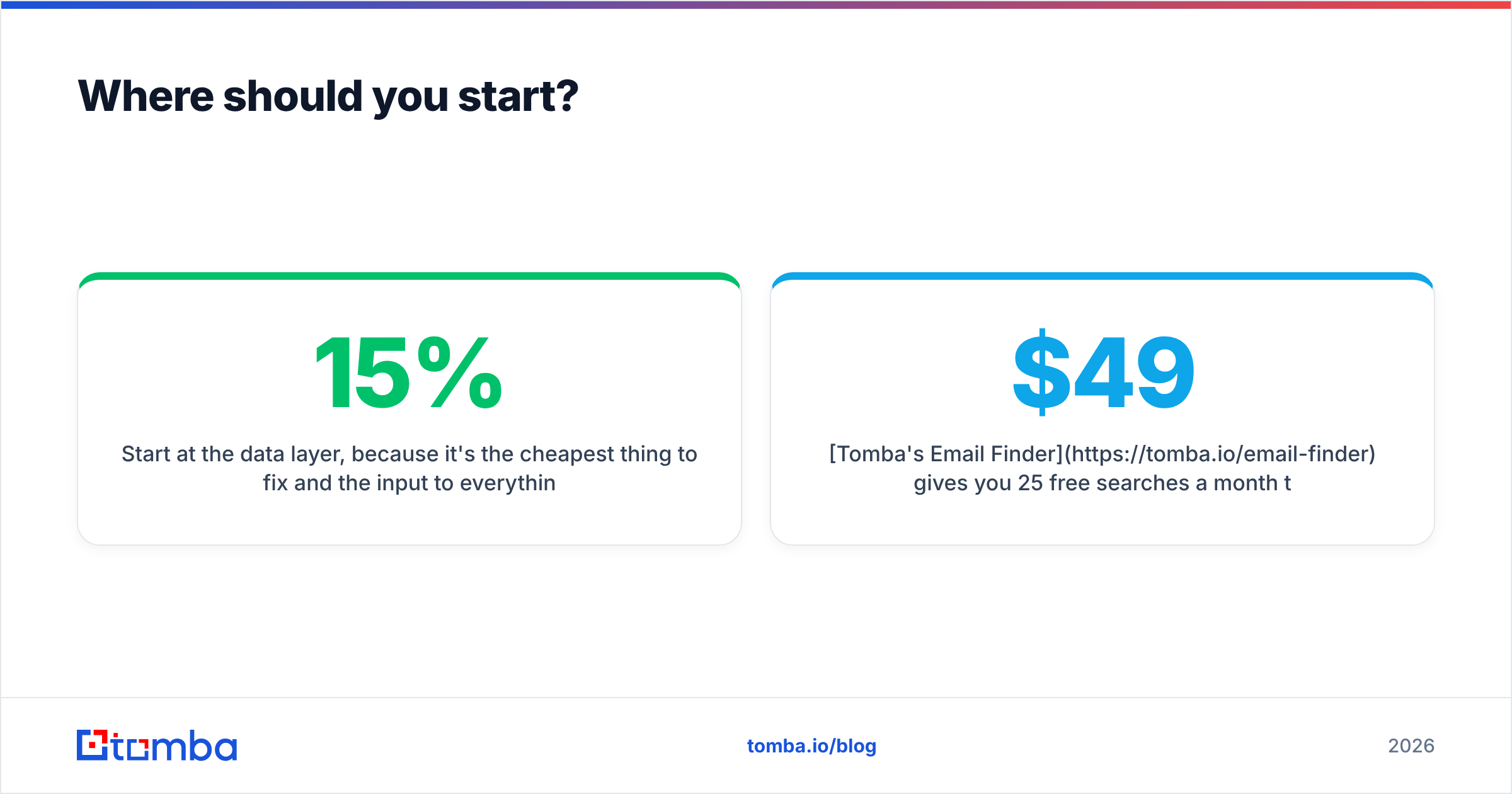
Start at the data layer, because it's the cheapest thing to fix and the input to everything else. Run your current list through a verifier before you renew anything — if 15% comes back invalid, you just found your conversion problem, and it wasn't the copy.
Tomba's Email Finder gives you 25 free searches a month to test coverage on your exact ICP before spending a dollar. Pull 50 contacts at three target accounts, check the results against LinkedIn, and see what your real accuracy rate looks like. If the data holds up, the $49/mo Starter plan covers most small teams; Growth at $99/mo and Pro at $249/mo scale with volume, and the API lets you feed verified contacts straight into whichever sequencer or AI agent you settle on — Floworks included.
Related guides#
Ready to find emails that actually work?
Join 150,000+ professionals who stopped guessing and started sending. Free credits on signup — no credit card required.
Get the Tomba newsletter
Practical outbound tactics and product updates — once every two weeks.
About the author