Follow Up Email After a Phone Call: Templates That Work
Most post-call emails die because they recap instead of advance. Here are the timing windows, structure, and eight tested templates that actually move deals forward in 2026.
TL;DR
- Send within 24 hours. Reply rates on post-call emails drop sharply after the first business day because the prospect's memory of the call — and their internal urgency — decays fast.
- A recap is not a follow-up. The email must contain a decision, a date, or a document. If it contains none of those, it is a receipt.
- Use a five-part structure: context line, confirmed takeaway, the one thing you promised, a dated next step, and a single question.
- Subject lines that reference something specific from the call ("the Q3 migration timeline") beat "Great speaking with you" by a wide margin.
- Eight copy-paste templates below cover discovery, demo, pricing objections, ghosting, gatekeeper referrals, and the polite breakup.
Why does a follow up email after a phone call matter more than the call itself?#
Because the call is where memory is created and the email is where it is stored.
Think of a sales call like a whiteboard session. Everyone nods, everyone agrees, the room feels aligned. Then someone wipes the board. Three days later nobody can reconstruct what was decided, and the version each person remembers is subtly different — usually in their own favour. Your follow up email after a phone call is the photo of the whiteboard. It becomes the shared record, and whoever writes the record controls the framing.
There's a second, less obvious reason. Your prospect almost certainly has to relay your conversation to someone who wasn't on it — a manager, a finance lead, a security reviewer. If your email is a wall of prose, they'll paraphrase it badly. If your email is three tight bullets and a next step, they'll forward it. That forward is worth more than any clever closing line you could write.
The practical failure mode is that most reps treat the follow-up as an act of politeness. "Great speaking with you today, let me know if you have any questions." That email asks the prospect to do all the work: remember the context, generate the questions, decide the next step, and initiate. Nobody does that for a vendor they met once.
When should you send it — and does timing really change reply rates?#
Send it the same day if the call ended before 3pm local time, and by 10am the next morning otherwise.
The mechanism is straightforward: your prospect's calendar refills. On day one your conversation is one of maybe four things competing for their attention. By day four it's competing with a new quarter's worth of noise, plus two other vendors who were faster than you. HubSpot's sales research has consistently found that speed of response is one of the strongest single predictors of whether a deal progresses, and post-call follow-up behaves the same way.
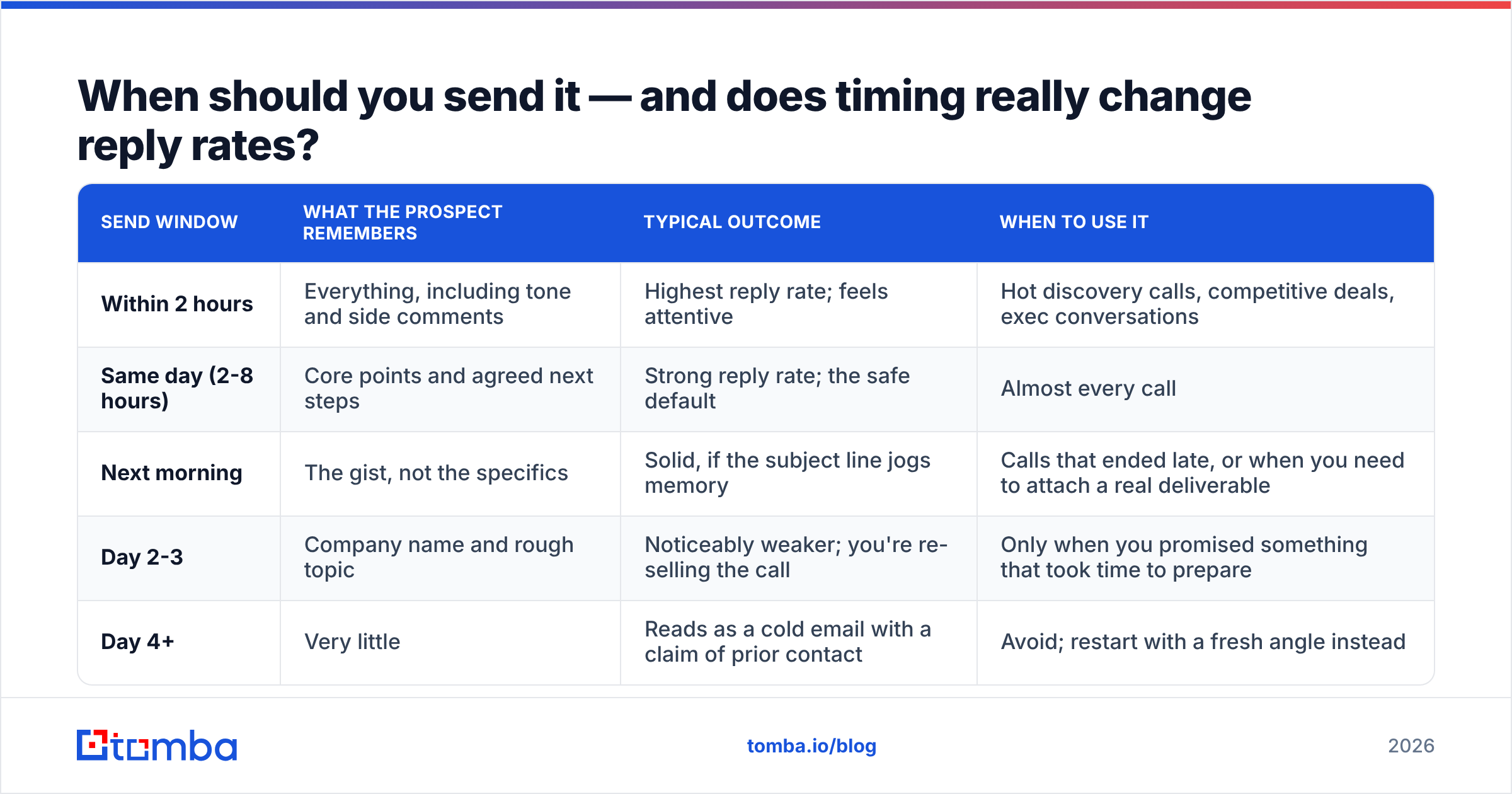
Here's how the timing windows actually break down in practice:
| Send window | What the prospect remembers | Typical outcome | When to use it |
|---|---|---|---|
| Within 2 hours | Everything, including tone and side comments | Highest reply rate; feels attentive | Hot discovery calls, competitive deals, exec conversations |
| Same day (2-8 hours) | Core points and agreed next steps | Strong reply rate; the safe default | Almost every call |
| Next morning | The gist, not the specifics | Solid, if the subject line jogs memory | Calls that ended late, or when you need to attach a real deliverable |
| Day 2-3 | Company name and rough topic | Noticeably weaker; you're re-selling the call | Only when you promised something that took time to prepare |
| Day 4+ | Very little | Reads as a cold email with a claim of prior contact | Avoid; restart with a fresh angle instead |
One caveat: speed without substance is worse than a short delay with substance. If you promised a security questionnaire response or a custom ROI model, a two-hour email saying "working on it" plus a next-day email with the actual document beats a rushed, half-finished attachment. Send the holding note, then send the goods.
What are the five parts every post-call email needs?#
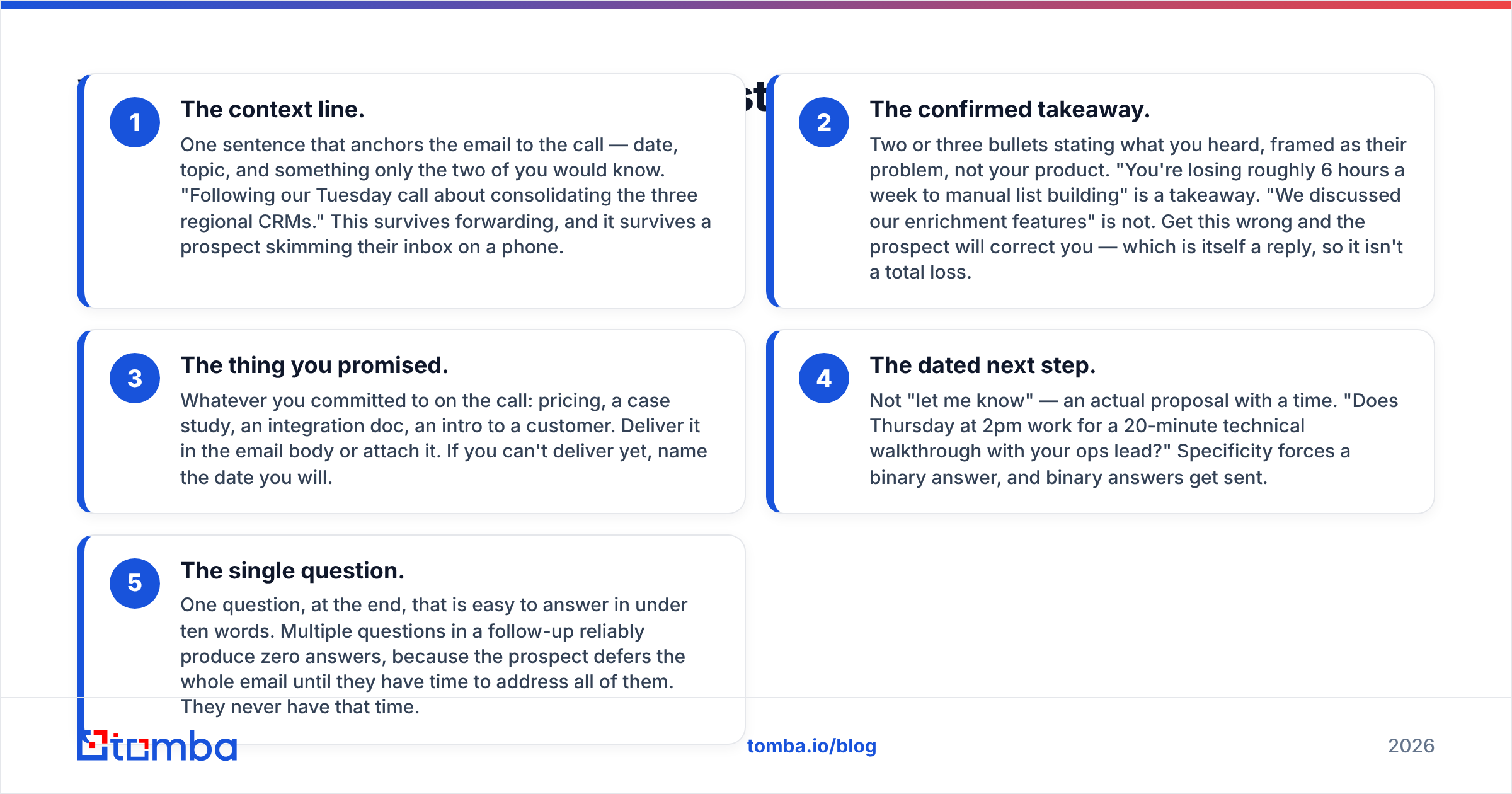
Every effective follow up email after a phone call contains the same five components, in roughly the same order.
- The context line. One sentence that anchors the email to the call — date, topic, and something only the two of you would know. "Following our Tuesday call about consolidating the three regional CRMs." This survives forwarding, and it survives a prospect skimming their inbox on a phone.
- The confirmed takeaway. Two or three bullets stating what you heard, framed as their problem, not your product. "You're losing roughly 6 hours a week to manual list building" is a takeaway. "We discussed our enrichment features" is not. Get this wrong and the prospect will correct you — which is itself a reply, so it isn't a total loss.
- The thing you promised. Whatever you committed to on the call: pricing, a case study, an integration doc, an intro to a customer. Deliver it in the email body or attach it. If you can't deliver yet, name the date you will.
- The dated next step. Not "let me know" — an actual proposal with a time. "Does Thursday at 2pm work for a 20-minute technical walkthrough with your ops lead?" Specificity forces a binary answer, and binary answers get sent.
- The single question. One question, at the end, that is easy to answer in under ten words. Multiple questions in a follow-up reliably produce zero answers, because the prospect defers the whole email until they have time to address all of them. They never have that time.
That's the skeleton. Everything else — pleasantries, social proof, links to your blog — is optional weight. Strip it unless it earns its place.
What does a good follow-up actually look like?#
Below are eight templates covering the situations that come up most. Adapt the specifics; keep the structure.
1. After a discovery call
Subject: Your Q3 migration timeline — recap + next step
Hi Dana,
Good talking through the regional CRM consolidation this morning. What I took away:
- Three instances, ~40k contacts total, heavy duplication between EMEA and APAC
- The blocker is data quality, not the migration tooling itself
- You want it done before the October freeze
I've attached the dedupe methodology doc I mentioned — pages 3-5 are the relevant part.
Does Thursday 2pm work for a 20-minute session with Marco to scope the field mapping?
One question in the meantime: who signs off on the data-quality standard — you or Marco?
2. After a demo
Lead with the two features they reacted to, not the full tour. Then: "You mentioned the approval workflow was the piece your team would care about most. Here's a 90-second clip of just that." A targeted clip gets watched; a 45-minute recording does not.
3. After a pricing objection
Do not re-justify the price in the email. Restate the cost of the status quo in their numbers, then offer a smaller entry point. "At 6 hours a week across four reps, you're spending roughly $38k a year on manual research. The Growth tier is $99/month per seat." Numbers they gave you are far more persuasive than numbers you assert.
4. When they went quiet after a good call
Subject: Still worth doing, or has priority shifted?
Hi Sam — no pressure either way. When we spoke on the 4th, the field-mapping project was slotted for this quarter. Has that moved? If it has, I'll check back in October rather than keep pinging you.
This works because it gives them a socially easy exit, which paradoxically produces more replies than a chase.
5. After a gatekeeper or referral call
Thank them, then make the intro trivially easy: write the forwardable paragraph for them. "Feel free to forward the below to Priya —" followed by three sentences she can read cold.
6. After a call where you couldn't answer something
Answer it. In the first line. Before anything else. "You asked whether we support SCIM provisioning — yes, on Pro and above, docs here." Reps consistently underrate how much credibility a fast, direct answer buys.
7. After a technical or security call
Attach the artifacts (SOC 2 summary, DPA, architecture diagram) and list them as a checklist so the reviewer can tick items off. Security teams process lists, not paragraphs.
8. The breakup email
Subject: Closing the loop
Hi Alex — I've reached out a few times since our call and haven't heard back, which usually means the timing isn't right. I'll stop here. If the contact-data problem resurfaces, my line's open.
Keep it genuinely final. Fake breakups that end with "unless…" get ignored the same way the previous four emails did.
How do you make sure the email actually lands in the inbox?#
A perfect follow-up in the spam folder converts at zero.
Most reps assume post-call emails are safe because the contact is warm. That's mostly true — but two things break it. First, if you're emailing a different address than the one they called from (or you got the address from a form, a business card, or a guess), you may be sending to a stale or malformed mailbox. Bounces on a warm thread still damage your sender reputation. Second, if your domain's authentication is misconfigured, corporate filters at large companies will quietly route you to junk regardless of prior contact.
Three checks worth doing once, properly:
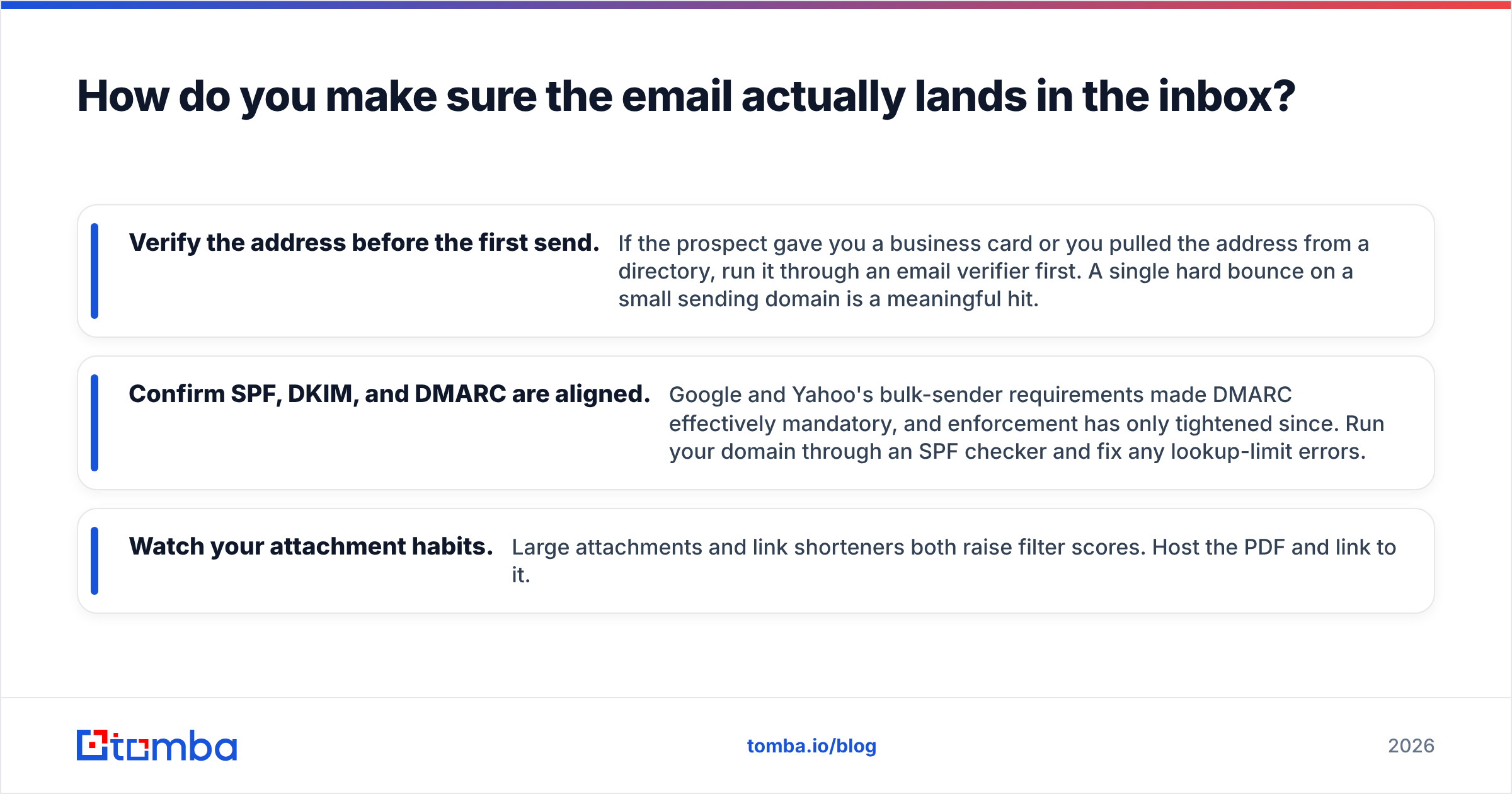
- Verify the address before the first send. If the prospect gave you a business card or you pulled the address from a directory, run it through an email verifier first. A single hard bounce on a small sending domain is a meaningful hit.
- Confirm SPF, DKIM, and DMARC are aligned. Google and Yahoo's bulk-sender requirements made DMARC effectively mandatory, and enforcement has only tightened since. Run your domain through an SPF checker and fix any lookup-limit errors.
- Watch your attachment habits. Large attachments and link shorteners both raise filter scores. Host the PDF and link to it.
If you're following up with someone whose direct address you never actually got — a common outcome after a switchboard call or a conference conversation — a domain search against their company will usually surface the pattern and the specific contact. That's a better move than guessing firstname@company.com and eating the bounce.
Follow-up email tools: what should you actually pay for?#
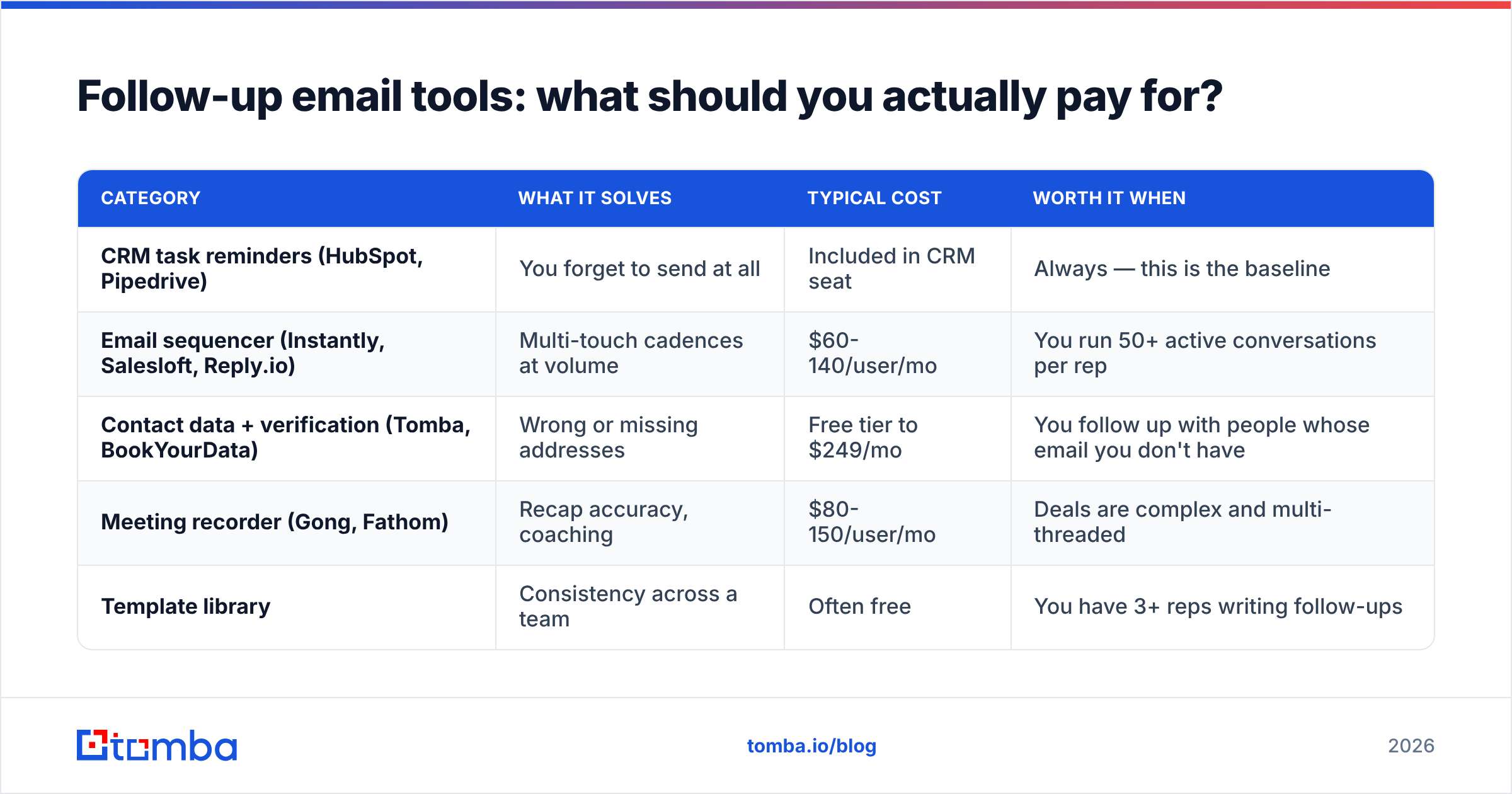
Most teams over-tool this. Here's an honest breakdown of what each category buys you.
| Category | What it solves | Typical cost | Worth it when |
|---|---|---|---|
| CRM task reminders (HubSpot, Pipedrive) | You forget to send at all | Included in CRM seat | Always — this is the baseline |
| Email sequencer (Instantly, Salesloft, Reply.io) | Multi-touch cadences at volume | $60-140/user/mo | You run 50+ active conversations per rep |
| Contact data + verification (Tomba, BookYourData) | Wrong or missing addresses | Free tier to $249/mo | You follow up with people whose email you don't have |
| Meeting recorder (Gong, Fathom) | Recap accuracy, coaching | $80-150/user/mo | Deals are complex and multi-threaded |
| Template library | Consistency across a team | Often free | You have 3+ reps writing follow-ups |
A realistic stack for a five-person team: CRM reminders plus a data/verification layer plus a shared template library. Sequencers and recorders are genuine upgrades but they solve volume and coaching problems, not follow-up-quality problems. If your emails are weak, a sequencer just sends weak emails faster.
On the data layer specifically, Tomba pricing runs from a free tier at 25 searches a month through Starter at $49/mo and Growth at $99/mo, with Pro at $249/mo for teams doing serious volume. BookYourData is a solid alternative if you prefer buying pre-built lists over searching on demand — the two solve slightly different halves of the same problem. Compare on G2 rather than on vendor pages.
What are the most common follow-up mistakes?#
- Recapping instead of advancing. If the email could have been written by someone who wasn't on the call, it's a recap. Add the decision.
- Burying the ask. The next step should be visible when the email is half-read on a phone. Put it above any attachments or links.
- Sending a wall of text. Aim for under 150 words for a standard follow-up. Long emails signal that replying will be expensive.
- Multi-question emails. One question. Always.
- CC'ing people who weren't on the call. It looks like pressure. If you want more stakeholders, ask your contact to forward.
- Using "just checking in." It contains no information and no reason to reply. Replace it with a new piece of value or a genuine status question.
- Not verifying the address. Especially after conference calls, switchboards, and handwritten notes.
One more, subtler than the rest: writing the follow-up before you've decided what outcome you want. Decide the next step during the call — ideally say it out loud on the call — then the email is just documentation of something already agreed. That single habit change does more for reply rates than any template.
How do you track whether your follow-ups are working?#
Track three numbers, not twenty.
Reply rate on first follow-up. Segment by call type. Discovery follow-ups should beat demo follow-ups; if they don't, your demos aren't landing.
Meeting-booked rate from the follow-up. This is the one that matters. A high reply rate with a low booking rate means your emails are pleasant but not directive.
Time-to-send. Median hours between call end and email sent, per rep. This is the easiest number to fix and often the one with the biggest lift. If your team's median is 19 hours, cutting it to 4 will move your response rate more than rewriting any template.
Review these monthly against a small sample of actual sent emails. Metrics tell you something is wrong; reading ten real emails tells you what.
Ready to stop guessing at addresses?#
The best follow-up template in the world fails if it goes to an address that doesn't exist. If you regularly leave calls without a direct email — switchboard conversations, conference intros, referrals passed along second-hand — the Tomba Email Finder will find the verified address by name and company domain, so your follow-up reaches a real inbox on the first try. Start on the free tier at 25 searches a month, and upgrade only when the volume justifies it.
Related guides#
Ready to find emails that actually work?
Join 150,000+ professionals who stopped guessing and started sending. Free credits on signup — no credit card required.
Get the Tomba newsletter
Practical outbound tactics and product updates — once every two weeks.
About the author