Follow Up Email After Discovery Call: Templates That Close
Most discovery calls die in the 48 hours after the call ends. Here are the timing rules, structure, and 6 tested templates that turn a good conversation into a booked next step.
TL;DR
- Send your follow up email after discovery call within 24 hours — ideally the same business day, while the buyer still remembers what they said.
- The email is not a thank-you note. It is a mutual summary that proves you listened, restates their problem in their words, and proposes one specific next step.
- Use a five-part structure: subject line referencing their words, one-line context, a bulleted recap of pain and priorities, the agreed next step with a date, and one attachment or link that moves them forward.
- Attach nothing generic. A tailored one-pager or a link to the exact case study you discussed beats a 40-slide deck every time.
- Plan four touches, not one. Most deals that stall out do so because the rep sent one recap and then went quiet.
Why does the follow up email after discovery call matter more than the call itself?#
Because the call happens inside your prospect's head, and the email is the only version that survives.
Think of the discovery call like a conversation at a conference. It felt great in the moment. Two days later, your prospect has taken nine more calls, sat through a QBR, and lost your name entirely. The written follow-up is the artifact that gets forwarded to the CFO, pasted into a Slack thread, and quoted back to you in week three. If the recap doesn't exist, neither does your deal.
There's also a purely mechanical reason. In most B2B purchases the person on your discovery call is not the person who signs. Gartner's research on B2B buying puts the typical buying group at six to ten stakeholders. Your follow-up email is the document your champion uses to sell you internally when you're not in the room. Write it for the people who weren't on the call.
The third reason is trust. A follow-up that accurately reflects what the buyer said — using their words, their metrics, their internal project name — is the cheapest possible proof that you were paying attention. Reps who skip it are indistinguishable from reps who read a script.
When should you send a follow up email after a discovery call?#
Within 24 hours. Same business day if the call ended before 3 p.m.
Here's the honest reasoning: recall decay is brutal. The specificity that makes your email land — "you said onboarding takes 11 days and your target is 4" — is exactly what fades first. Write the recap while the call notes are still open in another tab.
A workable cadence for the full sequence:
- Touch 1 — recap, 0-24 hours. The mutual summary plus the agreed next step. This is the email everything else hangs off.
- Touch 2 — value add, day 3-4. One resource that answers a question they raised. No ask, or a very soft one.
- Touch 3 — the nudge, day 7-8. Short. Reference the next step you proposed and offer two concrete times.
- Touch 4 — the close-the-loop, day 12-15. Give them a clean exit. "Should I assume this isn't a priority this quarter?" gets replies that "just checking in" never will.
Two things to avoid. Don't send the recap at 11 p.m. the night of the call — it reads as desperate and lands at the bottom of the morning inbox. And don't wait until "you have something to say." The recap itself is the something.
If your emails are going out but not arriving, timing won't save you. Check your email deliverability fundamentals and run a quick SPF checker pass on the sending domain before you blame the copy.
What goes into a follow up email after discovery call?#
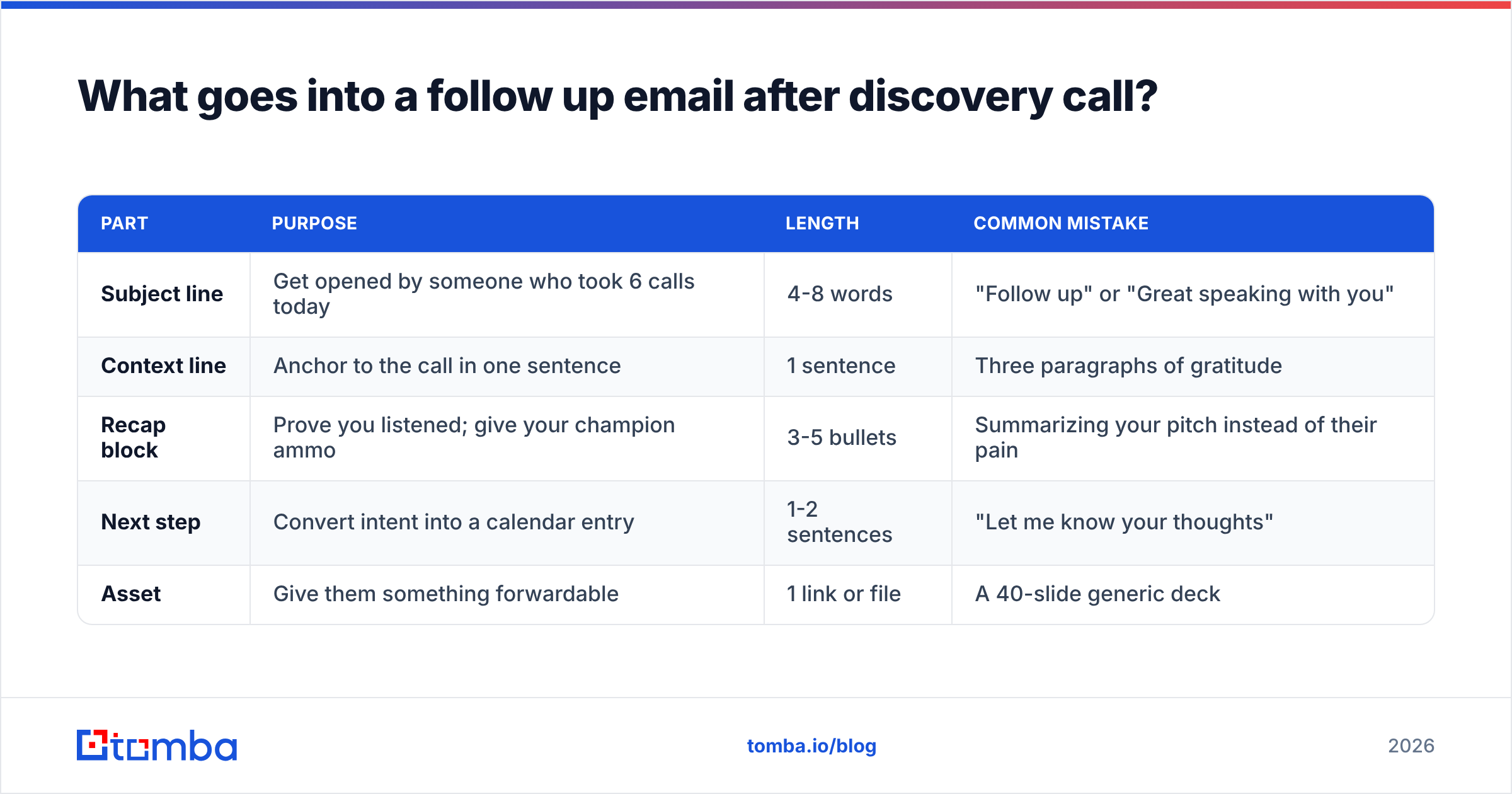
Five parts. Every one of them earns its place.
| Part | Purpose | Length | Common mistake |
|---|---|---|---|
| Subject line | Get opened by someone who took 6 calls today | 4-8 words | "Follow up" or "Great speaking with you" |
| Context line | Anchor to the call in one sentence | 1 sentence | Three paragraphs of gratitude |
| Recap block | Prove you listened; give your champion ammo | 3-5 bullets | Summarizing your pitch instead of their pain |
| Next step | Convert intent into a calendar entry | 1-2 sentences | "Let me know your thoughts" |
| Asset | Give them something forwardable | 1 link or file | A 40-slide generic deck |
The subject line. Reference something only the two of you discussed. "Onboarding at 11 days → your Q3 target" beats "Following up on our call" because it survives a scan of 60 unread messages. If you want a second opinion before sending, a subject line tester will flag length and spam-trigger issues in a few seconds.
The context line. One sentence. "Thanks for walking me through the onboarding workflow this morning — here's what I heard." Then get out of the way.
The recap block. This is the whole email. Three to five bullets covering: the problem in their words, the cost of the problem (number if you got one), what they've already tried, and their timeline or trigger event. Use their vocabulary. If they said "activation," don't write "onboarding."
The next step. Name a specific action, a specific date, and a specific person. "I'll send the security questionnaire Thursday; can we get Priya on a 30-minute technical review the week of the 14th?" Vague asks produce vague outcomes.
The asset. One thing. A tailored one-pager, a case study from their exact segment, a sandbox link. Not your entire content library.
What does a good follow up email look like in practice?#
Here are six templates. Adapt the specifics — the structure is the reusable part.
Template 1 — Standard recap (use this 70% of the time)
Subject: Onboarding at 11 days → your Q3 target
Hi Dana,
Thanks for the walkthrough this morning. Here's what I took away:
- New customers take ~11 days to reach first value; your target is 4.
- The bottleneck is manual data mapping — roughly 6 hours per account for your CS team.
- You tried scripting it internally last year; it broke when the schema changed.
- Board review is October 3, so a decision needs to land before then.
Did I miss anything or get anything wrong?
Next step: I'll send the mapping walkthrough Thursday. Can we get Marcus on a 30-minute technical review the week of the 8th? Tuesday 10 a.m. or Wednesday 2 p.m. work on my end.
— Alex
Template 2 — Multiple stakeholders were on the call
Address the group, but assign the next step to one named person. Diffused ownership kills momentum. Add a line explicitly inviting the person who stayed silent to weigh in — that's usually your blocker.
Template 3 — They raised an objection you couldn't answer
Lead with the objection. "You asked whether we can handle the EU data residency requirement — short answer: yes, here's the documentation." Answering the hard question first buys credibility for everything below it.
Template 4 — The call went badly / low interest
Be short and give an exit. "Sounds like the timing isn't right with the migration in flight. I'll check back in Q1 unless you'd rather I didn't." Roughly a third of "no" answers are actually "not now," and the graceful exit is what makes the re-open possible.
Template 5 — No response after the recap
Do not send "just bumping this." Send new information: a relevant customer result, a product change, a piece of news about their company. One paragraph. One question.
Template 6 — The breakup
"I haven't heard back, so I'll assume onboarding speed dropped down the list. If that changes, my line's open." Clean, no guilt trip. Breakup emails get replies precisely because they remove the pressure.
If you want more scaffolding to start from, the cold email templates library covers adjacent sequences, and a subject line generator helps when you're stuck at the top of the message.
How does a discovery follow-up differ from a cold email?#
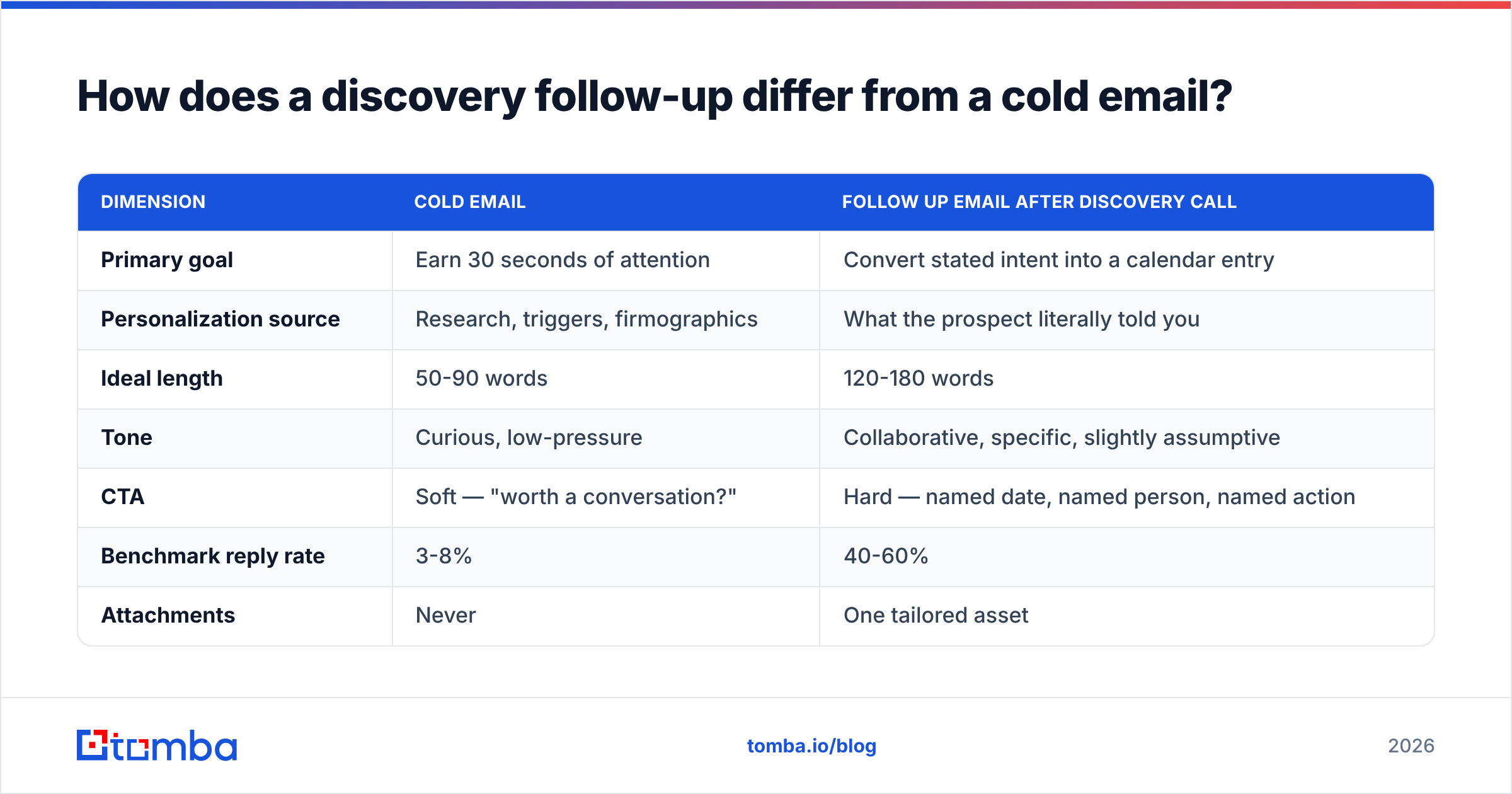
Completely different jobs. Treating them the same is the single most common mistake in mid-funnel outbound.
| Dimension | Cold email | Follow up email after discovery call |
|---|---|---|
| Primary goal | Earn 30 seconds of attention | Convert stated intent into a calendar entry |
| Personalization source | Research, triggers, firmographics | What the prospect literally told you |
| Ideal length | 50-90 words | 120-180 words |
| Tone | Curious, low-pressure | Collaborative, specific, slightly assumptive |
| CTA | Soft — "worth a conversation?" | Hard — named date, named person, named action |
| Benchmark reply rate | 3-8% | 40-60% |
| Attachments | Never | One tailored asset |
| Cadence | 4-7 touches over 3 weeks | 4 touches over 2 weeks |
The reply-rate gap explains why this email deserves real effort. A cold email that gets 5% is doing fine. A post-discovery recap that gets 5% means something broke on the call — you didn't secure a next step, you talked to the wrong person, or the interest was polite rather than real. Treat a low recap reply rate as a diagnostic signal about your discovery, not your writing. Track it alongside your broader response rate benchmarks so you know what normal looks like for your segment.
How do you scale follow-ups without sounding like a robot?#
Separate the parts that should be templated from the parts that must never be.
Template these: the structural skeleton, the signature, the meeting-link boilerplate, the asset library you pull from, the cadence timing rules. These are pure overhead and automating them saves an hour a day.
Never template these: the recap bullets, the subject line, and the next-step ask. The moment those become fill-in-the-blank, your email starts sounding like every other rep's, and your buyer can tell within two lines.
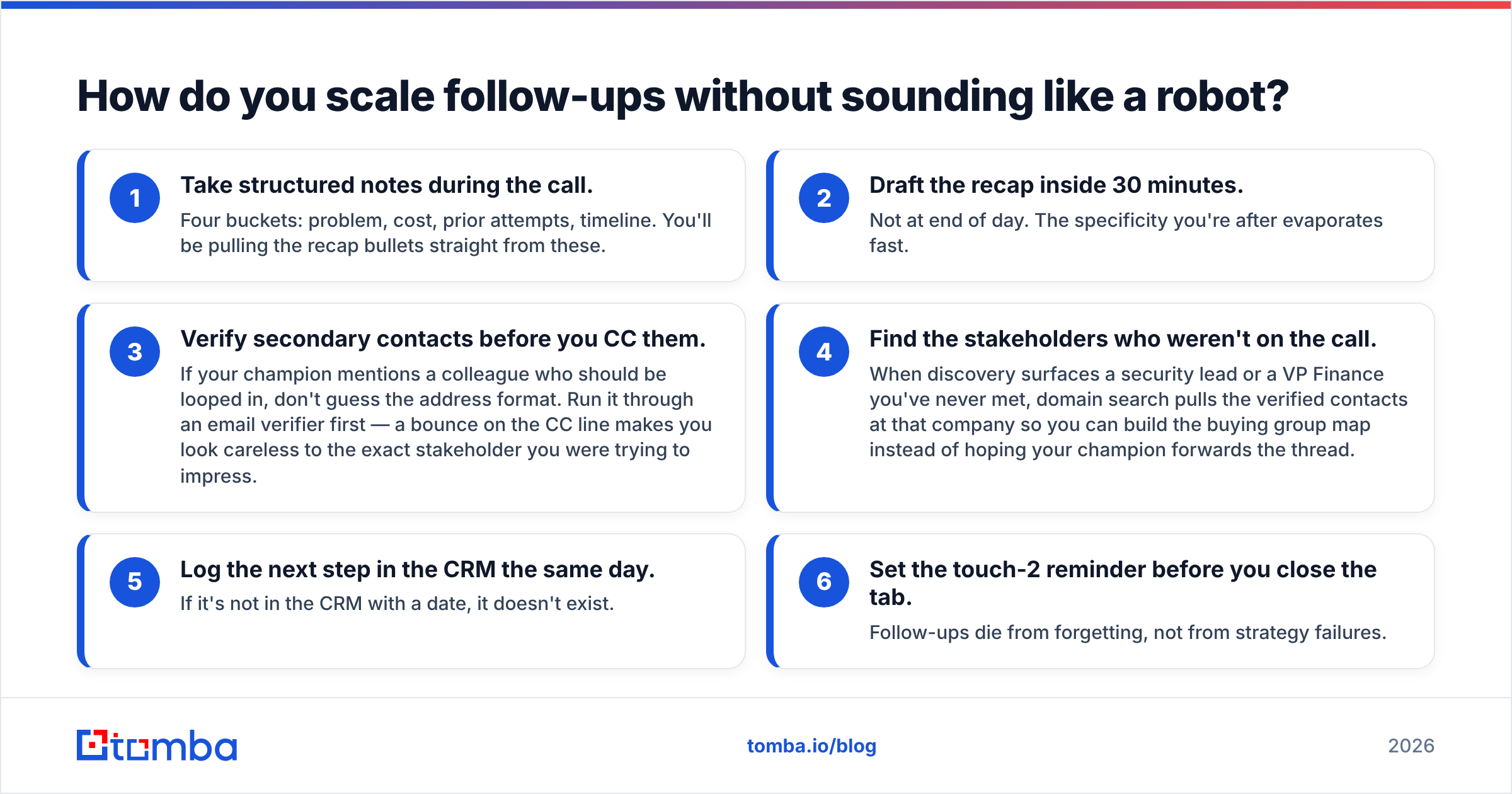
A practical workflow that holds up at 20+ calls a week:
- Take structured notes during the call. Four buckets: problem, cost, prior attempts, timeline. You'll be pulling the recap bullets straight from these.
- Draft the recap inside 30 minutes. Not at end of day. The specificity you're after evaporates fast.
- Verify secondary contacts before you CC them. If your champion mentions a colleague who should be looped in, don't guess the address format. Run it through an email verifier first — a bounce on the CC line makes you look careless to the exact stakeholder you were trying to impress.
- Find the stakeholders who weren't on the call. When discovery surfaces a security lead or a VP Finance you've never met, domain search pulls the verified contacts at that company so you can build the buying group map instead of hoping your champion forwards the thread.
- Log the next step in the CRM the same day. If it's not in the CRM with a date, it doesn't exist.
- Set the touch-2 reminder before you close the tab. Follow-ups die from forgetting, not from strategy failures.
One caution on automation. Sequencing tools that auto-send a "recap" template after every meeting produce emails that are technically on time and completely worthless. The delivery can be automated. The content cannot.
For teams evaluating tooling here, HubSpot's sales email research and peer reviews on G2 are more useful than vendor claims — look specifically at whether a tool lets you edit the draft before send, because the ones that don't will cost you deals.
What are the most common follow-up mistakes?#
- Summarizing your pitch instead of their problem. If your recap bullets are about your features, you took the wrong notes.
- The soft close. "Let me know your thoughts" is where deals go to die. Propose a time.
- Attaching the master deck. Nobody opens a 12 MB PDF. Send the one slide that matters.
- Writing only to the person on the call. Your email needs to make sense to a CFO who has never heard of you.
- Sending one email and calling it a follow-up. One touch is not a sequence. Four is the floor.
- Guessing at CC addresses. A bounced email to the exec your champion just mentioned undoes the credibility you spent 45 minutes building.
Fix the first two and your post-discovery conversion rate moves more than any subject-line optimization ever will.
Ready to build the buying group your discovery call revealed?#
Every good discovery call surfaces names you don't have contact details for — the security lead who has to sign off, the ops director who owns the budget, the VP whose team actually feels the pain. Your recap email is only as strong as your ability to reach those people directly instead of waiting for a forward that never comes.
Tomba Email Finder gives you verified work emails by name and domain, so the stakeholders your prospect mentions in passing become contacts you can actually loop in. Start free with 25 searches a month, or check Tomba pricing — Starter is $49/mo, Growth $99/mo, and Pro $249/mo when you're running discovery calls at volume across a full team.
Write the recap in 24 hours. Name the next step. Reach everyone who needs to see it.
Related guides#
Ready to find emails that actually work?
Join 150,000+ professionals who stopped guessing and started sending. Free credits on signup — no credit card required.
Get the Tomba newsletter
Practical outbound tactics and product updates — once every two weeks.
About the author