Follow Up Email For Cold Leads: The 2026 Playbook That Works
Most cold leads reply on email three, four, or five — not the first send. Here is the sequence structure, timing, and copy that actually pulls replies in 2026.
TL;DR
- Roughly half of all replies to cold sequences arrive after the first email — follow-ups 2 through 5 are where the pipeline actually comes from, not the opener.
- The single biggest killer of follow-up performance is not copy. It's a bad list: bounced, catch-all, or role-based addresses that quietly tank your domain reputation before email three ever lands.
- Space touches 3-4 business days apart, cap the sequence at 4-6 emails, and change the angle every time instead of repeating "just bumping this to the top of your inbox."
- Each follow-up needs a new reason to exist: a new insight, a new asset, a new question, or a clean break-up. Never a guilt trip.
- Reply-rate math: a 3% reply rate on touch 1 compounds to 8-11% cumulative across a well-built 5-touch sequence. That's the whole game.
Why do cold leads ignore your first email?#
Because nothing is wrong. That's the uncomfortable answer.
Think of cold outreach like knocking on the door of a house where the TV is loud. The person inside isn't refusing you — they didn't hear you. A VP of Engineering gets 120+ emails a day, triages in a 90-second scroll, and archives anything that doesn't map to a problem currently on fire. Your first email arrives on a Tuesday when their sprint is on fire. Your fourth arrives on a Thursday when procurement just asked them to cut tooling spend. Same email, different world.
That's the mechanism behind the persistent industry stat that most replies come after the first touch. Timing is a lottery, and follow-ups buy you more tickets.
There's also a credibility effect. One email from a stranger reads as spam. Four thoughtful, non-repetitive emails from the same stranger read as someone who actually cares about the account. HubSpot's sales research has documented this persistence gap for years: most reps stop at one or two attempts while buyers who eventually convert typically needed more.
So the question isn't should you follow up on cold leads. It's how many times, how far apart, and with what.
What is a follow up email for cold leads, exactly?#
A follow up email for cold leads is any message after the initial cold email to a prospect who has not responded and did not opt in. That last part matters legally and strategically — you're operating under legitimate-interest rules (GDPR) or CAN-SPAM, which means every touch needs a real business justification, an honest sender identity, and a working opt-out.
It is not a reminder. A reminder says "did you see my email?" and gives the recipient nothing new to react to. A real follow-up gives them a fresh reason to reply.
Here's how the five useful follow-up types break down:
- The value-add — you send a relevant benchmark, a teardown of their pricing page, or a competitor move they may have missed. No ask beyond "worth a look?"
- The angle switch — you drop the original pain point and pitch a different one. If "reduce data costs" got silence, try "your SDR ramp time."
- The social proof drop — one sentence naming a comparable company and one hard number. Not a case-study PDF dump.
- The one-line nudge — deliberately tiny, sent from the same thread, designed to be answerable in four words. "Still worth exploring, or park it?"
- The break-up — you close the loop cleanly and remove pressure. Consistently one of the highest-reply messages in any sequence, precisely because it asks for nothing.
Rotate those. Never send the same type twice in a row.
How many follow-ups should a cold sequence have?#
Four to six total emails, including the opener. Past six, reply rates flatten while spam complaints climb — and complaints are the metric that actually ends your domain.
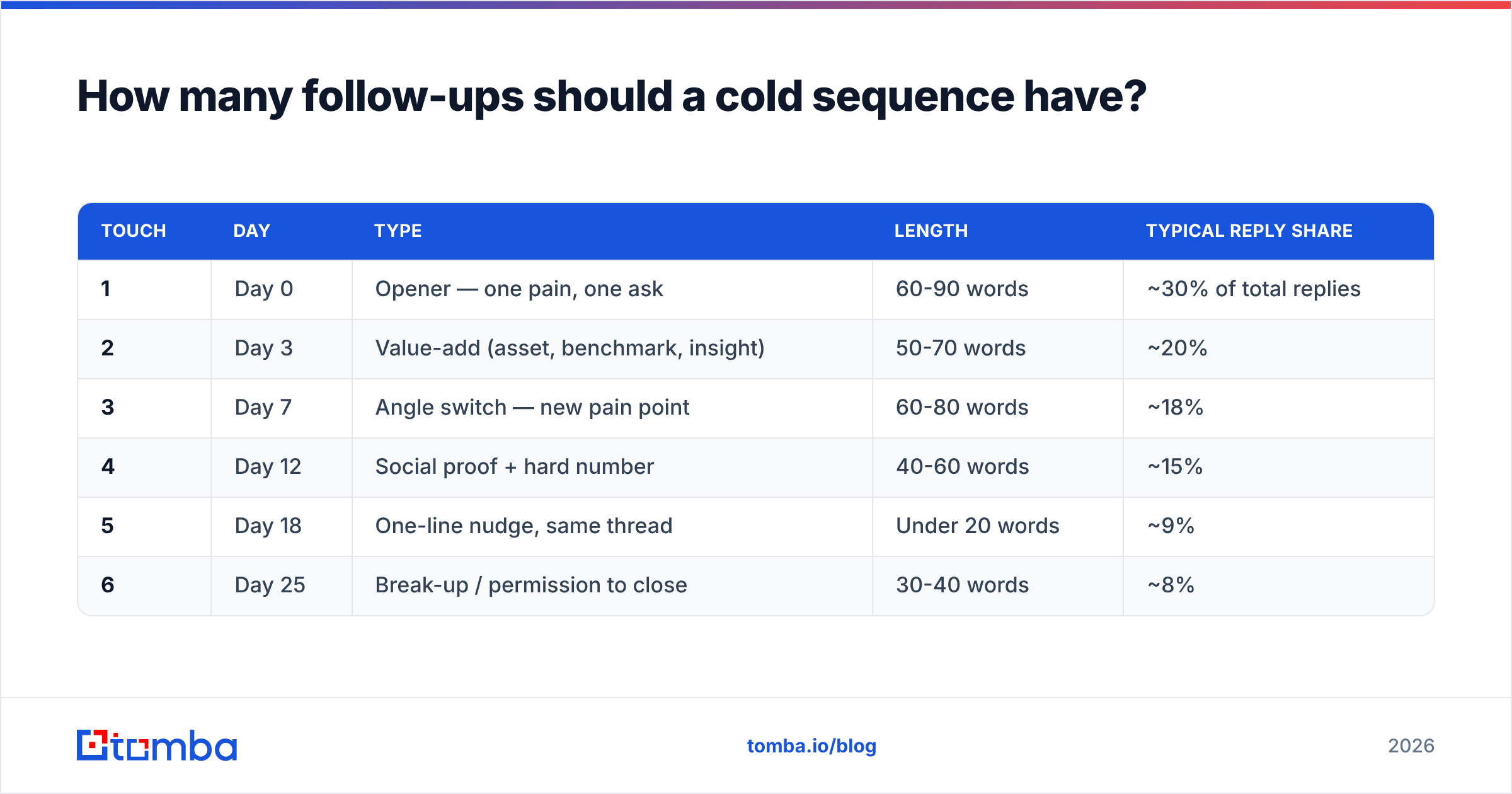
Cadence matters as much as count. Bunch them too tightly and you look automated; space them too far and the thread loses context. This is the structure that holds up across most B2B segments:
| Touch | Day | Type | Length | Typical reply share |
|---|---|---|---|---|
| 1 | Day 0 | Opener — one pain, one ask | 60-90 words | ~30% of total replies |
| 2 | Day 3 | Value-add (asset, benchmark, insight) | 50-70 words | ~20% |
| 3 | Day 7 | Angle switch — new pain point | 60-80 words | ~18% |
| 4 | Day 12 | Social proof + hard number | 40-60 words | ~15% |
| 5 | Day 18 | One-line nudge, same thread | Under 20 words | ~9% |
| 6 | Day 25 | Break-up / permission to close | 30-40 words | ~8% |
Two structural rules that people get wrong:
- Reply in-thread for touches 2, 5, and 6; start a new thread for 3 and 4. In-thread keeps context and feels human. A fresh thread with a fresh subject line gets a second shot at the preview pane for prospects who never opened the original.
- Business days only. A "day 3" follow-up that lands Saturday morning is a wasted touch. Most sending tools handle this; verify yours does.
Does list quality matter more than follow-up copy?#
Yes, and it isn't close.
Follow-ups multiply whatever your list already is. If 12% of your addresses are invalid, you don't just lose 12% of your prospects — you bounce them repeatedly across six touches, and mailbox providers read that pattern as spam behavior. Your reputation degrades, your deliverable emails start landing in Promotions, and your beautifully written touch 4 never gets seen by anyone.
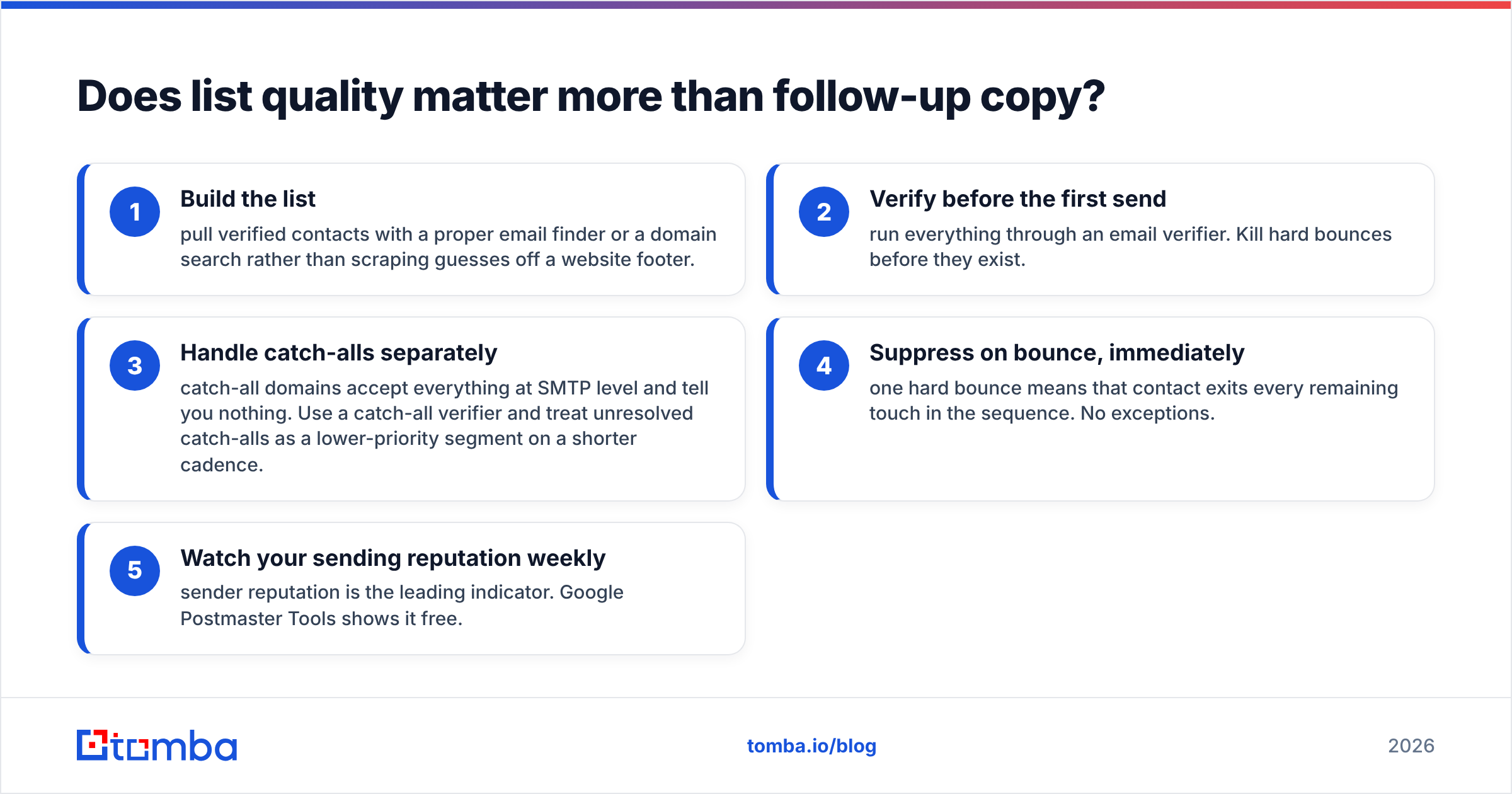
The order of operations is non-negotiable:
- Build the list — pull verified contacts with a proper email finder or a domain search rather than scraping guesses off a website footer.
- Verify before the first send — run everything through an email verifier. Kill hard bounces before they exist.
- Handle catch-alls separately — catch-all domains accept everything at SMTP level and tell you nothing. Use a catch-all verifier and treat unresolved catch-alls as a lower-priority segment on a shorter cadence.
- Suppress on bounce, immediately — one hard bounce means that contact exits every remaining touch in the sequence. No exceptions.
- Watch your sending reputation weekly — sender reputation is the leading indicator. Google Postmaster Tools shows it free.
A clean 400-contact list with six touches beats a dirty 4,000-contact list with two touches, every single time. It also costs less.
What should each follow-up actually say?#
Concrete templates beat theory. Adapt the variables; keep the structure.
Touch 2 — value-add (Day 3, in-thread)
Following up with something useful rather than a nudge.
Pulled the average time-to-first-reply for [industry] SDR teams — median is 41 hours. Teams under 6 hours book roughly 3x the meetings.
Two-line summary attached if useful. No ask.
Touch 3 — angle switch (Day 7, new thread, new subject)
Subject: ramp time, not tooling
[First name] — I pitched you on [original pain] last week and got silence, which usually means I aimed at the wrong problem.
The thing I hear more often from [role] at [company size] companies is that new reps take 5+ months to hit quota. Is that closer to what's on your desk this quarter?
Touch 5 — one-line nudge (Day 18, in-thread)
Worth a 15-minute look, or should I park this until Q4?
Touch 6 — break-up (Day 25, in-thread)
Closing the loop on this one — I'd rather stop than keep landing in your archive.
If [problem] moves up the list later this year, my inbox is open. Either way, good luck with [specific initiative you actually researched].
Three rules that apply to every one of them:
- No guilt. "I've reached out three times" makes the reader the villain. Delete it.
- One ask maximum. Two questions in a cold follow-up gets you zero answers.
- Sentence-case subject lines, no brackets, no emojis. Title Case and
[Case Study]both read as marketing blast.
If you want a starting library rather than a blank page, the cold email templates collection covers the common segments, and a subject line tester will catch the spam-trigger phrasing before you send.
How do follow-up strategies compare across approaches?#
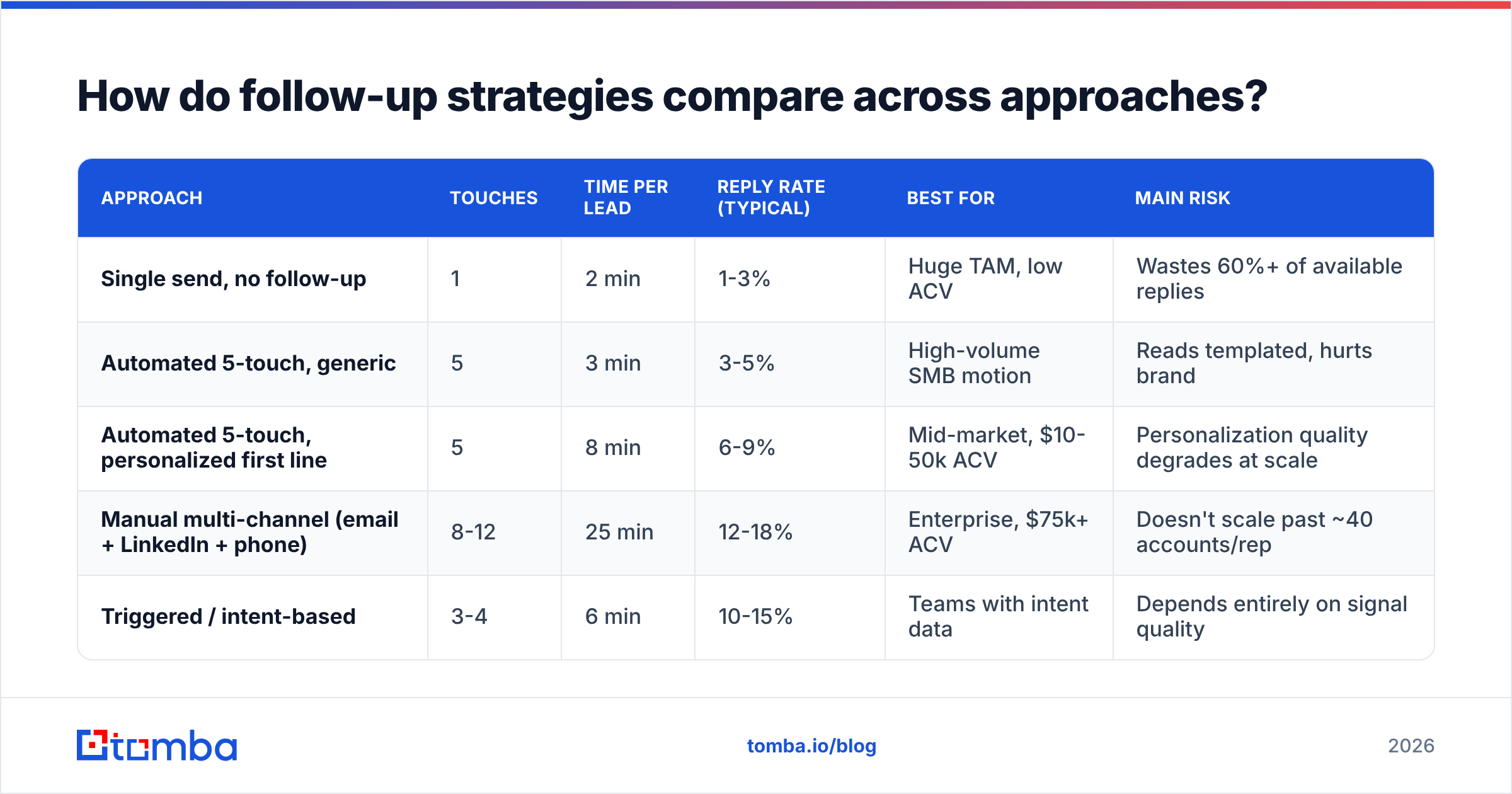
Not every team should run the same cadence. Here's the honest trade-off table:
| Approach | Touches | Time per lead | Reply rate (typical) | Best for | Main risk |
|---|---|---|---|---|---|
| Single send, no follow-up | 1 | 2 min | 1-3% | Huge TAM, low ACV | Wastes 60%+ of available replies |
| Automated 5-touch, generic | 5 | 3 min | 3-5% | High-volume SMB motion | Reads templated, hurts brand |
| Automated 5-touch, personalized first line | 5 | 8 min | 6-9% | Mid-market, $10-50k ACV | Personalization quality degrades at scale |
| Manual multi-channel (email + LinkedIn + phone) | 8-12 | 25 min | 12-18% | Enterprise, $75k+ ACV | Doesn't scale past ~40 accounts/rep |
| Triggered / intent-based | 3-4 | 6 min | 10-15% | Teams with intent data | Depends entirely on signal quality |
Most teams over-index on the middle two rows and never test the last one. If you have website visitor data, a triggered three-touch sequence to a prospect who just read your pricing page will outperform a cold five-touch to a matched-persona stranger by a wide margin — same copy, different timing. Website visitor reveal is one way to source that trigger; product usage, funding announcements, and job-change signals work too.
For a channel comparison beyond email, G2's sales engagement category shows what multi-channel platforms actually bundle and where the pricing floors sit.
What metrics tell you the follow-up sequence is working?#
Track four numbers per touch, not per sequence. Averaging across the whole sequence hides exactly the touch that's broken.
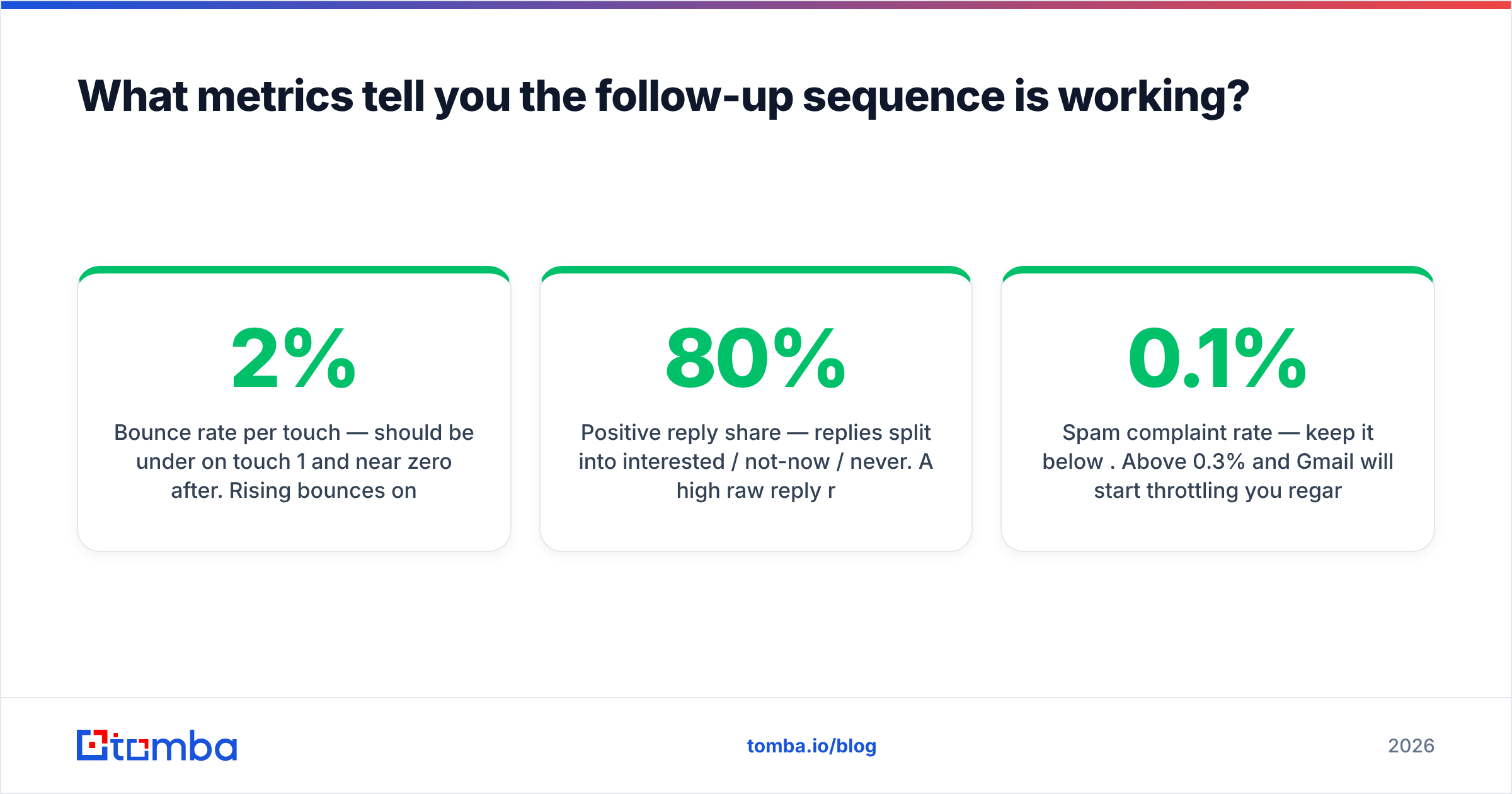
- Bounce rate per touch — should be under 2% on touch 1 and near zero after. Rising bounces on touch 3+ means your suppression logic is broken.
- Reply rate per touch — if touch 4 outperforms touch 2, your touch 2 has no reason to exist. Rewrite or delete it.
- Positive reply share — replies split into interested / not-now / never. A high raw reply rate with 80% "never" means your targeting is off, not your copy.
- Spam complaint rate — keep it below 0.1%. Above 0.3% and Gmail will start throttling you regardless of content quality. Google and Yahoo both formalized this threshold in their 2024 bulk-sender requirements, and enforcement has only tightened since.
The diagnostic shortcut: if opens are healthy but replies are flat, it's copy. If opens are collapsing across touches, it's email deliverability or list quality. Those need completely different fixes, and teams routinely rewrite copy when the real problem was a missing DMARC record.
Run an SPF checker and a blacklist checker before you touch a single subject line. Authentication problems masquerade as copy problems constantly.
What are the most common follow-up mistakes?#
Sending the same email with "bumping this up." The recipient already decided about that message. Repeating it just confirms the decision.
Following up too fast. A next-day follow-up on a cold email reads as desperate and, worse, arrives before the prospect has cleared their original backlog. Three business days minimum.
Following up on a bounced address. Obvious, still common. Sequence tools that don't hard-stop on bounce will happily send five more emails into a black hole while your reputation burns.
Attaching files on touch 1 or 2. Attachments from unknown senders trip filters. Link instead, and only after you've earned an open.
Never breaking up. Sequences that just stop leave the door ambiguous. The break-up email costs nothing, pulls a meaningful share of total replies, and cleanly recycles the lead for a re-approach in two quarters.
Ignoring the reply-to identity. If the sequence sends from sales@, replies feel like they're going into a queue. Send from a named human mailbox on a subdomain you're willing to burn.
How do you build the list that makes follow-ups worth sending?#
Start narrow. Two hundred genuinely well-matched, verified contacts will out-produce two thousand loosely matched ones, and the follow-up work is only sustainable at a size you can actually personalize.
The practical stack: identify target accounts, pull the right roles per account, verify every address, enrich with the context you'll reference in touches 3 and 4, then load the sequence. If you're pulling contacts at volume, a bulk email finder plus data enrichment handles the first and fourth steps in one pass, and Tomba pricing starts free at 25 searches a month, with Starter at $49/mo and Growth at $99/mo if you need real volume.
For teams that want peer comparisons on data providers, BookYourData is a solid option when you'd rather buy a pre-built, pay-as-you-go list than build one contact by contact — different model, genuinely useful for certain motions. Match the tool to whether your bottleneck is coverage or precision.
Then treat the follow-up sequence as the easy part. It is, once the data underneath it is real.
Ready to stop following up on addresses that never existed? Start with the Tomba Email Finder — find and verify professional emails by domain, name, or company before your sequence ever fires, so every one of your four to six touches lands in a real inbox. The free tier covers 25 searches a month, no card required, and you can test it against your existing list in about ten minutes.
Related guides#
Ready to find emails that actually work?
Join 150,000+ professionals who stopped guessing and started sending. Free credits on signup — no credit card required.
Get the Tomba newsletter
Practical outbound tactics and product updates — once every two weeks.
About the author