Follow Up Email For Collaboration: Templates That Get Replies
Most collaboration pitches die in the follow-up, not the first email. Here are the sequences, timing windows, and templates that actually pull replies from partners, creators, and brands in 2026.
TL;DR
- Roughly half of all collaboration replies arrive after the first email, not on it — but most people send one pitch and quit.
- The best-performing follow-up cadence for partnerships is 4 touches over 18–21 days, spaced wider than a sales sequence because partnership decisions involve more people.
- "Just bumping this up" is the single most-ignored opening line in partnership outreach. Every follow-up must add a new asset, a new angle, or a new reason to care.
- Reaching the wrong inbox kills more collaboration pitches than bad copy does. Verify the decision-maker's address before you write anything.
- Close the loop explicitly on touch 4 — a clean "I'll assume the timing isn't right" breakup email consistently out-performs a fifth soft bump.
Why Do Most Collaboration Follow-Ups Get Ignored?#
Because they contain zero new information.
Think of a collaboration pitch like asking someone to co-sign a lease. The first email is the ask. If they don't answer, sending "just checking in!" is like knocking on the same door harder — it gives them nothing new to evaluate. What actually moves them is showing up with the credit report, the numbers, and a shorter lease term.
That's the mental model for every follow up email for collaboration you write: each touch must lower the perceived risk of saying yes, or raise the cost of ignoring you.
Three structural reasons partnership follow-ups underperform cold sales follow-ups:
- The decision is committee-shaped. A partnership means marketing, legal, and sometimes product all weigh in. One person can say no; three people have to say yes. Your follow-up has to be forwardable — short enough to paste into Slack, concrete enough to survive without you in the room.
- There's no urgency mechanic. Nobody's quota depends on replying to your co-marketing idea. You have to manufacture legitimate timing: a launch date, a seasonal window, a content calendar that closes.
- You're often in the wrong inbox. Generic
partnerships@andhello@addresses are triage queues. A pitch sent there competes with invoices and spam. A pitch sent to the partnerships lead's real address competes with three other emails.
That third point is the one most people skip. Before you optimize subject lines, confirm the address is real and belongs to a human who owns the decision. A quick pass through an email verifier removes the bounce risk, and domain search surfaces the actual team members behind a company domain instead of the shared alias on their contact page.

What Is the Right Timing for a Collaboration Follow-Up Sequence?#
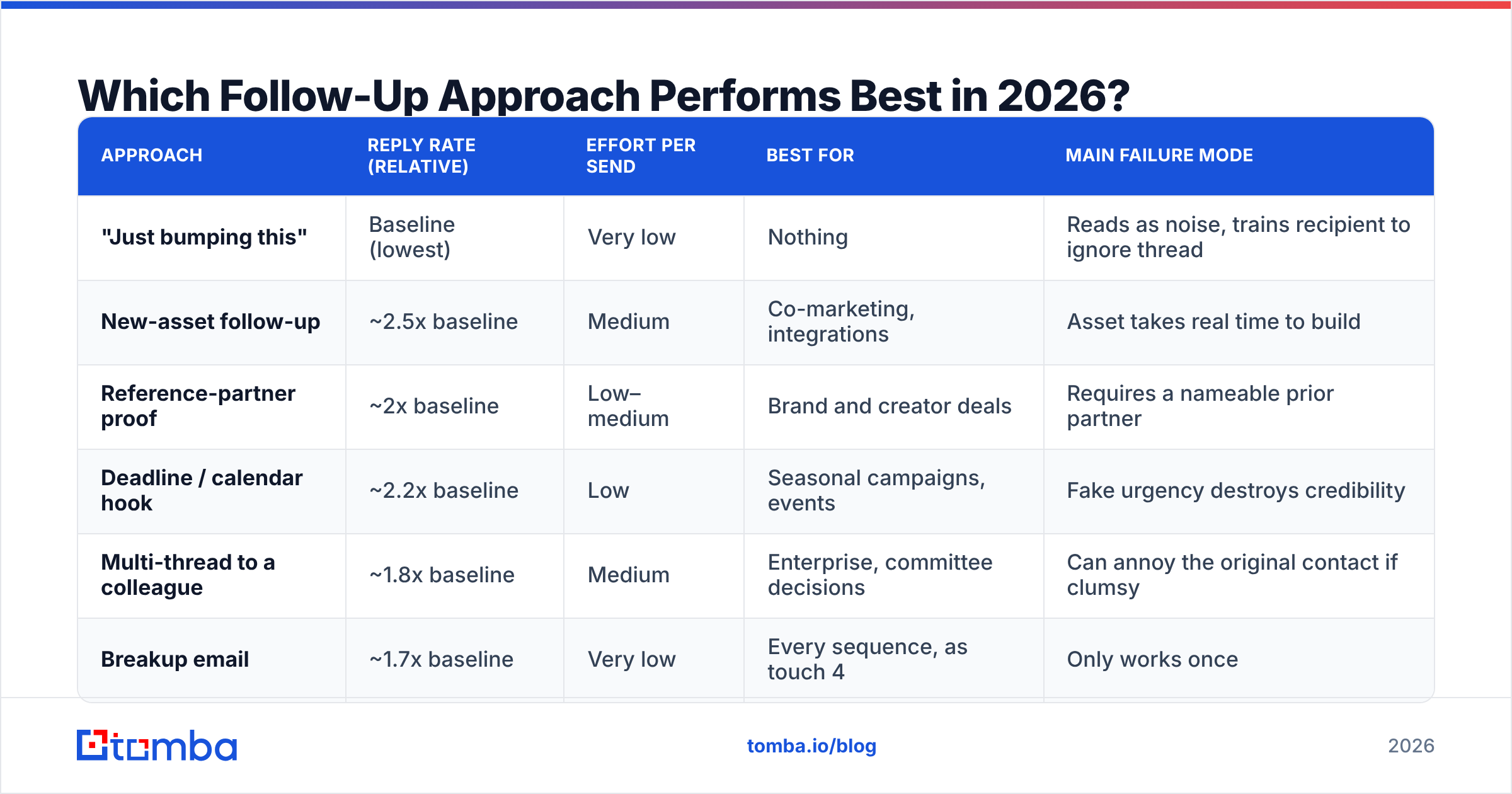
Wider than sales. A cold sales sequence often runs 5 touches in 12 days. Partnership outreach performs better at 4 touches over roughly three weeks, because the recipient genuinely needs time to loop in a colleague.
Here's the cadence that holds up across creator partnerships, co-marketing, integration pitches, and guest-content asks:
| Touch | Day | Angle | Length | Primary goal |
|---|---|---|---|---|
| 1 — Initial pitch | Day 0 | The idea + one proof point | 90–120 words | Make the value legible in 10 seconds |
| 2 — Asset drop | Day 3–4 | Add a deck, mockup, or draft outline | 60–80 words | Lower effort required to say yes |
| 3 — Social proof | Day 8–10 | Similar partner + result | 70–90 words | Reduce perceived risk |
| 4 — Breakup | Day 18–21 | Explicit close + door left open | 40–60 words | Force a decision or a clean archive |
Two timing rules that matter more than the exact days:
- Never follow up inside 48 hours. Partnership emails get read, flagged, and mentally queued. Bumping too early reads as impatience and signals you have nothing else going on.
- Skip Mondays and Friday afternoons. Monday is triage; Friday is deferral. Tuesday through Thursday, 8–10am local to the recipient, remains the reliable window.
If you're running this at any scale, timing per-recipient beats a global schedule. Send in the recipient's timezone, not yours.
How Should You Structure Each Follow Up Email for Collaboration?#
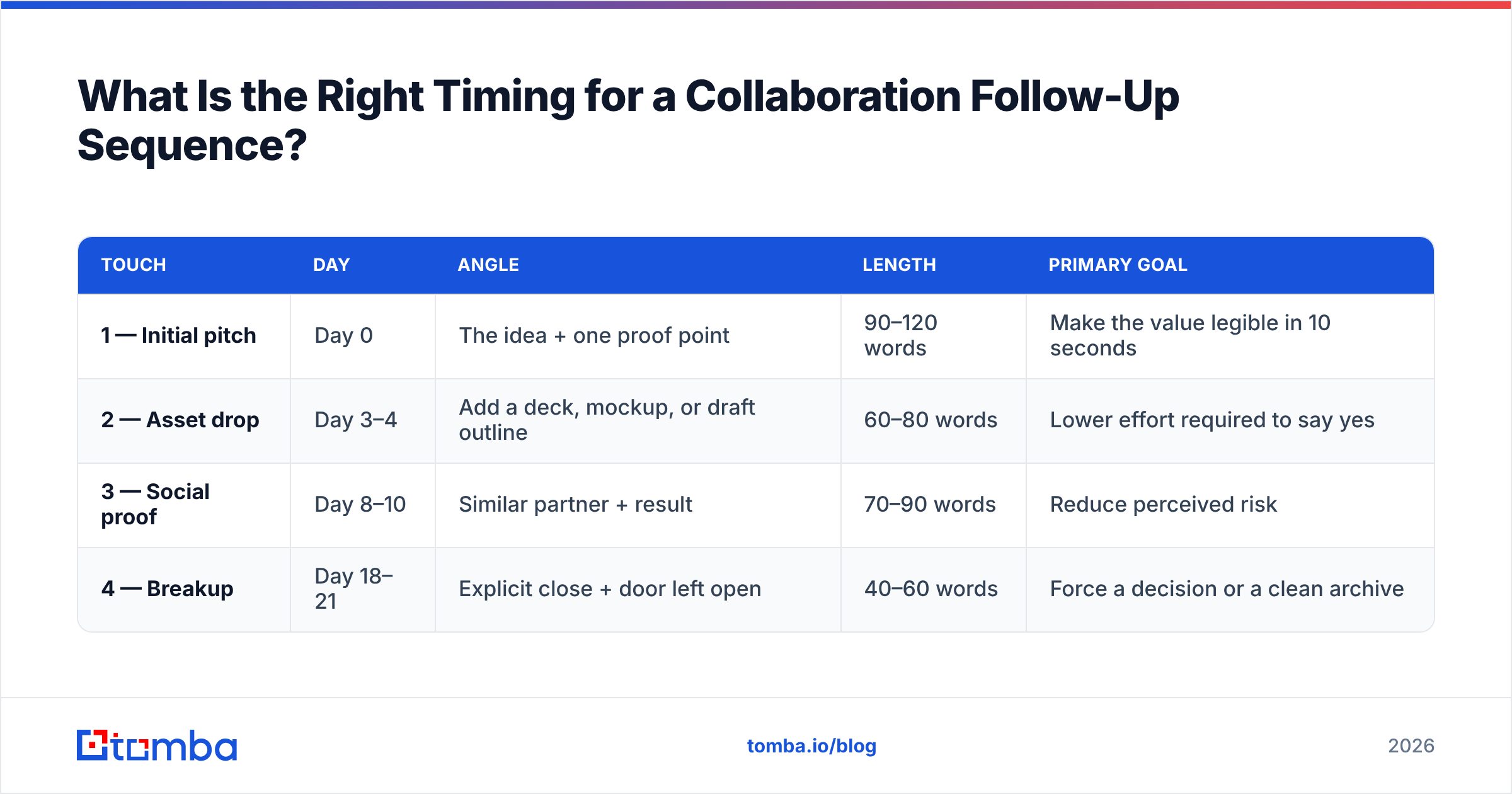
Every touch follows the same four-part skeleton. The content changes; the skeleton doesn't.
- Context line (1 sentence). Remind them who you are and what you proposed, without a guilt trip. "Following up on the co-hosted webinar idea from last week" beats "I hadn't heard back."
- New element (1–2 sentences). The asset, the data point, the reference partner. This is the whole reason the email exists.
- Deliberate narrowing (1 sentence). Shrink the ask each time. Touch 1 asks for a partnership; touch 3 asks for a 15-minute call; touch 4 asks for a yes/no.
- Single CTA (1 question). One question mark per email. Two questions split attention and halve your reply rate.
Word count discipline matters here. Touch 1 can run 120 words. By touch 4 you should be under 60. The sequence should visibly get easier to answer, not heavier.
The 9 Templates#
Template 1 — Asset drop (touch 2, co-marketing)
Subject: the outline for the joint report
Hi Priya — following up on the joint benchmark report idea.
I put together a rough outline so it's easier to judge: 6 sections, we handle the data pull and design, your team contributes the commentary and co-hosts the launch. Attached.
Worth 15 minutes to see if the shape works?
Template 2 — Reference partner (touch 3)
Subject: what this looked like with Northlane
Hi Priya — one more data point on the joint report idea.
We ran the same format with Northlane in Q1. They contributed roughly two hours of SME time total and it drove 340 signups to their side. Happy to forward the post-mortem.
Is the commentary lift the blocker, or is it timing?
Template 3 — Timing hook (touch 2, seasonal)
Subject: closing the Q4 calendar Friday
Hi Marcus — we're locking the Q4 content calendar Friday and I've held a slot for the joint webinar.
If it's a no for this quarter that's completely fine, I'll pencil you in for Q1 instead. Which one should I do?
Template 4 — Creator collaboration bump
Subject: re: the March collab
Hey Sam — circling back on the March collab.
Since I wrote, we finalized the budget: $4,000 flat, you keep full creative control, one round of feedback from us. That's the whole deal.
Yes or no is genuinely fine — just want to stop taking up inbox space.
Template 5 — Integration pitch (touch 2, technical)
Subject: sandbox key for the integration
Hi Dana — following up on the integration proposal.
To make it concrete, I generated a sandbox key for your team. The endpoint you'd need is documented and a working proof-of-concept takes about 40 minutes. Key in the reply below.
Want me to loop in our solutions engineer?
Template 6 — Guest content follow-up
Subject: three angles for the guest post
Hi Elena — following up on the guest post.
Rather than make you brief me, here are three angles I could write: (1) attribution for partner-sourced pipeline, (2) why co-marketing fails at Series B, (3) a teardown of five partner programs. Pick one and I'll draft it.
Any of those fit the calendar?
Template 7 — Reply revival (they went dark mid-thread)
Subject: re: partnership scope
Hi Tom — I know the reorg landed right as we were scoping this.
No pressure at all. Should I check back in six weeks, or is this off the table for the year?
Template 8 — The multi-threader
Subject: right person for partner integrations?
Hi Aisha — I reached out to Ben about a partner integration a couple weeks back and I suspect it landed at a busy moment.
If integrations sit with someone else on your side, could you point me their way? Happy to keep it off your plate entirely.
Template 9 — Breakup (touch 4, universal)
Subject: closing this out
Hi Priya — I'll assume the timing isn't right on the joint report and stop following up.
The outline is yours to use regardless. If it comes back around next quarter, reply to this thread and I'll pick it straight up.
Copy-paste those and you'll outperform a bump. Rewrite them in your own voice and you'll do better still. If you want a starting bank to remix from, Tomba's cold email templates library covers adjacent formats.
Which Follow-Up Approach Performs Best in 2026?#
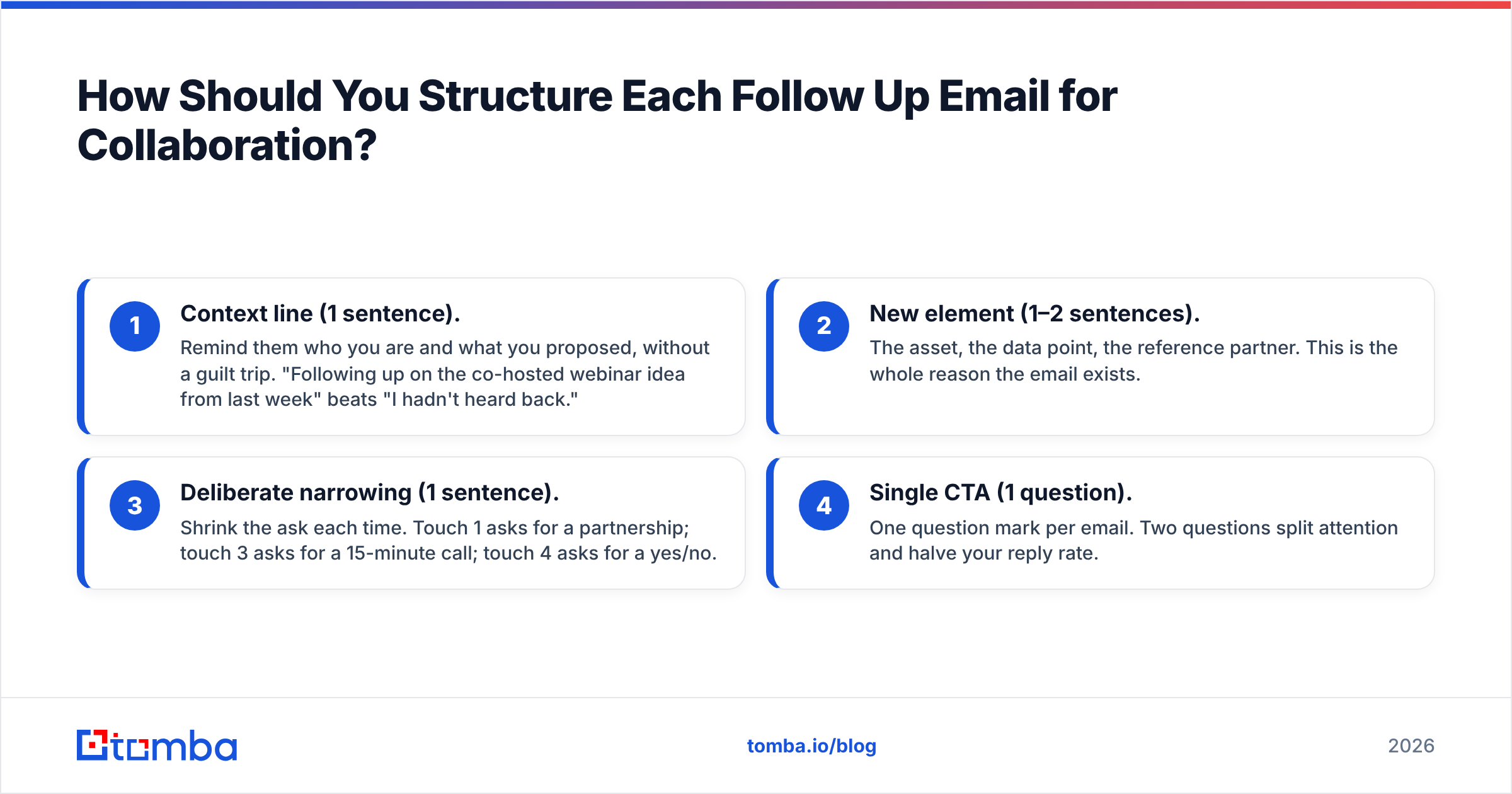
Not all follow-up styles carry the same weight. Here's how the common approaches compare on the metrics that decide partnership outcomes:
| Approach | Reply rate (relative) | Effort per send | Best for | Main failure mode |
|---|---|---|---|---|
| "Just bumping this" | Baseline (lowest) | Very low | Nothing | Reads as noise, trains recipient to ignore thread |
| New-asset follow-up | ~2.5x baseline | Medium | Co-marketing, integrations | Asset takes real time to build |
| Reference-partner proof | ~2x baseline | Low–medium | Brand and creator deals | Requires a nameable prior partner |
| Deadline / calendar hook | ~2.2x baseline | Low | Seasonal campaigns, events | Fake urgency destroys credibility |
| Multi-thread to a colleague | ~1.8x baseline | Medium | Enterprise, committee decisions | Can annoy the original contact if clumsy |
| Breakup email | ~1.7x baseline | Very low | Every sequence, as touch 4 | Only works once |
The pattern is consistent: effort invested before sending beats volume of sends. One follow-up with a real asset attached outperforms four bumps, and it costs you less relationship capital.
Two things worth noting from the vendor side. HubSpot's sales research has consistently found that a meaningful share of positive replies land on touches two through four rather than touch one — the persistence gap is real, and most senders stop before it pays. And peer review on G2 shows partnership teams increasingly judging outreach tools on data freshness rather than raw database size, which tracks with what actually breaks these sequences: stale contacts, not weak copy.

How Do You Make Sure the Follow-Up Actually Lands?#
Deliverability is the invisible half of this. You can write the best follow up email for collaboration in your category and still lose if it lands in spam or bounces off a dead address.
Run this checklist before any sequence goes out:
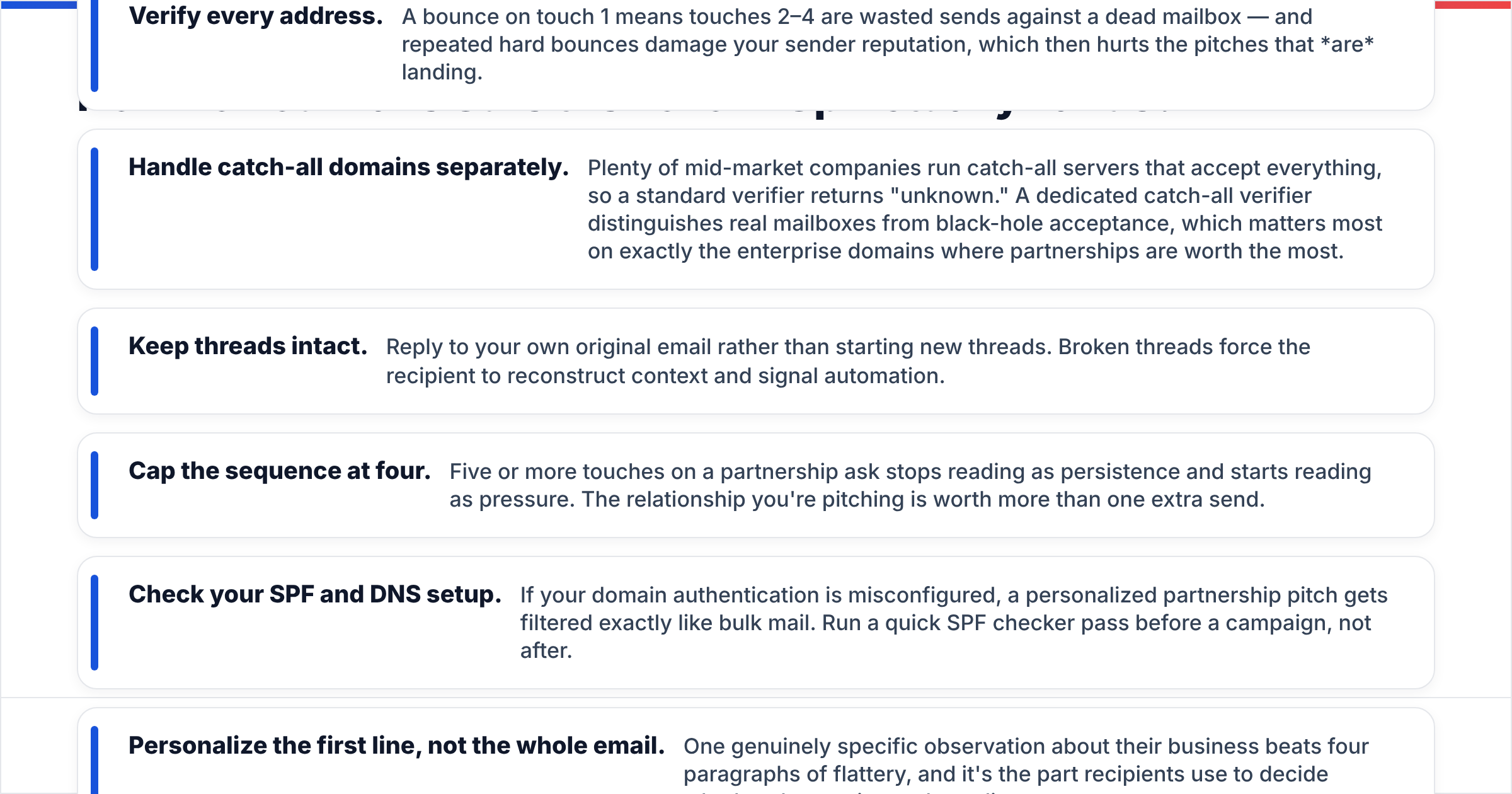
- Verify every address. A bounce on touch 1 means touches 2–4 are wasted sends against a dead mailbox — and repeated hard bounces damage your sender reputation, which then hurts the pitches that are landing.
- Handle catch-all domains separately. Plenty of mid-market companies run catch-all servers that accept everything, so a standard verifier returns "unknown." A dedicated catch-all verifier distinguishes real mailboxes from black-hole acceptance, which matters most on exactly the enterprise domains where partnerships are worth the most.
- Keep threads intact. Reply to your own original email rather than starting new threads. Broken threads force the recipient to reconstruct context and signal automation.
- Cap the sequence at four. Five or more touches on a partnership ask stops reading as persistence and starts reading as pressure. The relationship you're pitching is worth more than one extra send.
- Check your SPF and DNS setup. If your domain authentication is misconfigured, a personalized partnership pitch gets filtered exactly like bulk mail. Run a quick SPF checker pass before a campaign, not after.
- Personalize the first line, not the whole email. One genuinely specific observation about their business beats four paragraphs of flattery, and it's the part recipients use to decide whether the rest is worth reading.
One more operational note: partnership contacts move jobs frequently. A list you built eight months ago is meaningfully decayed. Re-verifying before a sequence costs minutes; sending a four-touch cadence into a departed contact's inbox costs you the entire opportunity.
What Should You Track to Know If Your Follow-Ups Work?#
Track four numbers per sequence, per touch:
- Reply rate by touch. If touch 3 outperforms touch 1, your initial pitch is the weak link — not your persistence. If touch 1 dominates, your follow-ups aren't adding anything new.
- Positive vs. total replies. "Not right now" is still a reply. Separate the two or you'll optimize for polite deflections. Your response rate means little without the positive split.
- Time-to-first-reply. If most replies arrive on day 9, compressing your cadence to 10 days is cutting your own sequence short.
- Bounce rate. Anything above 3% means your list-building step is broken, not your copy.
Review these monthly, not weekly. Partnership cycles are long enough that weekly readings are mostly noise.
Where Should You Start?#
Start with the list, not the copy. The most common failure I see is a team spending a week polishing four templates and then sending them to partnerships@ addresses that route to nobody.
Build a clean list of named decision-makers at the companies you actually want to partner with, confirm each address resolves to a real mailbox, then run the 4-touch cadence above with a genuine new element on every touch.
The Tomba Email Finder handles the first half of that: give it a company domain and a name, and it returns the verified professional address with a confidence score, so your follow-up sequence starts in a real inbox instead of a triage queue. The free tier includes 25 searches a month if you want to test the workflow on a handful of target partners first; paid plans start at $49/mo on Tomba pricing when you're ready to run full campaigns. Get the address right, and every follow-up after it has a chance to work.
Related guides#
Ready to find emails that actually work?
Join 150,000+ professionals who stopped guessing and started sending. Free credits on signup — no credit card required.
Get the Tomba newsletter
Practical outbound tactics and product updates — once every two weeks.
About the author