Follow Up Email For Project Proposal: Templates That Win Deals
Most proposals die in silence, not rejection. Here is the follow-up cadence, timing data, and eight copy-paste templates that get proposals unstuck and signed.
TL;DR
- Silence after a proposal is almost never a "no" — it is usually an internal delay, a missing stakeholder, or a budget cycle you cannot see.
- The highest-performing cadence is 5 touches over 21 days, each carrying a different reason to reply, not a repeated "just checking in."
- Proposals followed up within 24 hours of delivery close materially more often than those left to sit for a week.
- Every follow-up needs one job: unblock a specific decision, not request a status update.
- Eight copy-paste templates below cover the full arc — delivery confirmation, value add, stakeholder loop-in, deadline anchor, and the break-up.
You sent the proposal. You attached the scope, the timeline, the pricing tiers. You hit send with the quiet confidence of someone who nailed it.
Then nothing. Four days of nothing.
This is the most expensive silence in B2B. Not because the deal is dead, but because most sellers respond to it badly — with a limp "just following up on my proposal below" that gives the prospect zero new reason to open, read, or act. This guide fixes that.
Why does your project proposal get ignored?#
Because you are almost never the reason. Understanding the actual cause changes the email you write.
Here are the five reasons proposals go quiet, ranked by how often they actually happen:
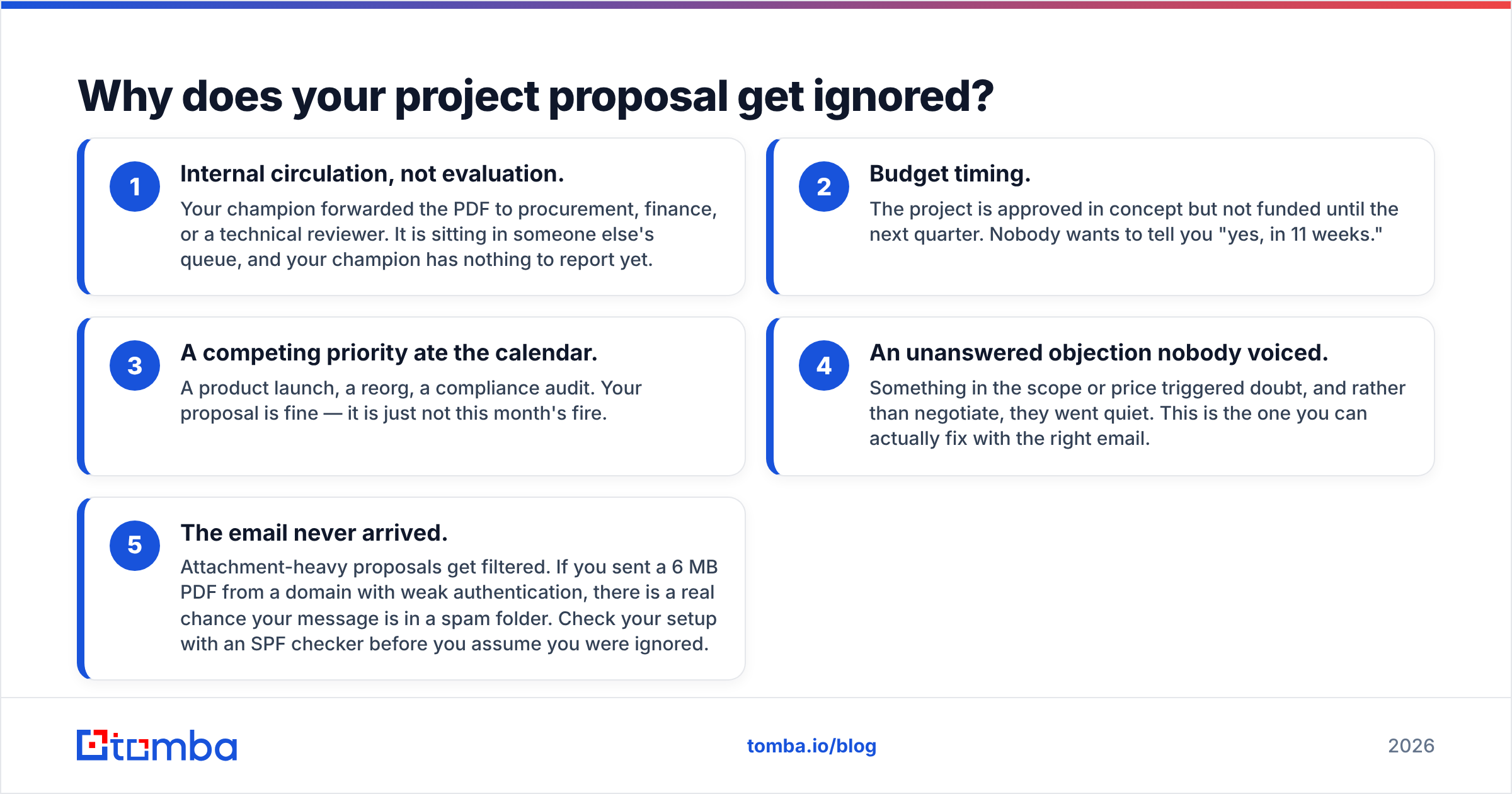
- Internal circulation, not evaluation. Your champion forwarded the PDF to procurement, finance, or a technical reviewer. It is sitting in someone else's queue, and your champion has nothing to report yet.
- Budget timing. The project is approved in concept but not funded until the next quarter. Nobody wants to tell you "yes, in 11 weeks."
- A competing priority ate the calendar. A product launch, a reorg, a compliance audit. Your proposal is fine — it is just not this month's fire.
- An unanswered objection nobody voiced. Something in the scope or price triggered doubt, and rather than negotiate, they went quiet. This is the one you can actually fix with the right email.
- The email never arrived. Attachment-heavy proposals get filtered. If you sent a 6 MB PDF from a domain with weak authentication, there is a real chance your message is in a spam folder. Check your setup with an SPF checker before you assume you were ignored.
Notice that only one of those five is "they hate the price." Your follow-up should therefore not open with a discount.

What is the right timing for a follow up email for project proposal?#
Send the first follow-up within 24 hours of delivery — not as a nudge, but as a confirmation and framing message. After that, widen the gaps.
Here is the cadence that consistently outperforms both the one-and-done approach and the aggressive daily chase:
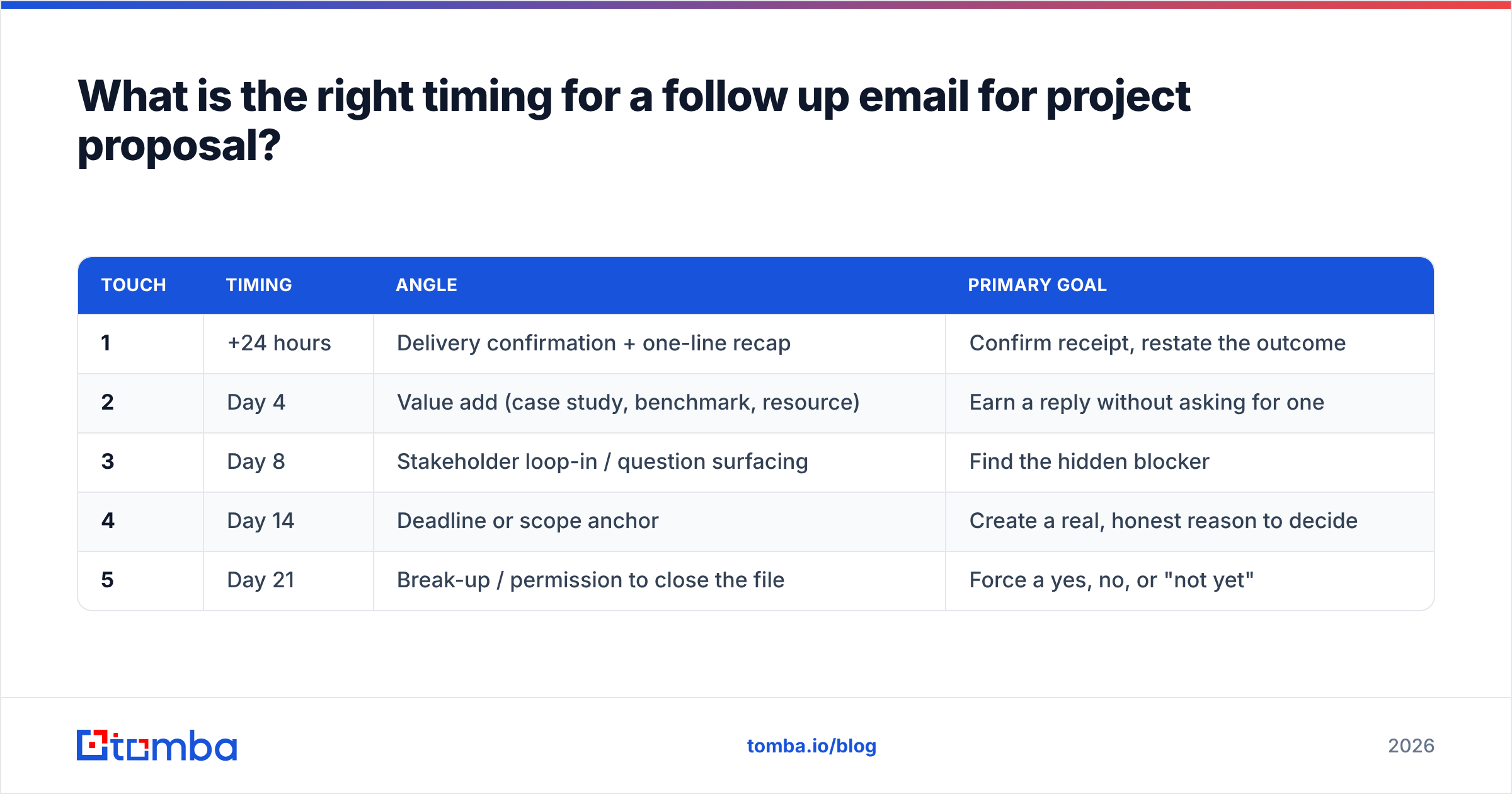
| Touch | Timing | Angle | Primary goal |
|---|---|---|---|
| 1 | +24 hours | Delivery confirmation + one-line recap | Confirm receipt, restate the outcome |
| 2 | Day 4 | Value add (case study, benchmark, resource) | Earn a reply without asking for one |
| 3 | Day 8 | Stakeholder loop-in / question surfacing | Find the hidden blocker |
| 4 | Day 14 | Deadline or scope anchor | Create a real, honest reason to decide |
| 5 | Day 21 | Break-up / permission to close the file | Force a yes, no, or "not yet" |
Three rules make this cadence work:
- Each touch carries new information. If a message could be deleted without the prospect losing anything, do not send it.
- Vary the channel by touch 3. Email, then email, then LinkedIn or phone. A B2B phone number at touch 4 converts stalled deals at a noticeably higher rate than a fifth email would.
- Reply in-thread for touches 1 and 2, start a fresh thread for 4 and 5. Old threads get visually buried; a new subject line resets attention.
Should you follow up in the same thread or start a new one?#
Same thread early, new thread late. The logic is about visual position, not etiquette.
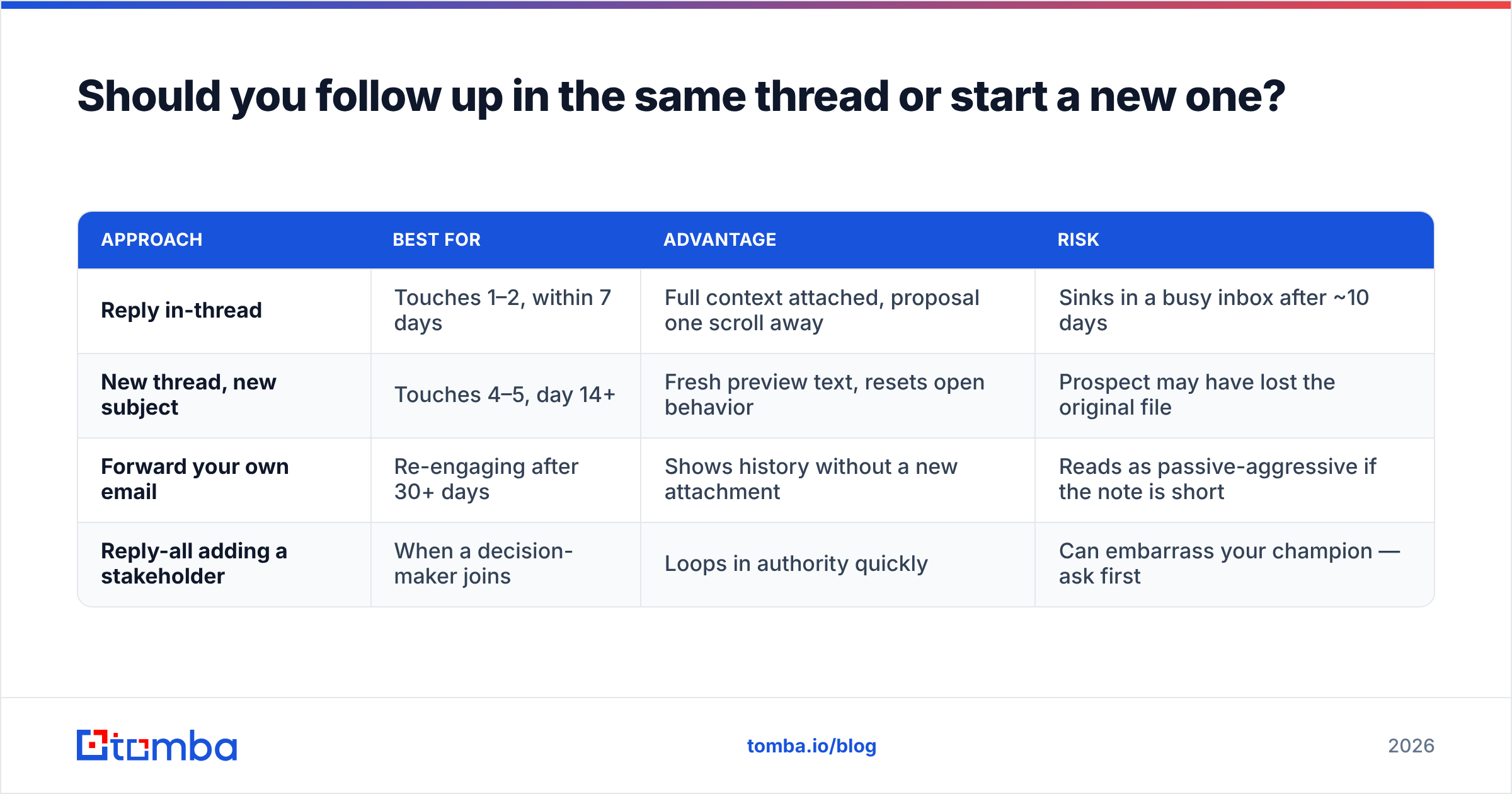
| Approach | Best for | Advantage | Risk |
|---|---|---|---|
| Reply in-thread | Touches 1–2, within 7 days | Full context attached, proposal one scroll away | Sinks in a busy inbox after ~10 days |
| New thread, new subject | Touches 4–5, day 14+ | Fresh preview text, resets open behavior | Prospect may have lost the original file |
| Forward your own email | Re-engaging after 30+ days | Shows history without a new attachment | Reads as passive-aggressive if the note is short |
| Reply-all adding a stakeholder | When a decision-maker joins | Loops in authority quickly | Can embarrass your champion — ask first |
If you go with a new thread at day 14, re-attach the proposal or link to it. Never make a busy person hunt for a document you want them to read.
What are the eight templates that actually get replies?#
Each of these is short by design. Proposal follow-ups over 120 words get skimmed, and skimming kills specificity.
1. The 24-hour delivery confirmation#
Subject: Re: Proposal — [Project name]
Hi [Name],
Sent the proposal yesterday — flagging it here so it does not get lost.
The short version: [outcome] in [timeframe] for [price tier], with [key differentiator] included from week one.
One question so I can prep the right next step — is this going through procurement, or is it a decision you and [colleague] can make directly?
[Your name]
Why it works: it asks a process question, not a status question. Process questions are easy to answer and reveal the real timeline.
2. The value-add (day 4)#
Subject: The [industry] benchmark I mentioned
Hi [Name],
Not chasing the proposal — I found the data point we talked about. [Company] in your space cut [metric] by [number]% using the approach in section 2. Two-page breakdown attached.
Worth 15 minutes to walk through how it maps to your setup?
[Your name]
3. The objection-surfacer (day 8)#
Subject: Was the [scope / timeline / price] the sticking point?
Hi [Name],
When proposals go quiet at this stage, it is usually one of three things: the scope is bigger than you need, the start date does not fit, or the number is above the band you were given.
Which is closest? I can adjust two of those three without a new approval cycle.
[Your name]
This is the highest-reply template in the set. Naming the objection first gives the prospect permission to be honest.
4. The stakeholder loop-in#
Subject: Anything [Stakeholder] needs from me?
Hi [Name],
Guessing this is with [finance / IT / legal] now. Happy to send a security overview, a shorter exec summary, or jump on a 10-minute call with them directly — whichever removes work from your plate.
What would help most?
[Your name]
5. The deadline anchor (day 14)#
Subject: [Project name] — holding your [Month] slot until [date]
Hi [Name],
Quick logistics note: we scheduled delivery capacity for [Month] based on the proposal timeline. I can hold that until [specific date], after which the start date moves to [later month].
No pressure either way — just did not want the timeline to shift without you knowing.
[Your name]
Only send this if it is true. Manufactured urgency is the fastest way to lose a deal you were still in.
6. The new-information restart#
Subject: New: [feature / pricing change / capability]
Hi [Name],
[Change] shipped last week, which affects your proposal — [specific benefit to their use case]. Revised the scope doc accordingly, attached.
Still worth a conversation, or should I close this out for now?
[Your name]
7. The break-up (day 21)#
Subject: Closing the file on [Project name]?
Hi [Name],
I have not heard back, which usually means the timing is off — completely understandable.
I will close this out on my end unless you tell me otherwise. If [quarter] makes more sense, say the word and I will check back then instead.
Either way, good luck with [specific initiative they mentioned].
[Your name]
Break-ups reliably generate replies because they remove the obligation to be enthusiastic. "Yes, check back in Q3" is a much easier email to send than "we are still deciding."
8. The quarterly re-open#
Subject: [Quarter] check-in — still relevant?
Hi [Name],
You mentioned [Q] might be better timing for [project]. We are there.
Two things changed since we last spoke: [change 1] and [change 2]. If the project is still on the roadmap, I will send an updated scope. If not, I will stop cluttering your inbox.
[Your name]
How do you make sure follow-ups actually land in the inbox?#
Deliverability decides whether any of this matters. A perfect template in a spam folder converts at zero.
Four checks before you run a proposal cadence:
- Authenticate the sending domain. SPF, DKIM, and DMARC are table stakes. Google's bulk sender guidelines treat unauthenticated mail as suspect regardless of volume.
- Verify the address you are writing to. People change jobs mid-deal. A bounce at touch 3 does not just fail — it damages your sender reputation. Run the contact through an email verifier before a long cadence.
- Drop the attachment after touch 1. Link to a hosted version instead. Repeated attachments across a thread trigger filters and slow mobile loading.
- Watch the reply-to and signature. Mismatched reply-to headers and image-heavy signatures both correlate with spam placement.
How many follow-ups is too many?#
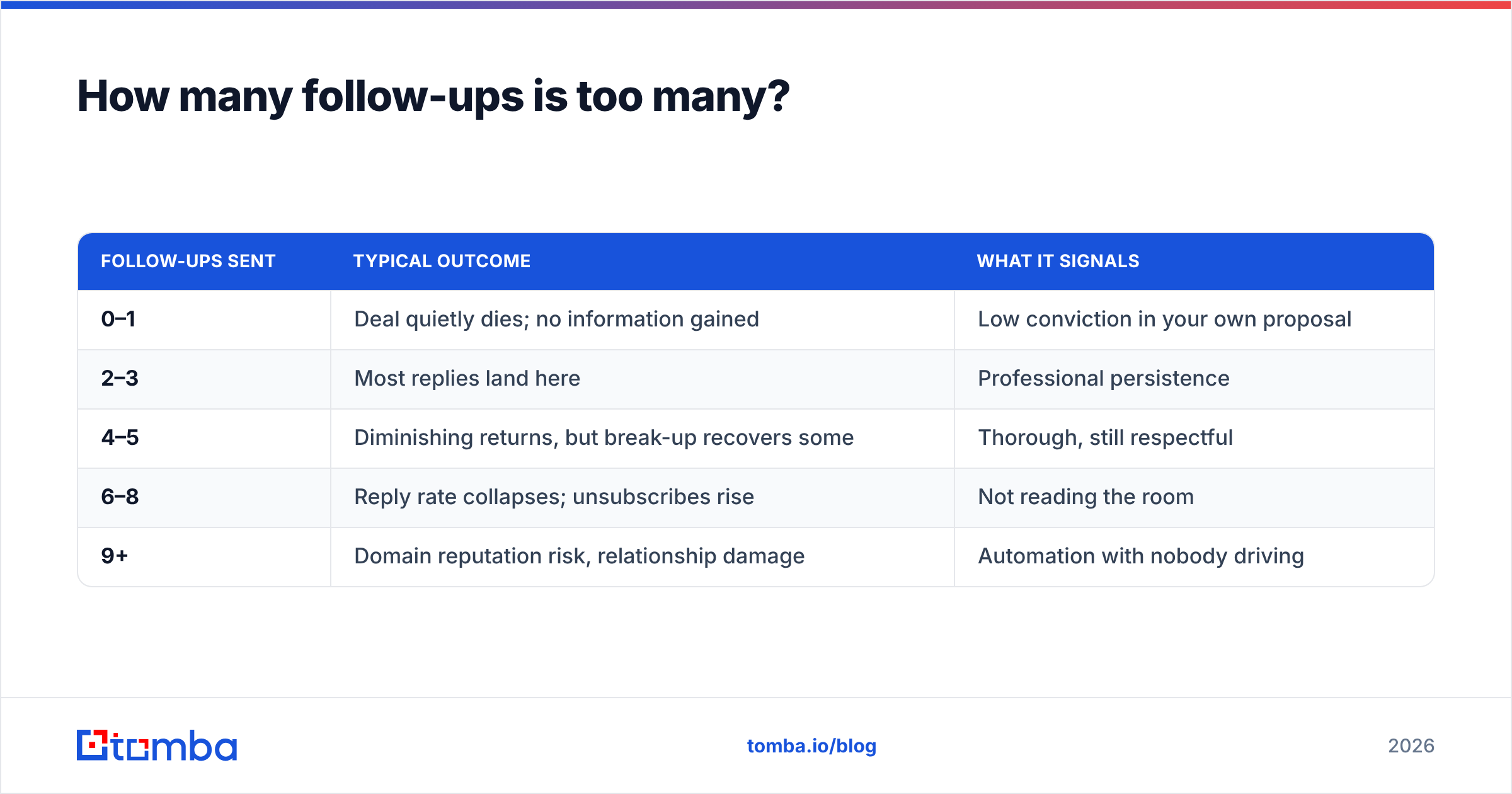
Five is the practical ceiling for a single proposal cycle. Beyond that, you are not persistent — you are noise, and you damage the relationship for the next cycle.
| Follow-ups sent | Typical outcome | What it signals |
|---|---|---|
| 0–1 | Deal quietly dies; no information gained | Low conviction in your own proposal |
| 2–3 | Most replies land here | Professional persistence |
| 4–5 | Diminishing returns, but break-up recovers some | Thorough, still respectful |
| 6–8 | Reply rate collapses; unsubscribes rise | Not reading the room |
| 9+ | Domain reputation risk, relationship damage | Automation with nobody driving |
The better lever is not more emails — it is better-targeted ones. If your champion has gone dark, the fix is a second contact at the account, not a sixth email to the same person. Use domain search to map who else owns the budget line, then loop them in politely rather than escalating volume.
What should you track to know if your cadence works?#
Track four numbers per template, not per campaign. Campaign-level metrics hide which specific message is doing the work.
- Reply rate by touch number. If touch 3 outperforms touch 1, your initial confirmation is too weak.
- Positive reply share. A "no" is a good outcome. Count it separately from silence.
- Time-to-first-reply. Shortening this from 9 days to 4 compresses your entire sales cycle.
- Proposal-to-close rate by cadence completion. Compare deals that got all five touches against those that stalled at two. The gap is your business case for discipline.
Industry benchmarking from sources like HubSpot's sales research and peer reviews on G2 is useful context, but your own historical data beats any published average. Your niche, deal size, and buyer seniority move these numbers more than any general benchmark does.
What is the single biggest mistake in proposal follow-ups?#
Asking for a status update instead of offering a decision.
"Any update on the proposal?" puts the work on the prospect: they have to gather information, form a position, and compose a reply. "Should I hold your March slot or move it to April?" gives them a binary choice they can answer in four words from their phone.
Rewrite every follow-up you have queued with that filter. If the recipient cannot answer with one sentence, it is not finished.
Second-biggest mistake: writing follow-ups for a contact you never properly verified. Long cadences to stale addresses burn deliverability and produce phantom "no responses" that were never delivered in the first place. Whether you are re-engaging an old pipeline or adding stakeholders mid-deal, start from clean data.
Get the contact data right before you run the cadence. The best proposal follow-up sequence in the world fails against a bounced address or a champion who left three weeks ago. Tomba Email Finder locates verified professional addresses by name and domain so every touch in your five-email sequence reaches a real inbox — and the built-in verification flags dead contacts before you waste a cycle on them. Start on the free tier with 25 searches a month, or scale to Starter at $49/mo when your pipeline demands it. Full Tomba pricing is public, with no per-seat surprises.
Related guides#
Ready to find emails that actually work?
Join 150,000+ professionals who stopped guessing and started sending. Free credits on signup — no credit card required.
Get the Tomba newsletter
Practical outbound tactics and product updates — once every two weeks.
About the author