Follow Up Email for Quotation Request: Templates That Get Replies
Most quotation requests die in silence — not because the price was wrong, but because nobody followed up properly. Here are the templates, timing windows, and sequences that actually pull a quote out of a stalled vendor or a stalled buyer.
TL;DR
- A follow up email for quotation request works when it adds a new input — a deadline, a revised quantity, a spec clarification — not when it asks "any update?"
- The highest-response window is 48–72 hours after the original request, then day 5, then day 10. Three touches recover most stalled quotes; a fourth rarely helps.
- Vendor-side follow-ups (you want a price) and buyer-side follow-ups (you sent a price) need completely different structures. Most templates online mix them up.
- Subject line rules: reference the RFQ number or product name, never write "Following up" alone. Threaded replies beat fresh subjects by a wide margin in B2B.
- If the contact never replies at all, the problem is usually routing — you emailed the wrong inbox. Verify the address and find the actual decision-maker before writing template #4.
What Is a Follow Up Email for Quotation Request?#
A follow up email for quotation request is the message you send when a pricing request has gone quiet. It comes in two flavors, and confusing them is the single most common reason these emails fail.
Direction 1 — you are the buyer. You asked a supplier for a quote on 500 units, or an agency for a scope of work, and eleven days later there is nothing in your inbox. Your follow-up needs to reduce the vendor's effort: restate the specs, restate the quantity, restate the deadline, and make replying a 30-second job.
Direction 2 — you are the seller. You sent a proposal or price sheet and the prospect went dark. Your follow-up needs to reduce the buyer's risk: surface objections, offer a smaller commitment, or give a reason the price changes soon.
Think of it like a restaurant order. In direction 1, you already ordered and the kitchen hasn't confirmed — you re-read the ticket back to them. In direction 2, you brought the bill to the table and nobody reached for it — you need to find out whether it's the price, the timing, or the person.
Technically, both are just re-engagement emails, but the levers are opposite. Buyer-side: lower friction. Seller-side: lower risk.

Why Do Quotation Requests Get Ignored?#
Silence almost never means "no." Here are the five real causes, ranked by how often they show up in B2B pipelines:
- Wrong inbox. You sent the RFQ to
info@orsales@and it landed in a shared mailbox nobody owns. This is the number one killer, and no template fixes it. - Incomplete spec. The vendor can't quote because you didn't state quantity, delivery date, tolerance, or destination — and they're too polite (or too busy) to ask.
- Internal approval stall. The person you emailed needs a manager's sign-off on discount authority. They're waiting, not ignoring.
- Priority displacement. Your request is real but it's the eighth item on a list of seven. It slides every day.
- Genuine disinterest. The smallest bucket. If your order size is below their minimum, they may simply deprioritize rather than decline.
Notice that four out of five causes are mechanical, not emotional. That's good news — mechanical problems respond to structured follow-ups. Before you assume cause 5, run the address through an email verifier to rule out cause 1. A hard bounce that you never noticed looks identical to being ignored.
When Should You Send a Follow Up Email for Quotation Request?#
Timing beats wording. Here's the cadence that consistently outperforms both the "wait a week and be polite" school and the daily-nudge school.
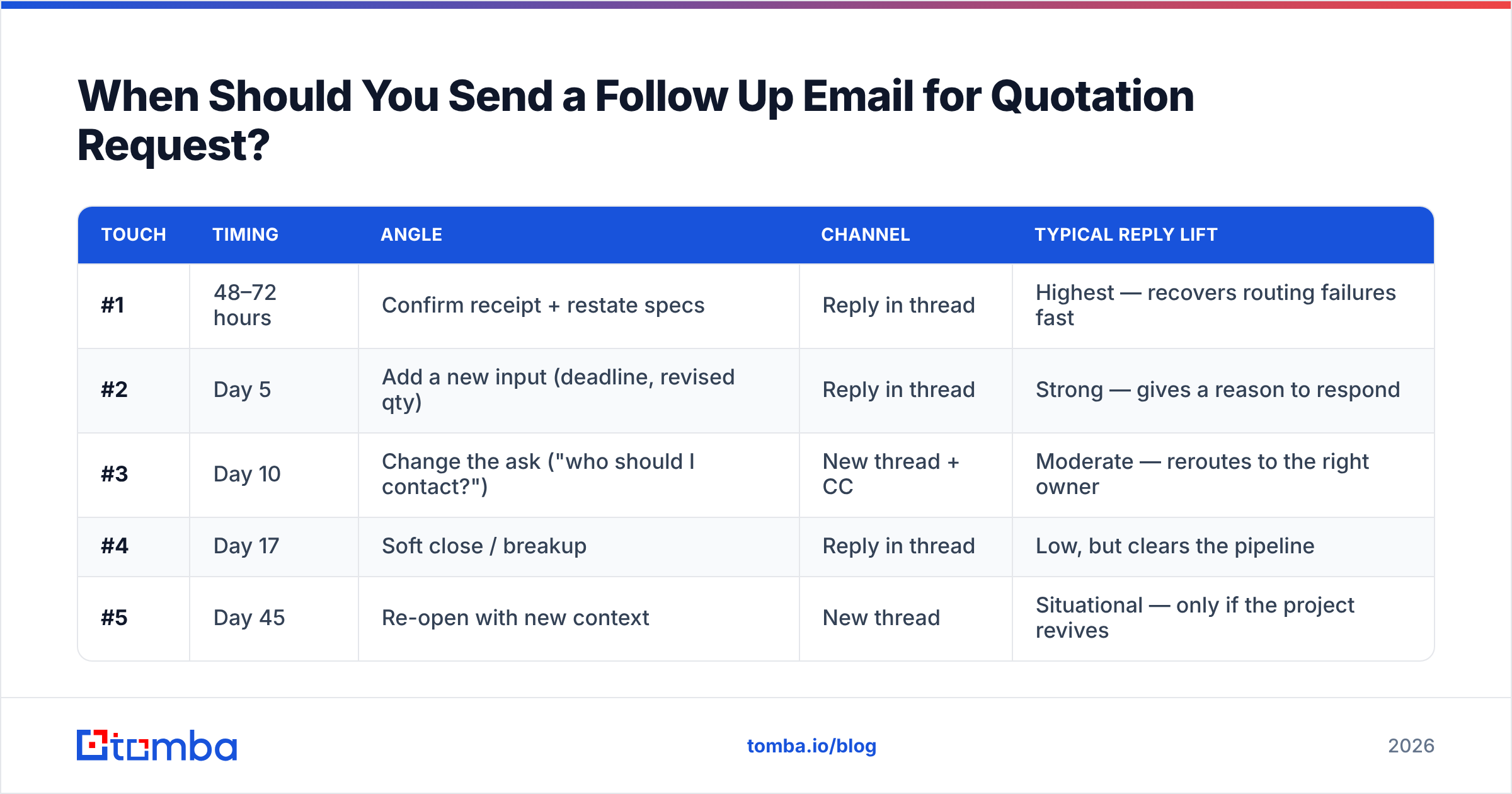
| Touch | Timing | Angle | Channel | Typical reply lift |
|---|---|---|---|---|
| #1 | 48–72 hours | Confirm receipt + restate specs | Reply in thread | Highest — recovers routing failures fast |
| #2 | Day 5 | Add a new input (deadline, revised qty) | Reply in thread | Strong — gives a reason to respond |
| #3 | Day 10 | Change the ask ("who should I contact?") | New thread + CC | Moderate — reroutes to the right owner |
| #4 | Day 17 | Soft close / breakup | Reply in thread | Low, but clears the pipeline |
| #5 | Day 45 | Re-open with new context | New thread | Situational — only if the project revives |
Two rules that hold across almost every B2B category:
- Never follow up in under 24 hours on a quote request. Preparing a real quotation involves costing, availability checks, and sometimes a supplier of their own. A same-day nudge signals you don't understand their process.
- Never let a stalled quote go past day 17 without a decision. Either escalate to a new contact or archive it. Endless "just checking in" emails are how your domain reputation degrades — every ignored thread teaches mailbox providers that your messages don't get engagement.
If you're pacing a broader outbound program alongside these, the same discipline applies to your sending volume. Check your sender reputation before ramping any sequence — follow-ups are the highest-frequency email type most teams send, and they're the first to trip filters.
What Should a Follow Up Email for Quotation Request Contain?#
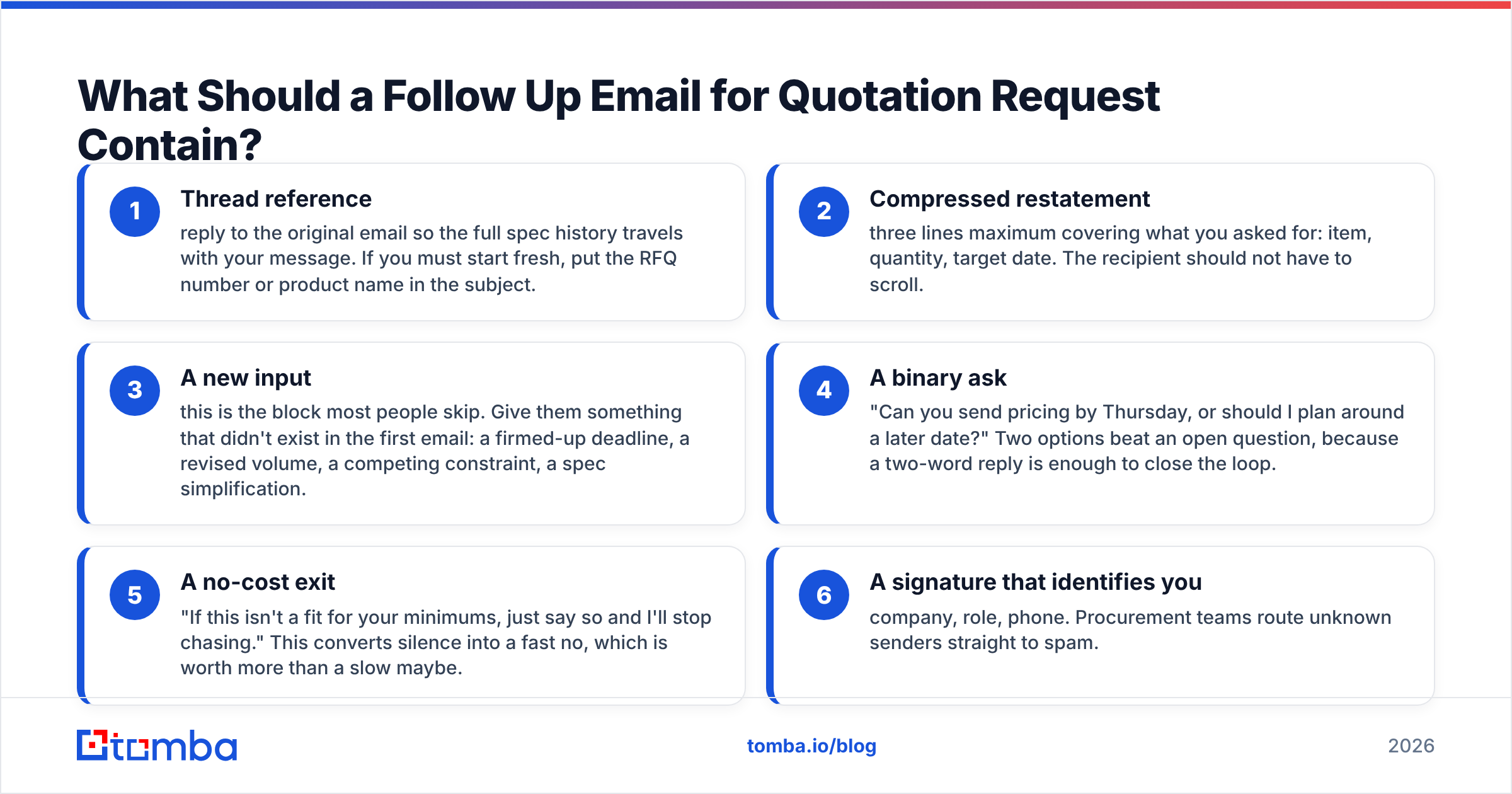
Every effective version contains the same six blocks. Miss two of them and reply rates fall off a cliff.
- Thread reference — reply to the original email so the full spec history travels with your message. If you must start fresh, put the RFQ number or product name in the subject.
- Compressed restatement — three lines maximum covering what you asked for: item, quantity, target date. The recipient should not have to scroll.
- A new input — this is the block most people skip. Give them something that didn't exist in the first email: a firmed-up deadline, a revised volume, a competing constraint, a spec simplification.
- A binary ask — "Can you send pricing by Thursday, or should I plan around a later date?" Two options beat an open question, because a two-word reply is enough to close the loop.
- A no-cost exit — "If this isn't a fit for your minimums, just say so and I'll stop chasing." This converts silence into a fast no, which is worth more than a slow maybe.
- A signature that identifies you — company, role, phone. Procurement teams route unknown senders straight to spam.
Here is what those six blocks look like assembled.
Template A — Buyer chasing a vendor (touch #1, day 2):
Subject: Re: RFQ 2026-441 — 500 units, ETA 14 March
Hi Dana,
Checking this landed. Quick recap: 500 units of the SKU-A models, delivered to our Rotterdam warehouse, needed on shelf by 14 March.
One update since I wrote: we can go to 650 units if that improves your tier pricing.
Can you send a quote by Thursday, or is a later date more realistic on your side? Either answer is useful — I just need to know which way to plan.
Best, Marc
Template B — Seller chasing a buyer (touch #2, day 5):
Subject: Re: Pricing for the Q2 rollout
Hi Priya,
The proposal I sent last Tuesday assumed a 40-seat rollout starting in April. If the timeline slipped, I can restructure it as a 15-seat pilot and remove the onboarding fee — that changes the first-year number substantially.
Which is closer to where things actually stand: April at full scope, or later at a smaller scope?
Happy to redo the numbers either way.
Sam
Template C — Rerouting (touch #3, day 10):
Subject: Who owns purchasing for SKU-A?
Hi Dana,
I don't want to keep landing in your inbox if this isn't yours. Who handles quotes for industrial fittings on your side? Happy to take it there directly.
Original request below for context.
Marc
Template C is the one that quietly does the heaviest lifting. It works because it's not a chase — it's a question anyone can answer in five seconds, and answering it costs the recipient nothing.
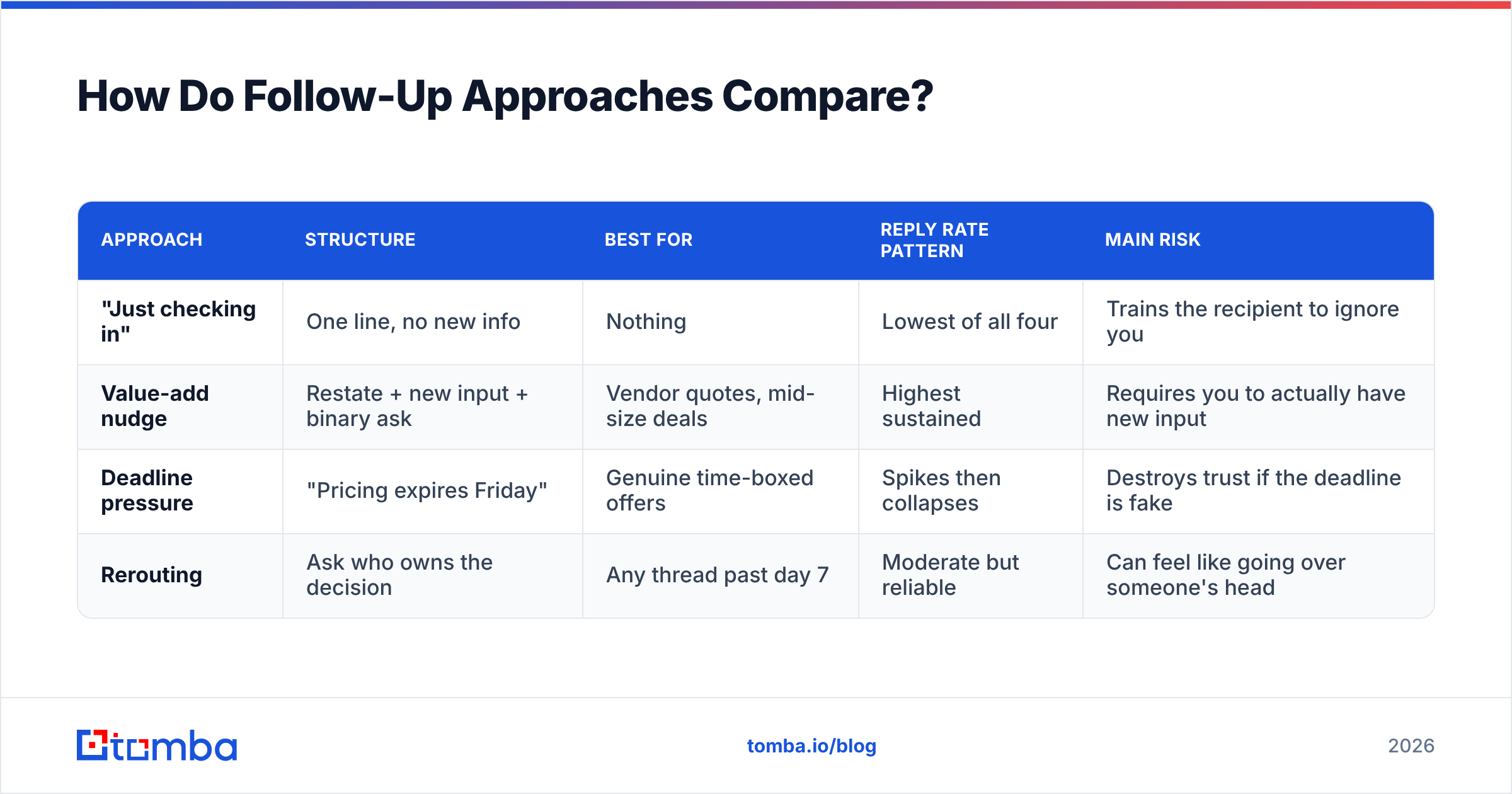
How Do Follow-Up Approaches Compare?#
Teams generally pick one of four postures. They are not equally effective, and the differences are large enough to matter.
| Approach | Structure | Best for | Reply rate pattern | Main risk |
|---|---|---|---|---|
| "Just checking in" | One line, no new info | Nothing | Lowest of all four | Trains the recipient to ignore you |
| Value-add nudge | Restate + new input + binary ask | Vendor quotes, mid-size deals | Highest sustained | Requires you to actually have new input |
| Deadline pressure | "Pricing expires Friday" | Genuine time-boxed offers | Spikes then collapses | Destroys trust if the deadline is fake |
| Rerouting | Ask who owns the decision | Any thread past day 7 | Moderate but reliable | Can feel like going over someone's head |
The value-add nudge wins for one structural reason: it gives the recipient a reason to write back that isn't guilt. A "checking in" email asks the reader to do work for your benefit. A "we can go to 650 units" email hands them something useful.
Deadline pressure deserves a specific warning. HubSpot's research on sales follow-up consistently shows manufactured urgency underperforming against genuine constraints — and in procurement contexts, buyers compare notes. If your "expires Friday" price is still available in May, you've spent credibility you can't rebuy.
What Subject Lines Work for Quotation Follow-Ups?#
Subject line strategy for quotation follow-ups is different from cold outreach, because you already have a thread.
Default to threading. Hitting reply on the original keeps the specs, the attachments, and the history in one place. It also signals "this is ongoing business," not "this is a new pitch."
When you do need a fresh subject, these patterns perform:
RFQ 2026-441 — revised quantity (650 units)— a change, not a chaseWho owns purchasing for [category]?— a routable questionQuick question on the [product] quote— low-pressure, high open rateClosing out RFQ 2026-441— the breakup, which often gets the fastest reply of the whole sequence
What to avoid: "Following up," "Touching base," "Just circling back," and anything with "URGENT" in caps. These are the four most-filtered phrases in B2B inboxes and they signal a template without signaling content. If you want to sanity-check variants before sending, run them through a subject line tester rather than guessing.
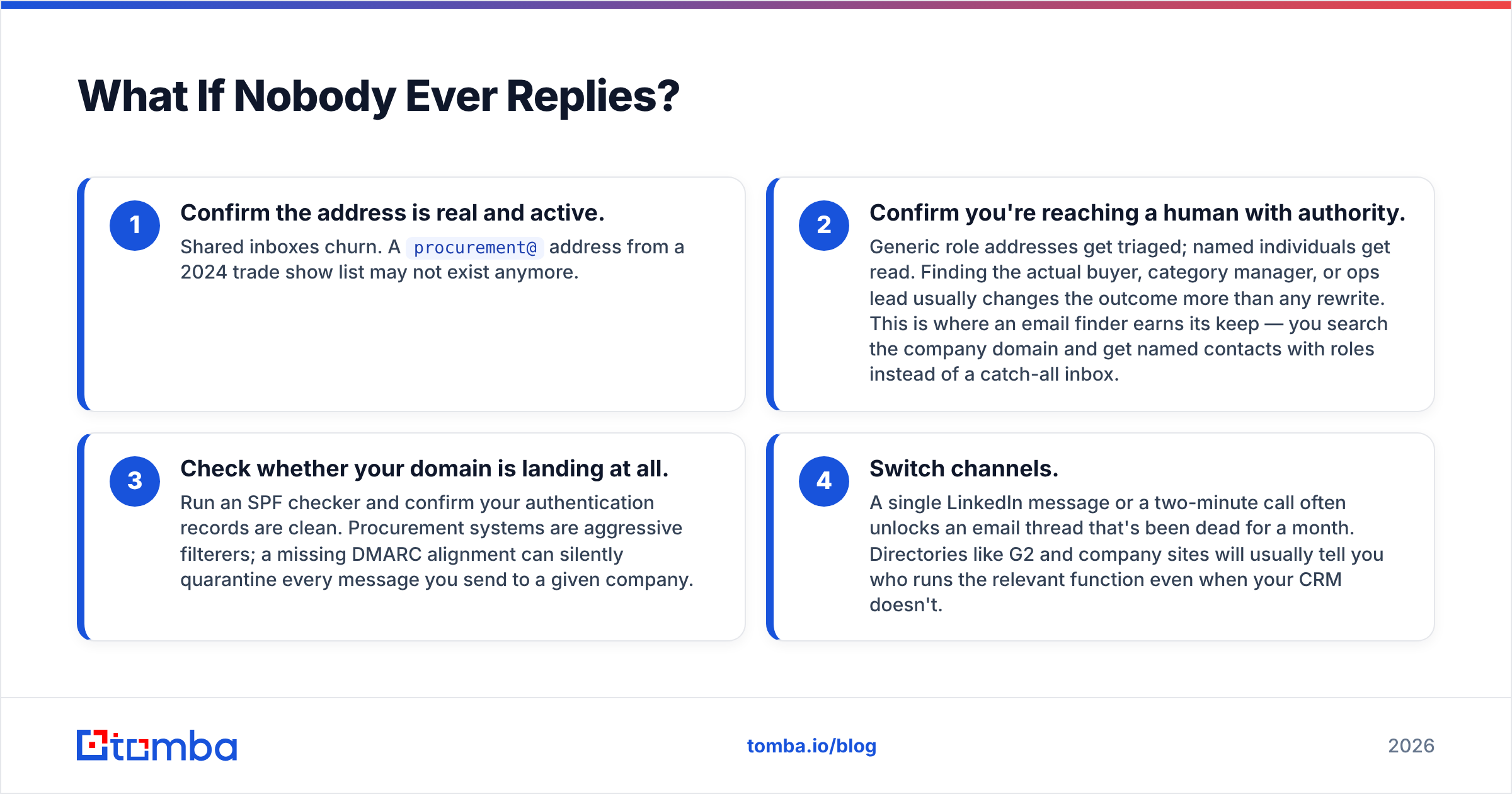
What If Nobody Ever Replies?#
If a thread goes fully silent through three touches, stop rewriting the email and start checking the plumbing. In that order:
- Confirm the address is real and active. Shared inboxes churn. A
procurement@address from a 2024 trade show list may not exist anymore. - Confirm you're reaching a human with authority. Generic role addresses get triaged; named individuals get read. Finding the actual buyer, category manager, or ops lead usually changes the outcome more than any rewrite. This is where an email finder earns its keep — you search the company domain and get named contacts with roles instead of a catch-all inbox.
- Check whether your domain is landing at all. Run an SPF checker and confirm your authentication records are clean. Procurement systems are aggressive filterers; a missing DMARC alignment can silently quarantine every message you send to a given company.
- Switch channels. A single LinkedIn message or a two-minute call often unlocks an email thread that's been dead for a month. Directories like G2 and company sites will usually tell you who runs the relevant function even when your CRM doesn't.
Rerouting deserves emphasis. In most mid-market and enterprise companies, the person who received your RFQ is not the person who approves it. Follow-up email #4 to a non-decision-maker is worth less than follow-up email #1 to the right one.
How Do You Scale Follow-Ups Without Sounding Robotic?#
Three practices separate teams that scale follow-ups from teams that get filtered.
Segment by deal stage, not by day count. A quotation request for a $2,000 order and a $200,000 order should not receive the same cadence. Large-order follow-ups can and should be slower, more specific, and often routed through a phone call. Small-order follow-ups can be tighter and more automated.
Personalize the variable that matters. You don't need five custom paragraphs. You need one accurate detail: the SKU, the delivery city, the seat count, the project name. One correct specific beats four generic compliments.
Keep list hygiene tight. Every bounced follow-up is a small tax on your domain. Before running any sequence at volume, clean the list — bulk verify is faster than discovering dead addresses one bounce at a time, and it prevents the slow reputation decay that makes every future email harder to deliver.
One more thing worth stating plainly: the follow-up is not where you win. The follow-up is where you avoid losing something you already earned. If your original quotation request was vague, or your proposal didn't match what the buyer asked for, no sequence will save it. Fix the first email and you'll need fewer of the rest.
What Should You Do Next?#
Pick the direction you're in and run the matching play.
If you're chasing a vendor: send touch #1 within 72 hours with a compressed spec restatement and one new input. If day 10 arrives with nothing, switch to Template C and reroute.
If you're chasing a buyer: lead with a restructured offer, not a reminder. Give them a smaller, easier yes.
If you're chasing anyone at scale: fix the contact data before you fix the copy. The most common reason a follow up email for quotation request fails is that it reached a mailbox nobody reads.
That last problem is the one worth solving first. Tomba Email Finder lets you search a company domain and pull named, role-tagged contacts — the category manager, the procurement lead, the ops director — instead of firing another message at info@. The free tier covers 25 searches a month, Starter runs $49/mo, and Growth is $99/mo; see Tomba pricing for full plan details. Find the right person once, and your second follow-up will do the work your fourth one never could.
Related guides#
Ready to find emails that actually work?
Join 150,000+ professionals who stopped guessing and started sending. Free credits on signup — no credit card required.
Get the Tomba newsletter
Practical outbound tactics and product updates — once every two weeks.
About the author