Follow Up Email To Get A Response: The 2026 Playbook
Most replies come from follow-ups, not the first email. Here is the cadence, timing, and copy that actually pulls responses in 2026 — with templates and a comparison of follow-up styles.
TL;DR
- Between 55% and 80% of replies to a cold sequence arrive after the first email — the follow-up is the campaign, not the afterthought.
- "Just bumping this to the top of your inbox" is the single worst-performing follow-up pattern because it adds zero new information and signals the sender has nothing else to say.
- The reliable structure is four to six touches over 18–24 days, each carrying one new angle: proof, resource, use case, question, breakup.
- Timing matters less than variance — sending every follow-up on the same weekday at the same hour trains the recipient to pattern-match and delete.
- None of it works on a bad address. Bounces on follow-up 2 and 3 destroy sender reputation faster than bad copy ever will.
Why do most follow-up emails get ignored?#
Because they restate the first email in a shorter, needier form.
Think of a follow-up like a second knock on a door. The first knock says "someone is here." A second identical knock says the same thing, louder. What actually opens the door is a different signal entirely — a voice saying "it's your neighbor, your package is at my house." New information, not repetition.
Most follow-ups fail one of these four tests:
- They add nothing new. "Circling back," "bumping this up," "any thoughts?" — all of these ask the recipient to do the work of remembering, evaluating, and replying, while the sender does nothing.
- They apologize. "Sorry to bother you again" frames the message as an imposition before the reader has decided whether it is one.
- They ask a closed, low-effort question. "Are you interested?" invites a one-word no, or more commonly, silence.
- They arrive on a schedule the recipient can feel. Same day, same hour, same tone, three times in a row reads as automation, and automation gets filtered.
The fix is not more persistence. It is a follow-up that could stand alone as a first email — one that would be worth reading even if the recipient had never seen your original.
What does a follow-up sequence that gets responses look like?#
Here is the structure that holds up across most B2B outbound programs. Each touch has a distinct job. No touch repeats the previous one.
- Touch 1 — The ask (Day 0). One observation about their business, one specific claim, one question. Under 90 words.
- Touch 2 — The proof (Day 3). A named customer, a number, or a short before/after. "We did X for a company like yours, here's the result." No re-ask.
- Touch 3 — The resource (Day 7). Send something useful with no strings: a teardown, a benchmark, a two-line audit of their site or careers page. This is the highest-converting touch in most sequences because it inverts the give/take ratio.
- Touch 4 — The reframe (Day 12). Same problem, different angle. If touch 1 pitched cost savings, touch 4 pitches speed or risk. People do not ignore you because they disagree; they ignore you because the frame didn't apply to them.
- Touch 5 — The referral ask (Day 17). "If this isn't your area, who owns it?" This converts at surprising rates because it is easy to answer and costs the recipient nothing.
- Touch 6 — The close-out (Day 22). Short, warm, no guilt. "I'll stop here — if it becomes relevant next quarter, I'm easy to find." Breakup emails routinely pull replies from people who fully intended to respond and forgot.
The whole sequence runs about three weeks. Longer cadences dilute; shorter ones feel like pressure.
How many follow-ups should you send before stopping?#
Four to six total touches, then stop or move the contact to a long-cycle nurture.
The data behind this is not exotic. HubSpot's sales research has consistently shown reply rates climbing through the third and fourth touch and flattening after the sixth. Past that point you are trading marginal replies for spam complaints — and in 2026, complaint rate is the metric that determines whether your domain keeps landing in the primary tab at all.
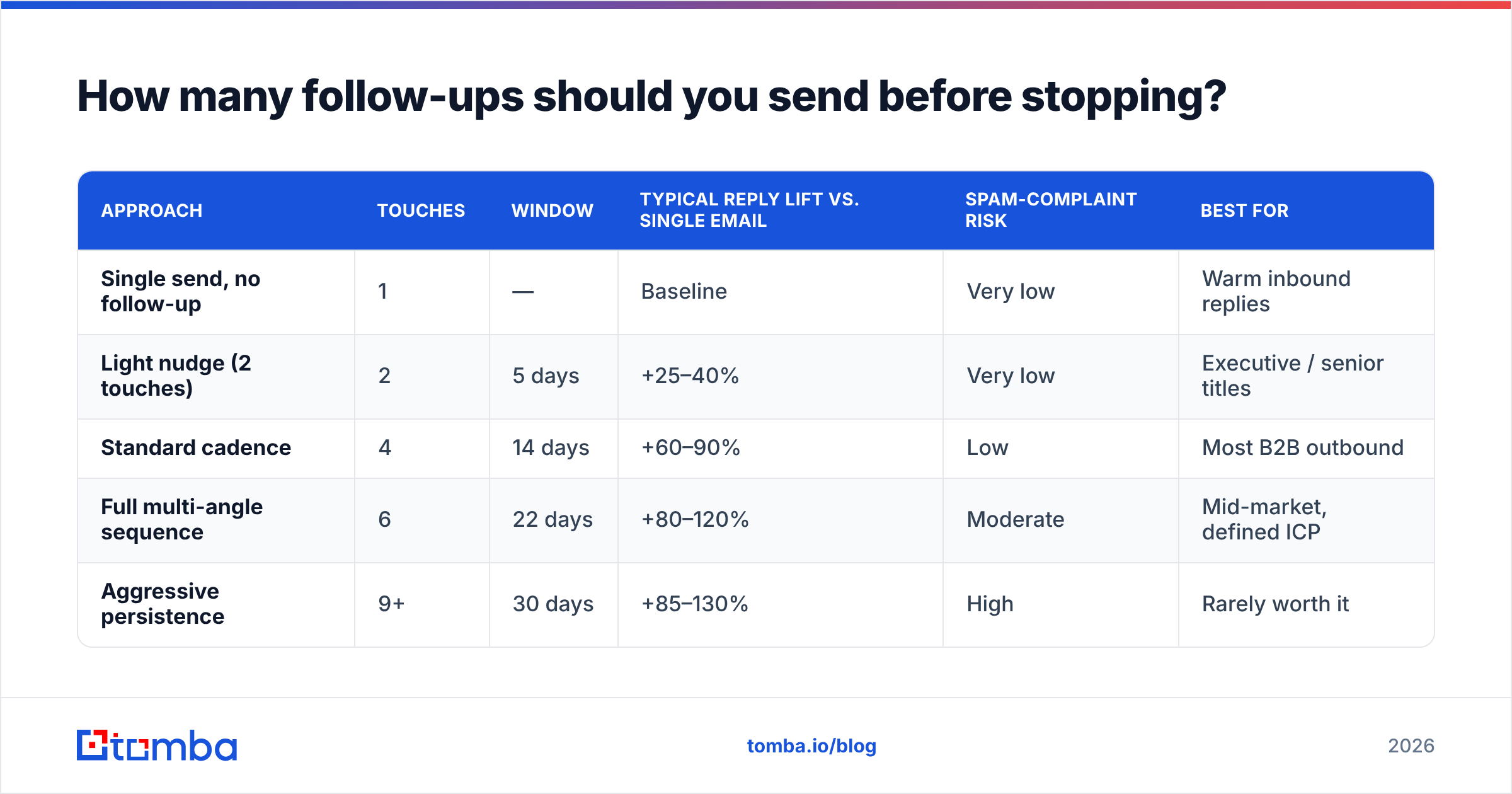
Here is how the common approaches compare:
| Approach | Touches | Window | Typical reply lift vs. single email | Spam-complaint risk | Best for |
|---|---|---|---|---|---|
| Single send, no follow-up | 1 | — | Baseline | Very low | Warm inbound replies |
| Light nudge (2 touches) | 2 | 5 days | +25–40% | Very low | Executive / senior titles |
| Standard cadence | 4 | 14 days | +60–90% | Low | Most B2B outbound |
| Full multi-angle sequence | 6 | 22 days | +80–120% | Moderate | Mid-market, defined ICP |
| Aggressive persistence | 9+ | 30 days | +85–130% | High | Rarely worth it |
The interesting row is the last one. Going from six touches to nine buys you a few extra points of reply rate and a meaningful jump in complaints. That trade is almost never worth the domain damage.
When should you send each follow-up?#
Spacing beats clock time. The gap between touches is what changes reply behavior; the specific hour barely moves the needle once you account for time zones.
Practical rules:
- Gap 1 → 2: 2–3 days. Long enough that it isn't nagging, short enough that context survives.
- Gap 2 → 3: 4 days. This is where the "resource" touch lands, and it benefits from a small breathing room.
- Gap 3 → 4: 5 days.
- Gap 4 → 5: 5 days.
- Gap 5 → 6: 5 days.
- Vary the send hour by ±3 hours across the sequence. Identical timestamps are the easiest automation tell there is.
Avoid sending every touch on Tuesday at 9:14 a.m. That precision is a fingerprint. Real humans email at irregular times.
One more thing on timing: reply to your own thread for touches 2 and 3, then start a fresh thread with a new subject line for touch 4. Long threads with five unanswered messages look like a monologue. A fresh subject at the midpoint resets the visual weight of the conversation.
What should you actually write? (templates)#
Touch 2 — Proof
Subject: (reply on existing thread)
One data point in case it's useful: [Company] had the same [problem] and cut [metric] by [number]% in [timeframe]. The mechanism was [one specific thing], not more headcount.
Happy to send the breakdown if that's a live problem for you.
Touch 3 — Resource
Subject: quick teardown of [their thing]
I looked at [specific page / job posting / product page] and noticed three things worth fixing: [A], [B], [C].
Wrote them up here — no ask attached, it's yours either way: [link]
Touch 4 — Reframe
Subject: different angle on [topic]
My first email framed this as a cost problem. Talking to a few other [role]s this month, the sharper version is a speed problem: [one-sentence reframe].
Does that land closer to how you're thinking about it?
Touch 5 — Referral
Subject: wrong person?
Entirely possible I aimed this at the wrong desk. If [problem] sits with someone else on your team, who should I be talking to?
Touch 6 — Close-out
Subject: closing the loop
I'll stop here so I'm not cluttering your inbox. If [problem] comes back around in Q[N], the offer stands — reply to this and I'll pick it up.
Notice what none of these do: apologize, restate the pitch verbatim, or ask "did you see my last email?" Every one carries something the previous touch didn't.
If you want a starting library rather than writing from scratch, our cold email templates collection covers the common patterns, and the subject line tester will flag the ones that read as promotional before you send.
Does deliverability affect your follow-up reply rate?#
Yes, more than copy does — and this is where most sequences quietly die.
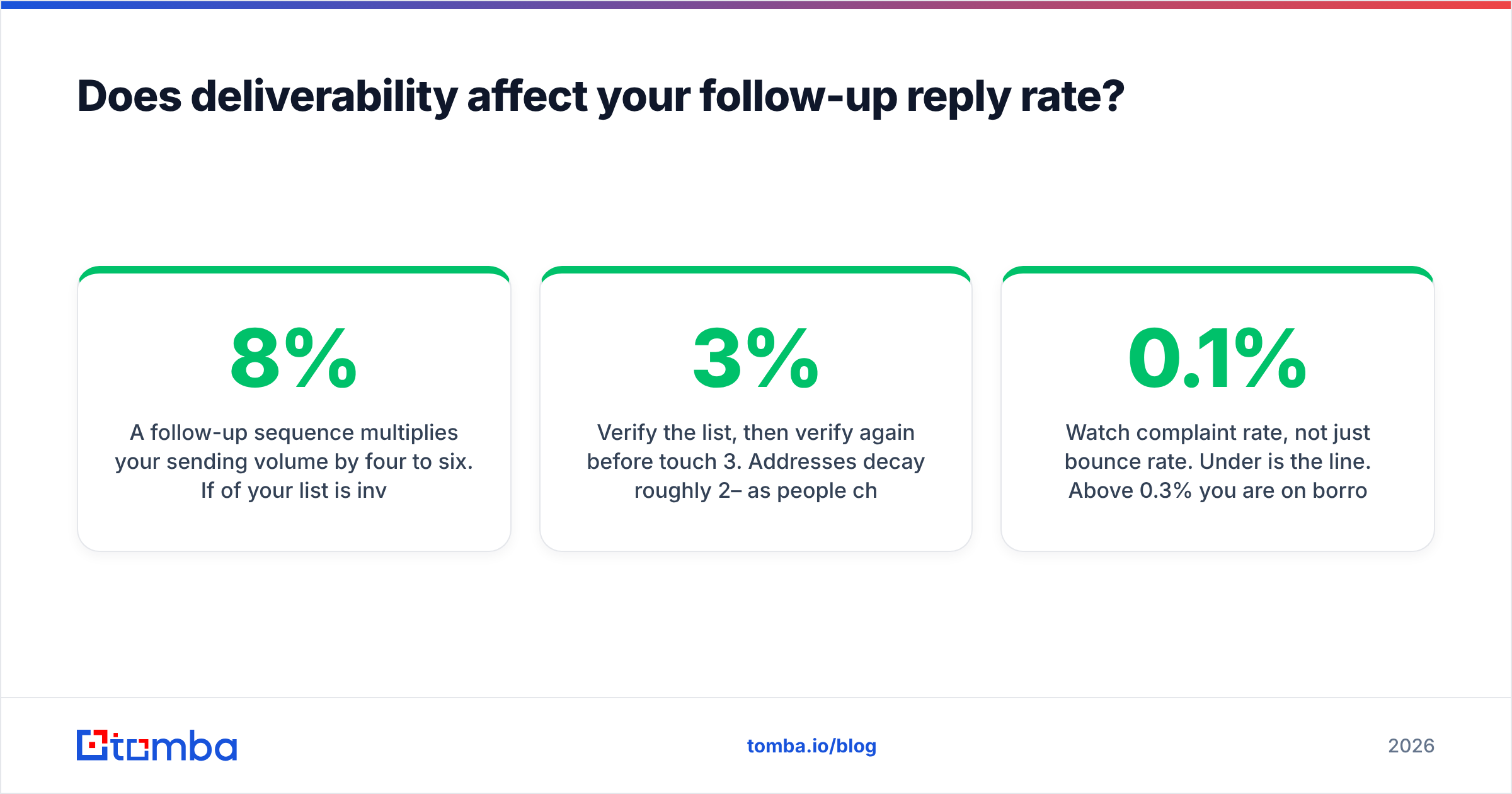
A follow-up sequence multiplies your sending volume by four to six. If 8% of your list is invalid, you are not sending 8% bad emails once; you are sending them five times each. Mailbox providers read that as a pattern, and the penalty lands on the good addresses too.
Three checks before any sequence goes live:
- Verify the list, then verify again before touch 3. Addresses decay roughly 2–3% per month as people change jobs. A list built in January is measurably worse by April. Run it through an email verifier rather than trusting the source.
- Confirm your authentication. SPF, DKIM, and DMARC are table stakes since the 2024 Google and Yahoo bulk-sender rules, which Google's own sender guidelines still enforce. A quick SPF checker run takes thirty seconds.
- Watch complaint rate, not just bounce rate. Under 0.1% is the line. Above 0.3% you are on borrowed time regardless of how good the copy is.
Sender reputation compounds in both directions. A clean list sending relevant follow-ups builds inbox placement over months. A dirty list burns it in weeks. If you want the mechanics, the email deliverability entry in our glossary covers the signals providers actually weigh.
How do you personalize follow-ups without spending an hour each?#
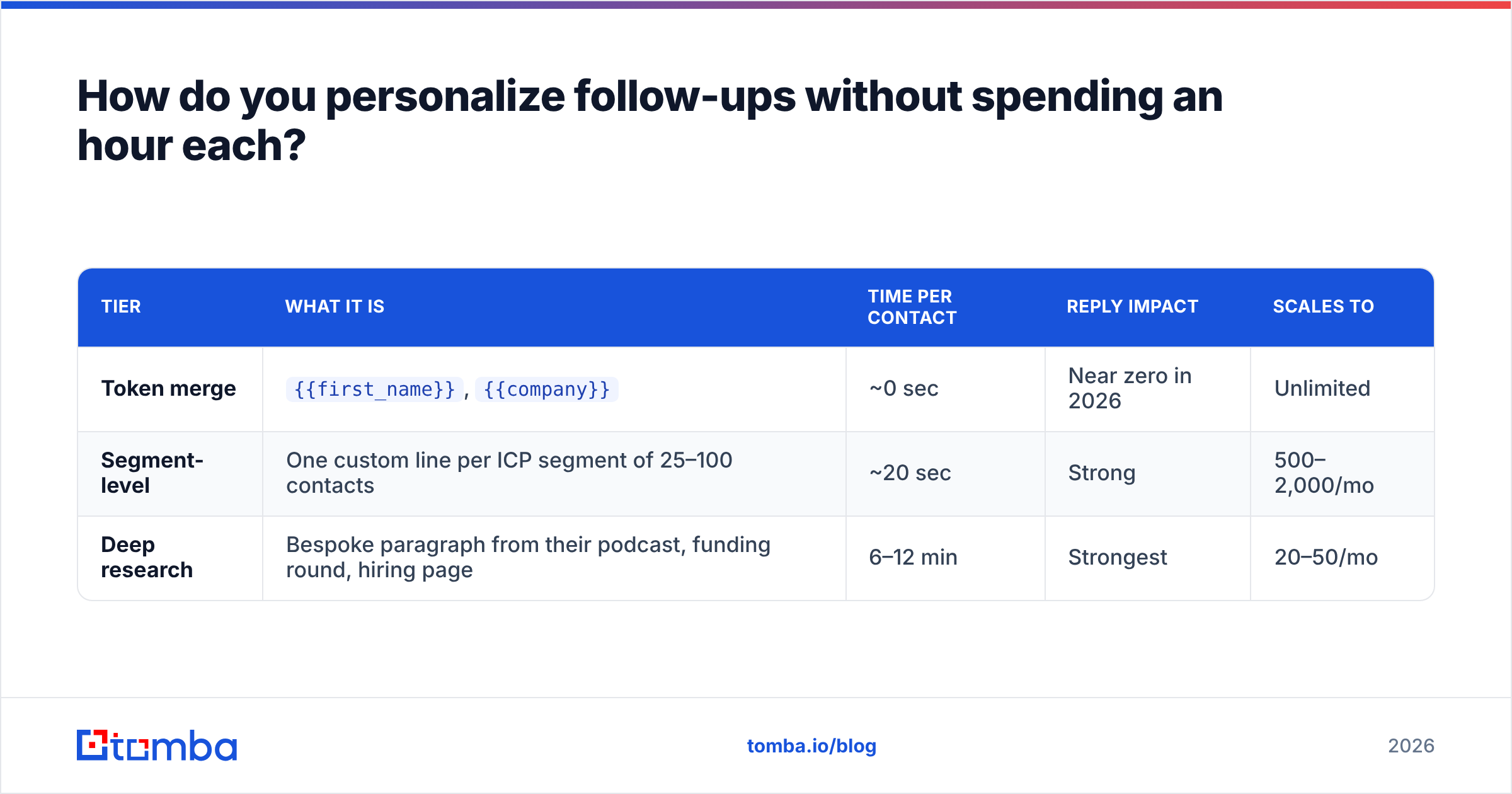
Personalization has three tiers, and only the middle one scales.
| Tier | What it is | Time per contact | Reply impact | Scales to |
|---|---|---|---|---|
| Token merge | {{first_name}}, {{company}} |
~0 sec | Near zero in 2026 | Unlimited |
| Segment-level | One custom line per ICP segment of 25–100 contacts | ~20 sec | Strong | 500–2,000/mo |
| Deep research | Bespoke paragraph from their podcast, funding round, hiring page | 6–12 min | Strongest | 20–50/mo |
Segment-level is the workhorse. Instead of researching 400 people, research four segments and write four distinct touch-3 resources — one per segment. Each recipient gets something that reads as specific because it genuinely is specific to their situation, just not to them individually.
Deep research should be reserved for your top 30 accounts. Nobody needs a bespoke paragraph for a $400 ACV deal.
A note on data quality: segment-level personalization only works if your firmographic and role data is accurate. Sending a CFO-framed follow-up to someone who left the CFO seat eight months ago is worse than sending nothing. Contact data enrichment that refreshes title and company on a rolling basis is what keeps segment logic honest.
Which tools help you run follow-up sequences?#
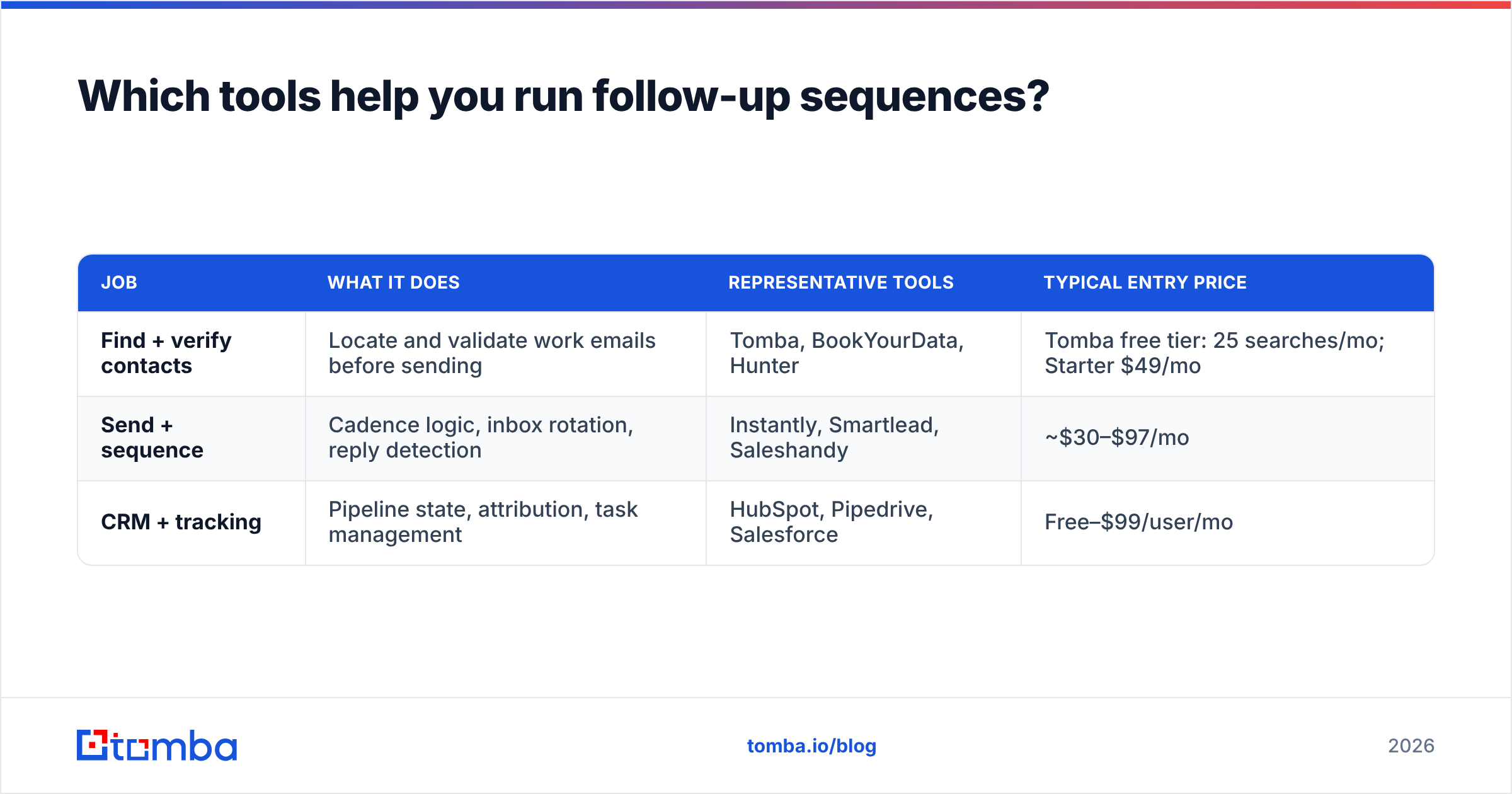
The stack splits into three jobs, and most teams over-buy on the middle one.
| Job | What it does | Representative tools | Typical entry price |
|---|---|---|---|
| Find + verify contacts | Locate and validate work emails before sending | Tomba, BookYourData, Hunter | Tomba free tier: 25 searches/mo; Starter $49/mo |
| Send + sequence | Cadence logic, inbox rotation, reply detection | Instantly, Smartlead, Saleshandy | ~$30–$97/mo |
| CRM + tracking | Pipeline state, attribution, task management | HubSpot, Pipedrive, Salesforce | Free–$99/user/mo |
You need one from each row. What you rarely need is a $500/mo all-in-one that does all three adequately and none well.
On the first row, the differentiator is verification depth rather than raw database size. A provider that returns 900 addresses with 94% deliverability beats one that returns 1,400 at 71% — because the second one will cost you the domain. Tomba's Tomba pricing runs a free tier at 25 searches per month, Starter at $49/mo, Growth at $99/mo, and Pro at $249/mo, with verification bundled rather than sold as a separate line item. BookYourData takes a different route with a pay-as-you-go, prepaid-credit model and a 97% accuracy guarantee, which suits teams that buy lists in bursts rather than continuously. Both are reasonable; the choice depends on whether your buying is steady-state or campaign-driven.
For sequencing, check G2's sales engagement category rather than vendor landing pages — the reviews there are more honest about reply-detection bugs, which is the failure mode that actually hurts you (nothing kills a relationship faster than follow-up 4 firing after someone already replied).
What are the most common follow-up mistakes?#
- Sending touch 2 the next morning. Reads as anxiety. Give it 48 hours minimum.
- Changing the offer every touch. Reframing the same problem is good. Pitching a different product each time signals you are guessing.
- Guilt language. "I've reached out three times now" makes the recipient the villain in your story. They did not sign up for it.
- Attachments in cold follow-ups. They trip filters and nobody opens them. Link instead.
- Long threads with no reply detection. If your tool can't reliably stop a sequence on reply, fix that before you fix your copy.
- Ignoring the unsubscribe. One-click unsubscribe is not optional under current bulk-sender requirements, and honoring it fast is cheaper than a complaint.
Frequently asked questions#
How long should a follow-up email be? Shorter than the first. Touch 2 through 6 should run 40–80 words. The first email earns attention; follow-ups spend it.
Should I follow up on the same thread or start a new one? Same thread for touches 2 and 3, fresh subject line for touch 4 onward. Threads longer than four unanswered messages start to look like a wall.
What reply rate is realistic? For a well-targeted list with verified addresses and a six-touch sequence, 5–12% reply rate is a normal band in 2026. Above 15% usually means either an unusually warm list or a very narrow ICP. Below 2% points to targeting or data quality, not copy.
Is it worth following up after a "no"? Not on the same offer. Log it, set a 90-day reminder, and come back with a genuinely different reason to talk.
Do follow-ups hurt sender reputation? Only if they land on invalid addresses or generate complaints. Follow-ups to verified, well-targeted contacts are neutral to positive — engagement signals help you.
Start with addresses that actually resolve#
A six-touch sequence is a multiplier. It multiplies good targeting into pipeline and bad data into bounces, complaints, and a domain you have to rebuild.
Before you tune a single subject line, make sure every address in the list resolves to a real person in a current role. The Tomba Email Finder locates verified work emails by name, domain, or company, with verification built into the same credit rather than billed separately — free tier at 25 searches per month if you want to test it against a list you already trust. Get the data right, and the follow-up sequence above will do the rest of the work.
Related guides#
Ready to find emails that actually work?
Join 150,000+ professionals who stopped guessing and started sending. Free credits on signup — no credit card required.
Get the Tomba newsletter
Practical outbound tactics and product updates — once every two weeks.
About the author