FOMO Email Subject Lines: 42 Examples That Actually Work
FOMO subject lines still move open rates — but only when the scarcity is real. Here are the formulas, 42 copy-paste examples, the spam traps to dodge, and a testing method that tells you if it worked.
TL;DR
- FOMO email subject lines work when the scarcity is verifiable (a real date, a real cap, a real price change) and collapse when it isn't. The mechanism is loss aversion, not novelty.
- In B2B, "last chance" language lifts opens but often drops reply quality. Measure replies and meetings, not opens.
- The highest-performing FOMO patterns are specific and low-volume: deadline + named benefit, peer proof, expiring access, and status change ("your seat is being released").
- Overusing urgency words trains your list to ignore you and raises spam-filter risk. Cap FOMO at roughly one in five sends per contact.
- None of it matters if the address is wrong. A 12% bounce rate destroys more deliverability than any subject line can rescue.
What are FOMO email subject lines?#
A FOMO email subject line is a subject that frames the email around something the reader stands to lose by not opening: a closing window, a limited allocation, a price that moves, or an advantage peers already have.
The name comes from fear of missing out, but the underlying driver is older and better documented: loss aversion. People weigh a potential loss roughly twice as heavily as an equivalent gain. "Save 20%" and "Don't lose your 20%" are the same math and very different emotional weights.
That is why FOMO subject lines are everywhere. It is also why they are so easy to ruin. Every inbox has been carpet-bombed with "FINAL HOURS" from senders whose final hours reset every Tuesday. Your reader's filter for fake urgency is now excellent.
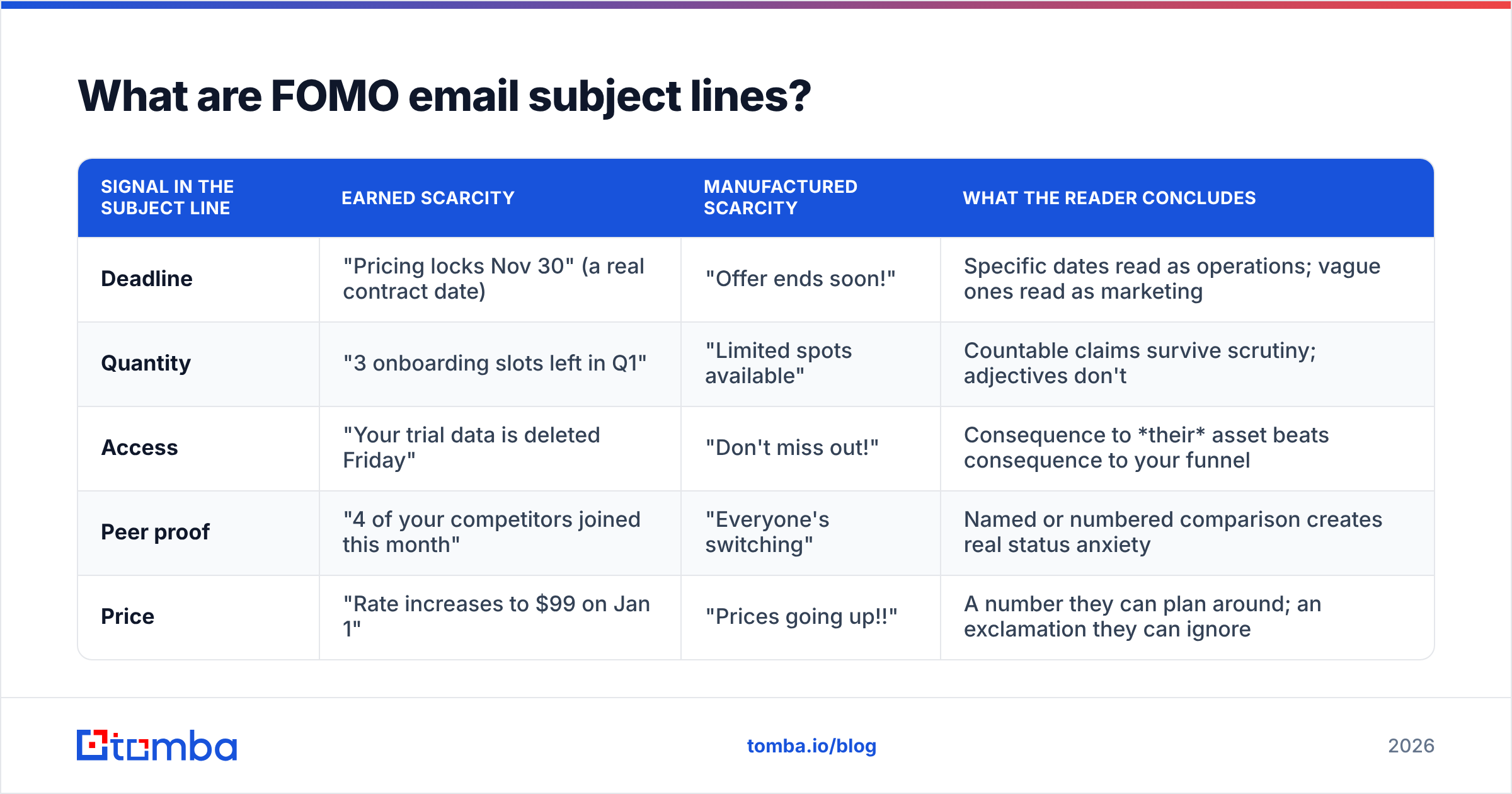
The useful distinction is not FOMO vs. no FOMO. It's earned scarcity vs. manufactured scarcity.
| Signal in the subject line | Earned scarcity | Manufactured scarcity | What the reader concludes |
|---|---|---|---|
| Deadline | "Pricing locks Nov 30" (a real contract date) | "Offer ends soon!" | Specific dates read as operations; vague ones read as marketing |
| Quantity | "3 onboarding slots left in Q1" | "Limited spots available" | Countable claims survive scrutiny; adjectives don't |
| Access | "Your trial data is deleted Friday" | "Don't miss out!" | Consequence to their asset beats consequence to your funnel |
| Peer proof | "4 of your competitors joined this month" | "Everyone's switching" | Named or numbered comparison creates real status anxiety |
| Price | "Rate increases to $99 on Jan 1" | "Prices going up!!" | A number they can plan around; an exclamation they can ignore |
If you cannot fill in the "earned" column honestly, do not write a FOMO subject line. Write a curiosity or value subject line instead — you will get a better meeting rate and keep your sender reputation intact.
Why does FOMO work in B2B inboxes, and when does it backfire?#
FOMO works in B2B for one unglamorous reason: buyers operate on cycles. Budgets close. Fiscal years end. Renewal dates exist whether or not you mention them. When your deadline maps onto a deadline your buyer already has, urgency isn't a tactic — it's a calendar reminder they were going to need anyway.
It backfires in three predictable ways.
It attracts the wrong opens. A hard urgency subject can lift opens meaningfully while replies stay flat or fall. You get discount hunters and tire-kickers, and your team spends the quarter in unqualified calls. Track your response rate and meeting-booked rate alongside opens, never opens alone.
It burns frequency. FOMO is a non-renewable resource per contact. The second "last chance" lands at maybe half the strength of the first. The fourth is noise. A practical ceiling: no more than one urgency-framed subject in every five emails a given contact receives from you.
It trips filters and humans alike. Spam classifiers weight urgency tokens, all-caps, and exclamation stacking. More importantly, so do people. A subject that reads like a Black Friday flyer signals "mass send" to a VP of Engineering, and mass sends get archived.

Which FOMO subject line formulas actually get opened?#
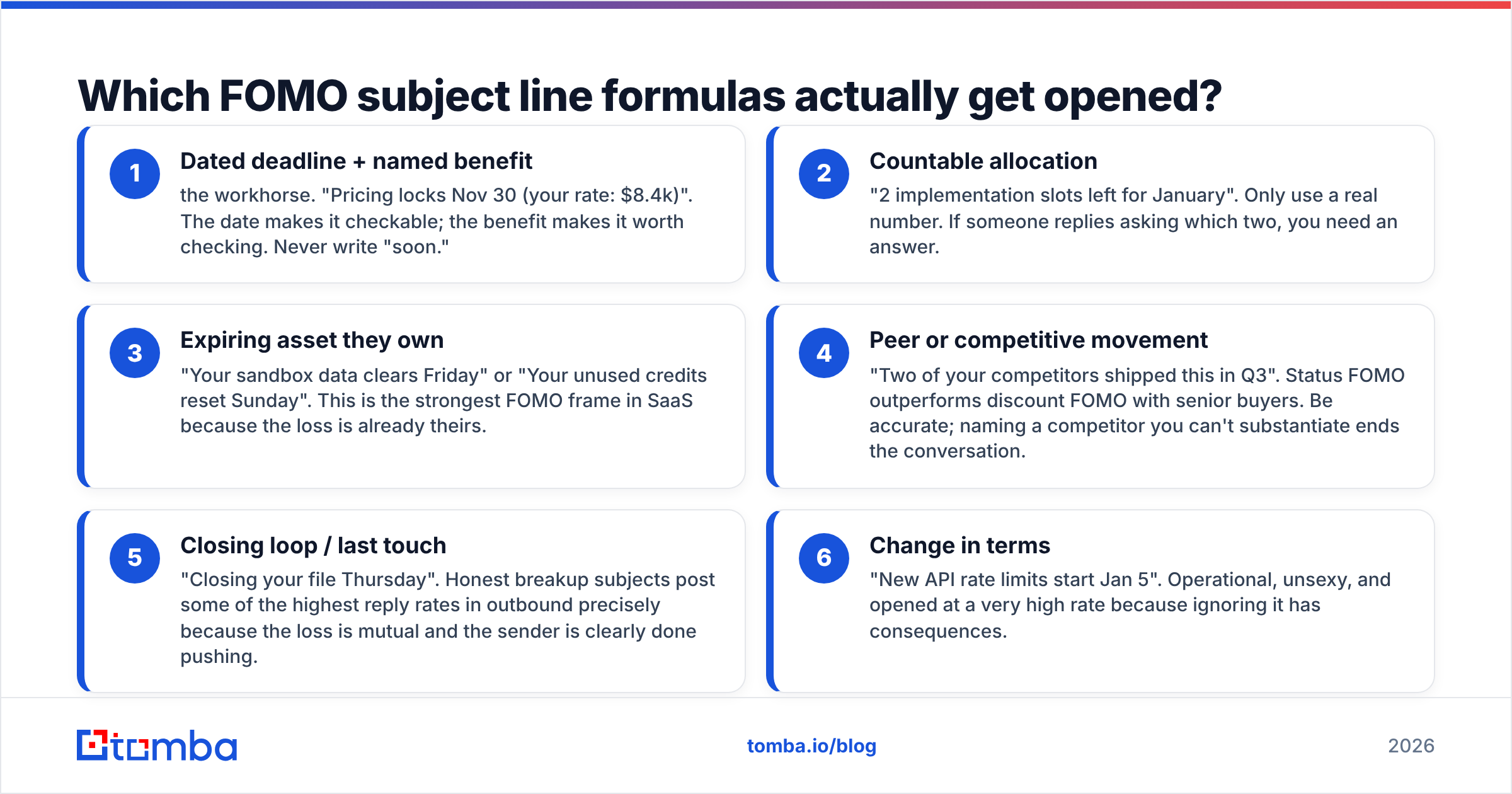
Six patterns carry most of the performance. Each one attaches the loss to something the reader already owns or already wants.
- Dated deadline + named benefit — the workhorse. "Pricing locks Nov 30 (your rate: $8.4k)". The date makes it checkable; the benefit makes it worth checking. Never write "soon."
- Countable allocation — "2 implementation slots left for January". Only use a real number. If someone replies asking which two, you need an answer.
- Expiring asset they own — "Your sandbox data clears Friday" or "Your unused credits reset Sunday". This is the strongest FOMO frame in SaaS because the loss is already theirs.
- Peer or competitive movement — "Two of your competitors shipped this in Q3". Status FOMO outperforms discount FOMO with senior buyers. Be accurate; naming a competitor you can't substantiate ends the conversation.
- Closing loop / last touch — "Closing your file Thursday". Honest breakup subjects post some of the highest reply rates in outbound precisely because the loss is mutual and the sender is clearly done pushing.
- Change in terms — "New API rate limits start Jan 5". Operational, unsexy, and opened at a very high rate because ignoring it has consequences.
Notice what's missing: exclamation marks, all caps, the word "URGENT," and the phrase "don't miss out." None of those are formulas. They are volume knobs on a signal that isn't there.
What are 42 FOMO subject line examples worth copying?#
Swap the brackets for real specifics. If you can't, the line doesn't ship.
Deadline-driven (B2B SaaS)
- Pricing locks [Nov 30] for [Company]
- [Q1] onboarding closes Friday
- Your [2026] rate expires in 6 days
- Last week to grandfather your [seat count]
- [Feature] sunsets [March 14] — migration options
- Renewal window: [12 days left]
- Contract terms change [Jan 1] — quick heads-up
Allocation and capacity 8. [3] implementation slots left this quarter 9. We can take [2] more accounts before [May] 10. Holding your spot until [Thursday] 11. Capacity for [Company] runs out [next week] 12. [1] seat left in the [March] cohort
Expiring assets they already have 13. Your trial data clears [Friday] 14. [420] unused credits reset Sunday 15. Your audit report expires in 48 hours 16. Reactivating [Company]'s account before it archives 17. Your sandbox goes read-only [Tuesday]
Peer and competitive movement 18. [2] of your competitors moved on this in [Q3] 19. [Competitor] shipped this in [8] weeks 20. What [3] teams in [industry] changed this quarter 21. You're the last of [5] [role]s I mapped without this 22. [Company] is behind [peer group] on [metric]
Event and content windows 23. Doors close [Wednesday] for [webinar] 24. Recording available for [72 hours] 25. [40] seats, [6] left 26. Q&A closes tonight — submit yours 27. Early-bird ends at midnight [ET]
Breakup and closing the loop 28. Closing your file [Thursday] 29. Should I stop reaching out? 30. Last email from me on [topic] 31. Archiving [Company] — unless? 32. Giving your slot to [next account]
Price and terms changes 33. Rate moves to [$99] on [Jan 1] 34. Locking [Company] at current pricing 35. [15%] increase starts [next quarter] 36. Your legacy plan ends [June 30]
Soft FOMO (safe for cold, first-touch) 37. Before [Q4] planning closes 38. Quick one before your [renewal date] 39. Timing this to your [fiscal year end] 40. [Industry] budgets close [October] — worth 10 min? 41. Ahead of your [conference] — [one specific idea] 42. While [trigger event] is still fresh
For first-touch cold email, stay in the last group. Hard scarcity from a stranger reads as a scam. Earn the right to use a deadline by having a relationship first — or by referencing their deadline, not yours. If you want variations at volume, a subject line generator will spin these patterns faster than you can, and a subject line tester will flag the ones that read spammy before you send.
Is FOMO better than curiosity or value subject lines?#
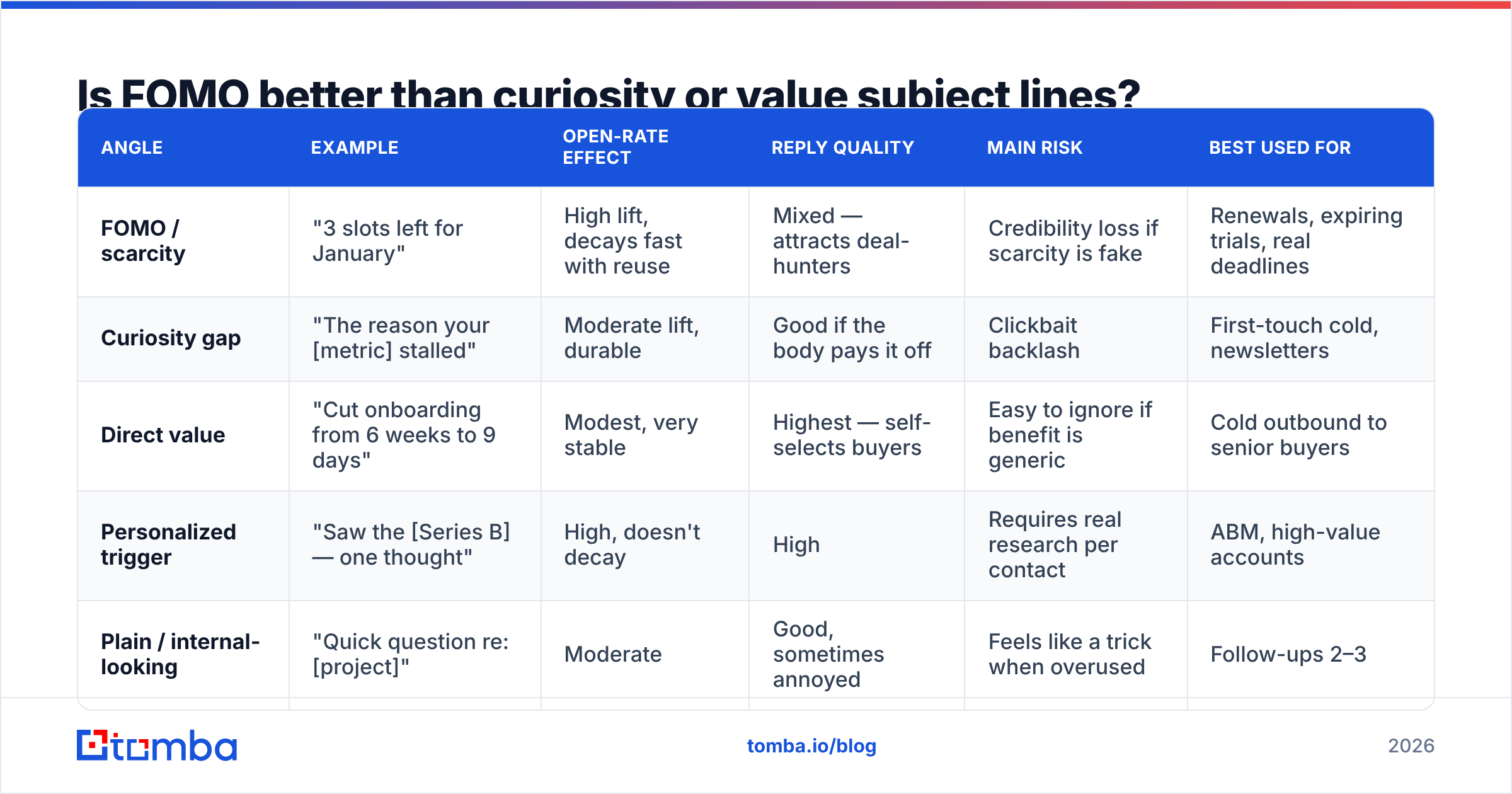
Not universally. It's the highest-variance option: bigger open lifts, bigger downside when misapplied. Here's how the four main angles stack up in B2B outbound.
| Angle | Example | Open-rate effect | Reply quality | Main risk | Best used for |
|---|---|---|---|---|---|
| FOMO / scarcity | "3 slots left for January" | High lift, decays fast with reuse | Mixed — attracts deal-hunters | Credibility loss if scarcity is fake | Renewals, expiring trials, real deadlines |
| Curiosity gap | "The reason your [metric] stalled" | Moderate lift, durable | Good if the body pays it off | Clickbait backlash | First-touch cold, newsletters |
| Direct value | "Cut onboarding from 6 weeks to 9 days" | Modest, very stable | Highest — self-selects buyers | Easy to ignore if benefit is generic | Cold outbound to senior buyers |
| Personalized trigger | "Saw the [Series B] — one thought" | High, doesn't decay | High | Requires real research per contact | ABM, high-value accounts |
| Plain / internal-looking | "Quick question re: [project]" | Moderate | Good, sometimes annoyed | Feels like a trick when overused | Follow-ups 2–3 |
The pragmatic sequencing: open with trigger or value, use curiosity in the middle, and save FOMO for the moment a genuine deadline exists. That way the one time you say "closing Thursday," people believe you.

How do you keep urgency out of the spam folder?#
Spam filters don't ban the word "limited." They score patterns. Urgency language becomes a problem when it stacks with other low-trust signals — a fresh domain, no authentication, a list full of bad addresses.
Keep these in order:
- Authenticate first. SPF, DKIM, and DMARC configured correctly. Run an SPF checker if you're unsure what's actually published. Missing authentication does more damage than any subject line.
- Cap the intensity markers. One exclamation mark maximum per email — ideally zero. No all-caps words. No "FREE," "ACT NOW," or "URGENT" in a B2B subject.
- Score before you send. A spam checker catches the phrasings that push a message over the line. It takes 20 seconds.
- Watch the complaint rate, not just the spam score. If urgency subjects correlate with unsubscribes and complaints, the filter that matters — the recipient — has already decided.
- Protect the list. Bounces above 2–3% put your whole domain at risk. See the industry guidance from HubSpot's marketing blog on list hygiene: no subject line survives a dirty list.
That last point is where most FOMO campaigns actually die. Teams optimize copy for weeks while sending to addresses that were guessed by a permutator six months ago.
How do you test whether a FOMO subject line worked?#
Set the success metric before you write the subject. Then run it honestly.
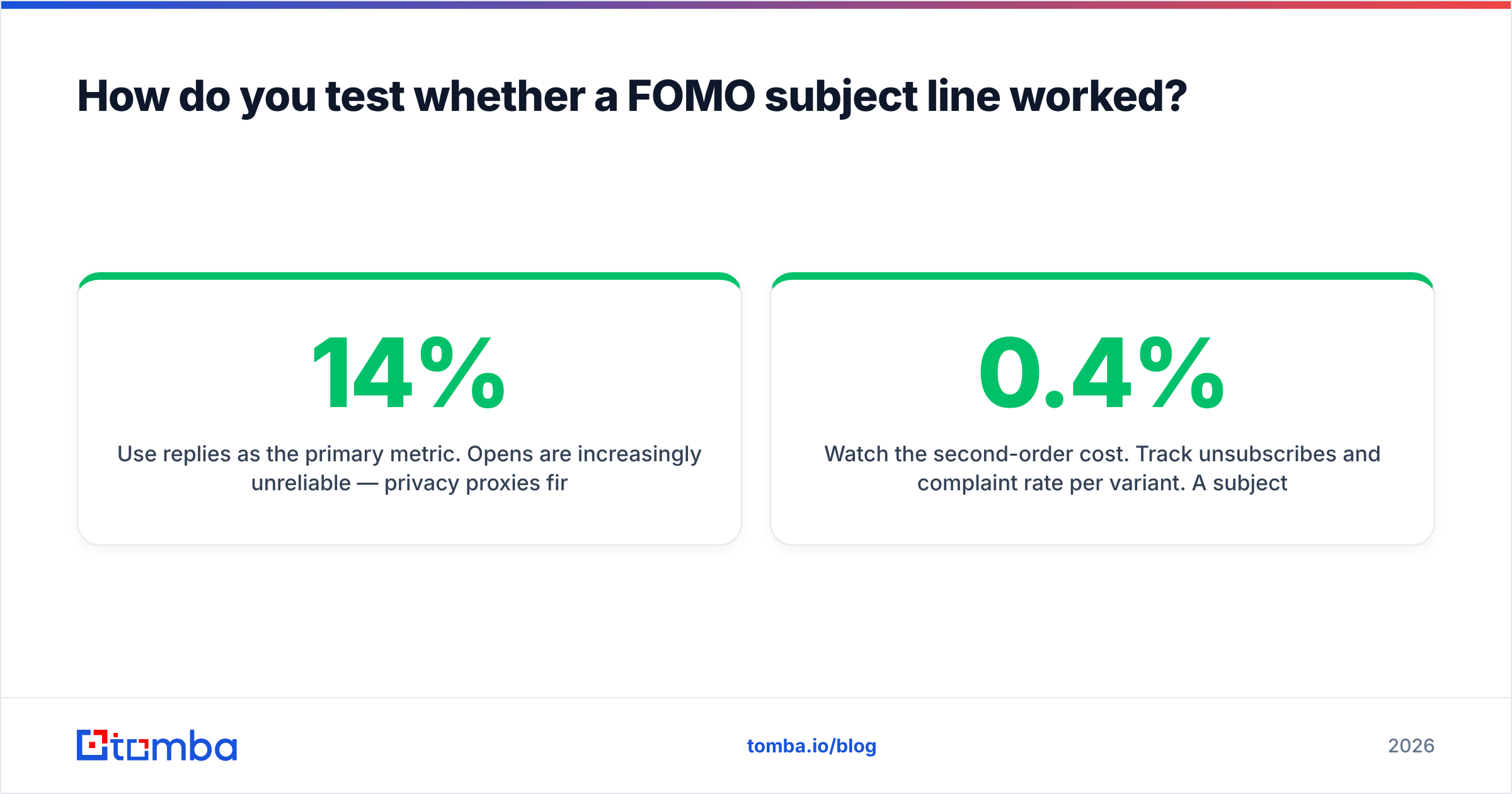
Use replies as the primary metric. Opens are increasingly unreliable — privacy proxies fire pixels without a human ever seeing the message. If your A/B test shows +14% opens and −3% replies, the FOMO variant lost.
Split by segment, not just by variant. Urgency performs very differently on cold prospects versus expiring trials. A single blended win rate hides both effects.
Give it enough volume. Under a few hundred sends per variant, you are reading noise. If your list is small, test sequentially over two sends instead of splitting it.
Watch the second-order cost. Track unsubscribes and complaint rate per variant. A subject that wins this week and burns 0.4% of your list has not won.
Re-test quarterly. FOMO decays with exposure. The formula that carried Q1 may be exhausted by Q3 on the same audience.
Does any of this work if your contact data is bad?#
No — and this is the least discussed part of subject-line optimization.
A FOMO subject aimed at the wrong person is worse than no email at all. "Your renewal closes Friday" sent to someone who left the company 14 months ago produces a hard bounce, which feeds your bounce rate, which lowers your inbox placement, which quietly suppresses the campaigns that were working. Urgency amplifies whatever your data quality already is.
Three fixes, in order of impact:
- Verify before every campaign, not once a year. B2B data decays roughly 2–3% per month as people change roles. Run the list through an email verifier and cut anything that isn't deliverable.
- Re-find, don't just delete. When a contact bounces, the account is usually still a fit — the person moved. Finding the current holder of that role is a research problem an email finder solves in seconds.
- Enrich for the specifics FOMO requires. Every strong example above has a bracket in it: a renewal date, a role, a competitor, a headcount. Without data enrichment, you fill those brackets with guesses, and guessed specificity is exactly what readers detect as fake.
The pattern holds across every high-performing outbound team: the copy is average, the targeting and data are excellent. Reverse that and no amount of urgency saves you.
What should you do on Monday?#
Pick one campaign. Audit its subject lines against the earned-vs-manufactured table above and delete every scarcity claim you can't substantiate with a date, a number, or a name. Re-verify the list. Then write one honest deadline subject, send it to the cleaned segment, and measure replies for two weeks.
If the deadline was real, you'll see it. If it wasn't, you just learned something cheaper than a burned domain would have taught you.
When you're ready to fill in the brackets — the right name, the right role, the right current address — start with Tomba Email Finder. Find verified professional emails by domain, name, or company, then check the pricing details: 25 free searches a month to test it, Starter at $49/mo, Growth at $99/mo. Clean data first, clever subject lines second. That order never changes.
Related guides#
Ready to find emails that actually work?
Join 150,000+ professionals who stopped guessing and started sending. Free credits on signup — no credit card required.
Get the Tomba newsletter
Practical outbound tactics and product updates — once every two weeks.
About the author