Forager vs Apollo.io in 2026: Data, Pricing, and Fit
Forager sells refreshed B2B contact data. Apollo sells a whole sales stack. We compare coverage, accuracy, credits, and real cost to show which one actually fits your outbound motion in 2026.
Forager vs Apollo.io comes down to one question: do you want raw contact data, or a whole sales stack? Here is the short answer, then the numbers behind it.
TL;DR
- Forager.ai is a data company. Apollo.io is a sales platform. Forager sells fresh B2B contact records through an API, a feed, or a license. Apollo bundles a 200M+ contact database with sequences, a dialer, and a light CRM.
- Apollo wins on breadth and self-serve pricing. A free tier plus per-seat plans from roughly $49/user/mo make it easy to start. Forager rarely publishes full pricing and usually routes you to sales.
- Forager wins on freshness for a few use cases — job-change signals, recruiting data, and enrichment pipelines. In those, a recent record matters more than a sequencer.
- Neither is cheap at scale. Apollo bills per seat, so a 10-rep team pays 10x for a database one person could query. Forager's contracts are usually annual and enterprise.
- If you only need verified emails, both are overkill. A dedicated email finder with API access and credit-based pricing does that one job for less.
What are Forager.ai and Apollo.io, exactly?#
They compete for the same budget line. They are not the same kind of product.
Forager.ai is a B2B data provider. Its pitch is refresh rate. It re-crawls and re-checks professional profiles far more often than most databases. Job changes, new titles, and company moves show up faster as a result. It is built for teams that want to consume data through an API, a bulk file, or a pipeline that feeds a CRM or a product. Recruiting platforms, data teams, and GTM engineers like it because they already own their outreach tools.
Apollo.io is an all-in-one sales engagement platform. It ships a large contact and company database — Apollo claims over 200 million contacts and 35 million companies. On top of that sit list building, email sequences, a power dialer, meeting scheduling, deal tracking, and CRM sync. The business model is per-seat SaaS: you buy a license for each rep, and each rep gets credits.
The practical difference: Forager assumes you already have a place to put the data. Apollo assumes you don't, and sells you that place too.
Here's how the two split along the axes buyers actually care about:
- Primary buyer — Forager sells to data/RevOps engineers and product teams. Apollo sells to SDR managers and founders running outbound themselves.
- Delivery model — Forager leans API, S3 drops, and licensed datasets. Apollo leans in-app UI first, API second (and API access is gated to higher tiers).
- Refresh philosophy — Forager re-checks records often and sells that as the point. Apollo refreshes all the time, but at its scale stale records are a common complaint.
- Pricing shape — Forager: custom, usually annual, volume-based. Apollo: published per-seat tiers with monthly and annual options, plus a genuinely usable free plan.
- Workflow depth — Forager stops at the record. Apollo takes you from record to sent email to booked meeting.
- Lock-in risk — Forager data lives in your systems. Apollo lists, sequences, and history live in Apollo.
Forager vs Apollo.io: how do they compare feature by feature?#
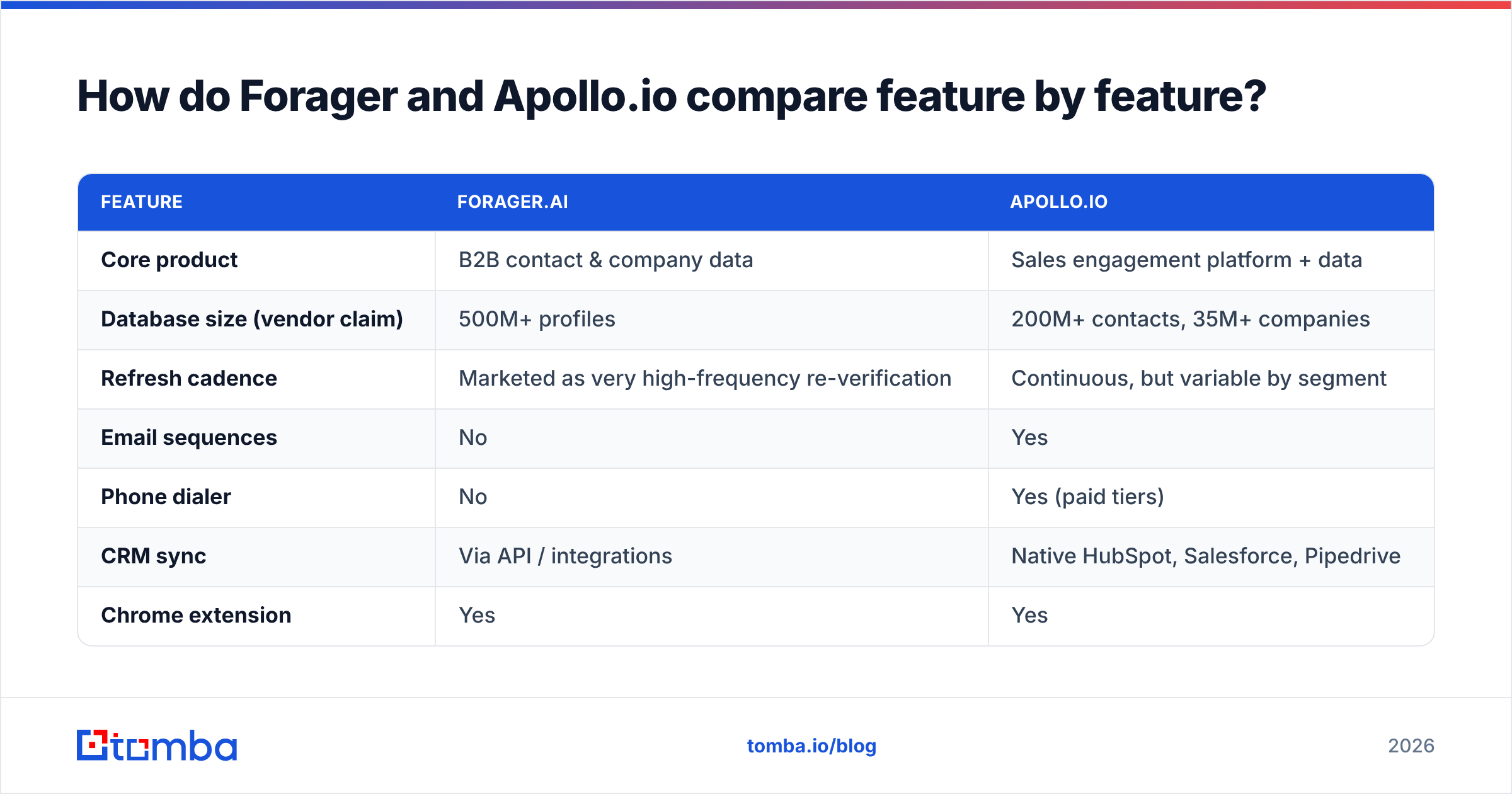
| Feature | Forager.ai | Apollo.io |
|---|---|---|
| Core product | B2B contact & company data | Sales engagement platform + data |
| Database size (vendor claim) | 500M+ profiles | 200M+ contacts, 35M+ companies |
| Refresh cadence | Marketed as very high-frequency re-verification | Continuous, but variable by segment |
| Email sequences | No | Yes |
| Phone dialer | No | Yes (paid tiers) |
| CRM sync | Via API / integrations | Native HubSpot, Salesforce, Pipedrive |
| Chrome extension | Yes | Yes |
| API access | Core delivery method | Available, gated to higher tiers |
| Free tier | No public free plan | Yes, limited credits |
| Published self-serve pricing | Mostly no — sales-led | Yes |
| Best for | Enrichment pipelines, recruiting data, GTM engineering | SDR teams wanting one tool end to end |
| Contract shape | Annual / volume | Monthly or annual, per seat |
The table turns the choice into a simpler question: what do you already own? If you have Outreach, Salesloft, Instantly, or your own sending setup, buying Apollo means paying twice for sequencing. If you have nothing, buying Forager means you still can't send an email.
Which one has more accurate data?#
Neither vendor will hand you a neutral answer, so test on your own ICP.
Accuracy in B2B data is not one number. It splits into at least four:
- Coverage — what share of your target list returns any contact at all?
- Deliverability — of the emails returned, what share actually accepts mail?
- Recency — is the title and company still correct today?
- Directness — is the phone number a switchboard or a mobile?
Forager sells recency, and that matters for job-change plays. If your play is "reach the person within 30 days of a new role," a slow database is worthless no matter how big it is. Apollo's edge is raw coverage, above all in US mid-market tech. Its users contribute records, so the pile is huge. That is also the weak spot: shared records age, and duplicate or job-changed contacts come up often in G2 reviews.

The only honest test is a bake-off. Take 200 accounts from your real ICP — not a generic "SaaS companies in the US" sample — and run the same list through both tools plus one control. Then:
- Measure hit rate — contacts returned divided by rows submitted.
- Measure verified rate — run every returned email through an independent email verifier rather than trusting the source tool's own confidence score.
- Measure bounce rate live — send a small, warmed campaign and count hard bounces. This is the only metric that pays your bills.
- Measure cost per usable contact — total spend divided by contacts that survived steps 2 and 3.
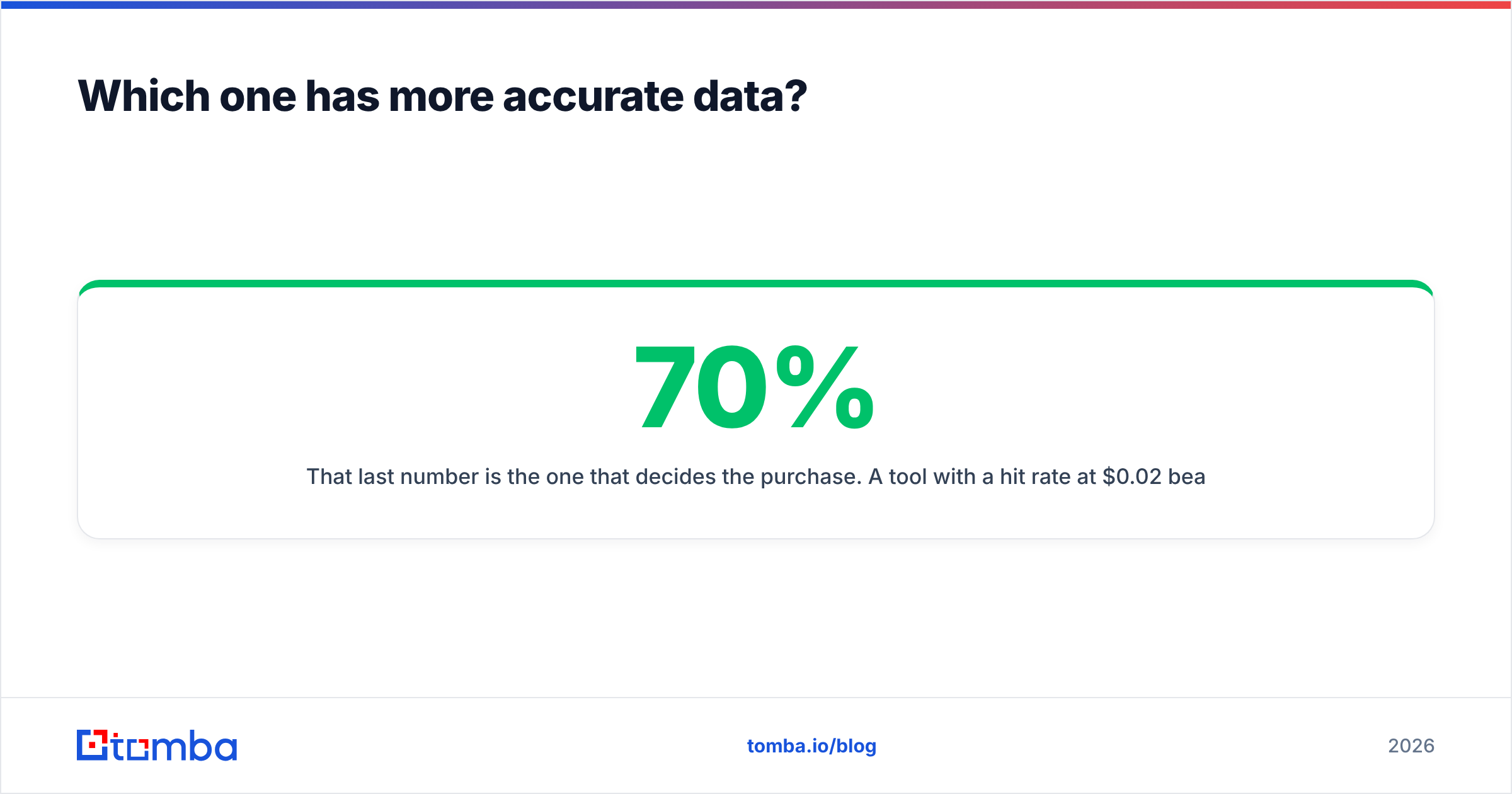
That last number decides the purchase. A tool with a 70% hit rate at $0.02 per credit beats a tool with a 90% hit rate at $0.10 per credit for most teams. Neither vendor's homepage will tell you that.
One more note. Both tools return catch-all domains, where the mail server accepts everything and tells you nothing. Catch-alls are common at large companies and in locked-down Microsoft 365 tenants. If much of your ICP sits behind one, add a catch-all verifier to the loop. Without it, your "verified" list is a guess wearing a green checkmark.
What does each actually cost in 2026?#
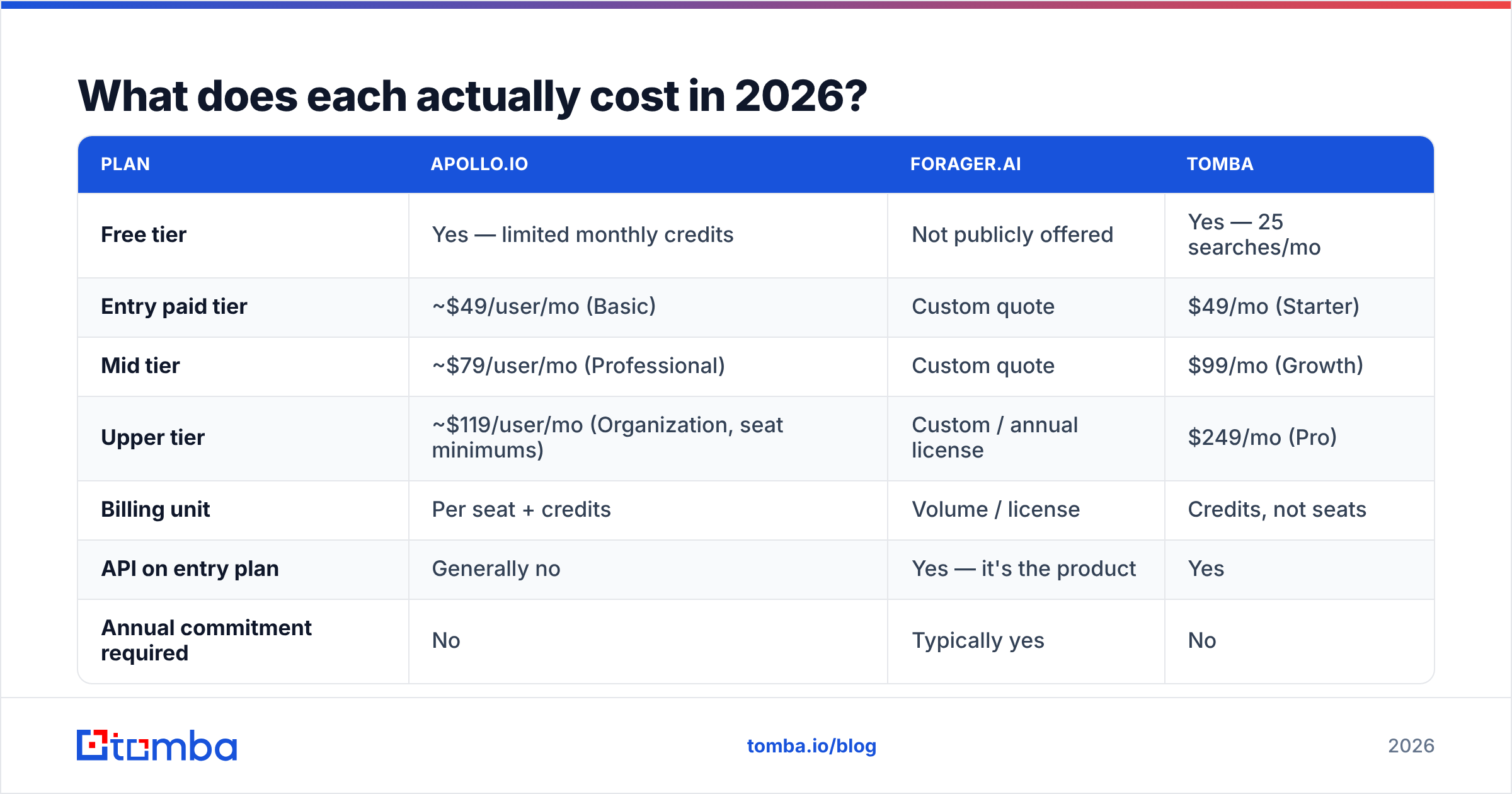
In a Forager vs Apollo.io cost comparison, the first gap is transparency. Apollo publishes pricing. Forager largely does not. That gap tells you who each product is sold to.
| Plan | Apollo.io | Forager.ai | Tomba |
|---|---|---|---|
| Free tier | Yes — limited monthly credits | Not publicly offered | Yes — 25 searches/mo |
| Entry paid tier | ~$49/user/mo (Basic) | Custom quote | $49/mo (Starter) |
| Mid tier | ~$79/user/mo (Professional) | Custom quote | $99/mo (Growth) |
| Upper tier | ~$119/user/mo (Organization, seat minimums) | Custom / annual license | $249/mo (Pro) |
| Billing unit | Per seat + credits | Volume / license | Credits, not seats |
| API on entry plan | Generally no | Yes — it's the product | Yes |
| Annual commitment required | No | Typically yes | No |
Check the current numbers on each vendor's own pricing page before you buy, because SaaS tiers move. The shape of these models is stable, and the shape is what should drive your choice.
The per-seat trap deserves a warning. Apollo charges per user, and credits are split per user. A five-person SDR team on Professional pays roughly $4,700 a year before anyone books a meeting. Most of those seats hit the same database for the same accounts. If your real need is "enrich a list once a week and push it to HubSpot," you are paying for four spare licenses. Credit-based tools skip the problem: one account, one credit pool, any number of people or scripts drawing from it. That is the core argument in most Apollo alternative reviews, and it holds up.
Forager's cost problem is different. Sales-led pricing means your rate depends on how well you negotiate and how much you commit to up front. For a funded data team buying a licensed feed, that is normal. For a 12-person startup that wants 3,000 emails a month, it is friction that ends in a quote you will decline.
Who should choose Forager over Apollo?#
Pick Forager.ai if:
- You are building a product or internal pipeline that reads contact data through code, and the UI does not matter to you.
- Recency is the feature you are buying — job-change triggers, recruiting, talent intelligence, or portfolio monitoring.
- You already own your outreach stack and refuse to pay for a second sequencer.
- You have annual budget and enough patience for a sales cycle.
Pick Apollo.io if:
- You want one tool for finding, sequencing, calling, and tracking, and you're fine with "good enough" in each category.
- Your team is small enough that per-seat pricing isn't yet punishing (roughly under five active users).
- You're US-focused mid-market tech, where Apollo's coverage is strongest.
- You want to start today without talking to anyone.
Pick neither if your job is narrower than both. A lot of teams buy a $1,200/month platform to solve one small problem: given a name and a company domain, return a verified work email. That is a domain search and a verifier, not a platform migration.

Where do both tools fall short?#
Every comparison post that only lists strengths is a brochure. Here's the other side.
Apollo's weak points:
- Credit accounting is confusing. Export credits, mobile credits, and email credits all behave differently. Hitting a wall mid-campaign is common.
- Data decay on long-tail records. Coverage that broad comes with records nobody has touched in a while.
- Sequences send from your own mailbox, and the built-in deliverability tools are thin. Bad list hygiene turns into a domain reputation problem fast.
- API access is a paywall feature, which frustrates technical teams that want to automate.
Forager's weak points:
- No self-serve path. You can't test it on a Tuesday afternoon with a credit card.
- No outreach layer at all — budget for a second tool.
- The enterprise contract shape doesn't fit small teams or spiky, seasonal usage.
- Less third-party review volume than Apollo, so outside validation is harder to find.
What both share:
- Neither replaces list hygiene. Both will return catch-alls, role accounts, and departed employees. Verification before sending is not optional.
- Neither guarantees compliance for your use case. GDPR, CCPA, and the regional rules apply to how you use the data, not how the vendor collected it. Read Gartner's guidance on B2B data governance before you scale a list into six figures.
- Both encourage volume over precision. The tool makes it trivial to export 50,000 contacts. Nothing in the tool stops you from burning your domain on them.

Is there a better third option for most teams?#
For a specific and very common profile — yes.
If your requirement list reads like this:
- Find verified work emails from a name + domain, or pull every public address on a company domain.
- Verify before sending, including catch-all handling.
- Work through an API and a spreadsheet, not just a UI.
- Pay for volume, not for headcount.
- Skip the sales call.
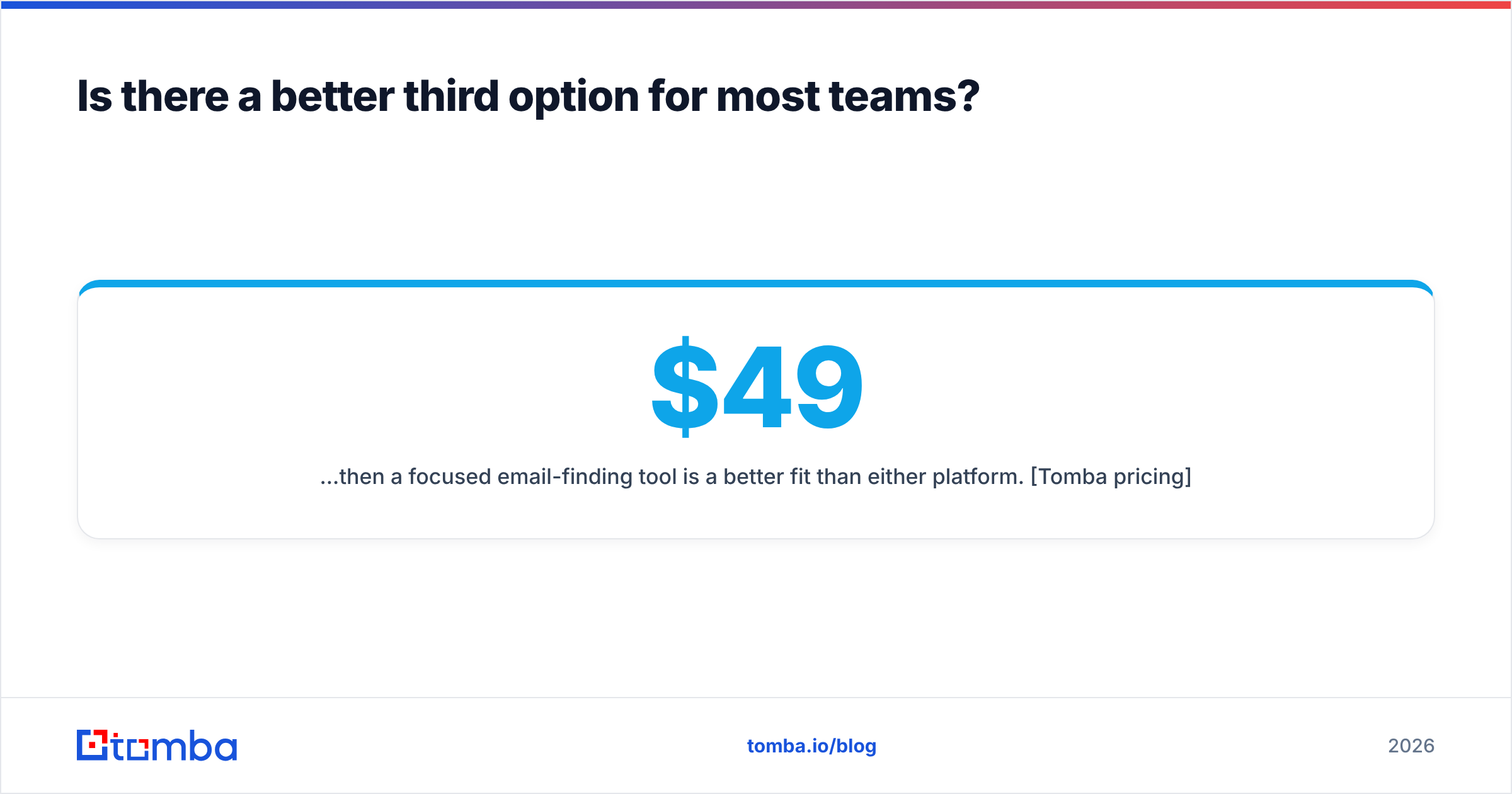
...then a focused email-finding tool fits better than either platform. Tomba pricing starts free at 25 searches per month, with Starter at $49/mo, Growth at $99/mo, and Pro at $249/mo. Prices run on credits, not seats, so adding a teammate or a script costs nothing extra. The Tomba API is open from the entry tier instead of locked behind an enterprise plan, and bulk email finder handles list-scale jobs with no per-user surcharge.
What it doesn't do: sequences, dialing, or pipeline management. That's the trade. If you already run Instantly, Smartlead, Outreach, or your own sender, that trade is free money. If you genuinely need an all-in-one, Apollo is the more sensible buy of the two compared here.
Frequently asked questions#
Is Apollo.io's free plan enough to test with? For a smoke test, yes. It gives you enough credits to check coverage on a few dozen target accounts. It's not enough to run a real campaign, and export limits will stop you quickly.
Does Forager.ai have a Chrome extension? Yes, and it's useful for spot-checking profiles. But the extension is not the product — the API and data delivery are.
Which has better international coverage? Both skew North American. European and APAC coverage thins out in both, above all outside tech. If EMEA is your market, run the bake-off described above before you sign an annual contract with either.
Can I use both? Plenty of teams do: Forager or a dedicated finder for the data layer, Apollo or a sequencer for the send layer. Just don't pay two vendors for the same database.
How often should I re-verify a list? Every 60 to 90 days for active lists, and always right before a send if the list is older than 30 days. B2B contact data decays at roughly 2-3% per month, and that compounds faster than most teams assume.
Start with the data layer#
Before you sign a per-seat contract or start a procurement cycle, test the part that drives every downstream metric: whether the email is real, and whether the person still works there.
Run your next 100 target accounts through the Tomba Email Finder on the free tier, verify the output, and send a small batch. Compare the bounce rate to whatever you pay for now. If a $49/month credit pool matches a $79/seat platform on usable contacts, you have found the cheapest line item in your GTM stack. That test settles Forager vs Apollo.io faster than any comparison page, this one included.
Related guides#
Ready to find emails that actually work?
Join 150,000+ professionals who stopped guessing and started sending. Free credits on signup — no credit card required.
Get the Tomba newsletter
Practical outbound tactics and product updates — once every two weeks.
About the author