Forager vs LeadRocks (2026): Which B2B Data Tool Wins?
Forager sells freshness and API-grade data. LeadRocks sells cheap credits and a LinkedIn extension. Here is how the two actually compare on coverage, verification, pricing and workflow fit in 2026.
Forager vs LeadRocks is a choice between two very different tools. Forager sells fresh, API-grade data. LeadRocks sells cheap credits and a LinkedIn extension. Here is how the two compare in 2026.
TL;DR
- Forager.ai is a data-first vendor: a large profile graph, fast refresh, API delivery, sales-led pricing. It fits data teams and RevOps, not a solo SDR.
- LeadRocks is a self-serve contact database with a LinkedIn Chrome extension and cheap credit packs. It fits budget prospecting and one-off list pulls.
- Neither tool wins on every axis. Forager is better on freshness and API access. LeadRocks is better on price per contact and speed to first list.
- Both hand you data that still needs checking. A database record is a claim, not a proven address.
- If you mainly need accurate work emails plus verification in one place, a dedicated email finder with a real free tier usually costs less than either.
Forager vs LeadRocks: what are they, and why compare them?#
They answer the same question from opposite ends of the market: where do I get contact data for this person or company?
Forager.ai sells data freshness. It re-crawls a professional profile graph on a constant loop. Job changes, company moves and new titles show up in days, not quarters. Delivery is API-first, with data feeds and enrichment endpoints. That suits teams who pipe records into a warehouse, a CRM or a scoring model.
LeadRocks sells access and price. You search a B2B contact database by title, company, location or industry. You can also run its Chrome extension over LinkedIn results and bulk-export what it matches. Emails and phone numbers come bundled, credits are cheap, and you can buy without a sales call.
Four practical differences drive most of the decision:
- Delivery model — Forager leans on APIs, feeds and integrations. LeadRocks leans on UI search, CSV export and a browser extension.
- Buying motion — Forager quotes for real volume. LeadRocks lists tiers you can pay for today.
- Refresh philosophy — Forager sells recency. LeadRocks sells breadth at a low unit cost.
- Who it is built for — Forager for RevOps, data and ABM teams. LeadRocks for founders, agencies and small outbound teams.
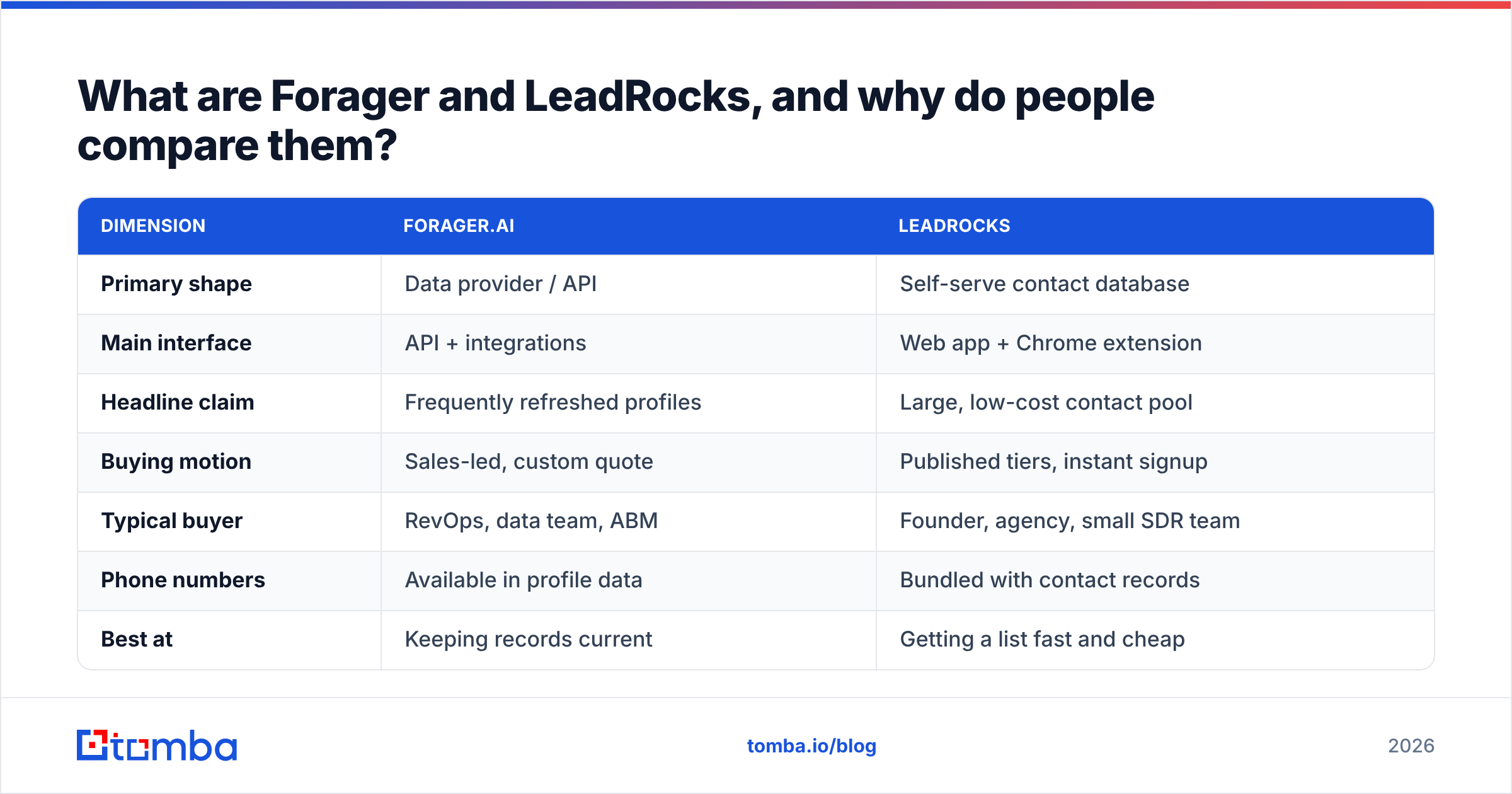
| Dimension | Forager.ai | LeadRocks |
|---|---|---|
| Primary shape | Data provider / API | Self-serve contact database |
| Main interface | API + integrations | Web app + Chrome extension |
| Headline claim | Frequently refreshed profiles | Large, low-cost contact pool |
| Buying motion | Sales-led, custom quote | Published tiers, instant signup |
| Typical buyer | RevOps, data team, ABM | Founder, agency, small SDR team |
| Phone numbers | Available in profile data | Bundled with contact records |
| Best at | Keeping records current | Getting a list fast and cheap |
| Weakest at | Fast, cheap self-serve start | Programmatic depth and freshness |

How do Forager and LeadRocks compare on data coverage?#
Coverage is the number everyone quotes and the one that matters least on its own. Both vendors claim hundreds of millions of profiles. In a real Forager vs LeadRocks test, that number tells you little. What you need to know is whether the 400 people on your list are in there with usable contact details.
What matters is match rate on your segment. A database can be huge and still return 22% coverage if you sell to heads of operations at 30-person manufacturers in Poland. The same database may hit 90% for VPs of Marketing at US SaaS firms with 200+ staff.
Broad patterns worth knowing before you test:
- Forager is stronger where profile depth matters: seniority, tenure, job-change signals, company links. If your play is "alert me when a champion moves", that is the data it is built to deliver.
- LeadRocks is strongest where its extension gets used most: sales, marketing and founder titles at SMB and mid-market firms in North America and Western Europe.
- Both thin out on non-English markets, tiny companies and non-desk roles. That is a category-wide limit, not a knock on either vendor.
The only honest test is your own. Pull 100 rows from a segment you really sell into. Run the same 100 through both tools. Then compare three columns: found, verifiable, and correct on reply. Skip the second column and you are measuring generosity, not accuracy.
Which one is more accurate — and how do you actually check?#
Accuracy is where "database" tools and "finder" tools split. A database returns what was true when the record was written. A finder resolves the address at query time. It can also check the address against the receiving mail server before handing it over.
That gap shows up in your bounce rate about four days after you launch a sequence.

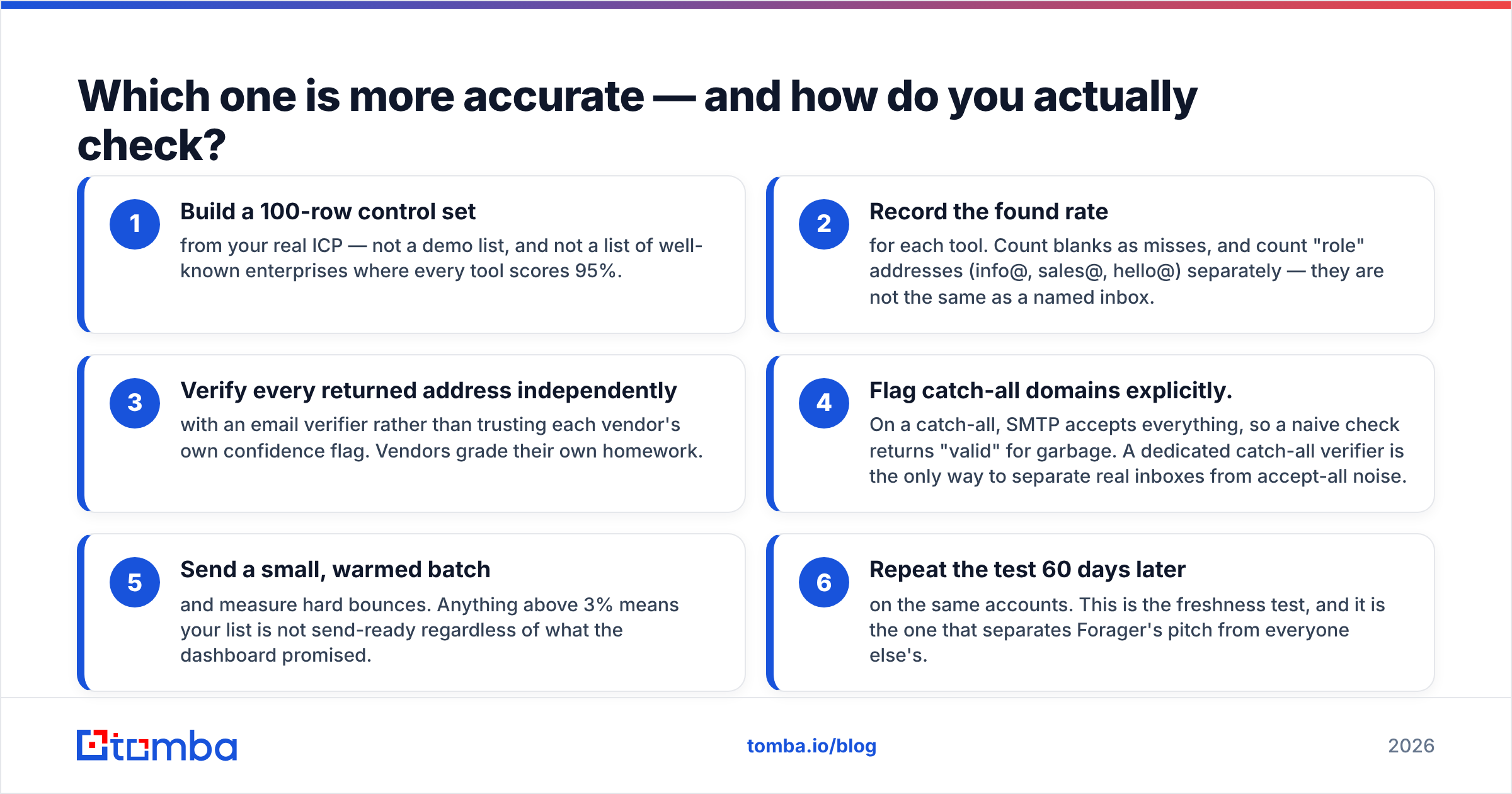
Run this test before you commit budget to either vendor:
- Build a 100-row control set from your real ICP. Not a demo list, and not big-name firms where every tool scores 95%.
- Record the found rate for each tool. Count blanks as misses. Count role addresses (info@, sales@, hello@) on their own — they are not named inboxes.
- Verify every returned address yourself with an email verifier instead of trusting each vendor's confidence flag. Vendors grade their own homework.
Then check the two things that quietly break most lists:
- Flag catch-all domains. On a catch-all, SMTP accepts everything, so a basic check calls garbage "valid". A catch-all verifier is the only way to tell real inboxes from accept-all noise.
- Send a small, warmed batch and count hard bounces. Anything above 3% means the list is not ready to send.
- Repeat the test 60 days later on the same accounts. That is the freshness test, and it is the one Forager is built to win.
Two teams running that protocol on different lists will pick different winners. That is the right outcome. It is also why the Forager vs LeadRocks accuracy question has no single answer.
How does pricing compare between Forager, LeadRocks and Tomba?#
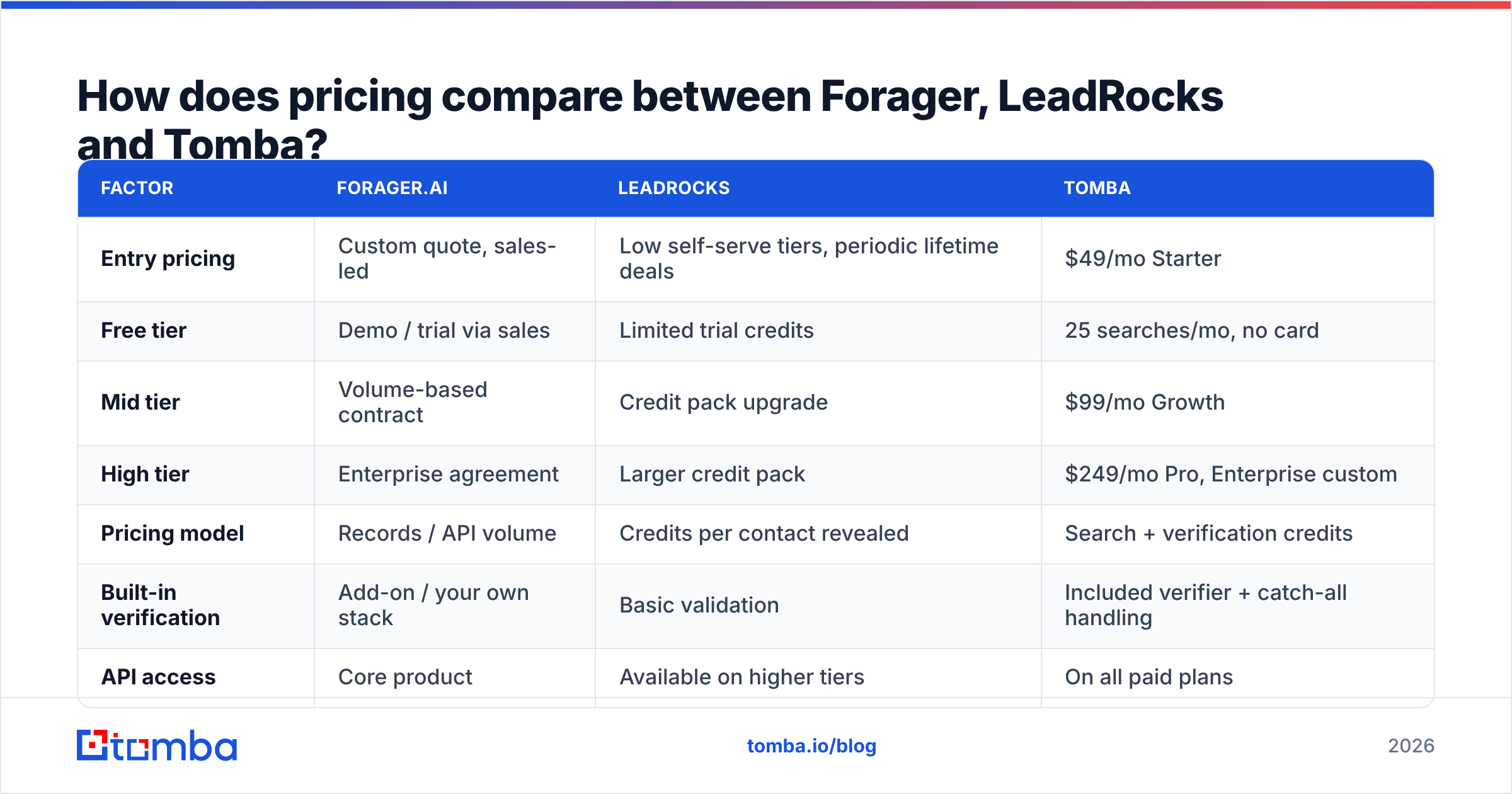
Pricing is the clearest split in Forager vs LeadRocks. Forager quotes. LeadRocks lists. Check both vendors' current pages before you budget, because contact-data prices move often and lifetime deals distort the picture.

| Factor | Forager.ai | LeadRocks | Tomba |
|---|---|---|---|
| Entry pricing | Custom quote, sales-led | Low self-serve tiers, periodic lifetime deals | $49/mo Starter |
| Free tier | Demo / trial via sales | Limited trial credits | 25 searches/mo, no card |
| Mid tier | Volume-based contract | Credit pack upgrade | $99/mo Growth |
| High tier | Enterprise agreement | Larger credit pack | $249/mo Pro, Enterprise custom |
| Pricing model | Records / API volume | Credits per contact revealed | Search + verification credits |
| Built-in verification | Add-on / your own stack | Basic validation | Included verifier + catch-all handling |
| API access | Core product | Available on higher tiers | On all paid plans |
| Contract friction | Annual commitment common | Card, cancel anytime | Monthly, cancel anytime |
Three things this table hides:
- Seat costs. Some vendors price per user. The bill triples the moment a second SDR joins. Ask before you sign.
- Credit burn on misses. Check whether a failed lookup eats a credit. If it does, one weak segment can drain a month's allowance in an afternoon.
- Verification you will buy anyway. If the tool does not verify, add $20–$60 a month for a standalone verifier and count it in the total. Tomba's pricing puts verification in the same credit pool, which is a real cost difference.

Is Forager better than LeadRocks for outbound teams?#
For most outbound teams under 20 reps, no. That is not a knock on Forager.
Forager's strengths are built in: constant refresh, API delivery, and profile depth that supports job-change triggers. Those strengths pay off when a data engineer owns the pipeline. Records land in a warehouse, and enrichment runs on a schedule across thousands of accounts. If that is your setup, Forager is a serious pick and the sales call is worth the friction.
LeadRocks' strengths are practical. You sign up, search, export, and you are prospecting the same morning. For an agency running six clients, or a founder building a first 500-contact list, that speed beats refresh measured in days.
The Forager vs LeadRocks answer flips with the job. Teams get burned when they pick Forager for a one-off conference list they need today, or pick LeadRocks to stop 40,000 CRM records from decaying.
It also helps to test the wider field. Look at Apollo alternatives and RocketReach alternatives in the same cycle. Peers like BookYourData take another route again: verified, purchase-ready lists sold outright rather than metered by credit. Three tools tested on your own ICP beats ten review-site summaries.
What about workflow, integrations and day-to-day use?#
Data quality decides whether the email lands. Workflow decides whether anyone still uses the tool in week three.
Forager assumes engineers are involved: API keys, scheduled jobs, field mapping into your warehouse or CRM. It is powerful, but setup costs real time. Reps rarely see it, which is fine, because it is not built for them.
LeadRocks assumes a human in a browser. Search, filter, select, export, upload to your sequencer. The Chrome extension over LinkedIn search is the fastest path from "I found the right people" to "I have their emails". It gets tedious at volume, though. Manual exports past a few thousand rows a month eat someone's afternoon.
A middle path most teams end up building anyway:
- Find in-flow — a browser email finder extension for the rep already on a prospect's site or profile.
- Find in bulk — a bulk email finder for lists you export from Sales Navigator or a conference page.
- Find by company — domain search when you know the account but not the person. It returns the email pattern and the named inboxes behind it.
- Automate the rest — an email finder API so enrichment runs on record creation, not on someone remembering.
- Verify everything before any address reaches a sequencer, whoever sourced it.
Want to know how a provider builds its records? Read the vendor's data sources page. Any provider that will not explain its sourcing is asking for trust it has not earned. Cross-check user reports on G2 too. Filter for reviewers whose company size and region match yours, because scores averaged across mixed segments mean very little.
Forager vs LeadRocks: which should you choose in 2026?#
Short version:
- Choose Forager if you have data engineers, you care about job-change and company-move signals, and record decay across a large CRM is your real problem. Budget for a quote and a contract.
- Choose LeadRocks if you need lists fast at the lowest credible cost per contact, you sell to SMB and mid-market in Western markets, and you can add your own verification layer.
- Choose neither yet if you have not run a 100-row match-rate test on your own ICP. Every claim here, including the ones that favour Tomba, should lose to your own data.
And if the job is narrower than either pitch suggests? Say you need verified work emails on demand, with no procurement cycle and no credit-pack gamble. Then start with the tool built for that. Tomba's Email Finder resolves addresses by name and domain. It runs verification and catch-all detection from the same credit pool. You also get 25 free searches a month to run your own comparison before you pay anyone. Test it against Forager and LeadRocks on the same 100 rows, then let the bounce rate pick the winner.
Related guides#
Ready to find emails that actually work?
Join 150,000+ professionals who stopped guessing and started sending. Free credits on signup — no credit card required.
Get the Tomba newsletter
Practical outbound tactics and product updates — once every two weeks.
About the author