Free B2B Platform Options in 2026: What You Actually Get
Free B2B platforms promise data, outreach, and CRM at zero cost — but the limits are where the real story is. Here's what each free tier actually gives you in 2026, and when paying beats stitching.
TL;DR
- A "free b2b platform" almost never means free forever at usable volume — it means a metered trial with a monthly reset, an export restriction, or a feature wall.
- The three honest free categories in 2026: free data/lookup credits (Tomba, Apollo, Lusha), free CRM seats (HubSpot, Zoho), and free outreach senders (Instantly-style trials, Brevo).
- The number that actually matters is not "free credits" — it's verified, exportable contacts per month. Most free tiers fail on export, not on volume.
- A stack of three free tiers (25–50 lookups + free CRM + free sender) can realistically support 100–200 first-touch prospects a month before it breaks.
- Upgrade when your time cost of stitching exceeds ~$50/mo. That's roughly the point where a single paid tier (Tomba Starter at $49/mo) replaces two hours of manual work per week.
What does "free B2B platform" actually mean in 2026?#
It means one of four business models, and knowing which one you're looking at tells you exactly when it will stop working for you.
- Metered free tier — You get N credits per month that reset. Email finders and enrichment tools use this. Tomba's free tier gives 25 searches/mo; Apollo and Lusha run similar reset-based models. The wall is volume.
- Seat-limited free tier — Unlimited-ish usage, limited users. Free CRMs work this way. HubSpot's free CRM is the canonical example: contacts are generous, but automation, sequences, and reporting sit behind paid tiers. The wall is features.
- Freemium-with-branding — Free sending or free landing pages, but the vendor's logo rides along and deliverability is shared-pool. The wall is reputation.
- Free-as-acquisition — A genuinely free product designed to get your domain and your credit card later. Chrome extensions and "free email lookup" widgets live here. The wall is data export.
The trap is category 4 dressed as category 1. You run 40 lookups, see results on screen, then discover CSV export is paid. You've spent an hour and own nothing.
Which free B2B platform tiers are worth the signup?#
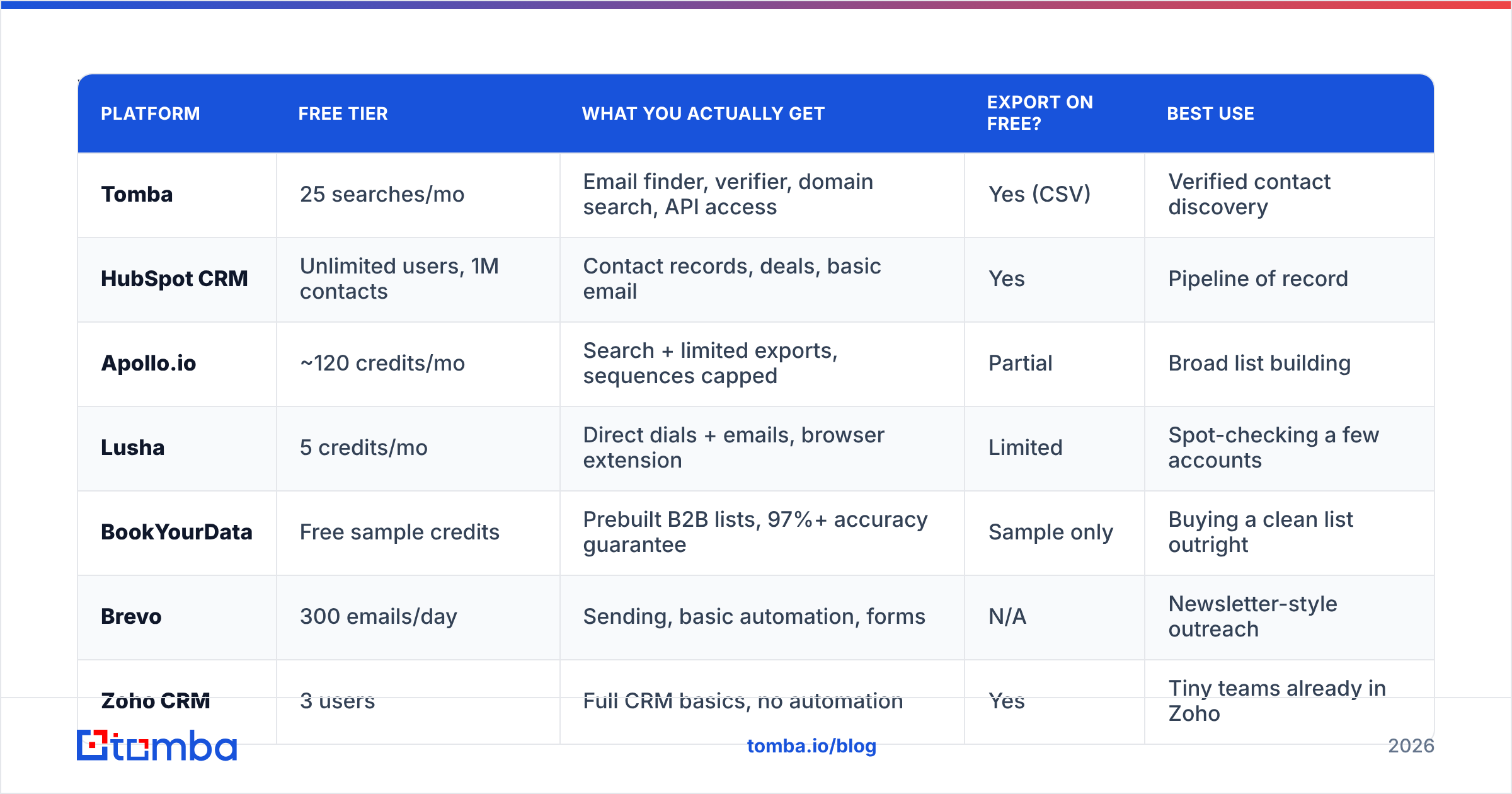
Here's the honest comparison across the three functional categories. Numbers reflect publicly listed free tiers as of early 2026 — always re-check on the vendor's own pricing page, because free tiers move quarterly.
| Platform | Free tier | What you actually get | Export on free? | Best use |
|---|---|---|---|---|
| Tomba | 25 searches/mo | Email finder, verifier, domain search, API access | Yes (CSV) | Verified contact discovery |
| HubSpot CRM | Unlimited users, 1M contacts | Contact records, deals, basic email | Yes | Pipeline of record |
| Apollo.io | ~120 credits/mo | Search + limited exports, sequences capped | Partial | Broad list building |
| Lusha | 5 credits/mo | Direct dials + emails, browser extension | Limited | Spot-checking a few accounts |
| BookYourData | Free sample credits | Prebuilt B2B lists, 97%+ accuracy guarantee | Sample only | Buying a clean list outright |
| Brevo | 300 emails/day | Sending, basic automation, forms | N/A | Newsletter-style outreach |
| Zoho CRM | 3 users | Full CRM basics, no automation | Yes | Tiny teams already in Zoho |
Two patterns jump out. First, free CRM is genuinely free — the CRM vendors monetize automation and reporting, not storage. Second, free data is never genuinely free at volume, because every lookup costs the vendor real money in verification infrastructure.
How do free data credits actually compare on accuracy?#
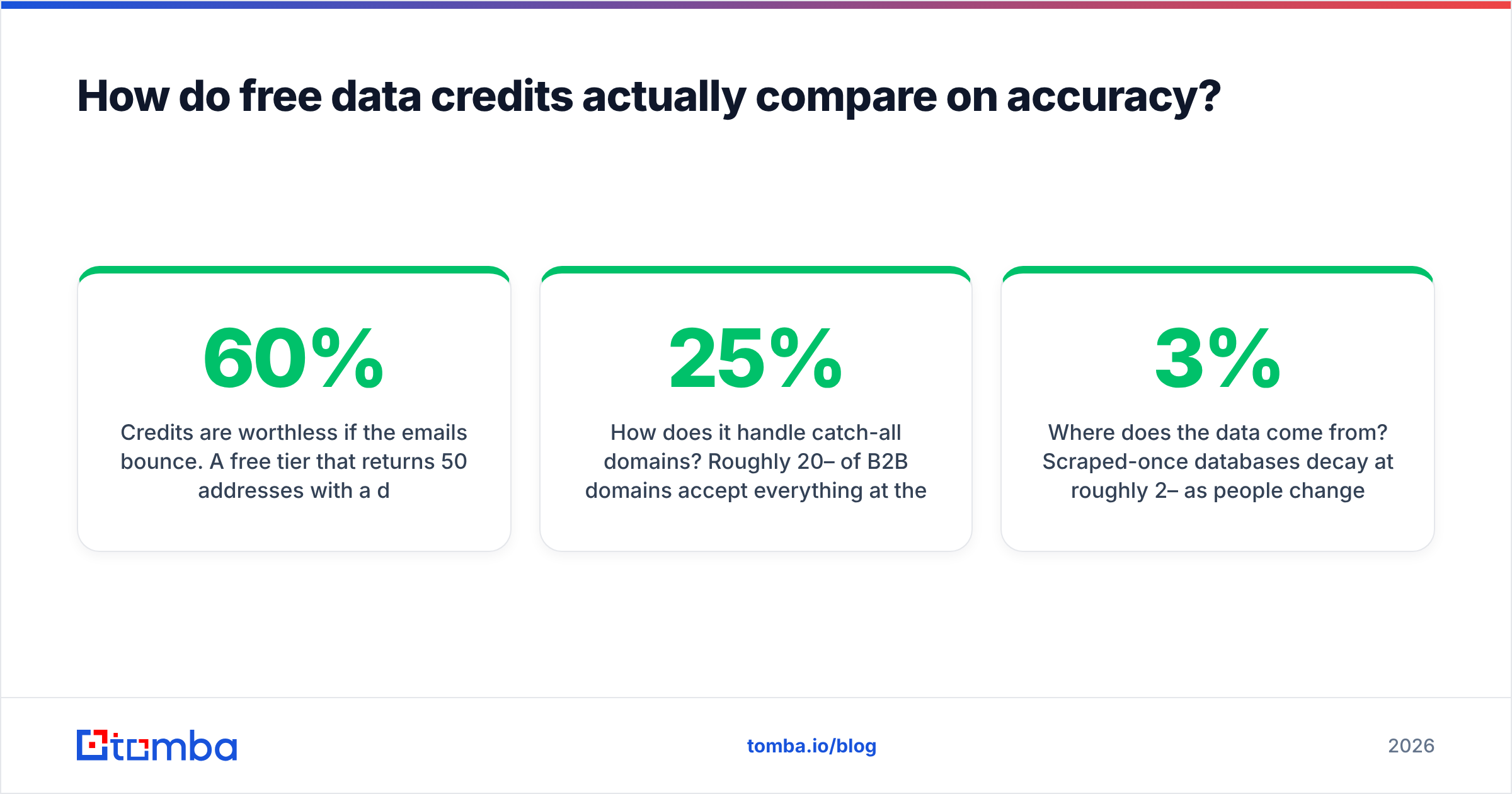
Credits are worthless if the emails bounce. A free tier that returns 50 addresses with a 60% deliverable rate is worse than one that returns 25 at 95%, because bounces cost you sender reputation — and reputation is the one asset you can't buy back.

Three things to check before you trust any free tier's output:
- Does it separate "found" from "verified"? Tools that return a single blob of addresses are guessing patterns. Tools that return a confidence score plus an SMTP result have actually checked. Run anything questionable through an email verifier before it touches your sending domain.
- How does it handle catch-all domains? Roughly 20–25% of B2B domains accept everything at the SMTP layer. A platform that marks these "valid" is lying to you. A catch-all verifier gives you a probability instead of a false green light.
- Where does the data come from? Scraped-once databases decay at roughly 2–3% per month as people change jobs. Platforms that re-crawl and re-verify — see data sources for how this works in practice — hold accuracy far better over a year.
That last point is why free tiers from database-only vendors feel great in month one and terrible in month six. The records didn't change; the world did.

Can you build a complete free B2B stack that actually works?#
Yes, for about 100–200 first-touch prospects a month. Beyond that it collapses. Here's the assembly that holds up longest:
- Sourcing layer — free CRM as the spine. Start with HubSpot's free CRM or Zoho's 3-seat tier. This is your system of record. Everything else feeds it. Do not let your prospect list live in a spreadsheet you rename every week.
- Discovery layer — metered lookups. Use a free email finder tier for the 25 highest-value accounts, not for bulk. Free credits are a scalpel, not a shovel. Spend them on named decision-makers you've already qualified.
- Verification layer — free checkers. Run every address through a free email checker before import. Zero-cost, and it's the single highest-ROI step in the whole chain.
- Enrichment layer — public sources. Company size, tech stack, and funding are findable free. A website tech stack check tells you whether a prospect already runs a competitor, which is worth more than a job title.
- Sending layer — capped free sender. Brevo's 300/day or Gmail's own limits work fine at this volume. Warm the domain properly first; free sending pools punish cold domains hard.
- Measurement layer — nothing fancy. Reply rate and meetings booked. Free CRMs report both. Skip the analytics tools until you have volume worth analyzing.
The friction point is step 2 into step 1. Free tiers rarely offer native CRM sync, so you're exporting CSVs and importing them. Budget 20–30 minutes per batch. That manual tax is the real price of "free."
Where does the free B2B platform stack break?#
Four predictable failure points, in the order most teams hit them.
Volume, at roughly 50 contacts/week. Free lookup credits reset monthly, not weekly. Once your outbound cadence needs more than ~25–50 verified contacts a month, you're either rationing or signing up for multiple free accounts — which most vendors' terms prohibit and their fingerprinting catches.
Export, immediately. This is the sharpest wall. Several free tiers show you data on screen but gate CSV or API export. If you can't get the data into your CRM programmatically, it isn't data — it's a demo. Check for API access on free before you invest time; Tomba's free tier includes API calls, which is unusual and genuinely useful for automation.
Deliverability, around week three. Free senders use shared IP pools. Your reputation is partly hostage to whoever else is on that pool. This is where cheap turns expensive: a burned domain costs weeks of warmup to recover. Read up on email deliverability fundamentals before you scale sends, and check your SPF record is actually correct.
Team, at two people. Free CRM seats are often unlimited, but free data tools are per-account. The moment a second rep needs lookups, you're duplicating free accounts or paying. Most teams pay here.
Is free actually cheaper than a $49 starter plan?#
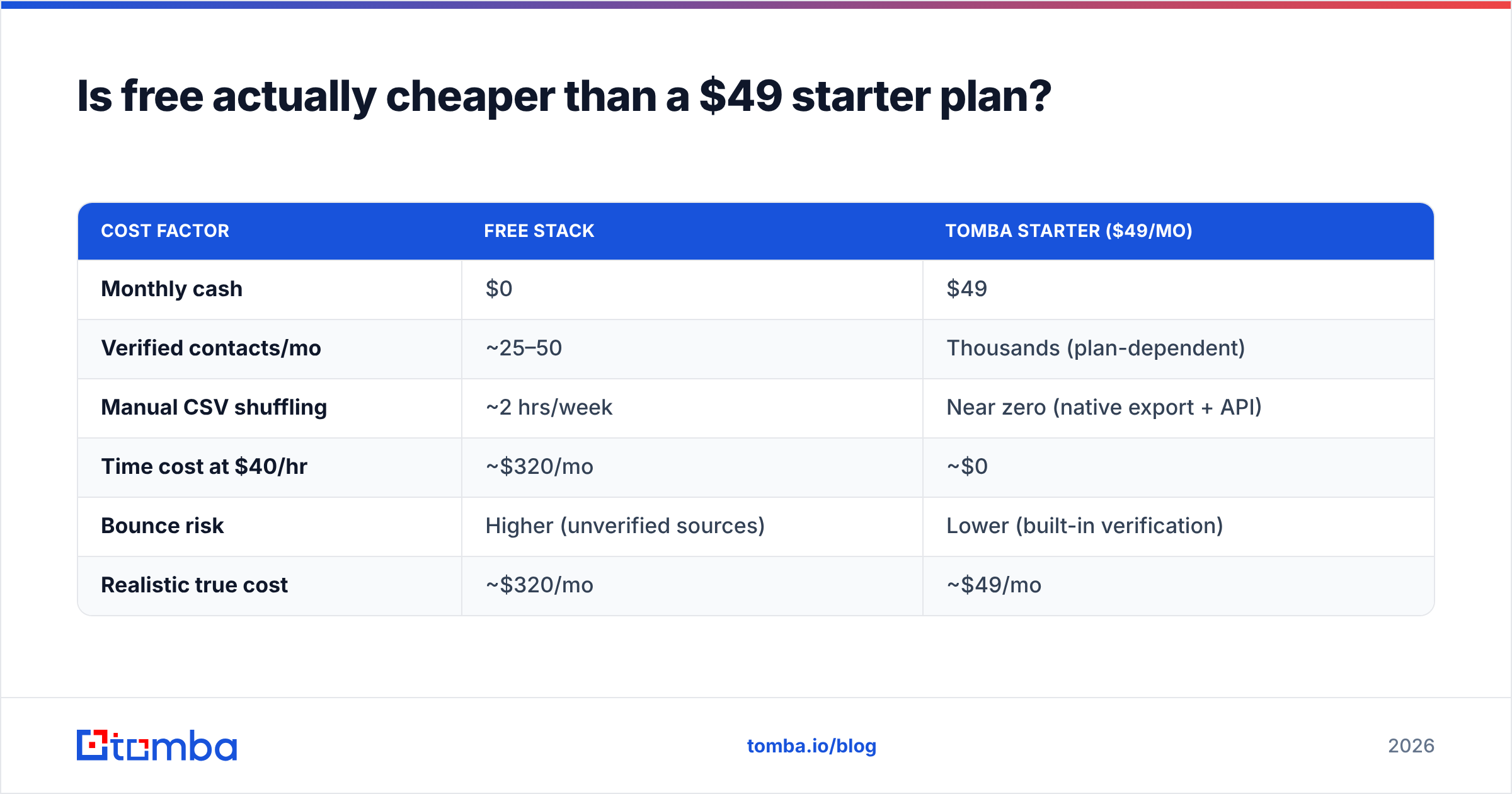
Run the arithmetic instead of the vibe.
| Cost factor | Free stack | Tomba Starter ($49/mo) |
|---|---|---|
| Monthly cash | $0 | $49 |
| Verified contacts/mo | ~25–50 | Thousands (plan-dependent) |
| Manual CSV shuffling | ~2 hrs/week | Near zero (native export + API) |
| Time cost at $40/hr | ~$320/mo | ~$0 |
| Bounce risk | Higher (unverified sources) | Lower (built-in verification) |
| Realistic true cost | ~$320/mo | ~$49/mo |
The free stack costs more than the paid one the moment your time is worth anything. That's not a Tomba-specific argument — it's true of Apollo, Lusha, and every other vendor's entry tier. The question is never "free vs paid," it's "at what volume does free stop being free?"
For most solo founders and one-person sales functions, the crossover is around 60–80 outbound contacts a month. Below that, stitch free tiers and don't feel bad about it. Above that, one paid tier beats three free ones — see Tomba pricing for where the tiers land, or compare against an Apollo alternative if you're already evaluating that side.
What should you check before committing to any free B2B platform?#
A five-minute due-diligence list that saves weeks:
- Read the export terms, not the credit count. Credits are marketing. Export rights are the product.
- Test 10 known-good contacts. Pick people whose email you already have. If the free tier returns 8/10 correctly, accuracy is real. If it returns 4/10, no credit allowance saves it.
- Check API availability on free. No API on free means you'll hand-copy forever. It also signals how the vendor thinks about developers.
- Check the reset window. Monthly reset vs one-time trial credits is a 12x difference over a year, and vendors describe both as "free."
- Check whether verification is included or metered separately. Some platforms charge credits for finding and verifying the same address. That halves your effective free tier without saying so.
- Look at bulk workflows. Even on free, does the platform support bulk email finder operations, or is it one-at-a-time? One-at-a-time is fine for 25 lookups and unbearable at 200.
Two outside references worth your time: G2's B2B data category has enough recent reviews to spot which free tiers quietly shrank, and HubSpot's free CRM page documents exactly which features are free versus paid — rare clarity in this category. For a broader market view of the data-provider landscape, Gartner's peer reviews are useful, if enterprise-skewed.
Which free tier should you start with?#
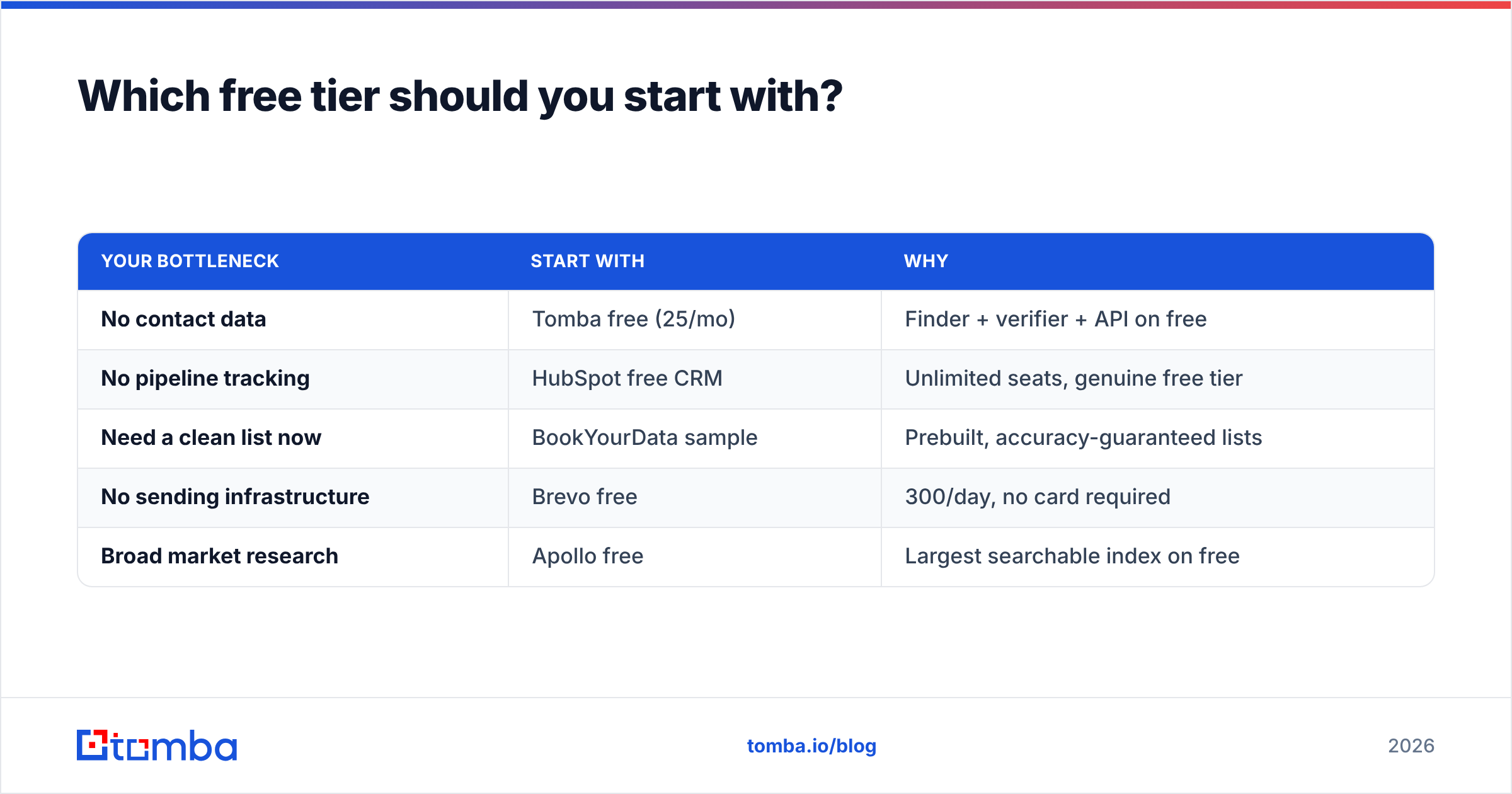
Match the tier to your actual bottleneck, not to the longest feature list.
| Your bottleneck | Start with | Why |
|---|---|---|
| No contact data | Tomba free (25/mo) | Finder + verifier + API on free |
| No pipeline tracking | HubSpot free CRM | Unlimited seats, genuine free tier |
| Need a clean list now | BookYourData sample | Prebuilt, accuracy-guaranteed lists |
| No sending infrastructure | Brevo free | 300/day, no card required |
| Broad market research | Apollo free | Largest searchable index on free |
Most teams need the first two. Stack them, run the workflow for 30 days, and you'll know precisely which wall you hit first — that wall is the thing you should pay for, and nothing else.
Ready to stop rationing credits?#
Start with the free tier and upgrade only when the volume proves you need it. The Tomba Email Finder gives you 25 verified searches a month at zero cost, with CSV export and API access included — the two things most free tiers hold back. Find the contacts, verify them before you send, and see whether 25 a month is enough for your motion. If it isn't, Starter at $49/mo picks up where free stops, and you'll upgrade knowing exactly what you're buying instead of guessing.
Related guides#
Ready to find emails that actually work?
Join 150,000+ professionals who stopped guessing and started sending. Free credits on signup — no credit card required.
Get the Tomba newsletter
Practical outbound tactics and product updates — once every two weeks.
About the author