Free Bulk Email Verification: What You Actually Get in 2026
Free bulk email verification tools promise clean lists at zero cost. Here's what the free tiers actually validate, where they quietly fail, and when paying beats free.

TL;DR
- Free bulk email verification exists, but "free" almost always means 25–500 addresses per month, syntax-and-MX-only checks, or a trial that expires in 7 days.
- The three checks that matter — SMTP handshake, catch-all detection, and role/disposable flagging — are the first things stripped out of free tiers.
- A regex-only "validator" will happily pass
john.smith@company.comfor a person who left in 2023. That's the bounce you pay for later. - For lists under ~500 addresses per month, free tools genuinely work. Above that, the math flips fast: one blocked sending domain costs more than a year of a $49/mo plan.
- Best practical setup: free tools for one-off spot checks, a paid verifier with catch-all handling for anything you'll actually send to.
What is free bulk email verification?#
Free bulk email verification is the process of uploading a list of email addresses — a CSV, a paste, or an API batch — and getting back a verdict on each one (valid, invalid, risky, unknown) without paying.
Think of it like a bouncer checking IDs at the door. A cheap bouncer glances at the photo and waves you through. An expensive one scans the barcode, checks it against a database, and notices the ID expired last March. Both are "checking IDs." Only one keeps the venue out of trouble.
Technically, a verifier runs a stack of checks in sequence, and free tiers usually stop partway down:
- Syntax validation — Does the address match RFC 5322 format? Catches typos like
name@@gmail.com. Free everywhere, worth almost nothing on its own. - Domain and MX record lookup — Does the domain exist and does it accept mail? Kills dead domains and typo'd TLDs (
@gmial.com). Usually free. - Disposable and role detection — Is this
mailinator.comorinfo@,sales@,noreply@? Sometimes free, often paywalled. - SMTP handshake — Connect to the receiving mail server and ask whether the mailbox exists, without sending anything. This is the expensive check. Almost never free at volume.
- Catch-all detection — Does the domain accept mail for every address, making the SMTP answer meaningless? This is where most lists quietly rot.
- Greylisting and retry logic — Servers that defer on first contact need re-checks. Free tools return "unknown" and move on.
Steps 1–2 cost the provider fractions of a cent. Steps 4–6 need IP pools, reputation management, and retry infrastructure. That's the entire economics of why free tiers cap out where they do.

How accurate is free bulk email verification really?#
Free tiers are accurate at what they measure — they just measure less.
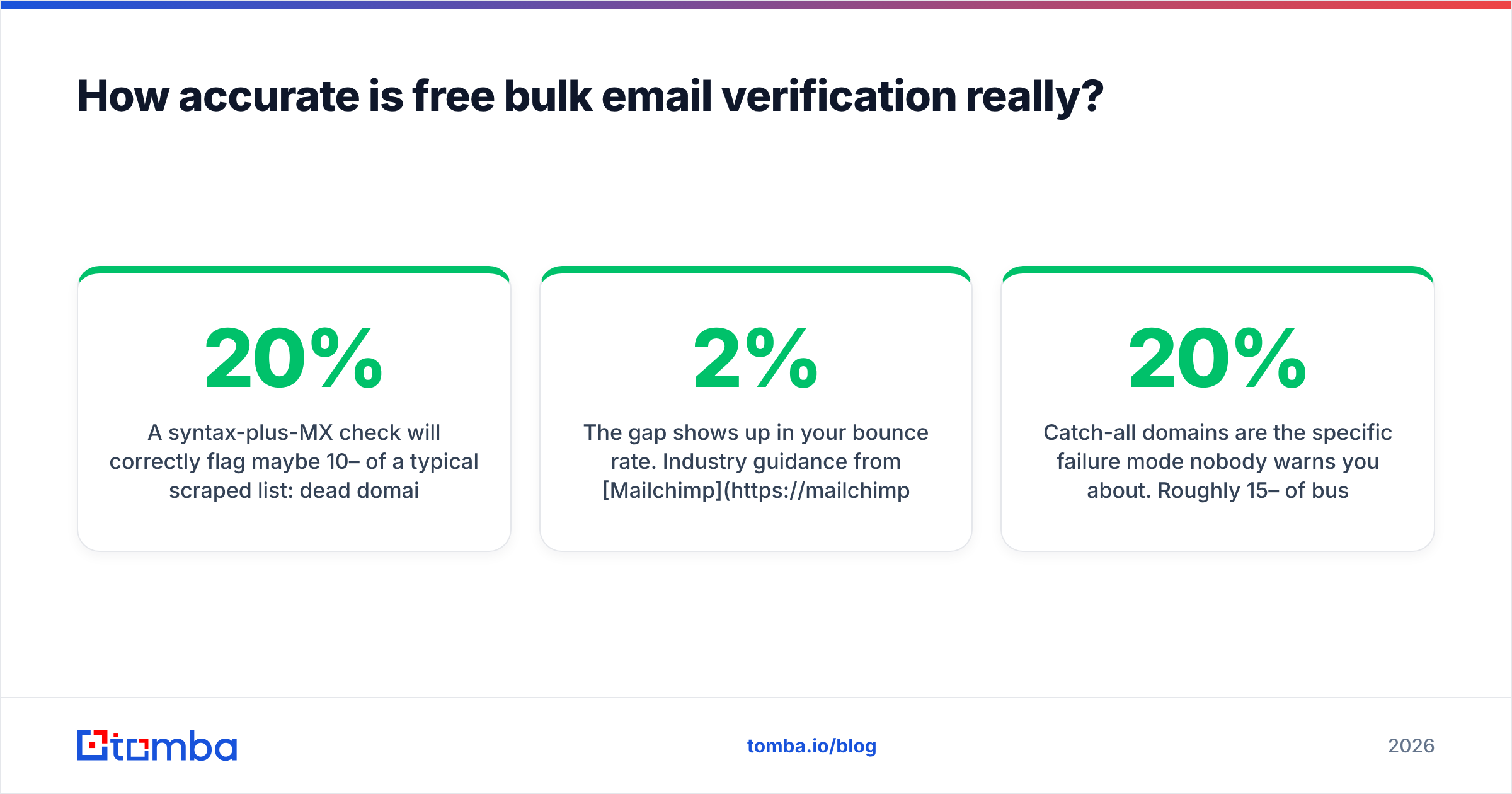
A syntax-plus-MX check will correctly flag maybe 10–20% of a typical scraped list: dead domains, malformed addresses, obvious junk. That's real value. But the remaining 80% comes back marked "valid" when a meaningful slice of it isn't. Employees change jobs. Aliases get retired. Domains migrate to catch-all configurations during an M&A and swallow everything.
The gap shows up in your bounce rate. Industry guidance from Mailchimp and most ESPs puts a healthy hard-bounce rate below 2%. Google and Yahoo's bulk-sender requirements, effective since 2024, put the spam-complaint threshold at 0.3%. A list cleaned by syntax-only checks routinely lands at 5–12% bounces on cold data. That is squarely in "your domain gets throttled" territory.
Catch-all domains are the specific failure mode nobody warns you about. Roughly 15–20% of business domains accept mail at any address. An SMTP check returns "OK" for asdfasdf@thatdomain.com — so a verifier without dedicated catch-all logic either marks the whole domain valid (optimistic, causes bounces) or marks it unknown (safe, but you throw away good leads). Handling this properly requires pattern inference and historical data, which is exactly what a catch-all verifier is built for.

The practical read: treat any free result marked "valid" as "not obviously broken," not as "safe to send." Those are different claims.
Which free bulk email verification tools actually exist in 2026?#
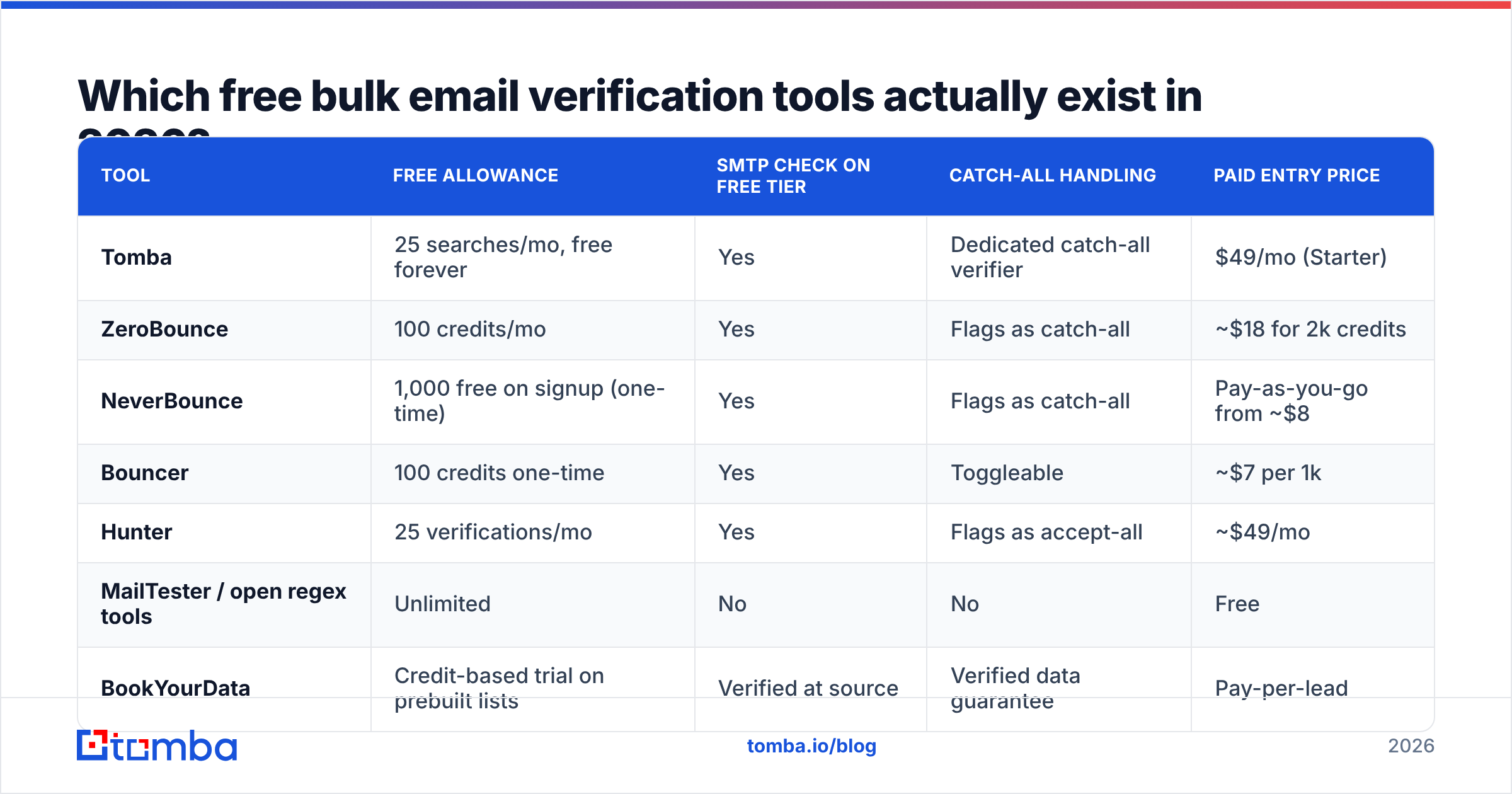
Here's what the commonly cited options give away before asking for a card. Free allowances change; check the vendor page before you plan a campaign around one.
| Tool | Free allowance | SMTP check on free tier | Catch-all handling | Paid entry price |
|---|---|---|---|---|
| Tomba | 25 searches/mo, free forever | Yes | Dedicated catch-all verifier | $49/mo (Starter) |
| ZeroBounce | 100 credits/mo | Yes | Flags as catch-all | ~$18 for 2k credits |
| NeverBounce | 1,000 free on signup (one-time) | Yes | Flags as catch-all | Pay-as-you-go from ~$8 |
| Bouncer | 100 credits one-time | Yes | Toggleable | ~$7 per 1k |
| Hunter | 25 verifications/mo | Yes | Flags as accept-all | ~$49/mo |
| MailTester / open regex tools | Unlimited | No | No | Free |
| BookYourData | Credit-based trial on prebuilt lists | Verified at source | Verified data guarantee | Pay-per-lead |
Two things stand out.
First, "unlimited free" always means no SMTP. The genuinely unlimited tools are doing regex and an MX lookup. Useful for sanity-checking a form field. Useless for protecting a sending domain.
Second, one-time free credits are acquisition, not a plan. NeverBounce's 1,000-credit grant and Bouncer's 100 credits are excellent for a single list cleanup. They are not a repeatable workflow. If you clean lists monthly, you're rotating accounts or paying — and rotating accounts violates most terms of service.
BookYourData takes a different route worth knowing about: instead of verifying a list you already have, you buy addresses that arrive pre-verified with a bounce guarantee. Different problem, different budget, but for teams without a source list it removes the verification step entirely.
Free vs paid: where does the break-even actually sit?#
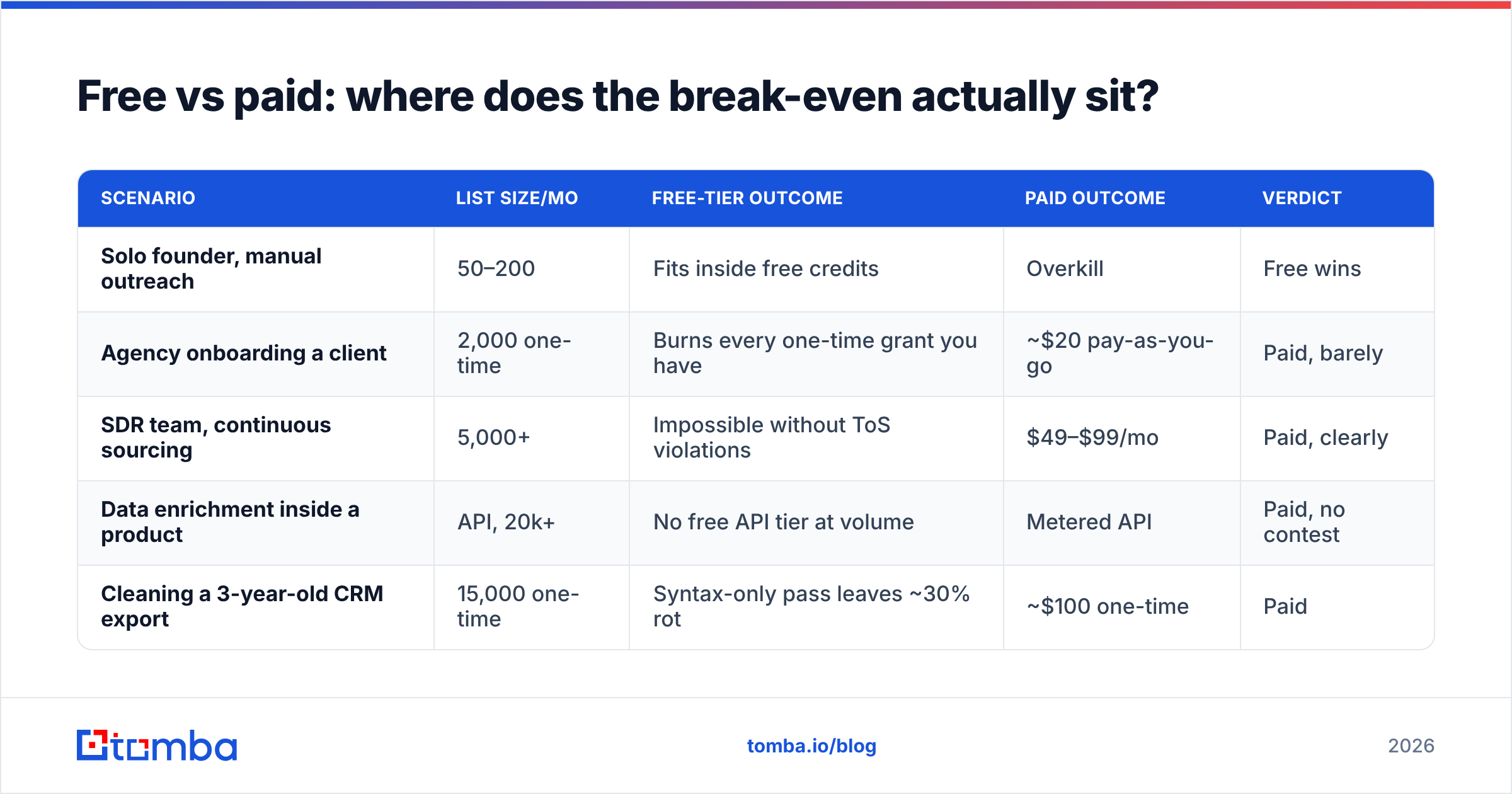
Run the numbers instead of arguing about it.
| Scenario | List size/mo | Free-tier outcome | Paid outcome | Verdict |
|---|---|---|---|---|
| Solo founder, manual outreach | 50–200 | Fits inside free credits | Overkill | Free wins |
| Agency onboarding a client | 2,000 one-time | Burns every one-time grant you have | ~$20 pay-as-you-go | Paid, barely |
| SDR team, continuous sourcing | 5,000+ | Impossible without ToS violations | $49–$99/mo | Paid, clearly |
| Data enrichment inside a product | API, 20k+ | No free API tier at volume | Metered API | Paid, no contest |
| Cleaning a 3-year-old CRM export | 15,000 one-time | Syntax-only pass leaves ~30% rot | ~$100 one-time | Paid |
The break-even is roughly 500 addresses per month. Below that, free tiers plus a manual eyeball pass are fine. Above it, the cost of a single deliverability incident dominates everything.
That cost is the part people underweight. If your primary sending domain gets flagged, you're looking at 3–6 weeks of warmup on a replacement domain, lost pipeline during the gap, and a permanent asterisk on the original. Against that, Tomba pricing at $49/mo for Starter or $99/mo for Growth is insurance, not a line item.
How do you build a workflow that mixes free and paid?#
You don't have to pick one. The efficient pattern is a funnel — cheap checks first, expensive checks only on survivors.
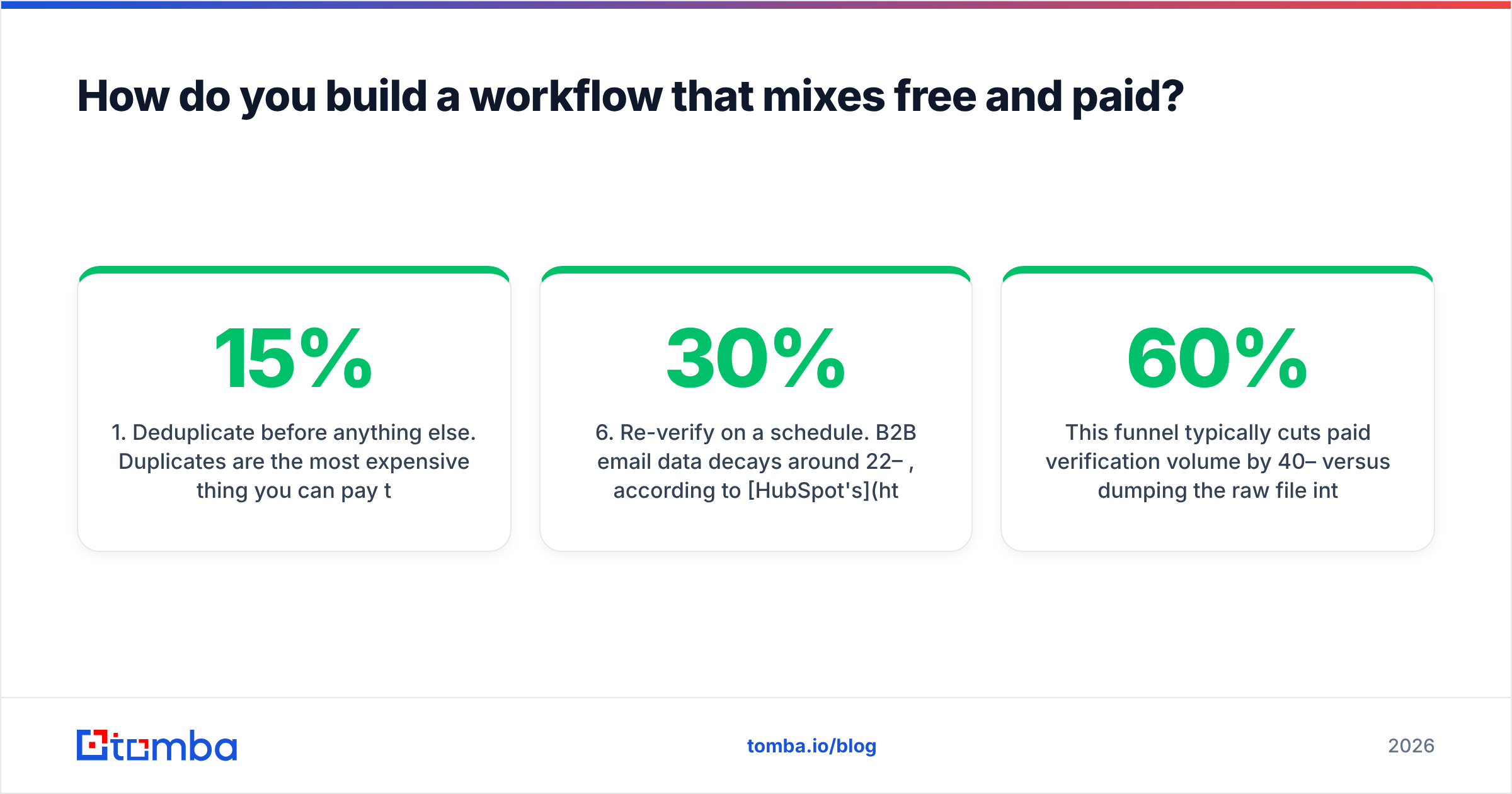
- Deduplicate before anything else. Duplicates are the most expensive thing you can pay to verify twice. Run a remove duplicates pass on the raw file. Free, instant, often trims 8–15% of a scraped list.
- Strip obvious junk with a free syntax pass. Anything with a malformed local part, a dead TLD, or a known disposable domain goes straight out. Use a free email checker for spot checks or any unlimited regex tool for the bulk pass.
- Segment by domain type. Split personal (gmail, outlook) from corporate. Personal domains verify cheaply and reliably. Corporate domains are where catch-all problems live.
- Run SMTP verification only on what's left. This is where your paid credits go. A bulk email finder run against the surviving list gives you real mailbox-level verdicts.
- Handle catch-alls separately, don't discard them. Catch-all domains are usually your best accounts — larger companies configure them more often. Route them through a catch-all finder rather than dumping them.
- Re-verify on a schedule. B2B email data decays around 22–30% per year, according to HubSpot's long-running analysis of contact databases. A list verified in January is meaningfully stale by July.
This funnel typically cuts paid verification volume by 40–60% versus dumping the raw file into a paid tool, which is the actual way to make free tiers earn their keep.
What should you never use a free verifier for?#
Three situations where free is the wrong tool, full stop.
Cold outreach to a new domain. A fresh sending domain has no reputation buffer. Your first 500 sends set the tone. Bouncing 8% of them at that stage is the single fastest way to end up in spam permanently. Verify properly or don't send.
Anything touching a shared ESP. If you're sending through a shared-IP provider, your bounces affect other senders and the provider will suspend you fast. Most ESP terms of service explicitly require list hygiene. "I used a free regex checker" is not a defense.
Lists you bought or scraped. These have the highest decay and the highest proportion of traps. Spam traps — recycled addresses that used to belong to real people — pass every syntax check and most SMTP checks. Only providers with trap databases catch them, and that data is never free.
Related: if your issue is finding addresses rather than validating them, verification isn't your bottleneck. A domain search that returns pattern-matched, pre-scored addresses solves the problem upstream, before you have a dirty list to clean.
What about API-based bulk verification?#
If verification is part of a product — form validation at signup, CRM hygiene on write, enrichment in a data pipeline — free tiers are a non-starter. No provider offers a free API tier that survives production traffic.
What to compare instead:
- Latency per check. Real-time signup validation needs sub-500ms. Batch CRM cleanup doesn't care.
- Batch vs single endpoints. Batch is cheaper per address and usually async with a webhook callback.
- Rate limits on the entry plan. Some vendors gate concurrency hard on lower tiers, which turns a 50k-row job into an overnight run.
- Unknown-result billing. Do you pay for addresses that come back "unknown"? Policies differ, and on catch-all-heavy lists this swings the real cost by 20%+.
The email verification API sits in the same credit pool as the finder endpoints, which matters if you're doing find-then-verify in one pipeline rather than paying two vendors.
Which free option should you start with?#
Match the tool to the job:
- Under 25 addresses, occasional — any free checker, including unlimited regex tools. The stakes are low enough that manual review covers the gap.
- 25–500/month, ongoing — a real free tier with SMTP included. Tomba's free plan at 25 searches/mo, ZeroBounce's 100 credits, or Hunter's 25 verifications all qualify.
- One-time cleanup of 1,000–2,000 — NeverBounce's signup grant handles this in a single run. Use it deliberately; you get it once.
- Recurring 500+/month — stop shopping free tiers. The account-rotation workaround costs more in time than the subscription costs in money, and it breaks terms of service.
- Production API — go straight to metered pricing and compare unknown-result billing carefully.
One more honest caveat: verification confirms a mailbox accepts mail. It does not confirm the person still works there, wants to hear from you, or that the address is the right one for your message. That's a data-quality problem, solved by contact enrichment and good sourcing, not by a verifier.
Ready to clean your list properly?#
Start with the free tier and see what your list actually looks like — 25 searches a month is enough to sample a few hundred rows and measure your real invalid rate before committing to anything. If the sample comes back clean, keep using free tools. If it doesn't, you now have a number to justify the upgrade.
For teams that need both sides of the problem solved — finding the addresses and confirming they're real — the Tomba Email Finder runs discovery and verification in one pass, with catch-all handling built in rather than bolted on. Starter is $49/mo, Growth is $99/mo, and the free plan doesn't expire. Test it against your worst list first; that's the only benchmark that tells you anything.
Related guides#
Ready to find emails that actually work?
Join 150,000+ professionals who stopped guessing and started sending. Free credits on signup — no credit card required.
Get the Tomba newsletter
Practical outbound tactics and product updates — once every two weeks.
About the author