Free Email List Cleaner: How to Clean Lists Without Paying
Free email list cleaners can strip 60-80% of the junk from a cold list before you pay for anything. Here's exactly how far the free tools go, where they quietly fail, and when the paid step is unavoidable.
TL;DR
- A free email list cleaner will reliably remove duplicates, malformed syntax, disposable domains, and dead MX records — that's usually 60–80% of the junk in a scraped list.
- What free tiers almost never do well: SMTP-level mailbox checks at volume, catch-all domain resolution, and role-account risk scoring.
- Browser-based "100% free, unlimited" cleaners are the ones to avoid — you're paying with your list. Prefer free tiers of real vendors over anonymous web forms.
- Realistic workflow: dedupe and syntax-clean locally for free → run free-tier verification on the survivors → pay only for the ambiguous remainder.
- Budget rule of thumb: cleaning 10,000 contacts costs $0 for the first pass and roughly $20–$70 for the paid second pass across most vendors.
What Does a Free Email List Cleaner Actually Do?#
Think of list cleaning like sorting recycling. The first pass is free and mechanical — anyone can pull out the cardboard, the obvious trash, the duplicates in the bin. The second pass needs a machine that can tell glass from ceramic, and that machine costs money.
Email list cleaning works in exactly those layers. Here's what happens at each one:
- Syntax validation — Does
john@@acme..comparse as a valid address under RFC 5322? Pure string logic, zero network calls, free everywhere including a regex you write yourself. - Duplicate and normalization removal — Stripping
John.Smith+news@acme.comdown to its canonical form and killing repeats. Free in Excel, Sheets, or any remove duplicates tool. - Domain and MX record checks — Does
acme.comexist and does it publish mail exchanger records? A DNS lookup. Cheap, fast, and offered free by nearly every vendor. - Disposable and role detection — Flagging
mailinator.comthrowaways andinfo@,sales@,support@role accounts. Rule-based, usually free. - SMTP mailbox verification — Opening a connection to the receiving server and asking whether that specific mailbox exists. This is where cost enters, because it needs IP reputation, rate limiting, and retry infrastructure.
- Catch-all resolution — Determining whether a domain accepts everything (so SMTP tells you nothing) and then inferring deliverability another way. The hardest layer, and effectively never free.
Layers 1–4 are commodity. Any free tool does them competently. Layers 5–6 are where lists actually get saved or destroyed, and that's the honest dividing line between free and paid.

Why Does List Cleaning Matter More in 2026 Than It Did in 2022?#
Because the mailbox providers changed the rules and never changed them back.
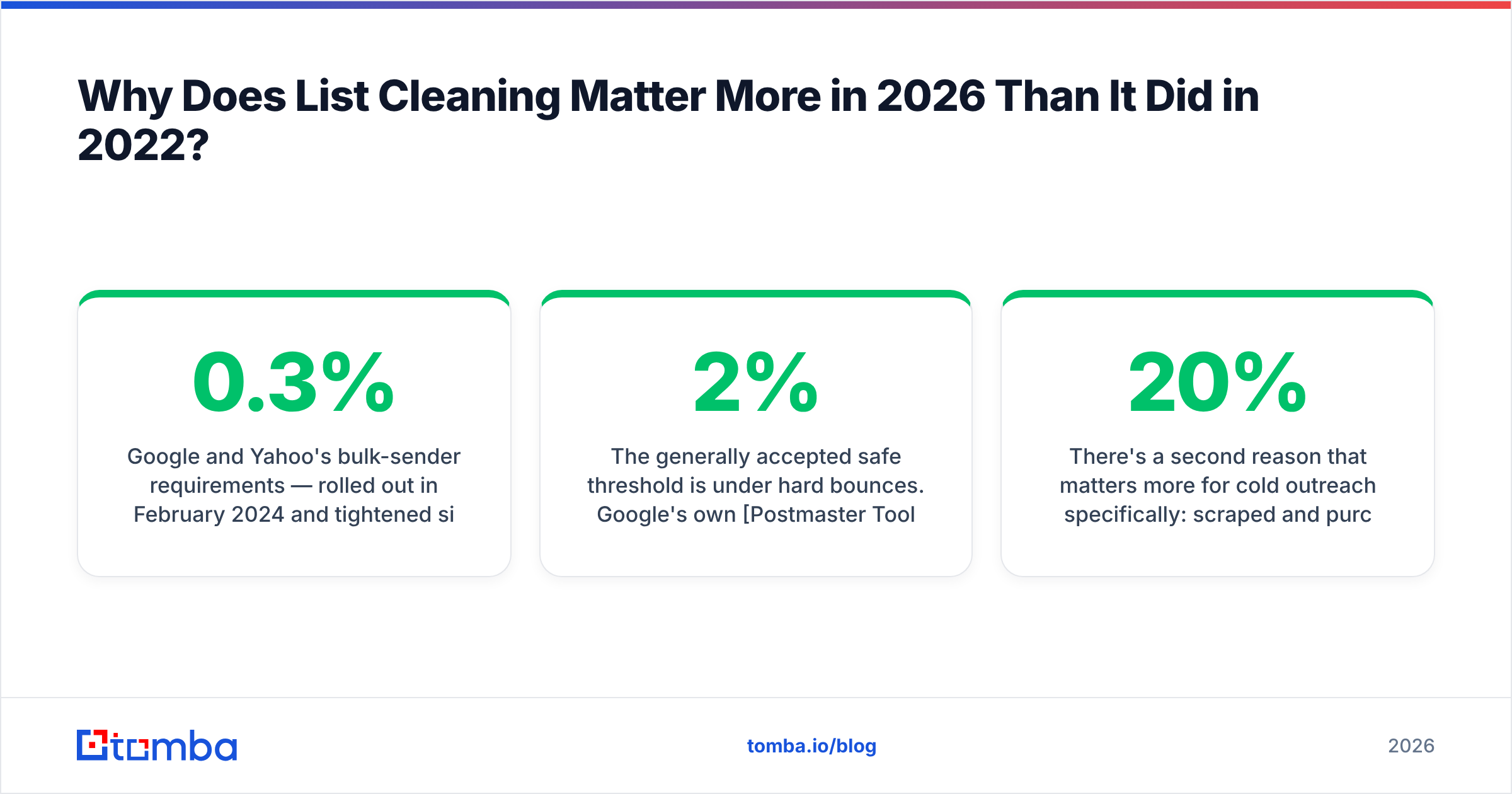
Google and Yahoo's bulk-sender requirements — rolled out in February 2024 and tightened since — put a hard spam-complaint ceiling of 0.3% on senders pushing 5,000+ messages a day to their users. Microsoft followed with its own enforcement for Outlook.com in 2025. The practical effect: bounce rate is no longer a vanity metric. A list with 12% invalid addresses will get your sending domain throttled long before your copy has a chance to underperform.
The generally accepted safe threshold is under 2% hard bounces. Google's own Postmaster Tools documentation spells out the reputation signals, and none of them forgive a dirty list.
There's a second reason that matters more for cold outreach specifically: scraped and purchased lists have gotten dirtier. B2B job-change rates have hovered near 20% annually, meaning a list built 18 months ago is roughly a third decayed even if it was perfect on day one. Cleaning isn't a one-time chore — it's maintenance.
How Do Free Tiers Compare Across the Main Tools?#
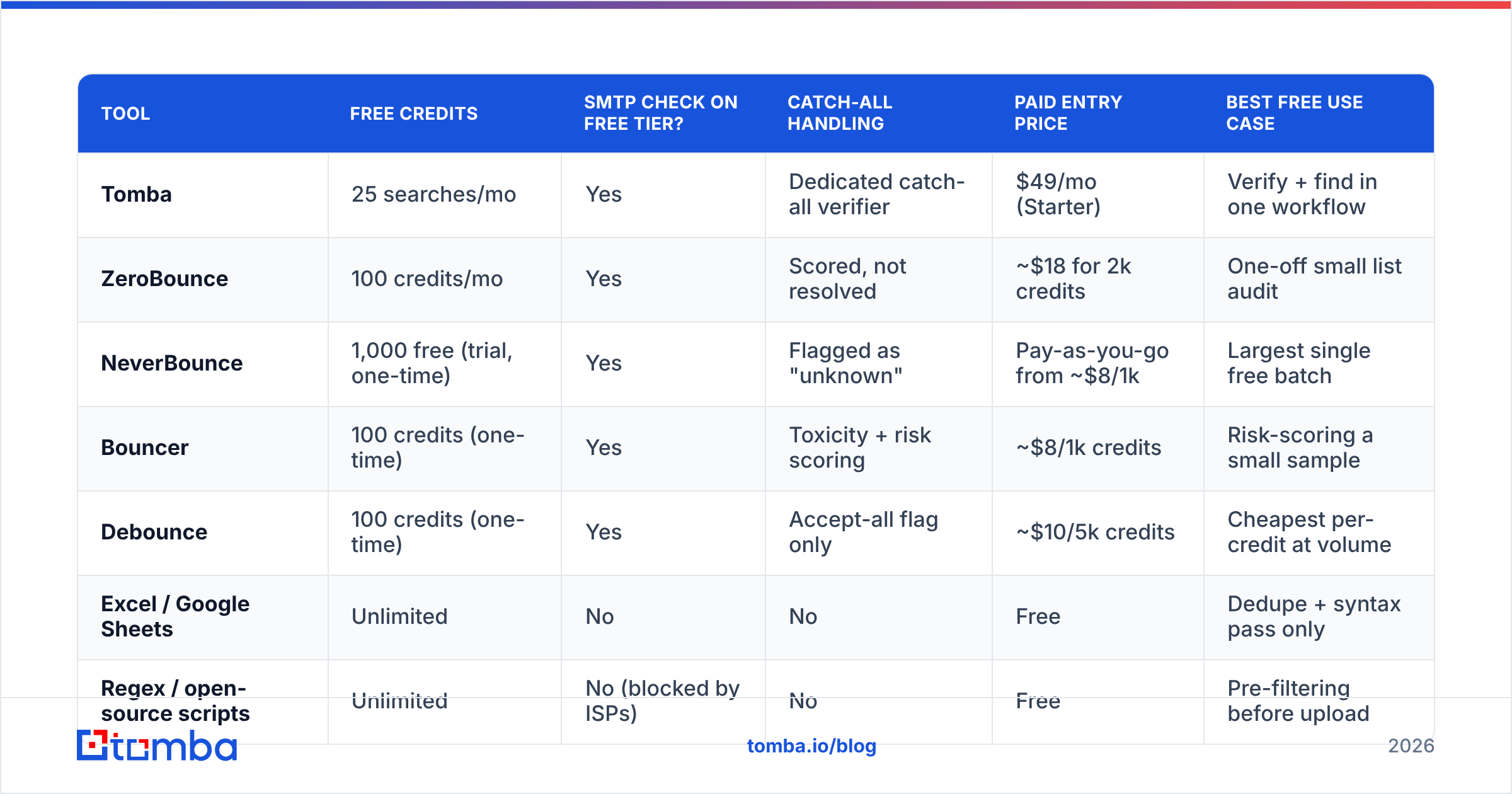
Here's what the free offerings actually give you. Credit counts are per month unless noted, and all reflect publicly listed free tiers as of early 2026.
| Tool | Free credits | SMTP check on free tier? | Catch-all handling | Paid entry price | Best free use case |
|---|---|---|---|---|---|
| Tomba | 25 searches/mo | Yes | Dedicated catch-all verifier | $49/mo (Starter) | Verify + find in one workflow |
| ZeroBounce | 100 credits/mo | Yes | Scored, not resolved | ~$18 for 2k credits | One-off small list audit |
| NeverBounce | 1,000 free (trial, one-time) | Yes | Flagged as "unknown" | Pay-as-you-go from ~$8/1k | Largest single free batch |
| Bouncer | 100 credits (one-time) | Yes | Toxicity + risk scoring | ~$8/1k credits | Risk-scoring a small sample |
| Debounce | 100 credits (one-time) | Yes | Accept-all flag only | ~$10/5k credits | Cheapest per-credit at volume |
| Excel / Google Sheets | Unlimited | No | No | Free | Dedupe + syntax pass only |
| Regex / open-source scripts | Unlimited | No (blocked by ISPs) | No | Free | Pre-filtering before upload |
Two things jump out of that table.
First, "free" almost always means a one-time trial, not a recurring allowance. NeverBounce's 1,000 free verifications are the biggest single grant, but you get them once. Tomba's 25 monthly searches and ZeroBounce's 100 monthly credits renew — which matters if your cleaning need is ongoing rather than a single migration.
Second, catch-all is the differentiator. Most vendors will happily return "unknown" or "accept-all" and charge you nothing further. That's not a bug — it genuinely is ambiguous at the SMTP layer. But it means 15–30% of a typical B2B list lands in a bucket the free tier can't resolve, and enterprise domains are disproportionately represented in that bucket. If your ICP is companies over 500 employees, expect a bigger unknown pile.
Is a "100% Free Unlimited" Web Cleaner Safe to Use?#
Usually not, and the reason is structural rather than malicious.
Real SMTP verification costs money to run. You need clean sending IPs, rotation infrastructure, rate-limit backoff logic, and a legal team. A site offering unlimited verification with no account and no cap is monetizing somewhere else. The three common models:
- Data harvesting. Your uploaded list becomes part of their database and gets resold. Read the terms — many say this outright in the data-processing clause.
- Fake results. The tool runs syntax + MX only and labels everything else "valid." You feel great and bounce at 14%.
- Lead-gen funnel. It's genuinely a limited free tier with an aggressive upsell wall at 50 rows. Harmless, just mislabeled.
The GDPR angle is worth a beat if you have EU contacts. Uploading a list of identifiable personal data to a processor with no DPA, no named data controller, and no stated retention period is a straightforward compliance problem — one that has nothing to do with whether the tool works. The ICO's guidance on processors is clear that you remain the controller and stay liable for where that data lands.
Rule of thumb: prefer the free tier of a company that sells verification over a free tool from a company that sells nothing. The first one has a business model that depends on being accurate. The second one has a business model you can't see.
What's the Actual Free-First Cleaning Workflow?#
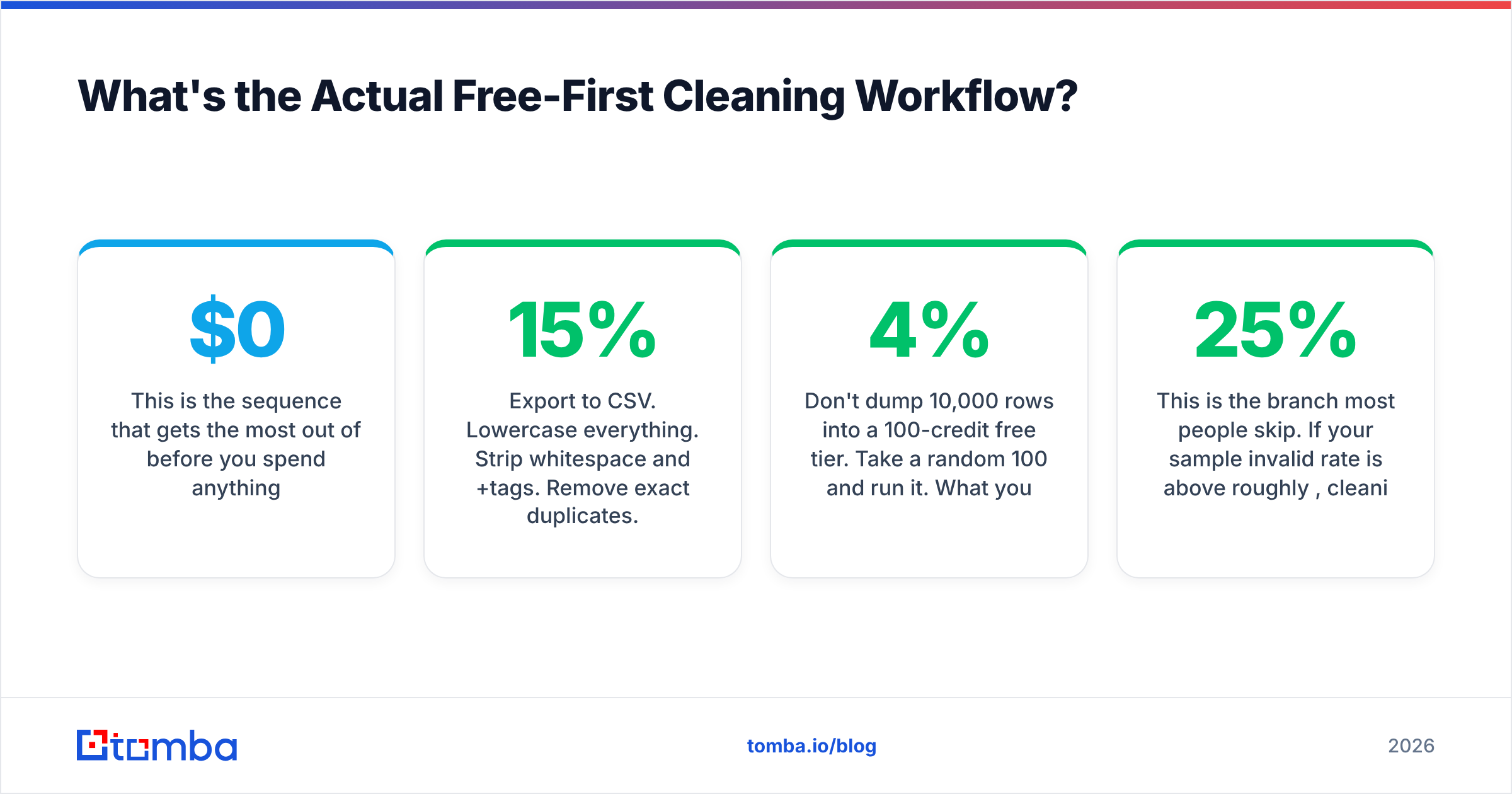
This is the sequence that gets the most out of $0 before you spend anything.
Step 1 — Normalize and dedupe locally (free, 10 minutes).
Export to CSV. Lowercase everything. Strip whitespace and +tags. Remove exact duplicates. In Google Sheets: =UNIQUE(LOWER(TRIM(A:A))). On a scraped list this alone typically removes 8–15% of rows. You've now stopped paying to verify the same address four times.
Step 2 — Kill the obvious junk with pattern rules (free, 10 minutes).
Filter out anything matching disposable domain lists (the community-maintained lists on GitHub are decent), anything with no @, anything with a TLD that doesn't exist. Decide your policy on role accounts here — info@ and support@ are technically valid and technically deliverable, but they convert terribly for cold outreach and complain more. For most cold campaigns, cut them. For customer-success re-engagement, keep them.
Step 3 — Free-tier verify a representative sample (free, 20 minutes). Don't dump 10,000 rows into a 100-credit free tier. Take a random 100 and run it. What you're measuring is the invalid rate, not cleaning the list. If the sample comes back 4% invalid, the paid pass is a cheap formality. If it comes back 31% invalid, your source is broken and you should fix acquisition before spending a cent on verification.
Step 4 — Decide: clean or rebuild. This is the branch most people skip. If your sample invalid rate is above roughly 25%, cleaning is throwing good money after bad — you're paying to confirm that a bad list is bad. Rebuilding from a verified source is usually cheaper. A domain search against your target accounts returns addresses that were verified at retrieval time, which sidesteps the whole problem.
Step 5 — Pay for the remainder (the only paid step). Whatever survives steps 1–3 goes through full verification. At 10,000 surviving rows you're looking at roughly $20–$70 depending on vendor and commitment. Compare that to the cost of a burned sending domain and it's not a close call.
How Do You Handle Catch-All Domains Without Paying for Guesswork?#
Catch-all is the single most misunderstood category in list hygiene, so it's worth being precise.
A catch-all (or "accept-all") domain is configured to accept mail for any address at that domain, valid or not. definitely-not-real-person@acme.com gets a 250 OK just like ceo@acme.com. SMTP verification returns "yes" for both, which means SMTP verification returns nothing useful.
Estimates of catch-all prevalence in B2B lists vary widely, but 15–25% is the range most vendors report, skewing higher among larger enterprises and companies using certain security gateways. So this isn't an edge case — it's a fifth of your list.
Free tools handle this three ways, in ascending order of honesty:
- Mark it valid. Wrong and dangerous. Inflates your "clean" count and produces bounces later.
- Mark it unknown and stop. Honest, and what most free tiers do. You now have a pile you have to decide about.
- Score it against pattern and historical data. Requires a dataset of known-good addresses at that domain to infer whether the pattern matches. This is genuinely hard and effectively never free.
Practical approach without paying: check whether the address matches the company's dominant email pattern. If 40 known contacts at acme.com are first.last@, then j.smith@acme.com is suspect and john.smith@acme.com is probably real. A company email pattern lookup gets you the dominant format for free, and you can filter your catch-all bucket against it manually. It's not verification, but it's a meaningful signal and it costs nothing.
For lists where the catch-all bucket is large enough to matter commercially, a dedicated catch-all verifier resolves it properly. Whether that's worth paying for is a volume question: at 200 catch-all addresses, filter manually; at 4,000, pay.
What Are the Real Trade-Offs Between Free and Paid Cleaning?#
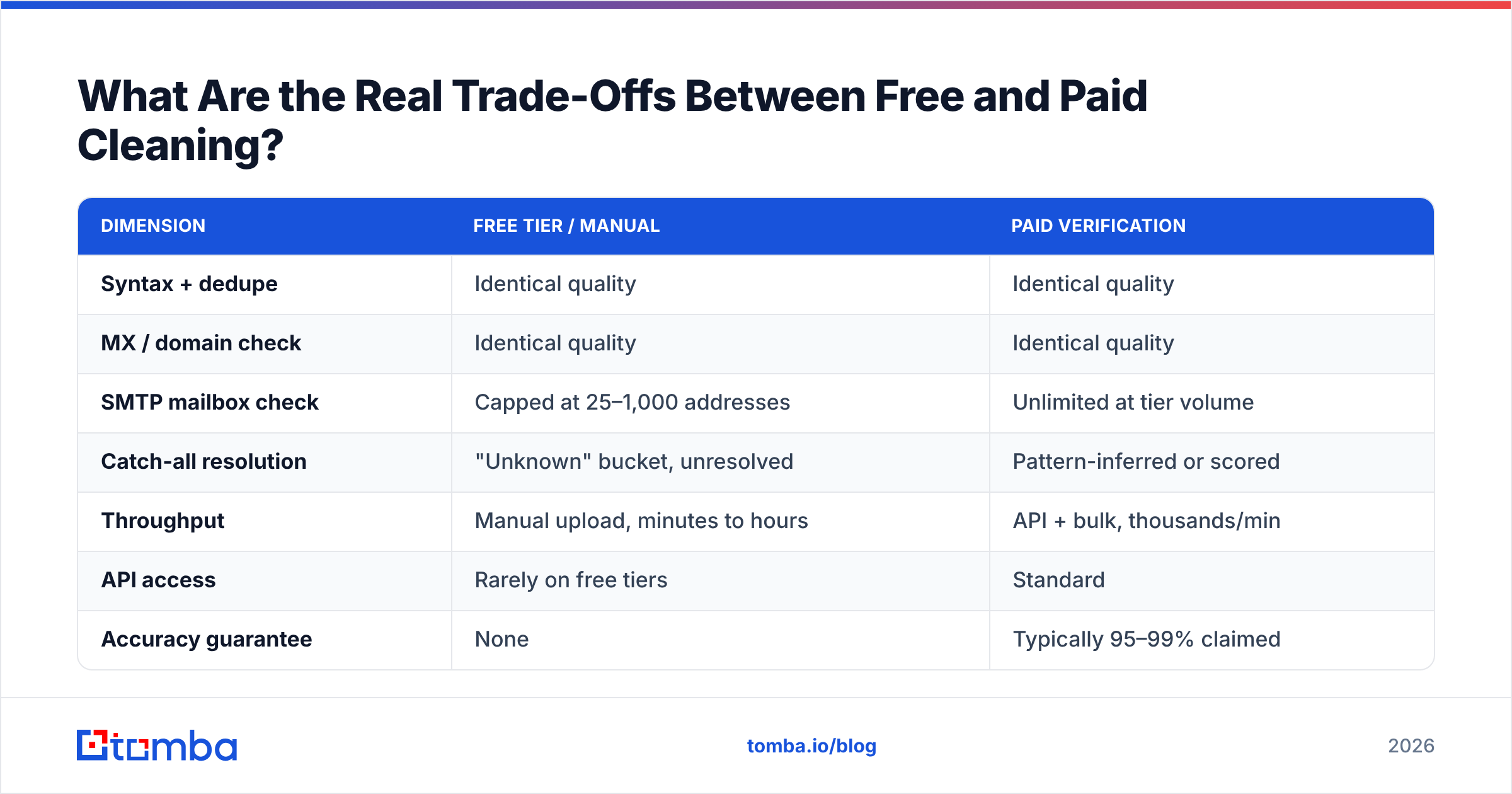
| Dimension | Free tier / manual | Paid verification |
|---|---|---|
| Syntax + dedupe | Identical quality | Identical quality |
| MX / domain check | Identical quality | Identical quality |
| SMTP mailbox check | Capped at 25–1,000 addresses | Unlimited at tier volume |
| Catch-all resolution | "Unknown" bucket, unresolved | Pattern-inferred or scored |
| Throughput | Manual upload, minutes to hours | API + bulk, thousands/min |
| API access | Rarely on free tiers | Standard |
| Accuracy guarantee | None | Typically 95–99% claimed |
| Cost at 10k contacts | $0 (partial coverage) | ~$20–$70 (full coverage) |
| Data-handling risk | High on anonymous tools | Contractual (DPA available) |
The row that decides it for most teams is throughput. Free-tier cleaning is completely viable at 500 contacts and completely impractical at 50,000 — not because the free tools are worse per-address, but because you'll spend more in labor stitching together five free tiers than the paid pass would have cost.
If you're running ongoing outbound rather than a one-time cleanup, the arithmetic shifts further. Verification at the point of acquisition is cheaper than verification as remediation, because you never build the dirty list in the first place. That's the argument for pairing an email verifier with your sourcing step rather than treating cleaning as a separate quarterly chore.
Which Free Option Should You Pick for Your Situation?#
- Under 500 contacts, one time. Sheets dedupe + any vendor's free tier. You will genuinely not need to pay. NeverBounce's one-time 1,000 free verifications cover this outright.
- 1,000–10,000 contacts, one time. Free-tier sample first to measure invalid rate, then a single pay-as-you-go batch. Debounce and NeverBounce price well for one-offs; no subscription needed.
- Ongoing outbound, any volume. Subscription with API access, and move verification upstream into sourcing. Tomba pricing starts at $49/mo on Starter with the verifier, domain search, and enrichment included, which usually beats stacking a separate finder and a separate verifier.
- Enterprise-heavy ICP with lots of catch-alls. Prioritize catch-all handling over raw credit count. The vendor with 10,000 credits and no catch-all resolution is worse for you than one with 2,000 credits that resolves them.
- EU contacts in the list. Skip anonymous web cleaners entirely. Pick a vendor that will sign a DPA, full stop.
- You inherited a list of unknown origin. Sample it before you clean it. If it comes back above 25% invalid, the right answer is usually to rebuild rather than remediate — and to find out where it came from.
One honest caveat on peer tools: if your problem is that you don't have a list rather than that your list is dirty, verification isn't the fix. Vendors like BookYourData sell pre-verified B2B contacts with bounce guarantees, which is a different product solving a different problem — you're buying coverage, not hygiene. Cleaning tools and data providers get compared constantly and shouldn't be; check which problem you actually have first.
What Should You Do Next?#
Start with the free pass, because it's genuinely free and it tells you whether you have a cleaning problem or a sourcing problem. Dedupe, normalize, strip disposables, then sample 100 addresses through a real vendor's free tier and read the invalid rate.
If that number is low, finish with a cheap paid batch and get back to sending. If it's high, stop cleaning and fix where the addresses come from.
For the second case — and it's more common than most teams expect — Tomba's Email Finder builds the list verified from the start: search by domain, name, or company, get addresses that were validated at retrieval rather than months later. The free tier gives you 25 searches a month to test whether sourcing clean beats cleaning dirty on your own accounts. For most B2B teams running cold outbound, it does.
Related guides#
Ready to find emails that actually work?
Join 150,000+ professionals who stopped guessing and started sending. Free credits on signup — no credit card required.
Get the Tomba newsletter
Practical outbound tactics and product updates — once every two weeks.
About the author