Free Email Prospecting Tools in 2026: What Actually Works
Free plans on email finders are real, but they are not equal. Here is what 12 popular tools actually give away in 2026 — credits, limits, verification quality — and when free stops paying off.
TL;DR
- Free email prospecting tools are real, but "free credits" means five different things across vendors: searches, lookups, exports, verifications, or API calls. Compare the unit, not the number.
- The honest free ceiling in 2026 is roughly 25–100 contacts per month per tool. Past that you are either paying, stacking accounts, or shipping unverified data into your sequences.
- A free plan that returns guessed patterns without verification is more expensive than a paid plan — one 12% bounce rate can cost you a sending domain.
- Stacking 2–3 free tiers (one finder, one verifier, one enrichment source) covers a solo founder doing 40–60 outbound touches a month. It does not cover a two-person SDR team.
- The switch point is mechanical: when your time spent hunting emails costs more than $49/month, free has stopped being free.
What Counts as a Free Email Prospecting Tool?#
A free email prospecting tool is any product that lets you find, verify, or enrich business contact data without entering a credit card. Three categories exist, and vendors deliberately blur them.
- Perpetual free tiers — a monthly credit reset that never expires. Tomba's 25 searches/month, Hunter's 25 monthly searches, Snov.io's small starter allowance. These are real and renewable.
- One-time trial credits — 50 or 100 credits granted once at signup, then a paywall. Apollo, RocketReach, and most enrichment platforms lean here. Useful for evaluation, useless for a workflow.
- Free utilities — pattern generators, permutators, syntax checkers, extractors. No database behind them. They guess, they do not know. A free email permutator is genuinely useful as a step in a process, but it is not a prospecting tool on its own.
The category confusion is where money leaks. You sign up for what looks like a renewable 100-credit plan, burn it in week one, and discover it was a trial. Then you either pay under pressure or start a second account with a different email address — which most vendors' terms of service prohibit and their fingerprinting catches.

How Do Free Credit Limits Actually Compare in 2026?#
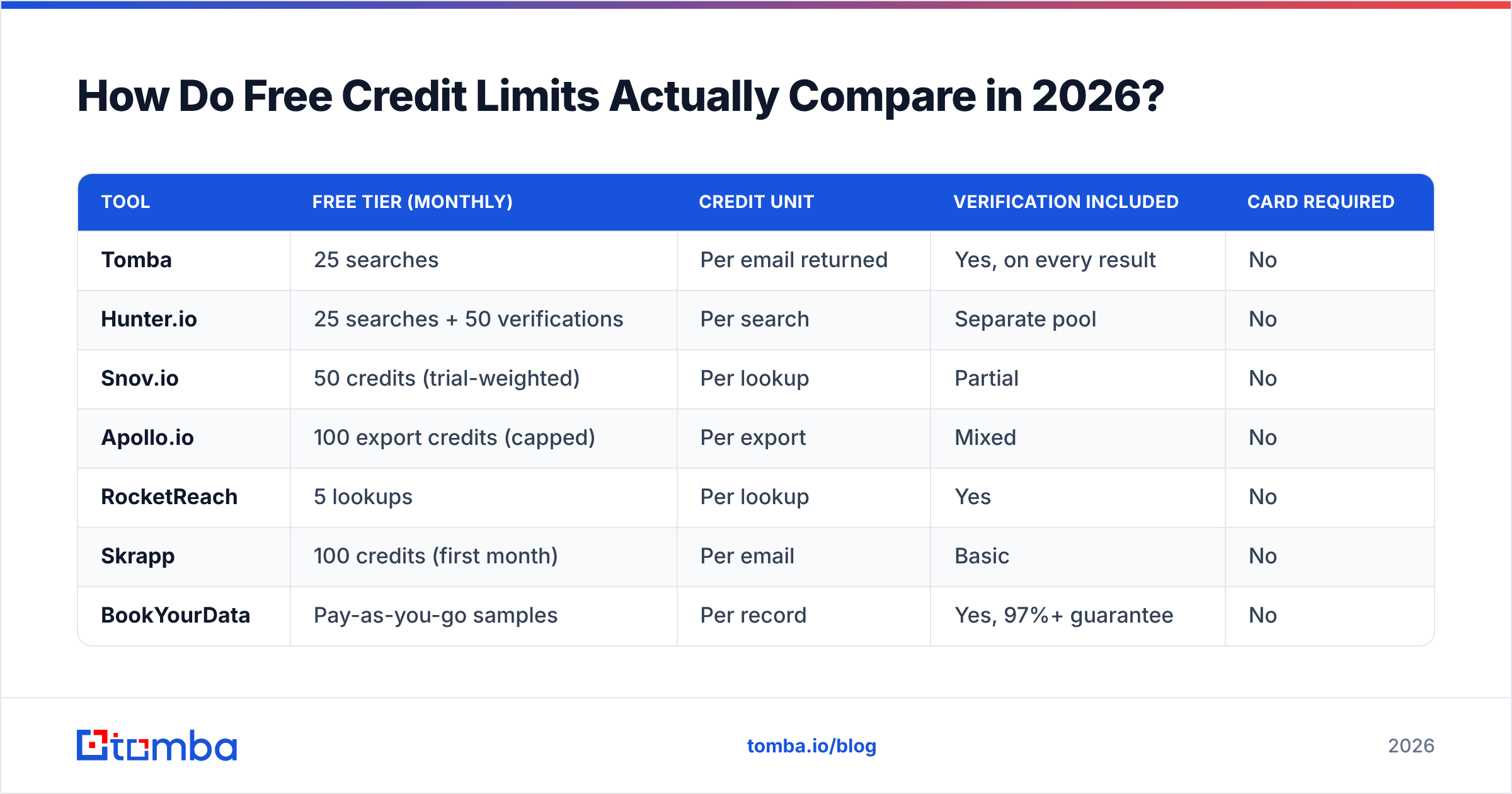
Here is the part vendors bury in footnotes: the unit of a credit. One tool's "credit" is one email returned. Another's is one API call whether or not it found anything. A third charges a credit per verification on top of the search.
| Tool | Free tier (monthly) | Credit unit | Verification included | Card required |
|---|---|---|---|---|
| Tomba | 25 searches | Per email returned | Yes, on every result | No |
| Hunter.io | 25 searches + 50 verifications | Per search | Separate pool | No |
| Snov.io | 50 credits (trial-weighted) | Per lookup | Partial | No |
| Apollo.io | 100 export credits (capped) | Per export | Mixed | No |
| RocketReach | 5 lookups | Per lookup | Yes | No |
| Skrapp | 100 credits (first month) | Per email | Basic | No |
| BookYourData | Pay-as-you-go samples | Per record | Yes, 97%+ guarantee | No |
| Findymail | Trial only | Per verified email | Yes | Yes |
Two things jump out. First, "100 credits" from a tool that charges per attempt is worth less than "25 searches" from a tool that only charges when it returns a deliverable address. Second, only a minority bundle verification. If verification is a separate pool, your effective free tier is the smaller of the two numbers, not the bigger one.
BookYourData is worth a separate mention because it plays a different game: instead of a monthly credit drip it sells verified records on a pay-as-you-go basis with an accuracy guarantee, which suits buyers who want a clean list once rather than a tool they open daily. Different shape, legitimately useful for list-building projects.

Why Does Accuracy Matter More Than Credit Count?#
Because a bounced email is not a neutral event. It is a negative signal to the receiving mailbox provider, and enough of them degrade your sender reputation to the point where your good emails stop landing.
Run the arithmetic. You find 100 addresses on a free tool with no verification layer. Pattern-guessing typically lands somewhere in the 55–70% correct range depending on company size and industry — smaller companies are far less predictable than the firstname.lastname enterprises. Send to all 100 and you eat roughly 30–45 bounces. Google and Microsoft both treat sustained bounce rates above 2–3% as a spam signal, and Google's bulk sender guidelines are explicit that senders must keep complaint and bounce rates low.
So the free 100 credits produced maybe 60 usable contacts and one damaged domain. The 25 verified credits produced 25 usable contacts and zero damage. The second option is worth more even though the number is smaller.
This is why the verification question is the first thing to ask about any free plan. If the tool returns a confidence score, a status (valid / risky / catch-all / invalid), and an SMTP-level check, the credits are real. If it returns an address with no status attached, you are getting a guess dressed as data. Run anything from a low-confidence source through a dedicated email verifier before it touches a sequence.
Catch-all domains are the specific trap. A catch-all server accepts every address at the domain, so a naive verifier marks everything "valid" and you find out the truth only when your reply rate is zero. Tools with a dedicated catch-all verifier resolve a meaningful share of those, which matters because catch-all configurations are common across mid-market SaaS.
How Do You Stack Free Tiers Into a Working Workflow?#
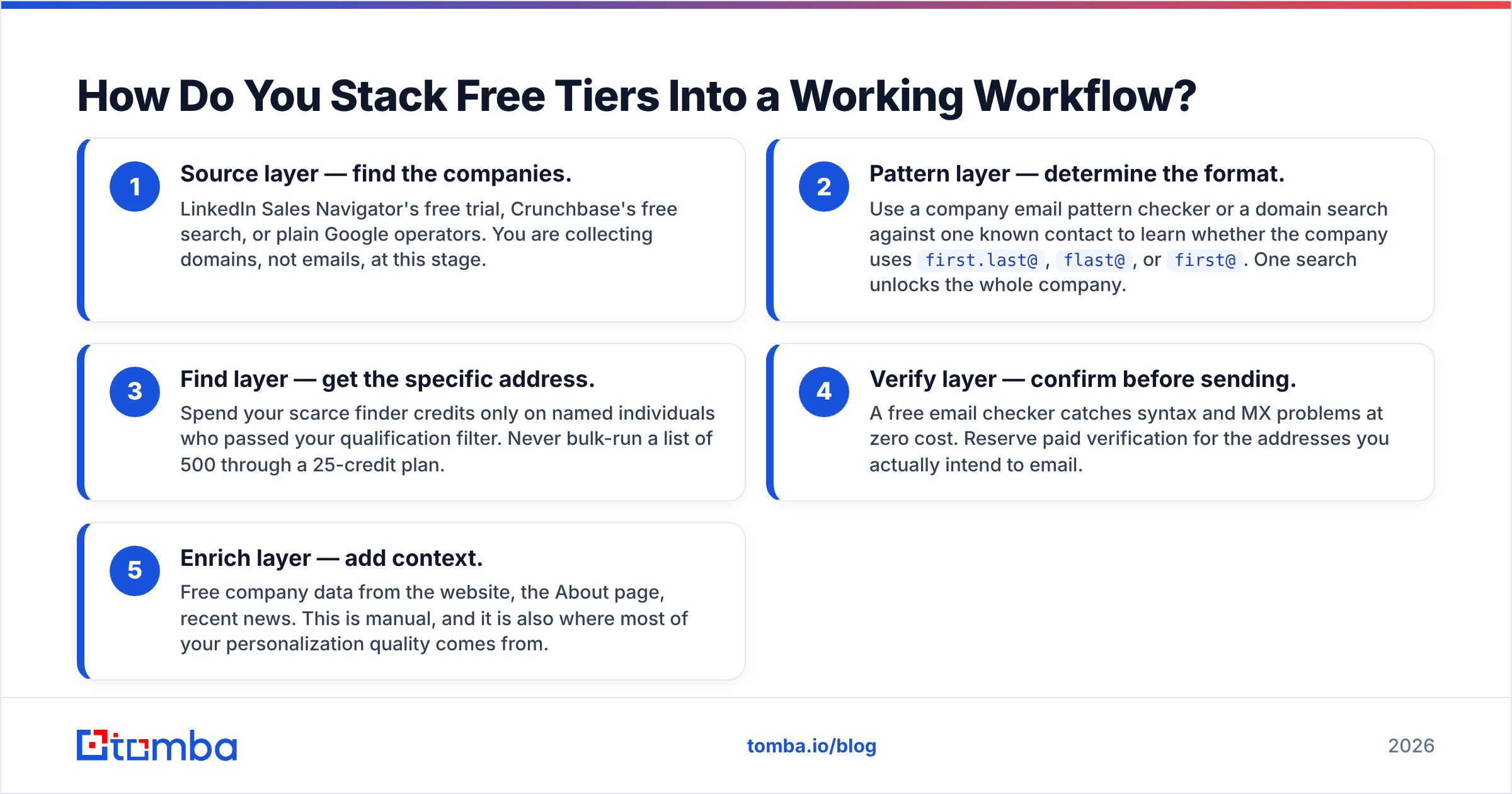
You can build a functional prospecting stack out of free tiers if you accept the volume ceiling. Here is the layered approach that holds up.
- Source layer — find the companies. LinkedIn Sales Navigator's free trial, Crunchbase's free search, or plain Google operators. You are collecting domains, not emails, at this stage.
- Pattern layer — determine the format. Use a company email pattern checker or a domain search against one known contact to learn whether the company uses
first.last@,flast@, orfirst@. One search unlocks the whole company. - Find layer — get the specific address. Spend your scarce finder credits only on named individuals who passed your qualification filter. Never bulk-run a list of 500 through a 25-credit plan.
- Verify layer — confirm before sending. A free email checker catches syntax and MX problems at zero cost. Reserve paid verification for the addresses you actually intend to email.
- Enrich layer — add context. Free company data from the website, the About page, recent news. This is manual, and it is also where most of your personalization quality comes from.
Step 2 is the leverage point almost everyone skips. Learning a company's pattern once and then applying it to twenty contacts turns one credit into twenty addresses — the catch being that you must verify each one, since patterns break for hires with duplicate names, acquired-company holdovers, and anyone whose alias predates the current convention.

What Are the Real Limits of Free Plans?#
Beyond the credit count, five constraints bite in practice.
- No bulk processing. Free tiers are almost universally one-at-a-time. Uploading a CSV of 200 prospects requires a paid bulk email finder, and doing it manually costs you hours you priced at zero.
- No API access. Or a token-limited demo key. If you want emails flowing into your CRM automatically, free stops immediately. That is the intended conversion trigger for most vendors.
- Rate limits and cooldowns. Some free plans throttle to a handful of requests per minute, which turns a 25-credit budget into a 25-minute session.
- No export. You can see the email in the UI but cannot download it. Apollo's free tier is the well-known example of export caps that surprise people mid-workflow.
- Weaker data freshness. Paid tiers often get re-verified data; free tiers sometimes serve from a staler cache. Ask the vendor about their data sources and refresh cadence — reputable ones publish it.
None of these are scandals. They are rational product design: the free tier proves the data quality, the paid tier removes the friction. The mistake is planning a quarter of outbound around a tier engineered to be inconvenient at volume.
When Should You Stop Using Free Tools?#
Three signals, any one of which means the math has flipped.
Signal one: your time cost exceeds the subscription. If you spend 90 minutes a month juggling three free accounts and your loaded hourly cost is $50, you are burning $75 to avoid a $49 bill. G2 reviews across the sales intelligence category repeatedly surface the same complaint — the workflow tax, not the price, is what pushes teams to upgrade.
Signal two: you need more than 50 contacts a month. Below that, stacking works. Above it, you spend more effort on credit management than on writing the actual emails, and email quality is what determines your response rate anyway.
Signal three: someone else has to run the process. Free tiers are single-seat and unshareable. The moment a second person needs the same data, account-sharing becomes a terms violation and a security problem.
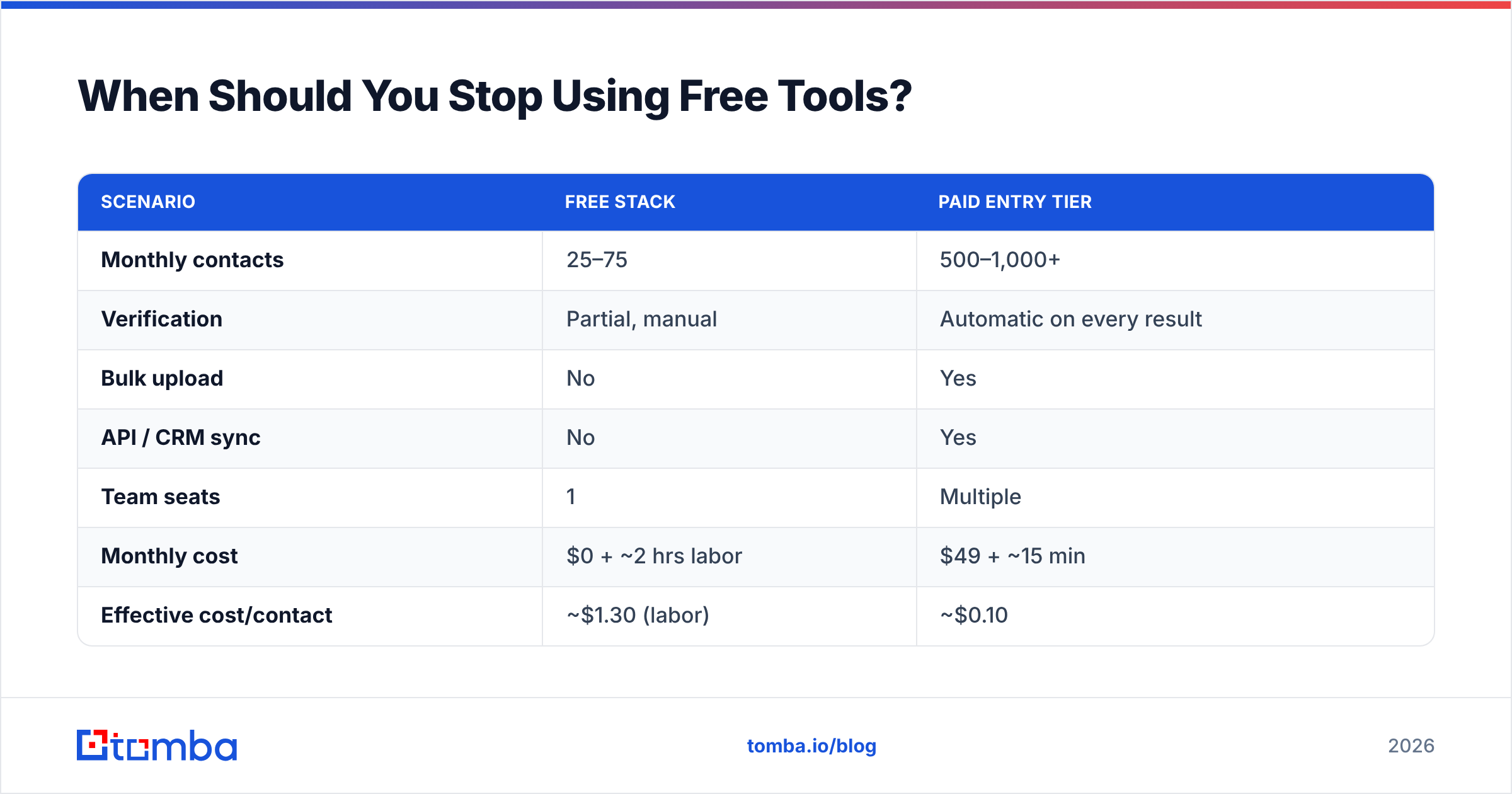
Here is the cost comparison at the point of decision:
| Scenario | Free stack | Paid entry tier |
|---|---|---|
| Monthly contacts | 25–75 | 500–1,000+ |
| Verification | Partial, manual | Automatic on every result |
| Bulk upload | No | Yes |
| API / CRM sync | No | Yes |
| Team seats | 1 | Multiple |
| Monthly cost | $0 + ~2 hrs labor | $49 + ~15 min |
| Effective cost/contact | ~$1.30 (labor) | ~$0.10 |
The effective cost per contact is where the argument ends. Free tiers are cheap in dollars and expensive in hours. That trade is correct when you are testing whether outbound works at all, and wrong the moment outbound is a real channel for you.
For reference on where paid tiers start, Tomba pricing runs Free at 25 searches/month, Starter at $49/month, Growth at $99/month, and Pro at $249/month, with Enterprise custom. Most competitors cluster in the same $39–$99 entry band, so the decision is rarely about price — it is about which database actually covers your target segment.
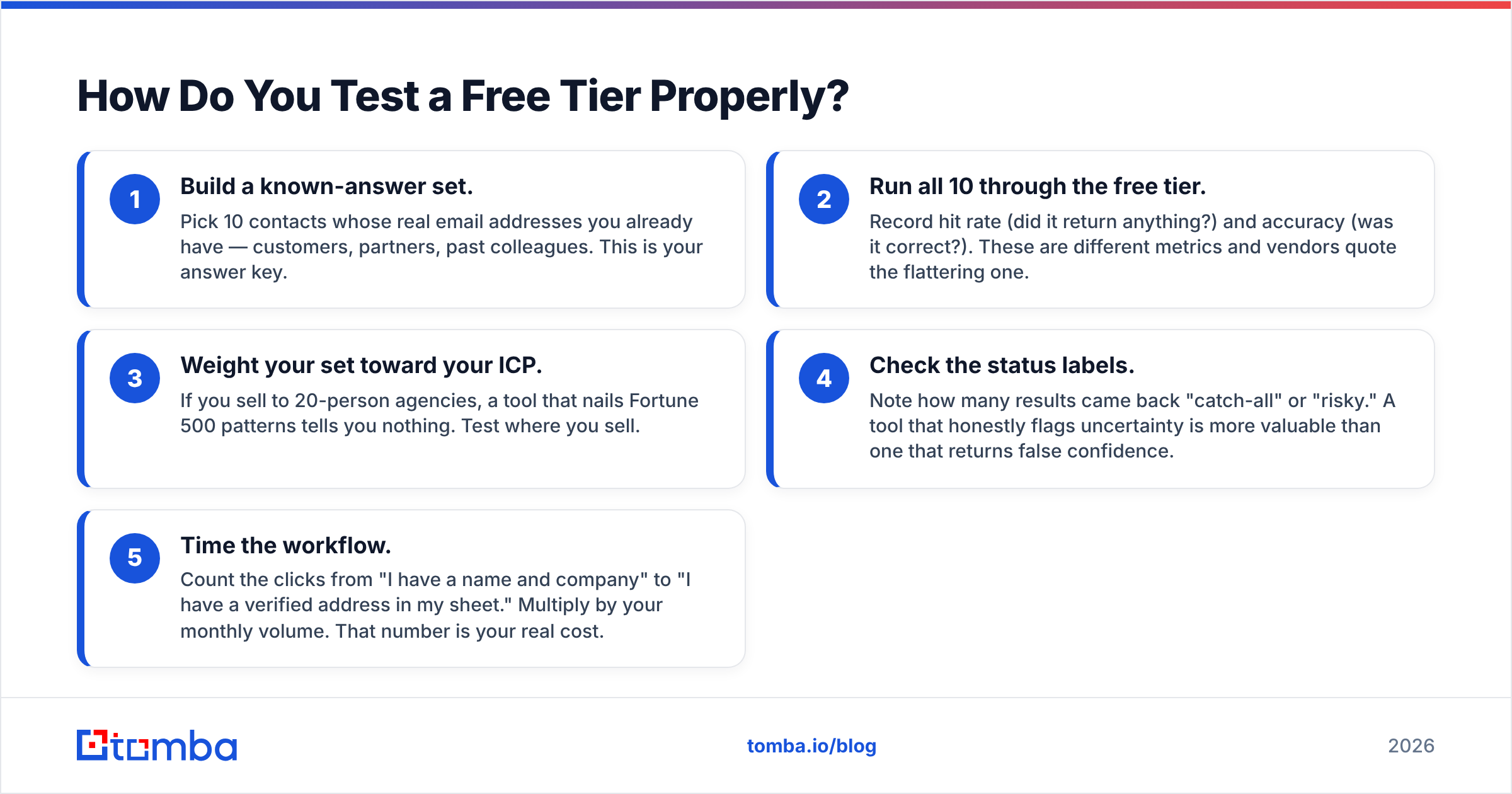
How Do You Test a Free Tier Properly?#
Do not evaluate a free plan by whether it finds emails. Evaluate it by whether it finds your emails. Run this test in under twenty minutes:
- Build a known-answer set. Pick 10 contacts whose real email addresses you already have — customers, partners, past colleagues. This is your answer key.
- Run all 10 through the free tier. Record hit rate (did it return anything?) and accuracy (was it correct?). These are different metrics and vendors quote the flattering one.
- Weight your set toward your ICP. If you sell to 20-person agencies, a tool that nails Fortune 500 patterns tells you nothing. Test where you sell.
- Check the status labels. Note how many results came back "catch-all" or "risky." A tool that honestly flags uncertainty is more valuable than one that returns false confidence.
- Time the workflow. Count the clicks from "I have a name and company" to "I have a verified address in my sheet." Multiply by your monthly volume. That number is your real cost.
Ten known contacts is a small sample, and you should treat the result as directional rather than statistical. But it will separate a tool with genuine coverage of your segment from one that does not — and that is the only question the free tier needs to answer.
What About Free Tools That Are Not Finders?#
A prospecting stack has more than one job, and several genuinely free utilities cover the rest of it without credits.
- Deliverability checks — an SPF checker and a blacklist checker confirm your sending domain is configured before you send anything. Free, and skipping them is how good lists get wasted.
- List hygiene — a remove duplicates tool prevents the same person getting two sequences, which is the fastest way to look like a bot.
- Content prep — a spam checker scores your copy before it hits a filter.
- Extraction — an email extractor pulls addresses out of text you already have, like conference attendee pages or public directories.
These do not consume finder credits, so they belong in every workflow regardless of what you pay for data. Configuring email deliverability correctly costs nothing and protects everything downstream.
The Honest Verdict#
Free email prospecting tools are a legitimate starting point and a poor operating system. Use them to validate that a segment responds, to test data coverage against your ICP, and to run the low-volume founder-led outbound that precedes a real sales motion. Stack a finder, a verifier, and a handful of free utilities and you will cover 40–60 quality touches a month without spending a dollar.
What free tiers cannot do is scale, verify at volume, feed a CRM, or survive a second user. The moment any of those becomes a requirement, the $49-a-month decision is not really a decision — the labor you are spending already exceeds it.
Start with the free tier of the Tomba Email Finder. You get 25 searches a month with verification included on every result and no card required, which is enough to run the ten-contact accuracy test above and see whether the coverage holds for your market. If it does, the paid tiers scale the same data; if it does not, you have lost nothing but twenty minutes — which is exactly what a free tier is for.
Related guides#
Ready to find emails that actually work?
Join 150,000+ professionals who stopped guessing and started sending. Free credits on signup — no credit card required.
Get the Tomba newsletter
Practical outbound tactics and product updates — once every two weeks.
About the author