Free Lead Scraping Tools in 2026: What Actually Works
Most free lead scraping tools give you volume, not deliverability. Here's what each free tier actually returns, where the hidden ceilings are, and how to build a legal, verified pipeline without paying on day one.
TL;DR
- "Free lead scraping tools" almost always means a capped free tier, not free software. The real ceiling is 25-100 contacts a month for most reputable vendors, or unlimited-but-unverified data from raw scrapers.
- Raw scrapers (Chrome extensions, Python libraries, Google Maps grabbers) hand you strings that look like emails. Roughly 20-35% of them bounce, and a 5% bounce rate is enough to damage your sender reputation.
- The workflow that actually works: scrape or source cheaply, then verify before you send. Verification is the step people skip and the one that decides whether your domain survives.
- Free tiers are best used as accuracy tests, not as a supply. Run the same 25 target contacts through three tools and compare hit rate before you commit budget.
- GDPR and CCPA don't ban B2B scraping, but they do govern what you store and how you justify it. Public professional data plus legitimate interest plus an opt-out is the defensible pattern.
What are free lead scraping tools, really?#
There are three different products hiding behind one search term, and confusing them is the reason most people end up with a list that bounces.
1. Open-source scrapers. Libraries and scripts — Scrapy, Playwright, BeautifulSoup, plus the endless supply of Google Maps and LinkedIn scraper repos on GitHub. Genuinely free, genuinely unlimited, and genuinely your problem when proxies get blocked or the target site changes its DOM. Output is raw HTML text, not validated contact records.
2. Freemium SaaS tiers. Apollo, Hunter, Tomba, Lusha, Snov.io and similar tools give you a small monthly credit allowance. The data is enriched and usually verified, the volume is small, and the intent is to convert you. This is the category most people actually mean.
3. Chrome extensions and "unlimited" grabbers. Browser tools that pull whatever is visible on a page. Free until the vendor throttles you, and legally the murkiest of the three because they typically operate inside a logged-in session in violation of that platform's terms of service.
The distinction matters because the failure modes are different. Open-source scrapers fail on maintenance. Freemium tiers fail on volume. Extensions fail on data quality and account safety.

How do the free tiers actually compare in 2026?#
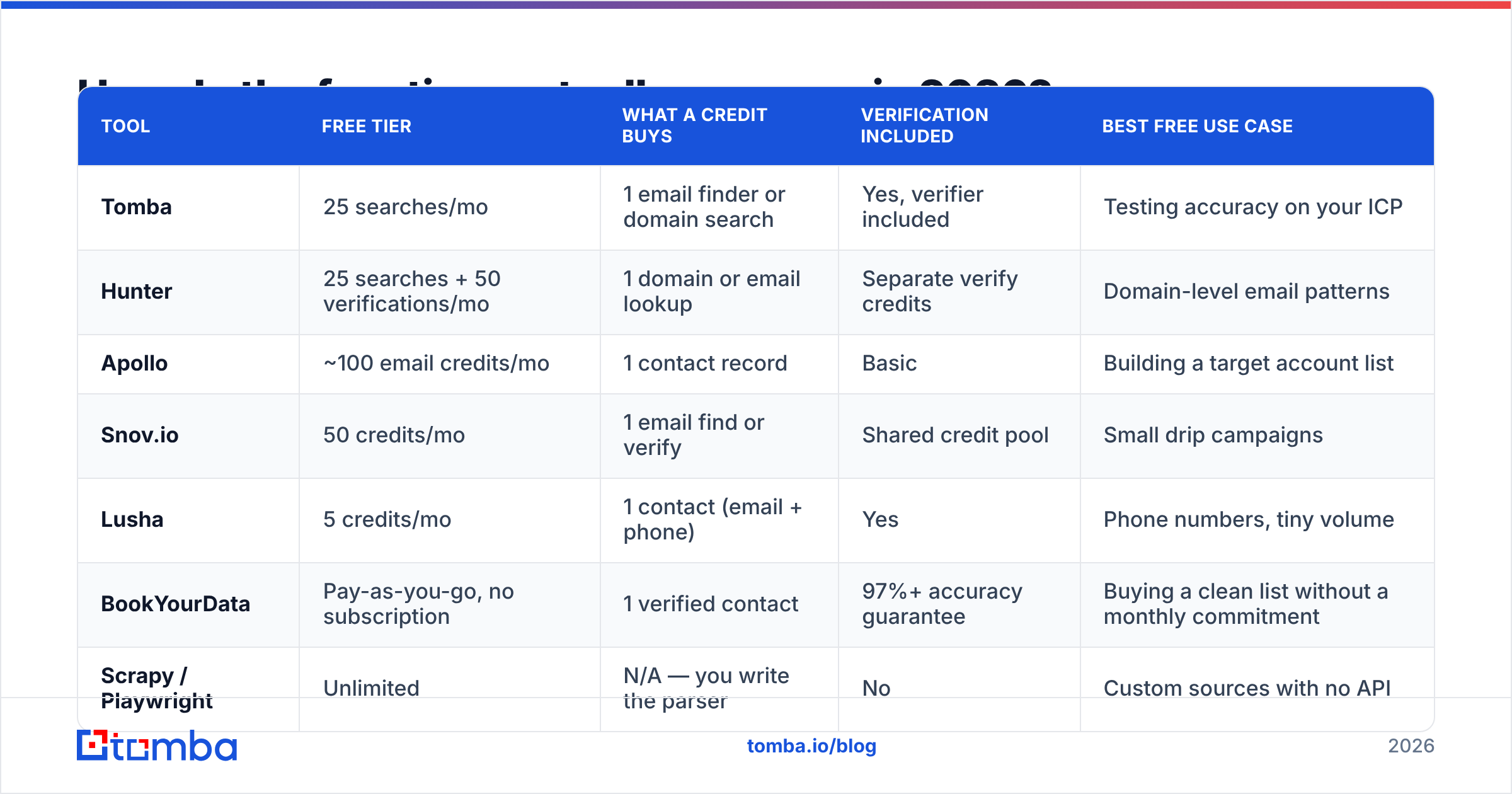
Here's what you get without paying, based on each vendor's published free plan. Credit definitions vary — some count a search, some count a returned contact, some count both — so read the fine print before you plan around a number.
| Tool | Free tier | What a credit buys | Verification included | Best free use case |
|---|---|---|---|---|
| Tomba | 25 searches/mo | 1 email finder or domain search | Yes, verifier included | Testing accuracy on your ICP |
| Hunter | 25 searches + 50 verifications/mo | 1 domain or email lookup | Separate verify credits | Domain-level email patterns |
| Apollo | ~100 email credits/mo | 1 contact record | Basic | Building a target account list |
| Snov.io | 50 credits/mo | 1 email find or verify | Shared credit pool | Small drip campaigns |
| Lusha | 5 credits/mo | 1 contact (email + phone) | Yes | Phone numbers, tiny volume |
| BookYourData | Pay-as-you-go, no subscription | 1 verified contact | 97%+ accuracy guarantee | Buying a clean list without a monthly commitment |
| Scrapy / Playwright | Unlimited | N/A — you write the parser | No | Custom sources with no API |
Two things stand out. First, no reputable vendor gives away meaningful volume — 25 to 100 contacts a month is a sampler, not a pipeline. Second, BookYourData sits in a different lane entirely: no free tier, but no subscription either, which makes it the sensible option when you need 2,000 clean records once and don't want to rent a seat for a year. "Free" and "cheap per record" are not the same problem.

Why do scraped leads bounce so much?#
Because a scraped email is a guess until something verifies it.
Think of it like a phone book someone photocopied three years ago. The names are real. The numbers were real. But people moved, companies got acquired, and the guy in accounts left in 2024. Nothing about the photocopy tells you which entries went stale.
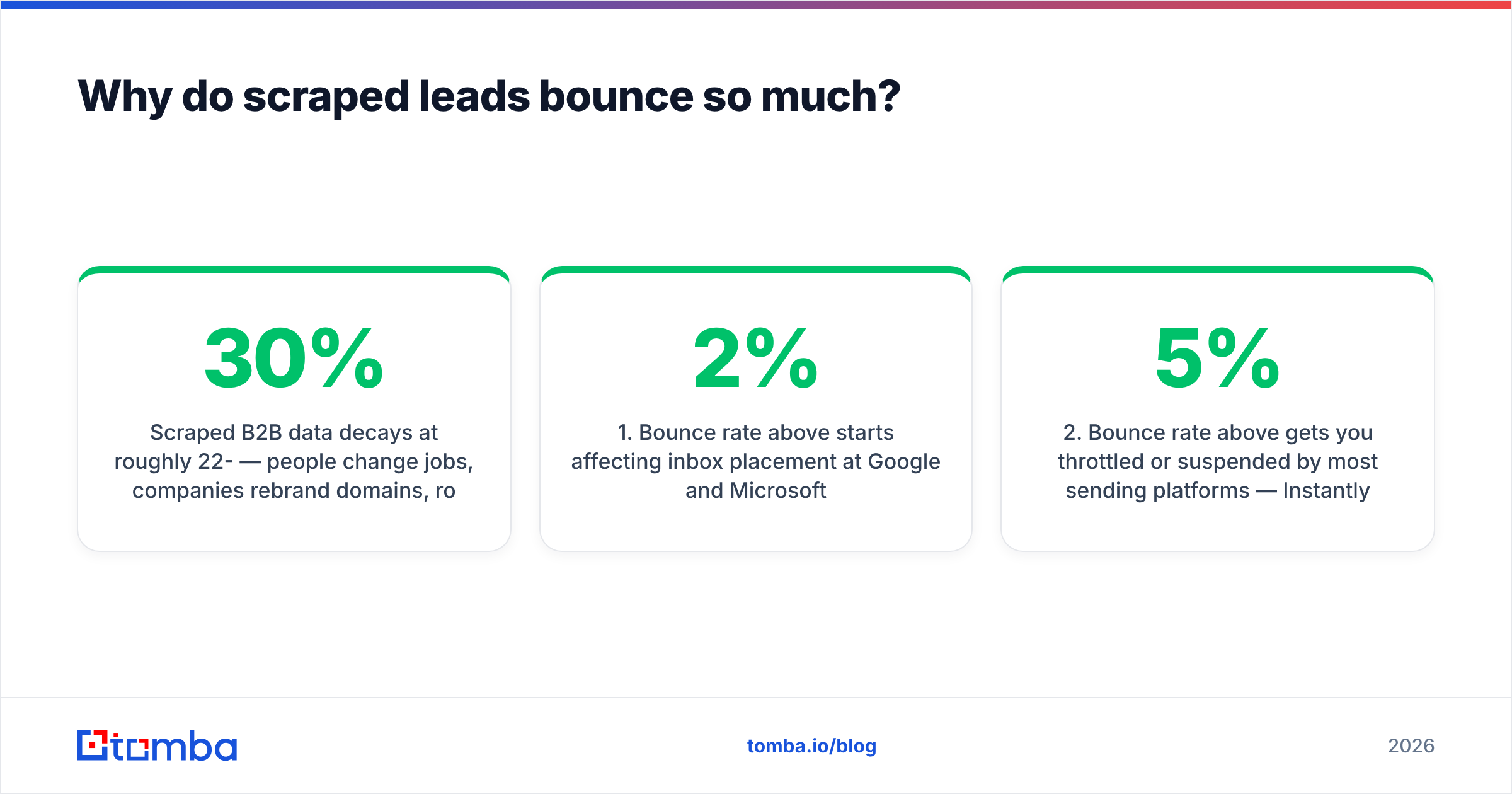
Scraped B2B data decays at roughly 22-30% per year — people change jobs, companies rebrand domains, roles get consolidated. Layer on the guesswork problem: many scrapers don't find emails, they generate them by applying a pattern (first.last@domain.com) to a name they scraped from LinkedIn. If the company actually uses finitial+last, every one of those addresses is fiction.
The consequences compound fast:
- Bounce rate above 2% starts affecting inbox placement at Google and Microsoft.
- Bounce rate above 5% gets you throttled or suspended by most sending platforms — Instantly, Smartlead, and Mailgun all enforce this.
- Spam traps are recycled addresses that were once real. Scrapers love them because they look valid. Hitting one can blacklist your sending domain outright.
- Domain reputation is sticky. Recovering sender reputation after a bad send takes weeks of low-volume warmup, not a weekend.
This is why the "unlimited free scraper" pitch is misleading. The scraping was free. The blacklisted domain cost you a quarter.
Is free scraping legal under GDPR and CCPA?#
Short answer: scraping publicly available B2B data is generally lawful in both the EU and the US, but storing and using it carries obligations that most free-tool users ignore.
Under GDPR, business contact data is still personal data if it identifies an individual — sarah.chen@acme.com is personal data, info@acme.com usually isn't. The workable legal basis for B2B outreach is legitimate interest (Article 6(1)(f)), which requires you to document a balancing test, disclose your source when asked, and honor deletion requests. The ICO's guidance on direct marketing is the clearest public reference on where the line sits.
Under CCPA/CPRA, you need a disclosed privacy notice and a working opt-out mechanism if you're selling or sharing data.
Separately from privacy law, there's terms-of-service risk. The hiQ v. LinkedIn line of cases established that scraping public pages generally isn't a Computer Fraud and Abuse Act violation, but that ruling protects you from criminal liability, not from having your LinkedIn account permanently banned for running an extension against it. Those are two different risks and people routinely conflate them.
Practical rules that keep you defensible:
- Scrape public sources only — company sites, public directories, published team pages. Not logged-in walled gardens.
- Log provenance for every record: source URL and date acquired.
- Honor unsubscribes globally, across every tool and list you own.
- Don't touch consumer data with B2B tooling. Different rules, much harsher penalties.
What's the actual workflow that works without a budget?#
Stop thinking "scrape 10,000 leads." Start thinking "find 200 right leads and make sure they're real."
Step 1 — Define the account list first. Use free sources: Crunchbase's free search, LinkedIn Sales Navigator's trial, G2 category pages, conference attendee lists, funding announcements. You want company domains, not contacts, at this stage. Fifty to two hundred accounts is plenty.
Step 2 — Find the pattern, not the person. Run one known contact per domain through a domain search to learn the company's email format. One credit tells you the pattern for the whole company — dramatically more efficient than burning a credit per person. Free tools like a company email pattern checker will confirm the format at zero cost.
Step 3 — Generate candidates from the pattern. Once you know Acme uses first.last@, an email permutator produces the candidate addresses for every name on your list without consuming find credits.
Step 4 — Verify everything before sending. This is non-negotiable. An email verifier performs the SMTP handshake and syntax/MX checks that separate a real mailbox from a plausible string. Free verification tiers exist at most vendors — this is the one credit type worth spending first.
Step 5 — Handle catch-all domains separately. Roughly 15-20% of B2B domains accept mail for any address, which means standard verification returns "unknown." A catch-all verifier applies additional signals. If you can't resolve it, either send at low volume with tight monitoring or drop the record.
Step 6 — Warm the sending domain before volume. Even a perfect list gets filtered if you go from 0 to 300 sends overnight. Use a warmup calculator to plan the ramp.

Which free tool should you pick for which job?#
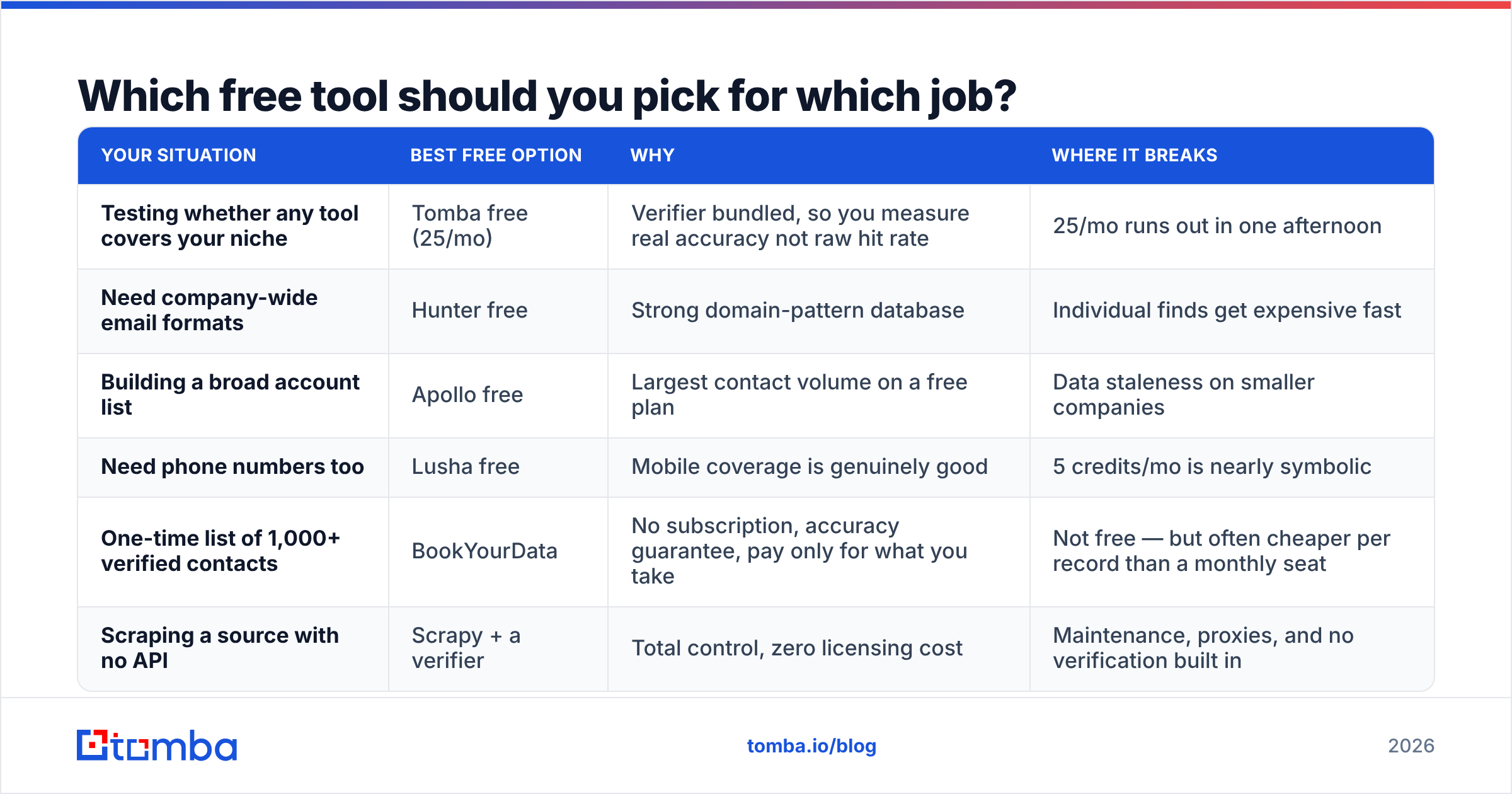
Match the tool to the job, not to the size of the free tier.
| Your situation | Best free option | Why | Where it breaks |
|---|---|---|---|
| Testing whether any tool covers your niche | Tomba free (25/mo) | Verifier bundled, so you measure real accuracy not raw hit rate | 25/mo runs out in one afternoon |
| Need company-wide email formats | Hunter free | Strong domain-pattern database | Individual finds get expensive fast |
| Building a broad account list | Apollo free | Largest contact volume on a free plan | Data staleness on smaller companies |
| Need phone numbers too | Lusha free | Mobile coverage is genuinely good | 5 credits/mo is nearly symbolic |
| One-time list of 1,000+ verified contacts | BookYourData | No subscription, accuracy guarantee, pay only for what you take | Not free — but often cheaper per record than a monthly seat |
| Scraping a source with no API | Scrapy + a verifier | Total control, zero licensing cost | Maintenance, proxies, and no verification built in |
The honest recommendation: use two or three free tiers simultaneously on the same 25-contact sample. Tools differ enormously by geography and company size. A tool with 95% coverage on US SaaS may return 40% on German manufacturing. Your niche is the only benchmark that matters, and running the sample costs nothing.

What are the hidden costs of "free"?#
Free tiers are priced in something other than money. Here's the ledger.
Your time. A DIY scraper takes 4-8 hours to build and roughly an hour a month to maintain as target sites change. At any realistic hourly rate, that exceeds a $49/mo subscription within the first month.
Your domain reputation. One send to an unverified 2,000-record list can put you in a multi-week recovery. That's the most expensive line item on this page and it never appears on a pricing table.
Credit-definition traps. Read what a credit means. Some vendors charge a credit for a search that returns nothing. Others charge separately for finding and verifying the same address. Two tools advertising "50 free credits" can differ by 3x in actual output.
Export restrictions. Several free tiers let you see contacts but not export them, or watermark the CSV, or block API access entirely. If your workflow is Sheets-based, check that a Google Sheets add-on or CSV export is available on the free plan before you build around it.
Data you can't audit. If a vendor won't tell you where records come from, you can't answer a GDPR source request. Check the vendor's data sources disclosure before you store anything.
When should you stop scraping for free and pay?#
Three signals, and any one of them is enough:
- You're sending more than 500 emails a month. Free credits can't feed that, and the manual stitching between tools costs more in labor than a plan does.
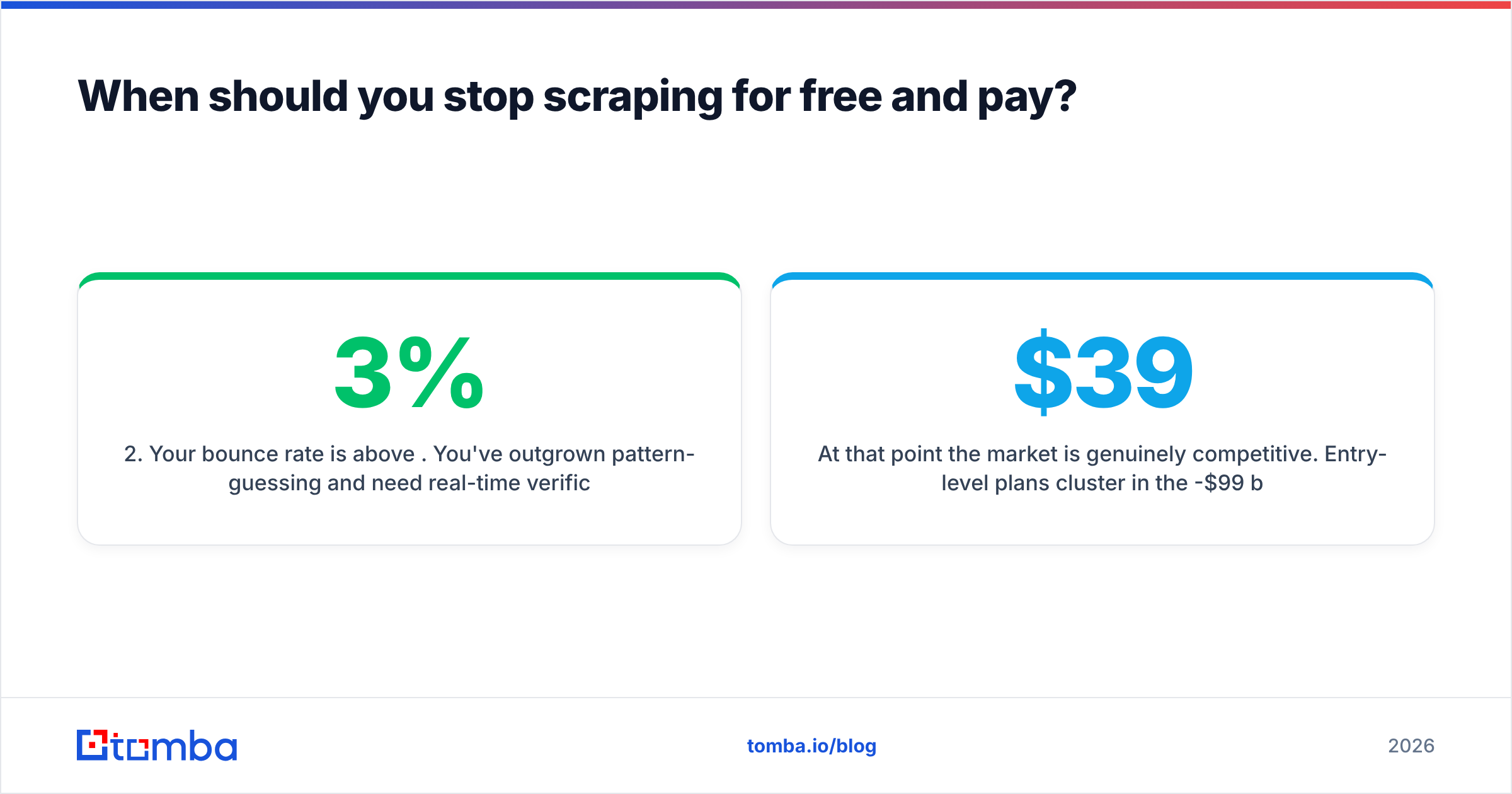
- Your bounce rate is above 3%. You've outgrown pattern-guessing and need real-time verification at volume.
- You need the data inside another system. CRM sync, an email finder API, bulk CSV enrichment — these live behind paid tiers everywhere, without exception.
At that point the market is genuinely competitive. Entry-level plans cluster in the $39-$99/mo band; Tomba pricing starts at $49/mo for Starter and $99/mo for Growth, with a free 25-search tier that stays available so you can keep testing new segments before committing volume. If your need is a one-off list rather than an ongoing pipeline, a pay-as-you-go provider like BookYourData is often the better economic fit — no seat, no monthly floor, and you only pay for records you actually take.
Compare on three axes and ignore the rest: coverage in your specific geography and company-size band, whether verification is bundled or billed separately, and credit rollover policy. Marketing-page accuracy claims are self-reported and functionally meaningless; your own 25-contact test is worth more than any vendor's benchmark.
The bottom line#
Free lead scraping tools are excellent for validation and poor for volume. Use them to answer one question — does this tool actually find my buyers? — and once you have the answer, either pay for the tool that won or accept the maintenance burden of a self-hosted scraper. What you cannot do is send unverified scraped data at scale and expect your domain to survive it.
The step that separates a working pipeline from a burned domain isn't the scraping. It's the verification that happens between the scrape and the send.
Start with the Tomba Email Finder free tier — 25 searches a month with verification included, so you're measuring deliverable addresses rather than plausible-looking strings. Run it against 25 contacts from your actual target list, compare the hit rate to whatever you're using now, and let the numbers decide.
Related guides#
Ready to find emails that actually work?
Join 150,000+ professionals who stopped guessing and started sending. Free credits on signup — no credit card required.
Get the Tomba newsletter
Practical outbound tactics and product updates — once every two weeks.
About the author