Funnel Gauge Pricing 2026: Reviews, Pros and Cons Compared
Funnel Gauge sells outcomes, not line items — which makes its pricing hard to compare. Here's how the model works, what reviewers actually complain about, and how the real per-meeting cost stacks up against cheaper stacks.
TL;DR
- Funnel Gauge sells through a quote-first motion rather than a public price list, so the number you see depends on seat count, contract length, and how hard you negotiate — budget for a demo call before you get a figure.
- The recurring complaint in reviews is not the headline price. It is the gap between credits purchased and contacts you can actually email after verification and deduplication.
- Pros: consolidated funnel reporting, decent CRM sync, and a support team reviewers generally rate well. Cons: annual lock-in, seat-based minimums, and add-on modules that inflate year-two renewal.
- If your team mostly needs accurate contact data rather than another dashboard, a transparent per-credit tool like Tomba pricing at $49/mo starter — or a pay-as-you-go provider like BookYourData — often does the same job for less.
- The only number that matters is cost per verified, replying contact. We include the worksheet below so you can run it on any vendor, Funnel Gauge included.
What is Funnel Gauge and who is it actually for?#
Funnel Gauge positions itself as a pipeline measurement and lead-flow platform: it stitches together where prospects come from, how they move between stages, and which touchpoints correlate with closed revenue. In practice that puts it in the same buying conversation as revenue-analytics suites, prospecting databases, and the reporting layer inside your CRM.
The buyer profile skews toward mid-market revenue teams with three characteristics: multiple lead sources they cannot reconcile, a sales leader who wants attribution the CRM does not natively give them, and enough headcount that per-seat pricing does not immediately break the budget. Solo founders and two-person SDR teams almost always find it oversized.
That context matters because pricing questions get answered differently depending on which job you are hiring the tool for. If you want attribution and funnel visibility, you are comparing against analytics platforms. If you mainly want contacts to email, you are comparing against data vendors — and the price ceiling in that market is much lower.
How does Funnel Gauge pricing actually work?#
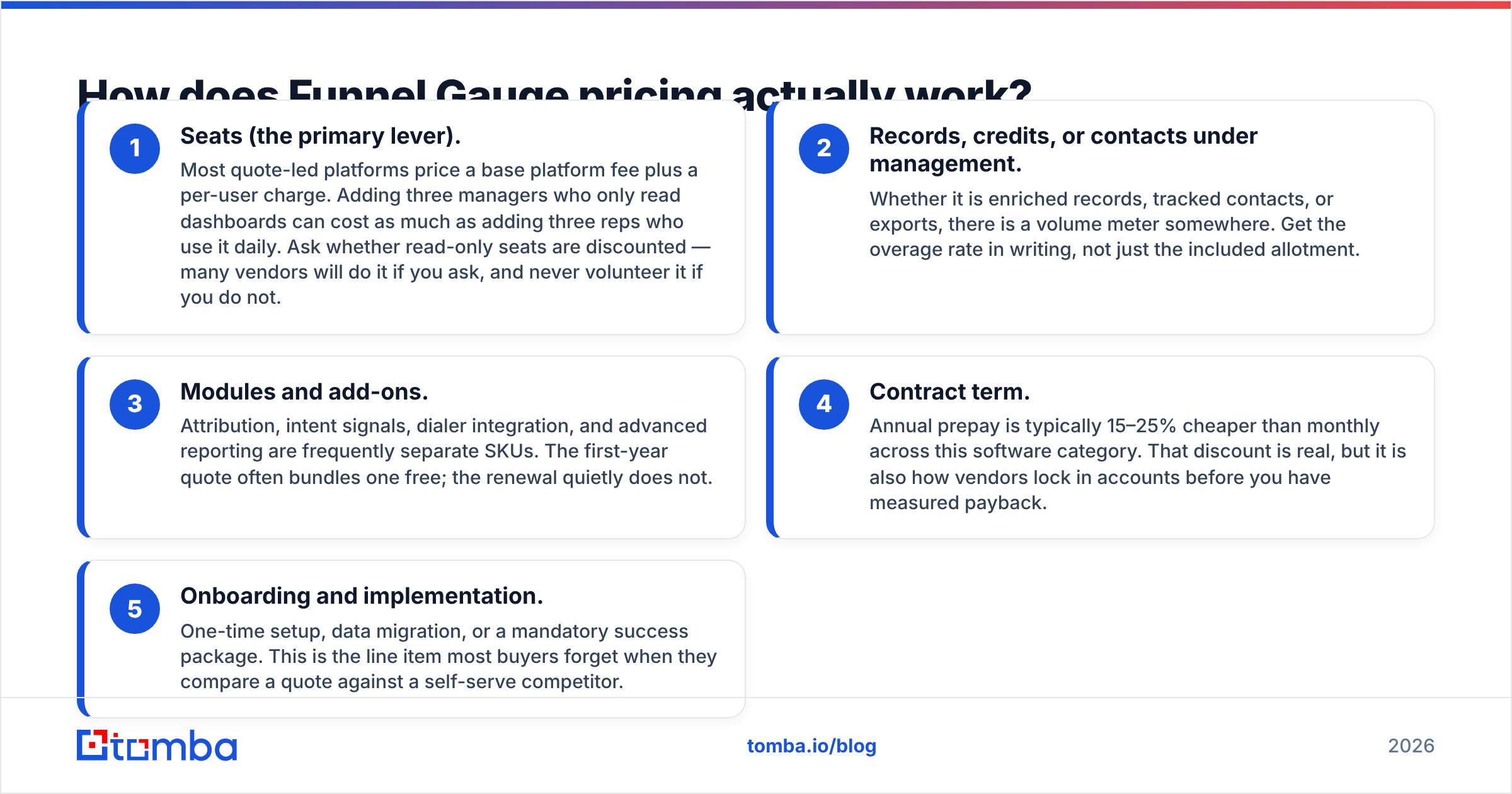
Funnel Gauge does not publish a complete public rate card at the time of writing, which is common for quote-led B2B software. What you can do is understand the levers that set your number. Every quote-based platform in this category prices on some combination of the following five factors:
- Seats (the primary lever). Most quote-led platforms price a base platform fee plus a per-user charge. Adding three managers who only read dashboards can cost as much as adding three reps who use it daily. Ask whether read-only seats are discounted — many vendors will do it if you ask, and never volunteer it if you do not.
- Records, credits, or contacts under management. Whether it is enriched records, tracked contacts, or exports, there is a volume meter somewhere. Get the overage rate in writing, not just the included allotment.
- Modules and add-ons. Attribution, intent signals, dialer integration, and advanced reporting are frequently separate SKUs. The first-year quote often bundles one free; the renewal quietly does not.
- Contract term. Annual prepay is typically 15–25% cheaper than monthly across this software category. That discount is real, but it is also how vendors lock in accounts before you have measured payback.
- Onboarding and implementation. One-time setup, data migration, or a mandatory success package. This is the line item most buyers forget when they compare a quote against a self-serve competitor.
Because those levers interact, two companies of similar size can receive quotes that differ by a factor of three. That is not a scandal — it is how enterprise SaaS works, as the general SaaS pricing model has evolved. But it does mean you cannot evaluate Funnel Gauge pricing reviews from other buyers as if they describe your quote. Treat them as directional signals about the shape of the deal, not the number.

What do Funnel Gauge reviews consistently praise?#
Pulling the recurring themes out of user reviews on public marketplaces like G2's sales intelligence category and Capterra, the positives for tools in this class cluster into four buckets:
- Consolidated visibility. Reviewers who arrive from spreadsheet-based reporting describe a genuine step change. Seeing source, stage, and velocity in one place removes a weekly manual reconciliation ritual.
- Support responsiveness. Quote-led vendors tend to staff customer success properly because retention economics demand it. Buyers routinely rate onboarding help above self-serve competitors.
- CRM sync quality. Bidirectional sync that does not create duplicate records is harder than it sounds, and reviewers notice when it works.
- Executive-ready reporting. The dashboards are built to be screenshotted into a board deck. That is a real, if unglamorous, value driver.
None of these are trivial. If your problem is "I cannot tell my CEO where pipeline came from," a platform that solves it is worth paying for.
What are the most common complaints?#
The criticisms are more instructive, because they predict where your renewal negotiation will hurt.
- Opaque entry pricing. Buyers dislike having to book a call to learn whether a tool is in budget. It filters out qualified small teams and wastes sales cycles on both sides.
- Seat minimums. A five-seat floor is fine at 40 reps and painful at eight.
- Credit math that does not survive contact with reality. This is the big one. A credit spent on a record that turns out to be a stale, bounced, or catch-all address still counts against your allotment. Teams routinely find that 100,000 "contacts" translates to a materially smaller list of addresses that survive verification.
- Renewal creep. Year-one discount, year-two list price, plus a module that used to be included. Standard playbook, but it surprises first-time buyers.
- Depth over breadth. Coverage tends to be strong in North American tech and thinner in EMEA mid-market, manufacturing, and non-English-speaking regions. Ask for a sample against your ICP before signing.
The credit-quality complaint is the one to take seriously, because it is fixable with process rather than with a bigger contract. Running exports through an independent email verifier before they enter a sequence turns an invisible waste line into a measurable one.
How does Funnel Gauge pricing compare to the alternatives?#
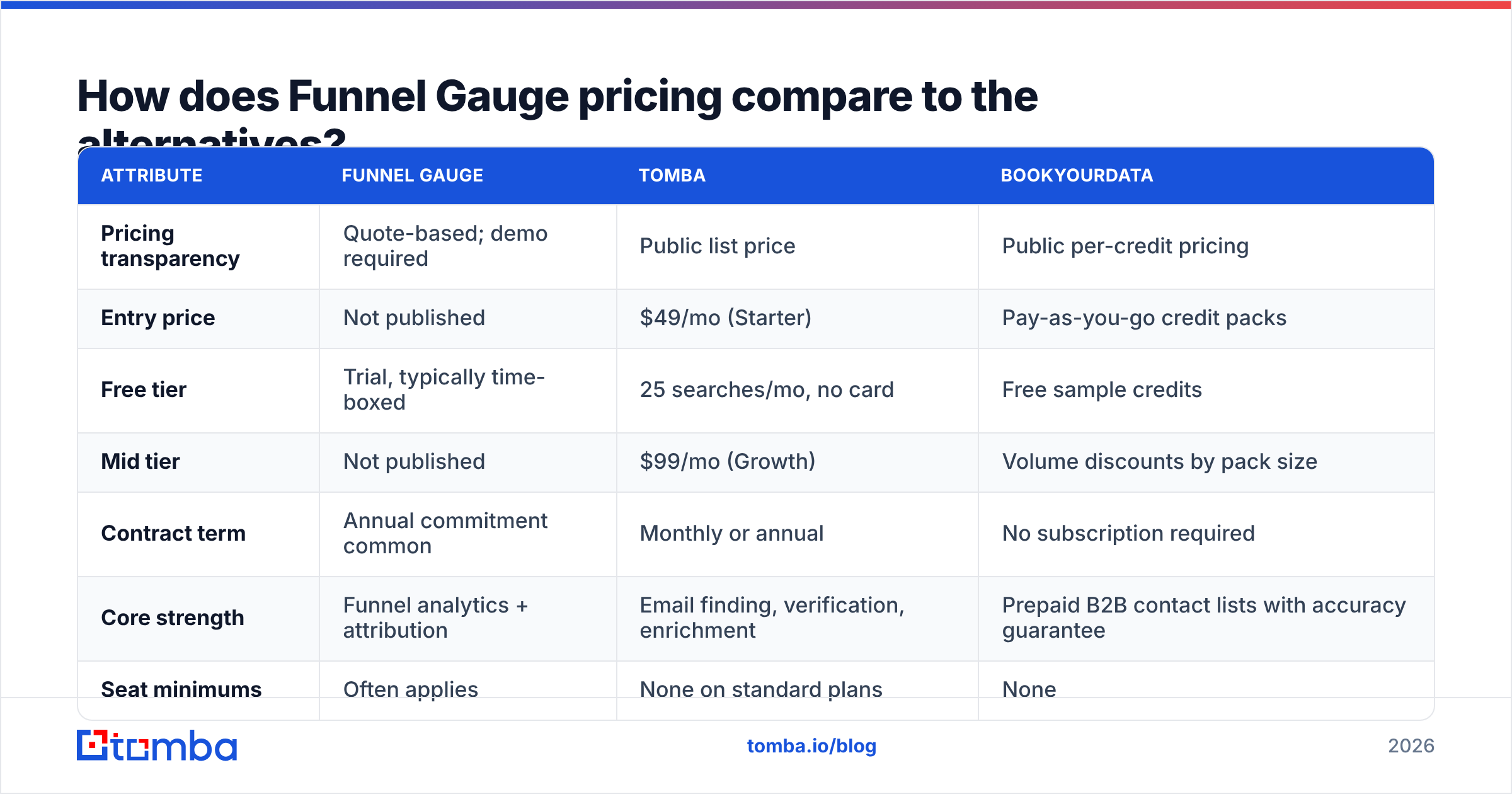
Here is the honest comparison. Where Funnel Gauge does not publish figures, the table says so rather than inventing them — verify your own quote against these numbers.
| Attribute | Funnel Gauge | Tomba | BookYourData |
|---|---|---|---|
| Pricing transparency | Quote-based; demo required | Public list price | Public per-credit pricing |
| Entry price | Not published | $49/mo (Starter) | Pay-as-you-go credit packs |
| Free tier | Trial, typically time-boxed | 25 searches/mo, no card | Free sample credits |
| Mid tier | Not published | $99/mo (Growth) | Volume discounts by pack size |
| Contract term | Annual commitment common | Monthly or annual | No subscription required |
| Core strength | Funnel analytics + attribution | Email finding, verification, enrichment | Prepaid B2B contact lists with accuracy guarantee |
| Seat minimums | Often applies | None on standard plans | None |
| Best fit | 20+ seat revenue teams needing attribution | Teams that need accurate contacts and an API | Buyers who want data without a subscription |
Two things jump out. First, the platforms are not substitutes — Funnel Gauge answers "where did pipeline come from," while a data provider answers "who do I contact." Second, if you were considering Funnel Gauge primarily as a contact source, you are paying analytics-tier prices for a data-tier job.
BookYourData is worth a serious look if your buying preference is prepaid and commitment-free; its per-record model makes cost forecasting trivial, and it publishes an accuracy guarantee you can hold it to. Tomba covers the same contact-data need with a subscription model plus a developer-grade email finder API if you want to embed lookups into your own workflow rather than log into another dashboard.
Where do the hidden costs actually live?#
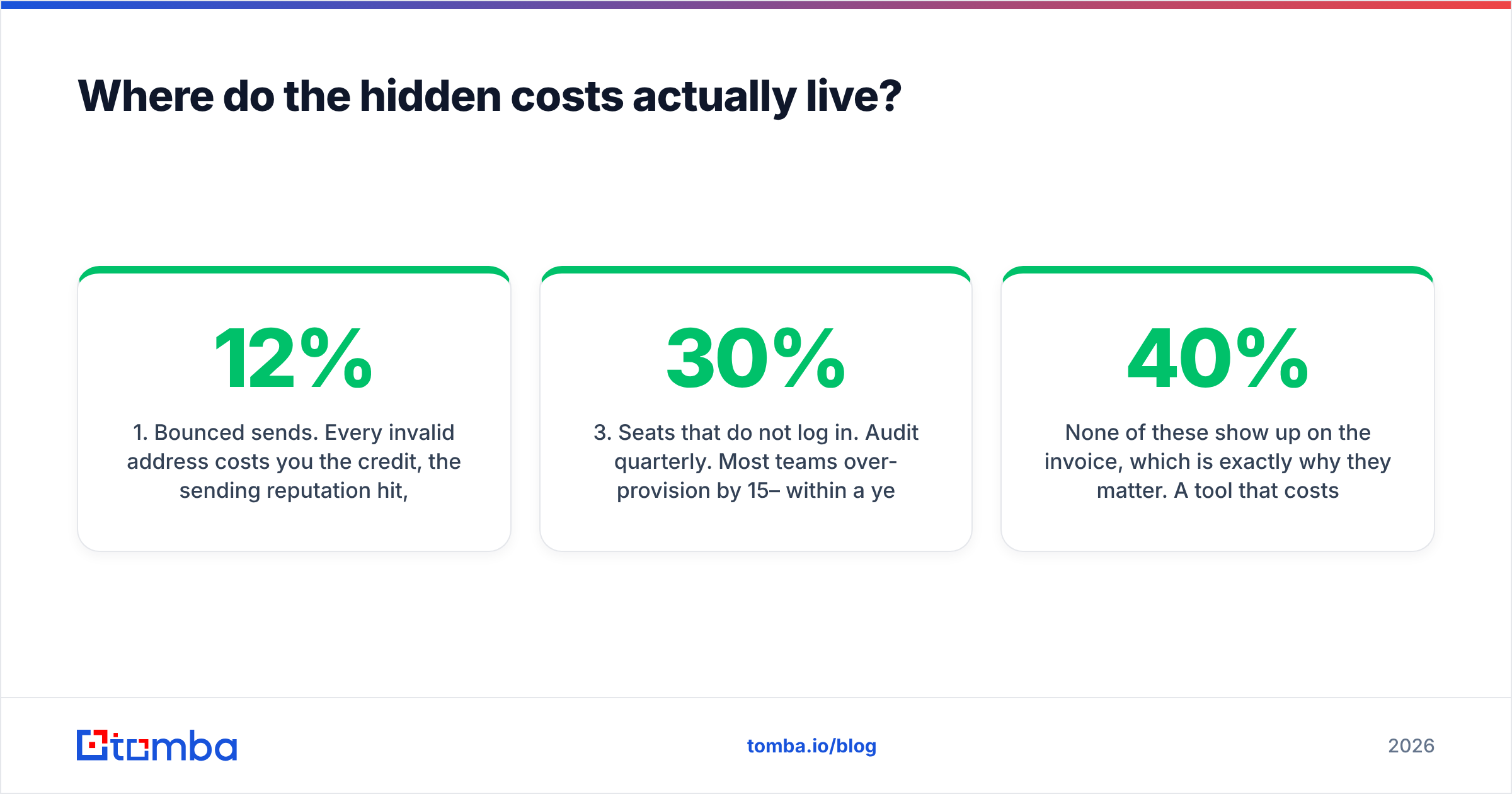
Four places, in rough order of how much money they quietly consume:
- Bounced sends. Every invalid address costs you the credit, the sending reputation hit, and the deliverability tax on the rest of the campaign. At a 12% bounce rate on 10,000 sends, you have burned 1,200 credits and possibly a sending domain.
- Duplicate records. Pulling from two vendors without deduplication means paying twice for the same person and emailing them twice. Run a remove duplicates pass on any merged list before it enters a sequence.
- Seats that do not log in. Audit quarterly. Most teams over-provision by 15–30% within a year.
- Integration glue. If the platform does not natively connect to your stack, someone builds and maintains a Zapier chain. That is a real hour cost that never appears in the quote.
None of these show up on the invoice, which is exactly why they matter. A tool that costs 40% more but bounces at 2% instead of 12% is cheaper.
How do you calculate the real cost per meeting?#
Use this rather than comparing sticker prices. It works on any vendor.
True cost per booked meeting =
  (annual platform fee + add-ons + onboarding + internal hours)
  ÷ (contacts sourced × verification pass rate × reply rate × meeting rate)
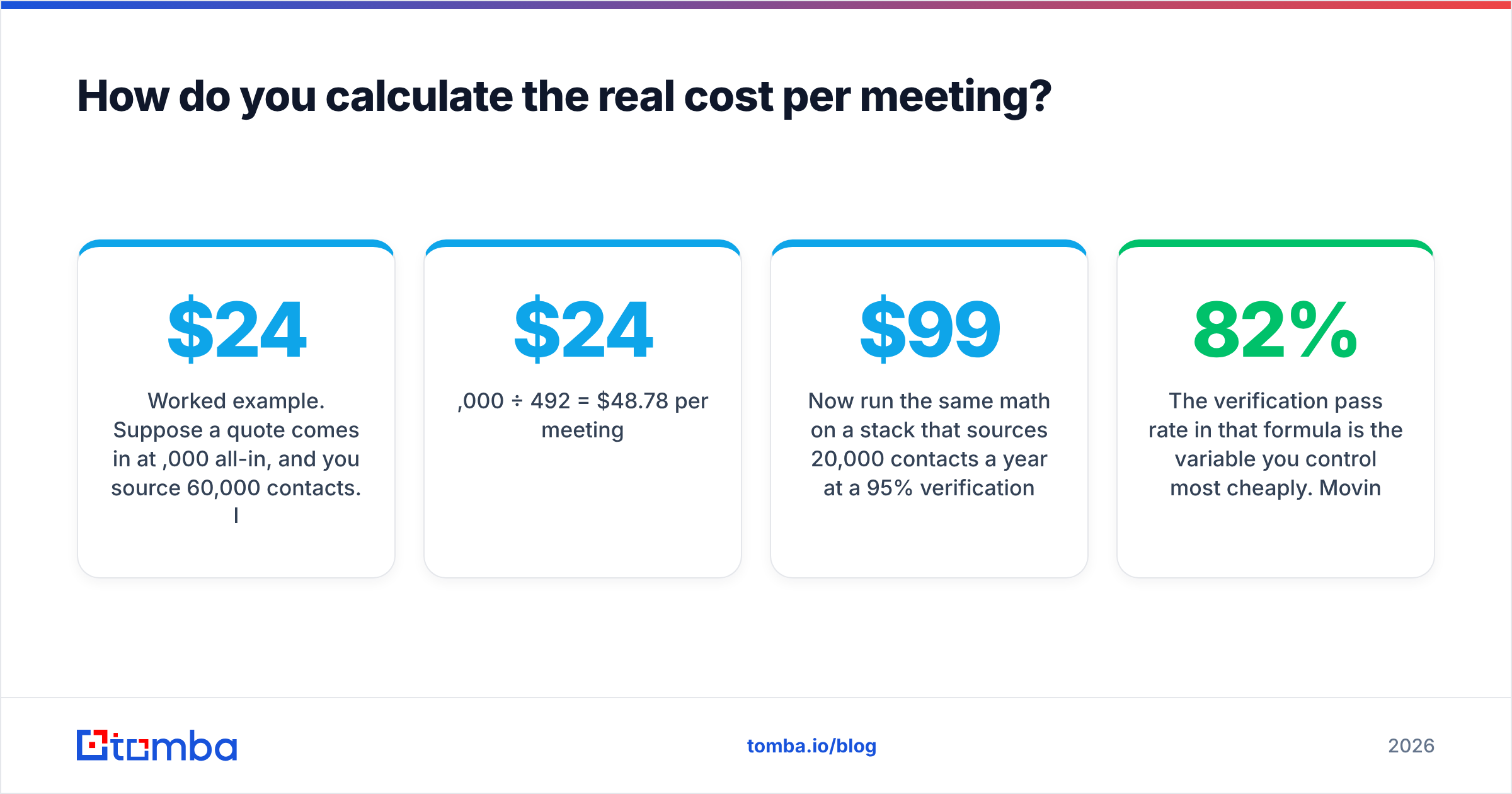
Worked example. Suppose a quote comes in at $24,000/year all-in, and you source 60,000 contacts. If 82% survive verification, 4% reply, and a quarter of replies become meetings:
- 60,000 × 0.82 = 49,200 usable contacts
- 49,200 × 0.04 = 1,968 replies
- 1,968 × 0.25 = 492 meetings
- $24,000 ÷ 492 = $48.78 per meeting
Now run the same math on a $99/mo stack that sources 20,000 contacts a year at a 95% verification pass rate. You get roughly 190 meetings for about $1,188, or $6.25 per meeting — but only 190 meetings, versus 492. Which is better depends entirely on whether your team can work 492 meetings. Capacity, not price, is usually the binding constraint. Companies that model this properly — the discipline HubSpot and most RevOps teams call unit-economics planning — buy the right size instead of the cheapest one.
The verification pass rate in that formula is the variable you control most cheaply. Moving from 82% to 95% on the larger contract adds roughly 78 meetings for the cost of a verification subscription. That is the single highest-ROI change available to most teams.
Who should buy Funnel Gauge, and who should skip it?#
Buy it if: you have 20+ revenue seats, multiple lead sources you cannot reconcile, a CRM that has become a reporting bottleneck, and a leader who will actually act on attribution data. In that setup, the platform fee is small relative to the decisions it improves.
Skip it if: you are under ten seats, your pipeline comes from one or two channels you already understand, or your actual bottleneck is "we do not have enough good contacts to email." In that last case you are buying a measurement layer for a volume problem — the dashboard will simply tell you, expensively, that you need more contacts.
Negotiate hard if you are in between. Ask for month-to-month for the first quarter, read-only seat pricing, the overage rate in writing, and a written commitment that year-two pricing will not exceed year-one by more than a defined percentage. Vendors say yes to these more often than buyers expect, especially near quarter end.
What is the smarter stack for most teams?#
For the majority of mid-market outbound teams, the honest answer is that you need three things, and only one of them is a funnel analytics platform:
- Accurate contact data, verified before it enters a sequence
- A sending setup with clean domains and sane volume
- Reporting good enough to tell you what is working
If your CRM already handles the third, spending analytics-tier money to improve it is a low-return move. Spending it on data accuracy is not — bad data degrades every downstream metric simultaneously.
Start where the leverage is. Run your target accounts through domain search to map who actually works there, verify before you send, and measure cost per replying contact rather than cost per record. If the number still says you need a full attribution platform, you will at least be negotiating from evidence rather than a demo.
Ready to fix the input before you pay for the dashboard? Try the Tomba Email Finder free — 25 searches a month, no card required — and see what your real verified-contact cost looks like before you sign a quote-based annual contract. Starter plans run $49/mo when you outgrow the free tier, with transparent pricing you can compare against any quote you receive.
Related guides#
Ready to find emails that actually work?
Join 150,000+ professionals who stopped guessing and started sending. Free credits on signup — no credit card required.
Get the Tomba newsletter
Practical outbound tactics and product updates — once every two weeks.
About the author