Funnelpool Pricing, Reviews, Pros and Cons: 2026 Breakdown
Funnelpool's plans look simple until you read the credit math. Here's what each tier really costs, what reviewers praise and complain about, and when a cheaper email finder does the same job.
TL;DR
- Funnelpool sells B2B contact data on a credit model, and the headline price is almost never the price you pay — annual commitments, seat fees, and credit expiry do most of the damage to your budget.
- Reviews cluster around two themes: people like the volume and the enrichment coverage, and they dislike the credit accounting, the export limits, and the difficulty of getting a refund on bad records.
- The single most useful question to ask before buying is not "how much per month?" but "how much per usable, verified contact after bounces?"
- If you mostly need accurate work emails at a specific set of companies, a focused email finder priced around $49/mo does the job for a fraction of a full database seat.
- Funnelpool is a reasonable fit for teams doing broad, list-first outbound. It's an expensive fit for teams doing narrow, account-based prospecting.
Pricing pages in the B2B data category are designed to be hard to compare. Every vendor uses a different unit — credits, exports, "reveals," lookups, contacts — and each unit hides a different set of exclusions. This breakdown walks through how Funnelpool's pricing is structured, what buyers actually say about it, and where it wins or loses against alternatives you're probably also evaluating.
One housekeeping note before the numbers: vendors in this space change list prices, credit ratios, and plan names frequently, often without announcement. Treat every figure here as a directional band to sanity-check against funnelpool.com and your own quote, not as a contract. The structure of the pricing is what stays stable, and that's what this post is really about.
What is Funnelpool and who is it built for?#
Funnelpool is a B2B lead generation and contact-data platform. The core promise is the same one every player in this category makes: search a database of companies and people, filter by firmographic and technographic attributes, and export contact records — work emails, sometimes direct dials, sometimes enriched company data — into your CRM or sequencer.
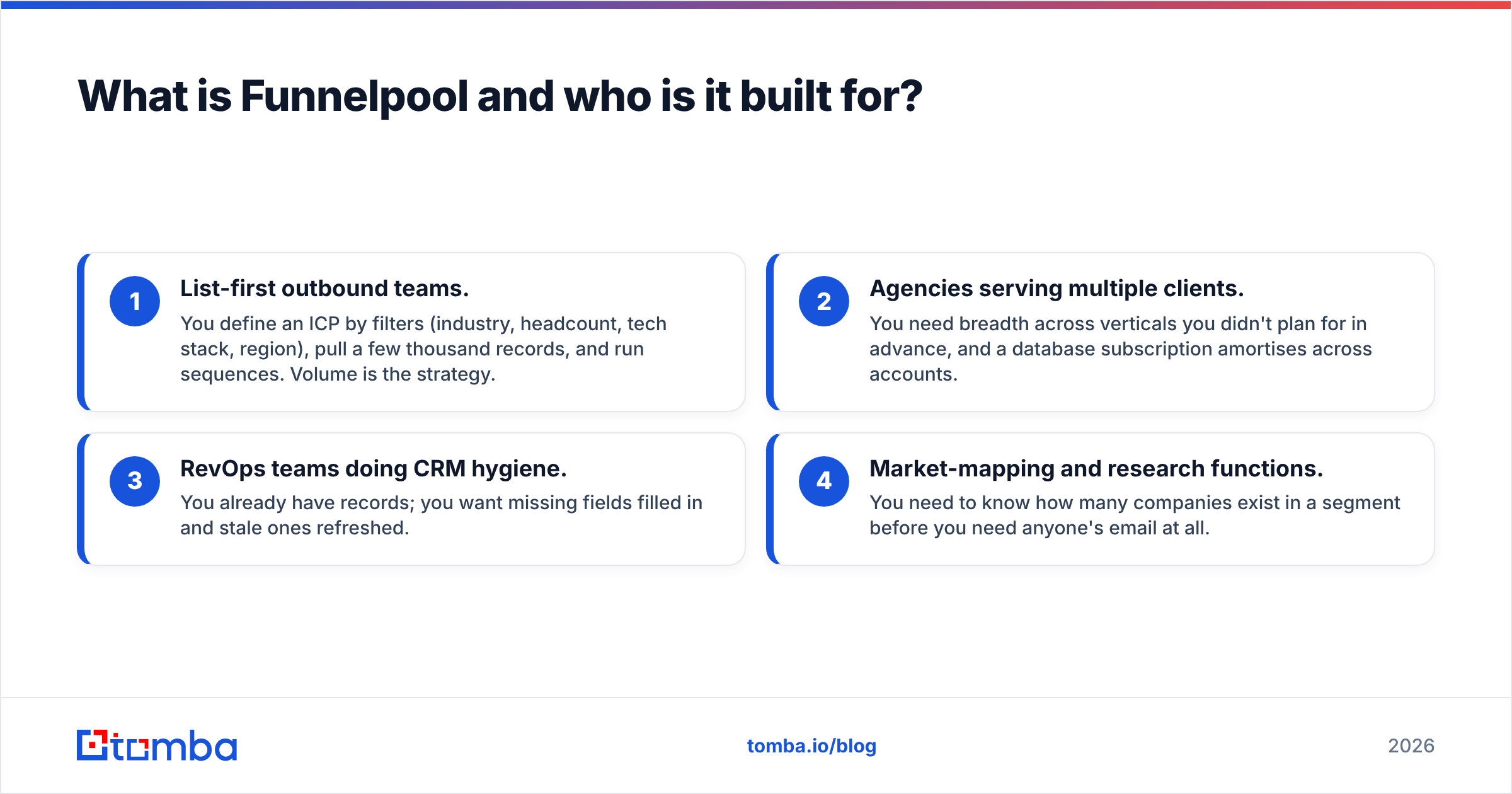
The buyer profile that gets the most value out of a tool like this looks like:
- List-first outbound teams. You define an ICP by filters (industry, headcount, tech stack, region), pull a few thousand records, and run sequences. Volume is the strategy.
- Agencies serving multiple clients. You need breadth across verticals you didn't plan for in advance, and a database subscription amortises across accounts.
- RevOps teams doing CRM hygiene. You already have records; you want missing fields filled in and stale ones refreshed.
- Market-mapping and research functions. You need to know how many companies exist in a segment before you need anyone's email at all.
The buyer profile that tends to overpay looks different: a small team selling into 200 named accounts, who needs the right five people at each one and doesn't care about the other four million records in the database. That team is paying for inventory it will never touch. Keep that distinction in mind — it drives most of the pricing verdict later.

How does Funnelpool pricing actually work?#
Funnelpool prices the way most contact databases price: a monthly or annual subscription that grants a credit allowance, with credits consumed by data-revealing actions. The variables that determine your real cost are these five:
- Credit-to-record ratio. A single "contact" is rarely one credit. Revealing an email may cost one, a phone number two or three, and a full enrichment payload more. Ask for the exact table in writing.
- Seat pricing. Database platforms almost always charge per user. A $99 plan for one rep is a $495 plan for a five-person team, and that multiplier is where most surprise spend lives.
- Credit rollover and expiry. Monthly credits that expire at the end of the cycle are effectively a use-it-or-lose-it tax. Annual credits released monthly behave the same way. Rollover is worth real money.
- Export limits separate from credit limits. Some plans cap how many rows you can push out at once, or gate CSV export behind a higher tier, even when you have credits to spare.
- Annual lock-in discount. The advertised "from $X/month" figure is usually the annual-prepay rate. The month-to-month rate is commonly 20–40% higher, and month-to-month may not be offered at all above a certain tier.
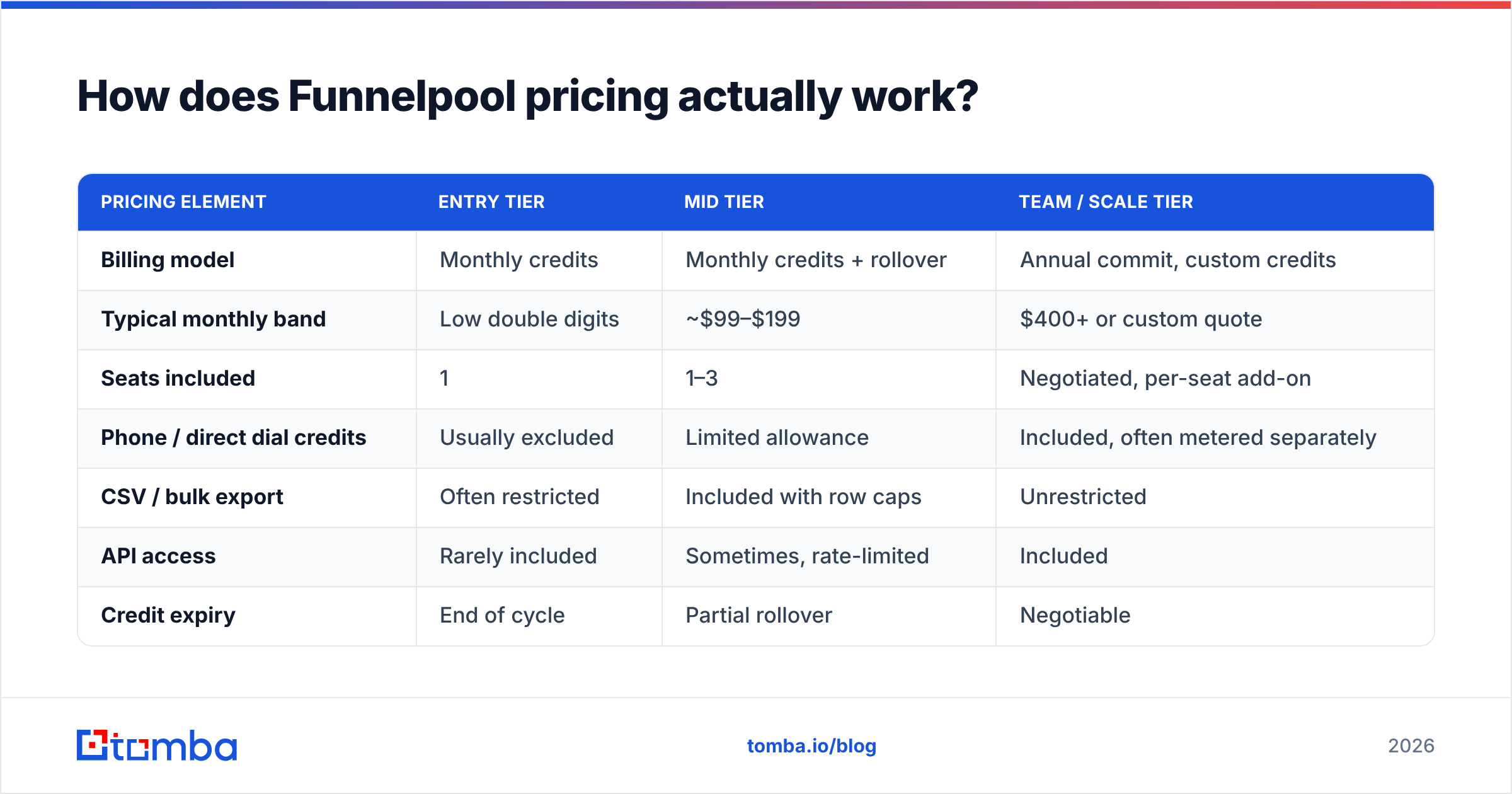
Here's the shape of what you'll typically encounter, expressed as bands rather than quoted figures — confirm the live numbers before you sign:
| Pricing element | Entry tier | Mid tier | Team / scale tier |
|---|---|---|---|
| Billing model | Monthly credits | Monthly credits + rollover | Annual commit, custom credits |
| Typical monthly band | Low double digits | ~$99–$199 | $400+ or custom quote |
| Seats included | 1 | 1–3 | Negotiated, per-seat add-on |
| Phone / direct dial credits | Usually excluded | Limited allowance | Included, often metered separately |
| CSV / bulk export | Often restricted | Included with row caps | Unrestricted |
| API access | Rarely included | Sometimes, rate-limited | Included |
| Credit expiry | End of cycle | Partial rollover | Negotiable |
The pattern to notice: the cheapest tier is priced to look competitive against single-purpose tools, but it strips out the two features that make a database worth owning — bulk export and API access. If you need either, your real entry point is the mid tier, and the comparison changes.
What do Funnelpool reviews say?#
Aggregate review sentiment for tools in this category — Funnelpool included — is fairly predictable once you know where to look. Check the vendor's profile on G2 and Capterra and read the three-star reviews specifically; five-star reviews are usually incentivised and one-star reviews are usually billing disputes. The middle band is where the honest signal is.
The recurring positives:
- Coverage breadth. Reviewers consistently say they can find companies in niches other databases miss, particularly outside the US mid-market.
- Filter depth. Technographic and headcount filters get called out as genuinely useful for building a segment from scratch.
- Speed to first list. Sign up, filter, export, and be sequencing within an hour is a real advantage over manual research.
The recurring complaints:
- Credit burn feels opaque. Users report spending credits on records that turn out to be incomplete or unverifiable, with no clear path to a refund.
- Bounce rates on exported emails. This is the big one, and it's near-universal across the category, not specific to any one vendor. Exported lists routinely need a second verification pass before they're safe to send to.
- Seat and renewal friction. Annual auto-renewal, difficulty downgrading mid-term, and per-seat pricing that scales faster than value are the most common billing frustrations.
- Data staleness in fast-moving segments. Contacts at high-churn companies (startups, agencies) go stale quickly, and re-verification isn't always free.
None of these are disqualifying. They're the standard trade-offs of buying inventory in bulk rather than looking up records on demand.
How accurate is Funnelpool's data — and why does it change the price?#
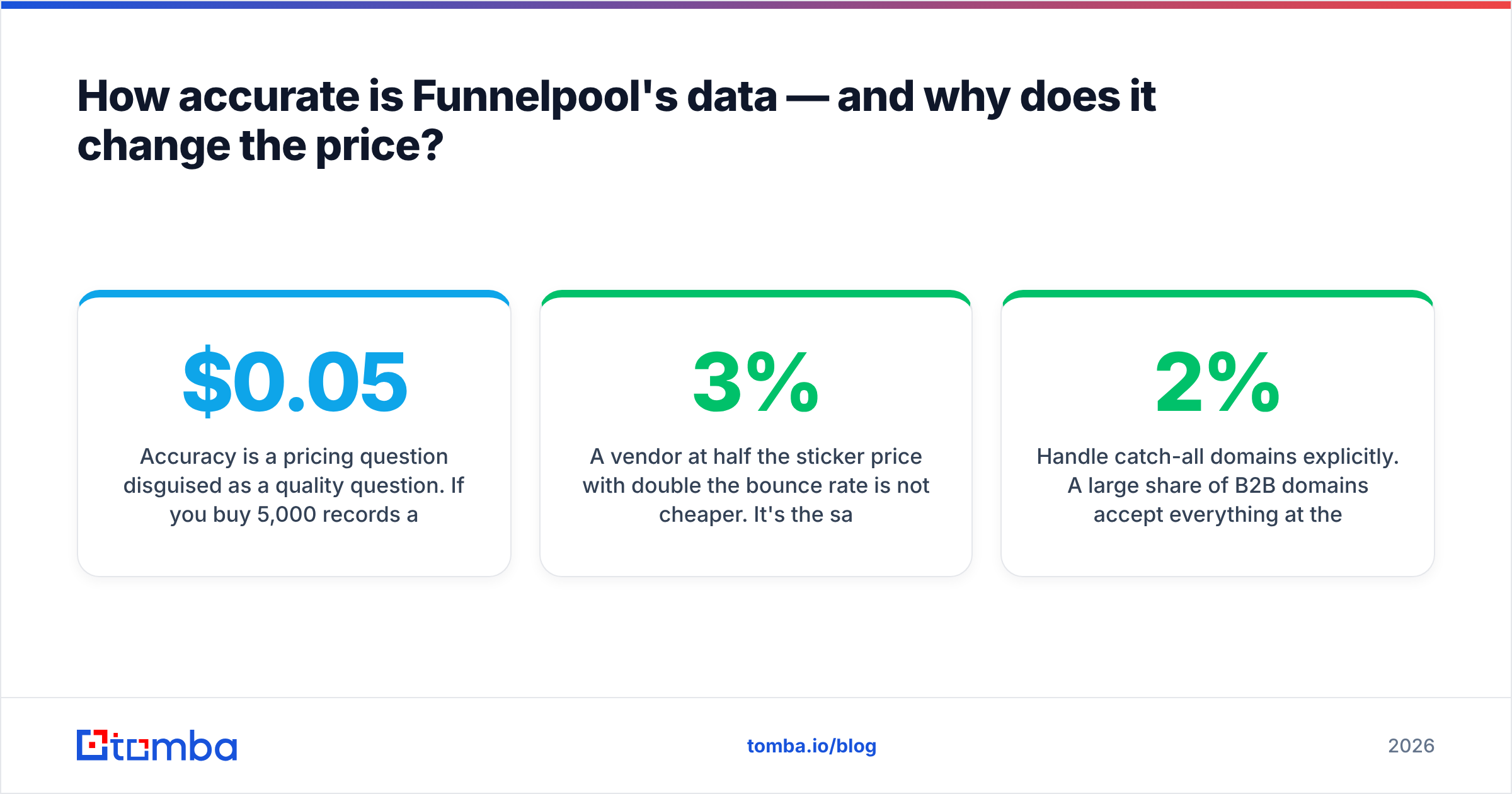
Accuracy is a pricing question disguised as a quality question. If you buy 5,000 records at $0.05 each, that's $250. If 22% of them bounce, you paid $250 for 3,900 usable contacts — an effective $0.064 each — and you also burned sender reputation, which costs more than the credits did.

Run this calculation before you compare any two vendors:
Effective cost per usable contact = (plan cost ÷ records exported) ÷ (1 − bounce rate)
A vendor at half the sticker price with double the bounce rate is not cheaper. It's the same price with extra deliverability damage attached. And a bounce rate above roughly 3% is the threshold where mailbox providers start throttling you, so the downstream cost isn't linear — it's a cliff.
Two practical defences, whichever vendor you pick:
- Never send to a raw database export. Run it through an independent email verifier first, and treat the verification pass as part of your data budget, not an optional extra.
- Handle catch-all domains explicitly. A large share of B2B domains accept everything at the SMTP layer, so "valid" from a basic checker means nothing. A dedicated catch-all verifier is the difference between a 2% and a 12% bounce rate on enterprise lists.
How does Funnelpool compare to the alternatives?#
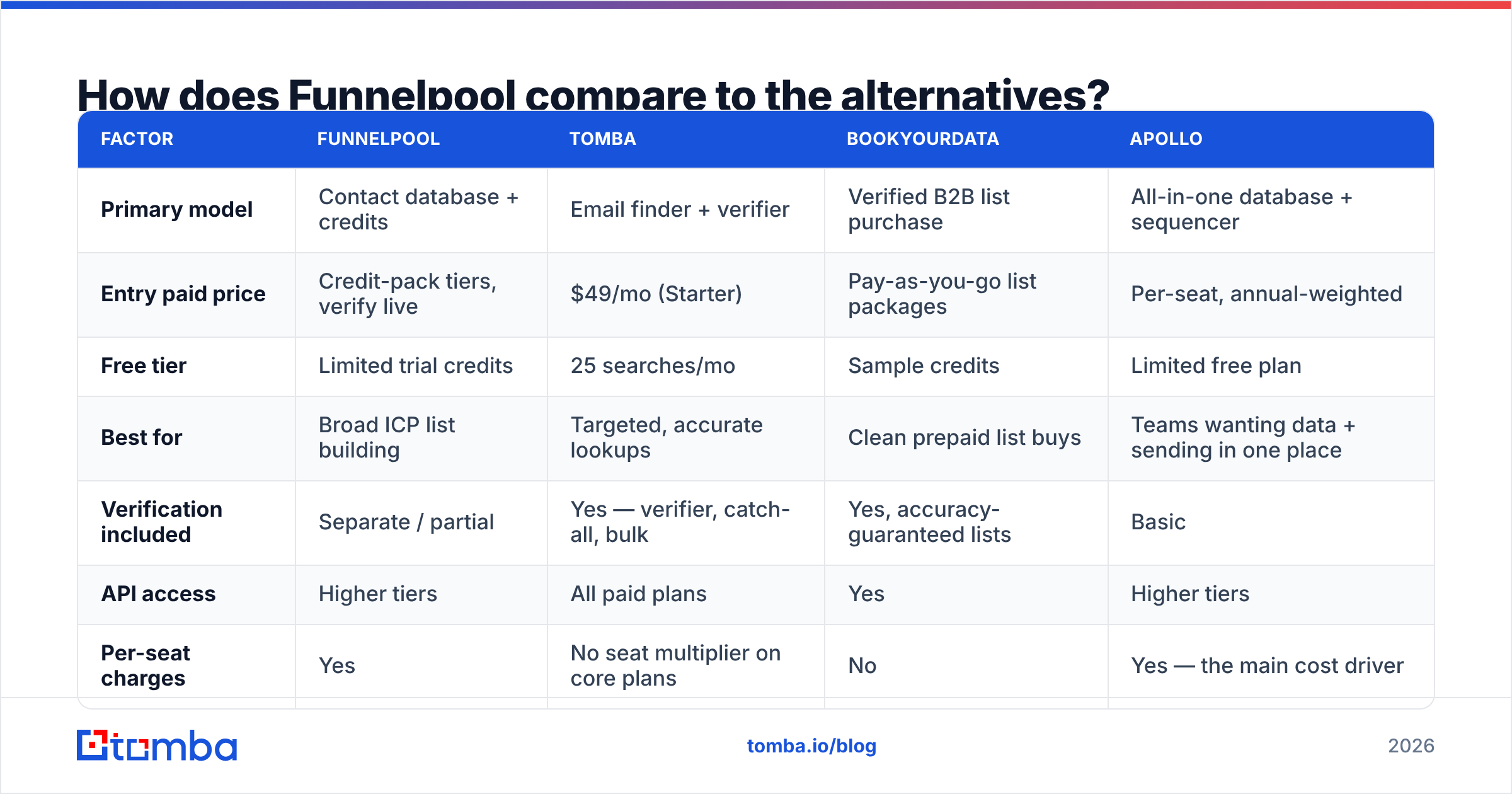
The honest comparison isn't Funnelpool versus one competitor — it's Funnelpool versus two different categories of tool. Databases sell you inventory. Email finders sell you lookups. They're priced differently because they solve different problems.

| Factor | Funnelpool | Tomba | BookYourData | Apollo |
|---|---|---|---|---|
| Primary model | Contact database + credits | Email finder + verifier | Verified B2B list purchase | All-in-one database + sequencer |
| Entry paid price | Credit-pack tiers, verify live | $49/mo (Starter) | Pay-as-you-go list packages | Per-seat, annual-weighted |
| Free tier | Limited trial credits | 25 searches/mo | Sample credits | Limited free plan |
| Best for | Broad ICP list building | Targeted, accurate lookups | Clean prepaid list buys | Teams wanting data + sending in one place |
| Verification included | Separate / partial | Yes — verifier, catch-all, bulk | Yes, accuracy-guaranteed lists | Basic |
| API access | Higher tiers | All paid plans | Yes | Higher tiers |
| Per-seat charges | Yes | No seat multiplier on core plans | No | Yes — the main cost driver |
| Sequencing built in | No | No | No | Yes |
A few things worth spelling out from that table.
BookYourData plays a genuinely different game — pay-as-you-go, accuracy-guaranteed list purchases with no subscription to babysit. If your buying pattern is lumpy (one big list per quarter rather than steady monthly usage), that model is often the cheapest honest option on the table, and it sidesteps the credit-expiry problem entirely.
Apollo bundles data and sending, which is convenient until you want to change one half of the stack. Its per-seat pricing is also the fastest-escalating cost in this comparison as the team grows — which is exactly why the Apollo alternative search volume is what it is.
Tomba sits at the opposite end from Funnelpool: instead of renting inventory, you look up exactly the contacts you need. Tomba pricing runs Free (25 searches/mo), Starter at $49/mo, Growth at $99/mo, Pro at $249/mo, and custom Enterprise, with the email finder API available on paid plans rather than gated to the top tier. For a five-person team, the absence of a seat multiplier is frequently the whole ballgame.

Is Funnelpool worth the price in 2026?#
Conditionally, yes — and the condition is your prospecting shape.
Funnelpool is worth it if:
- You build lists by filter, not by named account, and you export in the thousands per month.
- You need firmographic and technographic segmentation that a lookup tool simply doesn't offer.
- You'll actually consume the credits. Unused credits are the most expensive thing in B2B software.
- You have a separate verification step already in your workflow, so bounce risk is contained.
Funnelpool is not worth it if:
- Your target list is under a few hundred accounts. You're buying a warehouse to store one shelf.
- You're a team of three or more and per-seat pricing multiplies your quote past $300/mo before you've sent a single email.
- You need data inside another system — a spreadsheet, a CRM, a script — more than you need a UI to browse in. A bulk email finder or a direct API call is cheaper and less friction.
- Your outbound is high-intent and low-volume: 40 carefully-researched emails a week to people you've identified by name.
What should you check before you sign anything?#
Ask the sales rep these six questions in writing. The answers, not the pricing page, are your real contract:
- What is the exact credit cost per action — email reveal, phone reveal, full enrichment, re-verification of an existing record?
- Do credits roll over, and what happens to unused credits at renewal or on downgrade?
- What is the per-seat price for users 2 through 10, and are read-only seats free?
- What is the documented replacement policy for invalid records, and what evidence do you need to submit?
- Is month-to-month billing available at the tier you need, and what's the premium over annual?
- What's the cancellation and auto-renewal window? Thirty-day notice clauses buried in annual terms are common.
Then run a paid pilot before the full commitment. Pull 200 records from your actual ICP — not a demo segment the vendor picks — verify them independently, and calculate the effective cost per usable contact. That single test tells you more than every review site combined.
Where does Tomba fit?#
If your honest answer to "do I need a database or do I need lookups?" is lookups, start with the Tomba Email Finder. You give it a name and a domain, or a domain on its own, and it returns verified work emails with a confidence score and the sources behind it — no seat multipliers, no credit expiry games, and no export tier to unlock before you can use your own data.
Start on the free plan with 25 searches a month, run it against the same 200-contact ICP sample you'd use to pilot any database, and compare bounce rates side by side. If the lookup model wins on effective cost per usable contact, Starter at $49/mo is where most teams land — and you can keep whichever database you're using for the segmentation work it's genuinely good at.
Related guides#
Ready to find emails that actually work?
Join 150,000+ professionals who stopped guessing and started sending. Free credits on signup — no credit card required.
Get the Tomba newsletter
Practical outbound tactics and product updates — once every two weeks.
About the author