Gamalogic vs Apollo.io (2026): Email Finder Accuracy Compared
Gamalogic is a lean email finder and verifier. Apollo.io is a full sales platform with a database attached. Here is how they actually differ on accuracy, credits, pricing and workflow — and which one your team should pay for in 2026.
Gamalogic vs Apollo.io is a choice between a scalpel and a Swiss Army knife. One tool finds and verifies email addresses. The other runs your whole outbound motion. This guide compares the two on accuracy, pricing, data depth and daily workflow.
TL;DR
- Gamalogic is a focused email finder and verifier sold on credits. No sequencer, no dialer, no CRM. You buy lookups and you get lookups.
- Apollo.io is a go-to-market platform: a 275M+ contact database plus sequences, a dialer, intent signals and CRM sync — priced per seat, with credits layered on top.
- Gamalogic vs Apollo.io is not a fair fight. They compete for the same budget line, but they solve different problems. Gamalogic replaces a data vendor. Apollo replaces three tools.
- Cost trap: Apollo's per-seat pricing punishes small teams who only need data. Gamalogic's credit model punishes anyone who needs sequencing, because you still have to buy a sending tool.
- If you want finder-grade accuracy plus verification, a real API and no seat tax, a dedicated provider like Tomba sits between them at $49/mo flat.
Gamalogic vs Apollo.io: what is each tool?#
Think of it like buying flour versus buying a bakery. Gamalogic sells you the ingredient — verified B2B email addresses, by the credit. Apollo.io sells you the whole shop: the ingredient, the oven, the storefront and the delivery van.
Gamalogic positions itself as an email finder and email validation service for B2B teams. The core surface is small on purpose: single lookups, bulk uploads, a verification pass, and an API. Pricing is credit-based, not seat-based. That matters more than it sounds. You can put five people on one account and the bill does not move.
Apollo.io is a different animal. It started as a contact database and grew into a full outbound platform. You get search filters for company size, tech stack, funding, headcount growth and job titles. You get sequences with A/B testing. You get a dialer with recording. You also get two-way CRM sync to Salesforce and HubSpot. The database is the anchor, but the platform is the product.
That gap explains almost every argument about which tool is "better." A founder sending 200 manual emails a month is not shopping for the same thing as a 12-rep SDR team running 40 sequences.
Gamalogic vs Apollo.io: how do they compare at a glance?#
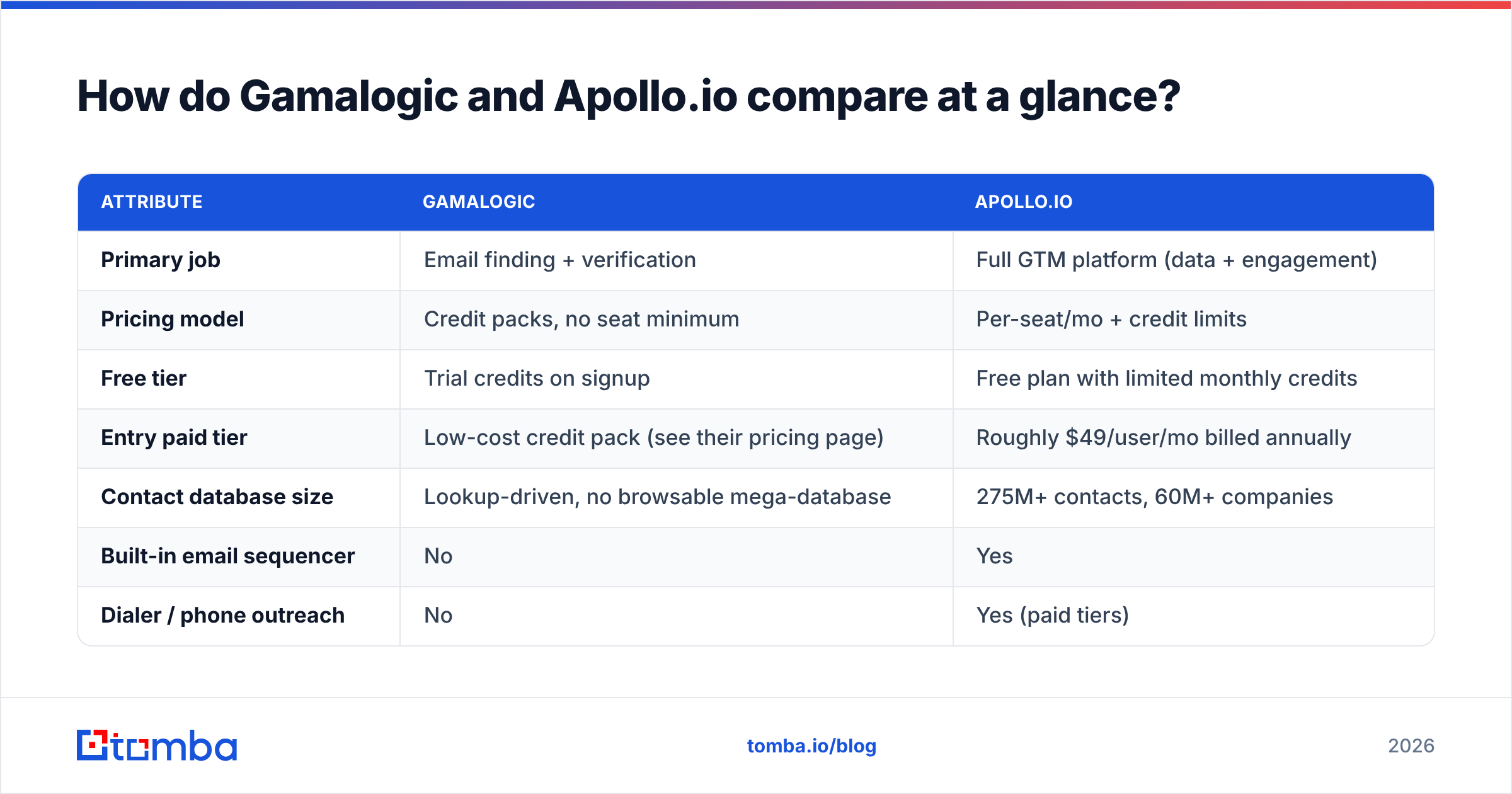
| Attribute | Gamalogic | Apollo.io |
|---|---|---|
| Primary job | Email finding + verification | Full GTM platform (data + engagement) |
| Pricing model | Credit packs, no seat minimum | Per-seat/mo + credit limits |
| Free tier | Trial credits on signup | Free plan with limited monthly credits |
| Entry paid tier | Low-cost credit pack (see their pricing page) | Roughly $49/user/mo billed annually |
| Contact database size | Lookup-driven, no browsable mega-database | 275M+ contacts, 60M+ companies |
| Built-in email sequencer | No | Yes |
| Dialer / phone outreach | No | Yes (paid tiers) |
| Verification included | Yes, core feature | Yes, but credits deduct separately |
| API access | Yes | Yes, higher tiers |
| CRM sync | Via export/integration | Native two-way (Salesforce, HubSpot) |
| Best for | Data-only buyers, agencies, devs | SDR teams running sequences in-app |
The table hides one thing worth saying out loud. Apollo's per-seat model means a five-person team on the entry tier already spends ~$245/month. That is before anyone checks whether the data is good. Gamalogic's credit model decouples cost from headcount entirely.

Gamalogic vs Apollo.io accuracy: which one finds more valid emails?#
Neither vendor will hand you a clean answer, so here is how to think about it.
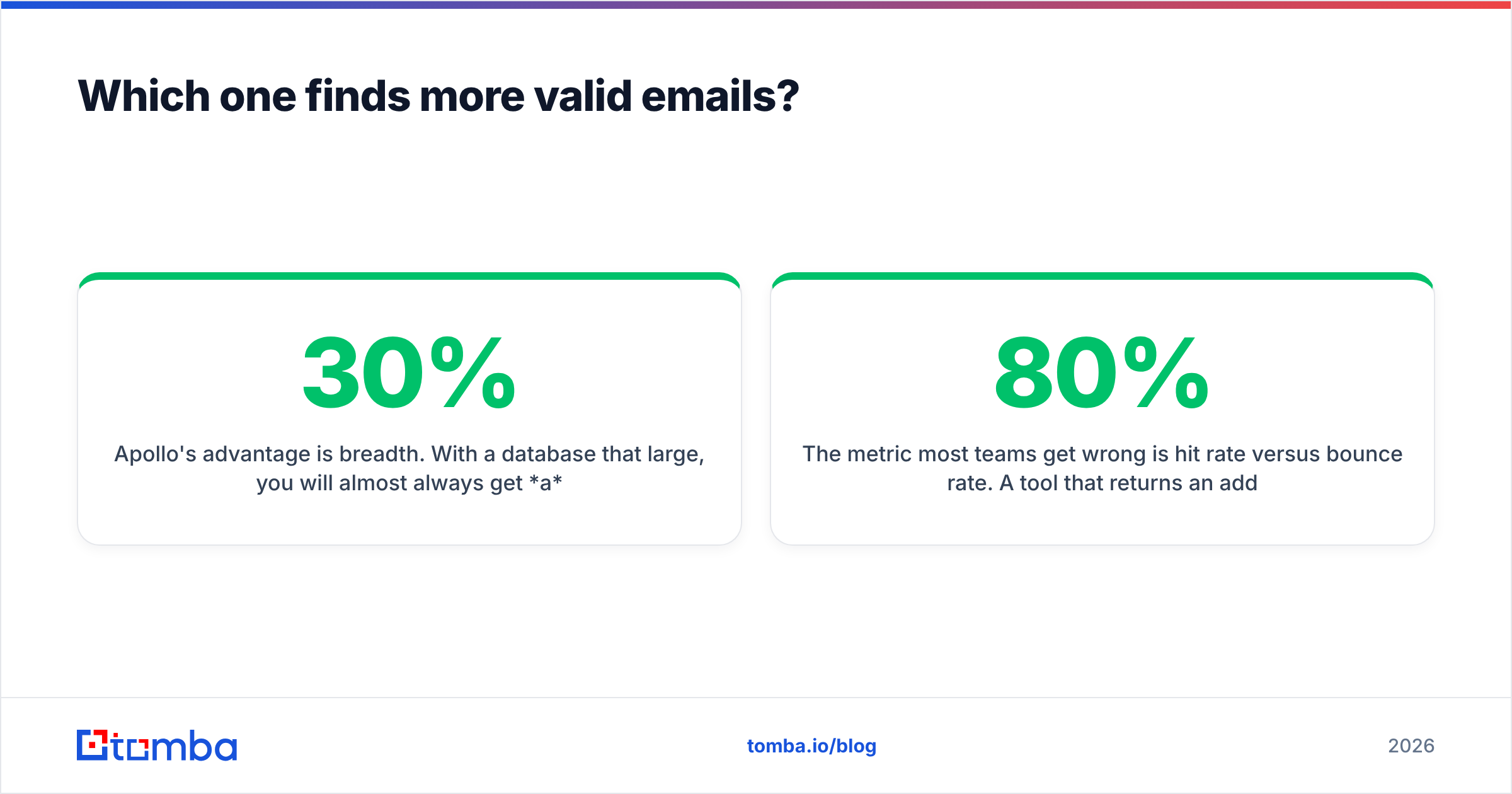
Apollo's advantage is breadth. With a database that large, you will almost always get a record back for a mid-market or enterprise contact. The catch is staleness. Large crowdsourced databases decay at roughly 25–30% per year as people change jobs, and Apollo's records are no exception. That is why the platform labels records "verified" or "guessed." A real share of returns are pattern-derived, not confirmed.
Gamalogic's advantage is that it does one thing. A finder-first tool spends its whole engineering budget on pattern detection, SMTP handshakes and catch-all handling. None of it goes into a sequence builder. In practice you tend to see fewer results returned, but a lower bounce rate on what does come back.

The metric most teams get wrong is hit rate versus bounce rate. Say one tool returns an address for 80% of your list and bounces on 12% of them. A tool that returns 55% and bounces on 2% is the better buy. Bounces damage your sender reputation, and that damage is retroactive. It hurts the campaigns you already sent.
Whichever you pick, run a separate verification pass before sending. Both platforms verify, but neither is neutral about its own data. An independent email verifier catches the records a vendor is optimistic about.
Gamalogic vs Apollo.io pricing: how does it actually work?#
This is where most evaluations go sideways. The two vendors count different things.
Gamalogic charges for credits. One credit is roughly one lookup or one verification. Credits usually come in packs you buy up front. There is no user minimum, so adding a teammate costs nothing. Check their current pricing page before you budget. Credit-pack vendors reprice often.
Apollo.io charges per user per month. Each tier includes an allowance of "credits" — email credits, mobile credits and export credits are separate buckets. Published tiers land around $49/user/mo for the entry paid plan, and roughly $79–$119/user/mo as you move up, with annual billing discounts. Trust the official pricing page over any third-party number, because Apollo adjusts tiers regularly. Two costs catch teams off guard:
- Mobile numbers are metered separately. Phone credits burn far faster than email credits and refill on their own schedule.
- Export limits are a real ceiling. Seeing a contact in-app and exporting it to your CRM are billed as different actions on some plans.
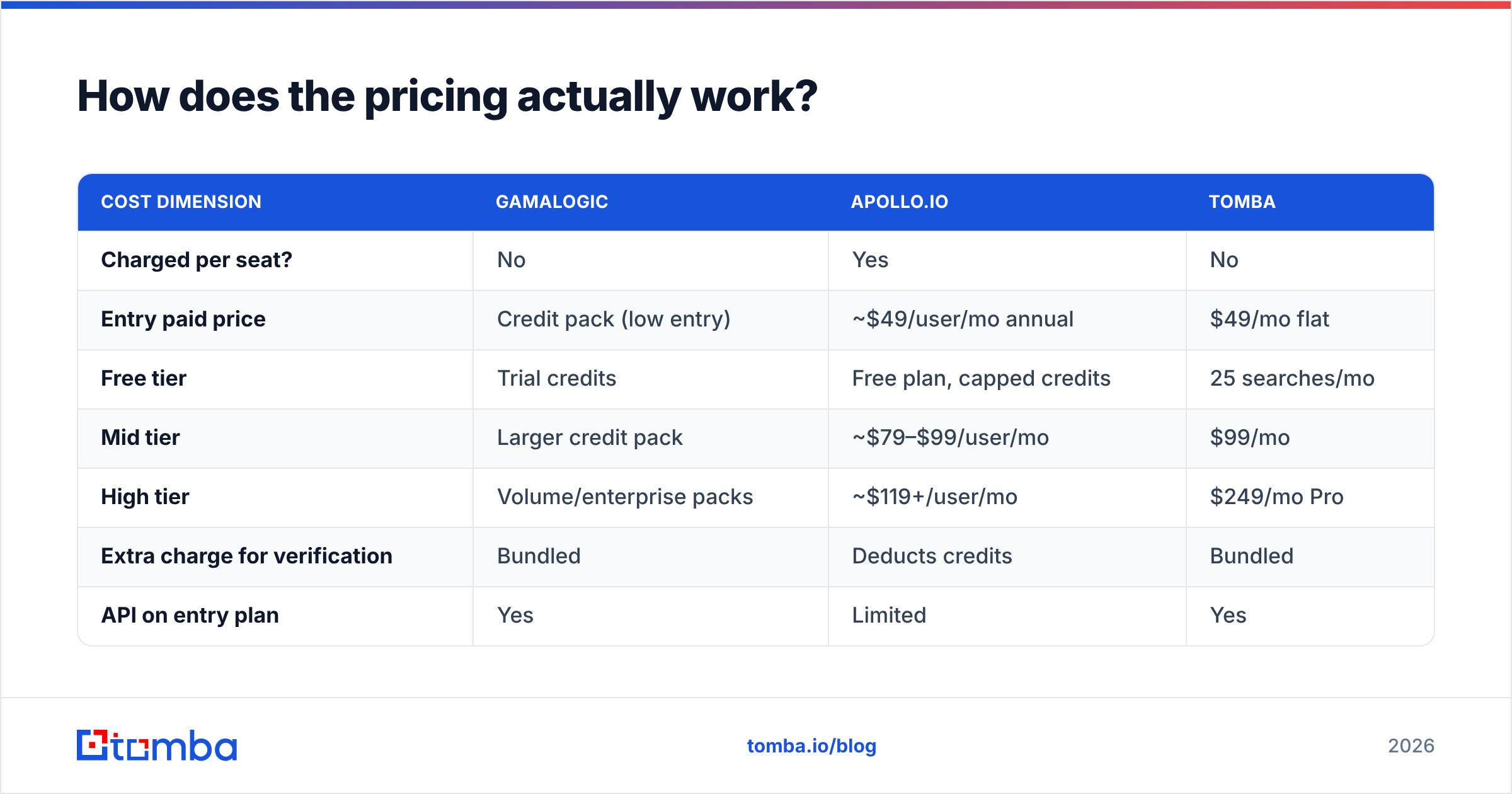
| Cost dimension | Gamalogic | Apollo.io | Tomba |
|---|---|---|---|
| Charged per seat? | No | Yes | No |
| Entry paid price | Credit pack (low entry) | ~$49/user/mo annual | $49/mo flat |
| Free tier | Trial credits | Free plan, capped credits | 25 searches/mo |
| Mid tier | Larger credit pack | ~$79–$99/user/mo | $99/mo |
| High tier | Volume/enterprise packs | ~$119+/user/mo | $249/mo Pro |
| Extra charge for verification | Bundled | Deducts credits | Bundled |
| API on entry plan | Yes | Limited | Yes |
On price, Gamalogic vs Apollo.io splits cleanly by team shape. Three people who need data and already own a sending tool will find Apollo's model structurally expensive. Eight SDRs who need sequences, dialing and CRM sync will find it structurally cheap. Assembling those pieces separately costs more.
What does the feature gap actually look like in daily work?#
Here is the same task in both tools: build a list of 500 heads of marketing at Series B SaaS companies and email them.
- In Apollo: filter the database, save the search, export or push straight into a sequence, write three steps, hit go. One tab. The sequence sends from your connected mailbox and replies land in the Apollo inbox.
- In Gamalogic: get your company or person list from somewhere else (a LinkedIn export, a scraper, a purchased list), upload it for bulk finding, download the enriched CSV, then import it to Instantly, Smartlead or Lemlist and write your sequence there.
On workflow, Gamalogic vs Apollo.io has a clear winner: Apollo. Gamalogic wins only if you already have a sending stack you like and refuse to migrate. That describes a lot of agencies, because their sending infrastructure is the business.
A lot of teams land on a third path. Keep your sequencer, but use a dedicated data layer with a proper API. A bulk email finder plus a domain search covers list building without a per-seat contract, and the Tomba API plugs into whatever orchestration you already run.


How do you test them yourself before committing?#
Vendor accuracy claims are marketing. Run this test instead. It takes about an hour and settles the argument with data.
- Build a 100-row golden list. Use contacts whose real email you already know — customers, past prospects, people who have replied to you. Strip the emails out.
- Run the identical list through both tools. Same order, same columns. Do not let anyone "clean" the input between runs.
- Score three numbers, not one. Hit rate (rows returned), match rate (returned address equals the known-correct one), and cost per correct match. The third number decides the purchase.
Then pressure-test the results before you sign anything:
- Send a 50-address test to the returns you can't verify manually. Track hard bounces. Anything over 3% is a red flag, whatever the dashboard promised.
- Time the API. If you plan to automate, measure p95 latency and the rate limit. A tool that returns great data at 12 seconds per lookup will not survive a 50,000-row enrichment job.
- Check catch-all handling explicitly. A large share of B2B domains accept everything at the server level. Ask each vendor what it does with those — guess, flag, or run deeper checks. A dedicated catch-all verifier will tell you what a general-purpose tool is quietly guessing at.
Buyers who skip step 3 almost always overpay. A tool with a 15% higher hit rate but a 4× price per correct match is a worse deal, and the dashboard will never tell you that.
Who should choose Gamalogic?#
In the Gamalogic vs Apollo.io decision, pick Gamalogic if most of these are true:
- You need email addresses and verification, and nothing else.
- Your headcount is growing but your data needs are flat. Seat-based pricing would tax you for no benefit.
- You already run a sending platform (Instantly, Smartlead, Lemlist, Saleshandy) and have no interest in switching.
- You build your prospect lists elsewhere and just need them enriched.
- You are an agency running lookups for clients and want cost tied to volume, not to users.
Where it will frustrate you: there is no browsable database, so you must bring your own list. There is no engagement layer at all.
Who should choose Apollo.io?#
Pick Apollo if most of these are true:
- You want prospecting, enrichment and sending in one login.
- You have a real SDR team where per-seat cost is justified by per-seat output.
- You need intent data, job-change alerts and technographic filters to build territories.
- Native two-way Salesforce or HubSpot sync is a hard requirement.
- You value database breadth over per-record precision and will verify before sending anyway.
Where it will frustrate you: credit buckets deplete unpredictably, long-tail contact data goes stale, and the bill scales with headcount rather than usage. That combination is why Apollo alternatives are one of the most-searched categories in this space.
Where does Tomba fit in this comparison?#
Honestly: Tomba is not trying to be Apollo. There is no dialer, no sequencer, no intent scoring. It sits much closer to Gamalogic — a dedicated data layer — with three differences that matter when you are stuck on Gamalogic vs Apollo.io.
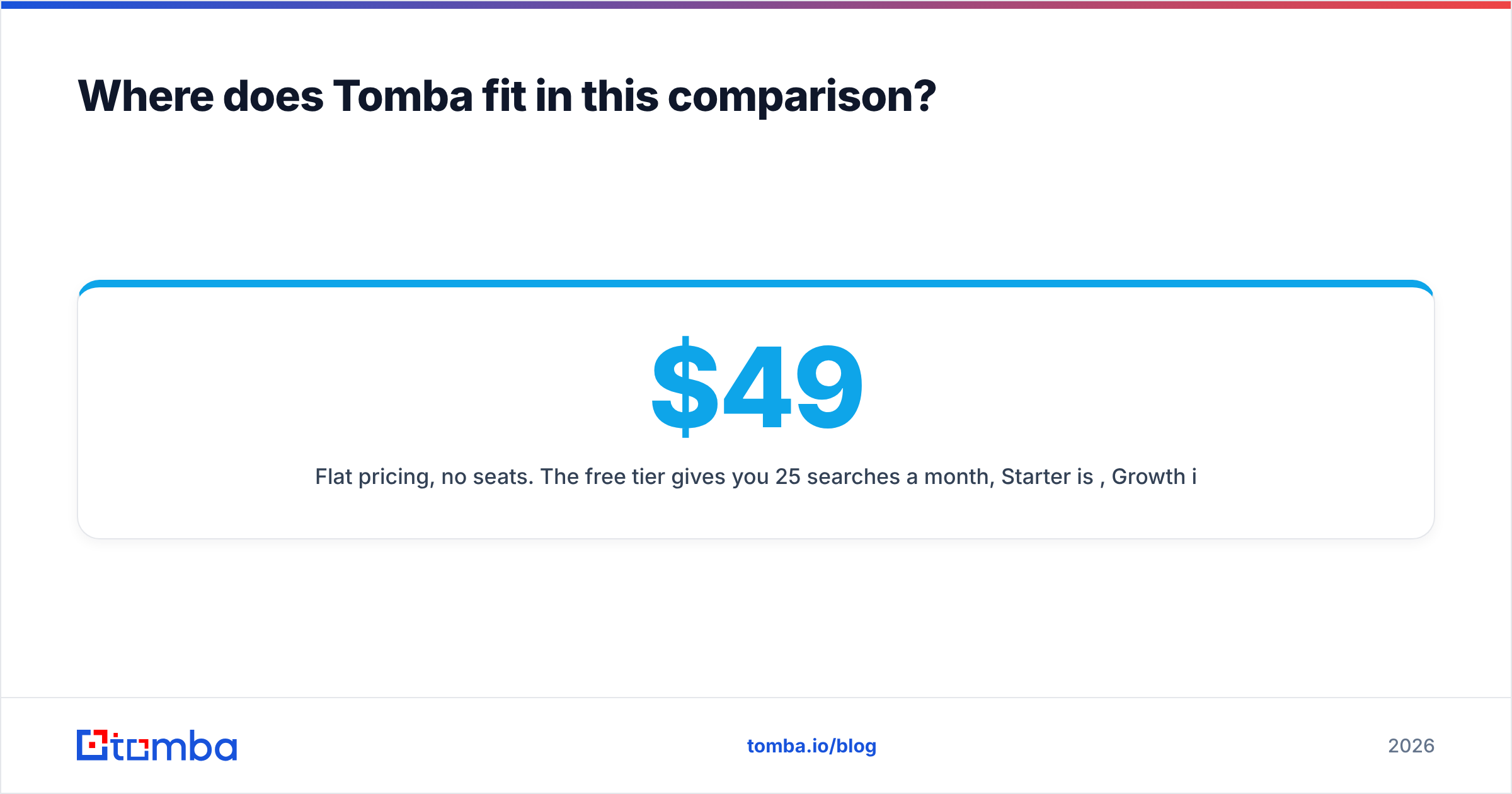
Flat pricing, no seats. The free tier gives you 25 searches a month. Starter is $49/mo, Growth is $99/mo and Pro is $249/mo. Adding teammates does not change the number. Full Tomba pricing is public, with no "contact sales" wall on the tiers most teams actually buy.
Verification bundled with finding. Every found address runs through validation, and catch-all domains get flagged rather than silently guessed. That is the single biggest driver of bounce rate. It is also where cheap credit-pack tools tend to cut corners.
Developer surface on every plan. API, CLI, MCP server, Chrome extension, Google Sheets and Excel add-ins, plus Zapier, Make, HubSpot and Salesforce connectors. If your workflow is "enrich rows in a spreadsheet on a schedule," you should not need an enterprise contract to do it.
The honest trade-off: if you need a browsable 275M-contact database with intent filters and a built-in dialer, Apollo does something Tomba does not. Buy Apollo. If what you need is accurate addresses that do not bounce, feeding a sending stack you already own, a dedicated finder is cheaper and cleaner.
What is the verdict?#
Gamalogic vs Apollo.io comes down to one question: are you buying data or buying a workflow?
Buying data → Gamalogic (or another finder-first tool) is the right shape, and you will pay a fraction of Apollo's per-seat rate.
Buying a workflow → Apollo, and stop comparing it to email finders. You are comparing it to Outreach and Salesloft, where it wins on price by a wide margin.
The mistake is buying Apollo for the database, ignoring 70% of the platform, and paying per seat for the privilege. That is the most common overspend in outbound tooling, and it is what drives teams to re-evaluate every renewal cycle. For a broader view of how buyers rate each category, G2's lead intelligence grid is a reasonable neutral starting point.
Ready to test the data layer without a seat contract? Start with the Tomba Email Finder — 25 free searches a month, no card, every result verified and catch-all domains flagged before they hit your sequencer. Add it to your own Gamalogic vs Apollo.io test, compare cost per correct match, and let the numbers pick your vendor.
Related guides#
Ready to find emails that actually work?
Join 150,000+ professionals who stopped guessing and started sending. Free credits on signup — no credit card required.
Get the Tomba newsletter
Practical outbound tactics and product updates — once every two weeks.
About the author