9 Best Generect Alternatives for B2B Lead Data in 2026
Generect is a solid LinkedIn-sourced lead API, but it is not the right fit for every team. Here are nine alternatives compared on data accuracy, pricing transparency, API limits, and how fast you can get from signup to a verified list.
TL;DR
- Generect is a LinkedIn-sourced B2B lead API with strong company/people search, but pricing is quote-driven and self-serve access is limited compared to newer tools.
- If you mainly need verified work emails at a predictable price, Tomba, Findymail, and BookYourData are the closest practical swaps.
- If you need full sequencing plus data in one seat, Apollo or Clay make more sense than a pure data API.
- The single biggest cost driver is not the sticker price — it is the bounce rate on the emails you pay for. Budget for verification either way.
- Run the same 100-contact test list through any two finalists before you commit to an annual contract. Coverage varies wildly by region and company size.
What is Generect and why do teams look for alternatives?#
Generect is a B2B lead generation platform built around LinkedIn-derived data. You give it a set of filters — job title, headcount, industry, geography, tech stack — and it returns matching people and companies, with emails and an API for pulling that data into your own systems. Its main pitch is real-time search rather than a stale static database, plus native LinkedIn search-URL ingestion, which is genuinely useful if your ICP already lives in Sales Navigator.
So why do people search for Generect alternatives? Four reasons come up repeatedly in buyer conversations and on review sites like G2:
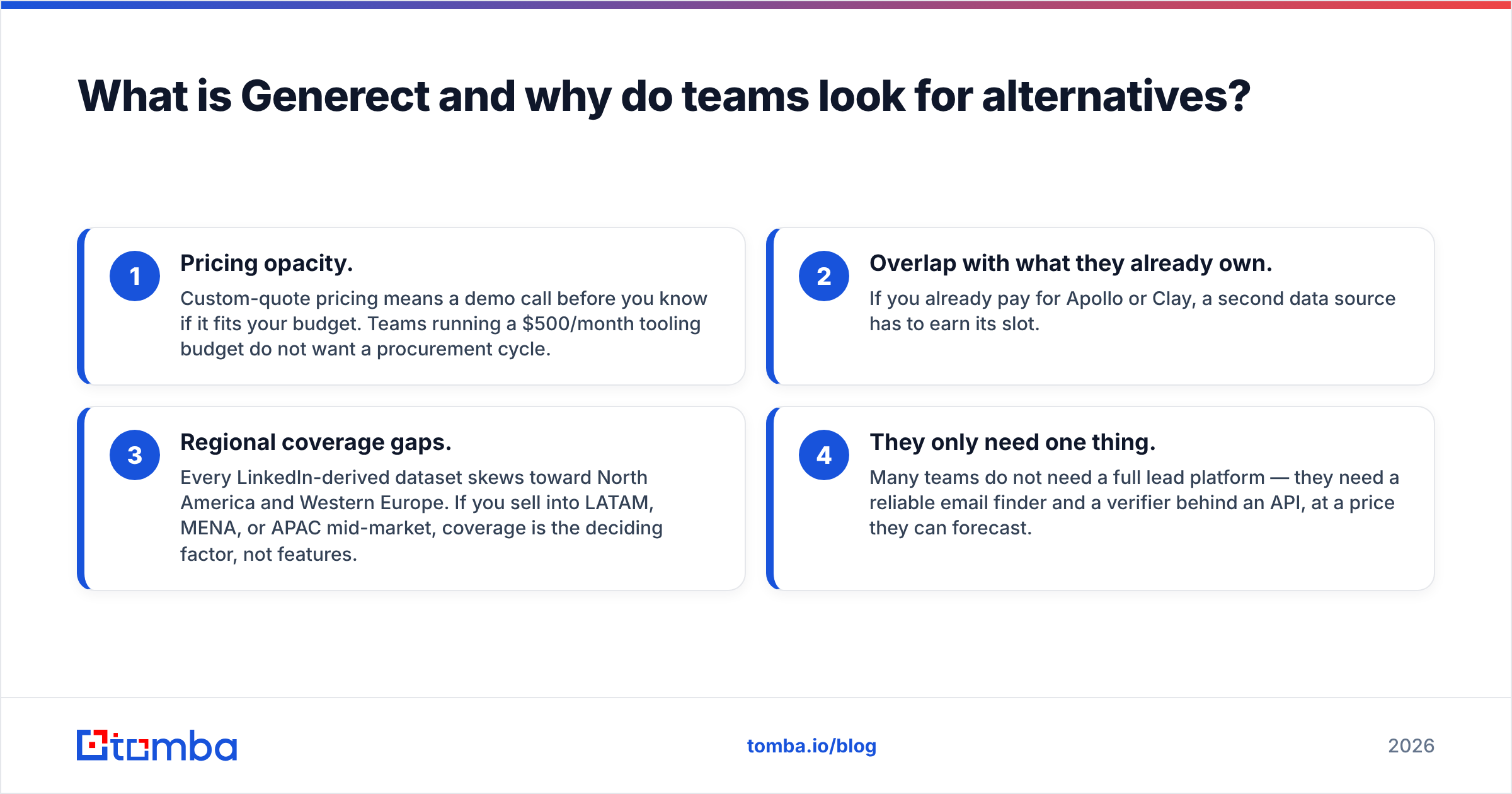
- Pricing opacity. Custom-quote pricing means a demo call before you know if it fits your budget. Teams running a $500/month tooling budget do not want a procurement cycle.
- Overlap with what they already own. If you already pay for Apollo or Clay, a second data source has to earn its slot.
- Regional coverage gaps. Every LinkedIn-derived dataset skews toward North America and Western Europe. If you sell into LATAM, MENA, or APAC mid-market, coverage is the deciding factor, not features.
- They only need one thing. Many teams do not need a full lead platform — they need a reliable email finder and a verifier behind an API, at a price they can forecast.
If any of those describe you, the list below is the shortlist worth testing.

What should you look for in a Generect alternative?#
Before you compare logos, get clear on the five variables that actually determine cost per meeting. Everything else is noise.
- Verified-email rate, not database size. "500M contacts" is a vanity number. What matters is the percentage of returned emails that are SMTP-verified and deliverable. A tool that returns 55 verified emails from 100 lookups beats one that returns 90 guesses.
- Credit accounting. Ask exactly when a credit burns. Some vendors charge for a search that returns nothing; the better ones only charge on a successful, verified result. Over a year, this difference is often 30–40% of spend.
- API depth and rate limits. If you are automating enrichment, you need documented endpoints, sane rate limits, webhooks, and bulk jobs — not just a UI export. Check whether the email finder API supports the batch sizes you actually run.
- Catch-all handling. Catch-all domains are where most vendors quietly fail. Some mark everything "accept-all" and hand you the risk. Others run deeper checks. Ask specifically how the vendor treats them, and test with a catch-all verifier before trusting the output.
- Exit cost. Can you export your data? Is the contract monthly or annual? Is there a free tier to keep as a fallback? Data vendors churn; assume you will switch again within 18 months and pick accordingly.
Which Generect alternatives are worth testing in 2026?#
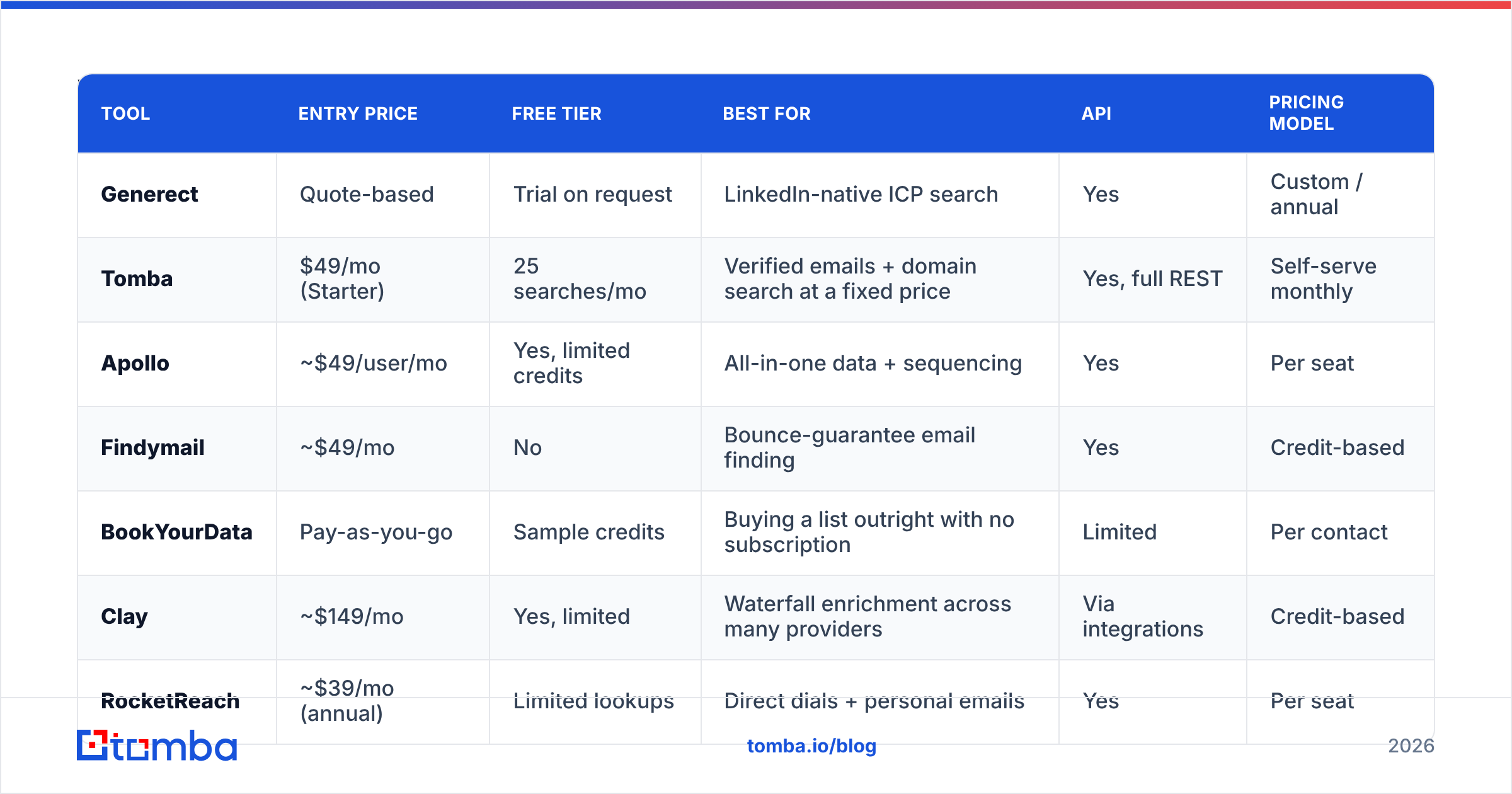
Here is the head-to-head. Prices are the publicly listed entry tiers at the time of writing — always confirm on the vendor's own pricing page, since data vendors reprice frequently.
| Tool | Entry price | Free tier | Best for | API | Pricing model |
|---|---|---|---|---|---|
| Generect | Quote-based | Trial on request | LinkedIn-native ICP search | Yes | Custom / annual |
| Tomba | $49/mo (Starter) | 25 searches/mo | Verified emails + domain search at a fixed price | Yes, full REST | Self-serve monthly |
| Apollo | ~$49/user/mo | Yes, limited credits | All-in-one data + sequencing | Yes | Per seat |
| Findymail | ~$49/mo | No | Bounce-guarantee email finding | Yes | Credit-based |
| BookYourData | Pay-as-you-go | Sample credits | Buying a list outright with no subscription | Limited | Per contact |
| Clay | ~$149/mo | Yes, limited | Waterfall enrichment across many providers | Via integrations | Credit-based |
| RocketReach | ~$39/mo (annual) | Limited lookups | Direct dials + personal emails | Yes | Per seat |
| Lusha | ~$36/user/mo | 50 credits/mo | Chrome-extension prospecting | Yes (higher tiers) | Per seat |
| Wiza | From ~$30/mo | Trial credits | Exporting Sales Navigator lists | Yes | Credit-based |

Tomba — best for predictable, verified email data#
Tomba is the closest thing to a like-for-like swap if what you valued in Generect was the data API rather than the LinkedIn UI. You get domain search (every public email pattern at a company), single and bulk email finder jobs, an email verifier, catch-all handling, phone lookup, and enrichment — all behind one documented API and one key.
The pricing is the differentiator for most teams leaving a quote-based vendor: Free (25 searches/month), Starter $49/mo, Growth $99/mo, Pro $249/mo, Enterprise custom. No demo call, no annual lock, and you can see the full Tomba pricing before you sign up. Native add-ins for Google Sheets, Excel, and Airtable cover the non-technical half of the team.
Weak spot: it is a data and verification layer, not a sequencer. You still need Instantly, Smartlead, or your CRM to send.
Apollo — best all-in-one replacement#
If you want data plus sequencing plus a dialer in one login, Apollo remains the default. Its database is large, the free tier is usable for testing, and the sequencer is decent. The trade-off is per-seat pricing that scales badly across a 10-person team and email accuracy that varies a lot by segment — plan on verifying before send regardless. Teams that want the data without the seat tax often pair a cheaper finder with a dedicated sender; see our breakdown of Apollo alternatives for that pattern.
Findymail — best bounce guarantee#
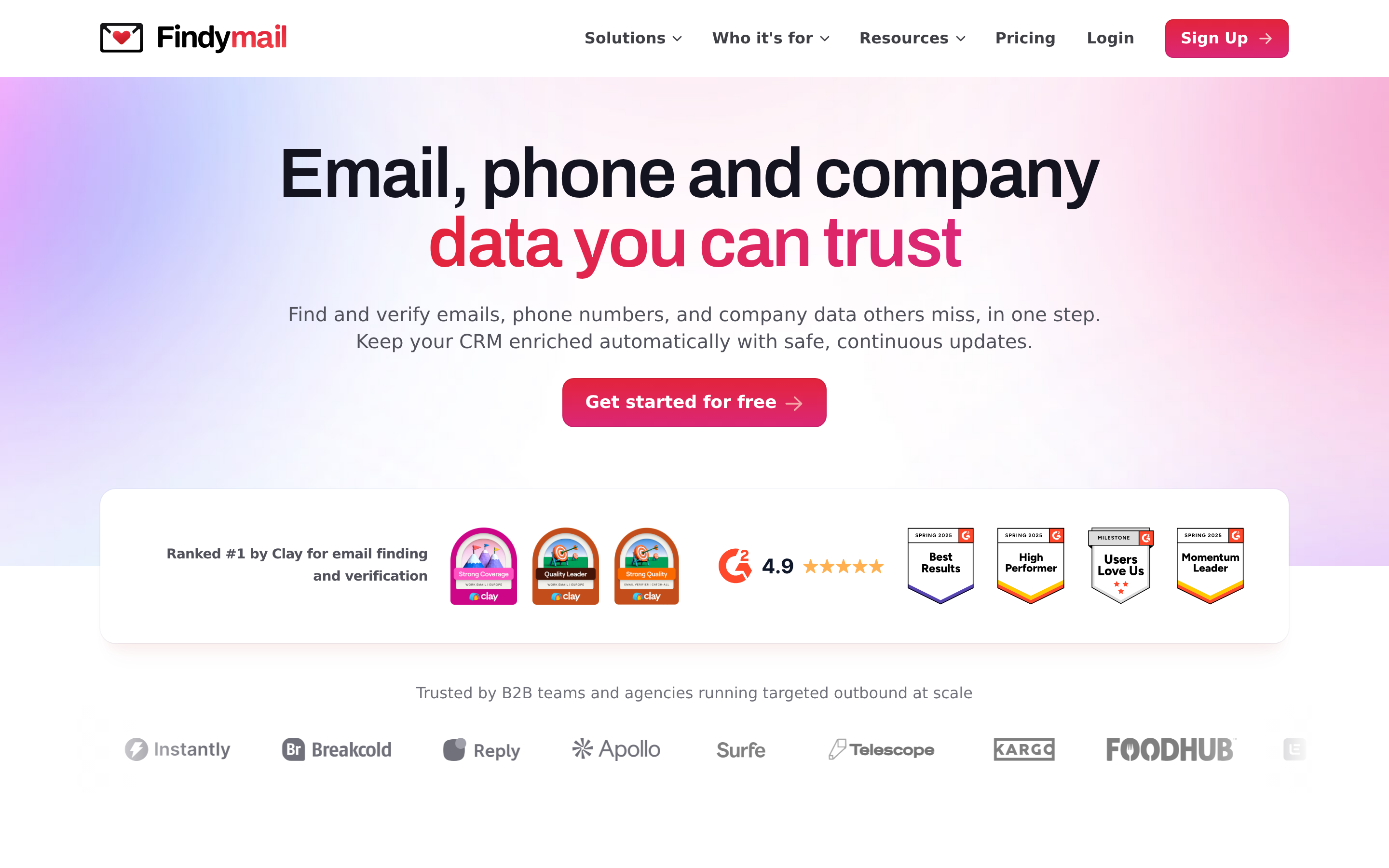
Findymail built its reputation on not returning junk. It refuses to sell you an email it cannot stand behind, which shows up as lower match rates but very low bounces. That is the right trade if your domain reputation is fragile. Pricing is credit-based and comparable to Tomba's entry tier; the API is simpler and there is no verification-only product.
BookYourData — best for buying a list outright#
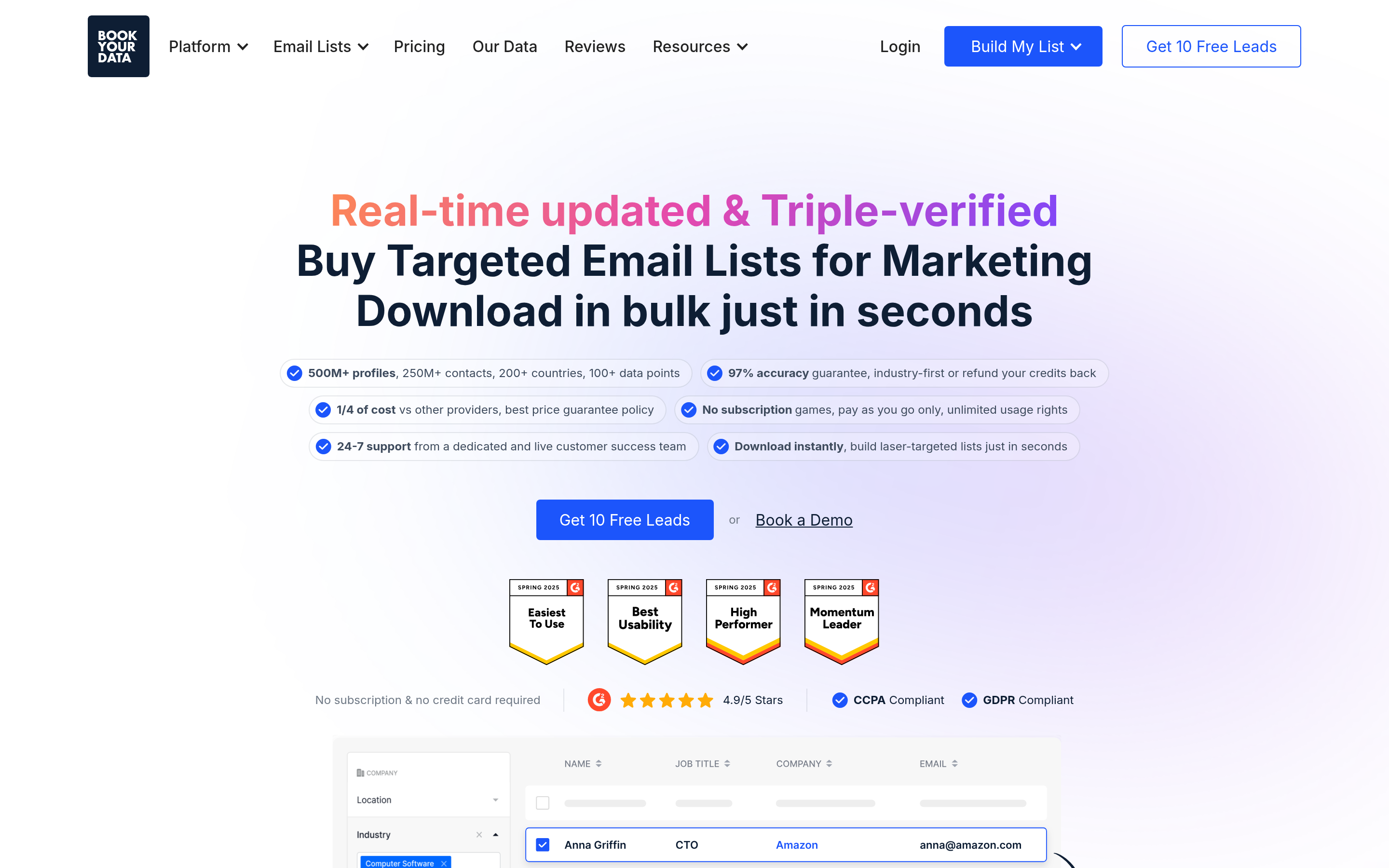
BookYourData takes a different approach: pay-as-you-go contact purchasing with an accuracy guarantee, no monthly subscription required. If you need 5,000 contacts for one campaign in one region and do not want another recurring line item, that model is genuinely cleaner than a seat license. It is less suited to continuous, API-driven enrichment where you are looking up contacts one at a time as they enter your CRM — different job, different tool.
Clay — best for waterfall enrichment#
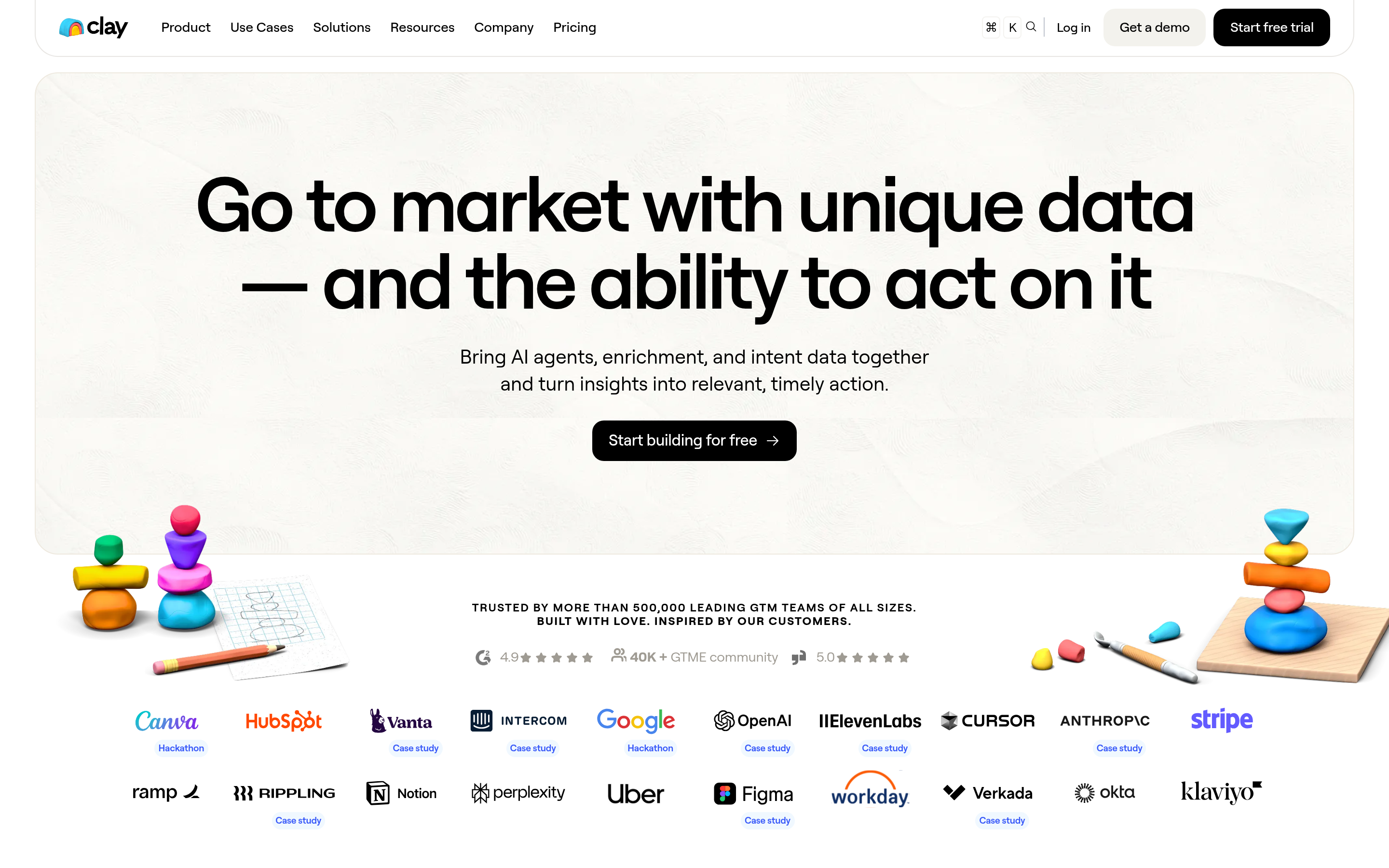
Clay does not own much data. It orchestrates other vendors, calling provider after provider until one returns a match. For a RevOps team with budget and patience, that produces the highest coverage of anything on this list. It is also the most expensive and the steepest to learn. Do not buy Clay to find 300 emails a month; buy it when enrichment logic itself is your bottleneck.
RocketReach, Lusha, and Wiza — the point solutions#
RocketReach and Lusha lean toward personal emails and direct dials, which is what you want for a phone-led motion. Wiza is the pragmatic choice if your workflow is literally "export this Sales Navigator search" — that is the one job it does better than almost anyone. None of these three replace a full lead-data API, but each beats a general-purpose tool at its narrow task.
How accurate are these tools, really?#
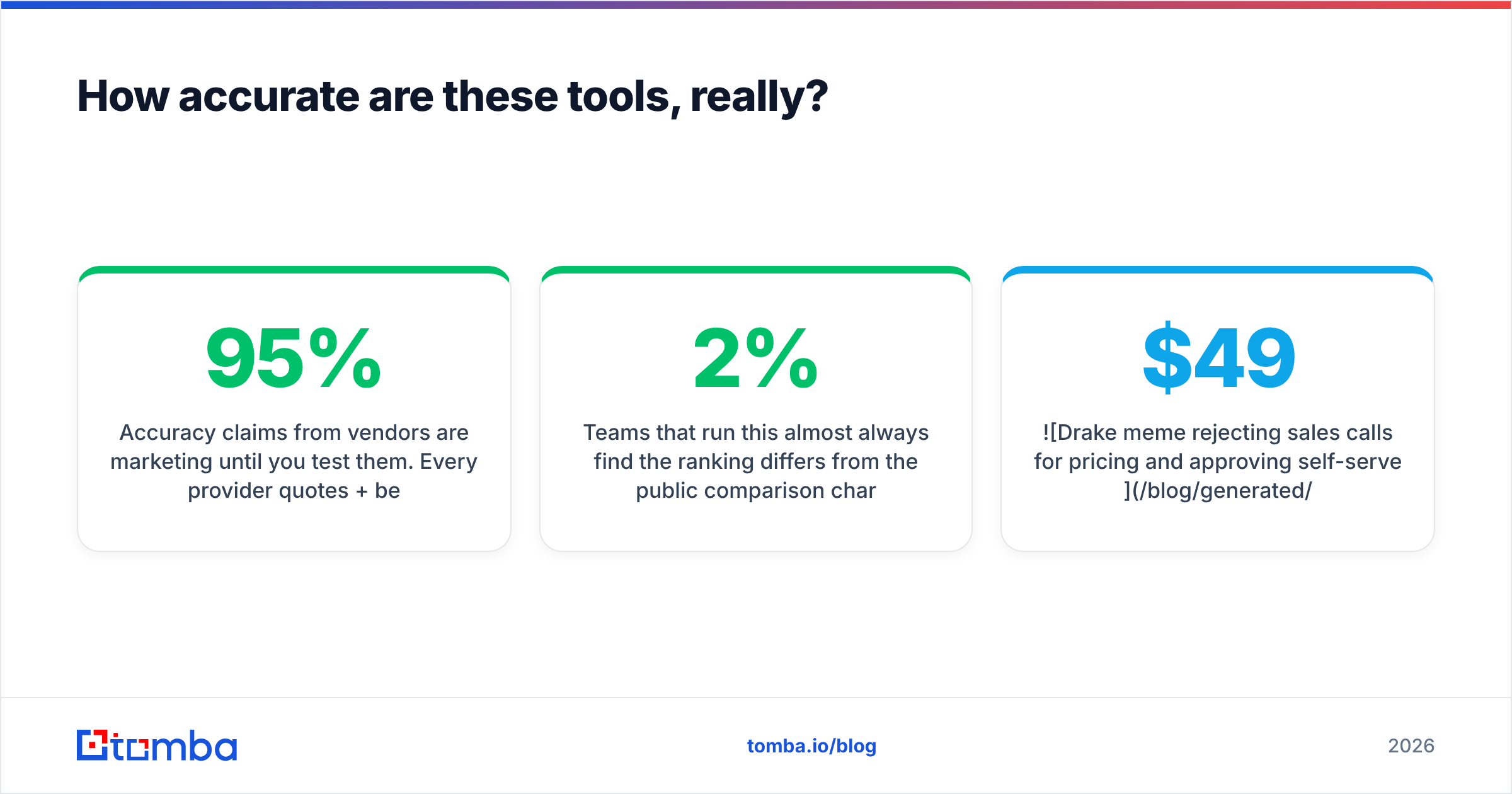
Accuracy claims from vendors are marketing until you test them. Every provider quotes 95%+ because they measure on the subset of contacts they are confident about, then exclude the misses from the denominator.

Here is a test protocol you can run in an afternoon, and it settles the argument better than any review site:
- Build one list of 100 contacts that mirrors your real ICP — same seniority, same company sizes, same countries. Do not use a list of Fortune 500 CMOs; everyone finds those.
- Run the identical list through each finalist's free tier or trial.
- Record three numbers per tool: match rate (emails returned / 100), verified rate (emails marked deliverable), and credits burned.
- Send a single low-volume warm-up campaign to each set and record the real bounce rate.
- Compute cost per deliverable email, not cost per credit.
Teams that run this almost always find the ranking differs from the public comparison charts, because coverage is regional. A tool that wins in Germany can lose badly in Brazil. Also check what happens on catch-all domains, since that is where the accuracy numbers diverge most — a vendor that returns "accept-all" without further checks is handing you an unmeasured risk. Read up on how email deliverability degrades once bounces cross 2% before you decide the difference is academic.
Which Generect alternative fits your specific use case?#
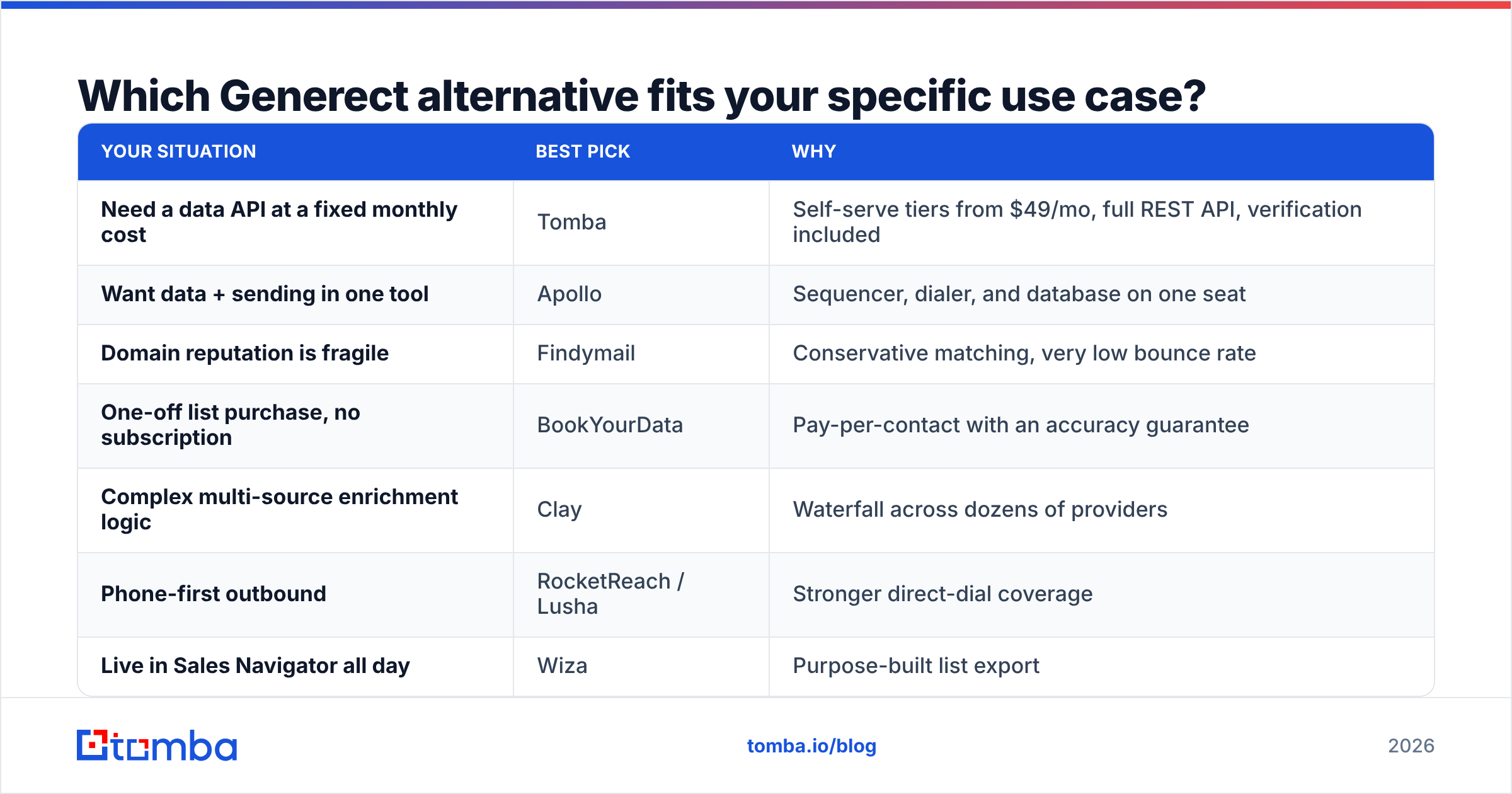
Match the tool to the motion, not to the feature list.
| Your situation | Best pick | Why |
|---|---|---|
| Need a data API at a fixed monthly cost | Tomba | Self-serve tiers from $49/mo, full REST API, verification included |
| Want data + sending in one tool | Apollo | Sequencer, dialer, and database on one seat |
| Domain reputation is fragile | Findymail | Conservative matching, very low bounce rate |
| One-off list purchase, no subscription | BookYourData | Pay-per-contact with an accuracy guarantee |
| Complex multi-source enrichment logic | Clay | Waterfall across dozens of providers |
| Phone-first outbound | RocketReach / Lusha | Stronger direct-dial coverage |
| Live in Sales Navigator all day | Wiza | Purpose-built list export |
How do you migrate off Generect without breaking your pipeline?#
Switching data vendors goes wrong in predictable ways. Do it in this order:
- Run parallel for 30 days. Keep Generect live while the replacement fills a second column in the same sheet. Compare on the same accounts, not on new ones.
- Re-verify your existing database before migrating it. B2B data decays roughly 2–2.5% per month as people change jobs. Half of what you export may already be dead. A bulk verification pass on your current list is cheaper than the reputation damage from sending to it.
- Rewrite the integration, do not port it. Field names, credit semantics, and rate limits differ. Map fields explicitly — especially confidence scores, which are not comparable across vendors.
- Keep a free tier as a fallback. Even after you commit, having a second account with free monthly credits means an outage never stops prospecting entirely.
- Log cost per booked meeting, not cost per credit. It is the only metric that tells you whether the switch worked. Wire it into your CRM reporting on day one so you have a baseline.
Frequently asked questions#
Is there a free Generect alternative? Yes, though free tiers are small by design. Tomba includes 25 searches per month free, Apollo and Lusha both offer limited monthly credits, and Clay has a free plan for testing. Free tiers are for validating coverage on your ICP, not for running campaigns.
Do I still need a separate email verifier? Usually yes, unless your finder verifies at the point of lookup. Even then, re-verify any list older than 60 days. Verification is the cheapest insurance you can buy against a blocked sending domain.
Which alternative has the best API? For pure data operations, Tomba and Apollo both expose complete REST APIs with bulk endpoints. Clay is the most flexible but works through its own orchestration layer rather than a plain API. Check rate limits against your peak volume, not your average.
Is scraping LinkedIn myself cheaper? It looks cheaper until you count the maintenance, the account bans, and the compliance exposure. Licensed data with a documented processing basis is the safer default for any team selling into the EU or UK.
Start with the data layer#
Most teams shopping for Generect alternatives do not need a new platform. They need reliable, verified contact data at a price they can put in a spreadsheet — and the freedom to change their sending stack without renegotiating a data contract.
That is exactly the slot Tomba Email Finder fills. Start on the free tier with 25 searches, run your own 100-contact test against whatever you use today, and compare cost per deliverable email rather than cost per credit. If the numbers hold up, Starter is $49/mo with no demo call required. If they do not, you have lost an afternoon and learned exactly which vendor covers your market.
Related guides#
Ready to find emails that actually work?
Join 150,000+ professionals who stopped guessing and started sending. Free credits on signup — no credit card required.
Get the Tomba newsletter
Practical outbound tactics and product updates — once every two weeks.
About the author