Generect vs Apollo.io (2026): Which B2B Data Tool Wins?
One is an API-first LinkedIn data engine. The other is a 200-million-contact sales platform with a sequencer bolted on. Here is which one actually earns a slot in your 2026 outbound stack.
Generect vs Apollo.io is a fight between two different products. One sells raw B2B data through an API. The other sells a whole sales platform, one seat at a time. Here is how they differ, and when to skip both.
TL;DR
- Generect is an API-first B2B data provider. It runs real-time LinkedIn lookups for people and companies. It sells data access, not a sales workflow.
- Apollo.io is an all-in-one platform. You get a huge contact database, filters, sequences, a dialer, and a light CRM. You pay per seat.
- Pick Generect if you have engineers. It fits teams that want fresh LinkedIn data piped into their own system, with no seat tax.
- Pick Apollo.io if you have an SDR team. They can search, enrich, and send from one screen tomorrow morning.
- Pick neither as your verify layer. Both bundle data and sending in ways that hide bounce risk. A finder plus a checker, priced by credit, is cheaper and safer.
Generect vs Apollo.io: what are they, actually?#
They are not the same kind of product. Most comparison posts get this wrong.
Generect is a data pipe. Its pitch is real-time B2B lead and company data, most of it drawn from LinkedIn. You reach it through an API, a leads database, and a few plug-ins. You send a query: job title, company, industry, headcount. It sends back clean rows. There is no sequencer, no dialer, no deal pipeline.
Apollo.io is a sales platform. It bundles a contact database of 200+ million records with a Chrome add-on. It also gives you list building, email sequences, a dialer, meeting booking, basic scoring, and CRM sync. One login, one seat price, one place for a rep to work all day.
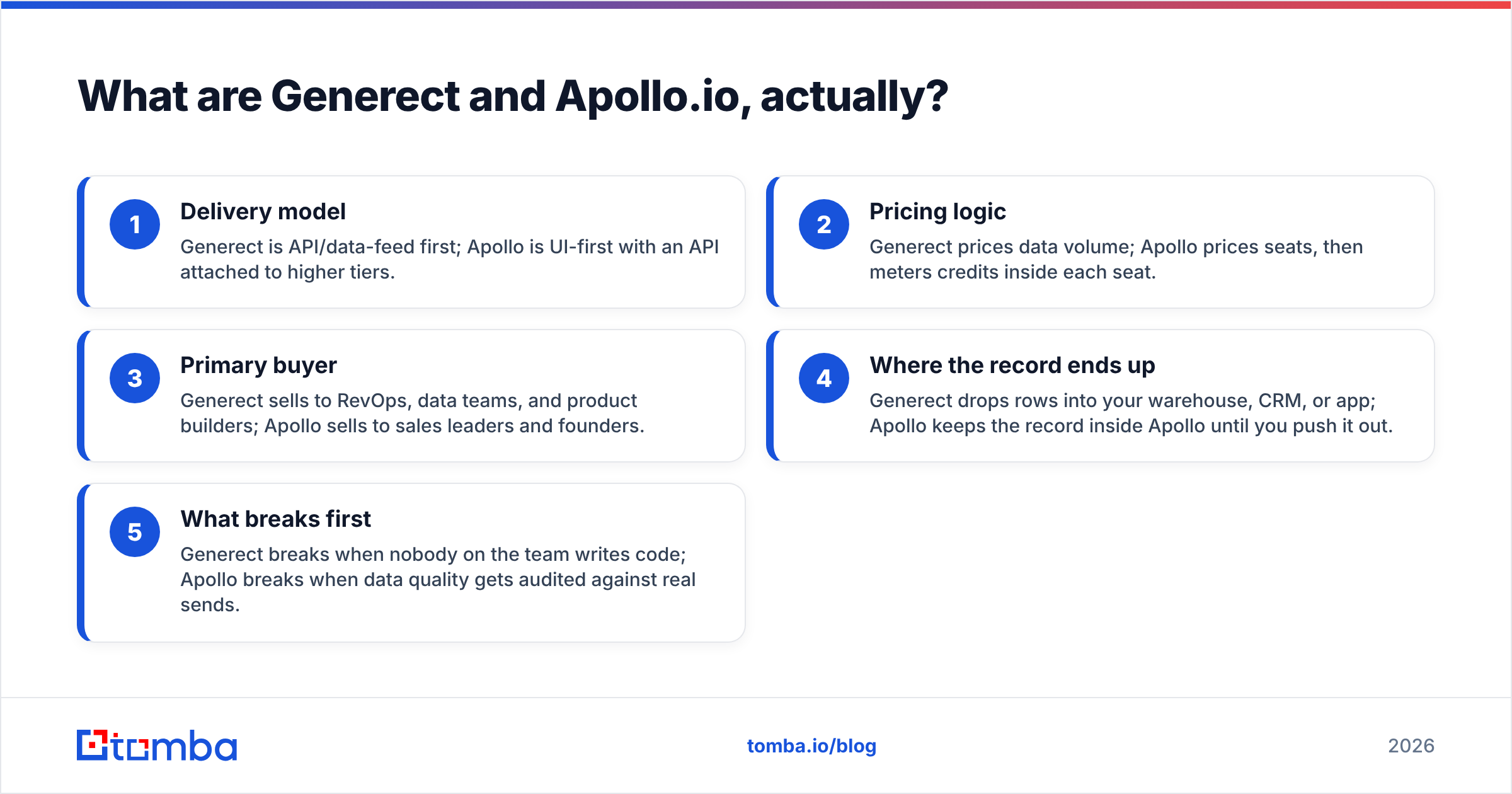
Here is the practical split:
- Delivery model — Generect is API-first. Apollo is UI-first, with an API on higher tiers.
- Pricing logic — Generect prices data volume. Apollo prices seats, then meters credits inside each seat.
- Main buyer — Generect sells to RevOps, data teams, and builders. Apollo sells to sales leaders and founders.
- Where the record lands — Generect drops rows into your warehouse, CRM, or app. Apollo holds the record until you push it out.
- What breaks first — Generect breaks when nobody writes code. Apollo breaks when someone checks the data against real sends.
Get that split right and the rest is math.
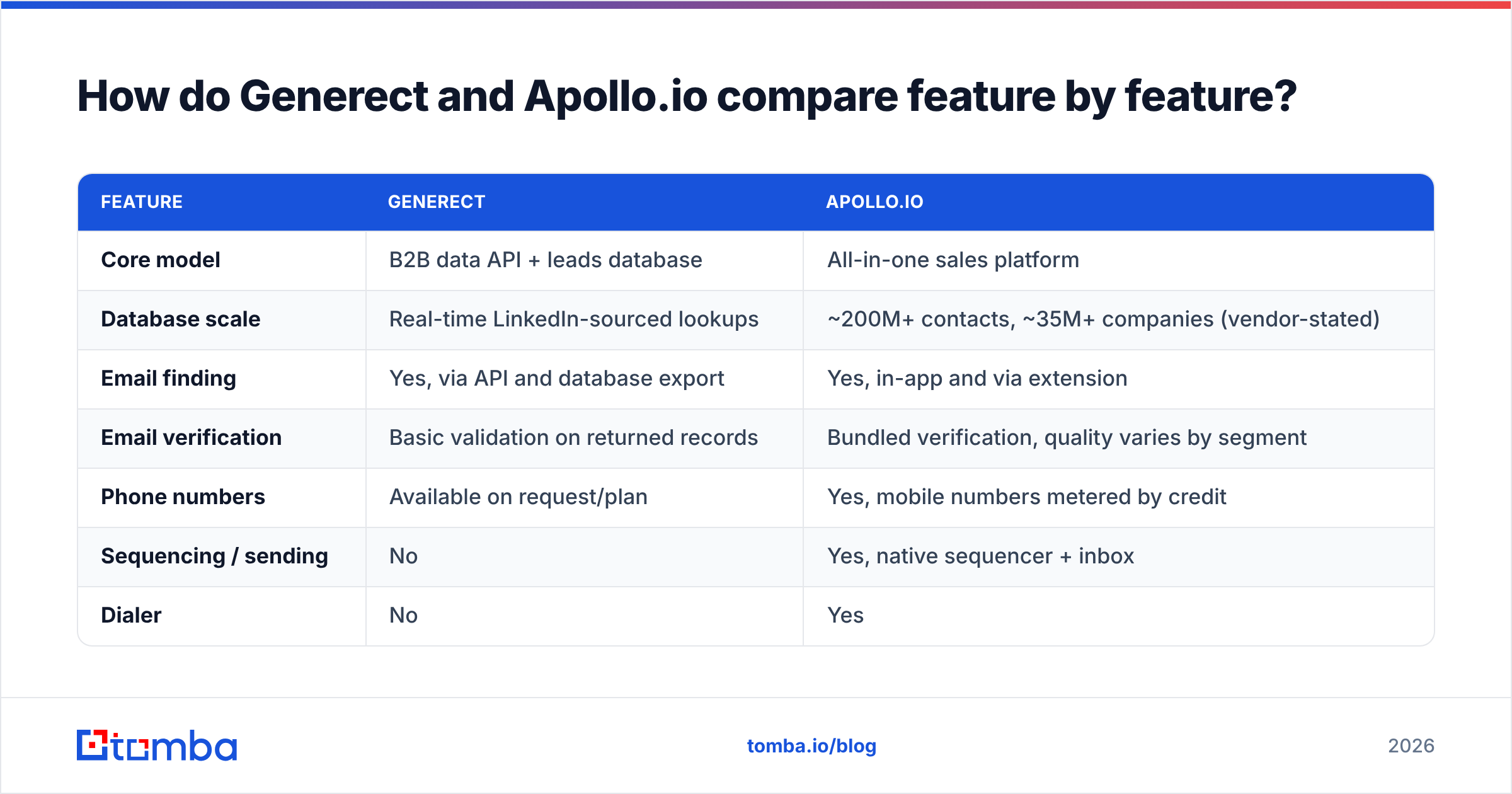
Generect vs Apollo.io: how do the features compare?#
| Feature | Generect | Apollo.io |
|---|---|---|
| Core model | B2B data API plus leads database. | All-in-one sales platform. |
| Database scale | Real-time LinkedIn lookups. | 200M+ contacts, 35M+ firms (vendor-stated). |
| Email finding | Yes, via API and export. | Yes, in the app and the add-on. |
| Email checks | Basic checks on the rows it returns. | Built in, though quality shifts by segment. |
| Phone numbers | On request or by plan. | Yes, mobile numbers cost credits. |
| Sequencing and sending | No. | Yes, with a built-in inbox. |
| Dialer | No. | Yes. |
| CRM built in | No. | Light CRM plus deal stages. |
| API access | Core product, on all plans. | Higher tiers only, rate-limited. |
| Chrome add-on | Limited. | Yes, and a big part of the product. |
| Best for | Data pipelines run by engineers. | SDR teams that want one screen. |
| Learning curve | Developer docs. | Steep, with a lot of surface area. |
The honest read: Apollo wins on breadth by a mile. Generect wins by doing one thing and staying out of your workflow. Say you already send from Instantly, Smartlead, or Salesloft. Then Apollo's best column, the sequencer, is dead weight you still pay for.
Whose data is more accurate?#
No vendor's headline accuracy number survives a real send. That is not a dig at either one. It is how the whole category works.

On Generect vs Apollo.io, three things move accuracy far more than the logo on the invoice.
1. How fresh the source is. Generect leans on LinkedIn, and that helps. When someone changes jobs, the profile updates in days. A static database waits for its next refresh, which can take months. For fast-moving targets, such as startups, agencies, and any firm under 200 staff, fresh data beats raw volume.
2. Scale hides decay. Apollo's 200M+ figure is real. But a big share of any database that size is stale by the time you export it. Users on G2 rate Apollo high on ease of use and lower on data accuracy outside US tech. Expect worse hit rates outside North American SaaS.
3. Catch-all domains break every confidence score. Say a company runs a catch-all mail server. SMTP checks then return "accept" for every address, real or made up. Both tools will hand you a "valid" address that lands nowhere. This is where you need a catch-all verifier, not a bundled green check mark.
Here is the flow that keeps your domain safe. Source from the provider that covers your segment. Then run every address through an email verifier before it enters a sequence. Teams that trust the source's own check end up with a 9% bounce rate and a burnt domain.
Generect vs Apollo.io: how much does each one cost?#
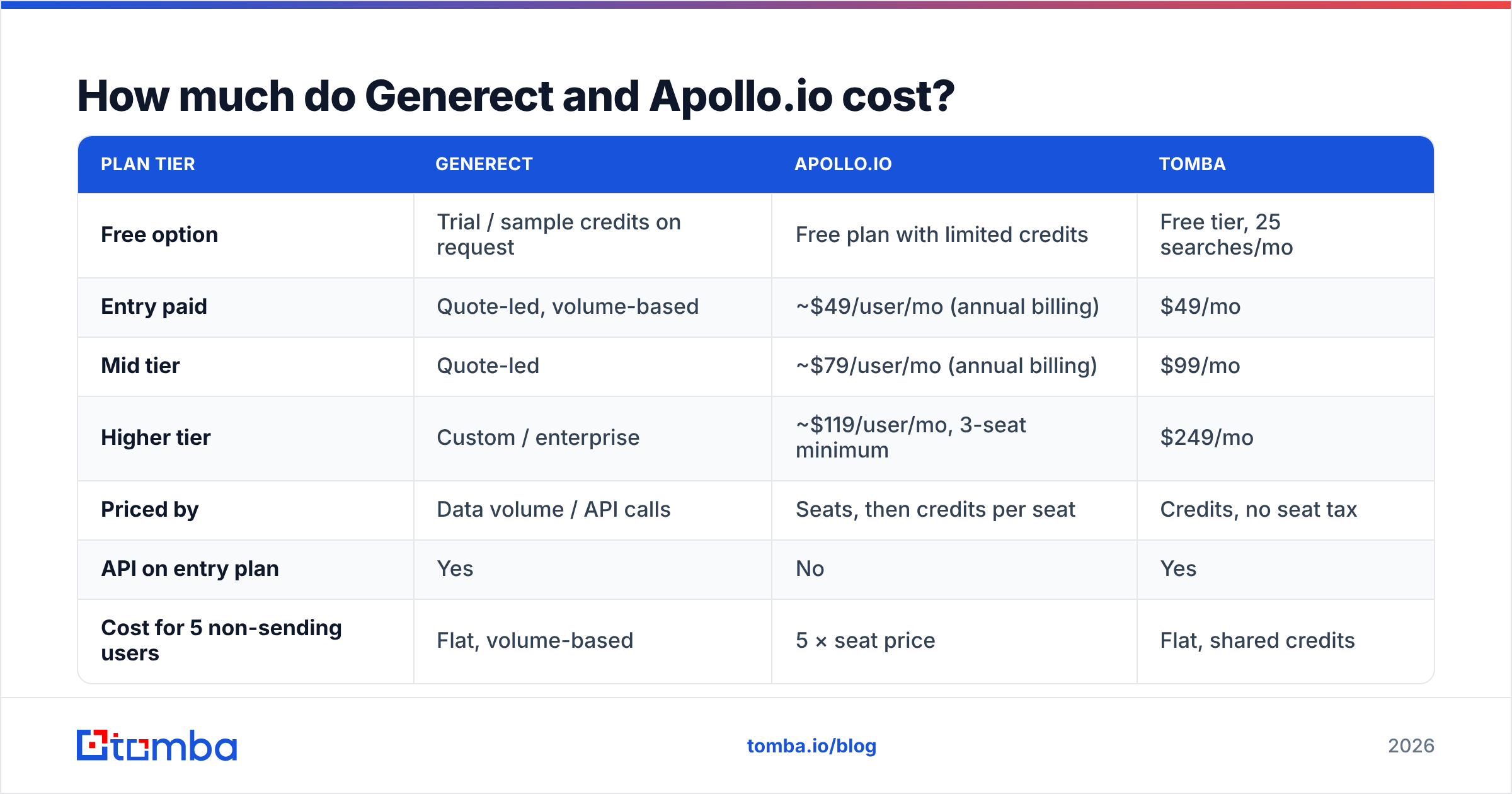
Prices change often. Treat these as rough, and check each vendor's page before you sign.
| Plan tier | Generect | Apollo.io | Tomba |
|---|---|---|---|
| Free option | Trial credits on request. | Free plan, few credits. | Free tier, 25 searches a month. |
| Entry paid | Quote-led, by volume. | ~$49 per user a month. | $49 a month. |
| Mid tier | Quote-led. | ~$79 per user a month. | $99 a month. |
| Higher tier | Custom or enterprise. | ~$119 per user, 3 seats min. | $249 a month. |
| Priced by | Data volume and API calls. | Seats, then credits per seat. | Credits, with no seat tax. |
| API on entry plan | Yes. | No. | Yes. |
| Cost for 5 light users | Flat, by volume. | 5 × seat price. | Flat, shared credits. |
The pricing shape matters more than the numbers. Apollo's seat model taxes the very people who need data most. Think of the marketer who pulls one list a month. Or the RevOps analyst who fills in a warehouse table. Or the founder doing partner research. You either buy a full seat for light use, or you route every ask through one licensed person. That person becomes the bottleneck.
Generect's volume model dodges that trap, but brings its own. Quote-led pricing means you cannot self-serve. You cannot compare cost per verified contact with other tools. Small teams often get quoted a floor that makes no sense for 2,000 lookups a month.
Credit pricing splits the difference. The whole team gets access, you pay for what you pull, and the unit cost is clear. That is how Tomba pricing works. It is also the model most data-led teams pick once a seat renewal has burned them.
Which one fits your workflow?#
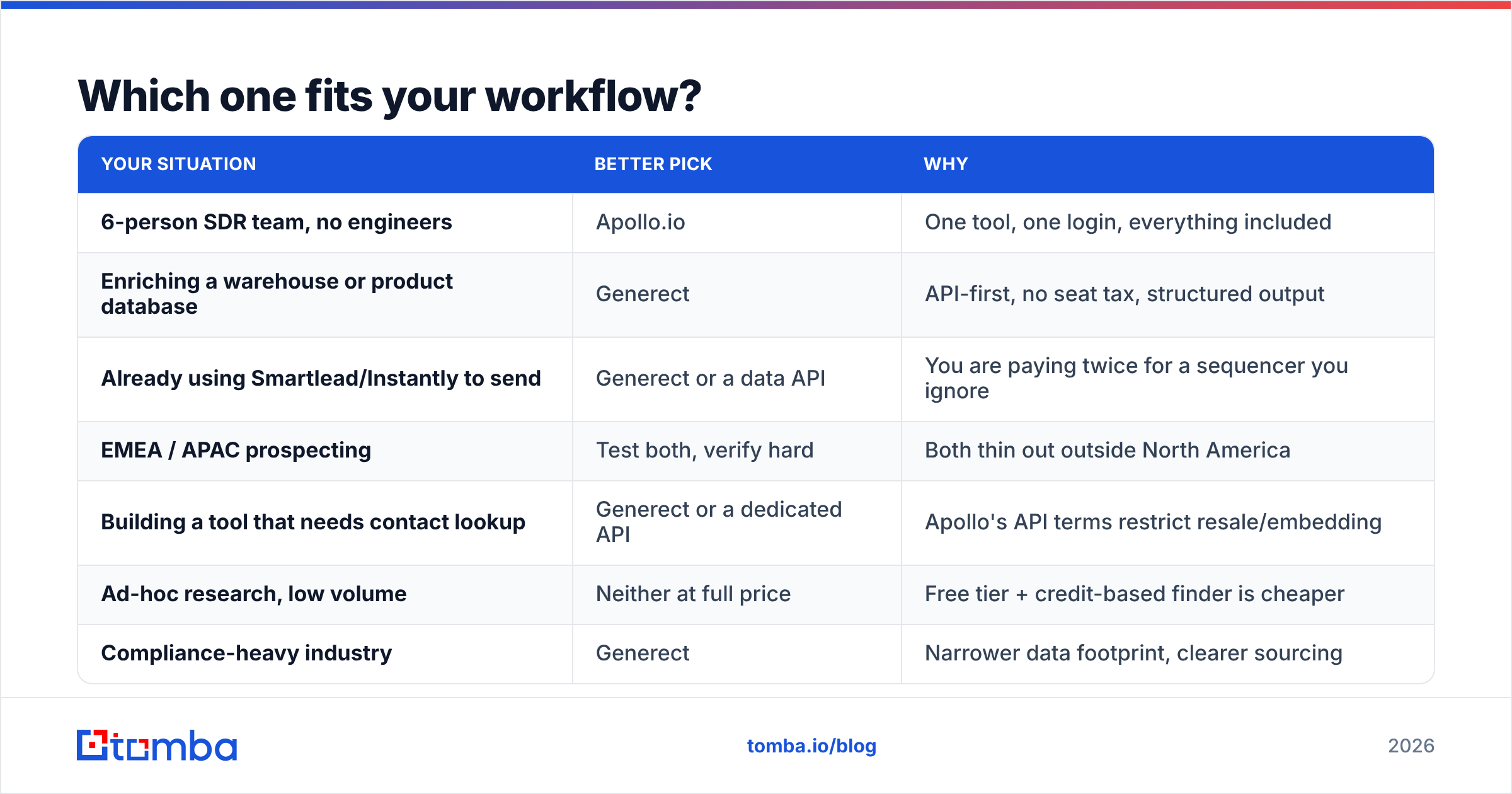
| Your situation | Better pick | Why |
|---|---|---|
| 6-person SDR team, no engineers | Apollo.io | One tool, one login, all in one place. |
| Filling a warehouse or product database | Generect | API-first, no seat tax, clean rows. |
| Already sending with Smartlead or Instantly | Generect or a data API | You pay twice for a sequencer you ignore. |
| EMEA or APAC prospecting | Test both, check hard | Both thin out beyond North America. |
| Building a tool that looks up contacts | Generect or a data API | Apollo's terms limit resale and embedding. |
| Ad-hoc research, low volume | Neither at full price | A free tier plus credits costs less. |
| Compliance-heavy industry | Generect | Smaller data footprint, clearer sourcing. |
One pattern is worth naming. Teams buy Apollo for the data. Six months later they add a specialist sending tool. That is the most common churn story in this category. If you know you will use a separate sequencer, the all-in-one is just paid-for overlap.
Where does each one fall short?#
Generect's weak points
- No public pricing. That slows any review and makes budget sign-off harder.
- No workflow layer. If your team cannot code, the data just sits in a sheet.
- A smaller brand and community, so you get fewer guides, templates, and recipes.
- Coverage tracks LinkedIn. It is strong for desk jobs, weak for trades, field ops, and small-shop owners.
Apollo.io's weak points
- Credits reset and expire in ways that shock people at renewal. Read the terms.
- Data gripes cluster around non-US regions, mid-market plants, and firms under 20 staff.
- The platform is heavy. New reps need weeks to learn it, and admins police exports.
- Seat minimums on higher tiers push small teams to buy seats they cannot staff.
- Its built-in checks are handy, but they are not a real verify pass. Catch-all domains prove it.

Is there a third option worth a look?#
Yes. Generect vs Apollo.io is not the only fork in the road. Most veteran outbound teams land in the same place: unbundle the stack.
Split the job into three layers and buy the best tool for each.
- Sourcing — where the contact comes from. Use a domain search to map an account. Use an email finder for named people.
- Checking — a separate pass that catches bad, role-based, throwaway, and catch-all addresses before they cost you a domain.
- Delivery — the sequencer, dialer, or CRM that reaches the human.
Why does this beat an all-in-one? Because you can tell what broke. When bounces spike on a bundled tool, you cannot say if the data, the checks, or the sending caused it. The vendor grades its own homework. With three layers, you swap the bad one and keep the rest.
It is usually cheaper, too. A credit-priced finder, a verifier, and a $30–$50 a month sequencer land under a three-seat Apollo bill. You also get better checks and an API on every plan, not just the top tier.

You may want to keep Apollo for its filters and sequencer. That is a fair call. Just route each export through a separate verifier first. If you would rather drop it, the Apollo alternative path is well worn. Source through an API, verify, then push to the sender you already use.
How should you run the evaluation?#
Do not compare marketing pages. Run a bake-off on your own ICP.
- Build a 100-row control list. Real accounts, real named people, spread across your top three segments. Not a generic tech list.
- Pull the same 100 from each provider. Log coverage: how many rows came back with an address at all.
- Check every result with a third tool. Never let a provider grade its own data.
- Send a small warmed test batch. Track hard bounces and real replies, not just delivery.
- Work out cost per verified, replied-to contact. This is the only number that counts, and it reorders the field almost every time.
- Test the API on day one. Rate limits, speed, and field coverage look very different in production than in the docs.
That test costs almost nothing and takes an afternoon. It often saves teams from a five-figure yearly deal with the wrong tool. To script the whole loop, the Tomba API covers steps 2 through 4 in one pipeline.
The verdict on Generect vs Apollo.io#
Generect wins for teams led by engineers. They get fresh LinkedIn data flowing into systems they already own, without paying per seat for a workflow they will never open.
Apollo.io wins for SDR teams. They get search, enrich, and send in one place today. The trade is uneven data quality outside core North American segments.
Neither wins on checks, and that is the layer where money leaks. Bounces do more than waste credits. They dent your sender reputation, which quietly caps every campaign for a quarter.
So pick a side, then put a real verify step between your list and your sequencer. Start with the Tomba Email Finder. It finds and verifies work addresses by domain, name, or company. It is priced by credit, not by seat, with API access on every plan, including the free 25-search tier. Run your control list through it next to both tools, compare cost per verified contact, and let the numbers pick your stack.
Related guides#
Ready to find emails that actually work?
Join 150,000+ professionals who stopped guessing and started sending. Free credits on signup — no credit card required.
Get the Tomba newsletter
Practical outbound tactics and product updates — once every two weeks.
About the author