Generect vs Kitt AI: Which B2B Prospecting Tool Wins in 2026?
Generect sells B2B data through an API. Kitt AI sells automation on top of data. They are not the same purchase — and picking the wrong one costs you a quarter of pipeline. Here is the honest breakdown.
TL;DR
- They are not competitors in the strict sense. Generect is a B2B data source you query (API-first, LinkedIn-derived company and people records). Kitt AI sits in the AI-agent layer — automation and outreach assistance built on top of data you supply or buy.
- If your bottleneck is "I don't have contacts," buy data. If your bottleneck is "my reps can't work the contacts fast enough," buy automation. Buying the wrong one is the single most common outbound tooling mistake.
- Neither tool removes your verification step. Both categories hand you addresses that decay ~2-2.5% per month. A dedicated email verifier is not optional overhead — it is the thing standing between you and a suspended sending domain.
- Pricing on both sides is quote-heavy. Published entry tiers move often; treat every number below as a starting point to confirm, not a contract.
- The cheapest reliable stack for most teams under 20 reps: one accurate data/enrichment source, one verifier, one sequencer. Tomba's Free tier (25 searches/mo) and $49/mo Starter cover the first two without a sales call.
What are Generect and Kitt AI, exactly?#
Generect is a B2B lead-generation and data platform. Its pitch is real-time lookups rather than a stale warehouse dump: you hit an API (or use the app) with a company domain, a LinkedIn URL, or a set of filters, and it returns company records and people records with contact details attached. Developers and RevOps teams are the natural buyers — the value shows up when you wire it into a CRM enrichment job, a scoring model, or an internal prospecting tool. You can see its current positioning at generect.com.
Kitt AI is the harder one to pin down, and you should be careful here. The kitt.ai domain has historically also carried speech and NLP tooling, so a chunk of the search traffic for "Kitt AI" is looking at something entirely different from a sales product. Before you evaluate, confirm on kitt.ai that the product in front of you is the one you think it is. In the go-to-market context, "Kitt AI" is discussed as an AI-native assistant layer: agents that research accounts, draft personalized messages, and take repetitive prospecting work off a rep's plate. The data underneath is typically brought by you or sourced through partners.
That distinction drives everything else in this comparison. One tool answers who should I email and what is their address. The other answers what do I say and how do I do it 400 times a week.
Ignore that image path — here is the real one:

How do Generect and Kitt AI compare head-to-head?#
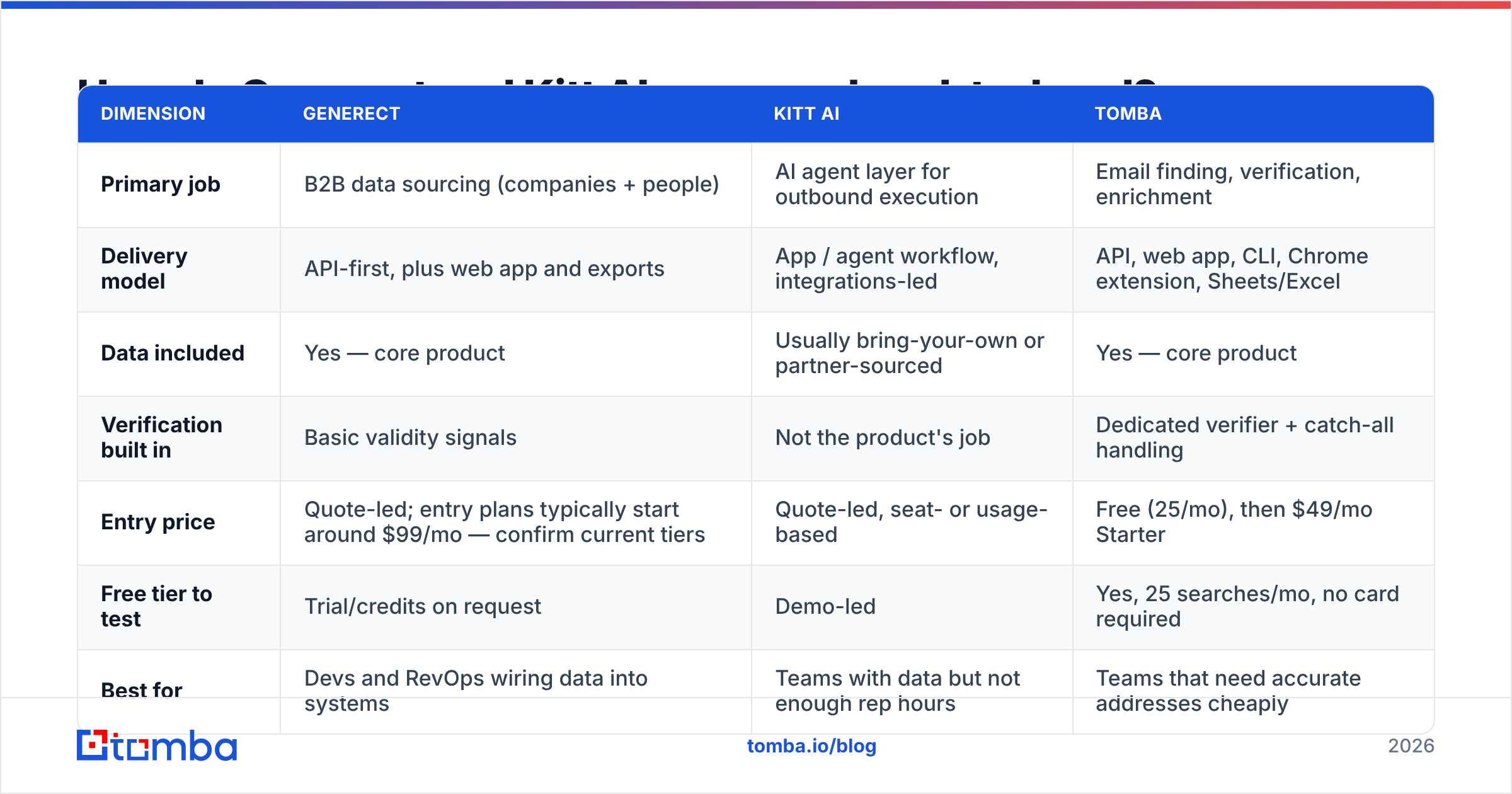
Here is the practical breakdown. Where a vendor does not publish a hard number, the cell says so rather than inventing one.
| Dimension | Generect | Kitt AI | Tomba |
|---|---|---|---|
| Primary job | B2B data sourcing (companies + people) | AI agent layer for outbound execution | Email finding, verification, enrichment |
| Delivery model | API-first, plus web app and exports | App / agent workflow, integrations-led | API, web app, CLI, Chrome extension, Sheets/Excel |
| Data included | Yes — core product | Usually bring-your-own or partner-sourced | Yes — core product |
| Verification built in | Basic validity signals | Not the product's job | Dedicated verifier + catch-all handling |
| Entry price | Quote-led; entry plans typically start around $99/mo — confirm current tiers | Quote-led, seat- or usage-based | Free (25/mo), then $49/mo Starter |
| Free tier to test | Trial/credits on request | Demo-led | Yes, 25 searches/mo, no card required |
| Best for | Devs and RevOps wiring data into systems | Teams with data but not enough rep hours | Teams that need accurate addresses cheaply |
| Weak spot | Not an outreach tool | Depends on the quality of data you feed it | Not a sequencer or dialer |
Read the table as a stack diagram rather than a leaderboard. A mature outbound motion usually has one column from each category. What kills budgets is paying two vendors for the same column.
Which one gives you better data coverage and accuracy?#
Generect wins this comparison by default, because Kitt AI is not primarily selling you records. But "wins by default" is not the same as "solves your accuracy problem."
Three things determine whether a B2B record is worth what you paid:
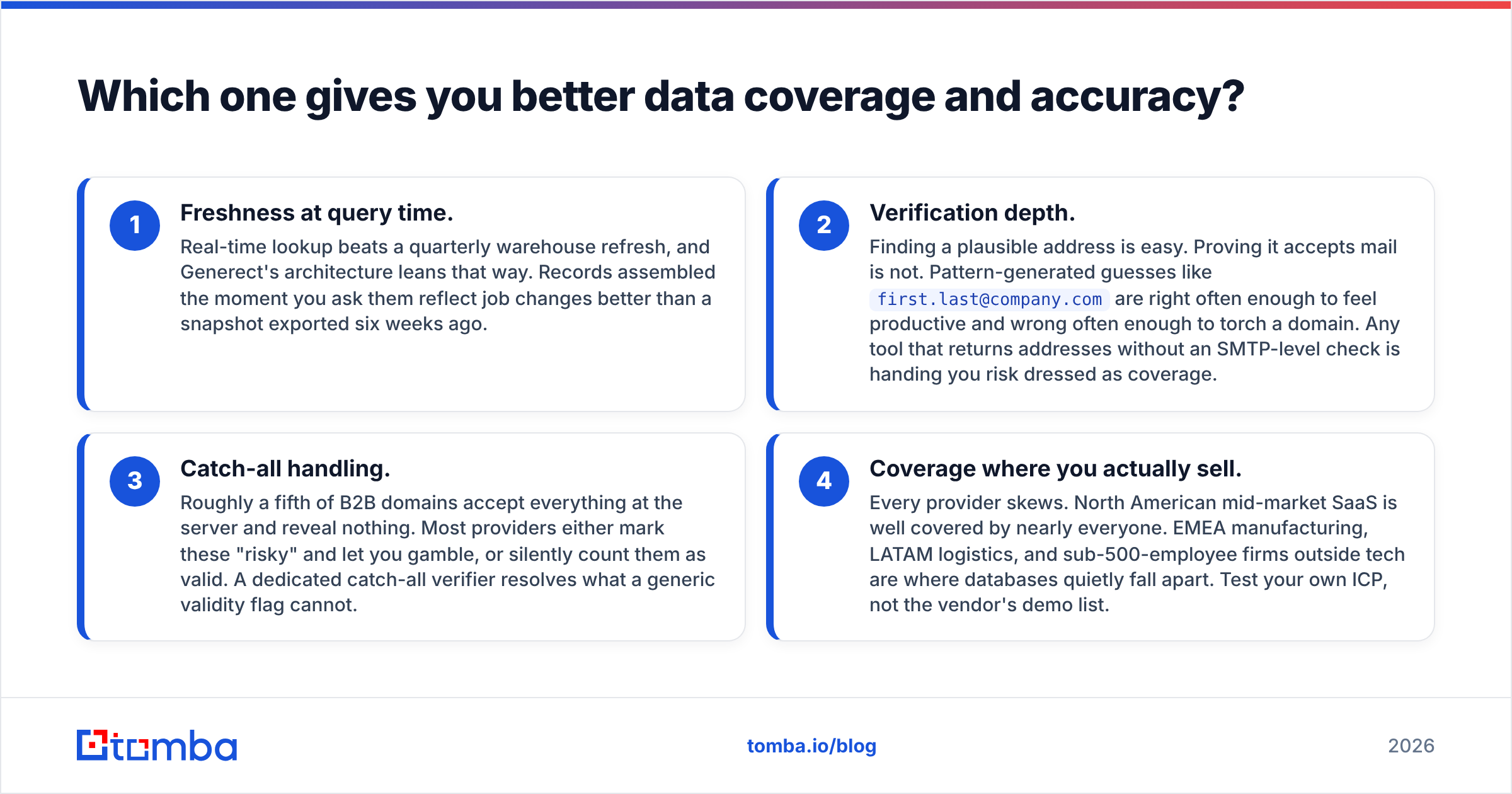
- Freshness at query time. Real-time lookup beats a quarterly warehouse refresh, and Generect's architecture leans that way. Records assembled the moment you ask them reflect job changes better than a snapshot exported six weeks ago.
- Verification depth. Finding a plausible address is easy. Proving it accepts mail is not. Pattern-generated guesses like
first.last@company.comare right often enough to feel productive and wrong often enough to torch a domain. Any tool that returns addresses without an SMTP-level check is handing you risk dressed as coverage. - Catch-all handling. Roughly a fifth of B2B domains accept everything at the server and reveal nothing. Most providers either mark these "risky" and let you gamble, or silently count them as valid. A dedicated catch-all verifier resolves what a generic validity flag cannot.
- Coverage where you actually sell. Every provider skews. North American mid-market SaaS is well covered by nearly everyone. EMEA manufacturing, LATAM logistics, and sub-500-employee firms outside tech are where databases quietly fall apart. Test your own ICP, not the vendor's demo list.
The practical test costs you an afternoon: pull 100 known-good contacts from closed-won accounts, strip the emails, and run the list through each candidate. Score match rate, bounce rate after verification, and how many records came back with a title that is more than two years stale. That single exercise beats every G2 grid — though G2's category pages are a reasonable place to sanity-check who else is in the running.
What does each tool actually cost you?#
Sticker price is the smallest line item. The real cost model has five parts:
- Platform fee. Generect's published entry plans sit in the low-hundreds-per-month range for meaningful volume; Kitt AI is demo-led and typically priced per seat or per action. Both will quote you.
- Credit burn on failures. Ask a direct question: do you charge for a search that returns nothing? Providers that bill only on successful finds are structurally cheaper than they look. Providers that bill per attempt are structurally more expensive.
- The verification bill you forgot. If your data source does not verify, you are paying a second vendor per address. Tomba folds finding and verification into the same credit pool — one reason Tomba pricing tends to land lower in total than a two-vendor split.
- Annual lock-in. Data contracts frequently require 12 months up front. If your ICP shifts in month four, you own the mistake for eight more.
- Engineering time. An API-first tool like Generect is cheap in dollars and expensive in developer hours if nobody on your team wants to own the integration. An agent tool is the reverse: fast to adopt, harder to audit.
For a five-rep team sending 3,000 emails a month, the difference between a well-chosen stack and a badly chosen one is routinely $600-$900/mo — before you count the cost of a burned sending domain.
Is Generect better than Kitt AI for outbound teams?#
It depends entirely on which half of the funnel is broken, and you can diagnose that in one question: do your reps run out of good contacts, or run out of hours?
Pick Generect (or another data-first source) when:
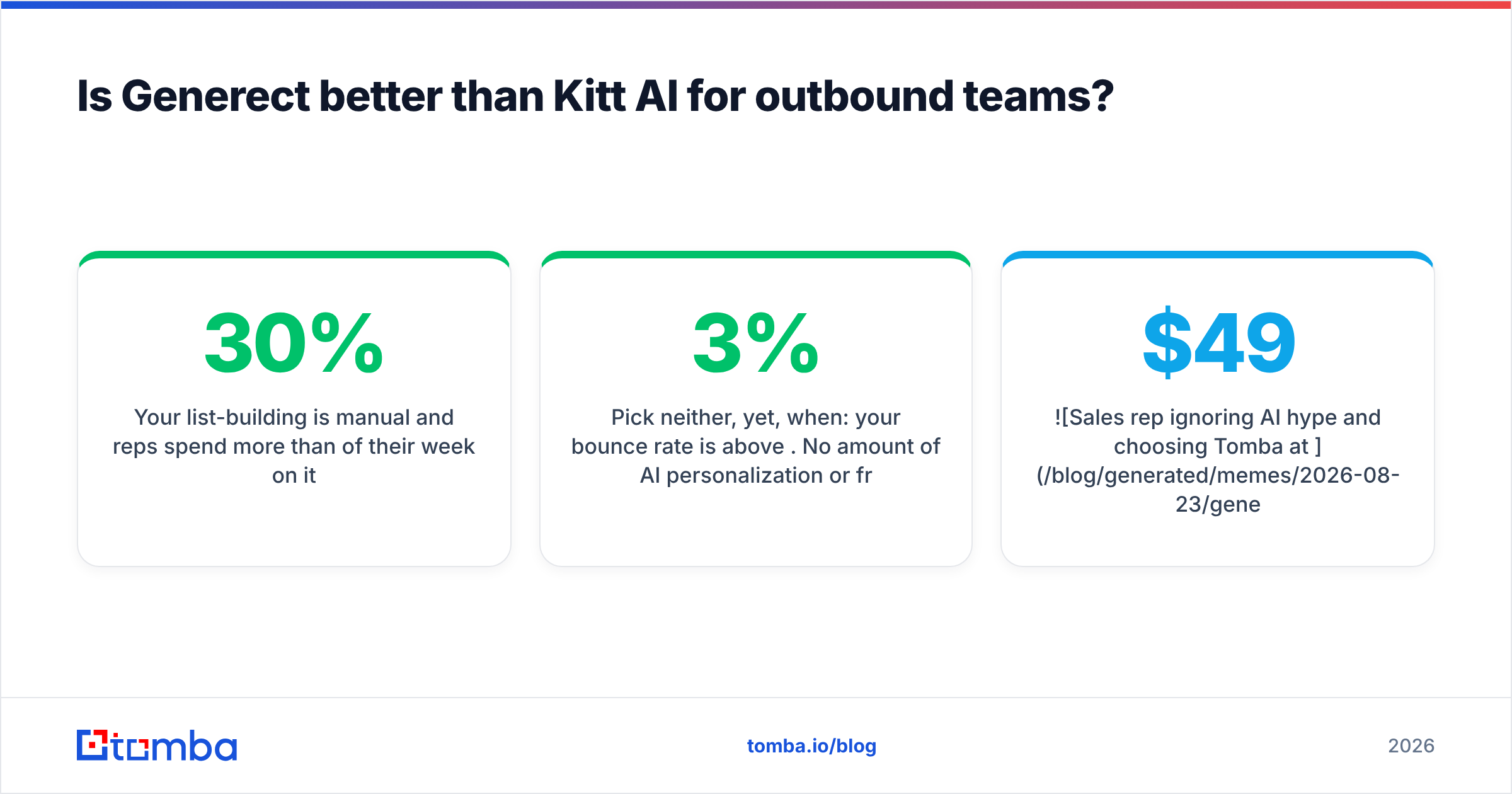
- Your list-building is manual and reps spend more than 30% of their week on it.
- You want enrichment inside your CRM, not in a separate tab.
- You have an engineer who will happily own an API integration.
- You need company-level firmographics as well as contact records.
Pick Kitt AI (or another agent layer) when:
- You already have a clean, verified database and it is under-worked.
- Personalization quality — not contact volume — is what's capping your reply rate.
- Your reps are senior and expensive, and the repetitive research step is the bottleneck.
- You can measure the lift; agent tools are easy to buy and hard to attribute.
Pick neither, yet, when: your bounce rate is above 3%. No amount of AI personalization or fresh sourcing survives a damaged sender reputation. Fix email deliverability first — authentication records, warmup, list hygiene — then buy the tool. This is the sequence most teams get backwards, and it's why so much outbound tooling gets churned in month three.

Where do both tools leave gaps in your stack?#
Neither product is a complete outbound system, and both leave the same two holes.
Hole one: independent verification. A data vendor grading its own homework is a conflict of interest. Whatever your source, run the output through a neutral verifier before it touches a sequencer. That is not a knock on Generect specifically — it applies to every provider in the category, including ones that market accuracy percentages. Percentages measured internally are marketing; bounce rate measured in your ESP is truth.
Hole two: multi-channel coverage. Email-only outbound is producing thinner returns each year. Teams that pair email with phone see materially better connect rates on the same list, which is why a phone finder belongs in the stack alongside whatever email source you choose. Neither tool here is built to be your dialer.
There is also a governance gap worth naming. If you operate in the EU or UK, you own the lawful-basis question for every record you buy — not the vendor. Ask for documentation on data sourcing before you sign. Vendors that publish where their data comes from make that conversation shorter.
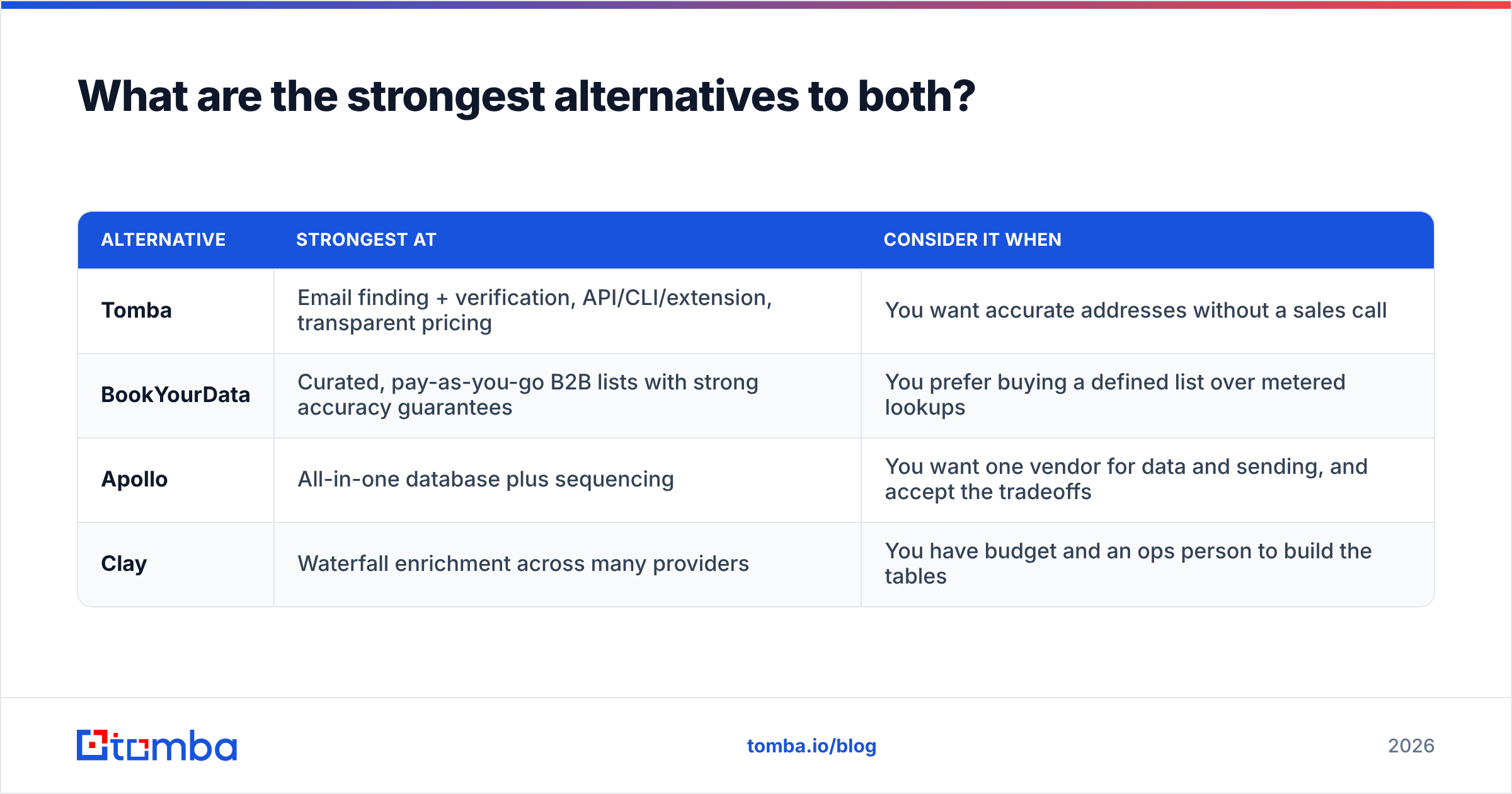
What are the strongest alternatives to both?#
If this comparison hasn't produced a clear winner, the honest answer is that your shortlist is probably too narrow.
| Alternative | Strongest at | Consider it when |
|---|---|---|
| Tomba | Email finding + verification, API/CLI/extension, transparent pricing | You want accurate addresses without a sales call |
| BookYourData | Curated, pay-as-you-go B2B lists with strong accuracy guarantees | You prefer buying a defined list over metered lookups |
| Apollo | All-in-one database plus sequencing | You want one vendor for data and sending, and accept the tradeoffs |
| Clay | Waterfall enrichment across many providers | You have budget and an ops person to build the tables |
BookYourData is a genuinely different purchase shape — you buy a specified, guaranteed list rather than metering API calls, which suits teams running a small number of large campaigns. Tomba suits the opposite pattern: continuous, programmatic lookups feeding a CRM. If you're evaluating the metered model, the Apollo alternative breakdown covers where all-in-one platforms trade depth for convenience.
For teams whose real requirement is "put verified emails into our systems automatically," the deciding factor is usually integration surface rather than raw database size. Being able to hit the same data from an API, a Chrome extension, Google Sheets, and a CLI removes more friction than another 50 million records nobody queries. That's the argument for the Tomba API over a pure app experience.
How do you decide in the next ten minutes?#
Run this sequence:
- Name the bottleneck. Contacts or hours. Write it down. If you can't pick one, it's contacts — it almost always is.
- Pull 100 known contacts from closed-won accounts and build a blind test list.
- Run the test on free or trial credits across three candidates, including at least one outside your original shortlist.
- Score on three numbers only: match rate, post-verification bounce rate, and cost per usable contact — not cost per credit.
- Buy monthly first. Convert to annual only after 60 days of measured performance. Any vendor unwilling to sell you one month is telling you something.
Whatever you land on, verify before you send. That step is cheap, fast, and the only one on this list that protects an asset you can't repurchase — your sending domain.
Ready to test your list against a real data source?#
If your honest bottleneck is contact accuracy rather than rep capacity, start with the data layer before you buy an agent on top of it. Tomba Email Finder gives you 25 free searches a month with no card, so you can run the 100-contact blind test today and compare match rates against Generect, Kitt AI, or whatever else is on your shortlist. Paid plans start at $49/mo and include verification in the same credit pool — so you aren't paying two vendors to solve one problem. Run your list, read the bounce rate, and let the numbers pick the winner.
Related guides#
Ready to find emails that actually work?
Join 150,000+ professionals who stopped guessing and started sending. Free credits on signup — no credit card required.
Get the Tomba newsletter
Practical outbound tactics and product updates — once every two weeks.
About the author