Generect vs LeadzenAI 2026: Which B2B Lead Data Wins?
Generect and LeadzenAI both promise fresh B2B contact data, but they solve different problems. Here's how coverage, verification, API depth and pricing actually compare — and which one fits your outbound motion.
Generect vs LeadzenAI is a common 2026 shortlist for outbound teams. Both tools sell B2B contact data. Neither one proves that data is deliverable. Here is how they compare on coverage, accuracy, API depth, and real pricing — and which one fits your motion.
TL;DR
- Generect is a data-first platform. It runs on LinkedIn-derived company and people search, through a UI plus a developer API. Teams choose it for structured firmographic search and a clean pipe into their own systems.
- LeadzenAI is a lead-intelligence suite built for broad discovery. You can search by name, domain, phone, or social handle. It adds bulk lookup and a browser extension, and it leans SMB and agency.
- Neither tool is a verification engine. Both hand you contacts. Proving those contacts are deliverable is still your job.
- If your outbound volume is real, three things decide the winner: bounce rate, credit rollover, and whether the API is a first-class product.
- A common 2026 stack: use a broad database to discover, then run every address through a dedicated email verifier before it reaches your sequencer.
What are Generect and LeadzenAI, really?#
Start with the honest framing. These are not the same product wearing different logos.
Generect is a B2B lead database with strong LinkedIn-style search. You define an audience — industry, headcount, geography, title, tech stack. It returns matching companies and people. An API is there for teams that want to skip the UI. The pitch is “structured, queryable, developer-friendly.”
LeadzenAI casts a wider net. Its edge is multi-input search. You can start from a person’s name, a company domain, a phone number, or a social profile, then work outward. It bundles a Chrome extension, bulk lookup, and campaign-adjacent features. The pitch is “find anyone, from any starting point.”
That difference matters more than any feature checkbox. Generect assumes you already know your ICP and want to query it at scale. LeadzenAI assumes you often start from a partial signal — a name on a webinar list, a phone number from an inbound call — and need to fill the gaps.
Both land in the same bucket for one reason: they sell you contact records, not deliverability. That fact drives most of the decisions below.
Generect vs LeadzenAI: how do they compare head to head?#
Here is the practical comparison. Treat pricing as directional. Both vendors change plans and credit rules often, so confirm on their own pages before you commit budget.
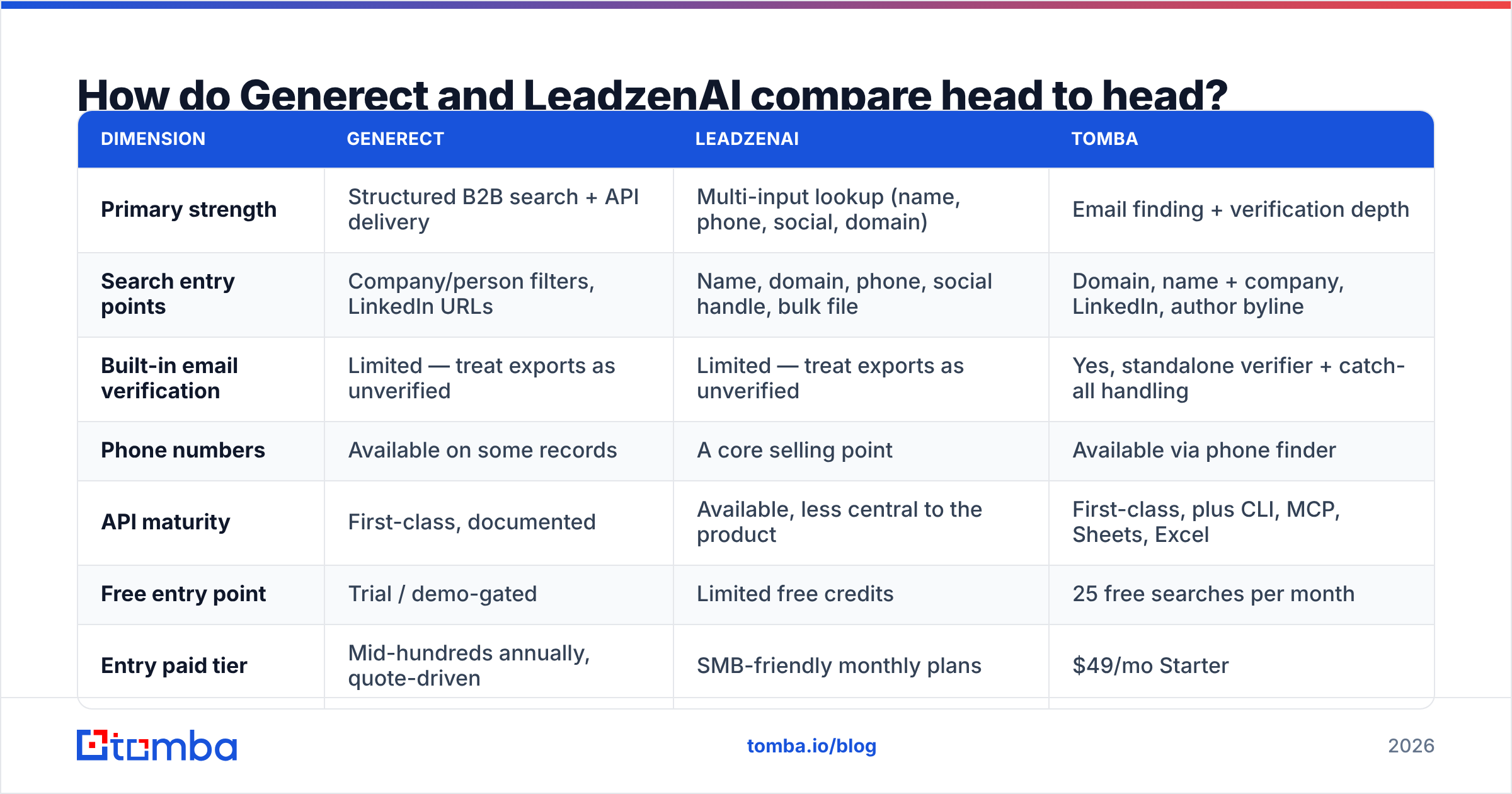
| Dimension | Generect | LeadzenAI | Tomba |
|---|---|---|---|
| Primary strength | Structured B2B search + API delivery | Multi-input lookup (name, phone, social, domain) | Email finding + verification depth |
| Search entry points | Company/person filters, LinkedIn URLs | Name, domain, phone, social handle, bulk file | Domain, name + company, LinkedIn, author byline |
| Built-in email verification | Limited — treat exports as unverified | Limited — treat exports as unverified | Yes, standalone verifier + catch-all handling |
| Phone numbers | Available on some records | A core selling point | Available via phone finder |
| API maturity | First-class, documented | Available, less central to the product | First-class, plus CLI, MCP, Sheets, Excel |
| Free entry point | Trial / demo-gated | Limited free credits | 25 free searches per month |
| Entry paid tier | Mid-hundreds annually, quote-driven | SMB-friendly monthly plans | $49/mo Starter |
| Best for | Data teams piping leads into a warehouse | SMBs and agencies doing mixed-signal research | Teams that need clean, deliverable emails at volume |
Two things jump out of that table.
First, API maturity is the real fork in the road. Say you plan to enrich records inside your own CRM workflow or data pipeline. Then Generect’s API-first design is a genuine edge over a UI-plus-extension product. If you live in a browser tab, that edge disappears.
Second, neither tool closes the verification loop. That is not a knock. It is a category boundary. Databases optimize for coverage. Verifiers optimize for precision. Doing both well in one product is rare.

Which one has better data accuracy?#
Accuracy is where vendor marketing gets slippery. Define your terms first.
Three separate numbers get collapsed into one “accuracy” claim:
- Match rate — of the contacts you searched, how many returned an email at all? A 40% match rate can be useless at volume, even when quality is perfect.
- Deliverability rate — of the addresses returned, how many actually accept mail? That is the number in your bounce report five days later.
- Freshness — how recently was the record confirmed? A 2023 snapshot of a company that has since cut staff twice is not accurate data today.
Vendors quote whichever number flatters them most. Generect leans on freshness from LinkedIn-derived signals. LeadzenAI leans on breadth of match. Neither publishes an audited deliverability figure. Be skeptical of any B2B data vendor that claims 98%+ without naming a method.

The only accuracy number that matters is the one you measure. Run the same 200-contact test list through both tools:
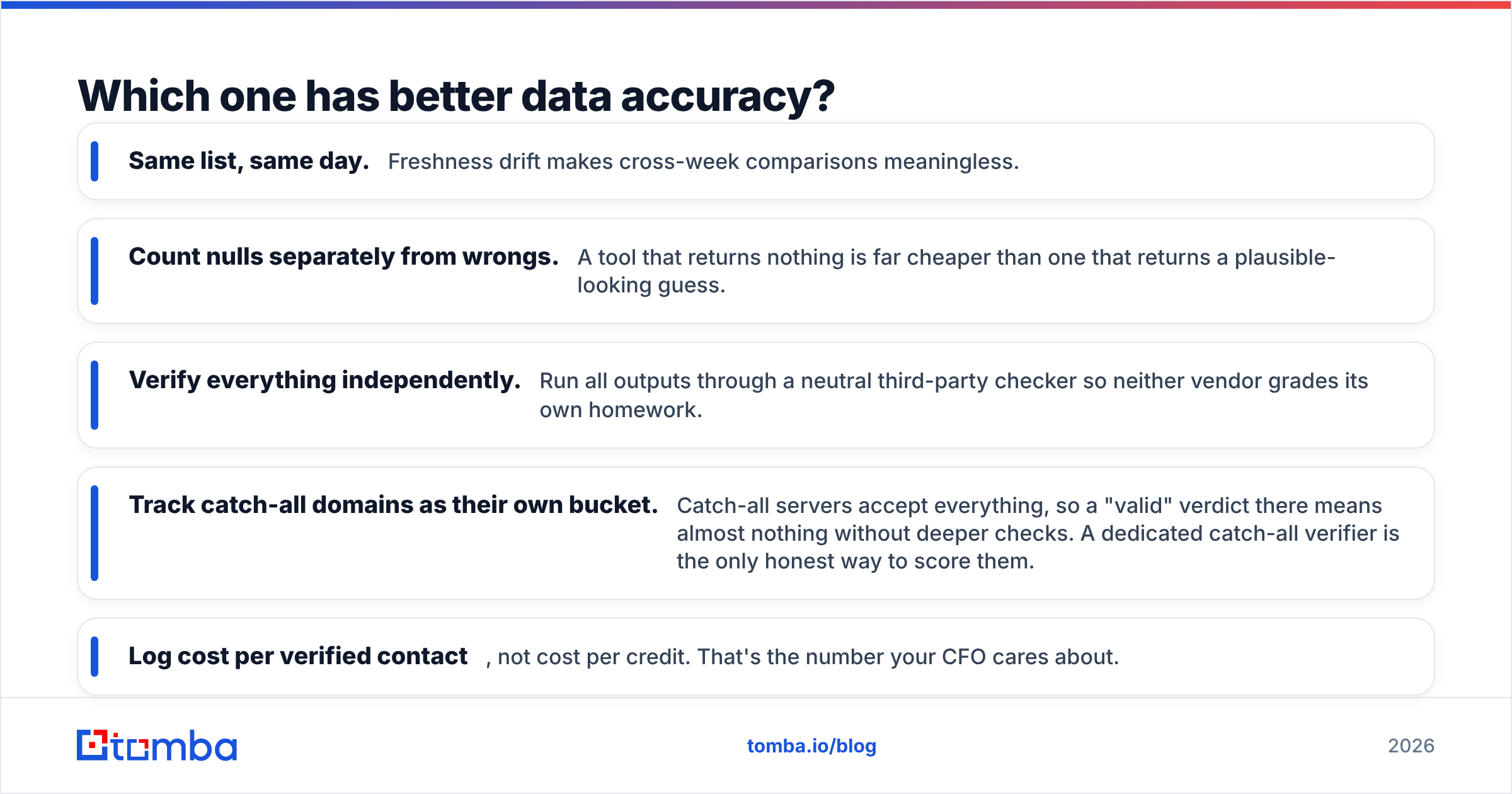
- Same list, same day. Data drifts week to week, so cross-week tests prove nothing.
- Count nulls separately from wrongs. A tool that returns nothing costs you far less than one that returns a plausible guess.
- Verify everything independently. Send all outputs through a neutral third-party checker. No vendor should grade its own homework.
- Track catch-all domains as their own bucket. Catch-all servers accept every address, so a “valid” verdict there means little. A dedicated catch-all verifier is the only honest way to score them.
- Log cost per verified contact, not cost per credit. That is the number your CFO cares about.
Most teams that run this test learn the same thing. The gap between the two vendors is smaller than the gap between raw database output and verified output.
How does pricing actually compare?#
Both products use credit-based pricing. That is where the comparison gets murky.
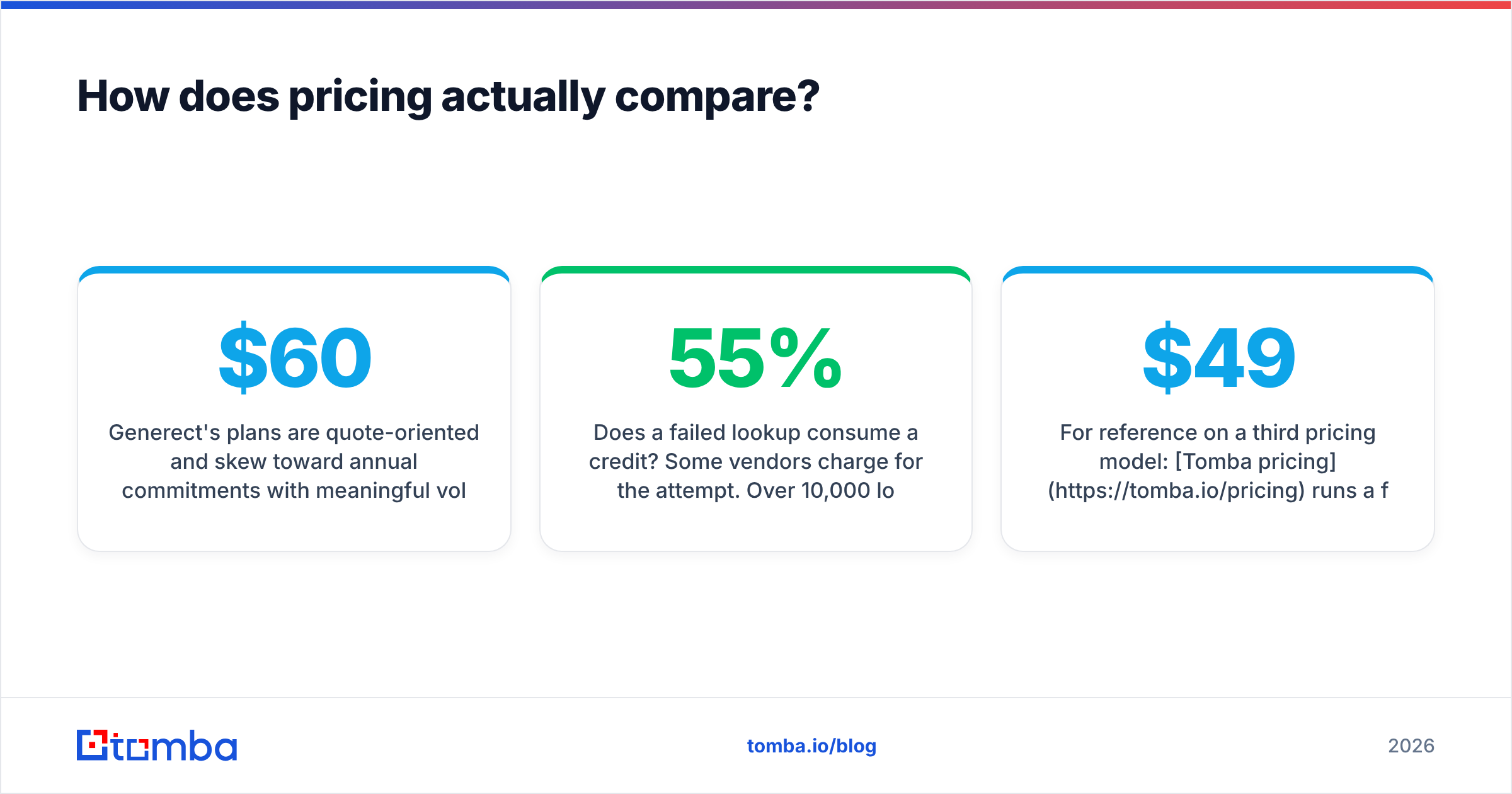
Generect’s plans are quote-oriented. They skew toward annual commitments and real volume. It is priced like infrastructure: reasonable per record at scale, less friendly if you want to spend $60 on a test.
LeadzenAI publishes SMB-shaped monthly tiers, so it is easier to start. The trade-off is credit definitions. A phone reveal, an email reveal, and a full enrichment may each cost a different amount. Your effective cost per usable contact is hard to predict from the pricing page.
Ask both vendors these questions, in writing:
- Does a failed lookup consume a credit? Some vendors charge for the attempt. Over 10,000 lookups at a 55% match rate, that difference is huge.
- Do credits roll over? Monthly expiry punishes bursty prospecting, and most teams work in bursts.
- Is the API included or an add-on? Finding out that your integration plan needs the next tier up is a common budget surprise.
- What is the export policy? Some contracts limit how many records you can pull out, or where you can store them.
- How is churn handled mid-term? Annual lock-in on an untested data product is a bad bet.
For a third pricing model: Tomba pricing starts free at 25 searches per month. Starter is $49/mo, Growth $99/mo, and Pro $249/mo, with Enterprise quoted. The free tier exists so you can measure match rate on your own ICP first — the exact test described above.
Is Generect better than LeadzenAI for outbound teams?#
It depends on which of these four profiles you recognize.
You have engineers and a data warehouse. Generect wins. An API-first product that returns clean, structured records beats a slicker UI, because your team never opens the UI. You enrich inside your pipeline, dedupe against your CRM, and score records before a human sees them.
You are a two-person agency working mixed-signal leads. LeadzenAI fits better. Your inputs are messy: a phone number here, a LinkedIn URL there. Multi-input search saves real hours, and the browser extension helps when research is manual by nature.
You run high-volume cold email. Neither tool is enough alone. Your constraint is not finding contacts. It is not burning your domain. You need a discovery source plus verification, and the verification step is non-negotiable. A 6% bounce rate will damage your sender reputation faster than good copy can repair it.
You need a specific niche or region. Test both, plus a specialist. Regional coverage varies a lot between B2B databases. No aggregate accuracy stat predicts how a vendor performs in, say, mid-market German manufacturing.

What alternatives should you test alongside them?#
Two-vendor comparisons create false binaries. Put at least two more options in the bake-off before you sign anything:
- BookYourData — strong if you want pay-as-you-go, prebuilt B2B lists with a clear bounce guarantee. It is a different purchase shape, and teams that hate subscriptions often prefer it.
- Tomba — built around email finding and verification as the core product, not an add-on. The email finder takes domain, name, and LinkedIn inputs. The verifier and catch-all tools sit in the same account, so discovery and validation happen in one pass.
- Apollo, Clearbit, or RocketReach — worth a benchmark if you want breadth plus a sequencer on one bill. Check G2’s B2B data category for user-reported match rates instead of vendor claims.
Comparing Tomba to what you already use? The Apollo alternative and RocketReach alternative breakdowns cover more detail than a table can.
How should you run the evaluation?#
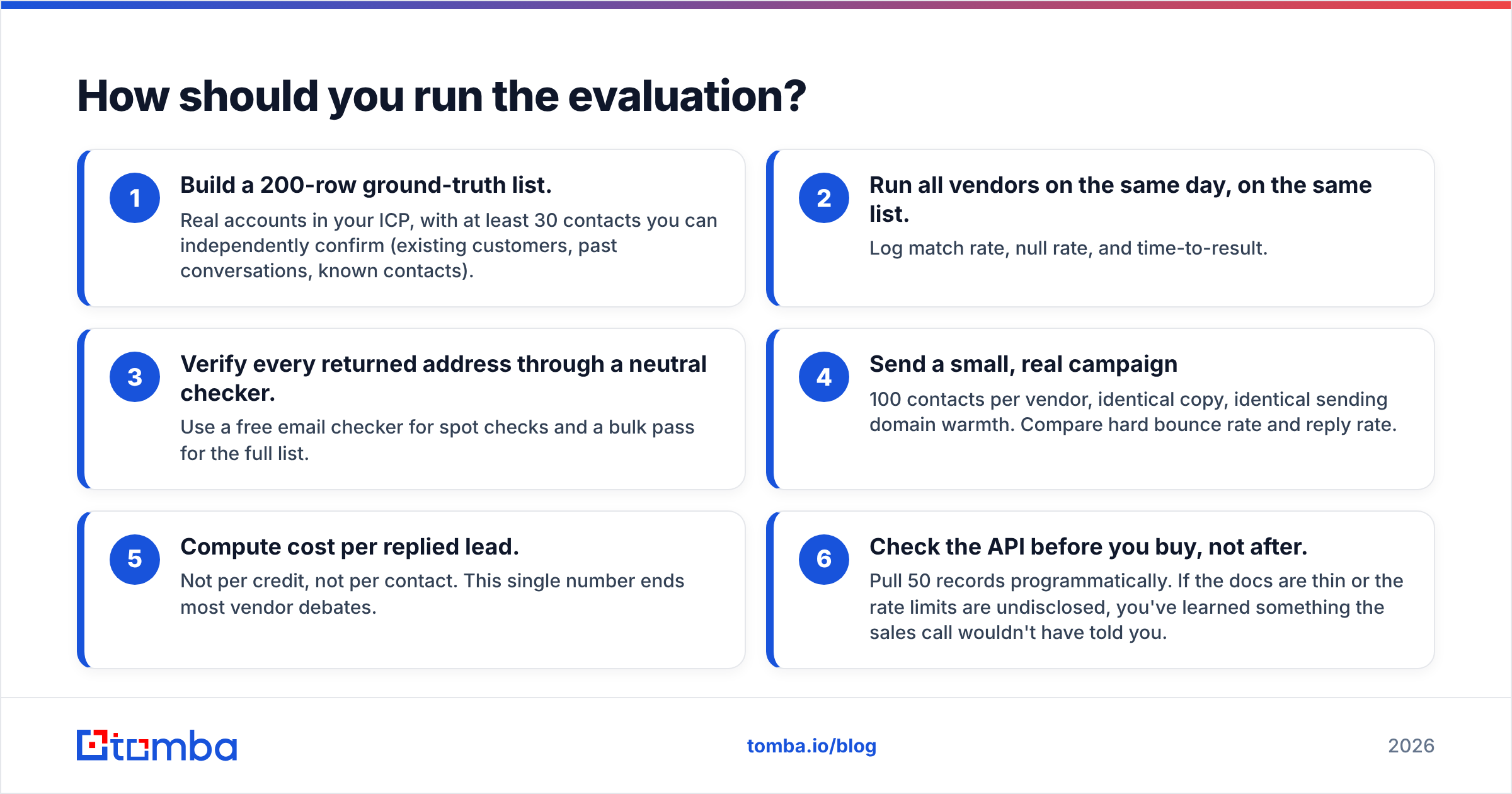
Give yourself two weeks and follow a fixed protocol. Vendors will gladly let you evaluate on their terms. Do not.
- Build a 200-row ground-truth list. Use real accounts in your ICP. Include at least 30 contacts you can confirm yourself.
- Run every vendor on the same day, on the same list. Log match rate, null rate, and time to result.
- Verify every returned address with a neutral checker. Use a free email checker for spot checks and a bulk pass for the full list.
- Send a small, real campaign. 100 contacts per vendor, same copy, same sending domain. Compare hard bounces and replies.
- Compute cost per replied lead. Not per credit. Not per contact. This one number ends most vendor debates.
- Test the API before you buy. Pull 50 records programmatically. Thin docs or hidden rate limits tell you what the sales call would not.
Teams that run this protocol usually end up with two tools, not one winner: a broad discovery source and a verification layer. That is not indecision. It is the right architecture when coverage and precision trade off against each other.
Verdict: which should you pick?#
Generect vs LeadzenAI comes down to how your team works, not to which brand markets harder.
Pick Generect if you are a data-mature team that consumes records through an API, you have a clear ICP, and you value structured search over exploratory lookup.
Pick LeadzenAI if you are an SMB or agency working from partial signals, you want a browser-first workflow, and monthly flexibility beats per-record economics at scale.
Pick neither as your only tool if you send cold email at volume. Both give you a starting list. Neither promises the list is safe to send to, and that gap is where domain reputations go to die.
The cheapest fix is also the most boring one. Verify before you send, every time.
Ready to close the accuracy gap? Start with the Tomba Email Finder. Find professional email addresses by domain, name, or company, then verify them in the same workflow. The free tier gives you 25 searches a month — enough to run the ground-truth test above against your real ICP. If Tomba matches or beats your current source on cost per verified contact, Starter is $49/mo and the Tomba API is included, not gated behind an enterprise call.
Related guides#
Ready to find emails that actually work?
Join 150,000+ professionals who stopped guessing and started sending. Free credits on signup — no credit card required.
Get the Tomba newsletter
Practical outbound tactics and product updates — once every two weeks.
About the author