Generect vs Mailmint (2026): Which B2B Lead Data Tool Wins?
Generect sells LinkedIn-sourced lead lists; Mailmint sells cheap verified email volume. We break down accuracy, pricing, and which one actually fits your outbound motion in 2026.
Generect vs Mailmint comes down to one question: do you need to find the right people, or just their email addresses? This guide compares both tools on accuracy, price, and what a usable contact really costs.
TL;DR
- Generect is a LinkedIn-first lead database. You filter by company, role, and headcount, then export contacts with emails attached. It builds lists well. Email accuracy depends on the profile match.
- Mailmint competes on price and volume: cheap credits, bulk email discovery, and a light verifier. Cost per contact is low. Company data is thin outside the US and EU.
- Neither tool replaces a proper email finder + verifier stack. Both push risky results into your export unless you verify separately.
- Entry plans cost about the same. Cost per verified contact does not, once you count bounces.
- Our pick: Generect if your ICP is defined by LinkedIn attributes. Mailmint if you already have domains and names. Verify either way.
What are Generect and Mailmint?#
Both tools solve the same problem: get a working email for a person you want to sell to. They just start from opposite ends.
Generect starts from the person. It indexes LinkedIn-style profile data. You build lists with filters like job title, seniority, headcount, industry, and geography. Each record holds a name, title, company, LinkedIn URL, and an email. The email is either found or guessed from the company's pattern. The typical buyer is an SDR team or agency that needs a fresh list every week.
Mailmint starts from the domain. Feed it companies, names, or a CSV, and it returns emails at volume with a confidence score. The typical buyer already knows the target accounts — from a scrape, a conference list, or an intent feed — and wants addresses cheaply.
That difference matters more than any feature checklist. If your bottleneck is "who should I contact," Generect's filters do real work. If it is "I have 8,000 rows and no emails," Mailmint's per-credit price wins.

Generect vs Mailmint: how do they compare head to head?#
Here is the practical comparison. It draws on public pricing pages, vendor documentation, and how each tool behaves on a typical mid-market B2B list.
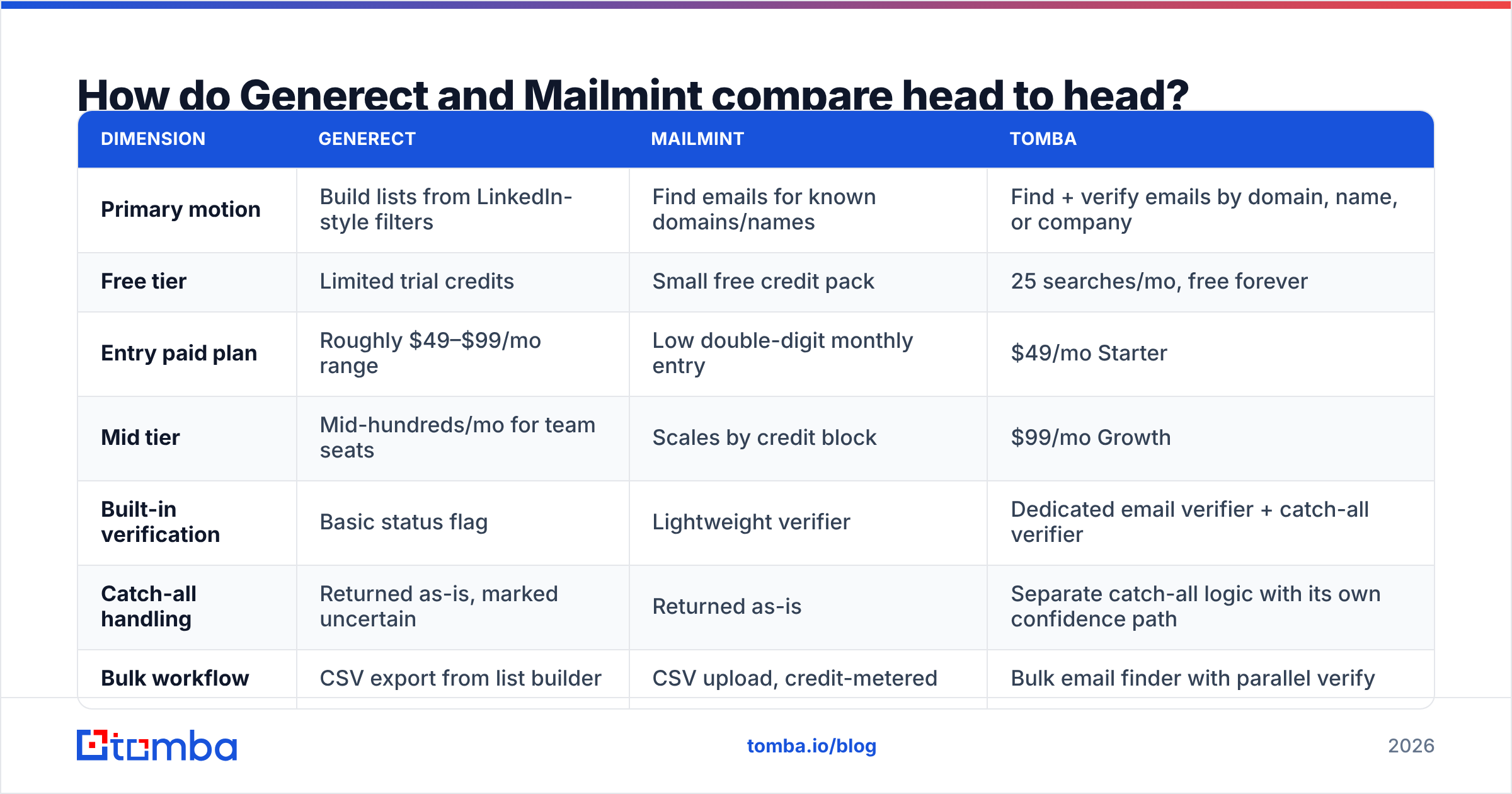
| Dimension | Generect | Mailmint | Tomba |
|---|---|---|---|
| Primary motion | Build lists from LinkedIn-style filters | Find emails for known domains/names | Find + verify emails by domain, name, or company |
| Free tier | Limited trial credits | Small free credit pack | 25 searches/mo, free forever |
| Entry paid plan | Roughly $49–$99/mo range | Low double-digit monthly entry | $49/mo Starter |
| Mid tier | Mid-hundreds/mo for team seats | Scales by credit block | $99/mo Growth |
| Built-in verification | Basic status flag | Lightweight verifier | Dedicated email verifier + catch-all verifier |
| Catch-all handling | Returned as-is, marked uncertain | Returned as-is | Separate catch-all logic with its own confidence path |
| Bulk workflow | CSV export from list builder | CSV upload, credit-metered | Bulk email finder with parallel verify |
| API | Yes | Yes, limited endpoints | Full Tomba API, CLI, and MCP server |
| Native spreadsheet add-ons | Limited | Limited | Google Sheets, Excel, Airtable |
| Best for | Persona-led prospecting | Cheap volume enrichment | Accuracy-led outbound at any volume |
The row that changes your budget is built-in verification. A tool that hands you 10,000 addresses at $0.01 each looks cheaper than one at $0.03. Then 18% of them bounce, your domain reputation drops, and you pay a third vendor to clean the rest.
Which one is more accurate?#
Accuracy here is not one number. It splits into three questions. Ask them of any vendor, including these two.
- Coverage — of 1,000 target contacts, how many return any email? Generect scores well when the ICP is visible on LinkedIn: SaaS, agencies, tech-adjacent roles. It scores poorly for offline work such as construction, local services, and factory-floor roles. Mailmint tracks the company's web footprint instead. It is strong for firms with public team pages and press coverage, weak for stealth or privacy-heavy domains.
- Precision — of the emails returned, how many actually deliver? This is where confidence-score marketing gets slippery. Both tools return catch-all domains without flagging the real risk. A catch-all accepts every address at the mail server. So a "valid" result there means almost nothing on its own.
- Freshness — how old is the record? Job-change churn in B2B runs about 20% a year, per LinkedIn's own workforce reporting. A list built 12 months ago is already wrong in places, however good it was on day one.
The honest read: neither vendor publishes an audited accuracy figure. Do not trust a self-reported "98% accurate" claim from either one. Check G2 and Capterra for bounce-rate complaints. Those are the most reliable public signal.

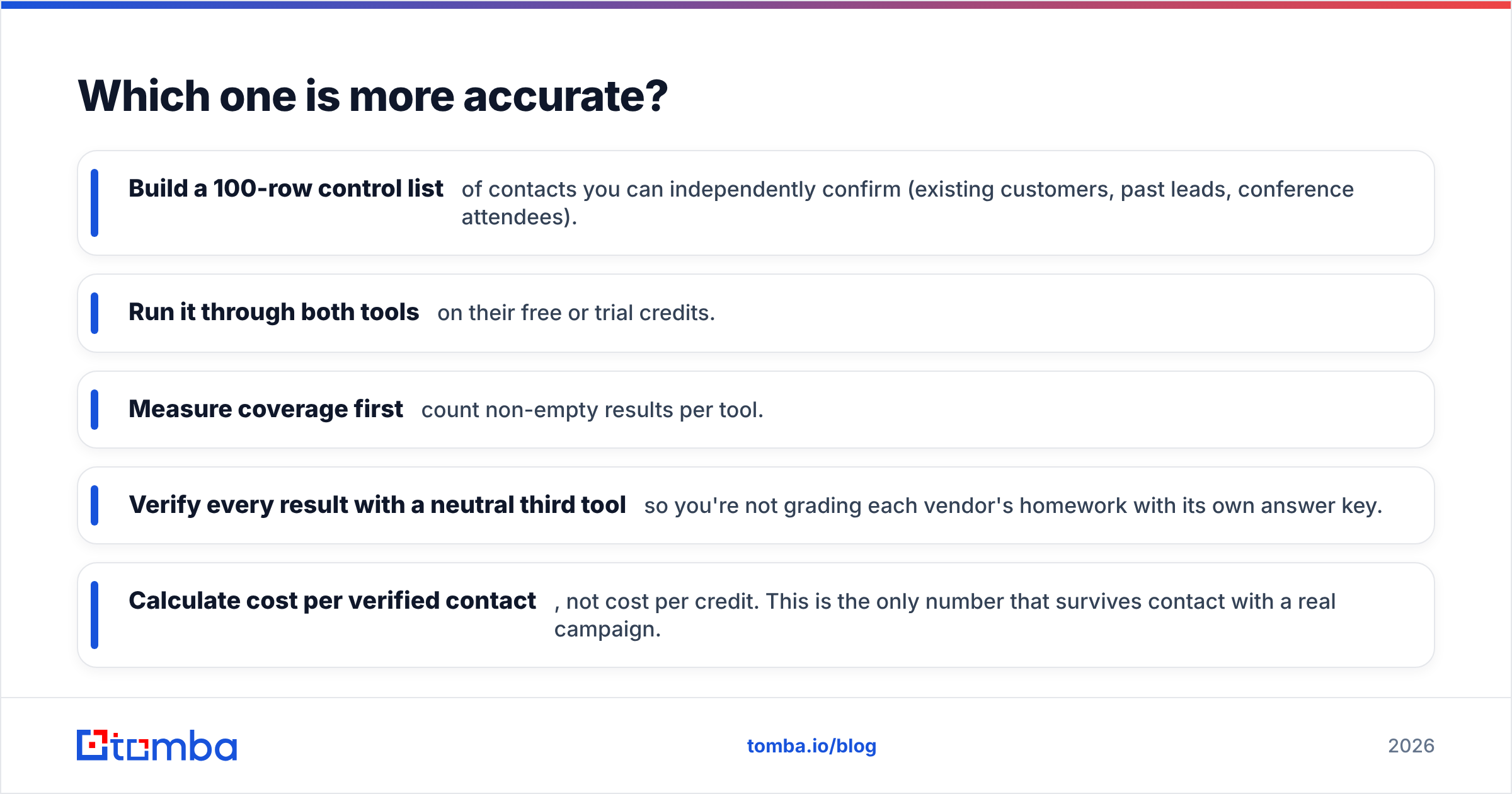
How to run your own test in 30 minutes:
- Build a 100-row control list of contacts you can confirm yourself: existing customers, past leads, conference attendees.
- Run it through both tools on their free or trial credits.
- Measure coverage first. Count the non-empty results per tool.
- Verify every result with a neutral third tool. No vendor should grade its own homework.
- Calculate cost per verified contact, not cost per credit. That is the only number that survives a real campaign.
Is Generect better than Mailmint for cold outreach?#
It depends on where your list comes from. That is not a cop-out. It is the whole decision.
Choose Generect when:
- Your ICP is defined by attributes, such as VP Marketing at a 50–200 person SaaS firm in DACH, rather than a fixed account list.
- You need net-new prospects every week and do not want to run a scraping stack.
- Your buyer is active on LinkedIn. If not, the tool's core advantage disappears.
Choose Mailmint when:
- You already have the account list, from an ABM program, a partner referral file, or website visitor reveal.
- Budget is the binding constraint and you will add a verification step later.
- Your volume is spiky: 20,000 rows one month, 500 the next. Credit blocks handle that better than seats.
Choose neither when:
- You need catch-all domains resolved reliably. Both punt on this.
- You need phone numbers too. That is a separate purchase in both cases. A phone finder or a multi-channel provider handles it better.
- Compliance review is strict. Ask both vendors, in writing, where the data comes from and what their GDPR lawful basis is. Vague answers are a red flag. A documented data sources page is the minimum bar.
What does each one actually cost per verified contact?#
Sticker price lies. Here is the arithmetic that does not.
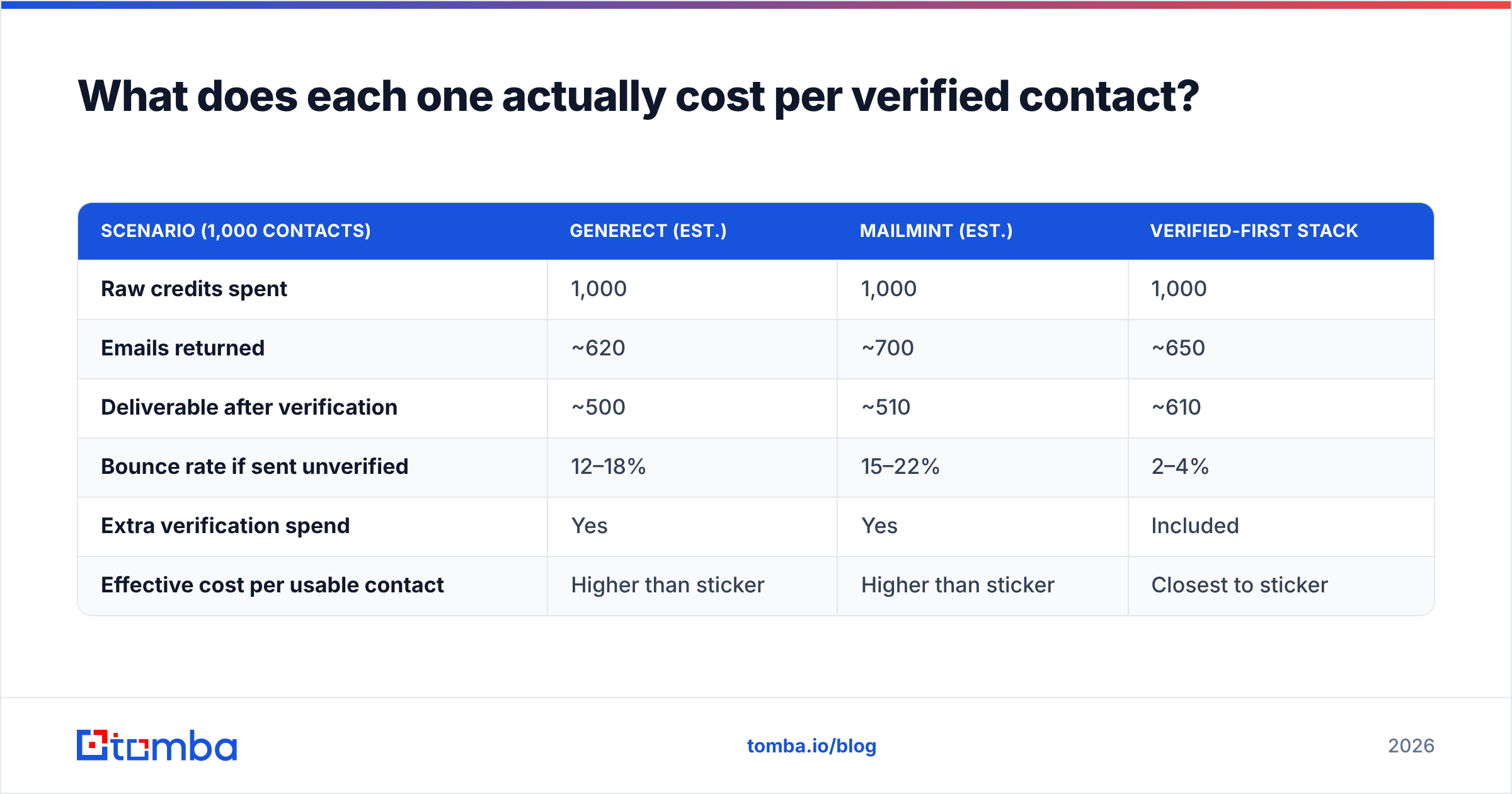
| Scenario (1,000 contacts) | Generect (est.) | Mailmint (est.) | Verified-first stack |
|---|---|---|---|
| Raw credits spent | 1,000 | 1,000 | 1,000 |
| Emails returned | ~620 | ~700 | ~650 |
| Deliverable after verification | ~500 | ~510 | ~610 |
| Bounce rate if sent unverified | 12–18% | 15–22% | 2–4% |
| Extra verification spend | Yes | Yes | Included |
| Effective cost per usable contact | Higher than sticker | Higher than sticker | Closest to sticker |
Those return rates are directional, not benchmarks. Run your own control list. But the shape holds across the category. The gap between emails returned and emails that land is where the money goes. In a Generect vs Mailmint bake-off, the winner is whichever tool leaves you fewer bounces to pay for.
Two rules save more budget than any discount code:
- Never send to an unverified list. A 15% bounce rate on a new sending domain gets you throttled by Google and Microsoft within a week. Both set a hard spam-complaint ceiling and expect authenticated, low-bounce sending. The details are in Google's bulk sender guidelines. Protecting email deliverability costs less than repairing it.
- Price the whole stack, not the tool. Finder, verifier, enrichment, sending platform. A finder that bundles verification removes a vendor, a data handoff, and a monthly invoice.

How do they handle catch-all domains and job changes?#
These two failure modes quietly destroy campaign performance. Most comparison posts skip them, so they get their own section here.
Catch-all domains accept mail for any address, then throw away the invalid ones without a bounce. Your verifier says "valid." Your campaign says "delivered." Your prospect never sees it.
Roughly a fifth of B2B domains work this way, mostly in enterprise and security-conscious sectors. Generect and Mailmint both return these results with a soft "uncertain" label and pass the risk to you. A dedicated catch-all finder approach improves the odds: pattern confidence, cross-checks against other sources, and past send data.
Job changes are the slower killer. Twenty percent annual churn means one in five records in a year-old list points at someone who has left. Worse, the message often delivers to a forwarding alias or a shared inbox. You see no bounce and no reply, so you blame your copy when the data is stale.
The fix is re-enrichment on a schedule, not a one-time buy. Run your CRM through contact enrichment each quarter and flag records whose company or title has changed.

What are the strongest alternatives to both?#
If neither tool is a clean fit, here is the shortlist worth testing:
- Tomba — an email finder with verification built into the same workflow, plus domain search, catch-all handling, and an API and CLI for engineering-led teams. The free tier is 25 searches a month; Starter is $49/mo. Best when accuracy per contact matters more than raw list size.
- BookYourData — a pay-as-you-go B2B contact database with a strong accuracy guarantee and no subscription lock-in. A good option if you want to buy a list outright. The no-recurring-fee model suits teams with irregular volume.
- Apollo — the all-in-one option: database, sequencer, and dialer. More surface area, more to learn, and data quality varies by segment. Read the honest breakdown of Apollo alternatives before you sign an annual contract.
- A finder plus a standalone verifier — any discovery tool feeding a dedicated verification API. More vendors to manage, but you can swap either half without re-platforming.
The right question is not "which tool is best." It is "which number am I optimizing?" Cost per credit, cost per verified contact, and cost per booked meeting point to three different purchases.
How should you run the evaluation?#
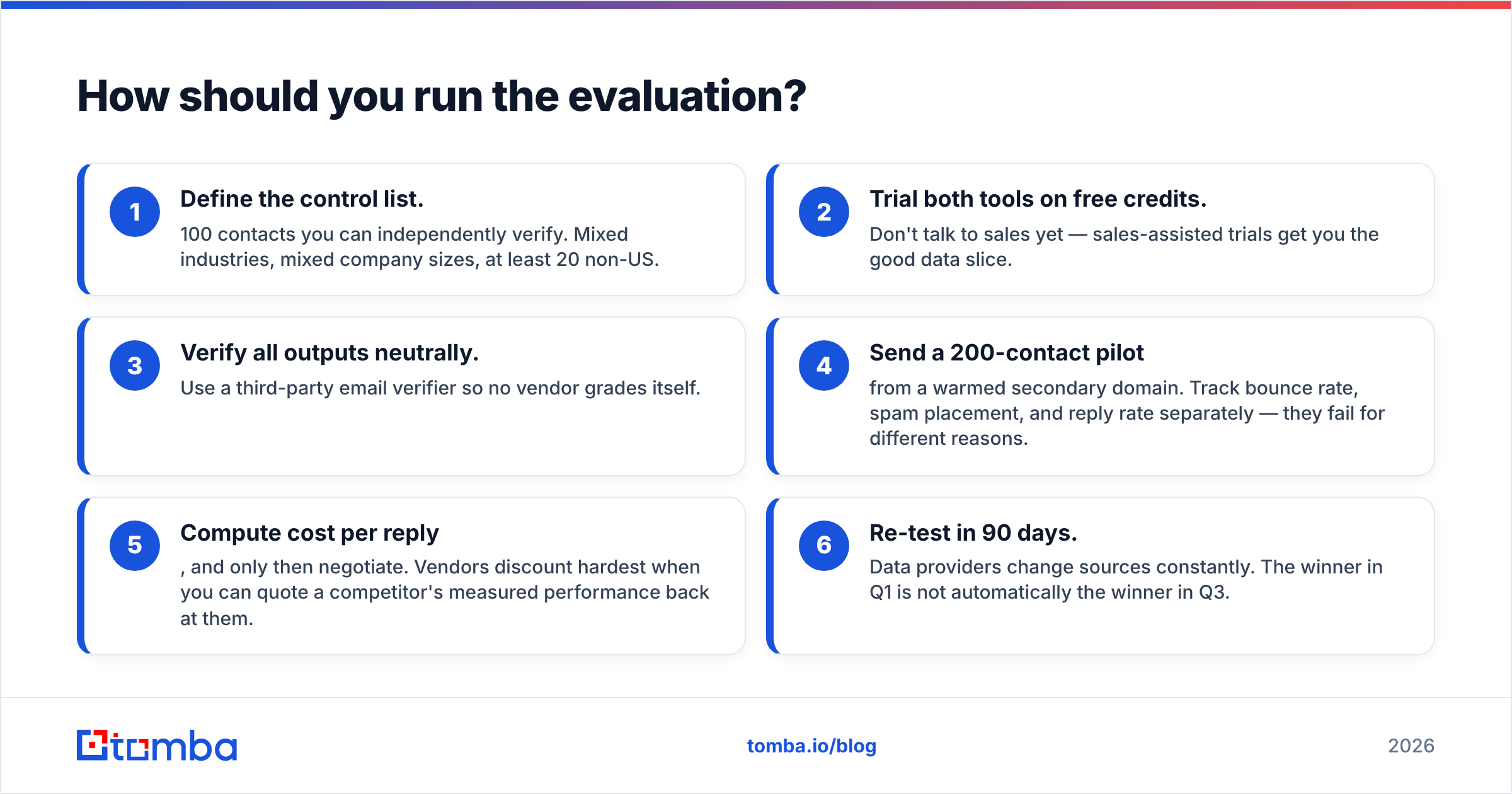
Give yourself one week and follow this sequence:
- Define the control list. 100 contacts you can verify yourself. Mixed industries, mixed company sizes, at least 20 outside the US.
- Trial both tools on free credits. Do not talk to sales yet. Sales-assisted trials hand you the good slice of the data.
- Verify all outputs neutrally. Use a third-party email verifier so no vendor grades itself.
- Send a 200-contact pilot from a warmed secondary domain. Track bounce rate, spam placement, and reply rate separately. They fail for different reasons.
- Compute cost per reply, and only then negotiate. Vendors discount hardest when you can quote a rival's measured numbers back at them.
- Re-test in 90 days. Data providers change sources constantly. The winner in Q1 is not automatically the winner in Q3.
The verdict#
Generect vs Mailmint has no single winner. Generect takes list-building when your ICP is LinkedIn-shaped. Mailmint takes cost when you already own the account list. Both hand you a verification problem they do not solve, and that is where most outbound budgets leak.
If your priority is contacts that actually land, start with the Tomba Email Finder. Search by domain, name, or company. Verification runs in the same workflow instead of arriving as a second invoice. The free tier gives you 25 searches a month, enough to run the control-list test above before you spend anything. Compare Tomba pricing against whatever quote you get, and decide on cost per verified contact. It is the only number that survives your first campaign.
Related guides#
Ready to find emails that actually work?
Join 150,000+ professionals who stopped guessing and started sending. Free credits on signup — no credit card required.
Get the Tomba newsletter
Practical outbound tactics and product updates — once every two weeks.
About the author