Generect vs Snappy Leads (2026): Which B2B Data Tool Wins?
Generect sells API-first LinkedIn-native lead data. Snappy Leads sells fast, cheap contact lookups. We compare coverage, email accuracy, pricing and export limits — and name the buyer each one actually fits.
TL;DR
- Generect is an API-first B2B data provider built around LinkedIn-native records — strongest when you want programmatic lead lists piped into your own stack, weakest when you want a cheap, casual seat for one rep.
- Snappy Leads is a lighter contact-lookup tool: browser extension, quick single searches, simple credit packs. Faster to start, thinner on enrichment depth and compliance paperwork.
- Neither vendor publishes a fully transparent, self-serve price ladder the way mid-market email finders do. Expect a sales conversation with Generect and credit-pack math with Snappy Leads.
- Email accuracy is where the two diverge most. Generect leans on structured profile data; Snappy Leads leans on pattern matching plus SMTP checks. Verify either one before you send.
- If you mainly need verified work emails with a published price and a real API, a dedicated email finder like Tomba (free tier, then $49/mo) is usually the cheaper starting point.
What are Generect and Snappy Leads?#
Two tools that both promise "B2B contacts," solving different halves of the problem.
Generect positions itself as a lead-generation data platform with a real-time LinkedIn-native index. The pitch is that instead of buying a stale CSV, you query for people and companies matching a filter set and get fresh records back — through a dashboard or, more commonly, through an API. Their public site (generect.com) leads with API documentation and integration language, not with a "sign up free" button. That tells you who they built it for: engineering-adjacent growth teams, agencies running data for clients, and companies stuffing records into their own CRM or scoring model.
Snappy Leads sits at the other end. It's a lookup tool — you're on a LinkedIn profile or a company page, you want the email, you click. Credit packs, browser extension, minimal onboarding. The audience is the individual SDR, the founder doing their own outbound, the recruiter who needs twenty contacts this week and not twenty thousand this quarter.
That framing matters more than any feature checklist. Comparing Generect vs Snappy Leads on "does it find emails" misses the point — both do. The real question is whether you're buying a data pipeline or a lookup habit.
How do Generect and Snappy Leads compare head to head?#
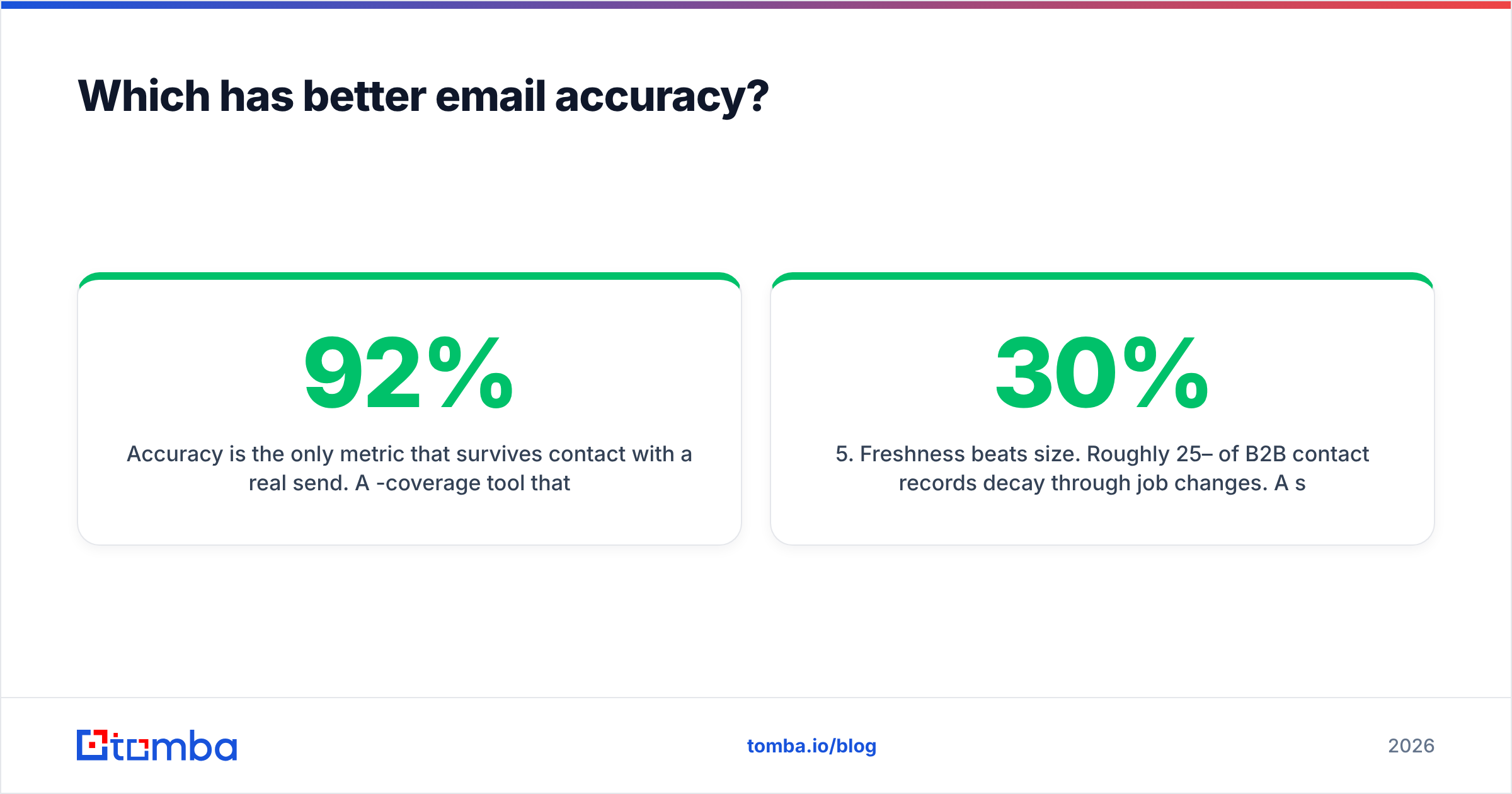
Here is the practical comparison. Pricing and limits shift, so treat published numbers as a starting point and confirm on each vendor's page before you commit.
| Dimension | Generect | Snappy Leads | Tomba |
|---|---|---|---|
| Primary model | API-first B2B data platform | Browser-extension lookup tool | Email finder + verifier suite |
| Best for | Agencies, RevOps, dev teams | Solo SDRs, founders, recruiters | Teams needing verified emails at scale |
| Free tier | Trial / demo on request | Limited free credits | 25 searches/mo, no card |
| Entry paid price | Custom quote (sales-led) | Credit packs (low entry) | $49/mo Starter |
| Mid tier | Custom | Credit packs | $99/mo Growth |
| Public API | Yes, core to the product | Limited | Yes, documented REST API |
| Bulk enrichment | Yes | Limited | Yes, bulk finder + verifier |
| Catch-all handling | Varies by record | Basic | Dedicated catch-all verifier |
| Phone numbers | Available on some plans | Limited | Phone finder add-on |
| CRM integrations | Via API / partners | Extension + export | HubSpot, Salesforce, Pipedrive, Zapier |
| Contract friction | Sales call, annual leaning | Self-serve | Self-serve monthly |
Three things stand out from that grid.
First, Generect's strength is also its tax. An API-first product with custom pricing is excellent when you have 50,000 records to enrich and a developer to wire it up. It's a poor fit when you want to test 200 leads this month and decide whether outbound works at all.
Second, Snappy Leads' strength is also its ceiling. Credit packs and a browser extension are the fastest possible on-ramp. But a lookup habit doesn't scale into a data operation — the moment you need scheduled re-enrichment, deduplication, or a webhook when a record changes, you've outgrown the category.
Third, both leave the verification question partly open, which is the expensive part.

Which has better email accuracy?#
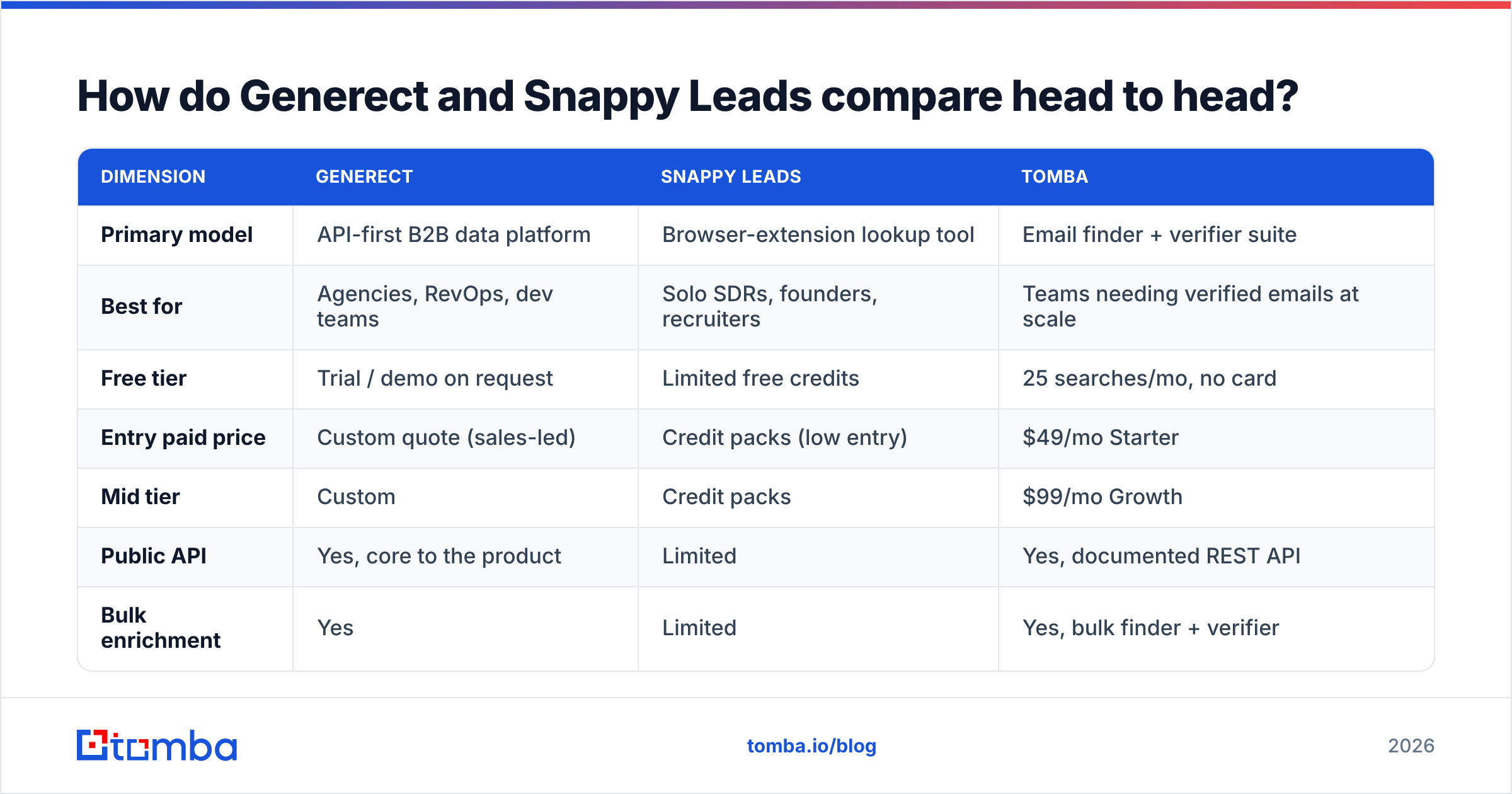
Accuracy is the only metric that survives contact with a real send. A 92%-coverage tool that returns 15% invalids will burn your domain faster than an 80%-coverage tool that returns 2%.
The two vendors get to an email by different routes:
- Generect — structured profile inference. Records are built from professional profile data plus company domain patterns. When the person is in a well-indexed company with a consistent email format, hit rates are strong. When the target is at a 12-person company with a custom format, the record may be absent rather than wrong — which is the safer failure mode.
- Snappy Leads — pattern generation plus SMTP probing. Fast and broad, but the failure mode flips: you get a plausible-looking guess that passes a syntax check and dies at the recipient server. That's the pattern that quietly wrecks sender reputation.
- Catch-all domains break both. Any domain configured to accept all mail returns "valid" to a naive SMTP check. Roughly a fifth of B2B domains are configured this way, and a catch-all-heavy list will inflate every vendor's self-reported accuracy number.
- Role accounts inflate coverage.
info@,sales@, andcontact@are trivial to find and nearly worthless for personalized outbound. Check whether a "found" rate includes them before you compare vendors. - Freshness beats size. Roughly 25–30% of B2B contact records decay per year through job changes. A smaller index refreshed monthly outperforms a huge index refreshed annually.

The practical takeaway: whichever tool you pick, run the output through an independent email verifier before it hits your sequencer. Vendors mark their own homework. A second-opinion verification pass — and a real catch-all verifier for the ambiguous domains — costs a fraction of a cent per record and saves you from the bounce spiral that gets a sending domain throttled.

Is Generect worth it for API-first teams?#
Yes, if three conditions hold.
You have volume. Sales-led pricing only makes sense above a threshold. If your monthly enrichment need is under a few thousand records, the per-record cost of a custom contract rarely beats a self-serve tool with published pricing.
You have engineering. Generect's value is in the integration — pulling filtered lists on a schedule, enriching inbound signups automatically, keeping a CRM warm. If nobody on your team is going to write that code, you're paying platform prices for a search box.
You need filter depth. Firmographic plus headcount-growth plus title-hierarchy filtering is genuinely hard to replicate with a generic finder. If your ICP is "Series B SaaS, 50–200 headcount, hired a VP of Sales in the last 90 days," a data platform earns its keep.
If any of those three is missing, you'll get better economics from a self-serve stack: a domain search to map the company, a finder to resolve individuals, and a verifier to clean the output.
Is Snappy Leads better for small teams?#
For a specific shape of small team, yes.
Snappy Leads wins on time-to-first-lead. Install, click, get an address. No procurement, no minimum, no implementation. For a founder validating a channel with 100 hand-picked prospects, that's exactly right — and honestly, over-tooling at that stage is a more common mistake than under-tooling.
Where it stops working:
- No repeatable pipeline. Manual clicking doesn't survive a second rep or a second market.
- Export friction. Getting data out cleanly and into a CRM is usually a copy-paste-and-pray affair.
- Thin verification. You'll want a separate cleaning step regardless.
- Credit math. Per-credit pricing looks cheap at 100 lookups and stops looking cheap at 5,000 — especially when failed lookups still consume credits, which is worth checking in the terms.
That last point is where a lot of buyers get surprised. Ask both vendors the same question: do I pay for a search that returns nothing? The answers differ, and the difference compounds.

What about the rest of the market?#
Neither of these is the only option, and pretending otherwise would be dishonest.
- BookYourData takes a pay-as-you-go database approach with a strong accuracy guarantee and no subscription lock-in — a genuinely good fit if you want a defined list purchase rather than an ongoing seat, and it's one of the more transparent players in the category.
- Apollo bundles data with a sequencer, which is convenient until you want to swap either half. If that's your direction, our Apollo alternative breakdown covers the trade-offs.
- Dedicated finders (Tomba included) do one job — resolve and verify a work email — and integrate with whatever you already use for sending.
- Enrichment-only providers fill in firmographics on records you already have, which is a different purchase entirely.
Cross-check any shortlist against real reviews on G2 rather than vendor case studies. Pay attention to reviews that mention support response time and refund policy on bad data — those two lines predict your actual experience better than any accuracy claim.
How should you decide between Generect and Snappy Leads?#
Run this in order. It takes an afternoon and beats a month of regret.
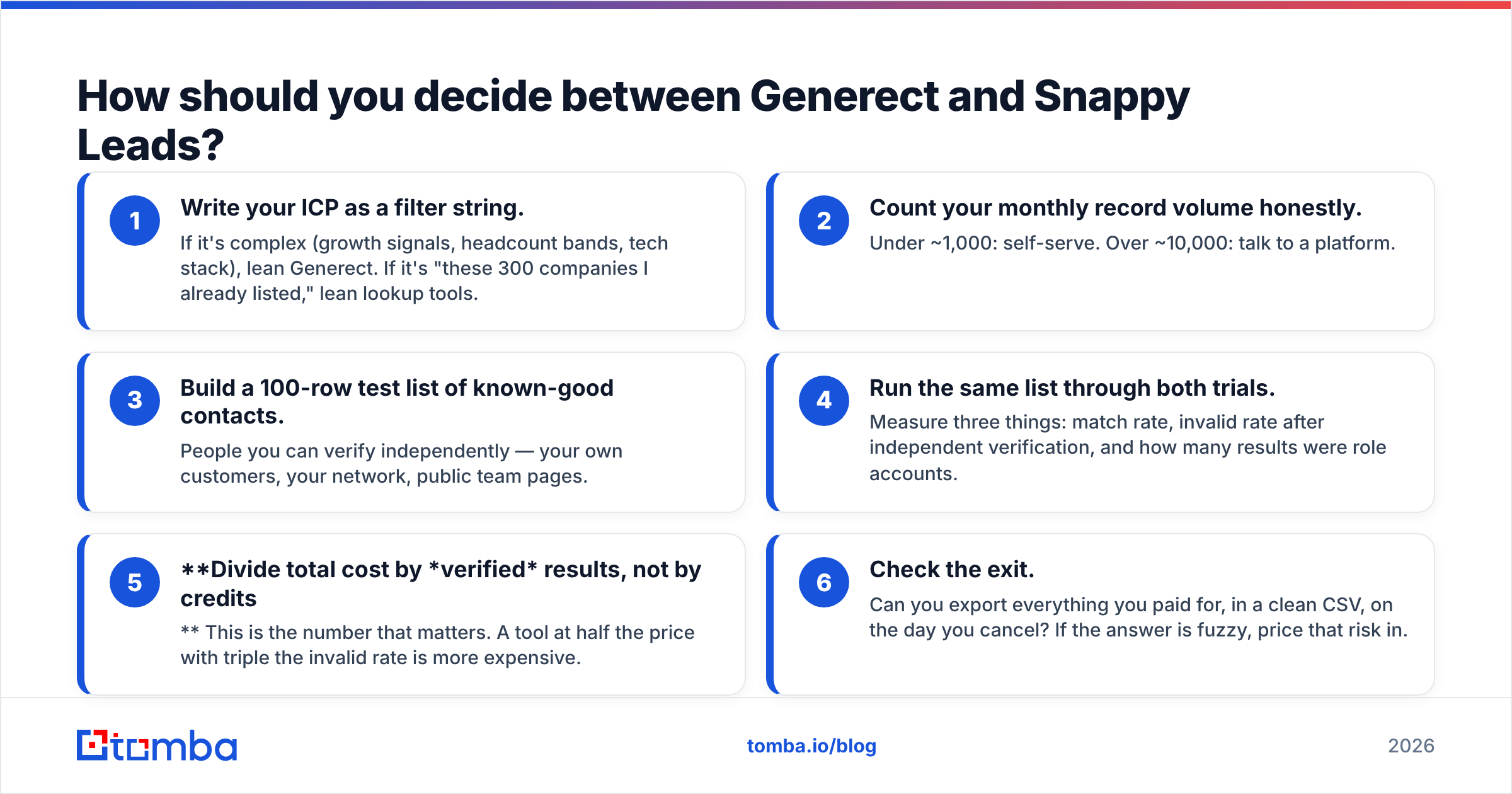
- Write your ICP as a filter string. If it's complex (growth signals, headcount bands, tech stack), lean Generect. If it's "these 300 companies I already listed," lean lookup tools.
- Count your monthly record volume honestly. Under ~1,000: self-serve. Over ~10,000: talk to a platform.
- Build a 100-row test list of known-good contacts. People you can verify independently — your own customers, your network, public team pages.
- Run the same list through both trials. Measure three things: match rate, invalid rate after independent verification, and how many results were role accounts.
- Divide total cost by verified results, not by credits. This is the number that matters. A tool at half the price with triple the invalid rate is more expensive.
- Check the exit. Can you export everything you paid for, in a clean CSV, on the day you cancel? If the answer is fuzzy, price that risk in.
Most teams running that test discover their bottleneck isn't sourcing — it's that a third of what they sourced was never deliverable. Fixing the verification layer improves reply rates more than switching data vendors does.
What does a sane stack look like in 2026?#
Separate the layers. Sourcing, verification, and sending should be swappable, because at least one of them will disappoint you within eighteen months.
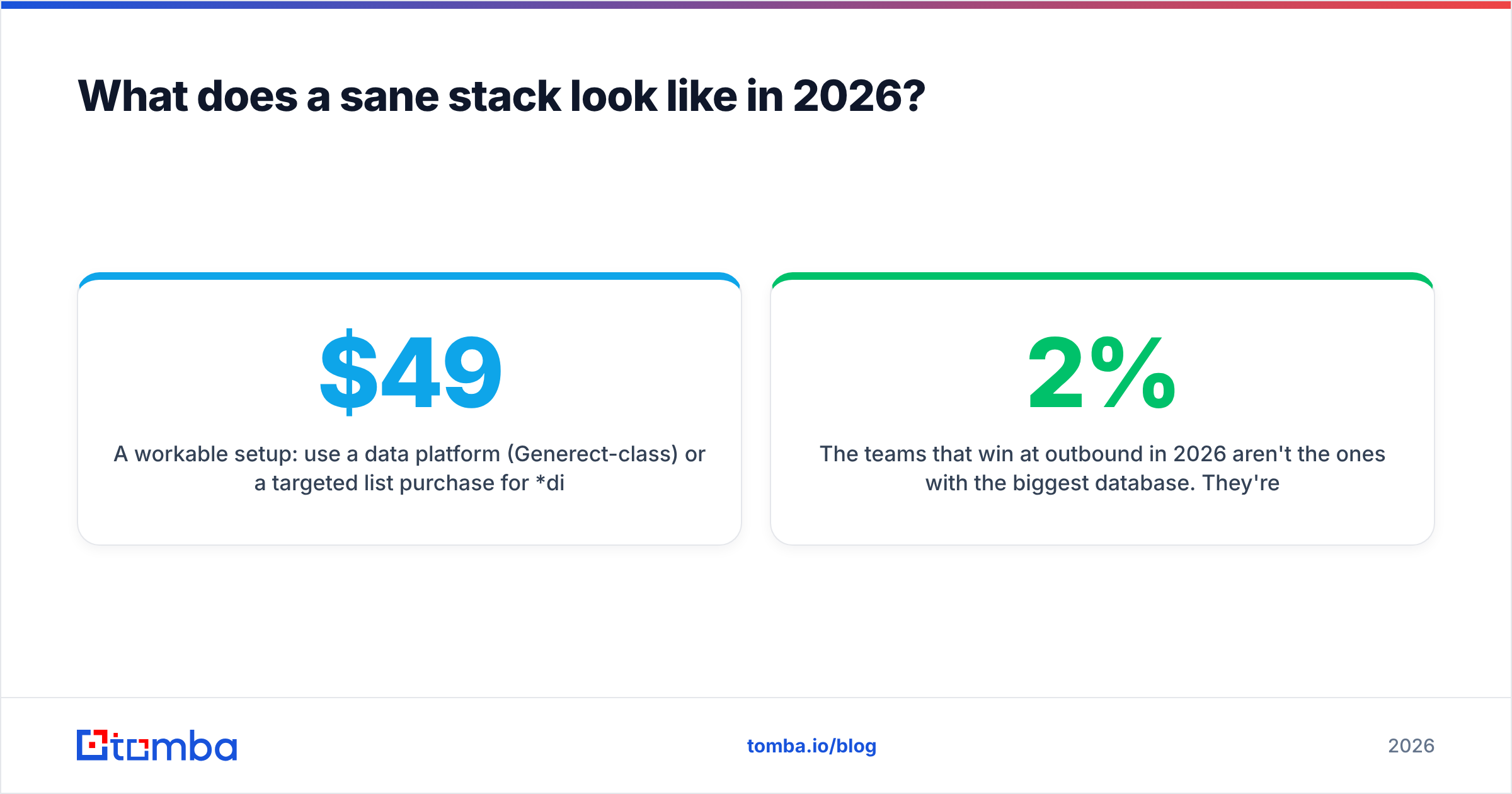
A workable setup: use a data platform (Generect-class) or a targeted list purchase for discovery, a dedicated finder and verifier for resolution and cleaning, and your sequencer of choice for delivery. Wire them with an API rather than CSV round-trips so the data stays current. If you want that layer without a procurement cycle, the Tomba API exposes finding, verification, and enrichment as plain REST endpoints with documented rate limits and published pricing — Free at 25 searches/month, $49/mo Starter, $99/mo Growth, $249/mo Pro.
The teams that win at outbound in 2026 aren't the ones with the biggest database. They're the ones whose bounce rate stays under 2% while everyone else's domain reputation quietly erodes.
Ready to test the resolution layer? Start with the Tomba Email Finder — 25 free searches a month, no card required. Run your 100-row test list through it alongside whatever Generect or Snappy Leads returns, compare verified results rather than raw matches, and let the numbers pick your vendor.
Related guides#
Ready to find emails that actually work?
Join 150,000+ professionals who stopped guessing and started sending. Free credits on signup — no credit card required.
Get the Tomba newsletter
Practical outbound tactics and product updates — once every two weeks.
About the author