Generect vs Soleadify: B2B Data Comparison for 2026
Generect sells LinkedIn-shaped B2B data through an API. Soleadify indexes small and local businesses most databases ignore. Here is how they actually differ on coverage, accuracy, pricing and API access.
Generect vs Soleadify is a choice between two very different data sets. Generect is built from LinkedIn-shaped professional records. Soleadify is built from the open web. Here is how they compare on coverage, accuracy, pricing, and API access.
TL;DR
- Generect serves LinkedIn-shaped B2B data — people, companies, and work emails — through a real-time API.
- Soleadify indexes the small and local firms those tools miss: dentists, plumbers, restaurants, regional agencies.
- They are not rivals on the same axis. Generect fits title-based selling into tech. Soleadify fits selling to Main Street.
- Neither is a pure email finder. Both bundle email into a wider database plan, and neither publishes full pricing.
- Need verified work emails at a set price? Tomba Email Finder starts at $49/mo and is the cheaper first layer.
Generect vs Soleadify: what are these two tools?#
Short version. Generect is a lead-data API built on LinkedIn-style professional records. Soleadify is a business database built on small and local firms that never show up cleanly in LinkedIn exports.
Generect sells real-time lookups. A static CSV decays 2-3% a month. Generect instead queries for people and companies when you ask. You get job titles, company data, and work emails through an API or a UI. Teams use it to power in-house prospecting tools, enrich CRM records on write, and build lists that mirror Sales Navigator filters without paying for seats.
Soleadify sells coverage where nobody else looks. Most B2B databases scrape professional networks and funding news. That makes them strong on venture-backed tech firms and weak on the two-person shop with a Squarespace site. Soleadify crawls the open web instead: business sites, listings, and local directories. From that it rebuilds a company profile — industry, services, tech used, contact details, and sometimes the owner's name and email.
Where the data comes from explains almost every other gap. Source drives coverage. Coverage drives fit. Fit decides whether either tool earns a line on your budget.
How do their data models actually differ?#
Five differences matter when you weigh Generect vs Soleadify:
- Source of truth. Generect leans on profile-shaped records. A person exists because they have a title and an employer. Soleadify leans on the firm's own web presence. A company exists because it has a site, a listing, or a storefront page.
- Primary entity. Generect is person-first. You search for humans and get their company as a field. Soleadify is company-first. You search for businesses and get contacts as a field — often a shared inbox like
info@rather than a named one. - Depth of detail. Soleadify goes deeper on what a business does: services listed on the site, products sold, whether it takes online bookings. Generect goes deeper on org charts: seniority, department, headcount band, and tenure.
- Freshness. Generect looks records up on demand, so they reflect the state at query time. Soleadify is a large index refreshed on a crawl cycle. That is fine for company facts and riskier for a named contact.
- Access. Generect leads with API-first delivery. Soleadify leads with list building and export. It offers an API, but that is not the core story.
Remember one line: Generect answers "who works there." Soleadify answers "what businesses exist."
Which one has better data coverage?#
Wrong question. Ask instead: coverage of what? This is where Generect vs Soleadify splits most clearly.
Generect is strong in the segments a professional network covers well. Think tech, SaaS, finance, consulting, and marketing, mid-market and up, in North America and Western Europe. It thins out fast in trades, hospitality, and healthcare practices. It also thins out in regions with low LinkedIn use. The owner of a four-person landscaping firm rarely keeps a profile with a clean job title.
Soleadify inverts that. It claims tens of millions of small businesses across many countries, including the segments Generect misses. The trade-off is the contact you get. It is often role-based rather than personal. Job titles are also less reliable, because they are inferred from an "About" or "Team" page rather than self-reported.
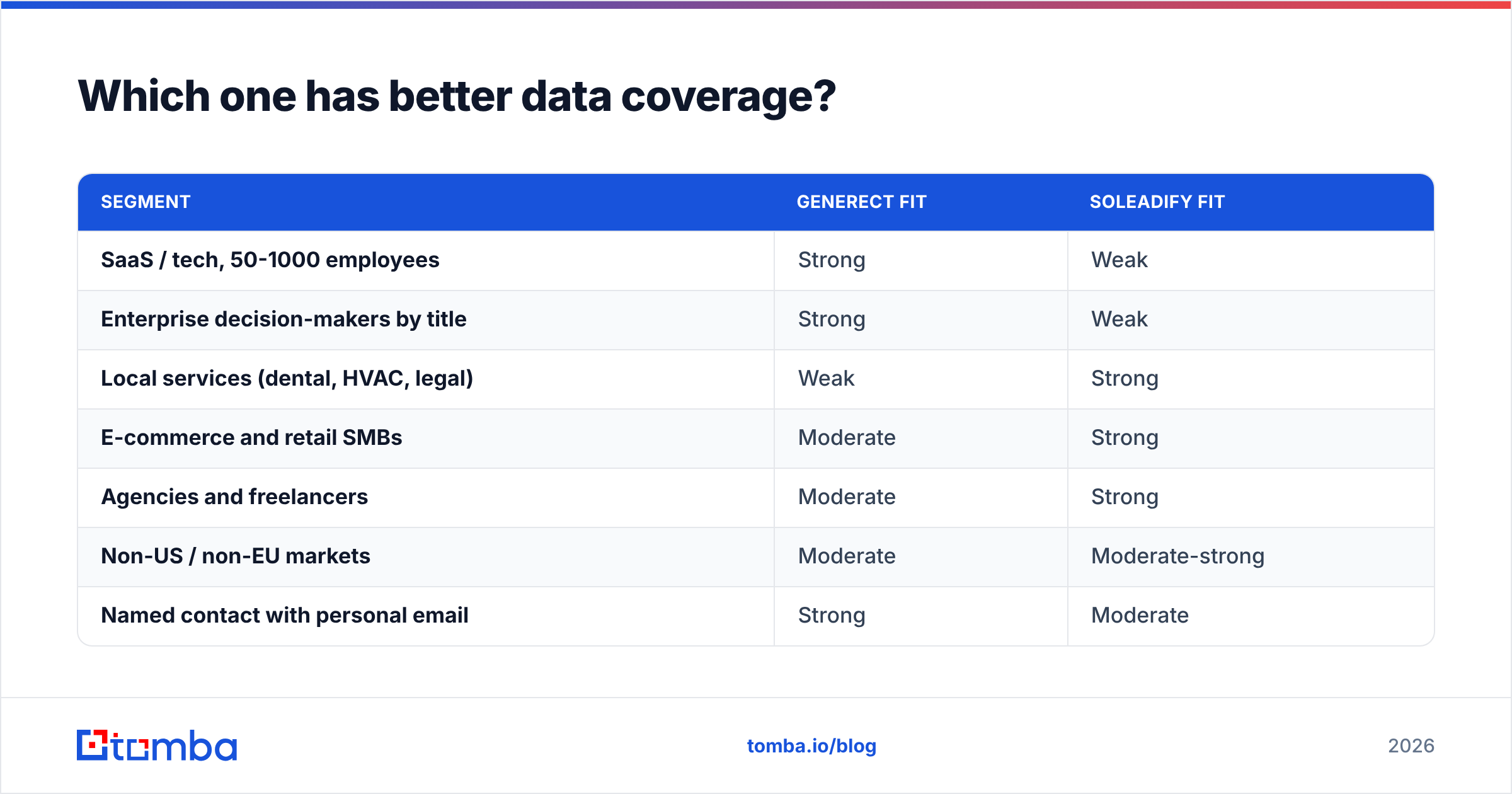
| Segment | Generect fit | Soleadify fit |
|---|---|---|
| SaaS / tech, 50-1000 employees | Strong | Weak |
| Enterprise decision-makers by title | Strong | Weak |
| Local services (dental, HVAC, legal) | Weak | Strong |
| E-commerce and retail SMBs | Moderate | Strong |
| Agencies and freelancers | Moderate | Strong |
| Non-US / non-EU markets | Moderate | Moderate-strong |
| Named contact with personal email | Strong | Moderate |
| Company-level firmographics | Moderate | Strong |
A practical test before you buy: take 50 accounts you already closed, strip them to domain names, and ask each vendor to enrich them during the trial. Match rate on your own customer list beats any coverage claim in a deck.
How accurate is the email data?#
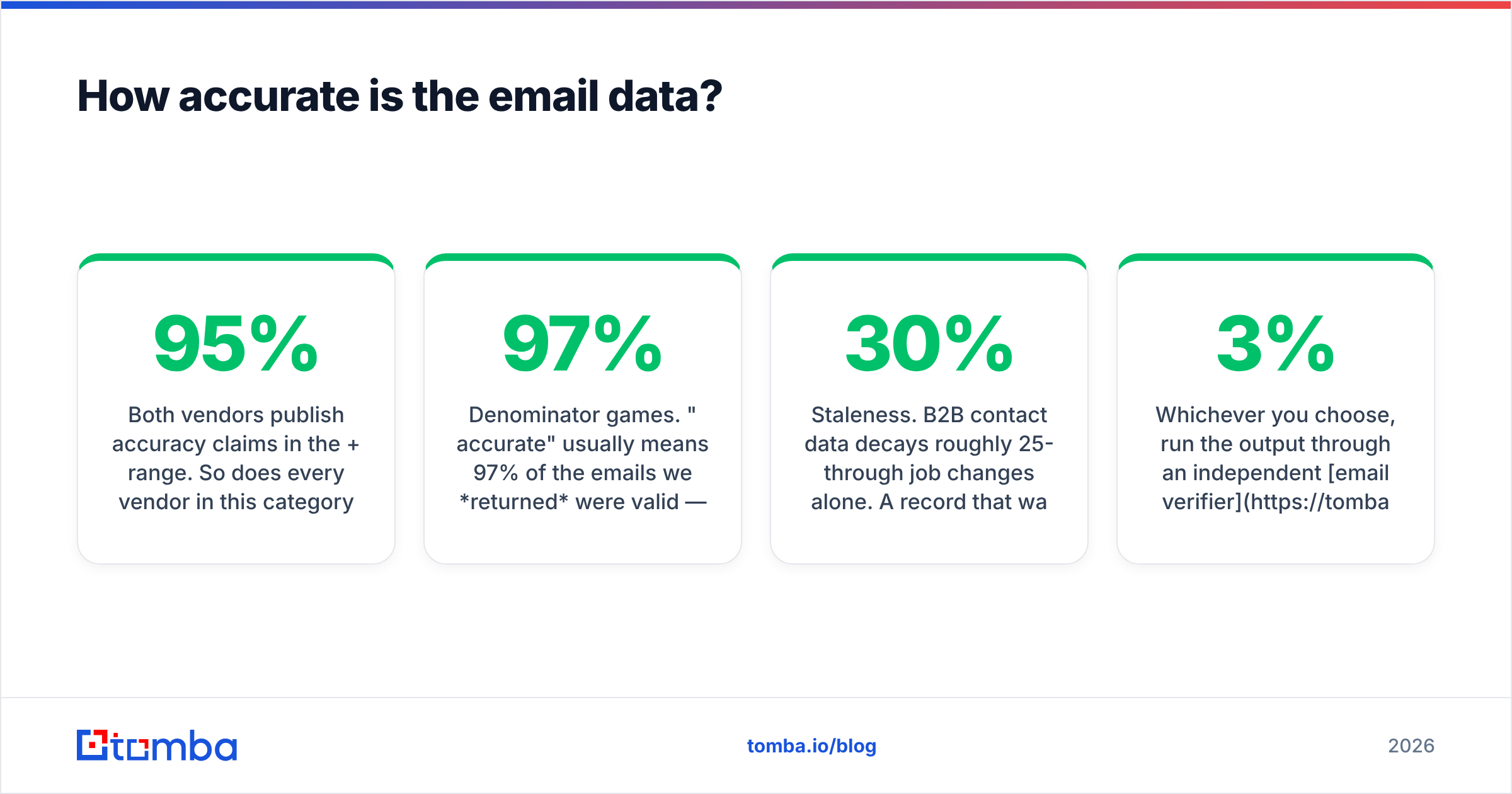
Both vendors claim 95%+ accuracy. So does every vendor here. The number means nothing until you know what it counts. On accuracy, Generect vs Soleadify is less about the headline figure and more about method.

Three things distort accuracy claims across this market:
- Denominator games. "97% accurate" usually means 97% of the emails a vendor returned were valid. It does not mean 97% of the contacts you asked for. A tool that returns nothing on hard lookups posts great accuracy and a poor match rate.
- Catch-all blindness. Many B2B domains accept mail sent to any address. SMTP checks cannot tell a real mailbox from a black hole there, so vendors mark them "valid" or quietly drop them. That is why a dedicated catch-all verifier is a separate step in most serious stacks.
- Staleness. B2B contact data decays 25-30% a year on job changes alone. A record that was right at crawl time can be dead six months later. Real-time lookups blunt this. A crawled index does not.
Whichever you pick, run the output through an independent email verifier first. Above a 3% bounce rate, mailbox providers start to throttle you. No vendor absorbs that cost. You do, through a damaged sender reputation.
Generect vs Soleadify: a feature-by-feature comparison#

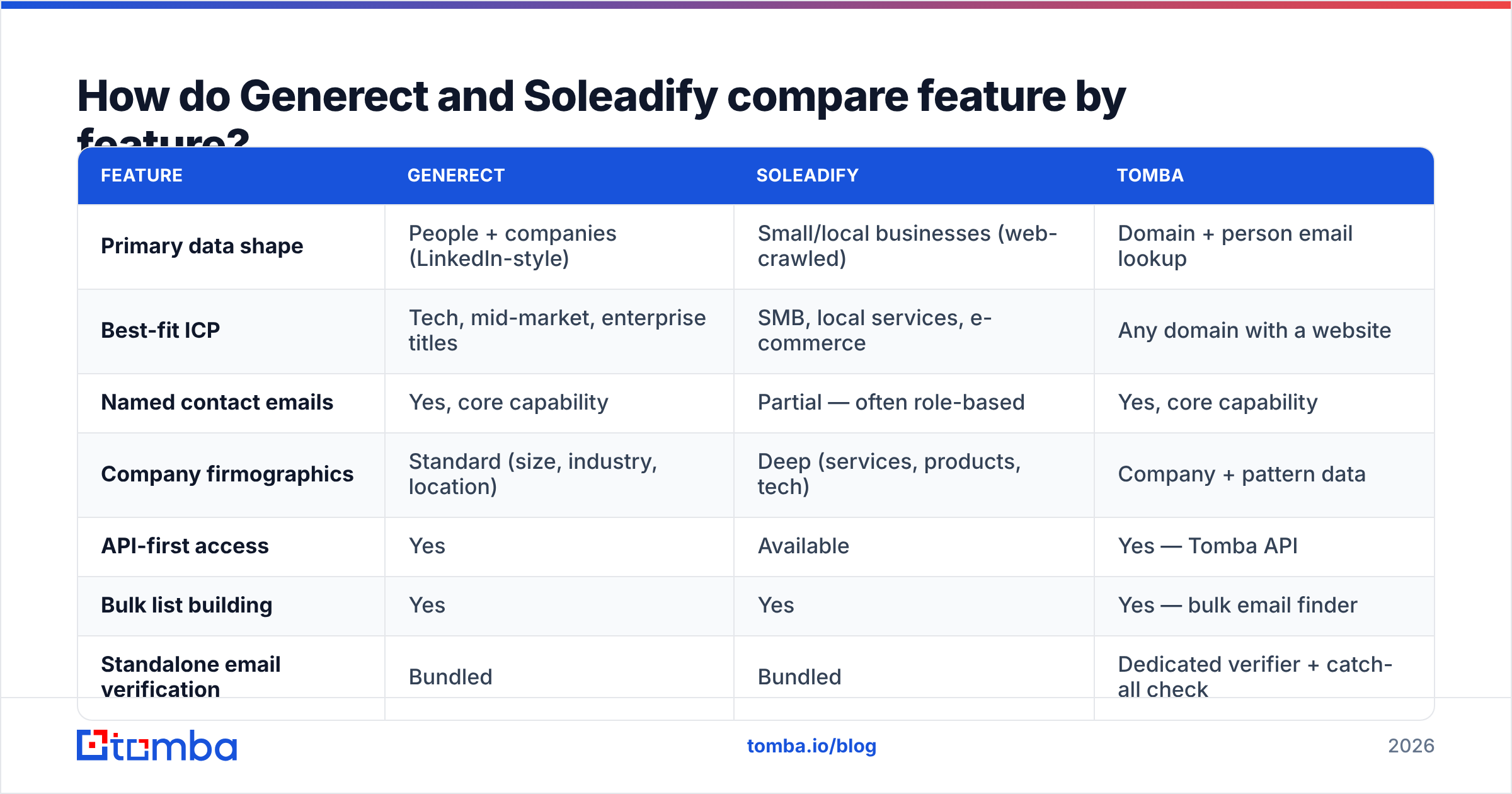
| Feature | Generect | Soleadify | Tomba |
|---|---|---|---|
| Primary data shape | People + companies (LinkedIn-style) | Small/local businesses (web-crawled) | Domain + person email lookup |
| Best-fit ICP | Tech, mid-market, enterprise titles | SMB, local services, e-commerce | Any domain with a website |
| Named contact emails | Yes, core capability | Partial — often role-based | Yes, core capability |
| Company firmographics | Standard (size, industry, location) | Deep (services, products, tech) | Company + pattern data |
| API-first access | Yes | Available | Yes — Tomba API |
| Bulk list building | Yes | Yes | Yes — bulk email finder |
| Standalone email verification | Bundled | Bundled | Dedicated verifier + catch-all check |
| Chrome extension | Yes | Yes | Yes |
| Free tier | Trial / demo-gated | Trial / demo-gated | 25 searches/mo, no card |
| Published entry price | Not fully public | Not fully public | $49/mo Starter |
| Spreadsheet add-ons | Limited | Limited | Google Sheets + Excel |
The table makes the point. Generect and Soleadify are database plans where email is one field among many. Tomba is a lookup tool where email is the product. Those are different purchases, and plenty of teams buy one of each.
Generect vs Soleadify pricing: what do they cost?#
Both vendors put real pricing behind a call. That is normal for database products. Price depends on record volume, seats, API limits, and term length. It still costs you three things as a buyer:
- You cannot compare cost per verified contact up front. Two vendors both quoting "$X per 1,000 credits" can differ 3x in real cost once failed lookups burn credits.
- Annual terms are the default. Expect 12 months with a discount attached, so a bad fit is costly to exit.
- Credit rules matter more than the headline price. Ask three things: do unused credits roll over, do failed searches burn credits, and what happens if you blow past the monthly cap mid-campaign?
Compare that with published tiers. Tomba pricing runs Free (25 searches/mo), Starter $49/mo, Growth $99/mo, Pro $249/mo, and Enterprise custom. You can model the cost before you talk to anyone. If you only need work emails against a known target list, that is often worth more than a deep database you use 10% of.
When you do take the calls, bring three numbers: net-new contacts needed per month, the share of your target accounts outside the LinkedIn-shaped world, and your current cost per booked meeting. Those three frame every deal.
Which tool should you pick for your use case?#
Pick Generect if: your buyer is defined by job title and company size. You want to build prospecting infrastructure, not click through a UI. Your engineers will pull the data into your own CRM or sequencer through an API. It fits outbound teams selling software to software firms.
Pick Soleadify if: your buyer is defined by what the business does, not by who works there. You sell POS systems to restaurants, marketing to dental practices, or insurance to contractors. No LinkedIn-derived database covers that market well. Soleadify's web-crawled approach is genuinely different there.
Pick neither if: you already know your target accounts and only need contact data. Buying a full database to solve "I have 800 domains and need the head of marketing at each" is like buying a grocery store because you need milk. A domain search against your account list solves it in an afternoon.
What are the alternatives worth shortlisting?#
A few names come up in the same Generect vs Soleadify evaluations. Here is where each sits:
- BookYourData — good if you want to buy verified lists outright, pay as you go, with no subscription. Well regarded for accuracy guarantees when your need is occasional.
- Apollo — the all-in-one: database, sequencing, and dialer. Broad, but shallow in places. Teams often outgrow the data quality first. See our take on Apollo alternatives.
- Clearbit-style enrichment — best when you already have inbound traffic or form fills to enrich. It is not built for cold list building.
- Tomba — the finder-plus-verifier layer: email finder, verifier, catch-all handling, phone data, and enrichment in one API with public pricing.
Before you sign, check review volume on G2 or Capterra. Read the reviews about support speed and refunds on bad data. That is where these vendors really differ.
What is the verdict on Generect vs Soleadify?#
There is no universal winner, and any post that claims one is selling something. Generect is the better buy for title-based prospecting into tech and mid-market accounts, especially if you want API-first delivery. Soleadify is the better buy for anyone selling to small and local firms. It has coverage that LinkedIn-derived tools structurally cannot match.
Both share one model: you pay for breadth you may not use, on terms you have to negotiate, with email as a bundled field rather than a promise. That is fine when breadth is the point. It is waste when you already know which companies you want to reach.
Start with the layer you can measure. If your bottleneck is "I have the list, I need verified work emails," run it through Tomba Email Finder first. You get 25 free searches to test match rate on your own domains, $49/mo Starter if it works, and a built-in verifier so nothing reaches your sending tool unchecked. A high match rate may mean you need no database at all. A low one tells you which segment you are missing — and that answers the Generect vs Soleadify question for you.
Related guides#
Ready to find emails that actually work?
Join 150,000+ professionals who stopped guessing and started sending. Free credits on signup — no credit card required.
Get the Tomba newsletter
Practical outbound tactics and product updates — once every two weeks.
About the author