Generect vs Validity (2026): Which B2B Data Tool Wins?
Generect finds you new contacts. Validity keeps the ones you have clean and delivered. Here is an honest breakdown of pricing, data coverage, and which one your GTM team actually needs in 2026.
Generect vs Validity looks like a head-to-head fight. It is not one. Generect finds new contacts. Validity keeps the contacts you already have clean and out of spam. Here is what each tool does, what it costs, and which one your team needs.
TL;DR
- Generect vs Validity is not a real matchup. Generect is a B2B lead-sourcing platform. Validity is a data-quality and deliverability suite.
- Is your problem "we have no one to email"? Generect fits better. Is it "half our email bounces or hits spam"? Validity's BriteVerify and Everest fit better.
- Both lean on sales-led pricing. Neither publishes a simple self-serve price for full API access. Small teams feel that friction first.
- Most real stacks have three parts: a sourcing tool, a verification layer, and a deliverability monitor. Often from three vendors.
- A pay-as-you-go email finder with built-in verification (Tomba starts free, then $49/mo) covers the first two legs. It costs a fraction of an enterprise contract.
Generect vs Validity: What Each Tool Actually Does#
Buyers make one big mistake with Generect vs Validity. They assume the two tools do the same job. They barely overlap.
Generect is a B2B lead-generation data provider. You search by company, job title, seniority, region, or industry. It returns contact records: names, roles, company data, and work email addresses. It also sells API access, so you can pull leads straight into your product, CRM, or enrichment flow. No manual CSV exports. The pitch is real-time lookup, not a stale database dump.
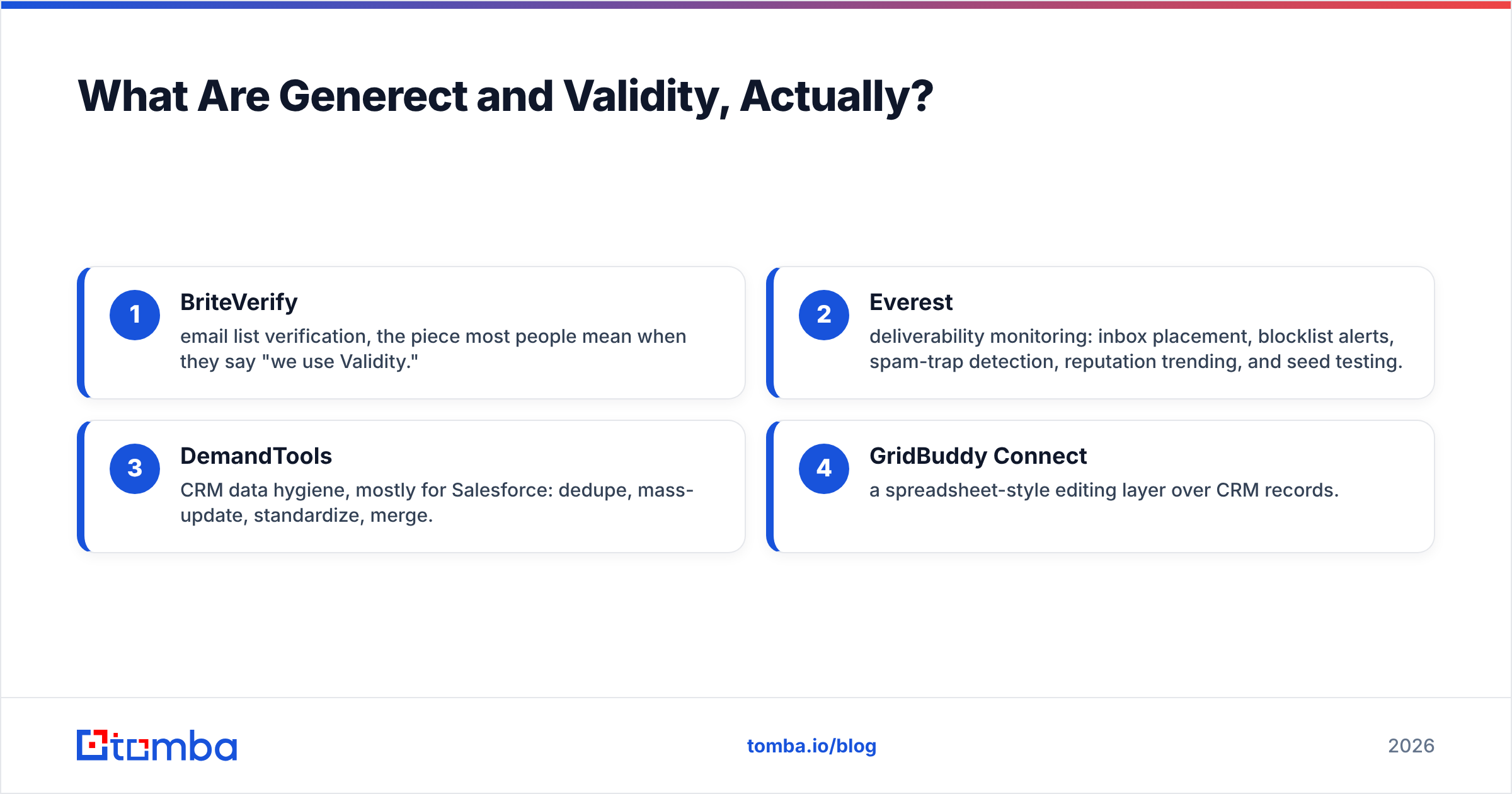
Validity is a data-quality and email-deliverability company. It owns four well-known products:
- BriteVerify — email list verification, the piece most people mean when they say "we use Validity."
- Everest — deliverability monitoring: inbox placement, blocklist alerts, spam-trap detection, reputation trending, and seed testing.
- DemandTools — CRM data hygiene, mostly for Salesforce: dedupe, mass-update, standardize, merge.
- GridBuddy Connect — a spreadsheet-style editing layer over CRM records.
So the honest framing of Generect vs Validity is simple: acquisition vs. hygiene. One brings contacts in the door. The other makes sure your current contacts are real, unique, and reachable.

That split matters at buying time too. SDR leaders, growth engineers, and founders buy Generect. RevOps, marketing ops, and email program managers buy Validity. The second group has usually been burned by a domain reputation problem already.
Generect vs Validity: The Head-to-Head Comparison#
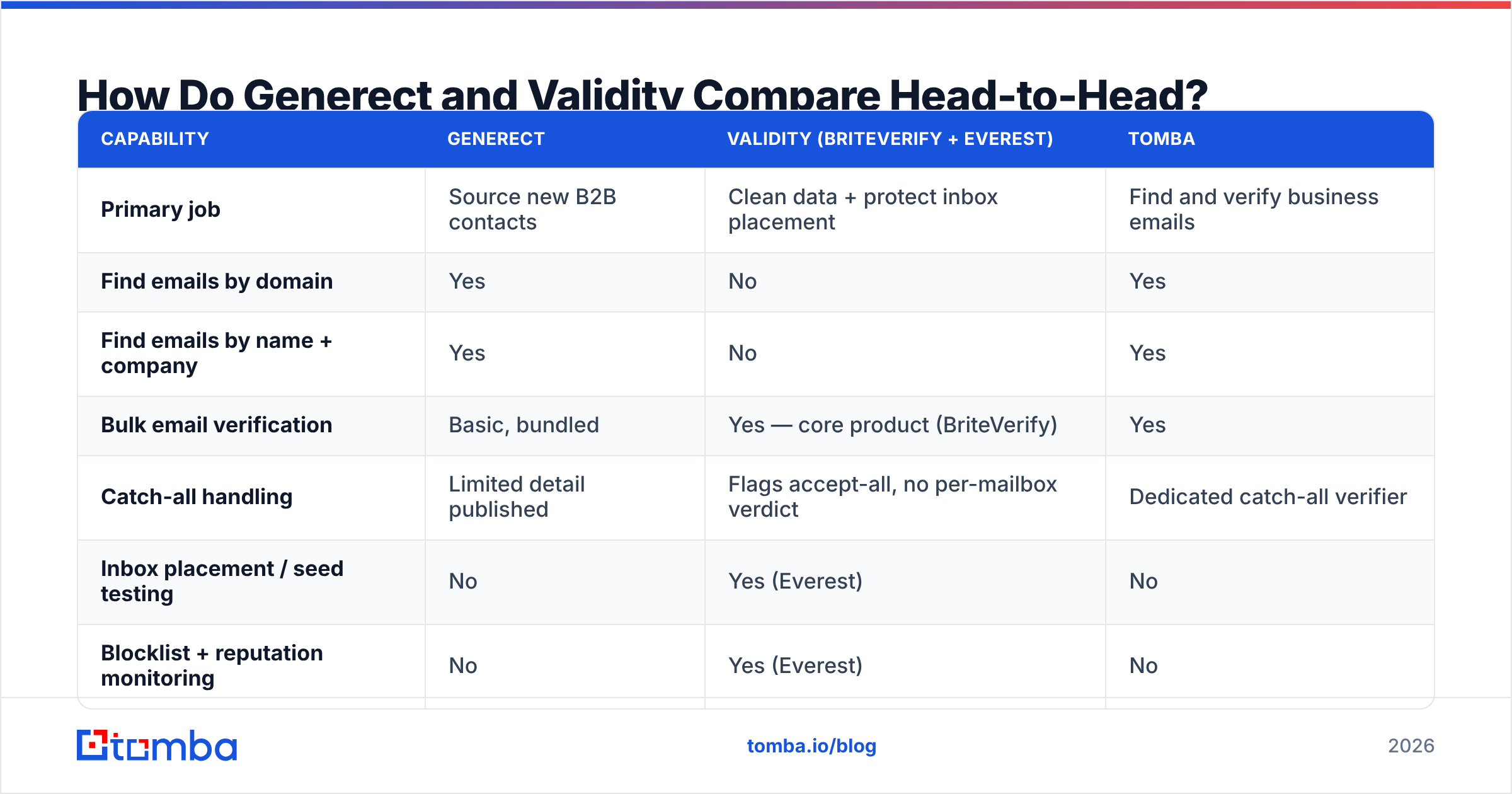
Here is the practical comparison. I added a lightweight email-finder stack as a third column, so you can see where the gaps sit.
| Capability | Generect | Validity (BriteVerify + Everest) | Tomba |
|---|---|---|---|
| Primary job | Source new B2B contacts | Clean data + protect inbox placement | Find and verify business emails |
| Find emails by domain | Yes | No | Yes |
| Find emails by name + company | Yes | No | Yes |
| Bulk email verification | Basic, bundled | Yes — core product (BriteVerify) | Yes |
| Catch-all handling | Limited detail published | Flags accept-all, no per-mailbox verdict | Dedicated catch-all verifier |
| Inbox placement / seed testing | No | Yes (Everest) | No |
| Blocklist + reputation monitoring | No | Yes (Everest) | No |
| CRM dedupe / mass update | No | Yes (DemandTools, Salesforce-first) | No |
| Phone numbers | Yes, on some plans | No | Yes |
| Public self-serve pricing | Partial — sales for API volume | Partial — sales for suite | Yes, fully published |
| Free tier to test | Trial / demo | Limited free credits on BriteVerify | 25 searches/month, free forever |
| API-first workflow | Yes | Yes (BriteVerify API) | Yes |
Two things jump out of that table.
First, the middle rows barely overlap. Generect cannot tell you if your sending domain sits on Spamhaus. Validity cannot find the email of a VP of Engineering you have never contacted. Anyone who frames this as "pick one" is selling you something.
Second, both vendors hide the interesting pricing behind a call. That is normal at enterprise scale. It is still annoying at team scale.
What Does Generect Do Well?#
Generect's best argument is fresh data plus API delivery. Static databases decay fast. G2 reviews and industry reports put the drift near 2–3% of B2B records per month. Over a year that compounds to roughly 25–30%, because people keep changing jobs.
A tool that resolves records at query time starts ahead of one that hands you an 18-month-old snapshot.
Where it fits well:
- Building outbound from zero. You have an ICP and no list. Generect turns filters into people you can contact.
- Putting lead data inside your own product. If you build a sales tool, a recruiting platform, or an enrichment feature, the API matters more than the UI.
- Recruiting and talent sourcing, where LinkedIn-style profile data is the whole point.
Where it gets weaker:
- Verification depth. Sourcing tools bundle "verified" emails. Bundled checks and dedicated checks are not the same rigor. If a provider marks a catch-all domain "valid" because the server accepts everything, your bounce rate finds out before you do.
- Coverage outside core markets. Like most profile-based datasets, it is densest in US and EU tech. It thins out in SMB, trades, and non-English regions. Test your own segment first.
- No deliverability feedback loop. Generect tells you who to email. It has no view on whether your last 5,000 sends landed in Promotions.
What Does Validity Do Well?#
Validity has one argument the other side cannot match. It is the only tool here that sees what happens after you hit send.
BriteVerify is a respected verification engine with a long track record and a plain API. Everest is rarer still. It puts seed-list inbox placement tests, blocklist monitoring, spam-trap hits, and mailbox-provider reputation data in one place. That turns "our open rates dropped" from a mystery into something you can diagnose.
Where it fits well:
- Large, established email programs. If you send hundreds of thousands of messages a month, deliverability drift costs real revenue. Everest pays for itself.
- Salesforce-heavy RevOps teams. DemandTools clears duplicate and junk records. No email finder touches that job.
- Compliance-heavy industries where list hygiene and consent tracking get audited, not just recommended.
Where it gets weaker:
- Cost. Validity is priced as an enterprise suite. BriteVerify pay-as-you-go starts near a cent per check at low volume and drops with commitment. The full suite is quoted and annual. It is not aimed at a five-person startup.
- No acquisition at all. Nothing in the Validity stack finds you a new contact.
- Catch-all ambiguity. This is an industry limit, not a Validity flaw. An SMTP handshake alone cannot resolve accept-all domains. If much of your ICP sits on catch-all domains, use a tool built for it, like a catch-all verifier. Otherwise you carry an unknown bucket and guess.
Generect vs Validity Pricing: How the Models Compare#
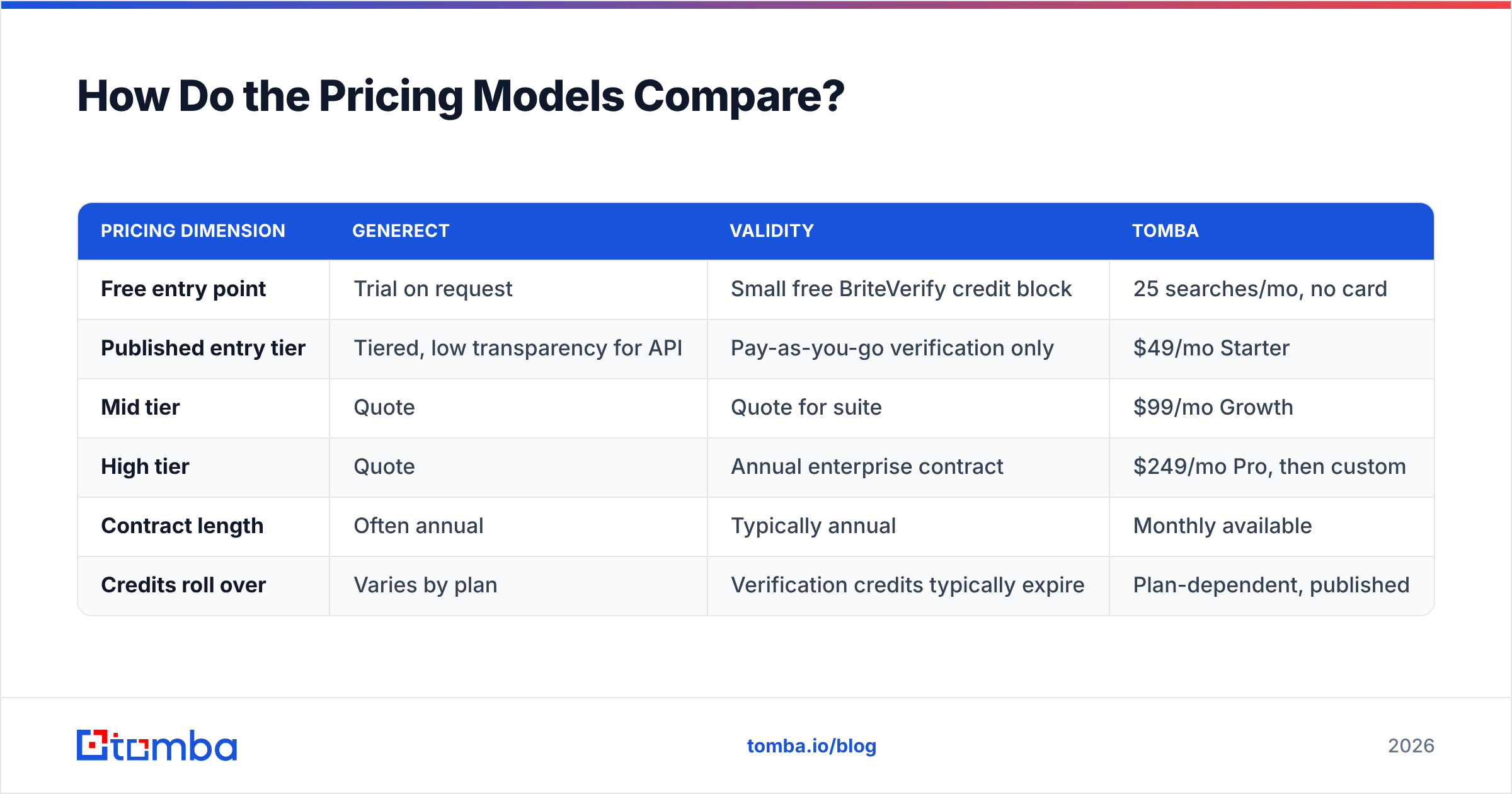
Pricing is where the two vendors finally agree — on "book a demo."
| Pricing dimension | Generect | Validity | Tomba |
|---|---|---|---|
| Free entry point | Trial on request | Small free BriteVerify credit block | 25 searches/mo, no card |
| Published entry tier | Tiered, low transparency for API | Pay-as-you-go verification only | $49/mo Starter |
| Mid tier | Quote | Quote for suite | $99/mo Growth |
| High tier | Quote | Annual enterprise contract | $249/mo Pro, then custom |
| Contract length | Often annual | Typically annual | Monthly available |
| Credits roll over | Varies by plan | Verification credits typically expire | Plan-dependent, published |
The read is simple. Say you have a $200 monthly budget and two weeks to decide. Both vendors are built for procurement cycles, not for a Tuesday afternoon. Neither is bad. They just do not match how you buy.
Compare that with a published, self-serve model on the Tomba pricing page. Then decide whether transparency is worth more to you than suite breadth.

Generect vs Validity for Cold Outreach: Which Wins?#
For cold outbound, neither one is a full answer. This is the part most comparison posts get wrong.
A working cold email stack has four jobs:
- Source — find people who match your ICP and get their work email. (Generect does this. Validity does not.)
- Verify — confirm the mailbox exists before you send. That keeps bounces under the ~2% line mailbox providers watch. (Validity does this well. Generect does it lightly.)
- Send and warm — infrastructure, domain setup, SPF/DKIM/DMARC, and a slow volume ramp. (Neither vendor does this. That is an Instantly, Smartlead, or Saleshandy job.)
- Monitor — track reputation, placement, and blocklists over time. (Validity does this. Generect does not.)
Buy only Generect and you will source well. You will also damage your domain, because nothing is watching step 4.
Buy only Validity and you get a spotless list you cannot grow.
Teams that make outbound work run at least two of these. The cheapest honest version is a sourcing tool with real verification built in. Add free deliverability tooling — Google Postmaster Tools, an SPF checker, and a blacklist checker — until your volume justifies Everest.
Where Does a Dedicated Email Finder Fit Between Them?#
There is a middle path. It covers the two costliest gaps, sourcing and verification, with no annual contract.
A dedicated email finder turns a name and domain into a work email. It verifies in the same call. Steps 1 and 2 collapse into one workflow. In practice, that means:
- Domain search to pull every contact it can find at a target company, with role and department context.
- Email verification before the record reaches your sequencer, using the email verifier instead of trusting the source's own "valid" flag.
- Catch-all resolution for accept-all domains. That is where most bulk lists quietly hide their bounce risk.
- API and integrations so the data lands in HubSpot, Salesforce, Sheets, or your own app. No CSV round trip. See the Tomba API if you build rather than click.
This does not replace Everest. At real scale, buy deliverability monitoring; the math works. But you do not need an enterprise suite before you have proven a channel.
Generect vs Validity: Which Should You Choose in 2026?#
Match the tool to your bottleneck, not to the review-site score.
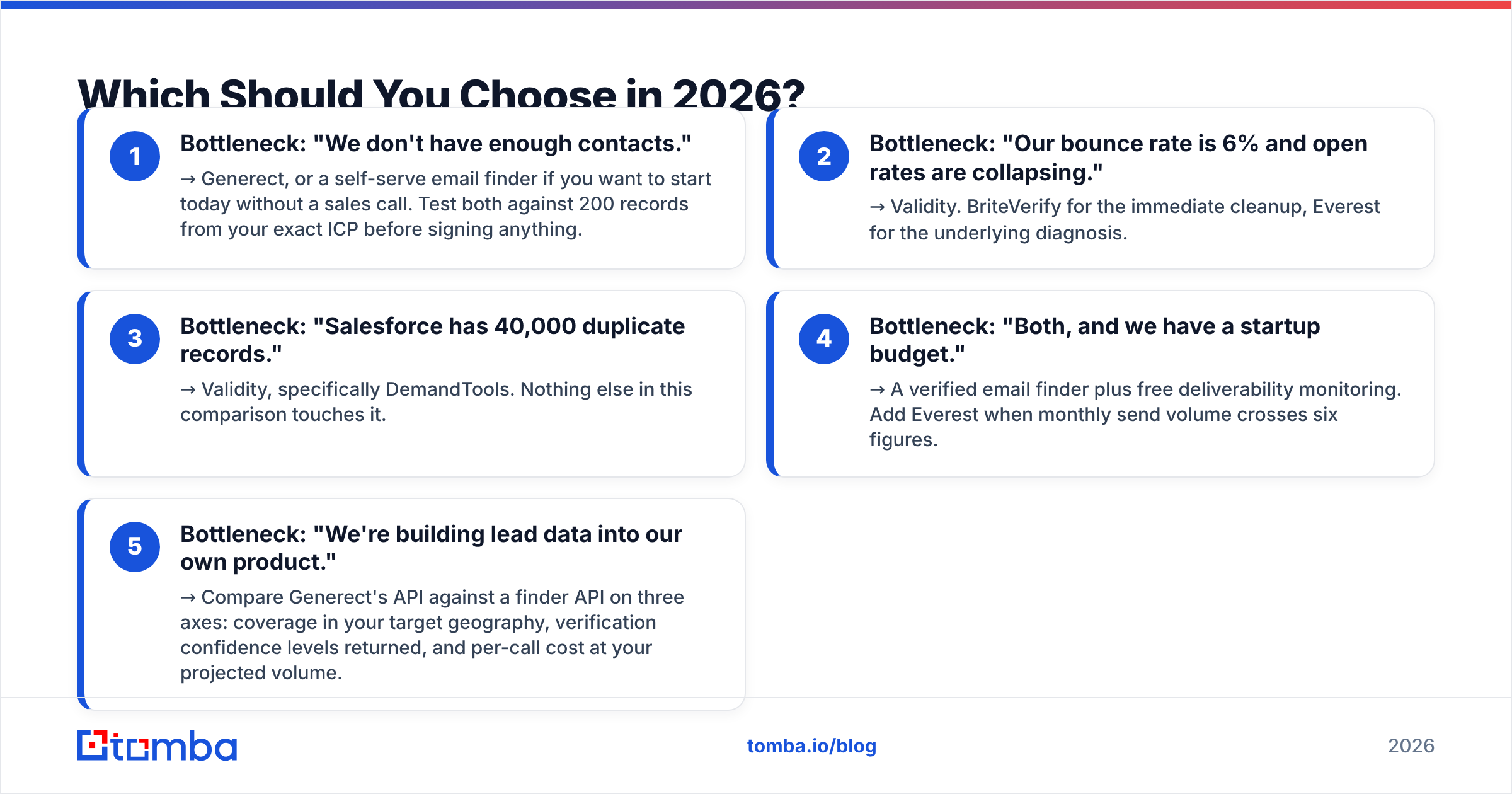
- "We don't have enough contacts." → Generect, or a self-serve email finder if you want to start today without a sales call. Test both on 200 records from your exact ICP before you sign.
- "Our bounce rate is 6% and open rates are falling." → Validity. BriteVerify for the cleanup, Everest for the diagnosis.
- "Salesforce has 40,000 duplicate records." → Validity, specifically DemandTools. Nothing else here touches it.
- "Both, and we have a startup budget." → A verified email finder plus free deliverability tools. Add Everest when monthly send volume crosses six figures.
- "We're building lead data into our own product." → Compare Generect's API against a finder API on three axes: coverage in your target region, verification confidence levels returned, and cost per call at your volume.
One test discipline saves money either way. Run the same 100-row sample through every finalist. Same companies, same roles, same week. Count real matches. Count catch-alls. Then send to a subset and count hard bounces.
Vendor-published accuracy rates are measured on the vendor's favorite dataset. Yours is the only one that counts.
The Bottom Line#
Generect vs Validity is a false binary. Generect fills the pipeline. Validity protects the channel. A mature GTM stack needs both jobs, and mature teams buy them separately.
Both leave the same thing on the table. Neither gives you a fast, openly priced path from "here's a company domain" to "here's a verified, sendable contact."
If that is the gap you feel right now, start with the Tomba Email Finder. The free tier gives you 25 searches a month with no card. Verification runs on every result. Paid plans start at $49/mo with published pricing you can check before you talk to anyone. Prove the channel first. Buy the enterprise suite when the volume earns it.
Related guides#
Ready to find emails that actually work?
Join 150,000+ professionals who stopped guessing and started sending. Free credits on signup — no credit card required.
Get the Tomba newsletter
Practical outbound tactics and product updates — once every two weeks.
About the author