GetProspect vs Grata (2026): Which Data Tool Fits Your GTM?
GetProspect finds email addresses. Grata finds companies nobody else can see. Here's an honest breakdown of pricing, data models, and which one your team should actually buy in 2026.
TL;DR
- GetProspect and Grata are not competitors. GetProspect is a contact-level prospecting tool (find and verify work emails at scale). Grata is a company-level search engine built for private-market deal sourcing.
- If your job is "book 30 meetings this month," GetProspect is in your category. If your job is "find every founder-owned HVAC roll-up candidate in the Southeast," Grata is in your category.
- Pricing lives in different universes: GetProspect is self-serve with a free tier and paid plans in the tens of dollars per month; Grata is quote-only enterprise software with annual contracts.
- The most common real-world stack is both layers: a company-discovery engine on top, a contact-finding and verification layer underneath.
- Whichever discovery tool you pick, budget for a dedicated verification step. Discovery platforms are optimized for coverage, not for inbox-safe deliverability.
What are GetProspect and Grata, actually?#
Start here, because most "GetProspect vs Grata" comparisons quietly assume they do the same thing. They don't.
GetProspect is a B2B email finder and contact database. You give it a name and a domain, a LinkedIn profile, a company URL, or a filtered search across its contact index, and it returns work email addresses with a validity signal attached. It ships a Chrome extension, a CSV enrichment flow, and a searchable database of contacts filtered by job title, industry, headcount, and geography. The buyer is an SDR, a founder doing their own outbound, or a growth marketer building a list.
Grata is a private-company intelligence and deal-sourcing platform. It indexes millions of private companies — the ones with no press coverage, no funding rounds, and a five-page website — and lets you search them by what they do, using natural-language descriptions rather than rigid SIC/NAICS codes. It layers on ownership signals, headcount growth, M&A history, and similar-company expansion. The buyer is a private equity associate, a corp-dev team, an investment bank, or an M&A advisor building a target list.
One tool answers "who is the VP of Marketing at this company and what's her email?" The other answers "which 400 companies in North America actually do industrial water treatment for food processors, and which of them are founder-owned?"
Why is GetProspect vs Grata an unfair comparison?#
Because they operate on different primitives. Here are the five differences that actually decide your purchase:
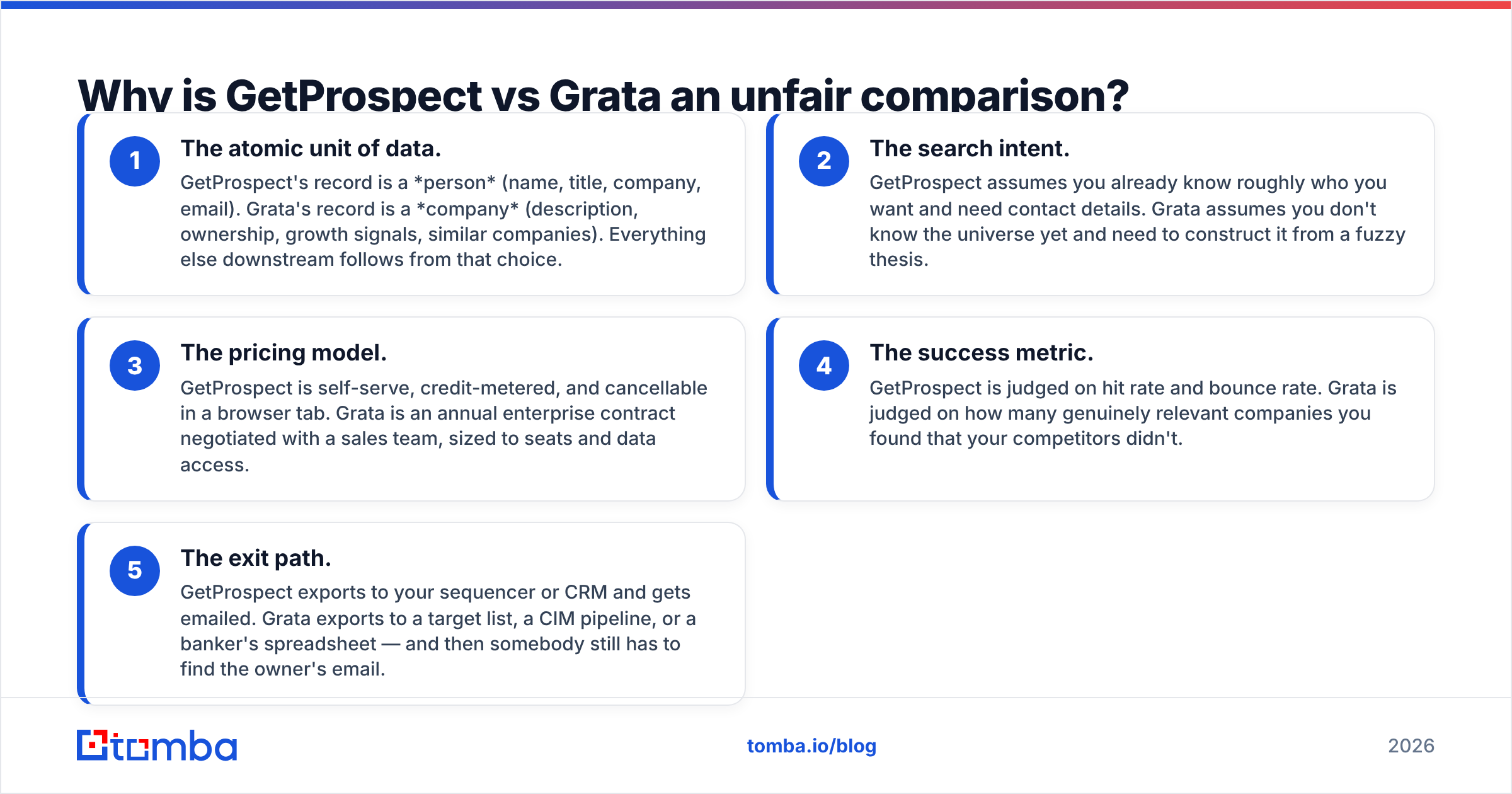
- The atomic unit of data. GetProspect's record is a person (name, title, company, email). Grata's record is a company (description, ownership, growth signals, similar companies). Everything else downstream follows from that choice.
- The search intent. GetProspect assumes you already know roughly who you want and need contact details. Grata assumes you don't know the universe yet and need to construct it from a fuzzy thesis.
- The pricing model. GetProspect is self-serve, credit-metered, and cancellable in a browser tab. Grata is an annual enterprise contract negotiated with a sales team, sized to seats and data access.
- The success metric. GetProspect is judged on hit rate and bounce rate. Grata is judged on how many genuinely relevant companies you found that your competitors didn't.
- The exit path. GetProspect exports to your sequencer or CRM and gets emailed. Grata exports to a target list, a CIM pipeline, or a banker's spreadsheet — and then somebody still has to find the owner's email.
That last point is where most teams discover they need both layers, not one.

How do GetProspect and Grata compare feature by feature?#
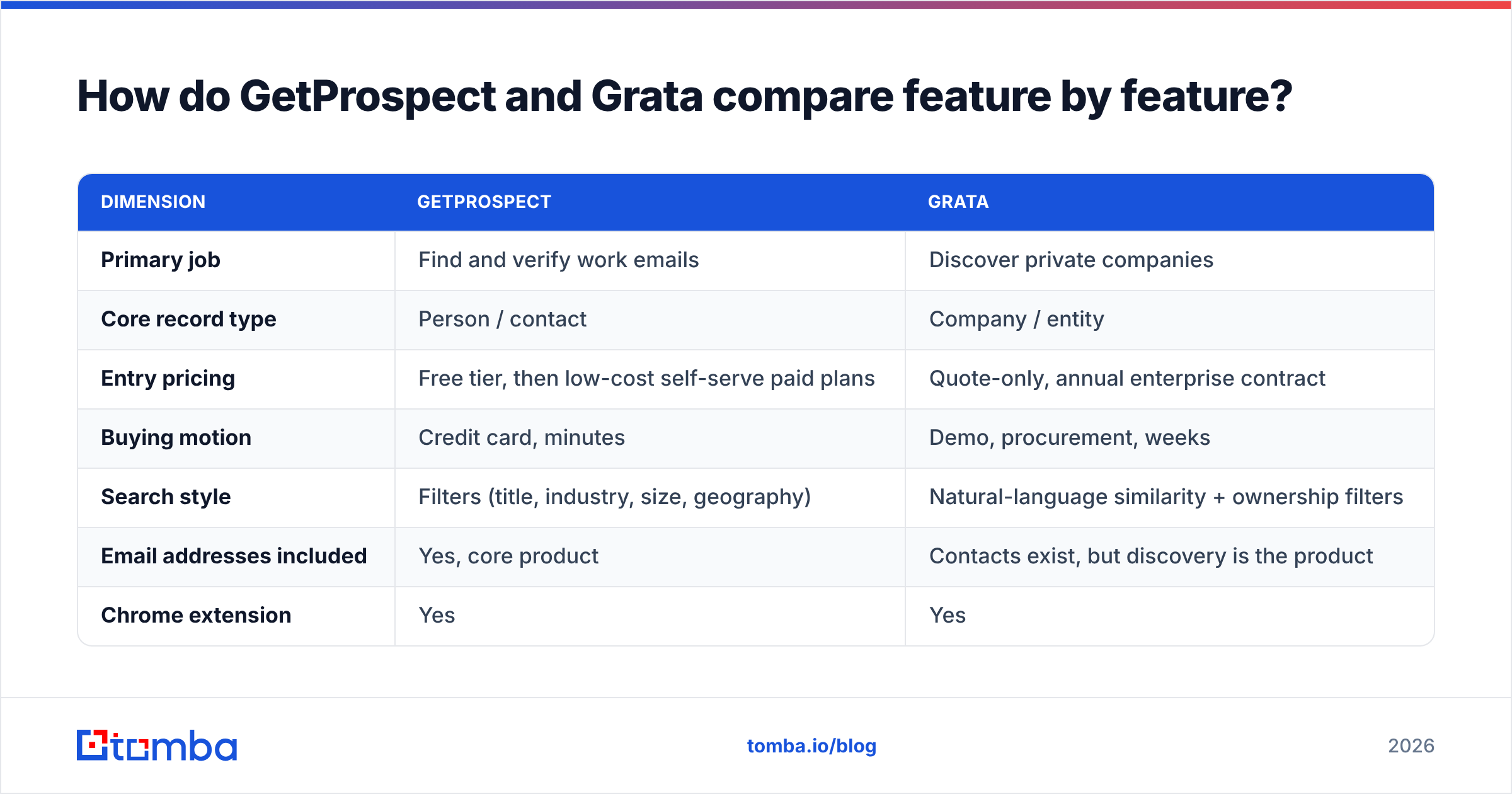
Pricing and packaging move often, so treat the numbers below as directional and confirm on each vendor's current pricing page before you commit budget. Grata does not publish public pricing at all; buyers consistently report annual contracts rather than monthly self-serve plans.
| Dimension | GetProspect | Grata |
|---|---|---|
| Primary job | Find and verify work emails | Discover private companies |
| Core record type | Person / contact | Company / entity |
| Entry pricing | Free tier, then low-cost self-serve paid plans | Quote-only, annual enterprise contract |
| Buying motion | Credit card, minutes | Demo, procurement, weeks |
| Search style | Filters (title, industry, size, geography) | Natural-language similarity + ownership filters |
| Email addresses included | Yes, core product | Contacts exist, but discovery is the product |
| Chrome extension | Yes | Yes |
| API access | Yes, on paid tiers | Yes, enterprise-tier |
| Bulk CSV enrichment | Yes | Limited to list export workflows |
| Typical buyer | SDR, founder, growth marketer | PE associate, corp dev, M&A advisor |
| Typical seat count | 1–20 | 3–50, procurement-approved |
| What it does badly | Deep company discovery from a fuzzy thesis | Cheap, high-volume contact-level outbound |
Read the table twice and the verdict falls out on its own: nobody is genuinely torn between these two products unless they've mislabeled their own problem.
Which one has better data quality?#
They have better data at different layers, and comparing them head-to-head on "accuracy" is a category error.
Grata's differentiator is coverage of the invisible middle market. Its indexing approach reads company websites rather than relying purely on structured registries, which is why it surfaces the eight-person specialty manufacturer that Crunchbase has never heard of. Independent user reviews on G2 consistently praise this discovery breadth and flag the usual middle-market data caveat: descriptions and headcounts drift, and website-derived signals age.
GetProspect's differentiator is contact-level hit rate and cost per email. Like every email finder, its output splits into three buckets — confirmed valid, risky/catch-all, and not found — and the honest way to evaluate it is on your own ICP rather than on any vendor's published average. Run 200 domains from your actual target list through any tool you're evaluating and measure three things: hit rate, verified-valid rate, and bounce rate after send. Those three numbers beat every marketing claim you'll read.
A caution that applies to both: neither platform's internal validity flag is a substitute for a real-time SMTP-level check at send time. Data decays roughly 2–3% per month as people change jobs, and a record verified in March is a guess by September. Running a final pass through a dedicated email verifier before a campaign is cheap insurance, and it's the single highest-ROI habit in outbound.

Who should buy GetProspect?#
Buy GetProspect if your workflow looks like this:
- You run volume outbound and need thousands of verified contacts per month at a predictable per-credit cost.
- Your ICP is describable with standard filters: "Head of RevOps at 50–500 employee SaaS companies in the UK."
- You want a Chrome extension your reps can use on LinkedIn without training.
- You need CSV in, enriched CSV out, no procurement cycle.
- Budget is measured in dollars per month, not thousands per year.
Where it will frustrate you: when your target definition doesn't map to an industry code. If your thesis is "companies that manufacture custom gaskets for aerospace," filter-based contact databases will hand you a mess of adjacent noise. That's a discovery problem, and a contact database is the wrong instrument for it.
Who should buy Grata?#
Buy Grata if your workflow looks like this:
- You build target lists from a thesis, not a filter — niche verticals, roll-up candidates, adjacent-market expansion.
- Ownership structure matters to you: founder-owned versus PE-backed versus strategic-owned changes whether a company is even actionable.
- You need to defend list completeness to an investment committee, where "we missed 30 relevant targets" is a real cost.
- You have annual software budget and a procurement process, and a five-figure contract is normal for your team.
- Contact-level email volume is small — you're sending 40 highly personalized notes, not 4,000.
Where it will frustrate you: as a day-to-day SDR tool. It's expensive per seat, the workflow is research-shaped rather than sequence-shaped, and high-volume email sourcing isn't the product's center of gravity. Handing Grata to a five-person SDR team and expecting Apollo-style throughput is a budgeting mistake, not a product flaw.
Can you use both, and what does the combined stack look like?#
Yes, and for M&A-adjacent go-to-market teams it's the standard architecture. Think of it like house-hunting: Grata is the map that shows you which neighborhoods exist; the email layer is the doorbell.
A working three-layer stack:
- Discovery layer — Grata (or an equivalent private-company engine) builds the account universe from your thesis. Output: a list of domains.
- Contact layer — a domain search pass turns each domain into named decision-makers with email patterns and role context. Output: named contacts.
- Hygiene layer — verification and enrichment clean the list before it touches a sequencer. Output: a send-safe list with firmographics attached for personalization.
The friction point is always the handoff between layers one and two. Deal-sourcing platforms export domains beautifully and contact coverage patchily; contact tools take domains as input and are priced per record. That's exactly the seam an email finder API is built for — you pipe the domain list straight from your discovery export into an enrichment job and skip the manual CSV shuffle entirely. Teams running weekly target-list refreshes save more time here than anywhere else in the workflow.
What are the alternatives to GetProspect and Grata?#
If neither tool fits cleanly, the honest map of adjacent options looks like this:
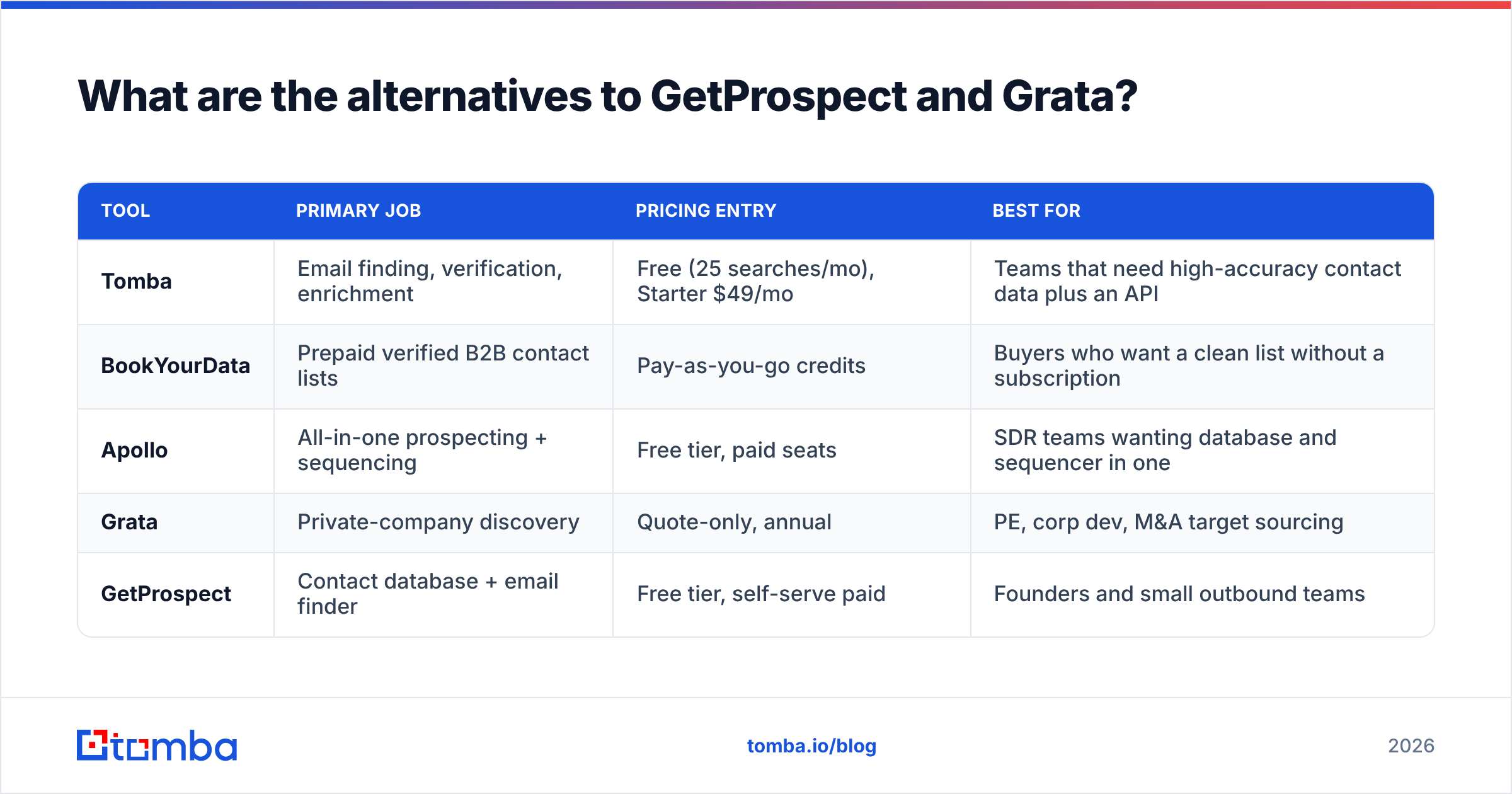
| Tool | Primary job | Pricing entry | Best for |
|---|---|---|---|
| Tomba | Email finding, verification, enrichment | Free (25 searches/mo), Starter $49/mo | Teams that need high-accuracy contact data plus an API |
| BookYourData | Prepaid verified B2B contact lists | Pay-as-you-go credits | Buyers who want a clean list without a subscription |
| Apollo | All-in-one prospecting + sequencing | Free tier, paid seats | SDR teams wanting database and sequencer in one |
| Grata | Private-company discovery | Quote-only, annual | PE, corp dev, M&A target sourcing |
| GetProspect | Contact database + email finder | Free tier, self-serve paid | Founders and small outbound teams |
A few notes on picking from that list. BookYourData suits teams that hate subscriptions and want credits that don't expire monthly — a genuinely different buying model worth considering if your list-building is bursty rather than continuous. Apollo suits teams that want one bill and one login, at the cost of depth in any single layer. Tomba suits teams who want the data layer to be excellent and API-first, then bring their own sequencer. And if you're evaluating a bundled platform mostly for its database, it's worth reading a straight Apollo alternative breakdown before you commit to seats you may not need.
How should you run the evaluation?#
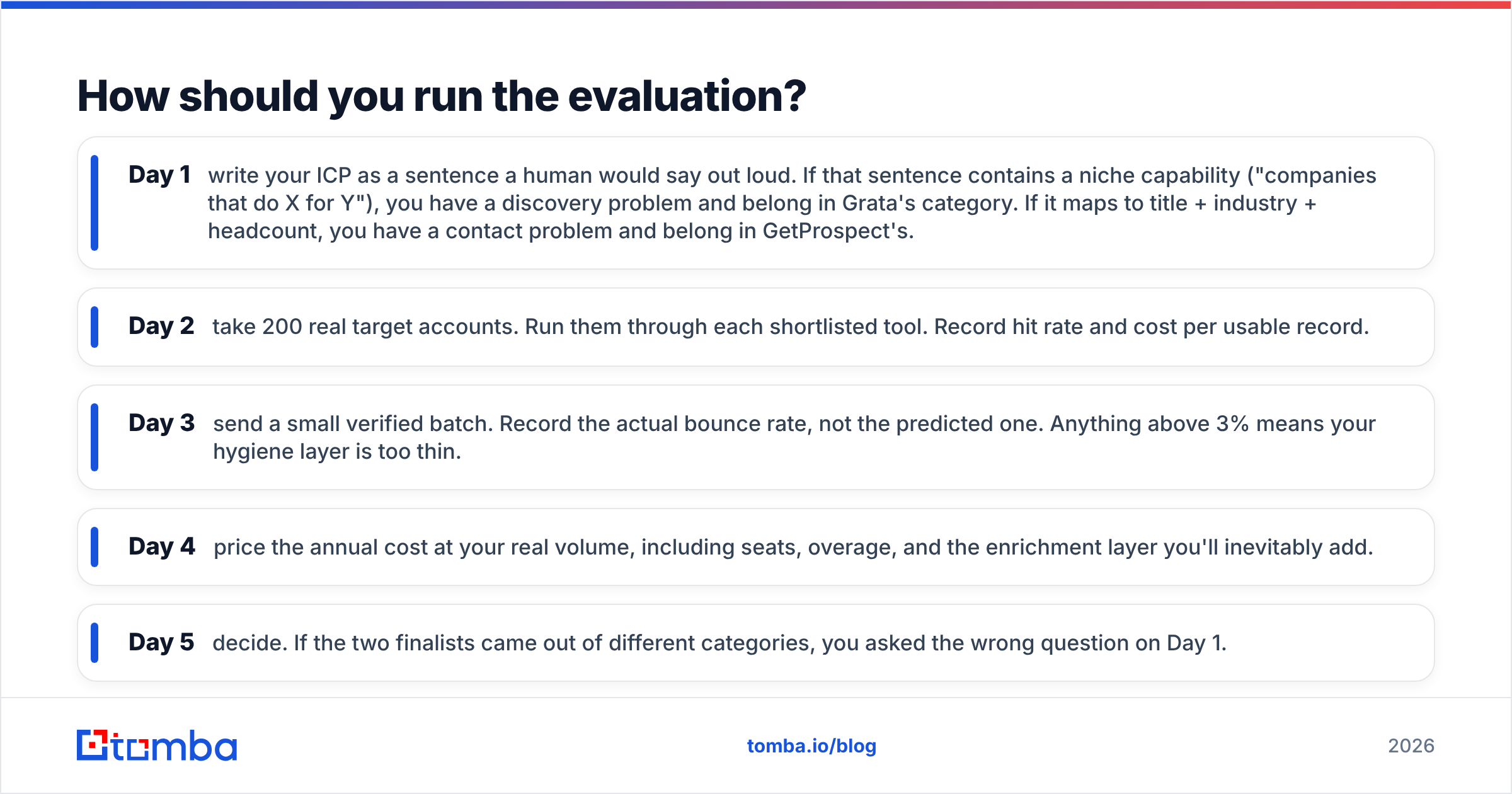
Don't run it on feature checklists. Run it on your own data, in one week:
- Day 1 — write your ICP as a sentence a human would say out loud. If that sentence contains a niche capability ("companies that do X for Y"), you have a discovery problem and belong in Grata's category. If it maps to title + industry + headcount, you have a contact problem and belong in GetProspect's.
- Day 2 — take 200 real target accounts. Run them through each shortlisted tool. Record hit rate and cost per usable record.
- Day 3 — send a small verified batch. Record the actual bounce rate, not the predicted one. Anything above 3% means your hygiene layer is too thin.
- Day 4 — price the annual cost at your real volume, including seats, overage, and the enrichment layer you'll inevitably add.
- Day 5 — decide. If the two finalists came out of different categories, you asked the wrong question on Day 1.
That process costs one week and saves the far more common alternative: a twelve-month contract for a tool that solves a problem you didn't have.
The verdict#
GetProspect wins if you need contacts, cheaply, now. Grata wins if you need to find companies nobody else has found, and you have the budget that implies. Neither one loses to the other, because they were never in the same race.
What both leave behind is the same gap: a verified, send-safe contact record at the end of the workflow. Discovery gets you a domain; prospecting gets you a name; deliverability is a separate discipline with its own tooling.
If that's the layer you're shopping for, start with the Tomba Email Finder. The free tier gives you 25 searches a month to benchmark hit rate against whatever you're using today, paid plans start at $49/mo on Tomba pricing, and the API drops straight into the export step of any discovery platform — including Grata. Run your 200-domain test against it alongside your current stack and let the bounce rate pick the winner.
Related guides#
Ready to find emails that actually work?
Join 150,000+ professionals who stopped guessing and started sending. Free credits on signup — no credit card required.
Get the Tomba newsletter
Practical outbound tactics and product updates — once every two weeks.
About the author