GetProspect vs PlusVibe: Which B2B Tool Wins in 2026?
GetProspect finds and verifies B2B emails. PlusVibe sends them. We break down pricing, data accuracy, deliverability features, and which one actually belongs in your stack.
TL;DR
- GetProspect and PlusVibe are not really competitors. GetProspect is a B2B contact database plus email finder; PlusVibe is a cold-email sending platform with inbox rotation and warmup. Most teams that "compare" them end up buying both.
- If your problem is "I don't have enough good contacts," GetProspect (or a dedicated finder like Tomba) is the buy. If your problem is "my emails land in spam," PlusVibe is the buy.
- PlusVibe's unlimited-inbox pricing model (roughly $29–$79/mo depending on tier and billing) is the cheapest way into multi-inbox sending. GetProspect's free tier gives you 50 valid emails/month, then scales by credits.
- GetProspect's built-in verification is decent but not best-in-class; running a second verification pass before import cuts bounces meaningfully.
- The stack that actually works: a high-accuracy finder + verifier for data, a sending platform for delivery, and one CRM as the source of truth. Buying one tool to do all three is where pipelines go to die.
What are GetProspect and PlusVibe, actually?#
Different layers of the same funnel.
GetProspect is a B2B lead database and email finder. You filter a contact database by job title, industry, headcount, tech stack, and location, then export enriched rows with work emails. It also runs a Chrome extension for LinkedIn, a bulk finder for CSV lists, and a light CRM-ish list manager. In 2024–2025 it added a basic sending module, but sending is not what the product is known for.
PlusVibe is a cold-email sending platform in the Instantly/Smartlead category. Its pitch is unlimited email accounts on every plan, built-in warmup, inbox rotation, spintax, a unibox for replies, and AI-assisted copy. It also bundles a lead database, but the database is not why anyone buys it.
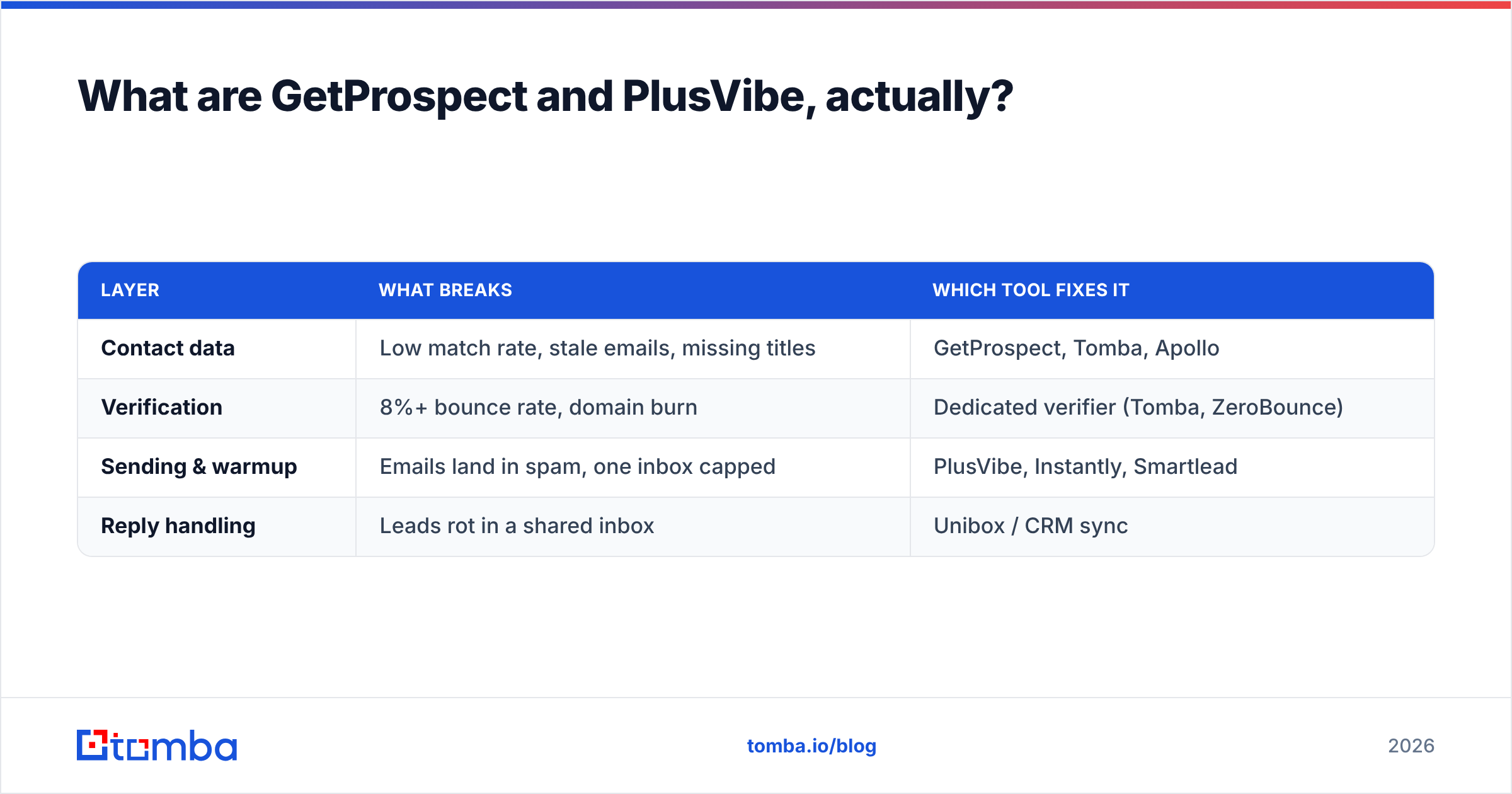
So the honest framing of getprospect vs plusvibe is not "which is better." It's "which layer is currently breaking your outbound?"
| Layer | What breaks | Which tool fixes it |
|---|---|---|
| Contact data | Low match rate, stale emails, missing titles | GetProspect, Tomba, Apollo |
| Verification | 8%+ bounce rate, domain burn | Dedicated verifier (Tomba, ZeroBounce) |
| Sending & warmup | Emails land in spam, one inbox capped | PlusVibe, Instantly, Smartlead |
| Reply handling | Leads rot in a shared inbox | Unibox / CRM sync |
How do GetProspect and PlusVibe compare on features?#
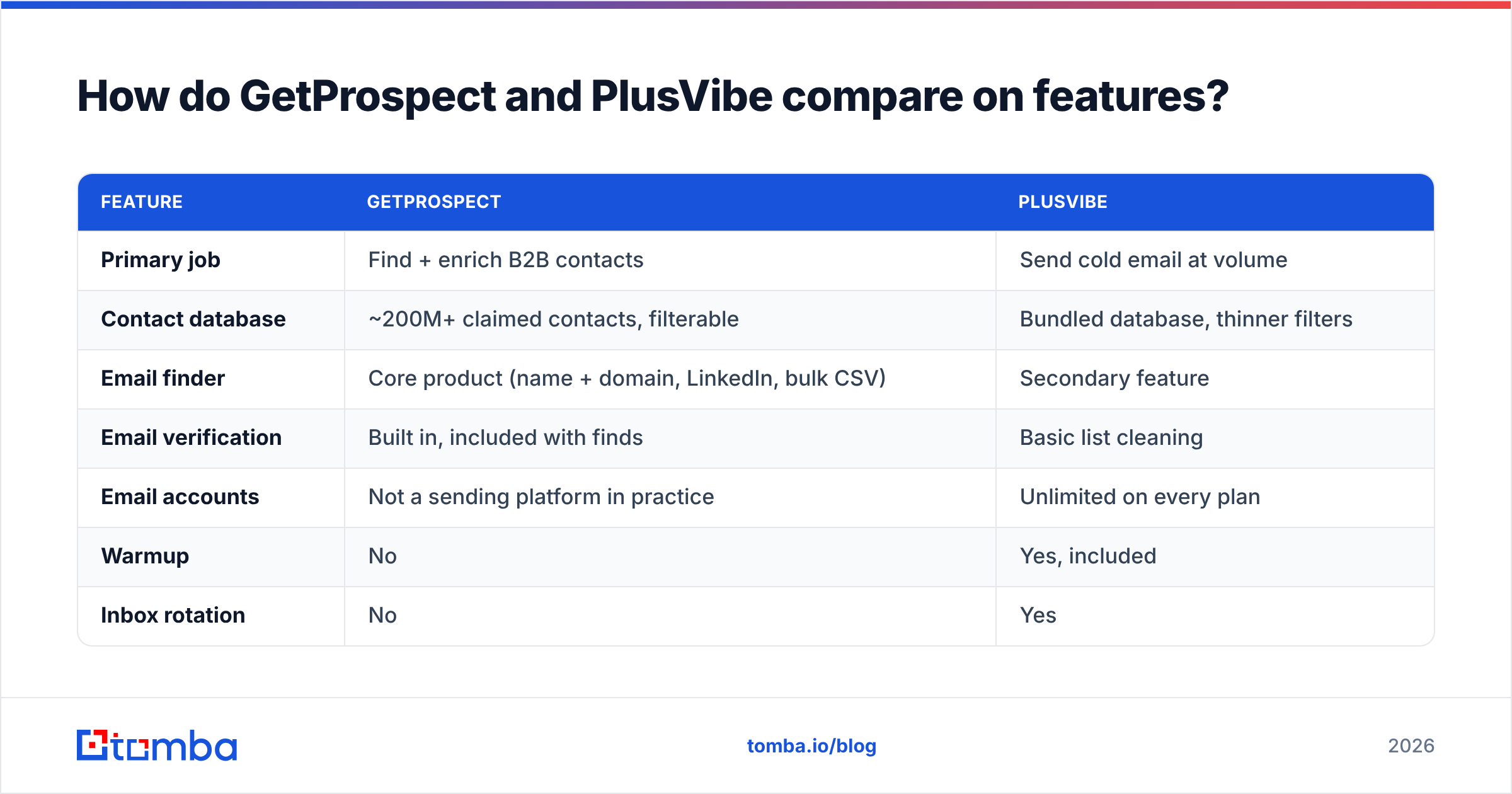
Here is the head-to-head on the dimensions that actually change outcomes.
| Feature | GetProspect | PlusVibe |
|---|---|---|
| Primary job | Find + enrich B2B contacts | Send cold email at volume |
| Contact database | ~200M+ claimed contacts, filterable | Bundled database, thinner filters |
| Email finder | Core product (name + domain, LinkedIn, bulk CSV) | Secondary feature |
| Email verification | Built in, included with finds | Basic list cleaning |
| Email accounts | Not a sending platform in practice | Unlimited on every plan |
| Warmup | No | Yes, included |
| Inbox rotation | No | Yes |
| Unibox / reply management | Minimal | Yes |
| Spintax + A/Z testing | No | Yes |
| CRM sync | HubSpot, Pipedrive, Zapier | HubSpot, Zapier, webhooks |
| Free tier | 50 valid emails/mo | Free trial, no permanent free tier |
| Entry paid price | ~$49/mo range | ~$29–$39/mo range |
| Best for | Building the list | Working the list |
Read that table twice. There is exactly one row where they overlap meaningfully (the bundled database), and in that row each tool is weaker than a specialist.
Which one has better data accuracy?#
GetProspect wins on data — but "better than PlusVibe" is a low bar, and neither is the accuracy ceiling.
GetProspect's finder works the way most finders do: pattern inference from a domain's known formats, cross-referenced against a crawled contact index, then an SMTP-level check before the credit is charged. In practice you should expect:
- Match rate of roughly 60–75% on clean B2B lists with a first name, last name, and corporate domain. It drops hard on generic domains (gmail, outlook) and on companies under ~10 employees.
- Bounce rate of 3–6% on exported "valid" contacts if you send immediately without a second verification pass.
- Weak coverage on catch-all domains, which are now roughly a third of mid-market B2B domains. Most finders mark these "accept-all" and hand you the risk.
- Title drift — the job title in the row is only as fresh as the last crawl. On a 12-month-old record, assume one in five titles is stale.
That last point is why a re-verification step before every send matters more than the finder you picked. Run exports through an email verifier and, for accept-all domains specifically, a catch-all verifier that actually resolves rather than shrugging.
PlusVibe's bundled database is a convenience feature. It exists so a new user can send something on day one. It is not a substitute for a purpose-built finder, and treating it as one is the fastest way to torch the domain reputation the rest of PlusVibe is designed to protect.

How does pricing compare in 2026?#
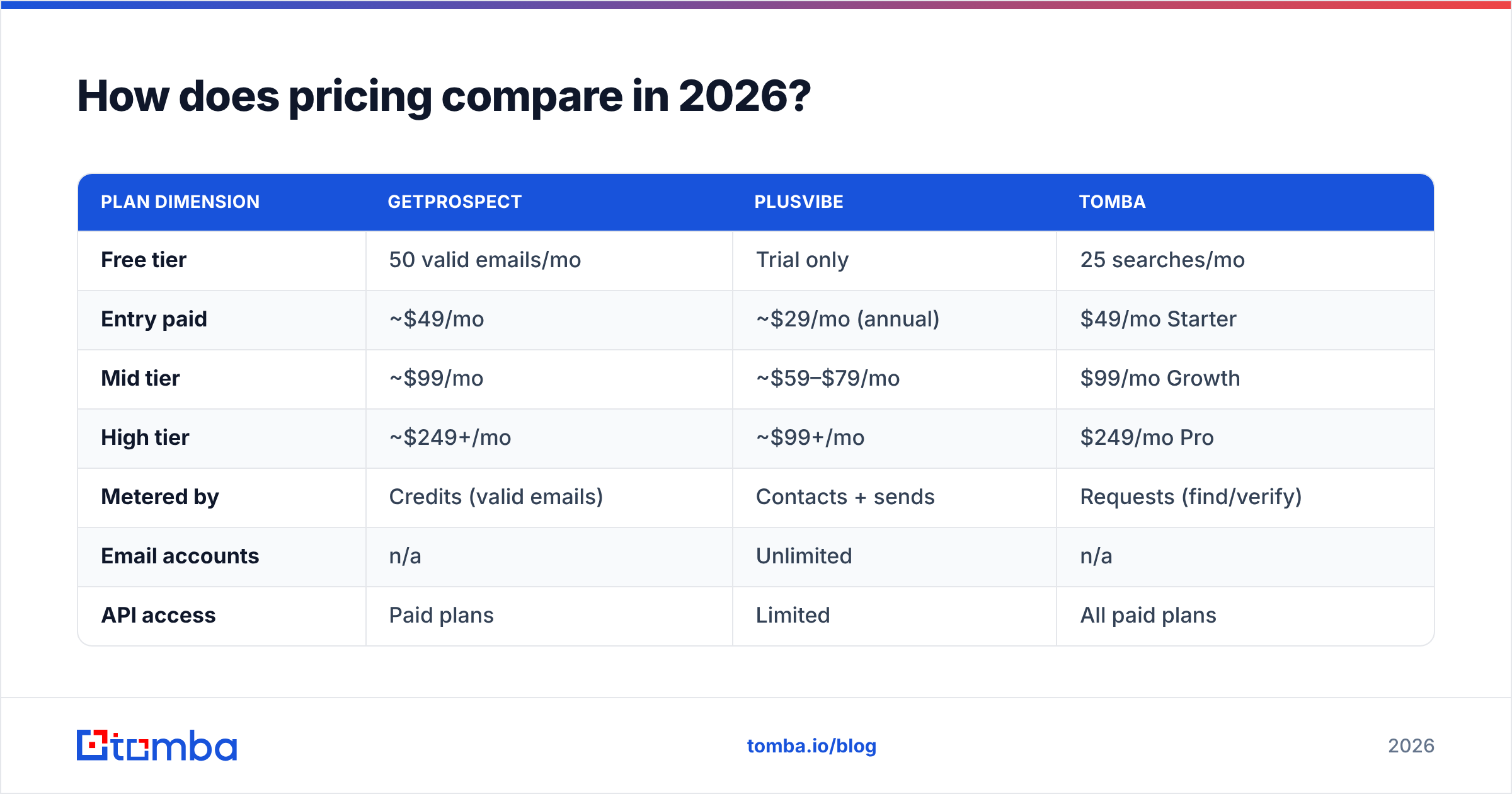
Two different meters, so per-month numbers alone mislead.
GetProspect meters credits — one valid email found equals one credit, with enrichment fields sometimes costing extra. PlusVibe meters contacts uploaded and emails sent, with inboxes unlimited. If you send 30 emails to the same 1,000 contacts, GetProspect charges you once and PlusVibe charges you for the sending volume.
| Plan dimension | GetProspect | PlusVibe | Tomba |
|---|---|---|---|
| Free tier | 50 valid emails/mo | Trial only | 25 searches/mo |
| Entry paid | ~$49/mo | ~$29/mo (annual) | $49/mo Starter |
| Mid tier | ~$99/mo | ~$59–$79/mo | $99/mo Growth |
| High tier | ~$249+/mo | ~$99+/mo | $249/mo Pro |
| Metered by | Credits (valid emails) | Contacts + sends | Requests (find/verify) |
| Email accounts | n/a | Unlimited | n/a |
| API access | Paid plans | Limited | All paid plans |
| Bulk processing | Yes | Import only | Yes, bulk email finder |
| Verification included | Yes | Basic | Yes, separate + bulk |
Vendor pricing moves; check the live pages before you commit budget. Tomba's numbers are fixed and public on the Tomba pricing page, and you can compare G2's current category snapshots on g2.com if you want third-party signal on where each vendor sits.
The practical cost lesson: credit-metered finders reward narrow, high-intent lists. Send-metered platforms reward reuse of a list you already trust. If you buy both and then blast a wide unverified list, you pay twice for the same bad outcome.
Is PlusVibe better than GetProspect for cold outreach?#
For the sending half of cold outreach, yes — and it isn't close.
PlusVibe's core value is infrastructure most finders don't touch:
- Unlimited inboxes on every tier. Deliverability at volume is a distribution problem. Sending 500/day from one inbox burns it; sending 25/day across 20 inboxes doesn't. Charging per-inbox (as Instantly and Outreach historically did) makes the correct architecture expensive. PlusVibe removing that meter is a genuine structural advantage.
- Built-in warmup with reply simulation. New domains and new inboxes need weeks of ramp. A warmup pool that generates realistic opens and replies shortens that ramp. If you want to plan the ramp curve first, the email warmup calculator will tell you how long you actually need.
- Inbox rotation with per-account caps. The scheduler distributes sends and respects per-inbox limits automatically.
- Unibox. All replies from all inboxes in one queue, which stops the classic failure where a hot reply sits unread in inbox #14 for six days.
Where PlusVibe won't save you: bad data. Warmup does not fix a 12% bounce rate. Google and Microsoft's 2024 bulk-sender requirements made bounce and spam-complaint thresholds explicit, and both are list-quality problems, not sending-platform problems. Google's own bulk sender guidelines spell out the SPF, DKIM, DMARC, and complaint-rate expectations — read them once and check your setup against a SPF checker before you scale volume.
That's the trap. Teams buy a sending platform to fix email deliverability, then feed it a list that guarantees the problem repeats.
Is GetProspect better than PlusVibe for list building?#
Yes — with the caveat that a database-first tool has structural limits.
GetProspect's strength is the filtered search: you pick "VP of Engineering, 50–200 employees, SaaS, US, uses AWS" and get a list. That's fast, and for ICPs that match common firmographic filters it's the right motion.
Its structural limits are the same as every database product:
- Database coverage decays. Any static index goes stale between refreshes. Roles churn 20–30% annually in B2B sales and marketing functions.
- Long-tail companies are thin. Sub-50-employee companies, non-US markets, and newly funded startups are consistently underrepresented in every commercial database, GetProspect included.
- Filters can't express intent. "Companies hiring for a data role" or "companies that published a blog post about our category" require a different motion — a targeted finder run against a list you assembled yourself.
- Everyone else bought the same list. A filter that's easy for you is easy for your competitors. The rows you pull are being emailed by six other vendors this quarter.
That fourth point is the one worth sitting with. Differentiated pipeline comes from lists nobody else can generate — conference attendee pages, podcast guest rosters, GitHub contributors, article bylines. For that motion you want a finder you can point at arbitrary inputs: a domain search for every email at a target company, an author finder to get from a byline to a real inbox, or the Tomba API wired into whatever scraper produced your list.
If you're evaluating alternatives to database-first tools generally, the comparison patterns on BookYourData, Apollo, and Cognism are worth a look — BookYourData in particular takes a pay-as-you-go, verified-on-delivery approach that suits teams who don't want a subscription meter running.

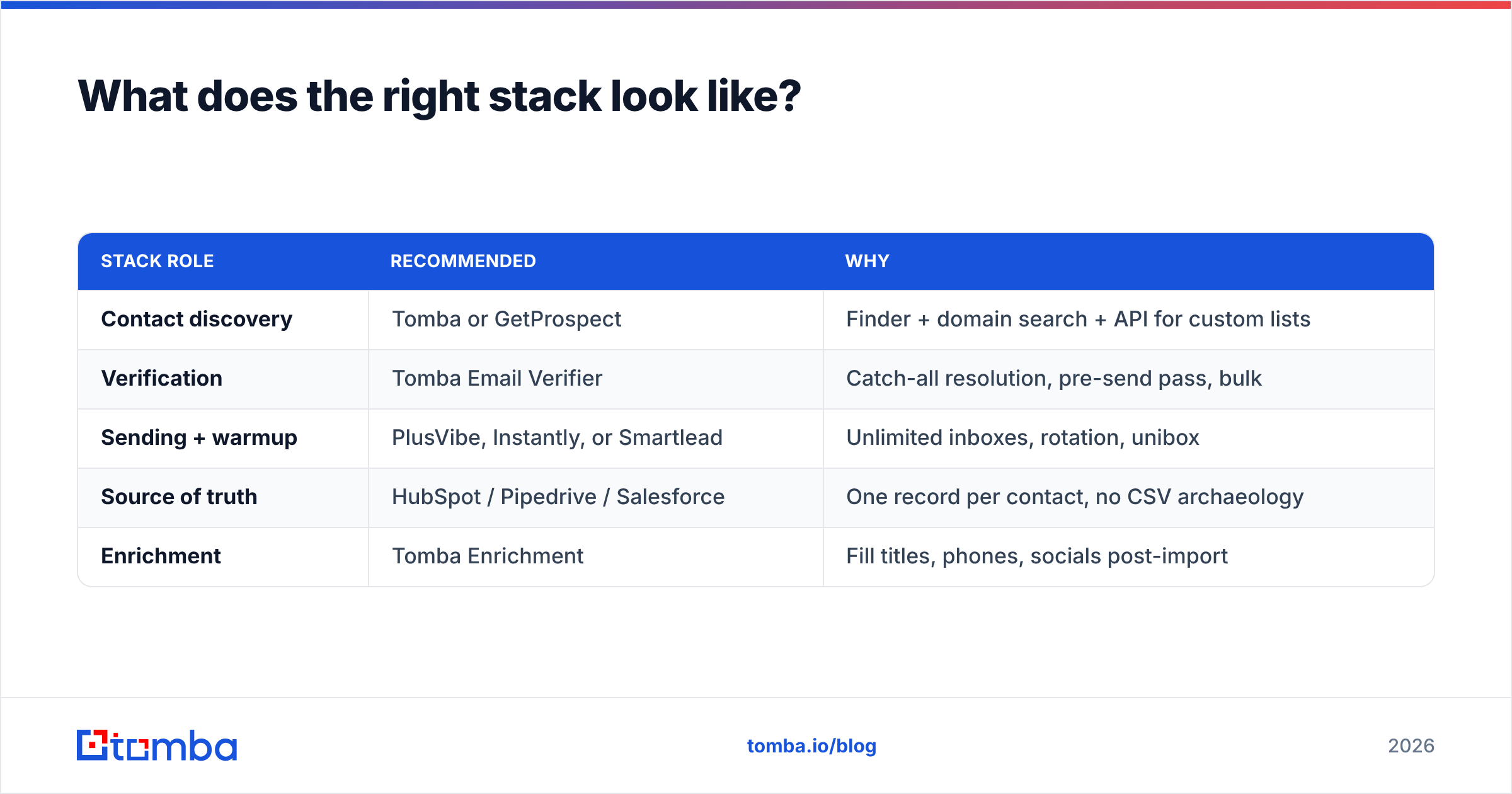
What does the right stack look like?#
Three layers, three specialists, one CRM.
| Stack role | Recommended | Why |
|---|---|---|
| Contact discovery | Tomba or GetProspect | Finder + domain search + API for custom lists |
| Verification | Tomba Email Verifier | Catch-all resolution, pre-send pass, bulk |
| Sending + warmup | PlusVibe, Instantly, or Smartlead | Unlimited inboxes, rotation, unibox |
| Source of truth | HubSpot / Pipedrive / Salesforce | One record per contact, no CSV archaeology |
| Enrichment | Tomba Enrichment | Fill titles, phones, socials post-import |
The workflow that follows from it:
- Build the list from a filtered database search and a custom source your competitors don't have.
- Enrich and find emails via API so the step is repeatable, not a manual export. Data enrichment fills the gaps the database left blank.
- Verify everything, including catch-alls, immediately before import. Not last month. Not "it was verified at export."
- Import to the sender, split across inboxes, respect per-inbox caps, and let warmup run for at least two weeks on new domains.
- Push replies to the CRM the same day, not weekly. A reply that isn't in the CRM within 24 hours has already cooled.
Skip step 3 and the rest of the stack is decoration.
Which should you buy first?#
Buy for the constraint you actually have right now.
- Bounce rate above 5%? Data problem. Fix verification before you touch anything else. A finder with real catch-all handling pays for itself in one campaign.
- Deliverability fine but volume capped by inbox count? PlusVibe. Unlimited inboxes at ~$29–$79/mo is the cheapest fix for that specific constraint on the market.
- Good sending setup, but running out of ICP contacts? GetProspect for filterable volume, or a finder + API if your ICP doesn't map cleanly to firmographic filters.
- Early, under $500/mo total tooling budget? Start with a free finder tier and one warmed inbox. Prove the message converts on 200 contacts before you buy volume for 20,000.
- Enterprise with a data team? Skip both bundled databases and buy API access to a finder you can call from your own pipeline.
Neither tool is a bad purchase. Buying both and expecting either to cover the other's job is the actual mistake.
Where does Tomba fit?#
On the data layer — deliberately, and only there.
Tomba doesn't send email, doesn't run warmup, and doesn't compete with PlusVibe. It does one thing: turn a name, a domain, a LinkedIn URL, or a byline into a verified work email, with catch-all domains resolved rather than flagged and shrugged at. Free tier is 25 searches/month; Starter is $49/mo, Growth $99/mo, Pro $249/mo, with API access on every paid plan and a Google Sheets add-on and Chrome extension if you'd rather not write code.
If your outbound is stalling because the list is thin or the bounces are high, start with the Tomba Email Finder — find the addresses, verify them in the same pass, then hand a clean list to whatever sending platform you already trust. Fix the data layer first; the sending layer is much easier to fix afterward.
Sources: g2.com, Google bulk sender guidelines, bookyourdata.com
Related guides#
Ready to find emails that actually work?
Join 150,000+ professionals who stopped guessing and started sending. Free credits on signup — no credit card required.
Get the Tomba newsletter
Practical outbound tactics and product updates — once every two weeks.
About the author