Getro vs Apollo.io in 2026: Which One Fits Your GTM Team?
Getro runs talent networks for VCs and communities. Apollo.io runs outbound at scale. They get compared constantly, but they solve different problems — here's the honest breakdown, plus pricing math and where a cheaper data layer beats both.
TL;DR
- Getro vs Apollo.io is not a real head-to-head. The two tools do different jobs. Getro is talent-network software for VC firms, accelerators, and communities. Apollo.io is a sales data and outreach platform.
- Pick Getro if your job is to link portfolio companies with candidates. You get a job board plus a warm talent pool.
- Pick Apollo.io if your job is to find buyers, load them into sequences, and email or call them at volume.
- The pricing models are opposites. Getro is quote-based and annual. Apollo is public and per seat, from $0 up to about $149 per user each month.
- Maybe you just need accurate contact data. Not a job board, not a sequencer. A dedicated email finder costs $49/mo and plugs into the stack you already run.
Why do people compare Getro vs Apollo.io at all?#
Because both land in the same budget line: "the tool we use to reach people."
Picture a platform lead at a seed fund. She gets two asks in one quarter. First, help 40 portfolio companies fill roles. Second, help the fund find deals and build ties with operators. Getro answers the first ask. Apollo answers the second one, or close to it. Someone drops both names in a spreadsheet, and the comparison gets written.
Here is the honest framing. These tools are neighbors, not rivals. They share almost no features. Getro is built around talent: jobs, candidates, intros, and the network around a fund. Apollo is built around revenue: contacts, buying signals, sequences, dialers, and pipeline. Mixing them up costs real money. Buy the wrong one and you can burn six months wondering why nothing works.
You still get the full Getro vs Apollo.io breakdown below. The choice is real, even if the category label is fuzzy. We cover what each tool does, what each one costs, where the data quality lands, and the third option most teams miss.
What is Getro, and who is it built for?#
Getro (formerly Getro.io, at getro.com) sells software to groups that run a network. Think venture funds, accelerators, private equity firms, professional communities, and university programs. It has two core products today. One is a job board that pulls open roles from every company in your portfolio. The other is a talent network that collects candidate profiles and routes them to the right company.
The value is simple: gather roles in one place, then route warm candidates. A fund with 60 portfolio companies has hundreds of open roles spread across 60 careers pages. Getro crawls those pages, cleans up the listings, and posts them on a branded board at jobs.yourfund.com. Candidates sign up once. Every company in the network can then search them. Platform teams stop acting as human job boards.
Who it fits:
- Venture and PE platform teams who own talent as a portfolio service and need numbers to prove it.
- Accelerators and startup programs running cohort job boards where roles change every month.
- Professional communities and associations that want a member job board to sell or to stand out.
- Ecosystem builders — city or sector groups that want a public jobs hub at the top of the funnel.
- Anyone whose "leads" are candidates, not buyers.
Who it does not fit: an SDR team. Getro has no sequencer, no dialer, no intent data, and no buyer filters. That is not a flaw. It was never the product.
What is Apollo.io, and who is it built for?#
Apollo.io (apollo.io) pairs a B2B contact database with the tools to act on it. The database side claims hundreds of millions of contacts and tens of millions of companies. You can filter by title, seniority, industry, headcount, tech stack, and buying signals. The action side adds sequences, an email sender, a dialer, a Chrome extension for LinkedIn, meeting booking, and sync with HubSpot or Salesforce.
The pitch is bundling. You skip paying for a data vendor, a sequencer, and a dialer one by one. You buy one seat and get all three. For a small team with no tools yet, that math looks good. It is also why Apollo shows up on nearly every G2 grid for sales intelligence.
The trade-off is depth. A bundled dialer rarely beats a dedicated one. Bundled email sending rarely matches a real cold email platform on deliverability. And the bundled data draws the most complaints. Coverage is broad, but verification quality swings by region and company size. Teams selling to US mid-market are often happy. Teams selling to EMEA SMB or non-English markets are often not. That gap is why people search for an Apollo alternative in the first place.

Getro vs Apollo.io: how do they compare head-to-head?#
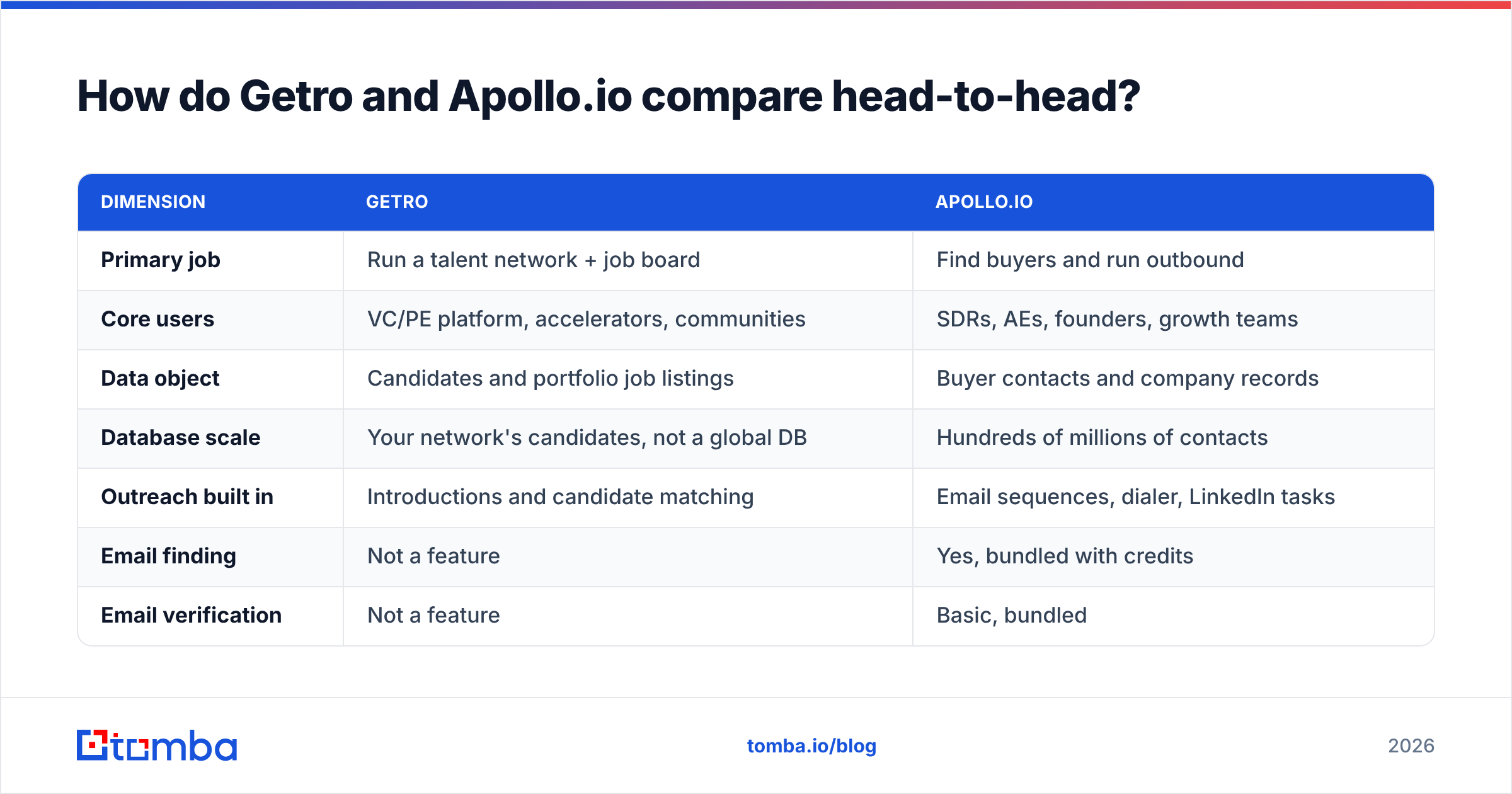
| Dimension | Getro | Apollo.io |
|---|---|---|
| Primary job | Run a talent network + job board | Find buyers and run outbound |
| Core users | VC/PE platform, accelerators, communities | SDRs, AEs, founders, growth teams |
| Data object | Candidates and portfolio job listings | Buyer contacts and company records |
| Database scale | Your network's candidates, not a global DB | Hundreds of millions of contacts |
| Outreach built in | Introductions and candidate matching | Email sequences, dialer, LinkedIn tasks |
| Email finding | Not a feature | Yes, bundled with credits |
| Email verification | Not a feature | Basic, bundled |
| Intent / buying signals | No | Yes, on higher tiers |
| CRM sync | Limited, network-focused | HubSpot, Salesforce, two-way |
| API access | Available | Available, tier-gated |
| Pricing model | Quote-based, annual | Public, per-seat, monthly or annual |
| Free tier | No | Yes, limited credits |
| Typical buyer | Platform / community lead | Sales or RevOps lead |
Read that table as two departments, not two vendors fighting over one budget. They collide on one row only: "we need to reach people we do not know yet." Even there they differ. Getro reaches candidates who joined your network. Apollo reaches strangers who did not.
Getro vs Apollo.io pricing: what does each one cost?#
Getro does not publish a price list. Deals are quoted and annual. The price scales with network size, the number of portfolio companies, and the products you turn on. Expect a demo, a sales call, and a contract. That is normal for software sold to funds. So ask for a quote early. There is no pricing page to scrape here.
Apollo publishes everything, so the math is easy. Plans start free with limited monthly credits. Paid tiers are per user. The top self-serve tier lands near $149 per user each month on monthly billing, and less on annual. Credits, exports, and features like advanced intent depend on the tier. Higher plans also carry seat minimums.
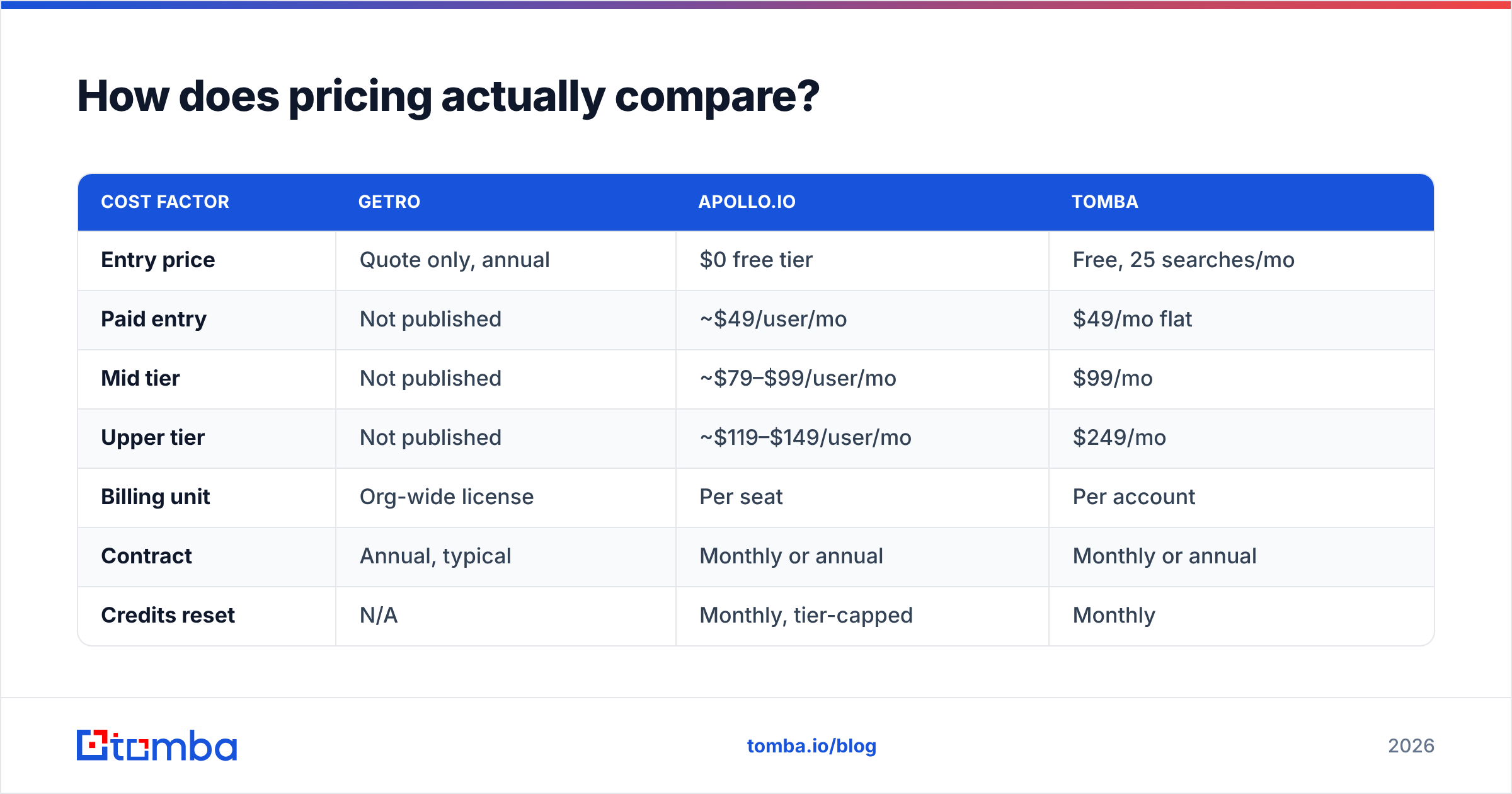
| Cost factor | Getro | Apollo.io | Tomba |
|---|---|---|---|
| Entry price | Quote only, annual | $0 free tier | Free, 25 searches/mo |
| Paid entry | Not published | ~$49/user/mo | $49/mo flat |
| Mid tier | Not published | ~$79–$99/user/mo | $99/mo |
| Upper tier | Not published | ~$119–$149/user/mo | $249/mo |
| Billing unit | Org-wide license | Per seat | Per account |
| Contract | Annual, typical | Monthly or annual | Monthly or annual |
| Credits reset | N/A | Monthly, tier-capped | Monthly |
The structure matters more than the numbers. Per-seat pricing punishes you for hiring. Org-wide licensing punishes you for being small. Five reps on Apollo's mid tier cost about what one Getro license might cost. Neither number tells you if the data underneath is any good.
Most Getro vs Apollo.io comparisons skip that question. See our Tomba pricing page for the flat-rate version of this math.
Getro vs Apollo.io data quality: which one is better?#
That is the wrong question, mostly. The two hold different data. But there is a real answer for the part that overlaps.
Getro's candidate data is first-party. People opt in, fill out a profile, and update it themselves. Intent runs high, and active job seekers stay fresh. Everyone else goes stale. A profile from 18 months ago describes an 18-month-old career. Getro does not check those emails against live mail servers. It does not need to, since the person came to you.
Apollo's contact data is third-party and gathered at scale. Sources include public pages, data shared by users' inboxes and extensions, and guesses from patterns. Coverage is broad and the filters are useful. Bounce rates swing hard by segment. Emails marked verified do fine. Anything marked "likely," or pulled from a small non-US company, is a coin flip. Catch-all domains are where bundled checks tend to give up.
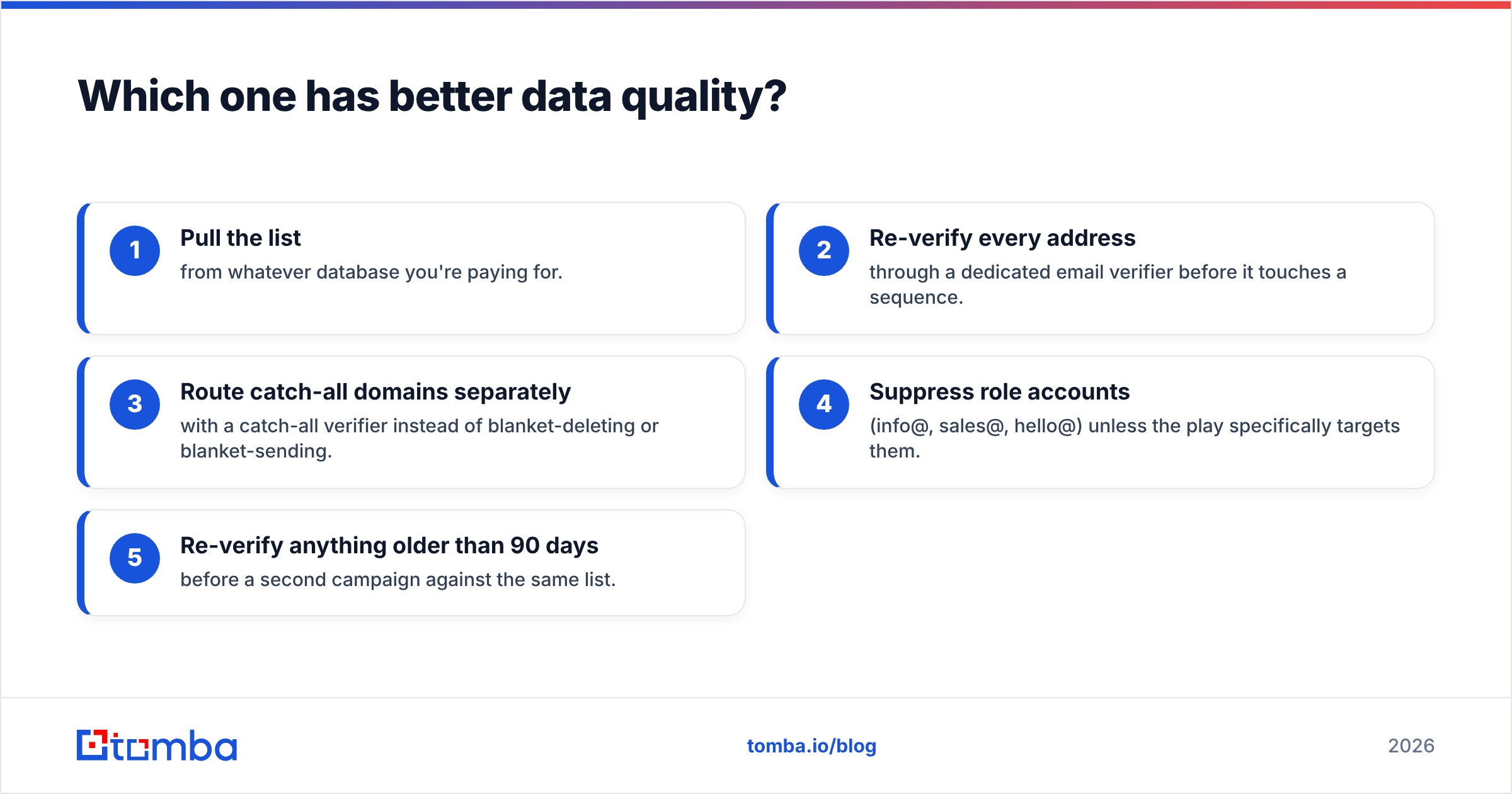
If you send at volume, treat bundled verification as a first pass, never the last one. Here is the workflow that protects your domain:
- Pull the list from whatever database you pay for.
- Re-check every address with a dedicated email verifier before it hits a sequence.
- Route catch-all domains apart with a catch-all verifier. Do not delete them all, and do not mail them all.
- Drop role accounts (info@, sales@, hello@) unless the play targets them on purpose.
- Re-check anything older than 90 days before you mail that list again.
Those five steps cost less than the sender reputation you lose on one 12% bounce campaign. Once bounces pass about 3%, mailbox providers start to treat you as a risk. No amount of clever copy wins that back.
Do you have to choose between them at all?#
Usually not. For most teams the real answer is "neither, alone."
Three common shapes:
You lead platform at a fund. Getro solves the job board and the candidate pool. It does not help you find deals. For that you need contact data on founders and operators. That means Apollo's database, or a lighter and cheaper data layer feeding your CRM. Getro plus a domain search tool covers both jobs for far less than Getro plus full Apollo seats.
You run a sales team. Getro is beside the point. The real match-up is Apollo against an unbundled stack: one data source, one sending platform, one dialer. Bundles win on setup time. Unbundled stacks win on quality, and on cost once you pass five seats.
You are a founder doing both. You hire and sell at the same time, with no budget for two annual contracts. At that stage a plain careers page beats Getro. And you want contact data on demand, without buying seats for a team you have not hired.

One pattern runs under all three. Buy the data layer and the workflow layer apart. Workflow tools change every 18 months as your motion changes. Contact data is plumbing. You want it accurate, open by API, and priced so it does not grow with headcount.
Where does Tomba fit in this comparison?#
Narrowly, and on purpose. Tomba is not a job board and not a sequencer. It is the data layer. Find work email addresses by domain, name, or company. Verify them. Enrich the record.
It belongs in this post because of seat math. Say you are looking at Apollo because "we need emails for people we already found." Then you are buying a whole GTM platform to use one module. That is a $99-per-user-per-month answer to a problem a $49-per-month flat plan solves. And the flat plan does not re-price when you hire two more reps.
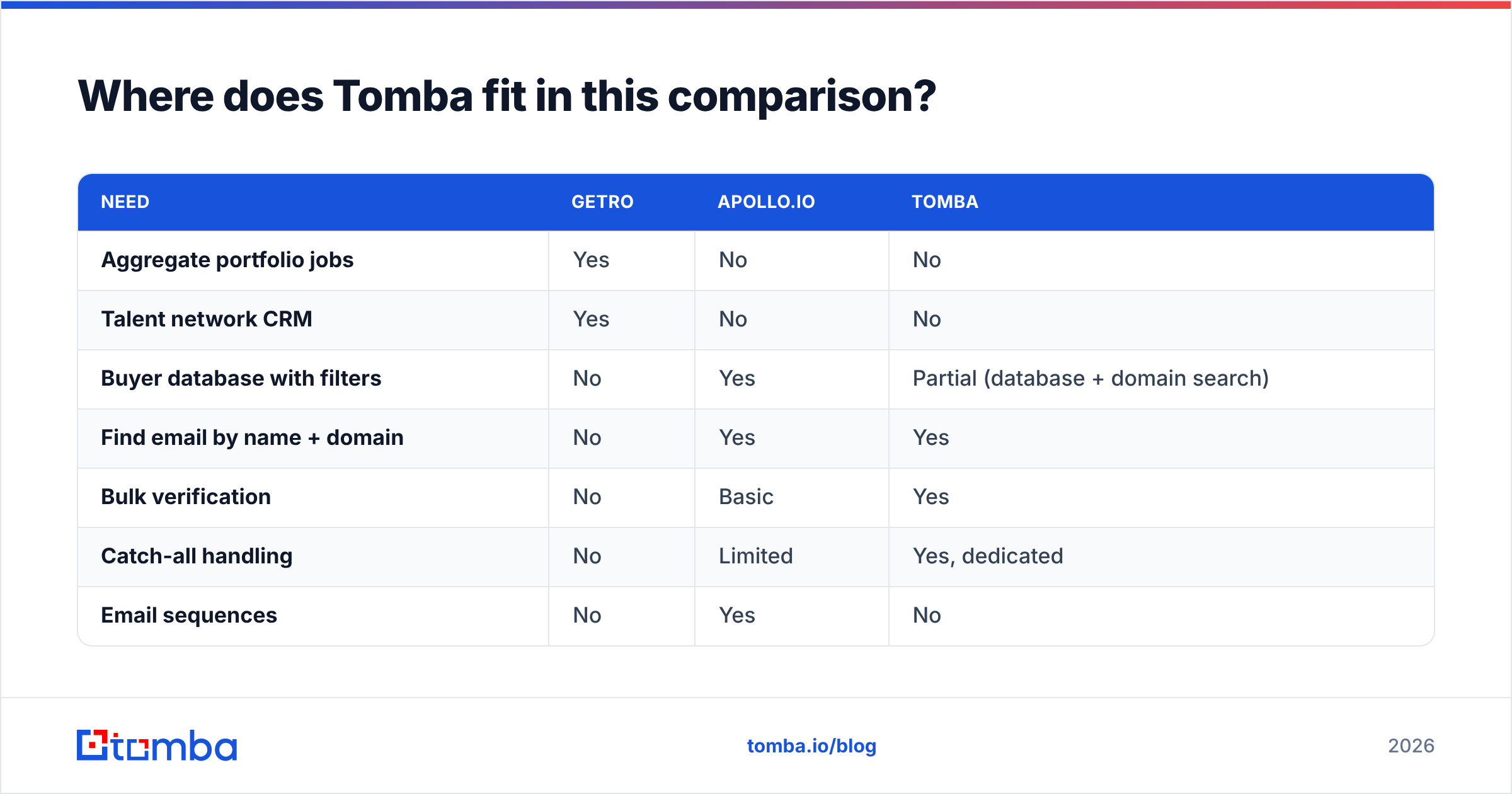
| Need | Getro | Apollo.io | Tomba |
|---|---|---|---|
| Aggregate portfolio jobs | Yes | No | No |
| Talent network CRM | Yes | No | No |
| Buyer database with filters | No | Yes | Partial (database + domain search) |
| Find email by name + domain | No | Yes | Yes |
| Bulk verification | No | Basic | Yes |
| Catch-all handling | No | Limited | Yes, dedicated |
| Email sequences | No | Yes | No |
| Dialer | No | Yes | No |
| Phone number lookup | No | Yes | Yes |
| Flat non-seat pricing | No | No | Yes |
| Free tier to test | No | Yes | Yes, 25 searches/mo |
| Developer API | Yes | Tier-gated | Yes, all paid plans |
A realistic 2026 stack for a small outbound team looks like this. Source targets wherever you like. Apollo's filters are good, LinkedIn is fine, and a conference list is often better. Then resolve and verify the contact details through the Tomba API or the bulk email finder. Then send through the platform your deliverability team actually trusts. Swap any layer without renegotiating the others.
For platform teams at funds: Getro for talent, a light data layer for founder and operator outreach, and no Apollo seats at all unless someone prospects full time.
Getro vs Apollo.io: what's the verdict?#
Choose Getro if you own a network's talent results. Job aggregation across a portfolio, a branded board, and a warm candidate pool is a hard, specific problem. Getro is built for it. Ask for a quote early, since pricing is private and the cycle is annual.
Choose Apollo.io if you need an all-in-one outbound engine tomorrow, your team is under five seats, and you sell into US mid-market. Start on the free tier. Run 200 real contacts through it. Measure the bounce rate yourself before you sign for annual seats.
Choose neither if your real bottleneck is contact accuracy. That is a data problem. Buying a platform to fix a data problem is how tool sprawl starts.
So end the Getro vs Apollo.io debate where it really starts: with the layer everything else depends on. Run a domain through the Tomba Email Finder on the free tier. You get 25 searches and no card. Compare what comes back against what your current list costs per seat. If the emails land, the rest of the stack gets much easier to choose.
Related guides#
Ready to find emails that actually work?
Join 150,000+ professionals who stopped guessing and started sending. Free credits on signup — no credit card required.
Get the Tomba newsletter
Practical outbound tactics and product updates — once every two weeks.
About the author