Global Database vs Apollo.io (2026): Which B2B Data Wins?
Global Database sells depth on company records. Apollo.io sells scale plus a sequencer. We compare coverage, email accuracy, seat pricing and export limits so you can pick the one your team will actually use in 2026.
Global Database vs Apollo.io is a choice between two shapes of data. One sells depth on companies. The other sells reach on people.
TL;DR
- Global Database is a company-first data platform: deep firmographics, credit and compliance records, strongest in the UK and EU. Pricing is quote-based, which slows small teams down.
- Apollo.io is a contact-first prospecting platform with a huge contact index, a built-in sequencer and a Chrome extension. It is priced per seat, and the export/credit limits are where most teams get surprised.
- Neither wins on raw email accuracy. Both publish confidence scores, and both will hand you dead mailboxes if you skip verification.
Two more points to weigh before you sign anything:
- If you only need clean, verified work emails at volume, a dedicated finder plus a verifier costs a fraction of either platform. It also plugs into the CRM you already run.
- Decision rule: buy Global Database for account research and EU compliance, Apollo for a one-tool outbound stack, and a standalone finder when data quality per dollar is the only thing you care about.
Global Database vs Apollo.io: what is each tool?#
They solve different problems that happen to overlap in a demo.
Global Database is a business intelligence platform built around company records. Its core asset is structured firmographic data — registered entity details, financials, credit signals, tech usage, employee counts, ownership structures — with contacts attached to those companies. It leans hard into UK and European coverage. Companies House-style registry data gives it an edge most US-first vendors do not have. Sales teams use it, but so do credit, procurement and compliance teams.
Apollo.io is a go-to-market platform built around people. It combines a very large contact index with sequencing, dialing, meeting booking, basic CRM functionality and a browser extension that pulls contact data off LinkedIn. Apollo's pitch is consolidation: one subscription instead of a data vendor plus an outreach tool plus an enrichment tool.
That framing explains most of the differences below. Global Database answers "tell me everything about this company." Apollo answers "give me 500 people matching this persona and start emailing them by Thursday."
How do they compare on paper?#
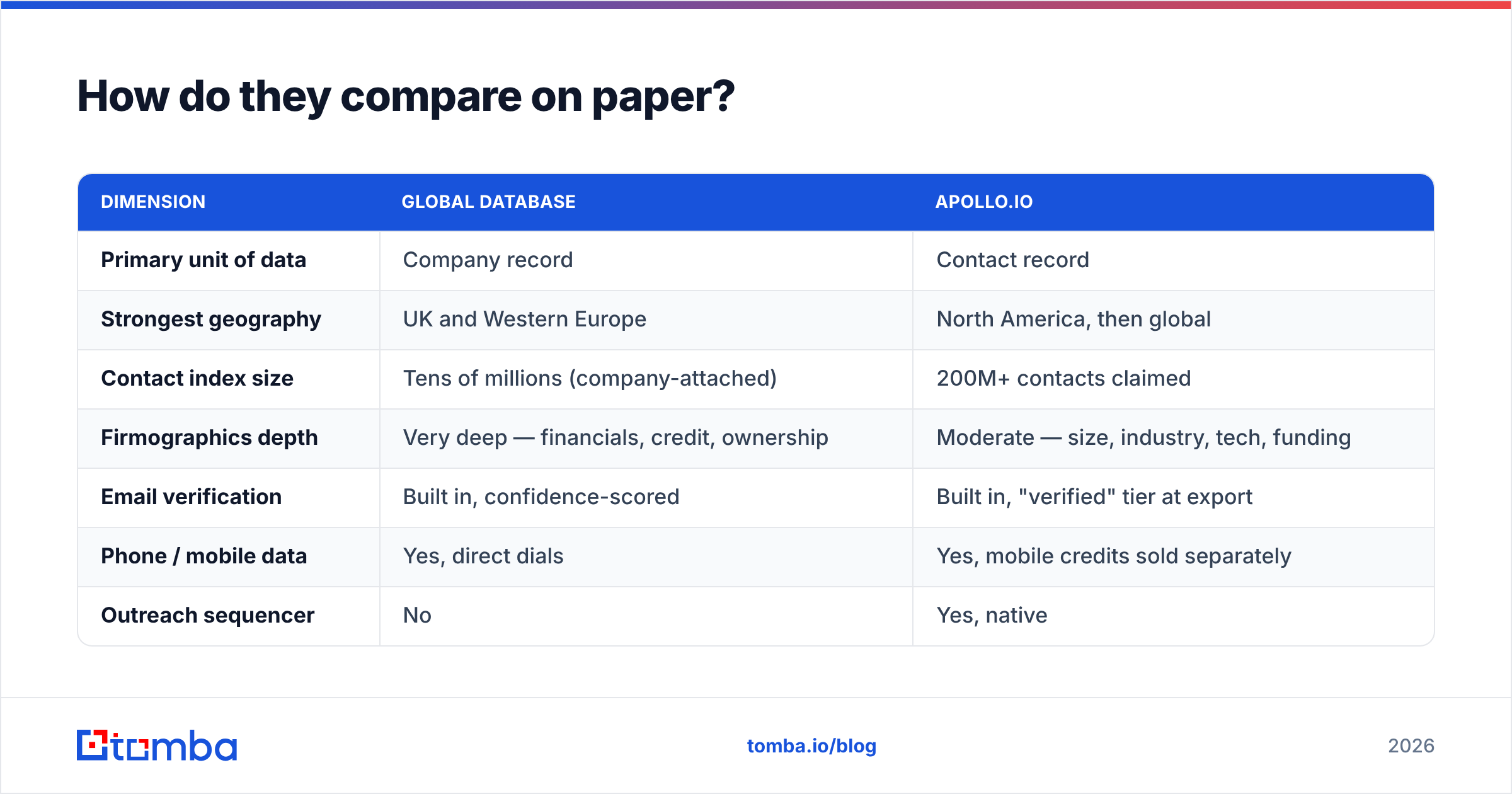
| Dimension | Global Database | Apollo.io |
|---|---|---|
| Primary unit of data | Company record | Contact record |
| Strongest geography | UK and Western Europe | North America, then global |
| Contact index size | Tens of millions (company-attached) | 200M+ contacts claimed |
| Firmographics depth | Very deep — financials, credit, ownership | Moderate — size, industry, tech, funding |
| Email verification | Built in, confidence-scored | Built in, "verified" tier at export |
| Phone / mobile data | Yes, direct dials | Yes, mobile credits sold separately |
| Outreach sequencer | No | Yes, native |
| Chrome extension | Limited | Yes, core to the workflow |
| API access | Yes, plan-dependent | Yes, credit-metered |
| Pricing model | Quote-based, annual | Per seat, published tiers |
| Free tier | Trial / demo only | Yes, limited credits |
| Best for | Account research, credit, EU compliance | High-volume outbound teams |
The table hides one thing worth stating plainly: Apollo is far easier to buy. You can sign up, run a search and export a list in ten minutes. Global Database usually routes you through a sales conversation and a scoped contract. For a two-person startup that difference alone decides it.

Whose contact data is actually more accurate?#
Neither vendor's marketing number should be taken at face value, and both are measuring different things.
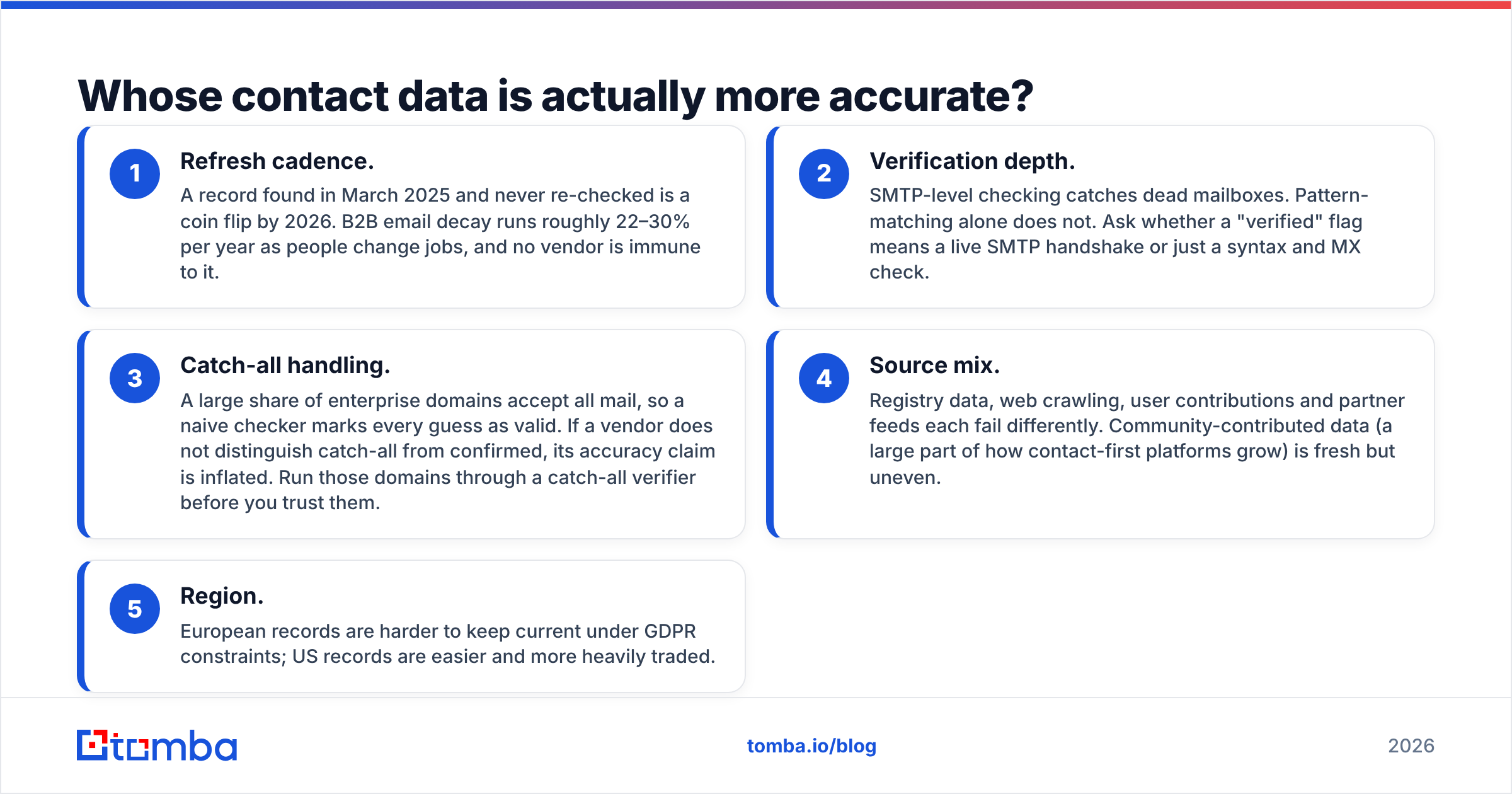
Here is what actually drives accuracy in B2B contact data:
- Refresh cadence. A record found in March 2025 and never re-checked is a coin flip by 2026. B2B email decay runs roughly 22–30% per year as people change jobs, and no vendor is immune to it.
- Verification depth. SMTP-level checking catches dead mailboxes. Pattern-matching alone does not. Ask whether a "verified" flag means a live SMTP handshake or just a syntax and MX check.
- Catch-all handling. A large share of enterprise domains accept all mail, so a naive checker marks every guess as valid. If a vendor does not distinguish catch-all from confirmed, its accuracy claim is inflated. Run those domains through a catch-all verifier before you trust them.
- Source mix. Registry data, web crawling, user contributions and partner feeds each fail differently. Community-contributed data (a large part of how contact-first platforms grow) is fresh but uneven.
- Region. European records are harder to keep current under GDPR constraints; US records are easier and more heavily traded.
In practice, teams that test both report a similar pattern. Apollo returns more contacts per search. Global Database returns fewer contacts but better company context around them. Apollo's bounce rate on unverified exports is the common complaint on G2 reviews, which is why experienced operators re-verify Apollo exports before loading a sequence. Global Database's contact volume per account is thinner, so you spend less time deleting bad rows. You spend more time finding that the person you want simply is not in there.

The honest summary: treat any platform's "verified" label as a first pass, not a guarantee. Running exports through an independent email verifier before send is the single highest-ROI step in this whole comparison, and it costs less than one bounced campaign.
What does each one really cost?#
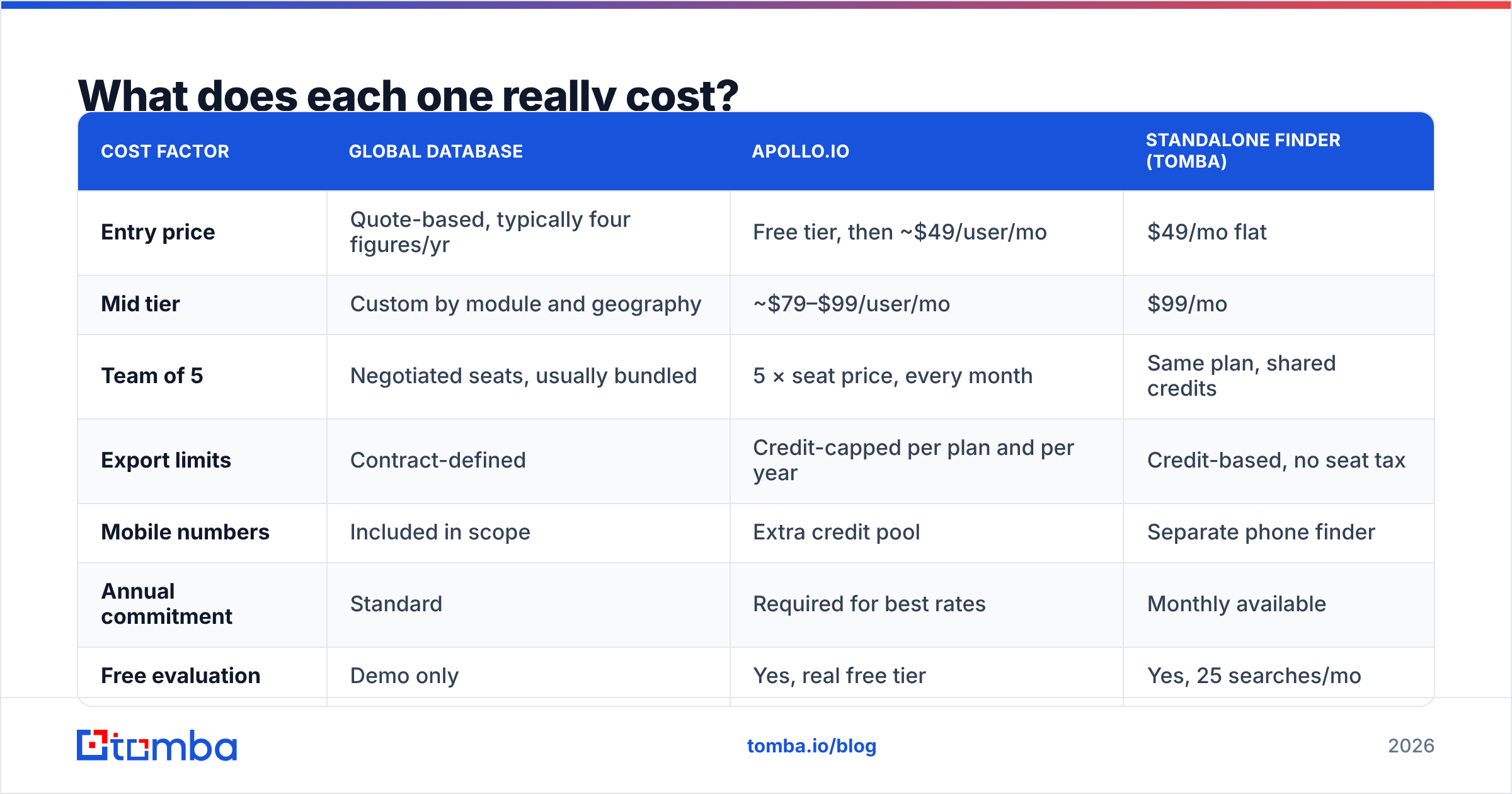
Apollo publishes pricing; Global Database does not, so the figures below reflect what buyers typically report. Always confirm on the vendor page before you sign. Most of the Global Database vs Apollo.io cost gap comes down to seats and export caps, not list quality.
| Cost factor | Global Database | Apollo.io | Standalone finder (Tomba) |
|---|---|---|---|
| Entry price | Quote-based, typically four figures/yr | Free tier, then ~$49/user/mo | $49/mo flat |
| Mid tier | Custom by module and geography | ~$79–$99/user/mo | $99/mo |
| Team of 5 | Negotiated seats, usually bundled | 5 × seat price, every month | Same plan, shared credits |
| Export limits | Contract-defined | Credit-capped per plan and per year | Credit-based, no seat tax |
| Mobile numbers | Included in scope | Extra credit pool | Separate phone finder |
| Annual commitment | Standard | Required for best rates | Monthly available |
| Free evaluation | Demo only | Yes, real free tier | Yes, 25 searches/mo |
Two structural traps are worth calling out.
Seat multiplication. Apollo charges per user. A five-person SDR pod on the mid tier crosses $5,000 a year before anyone opens a sequence. If only two people actually pull lists, you are funding three dormant logins.
Export ceilings. Apollo's plans cap how many records you can export, and the caps are annual on some tiers. Teams that build large TAM lists hit the wall mid-quarter and negotiate an upgrade from a weak position. Global Database's caps are contractual instead of self-serve, which is slower to change but at least visible up front.
By comparison, credit-based tools decouple cost from headcount. Tomba pricing runs a free tier at 25 searches a month, Starter at $49/mo, Growth at $99/mo and Pro at $249/mo, with credits shared across the workspace rather than locked to a seat. That is not a like-for-like replacement for Apollo's sequencer. It replaces the data layer only, which is exactly the point if you already run Instantly, Smartlead or HubSpot for sending.

Which one fits your motion?#
Pick by workflow, not by feature count.
- You sell into UK/EU mid-market and need company depth. Global Database. Registry-grade firmographics, credit signals and ownership data are things Apollo simply does not carry at the same depth. If your ICP filter includes revenue bands or financial health, this is the one.
- You run high-volume outbound with a small team and want one tool. Apollo. The sequencer, dialer and extension in one subscription genuinely removes integration work, and the free tier lets you validate the data before committing.
- You already own a sequencer and a CRM. Neither, at full price. Buy data on credits and keep your sending stack. Look at an Apollo alternative that charges for records instead of logins.
Three more cases come up often:
- You need compliance-defensible sourcing. Global Database, with a caveat: ask both vendors for their lawful-basis documentation and data-subject request process in writing before you buy.
- You need enriched records inside an existing pipeline. An API-first approach beats a UI. Both vendors offer APIs, but if enrichment is the whole job, a purpose-built email finder API is cheaper per call and faster to wire into a workflow.
- You need bulk lists on a fixed budget. Consider a pay-as-you-go database like BookYourData alongside either platform. Buying a scoped list outright can beat a subscription when your ICP is narrow and stable.
Where does each tool fall down?#
Global Database's weak spots:
- Contact volume per company is thinner than contact-first platforms. Great for the CFO of a £40M manufacturer; patchy for the fourth product manager at a 2,000-person SaaS company.
- No native outreach. You will pay for a sequencer separately.
- Quote-based pricing means no fast experimentation. You cannot spin it up for one quarter and cancel.
- US coverage trails its European coverage.
Apollo's weak spots:
- Export and credit caps that bite exactly when a campaign is working.
- Data freshness varies by segment; long-tail SMB records are noticeably staler than enterprise ones.
- Deliverability risk when teams treat the platform's own "verified" flag as sufficient and skip an independent check.
- Per-seat pricing punishes teams where only a couple of people actually source lists.
- The all-in-one design creates lock-in. Migrating sequences out later is real work.

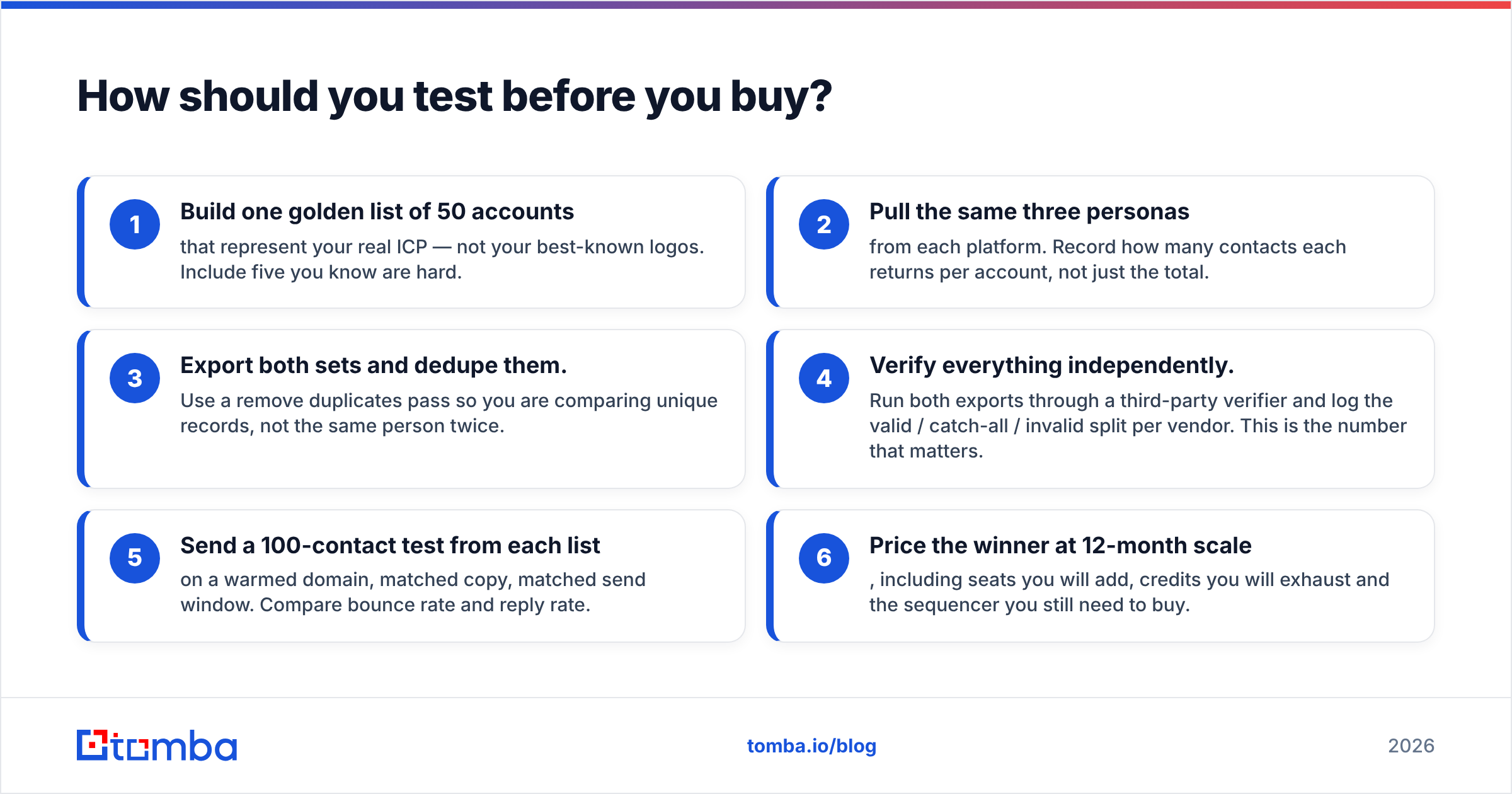
How should you test before you buy?#
Run the same evaluation on both. It takes about two hours and it settles arguments faster than any review site.
- Build one golden list of 50 accounts that represent your real ICP — not your best-known logos. Include five you know are hard.
- Pull the same three personas from each platform. Record how many contacts each returns per account, not just the total.
- Export both sets and dedupe them. Use a remove duplicates pass so you are comparing unique records, not the same person twice.
- Verify everything independently. Run both exports through a third-party verifier and log the valid / catch-all / invalid split per vendor. This is the number that matters.
- Send a 100-contact test from each list on a warmed domain, matched copy, matched send window. Compare bounce rate and reply rate.
- Price the winner at 12-month scale, including seats you will add, credits you will exhaust and the sequencer you still need to buy.
Most teams find the bounce-rate delta is smaller than expected and the cost delta is much larger than expected. That is usually the deciding fact.
Global Database vs Apollo.io: which one wins?#
There is no single winner, and any post that tells you there is has picked an affiliate.
Global Database wins if company intelligence is the product you are buying — European coverage, financial and credit context, compliance-heavy sales cycles. It is a research tool that happens to include contacts.
Apollo.io wins if you are a small outbound team that wants to go from zero to sending this week and values consolidation over best-in-class data. Its free tier is genuinely useful for evaluation, which is more than most vendors offer.
Neither wins if what you actually need is a reliable stream of verified work emails to feed a stack you already own. That is a narrower job, and paying platform prices for it is how outbound budgets quietly bloat. In that case, pair a focused finder with a verifier, keep your sequencer, and spend the difference on domains and copy.
Whichever way you lean, do the verification step. The most expensive contact database in the world still sends your reputation into the ground if 12% of the list bounces on day one.
Ready to test the data layer on its own? Run your next 50-account list through the Tomba Email Finder — 25 free searches a month, no seat fees, and every result comes back with a verification status you can act on. Compare the valid-rate against whatever platform you are evaluating, then decide what you actually need to pay for.
Related guides#
Ready to find emails that actually work?
Join 150,000+ professionals who stopped guessing and started sending. Free credits on signup — no credit card required.
Get the Tomba newsletter
Practical outbound tactics and product updates — once every two weeks.
About the author