Global Database vs SignalHire: Which B2B Contact Tool Wins in 2026?
Global Database sells company intelligence with contacts attached. SignalHire sells contact discovery with a browser extension. We compare coverage, accuracy, pricing and export limits to show which one actually fits your outbound motion.
TL;DR
- Global Database is a company-intelligence platform first: financials, filings, firmographics, credit data across ~50M+ businesses, with contacts bolted on. Buy it when you need to research accounts, not just email them.
- SignalHire is a contact-reveal tool first: a Chrome extension over LinkedIn plus a searchable people database, strong on personal emails and mobile numbers. Buy it when you need to reach people fast.
- Neither is a great fit if your core need is domain-level email discovery at scale with verification built in — that's a different tool category (Hunter, Tomba, Findymail sit here).
- Pricing shape differs hard: Global Database quotes annual, seat-based, mostly custom. SignalHire is credit-based and self-serve from roughly $49/mo for 350 credits.
- Cheapest honest verdict: SignalHire for recruiters and multichannel SDRs. Global Database for account research, credit risk and market sizing. A dedicated email finder for cold email volume.
What is Global Database, and who actually buys it?#
Global Database is a UK-headquartered B2B data provider that started life as a company-information service — think Companies House filings, credit scores, financial statements, industry codes — and later layered contact records on top. Its own site leans on business intelligence language: company profiles, credit reports, technology tracking, import/export data.
That heritage matters. When you search in Global Database you typically start from a company and drill into people, not the other way round. The filters that get the most attention are firmographic and financial: turnover band, employee count, SIC code, incorporation date, credit rating, tech stack installed on the domain.
Typical buyers:
- Market researchers and strategy teams sizing a segment before a GTM push
- Credit and risk teams screening counterparties
- Enterprise sales teams in regulated or finance-adjacent verticals where "is this company solvent" precedes "who is the CFO"
- ABM teams building account lists with hard financial thresholds
What it is not optimised for: throwing 5,000 domains at an API and getting verified work emails back in twenty minutes.
What is SignalHire, and how is it different?#
SignalHire is a contact-discovery tool built around a browser extension. You open a LinkedIn profile, a GitHub page, a company site, or a search result list, click the extension, and it attempts to reveal work email, personal email, and phone number. There's also a web app with a filterable people database and a bulk/API path.
Its centre of gravity is recruiting. SignalHire's marketing has always been heavy on ATS features, candidate pipelines, and personal contact details — recruiters need someone's Gmail and mobile far more than their corporate address, because the whole point is reaching them outside work.
That produces a distinct data profile: SignalHire tends to be comparatively strong on personal emails and mobile numbers, and comparatively ordinary on things like "give me every marketing email at acme.com."

Global Database vs SignalHire: how do they compare head to head?#
Here's the practical comparison. Treat any counts as vendor-published order-of-magnitude figures, not audited numbers — every data vendor counts records generously.
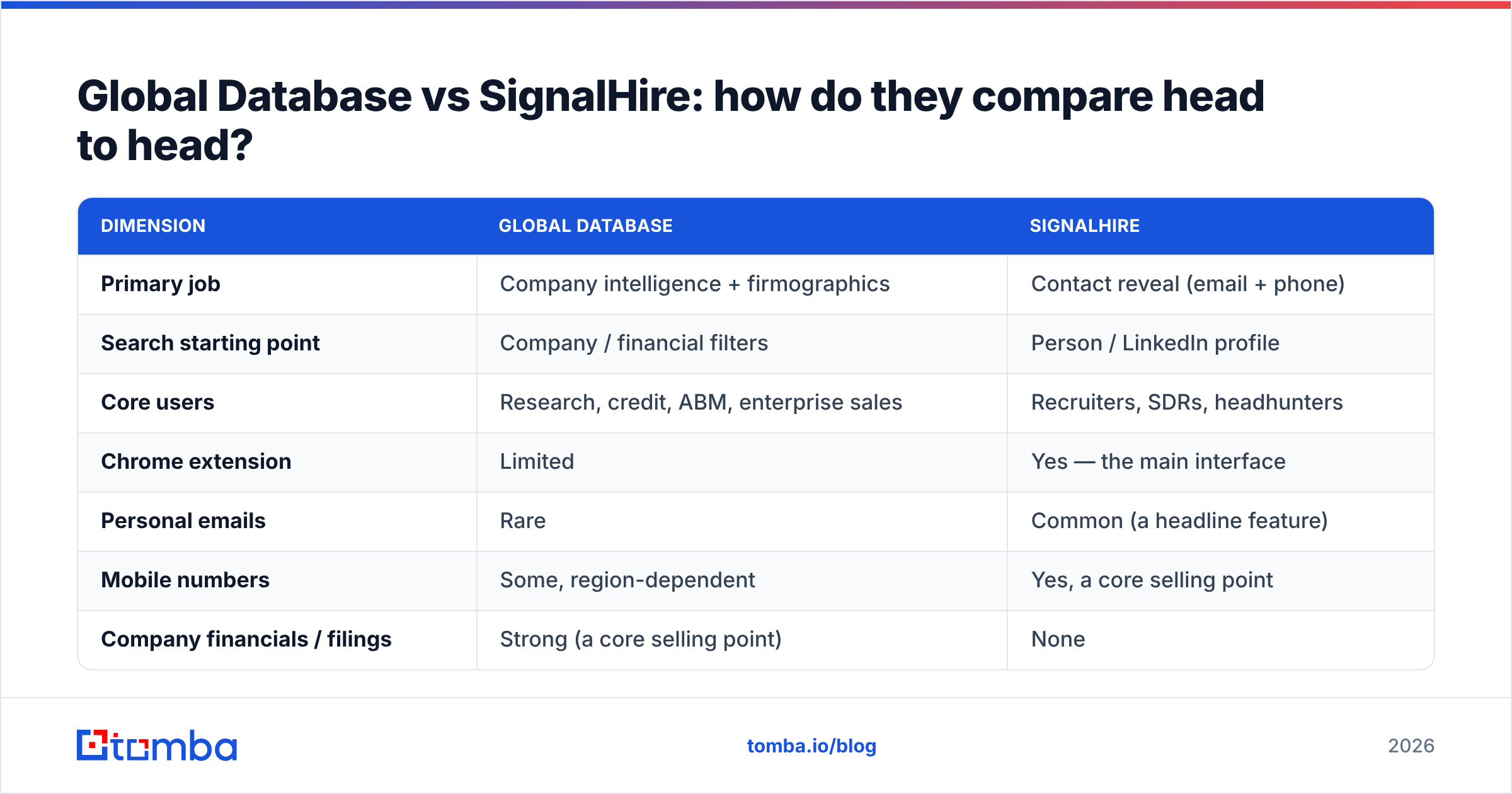
| Dimension | Global Database | SignalHire |
|---|---|---|
| Primary job | Company intelligence + firmographics | Contact reveal (email + phone) |
| Search starting point | Company / financial filters | Person / LinkedIn profile |
| Core users | Research, credit, ABM, enterprise sales | Recruiters, SDRs, headhunters |
| Chrome extension | Limited | Yes — the main interface |
| Personal emails | Rare | Common (a headline feature) |
| Mobile numbers | Some, region-dependent | Yes, a core selling point |
| Company financials / filings | Strong (a core selling point) | None |
| Entry pricing | Quote-based, annual, seat-heavy | Self-serve, credit packs from ~$49/mo |
| Free trial | Demo / limited trial on request | Free credits on signup |
| Bulk + API | Yes, on higher tiers | Yes, credit-metered |
| Best geography | Strong UK/EU, decent global | Global, strongest where LinkedIn is dense |
| Verification built in | Basic | Basic (claims validation at reveal) |
The takeaway from that table: these tools barely overlap in intent. People compare them because both appear in "B2B contact data" listicles, but a credit analyst and a recruiter would never shortlist the same product.
Which one has better data accuracy?#
Different question for each, because they're guessing at different things.
SignalHire's accuracy risk is the reveal. When the extension can't find a verified record, it may return a pattern-derived guess. Guessed emails are the number-one source of silent bounce damage in cold outbound — they look fine in a CSV and then quietly torch your sender reputation. Always run reveals through an email verifier before they touch a sequence, regardless of what the source tool claims.
Global Database's accuracy risk is staleness. Registry and filings data is genuinely reliable — it comes from official sources. Contact data attached to those companies is the softer part: job titles drift, people leave, and the refresh cadence on person records is slower than on the company records they hang off. If you're pulling a CFO name from a company profile, sanity-check it against LinkedIn before you write "Hi Sarah."
A practical protocol that works for either tool:
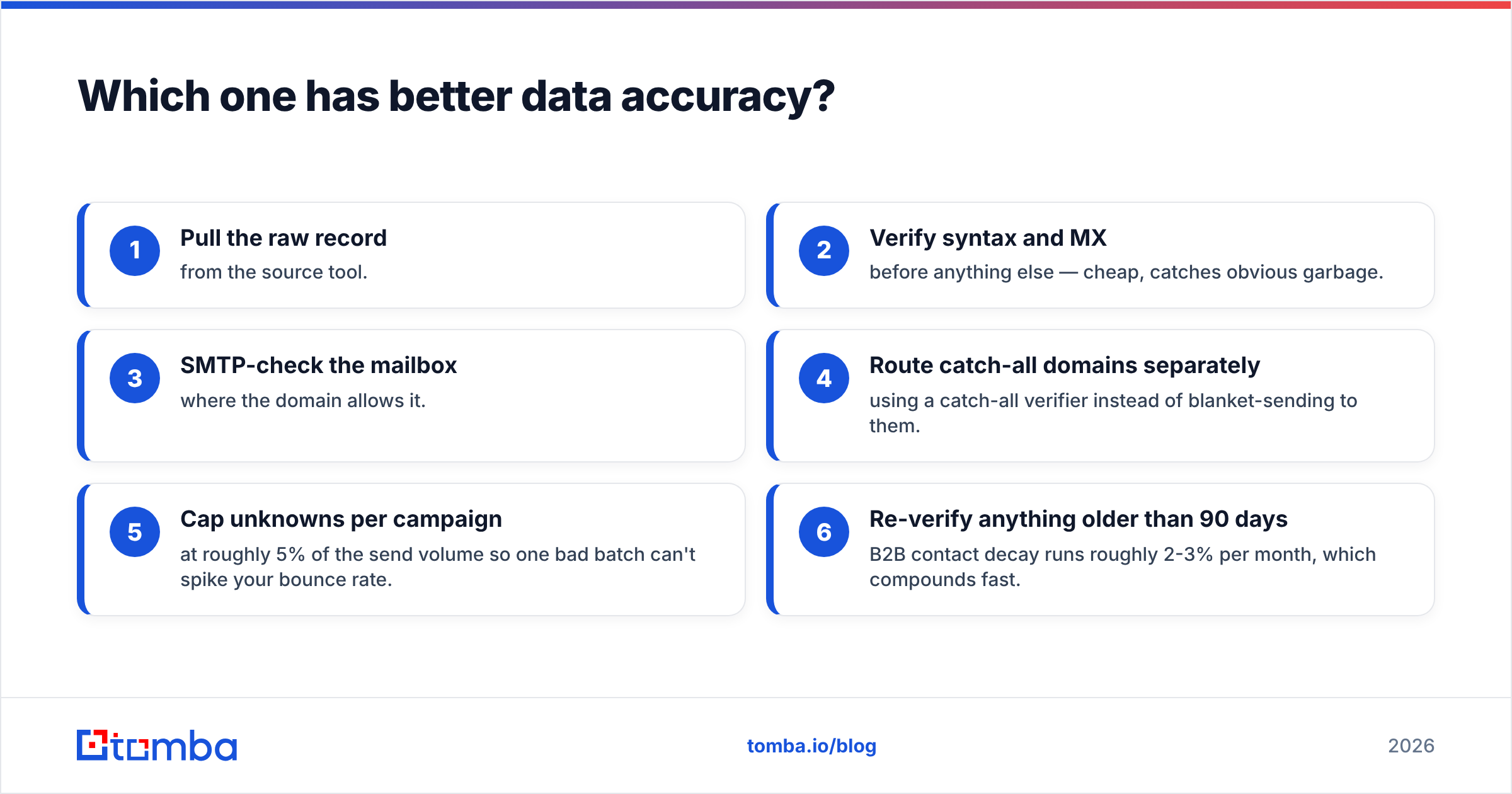
- Pull the raw record from the source tool.
- Verify syntax and MX before anything else — cheap, catches obvious garbage.
- SMTP-check the mailbox where the domain allows it.
- Route catch-all domains separately using a catch-all verifier instead of blanket-sending to them.
- Cap unknowns per campaign at roughly 5% of the send volume so one bad batch can't spike your bounce rate.
- Re-verify anything older than 90 days — B2B contact decay runs roughly 2-3% per month, which compounds fast.
What does each one cost in 2026?#
Pricing is where the two products diverge most visibly.
Global Database is quote-driven. There is no public self-serve checkout for the full platform. Expect an annual contract, per-seat pricing, and modules priced separately — company data, contact data, credit reports, and technology tracking are often distinct line items. Realistically you're in four-figure-annual territory minimum, and it climbs quickly with seats and modules. That's normal for the business-intelligence category and it's not a criticism; it's just a different buying motion than dropping a card in a checkout.
SignalHire is transparent and credit-metered. Public tiers have historically started around $49/month for a few hundred credits, scaling up through team plans, with per-credit cost dropping as you buy volume. One credit generally equals one contact reveal. The catch that bites people: a reveal that returns only a phone number, or only a personal email, still burns a credit. Budget for a real-world yield well below 100%.
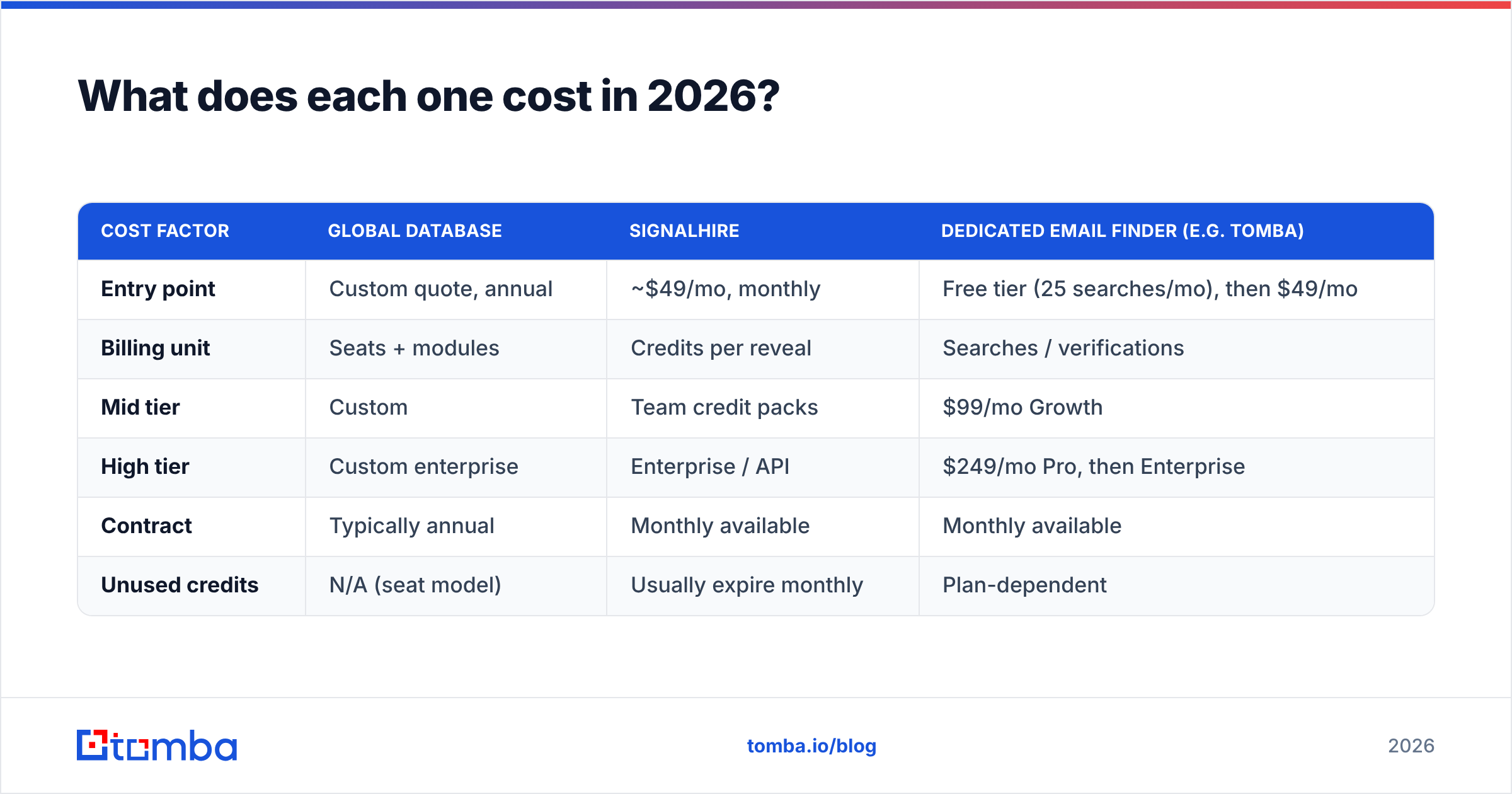
| Cost factor | Global Database | SignalHire | Dedicated email finder (e.g. Tomba) |
|---|---|---|---|
| Entry point | Custom quote, annual | ~$49/mo, monthly | Free tier (25 searches/mo), then $49/mo |
| Billing unit | Seats + modules | Credits per reveal | Searches / verifications |
| Mid tier | Custom | Team credit packs | $99/mo Growth |
| High tier | Custom enterprise | Enterprise / API | $249/mo Pro, then Enterprise |
| Contract | Typically annual | Monthly available | Monthly available |
| Unused credits | N/A (seat model) | Usually expire monthly | Plan-dependent |
If cost predictability matters, compare that against straightforward Tomba pricing — the point isn't that one is universally cheaper, it's that credit-burn models and seat models fail in different ways. Credits fail when your hit rate is low. Seats fail when only two people actually log in.

When should you use neither?#
Be honest about your motion. If your job is "email 2,000 marketing directors at SaaS companies this quarter," neither Global Database nor SignalHire is the efficient centre of that stack.
You want a domain-first email finder when:
- You start from company lists, not people lists. You have 800 domains and need every relevant contact at each one. A domain search returns the full pattern plus known addresses in one call — no per-profile clicking.
- Volume is your constraint. Extension-based reveal is inherently manual. Even with bulk upload, a tool designed around one-profile-at-a-time has a ceiling.
- Verification must be inline, not a second vendor. Paying one tool to find and another to verify doubles your integration surface and your latency.
- You need an API your engineers won't hate. If enrichment runs inside your product or your CRM sync, a documented email finder API beats a scraping extension every time.
- Deliverability is the whole game. Cold email lives or dies on bounce rate. Sources that guess should be treated as suspects, not as inputs.
Conversely, you genuinely want SignalHire when the person is the unit of work — recruiting, executive search, or founder-led outreach where you're contacting 30 hand-picked people and want their mobile.
And you genuinely want Global Database when the company is the unit of work — when "does this business turn over £10M+ and file on time" is the qualifying question, and the contact is an afterthought you'll find later.
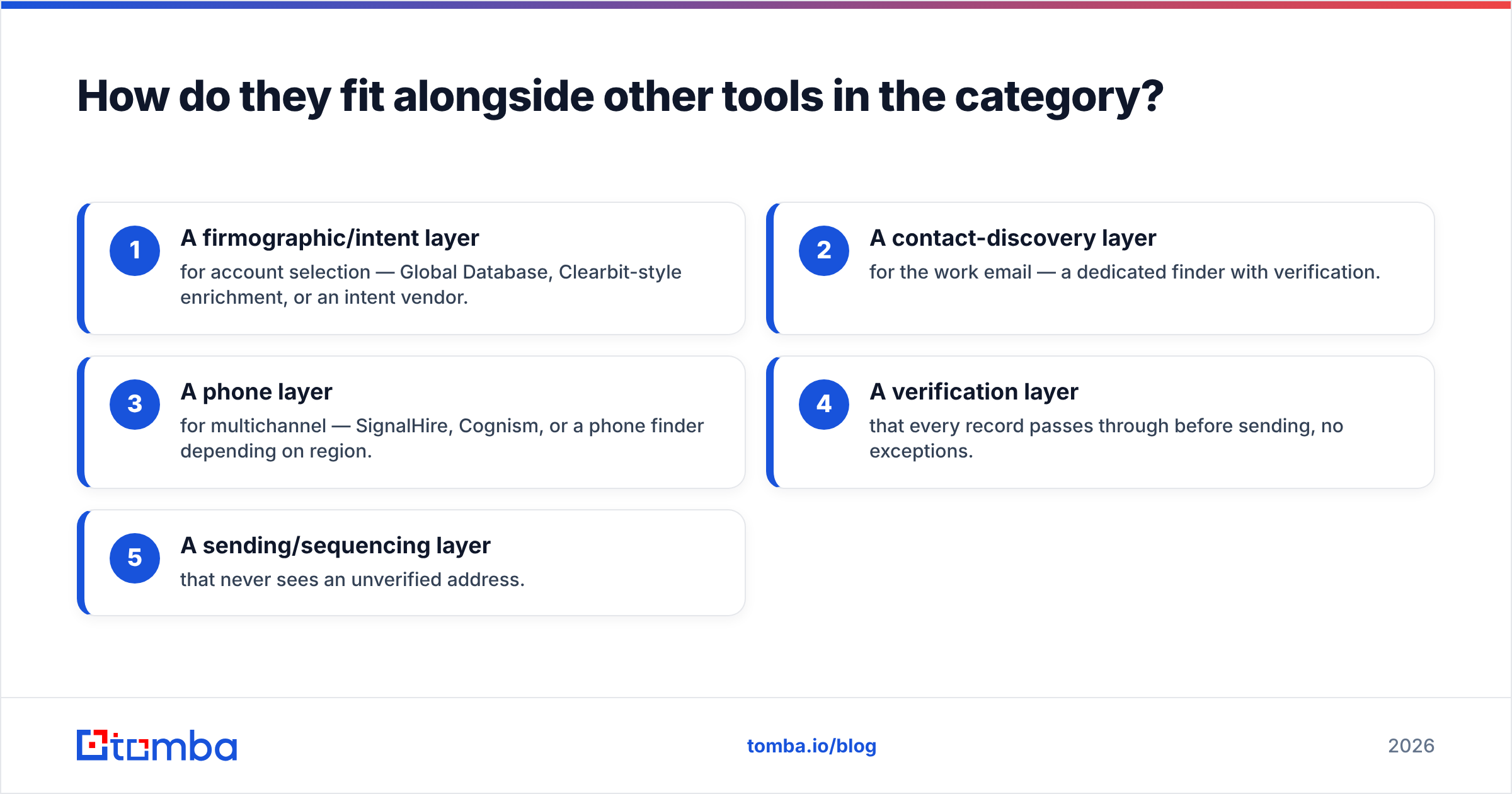
How do they fit alongside other tools in the category?#
Most teams end up with two or three data sources, not one, because coverage overlap between vendors is lower than any vendor admits. A common working stack:
- A firmographic/intent layer for account selection — Global Database, Clearbit-style enrichment, or an intent vendor.
- A contact-discovery layer for the work email — a dedicated finder with verification.
- A phone layer for multichannel — SignalHire, Cognism, or a phone finder depending on region.
- A verification layer that every record passes through before sending, no exceptions.
- A sending/sequencing layer that never sees an unverified address.
Peers worth shortlisting depending on the gap you're filling: BookYourData is a solid choice when you want pre-built, human-verified lists you can buy outright rather than assemble — a genuinely different and legitimate procurement model that suits teams who'd rather buy a clean list than run a discovery pipeline. Apollo bundles data with sequencing. RocketReach and ContactOut sit close to SignalHire on the profile-reveal axis. If you're evaluating replacements, our Apollo alternative and RocketReach alternative breakdowns go deeper on each.
Cross-check any shortlist against G2's B2B data category reviews before you commit to an annual contract — the review volume tells you as much about a vendor's real-world support experience as any feature grid does.
What about compliance and GDPR?#
This is not a footnote if you sell into Europe.
Global Database's registry-derived data is on solid ground — public filings are public. Its contact data, like everyone's, relies on legitimate interest under GDPR Article 6(1)(f), which means you need a documented balancing test and a working opt-out path.
SignalHire's personal-email and mobile data sits in a more sensitive bracket. A personal Gmail and a mobile number are more clearly personal data than firstname@company.com, and regulators have shown more appetite for scrutinising exactly this. If you operate in the EU or UK, get your DPO to look at your reveal-to-send workflow specifically, not just the vendor's DPA. The ICO's guidance on legitimate interests is the clearest free reference here.
Practical rule: prefer role-based work emails for cold outbound. They're lower risk, higher deliverability, and nobody has ever complained to a regulator about being emailed at their work address by a vendor in their category.
Which should you actually pick?#
Match the tool to the unit of work:
- You research companies before you contact them → Global Database. The financial and filings depth is real and hard to replicate elsewhere.
- You contact named individuals and need their mobile → SignalHire. The extension workflow is fast and the personal-contact coverage justifies the credits.
- You run high-volume cold email from domain lists → neither. Get a purpose-built finder with verification in the same product.
- You need pre-cleaned lists without building a pipeline → a list vendor like BookYourData is a reasonable, lower-effort route.
- You're enriching inside your own product or CRM → API-first tooling, every time.
Run a paid pilot on the same 200 target accounts before you sign anything annual. Measure three numbers only: fill rate (how many records came back), bounce rate (how many were actually deliverable), and cost per valid contact. Vendor coverage claims are marketing; those three numbers are procurement.
Ready to test your list against a purpose-built finder?#
If the honest answer to "what's my unit of work" is domains and volume, start there. Point the Tomba Email Finder at your target domains, let the verification run inline, and compare the cost per valid contact against whatever quote or credit pack you're weighing. The free tier gives you 25 searches a month — enough to benchmark a sample list before anyone signs a contract. Run the same 200 accounts through all three options and let the bounce rate pick the winner.
Related guides#
Ready to find emails that actually work?
Join 150,000+ professionals who stopped guessing and started sending. Free credits on signup — no credit card required.
Get the Tomba newsletter
Practical outbound tactics and product updates — once every two weeks.
About the author