Go To Market Alignment in 2026: A Practical RevOps Guide
Most GTM alignment projects fail because they start with a meeting cadence instead of a shared definition of a qualified account. Here is what actually works in 2026.
TL;DR
- Go to market alignment is not a meeting cadence. It is a set of shared definitions, a shared data layer, and shared numbers that sales, marketing, customer success, and finance are all measured against.
- The single biggest cause of misalignment is not politics — it is that each team runs on a different contact record. Fix the data layer before you fix the org chart.
- Three artifacts do most of the work: a written ICP, a lifecycle-stage contract with entry/exit rules, and one revenue dashboard nobody can dispute.
- Measure alignment with lagging outcomes (win rate, CAC payback, pipeline coverage) plus one leading indicator: percentage of accepted leads that reach a first meeting.
- Budget 90 days. Weeks 1–4 for definitions, 5–8 for data hygiene and routing, 9–12 for the shared scorecard and comp changes.
What is go to market alignment, actually?#
Go to market alignment means every revenue-facing team — marketing, SDR, AE, customer success, RevOps, and finance — operates from the same definition of who you sell to, the same record of who that person is, and the same scoreboard for whether it worked.
That is a narrow definition on purpose. Plenty of teams use "alignment" as a synonym for "getting along," which is why so many alignment initiatives produce a nice offsite and zero change in win rate. Getting along is a byproduct. The mechanism is shared definitions enforced in shared systems.
Think of it like an airline. Ticketing, gate agents, ground crew, and pilots do not need to like each other. They need the same flight number, the same manifest, and the same clock. When those three things drift, the plane leaves without half the passengers — regardless of how friendly the team is.
The technical version: alignment is a contract layer between functions. Each handoff (MQL to SDR, SQL to AE, closed-won to CS) has explicit entry criteria, an SLA, and a rejection path. Without a rejection path, you get silent failure — marketing thinks it delivered 400 leads, sales thinks it got 40 real ones, and nobody can prove either number.
Why do most GTM alignment projects fail?#
They start at the wrong layer. The usual sequence is: leadership notices pipeline is soft, calls a summit, agrees on a new MQL definition, updates a slide, and moves on. Ninety days later nothing changed because the CRM still routes on the old rules and the contact data is still 30% stale.
Here are the failure modes worth naming:
- No shared ICP document. Marketing targets by firmographic segment, sales targets by whoever picks up the phone. Both are optimizing honestly against different targets.
- Different source-of-truth systems. Marketing lives in the automation platform, sales in the CRM, CS in the support tool. Three contact records for one human being.
- Dirty contact data. Roughly a quarter of B2B contact data decays annually as people change roles. If your handoff includes a bad email or a stale title, the receiving team blames the sending team rather than the decay.
- Metrics that reward opposite behavior. Marketing is comped on lead volume, sales on closed revenue. Volume wins by lowering the bar. This is a comp design problem, not an attitude problem.
- No rejection path. When an AE can't send a lead back with a reason code, quality never improves because quality is never measured.
- Alignment owned by nobody. If revenue operations does not own the contract, it is a suggestion.
What are the four layers of go to market alignment?#
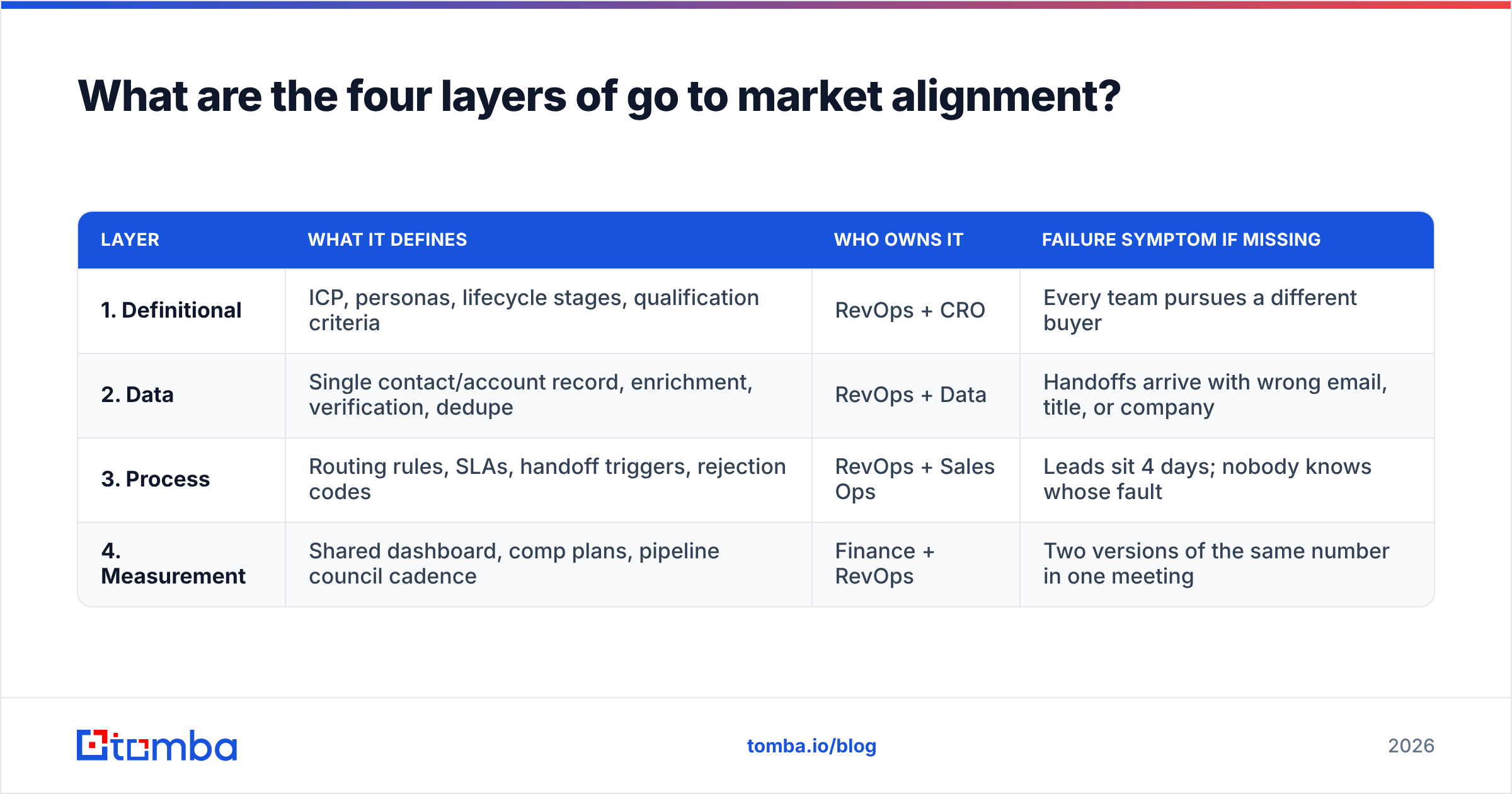
Alignment stacks. You cannot skip a layer and expect the ones above it to hold.
| Layer | What it defines | Who owns it | Failure symptom if missing |
|---|---|---|---|
| 1. Definitional | ICP, personas, lifecycle stages, qualification criteria | RevOps + CRO | Every team pursues a different buyer |
| 2. Data | Single contact/account record, enrichment, verification, dedupe | RevOps + Data | Handoffs arrive with wrong email, title, or company |
| 3. Process | Routing rules, SLAs, handoff triggers, rejection codes | RevOps + Sales Ops | Leads sit 4 days; nobody knows whose fault |
| 4. Measurement | Shared dashboard, comp plans, pipeline council cadence | Finance + RevOps | Two versions of the same number in one meeting |
Most companies attempt layer 4 first because a dashboard is the easiest thing to build. It is also the least useful when the underlying records disagree. A dashboard on top of a bad data layer just gives everyone a more confident way to be wrong.
The definitional layer in practice#
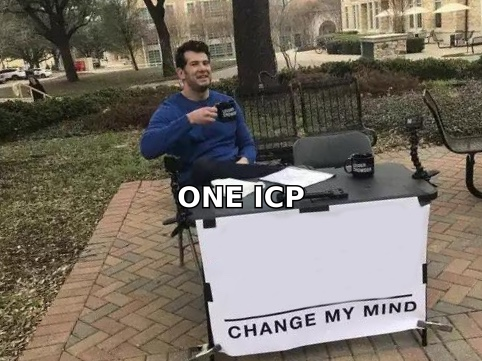
Write the ICP as a filter, not an adjective. "Mid-market SaaS companies who value innovation" is not a filter. "US or EU headquartered, 50–500 employees, Series A through C, uses Salesforce or HubSpot, has at least two people with 'RevOps' or 'Sales Operations' in their title" is a filter — you can query it, you can count it, and you can disagree with it precisely.
Then define your marketing qualified lead with the same rigor. An MQL should have an entry condition (fits ICP filter AND crossed a behavioral score threshold) and an exit condition (accepted by SDR within 24 hours, or returned with one of five reason codes).
How do you fix the data layer first?#
Start by measuring the decay, not by buying a tool. Pull 200 random contacts your team touched in the last quarter and check three things: is the email still deliverable, is the title still current, and is the account still in the ICP filter. That gives you a baseline percentage to argue from.
Most teams find something ugly — 20% to 35% of records failing at least one check is common for lists older than 12 months. That number is the actual reason your MQL-to-SQL conversion looks bad, and it is far more actionable than a debate about lead quality philosophy.
Then fix it in this order:
- Deduplicate before enriching. Enriching duplicates just makes more confident duplicates. Run a remove duplicates pass on exports before they hit the CRM.
- Verify what you already have. A bulk pass through an email verifier tells you which records are dead weight. Suppress rather than delete so you keep the historical attribution.
- Enrich the gaps. Missing direct emails, phone numbers, and titles get filled from a provider. This is where a data enrichment step belongs in the pipeline — after dedupe, after verification.
- Set a refresh cadence. Quarterly re-verification of active pipeline, semiannual for the broader database. Put it on a calendar, not on someone's good intentions.
- Instrument the decay. Track "percentage of records verified in the last 90 days" as a standing RevOps metric. It is the closest thing to a health score for your data layer.
One note on catch-all domains, because they cause more inter-team friction than they should: when a domain accepts everything, standard verification returns "unknown," and sales reads that as marketing sending junk. Run those through a dedicated catch-all verifier and label the result explicitly so the handoff carries confidence, not ambiguity.
What does a working handoff contract look like?#
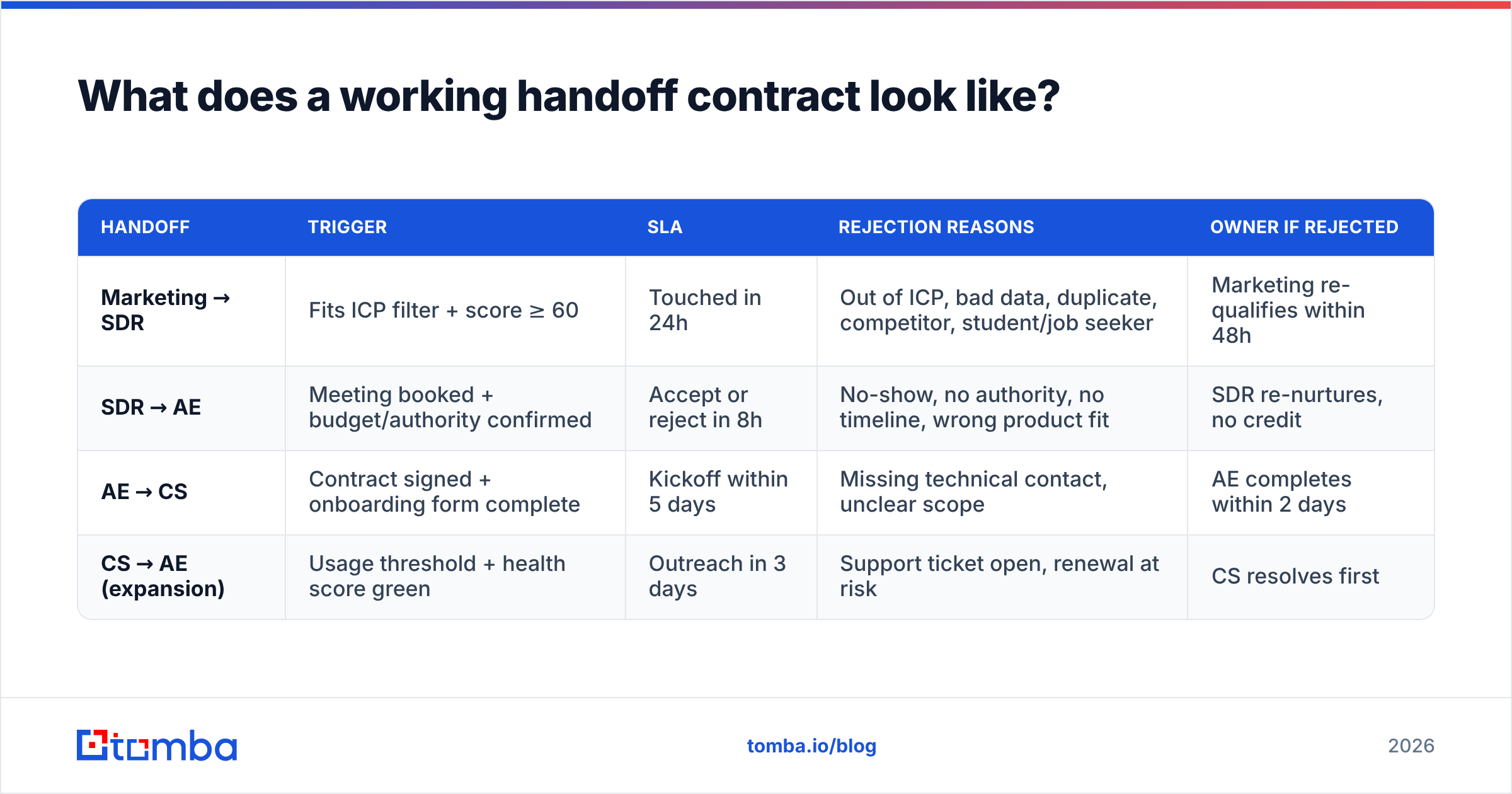
Here is the smallest version that works. Four handoffs, each with a trigger, an SLA, and a rejection path.
| Handoff | Trigger | SLA | Rejection reasons | Owner if rejected |
|---|---|---|---|---|
| Marketing → SDR | Fits ICP filter + score ≥ 60 | Touched in 24h | Out of ICP, bad data, duplicate, competitor, student/job seeker | Marketing re-qualifies within 48h |
| SDR → AE | Meeting booked + budget/authority confirmed | Accept or reject in 8h | No-show, no authority, no timeline, wrong product fit | SDR re-nurtures, no credit |
| AE → CS | Contract signed + onboarding form complete | Kickoff within 5 days | Missing technical contact, unclear scope | AE completes within 2 days |
| CS → AE (expansion) | Usage threshold + health score green | Outreach in 3 days | Support ticket open, renewal at risk | CS resolves first |
Two design rules make this stick. First, the rejection reason list must be short and closed — five options maximum, no free text. Free text is unqueryable and therefore uncoachable. Second, rejections must be reviewed weekly by both sides together. The review is where the ICP filter actually gets tuned.
For a deeper treatment of stage definitions, HubSpot's lifecycle stage documentation is a reasonable reference implementation to adapt rather than invent from scratch.
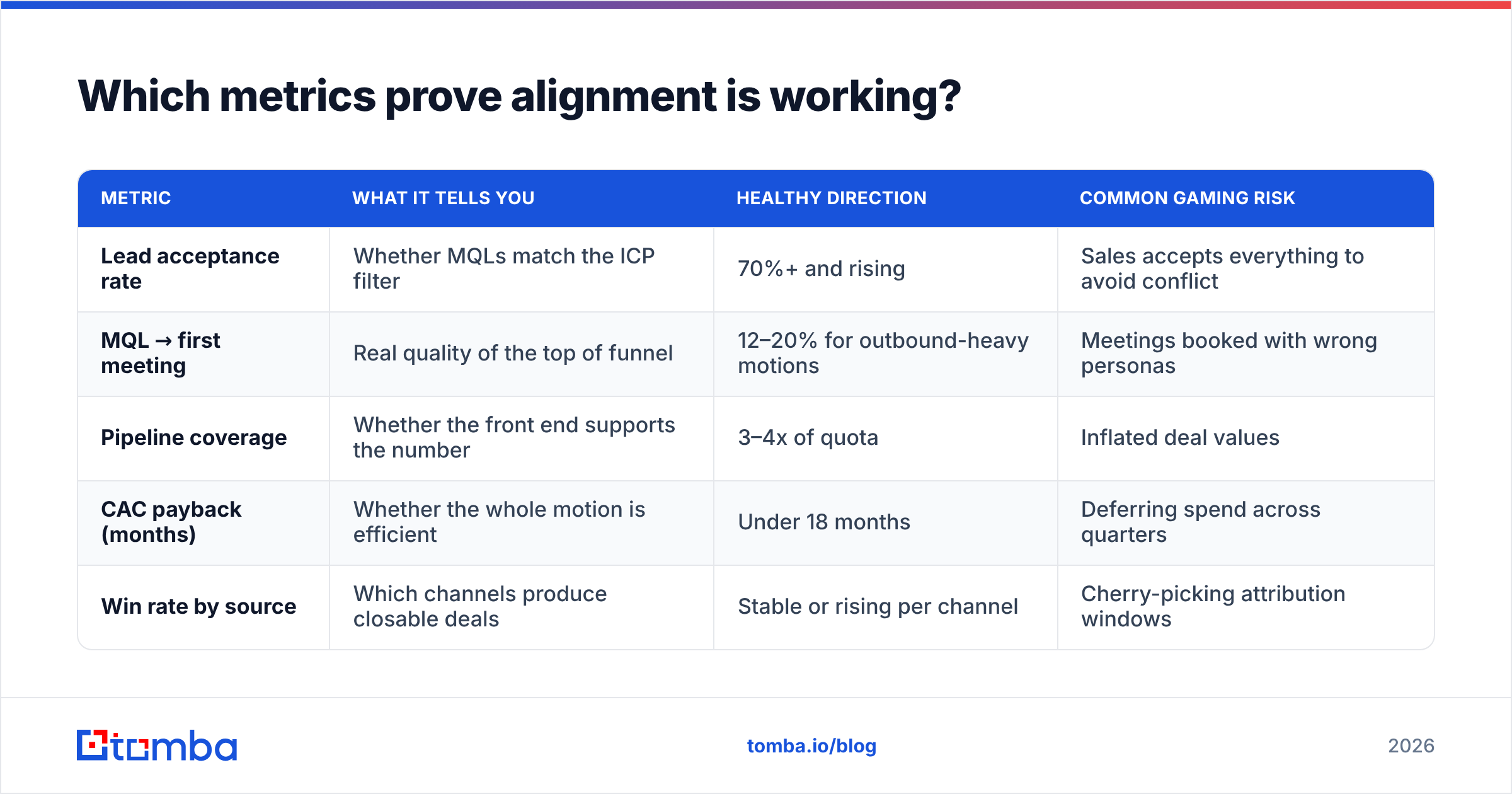
Which metrics prove alignment is working?#
Pick five and put them on one dashboard that finance publishes. Not marketing, not sales — finance, because a neutral publisher removes the "your numbers" argument.
| Metric | What it tells you | Healthy direction | Common gaming risk |
|---|---|---|---|
| Lead acceptance rate | Whether MQLs match the ICP filter | 70%+ and rising | Sales accepts everything to avoid conflict |
| MQL → first meeting | Real quality of the top of funnel | 12–20% for outbound-heavy motions | Meetings booked with wrong personas |
| Pipeline coverage | Whether the front end supports the number | 3–4x of quota | Inflated deal values |
| CAC payback (months) | Whether the whole motion is efficient | Under 18 months | Deferring spend across quarters |
| Win rate by source | Which channels produce closable deals | Stable or rising per channel | Cherry-picking attribution windows |
Add one leading indicator on top: time from lead creation to first human touch. It is boring, it is easy to measure, and it correlates with almost everything else. Teams that fix this number usually find the other four improve without a separate initiative.
Also worth tracking as a diagnostic, not a target: your response rate segmented by data source. If contacts sourced from one provider reply at 8% and another at 2%, you have located a data-quality problem that no amount of copy testing will fix.
How do you sequence a 90-day alignment program?#
Do not try to run all four layers at once. Sequence them.
Days 1–30: definitions. Write the ICP filter. Write lifecycle stage entry/exit criteria. Get the CRO, CMO, and Head of CS to physically sign the document. Audit 200 records for the data baseline described earlier. Do not change a single system yet.
Days 31–60: data and routing. Dedupe, verify, enrich, and set the refresh cadence. Implement the ICP filter as an actual query in your CRM so records auto-flag as in/out of ICP. Build routing rules and the five rejection reason codes. Turn on SLA timers.
Days 61–90: measurement and incentives. Ship the shared dashboard. Start the weekly rejection review. Then — and only then — adjust comp. Marketing gets a component tied to accepted leads or sourced pipeline, not raw MQL count. SDRs get credited on AE-accepted meetings, not booked meetings.
The order matters because comp changes without a working data layer create resentment. You are asking marketing to be accountable for a number they cannot influence until the contact records are clean.
For benchmarking your progress against peers, Gartner's sales and marketing research and peer review data on G2 are more useful than internal historicals, which encode the misalignment you are trying to remove.
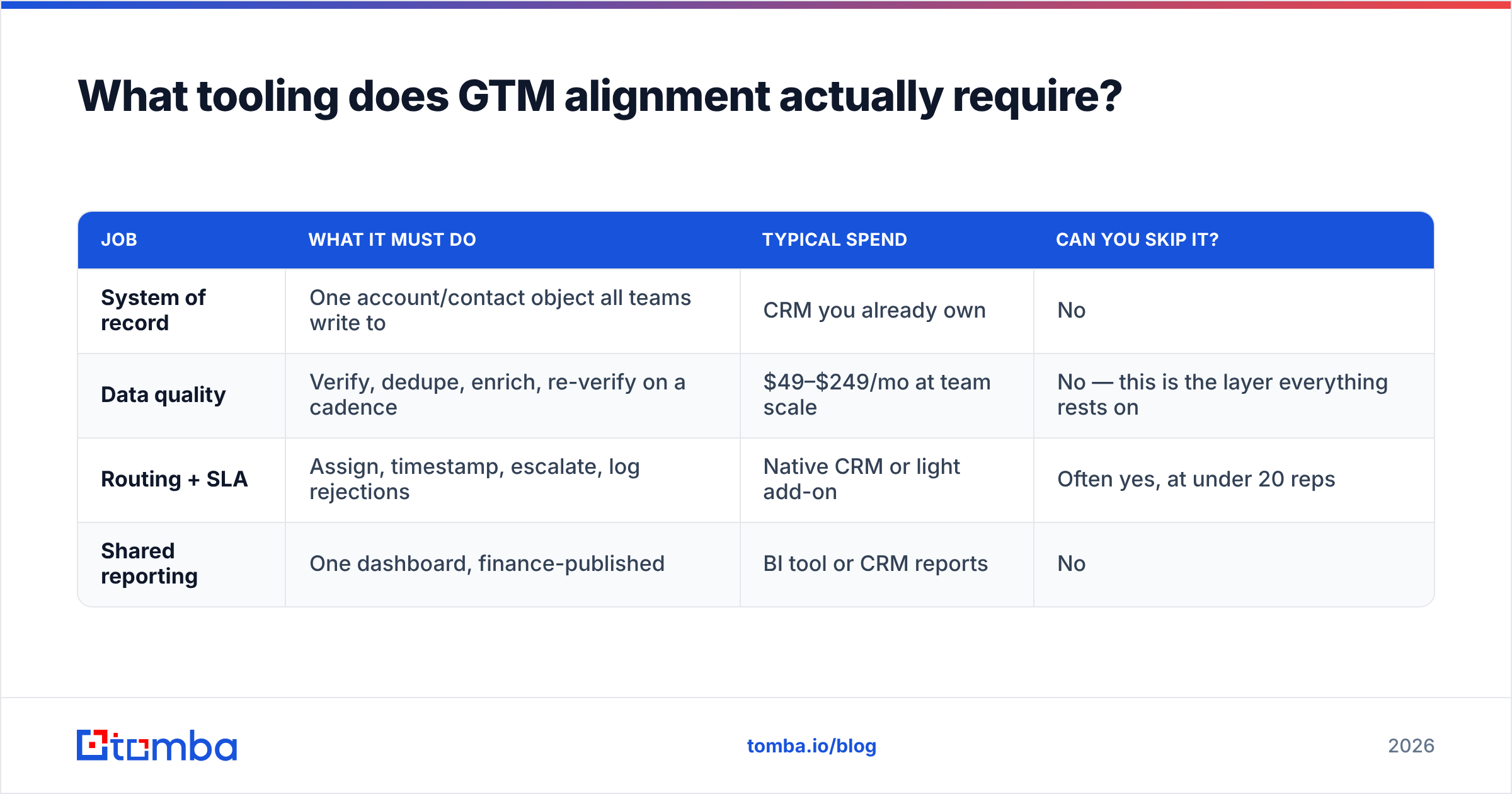
What tooling does GTM alignment actually require?#
Less than vendors suggest. The stack breaks into four jobs, and many teams already own three of them.
| Job | What it must do | Typical spend | Can you skip it? |
|---|---|---|---|
| System of record | One account/contact object all teams write to | CRM you already own | No |
| Data quality | Verify, dedupe, enrich, re-verify on a cadence | $49–$249/mo at team scale | No — this is the layer everything rests on |
| Routing + SLA | Assign, timestamp, escalate, log rejections | Native CRM or light add-on | Often yes, at under 20 reps |
| Shared reporting | One dashboard, finance-published | BI tool or CRM reports | No |
On the data-quality line, the practical question is coverage versus cost per verified contact. Tomba pricing runs a free tier at 25 searches a month, Starter at $49/mo, Growth at $99/mo, and Pro at $249/mo, with an API for pushing verification into the routing step rather than running it as a manual batch. Peers like BookYourData take a database-first approach that suits teams buying pre-built lists rather than sourcing per-account — both models are legitimate; pick based on whether your motion is list-led or account-led.
The thing to avoid is buying a "GTM alignment platform" before you have written the ICP document. Tools enforce contracts. They do not write them.
How do you keep alignment from decaying?#
Alignment is a maintenance problem, not a project. Three rituals hold it in place:
- Weekly rejection review, 30 minutes. Marketing and sales look at every rejected lead and its reason code together. Tune the ICP filter based on patterns, not anecdotes.
- Monthly pipeline council, 60 minutes. CRO, CMO, CS lead, and finance review the five shared metrics. One agenda rule: no team presents its own numbers. Finance presents all of them.
- Quarterly ICP re-ratification. Markets move. Re-read the ICP filter and either sign it again or change it. An unchanged ICP after four quarters usually means nobody is reading it.
Add a data hygiene sprint every quarter — re-verify the active pipeline, re-enrich anything older than six months, and report the "percent verified in last 90 days" number in the pipeline council. Making data quality visible in a revenue meeting is what keeps it funded.
Get the data layer right first#
Alignment fails at the record level long before it fails at the relationship level. If your SDRs are working bounced emails and outdated titles, no amount of shared vocabulary will fix the conversion rate — and every meeting about it will devolve into blame that nobody can settle with evidence.
Start by making your contact data defensible. Use the Tomba Email Finder to source verified professional emails against your ICP filter, run existing records through verification on a quarterly cadence, and push both into your CRM through the API so the data layer stays clean without anyone remembering to do it. Free tier gives you 25 searches a month to run the 200-record audit described above — enough to get the baseline number you need before the first alignment meeting.
Related guides#
Ready to find emails that actually work?
Join 150,000+ professionals who stopped guessing and started sending. Free credits on signup — no credit card required.
Get the Tomba newsletter
Practical outbound tactics and product updates — once every two weeks.
About the author