How to Build a Go To Market Plan That Actually Works in 2026
Most go-to-market plans die in the slide deck. This guide walks through the seven components that survive contact with a real pipeline — segmentation, ICP, channel math, and the data layer underneath it all.

TL;DR
- A go to market plan is not a positioning deck. It is a set of numbers — segment size, channel conversion, CAC, cycle length — that tell you whether the revenue target is reachable with the headcount you have.
- Start with the segment, not the product. Narrow beats broad: a 4,000-account addressable list you can actually name outperforms a 400,000-company TAM slide every time.
- Pick one primary motion (sales-led, product-led, partner-led, or community-led) and one supporting motion. Three primary motions means none of them get funded properly.
- The data layer is the part nobody plans for and everybody blames later. Bad contact data silently caps every channel you build on top of it.
- Review the plan on a 90-day cycle with pre-committed kill criteria. A GTM plan without a written "we stop doing this if X" is a wish list.
What is a go to market plan, really?#
A go to market plan is the operating document that connects a revenue target to the specific segments, channels, messages, and headcount that will produce it. Think of it like a flight plan: the destination is the revenue number, but the plan is the fuel load, the route, the waypoints, and the abort criteria. Nobody files a flight plan that says "fly toward the coast and see what happens."
Most plans fail because they are written as narrative. Narrative is cheap. A useful plan is mostly arithmetic with a short story wrapped around it.
The distinction that matters: strategy is which fights you pick, the plan is the resourcing and sequencing that makes those fights winnable. A team can have excellent strategy and still miss badly because nobody worked out that 40 SQLs a month requires roughly 1,200 qualified contacts entering the top of the funnel, and nobody owns sourcing those 1,200.
The seven components of a working plan#
- Segment definition — the named, countable set of accounts you will target this quarter, not the theoretical market.
- ICP and buyer map — firmographic fit criteria plus the two or three job titles who actually sign, influence, and block.
- Positioning and message — the specific problem you solve, in the words the buyer uses, with the alternative they'd otherwise pick named explicitly.
- Channel mix and motion — how you reach the segment, ranked by expected cost per qualified opportunity.
- Pricing and packaging — entry price, expansion path, and the friction point that determines whether self-serve is viable.
- Data and tooling layer — where contact records come from, how they're verified, and how they flow into the CRM.
- Metrics and kill criteria — the four numbers you review weekly and the pre-agreed conditions for shutting a channel down.
Miss any one and the plan leaks. Miss the data layer and the plan leaks silently, which is worse.
Why do most go to market plans fail in the first 90 days?#
Three failure modes account for most of it.
The TAM trap. A plan opens with "$14B market growing 22% CAGR." That number cannot be executed against. What a rep needs on Monday morning is a list of 300 accounts with names, domains, and a reason to call. Total addressable market is a fundraising artifact; your plan needs a serviceable, contactable list.
Motion sprawl. A seed-stage team decides to run outbound, content, paid search, a partner program, and a community Slack simultaneously. Each gets 20% of the attention required to work. Six months later every channel shows a weak signal and nobody can tell which one deserved the budget. Forrester's B2B research has been consistent on this point for years: channel focus beats channel coverage at every stage below roughly $20M ARR.
The assumed data layer. The plan says "SDRs will book 12 meetings each per month." Nobody asks where the 400 verified contacts per SDR per month come from, what they cost, or what happens when 28% of them bounce. This is the quiet killer, and it's the one most recoverable if you catch it during planning rather than in month four.
Screenshot placeholder: a GTM planning board in Notion or Airtable showing segment tiers, owner, and 90-day kill criteria columns.
How do you choose your go-to-market motion?#
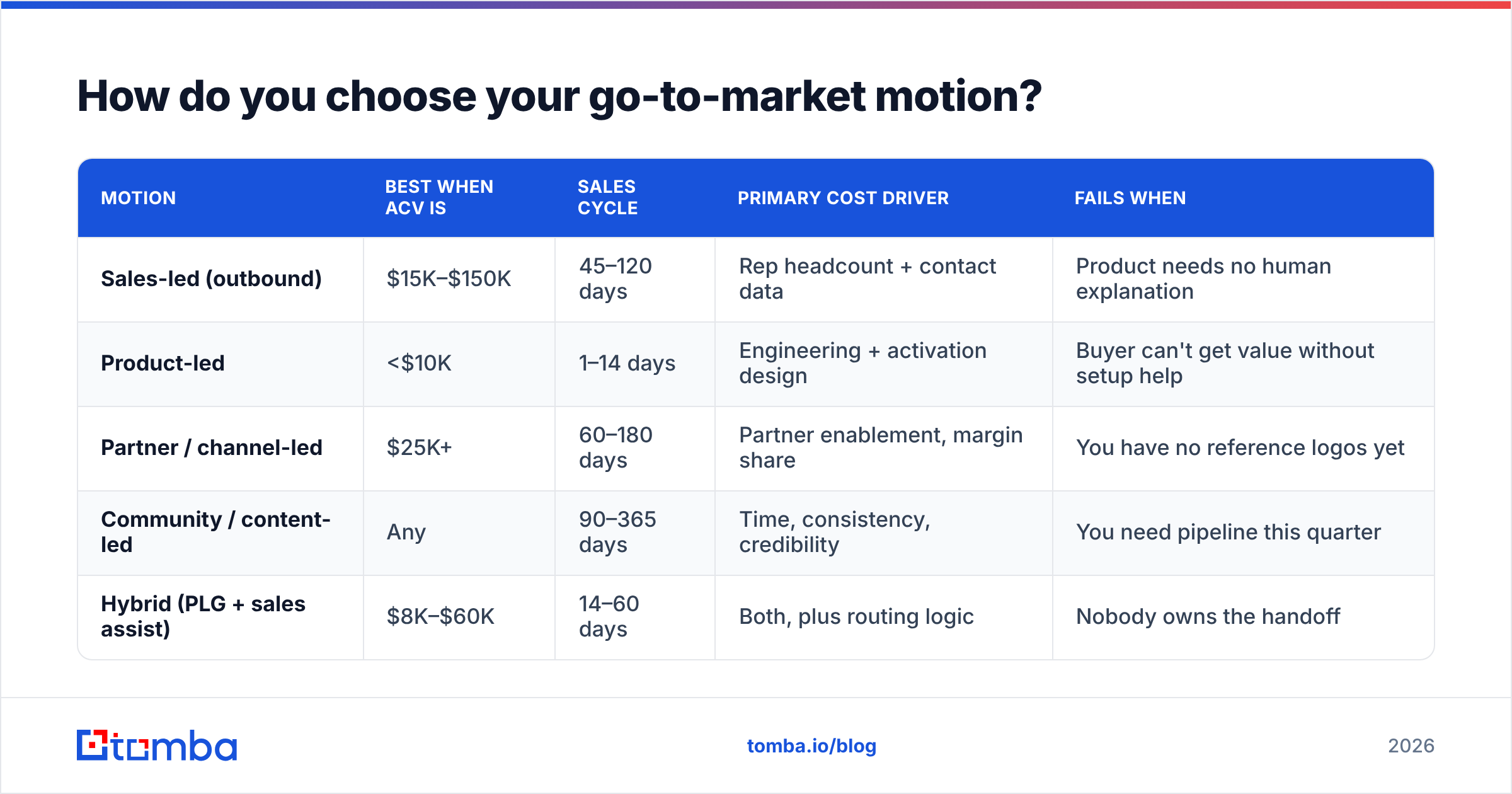
Four motions dominate B2B. Pick one primary, one supporting, and explicitly defer the rest.
| Motion | Best when ACV is | Sales cycle | Primary cost driver | Fails when |
|---|---|---|---|---|
| Sales-led (outbound) | $15K–$150K | 45–120 days | Rep headcount + contact data | Product needs no human explanation |
| Product-led | <$10K | 1–14 days | Engineering + activation design | Buyer can't get value without setup help |
| Partner / channel-led | $25K+ | 60–180 days | Partner enablement, margin share | You have no reference logos yet |
| Community / content-led | Any | 90–365 days | Time, consistency, credibility | You need pipeline this quarter |
| Hybrid (PLG + sales assist) | $8K–$60K | 14–60 days | Both, plus routing logic | Nobody owns the handoff |
The ACV column does most of the work. If your average contract value is $6,000, you cannot afford a $9,000 fully-loaded cost per closed deal from an outbound team — the math simply doesn't close. If your ACV is $80,000, a self-serve signup flow will attract exactly the buyers who can't approve the spend.
Hybrid is the most common answer in 2026 and also the most commonly botched. The failure point is always the handoff: a product-qualified lead trips a usage threshold, and then sits in a queue for nine days because routing was never specified. Write the routing rule into the plan, with an SLA in hours.
What does a real ICP look like versus a fake one?#
A fake ICP: "mid-market SaaS companies in North America who care about efficiency."
A real ICP is falsifiable. You should be able to hand it to someone who has never met your product and have them build the same list you would.
- Firmographic gate — employee count 50–500, headquartered in US/UK/DE, raised a Series A or later, or $5M+ revenue.
- Technographic trigger — running HubSpot or Salesforce, plus at least one sales-engagement tool. You can check this with a website tech stack lookup before a single email goes out.
- Behavioral signal — hiring for an SDR or RevOps role in the last 60 days, or a recent funding announcement.
- Buyer titles — VP Sales (economic buyer), Head of RevOps (technical evaluator), CFO (blocker above $50K).
- Disqualifiers — write these down. Under 20 employees, agency business model, or no existing CRM means you skip the account entirely.
That last bullet is the one teams skip and it's the highest-leverage one. A written disqualifier list saves more rep hours than any tooling purchase.
Once the ICP is defined, the list-building becomes mechanical. Pull the account list from a database or a scraped source, then resolve contacts against it — a domain search returns the people at a target company by role, which is faster than working name-by-name from LinkedIn exports.
How do you build the channel math?#
This is the section that separates a plan from a deck. Work backward from the revenue number.
Assume a $2.4M net-new ARR target, $30K ACV. That's 80 closed deals. At a 22% opportunity-to-close rate, you need 364 opportunities. At a 35% SQL-to-opportunity rate, 1,040 SQLs. At a 4% reply-to-SQL rate on outbound, roughly 26,000 contacts touched — for outbound alone.
Now the uncomfortable question: can you source 26,000 accurate, verified contacts in your ICP this year? At what unit cost? If the answer is no, the plan is already broken and you have discovered it in week one instead of month seven.
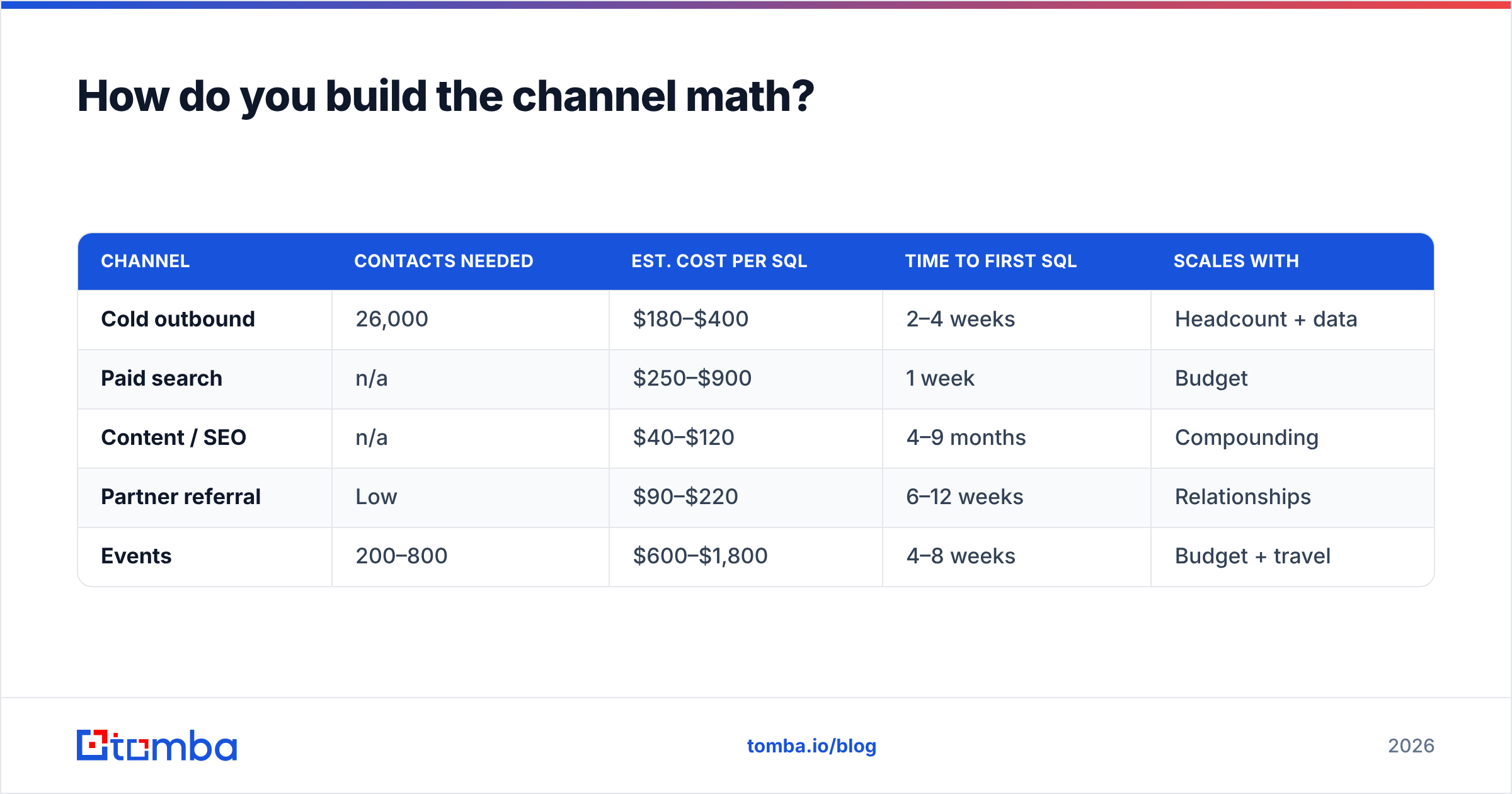
| Channel | Contacts needed | Est. cost per SQL | Time to first SQL | Scales with |
|---|---|---|---|---|
| Cold outbound | 26,000 | $180–$400 | 2–4 weeks | Headcount + data |
| Paid search | n/a | $250–$900 | 1 week | Budget |
| Content / SEO | n/a | $40–$120 | 4–9 months | Compounding |
| Partner referral | Low | $90–$220 | 6–12 weeks | Relationships |
| Events | 200–800 | $600–$1,800 | 4–8 weeks | Budget + travel |
Two things fall out of this table immediately. First, content has the best unit economics and the worst time-to-value — which is why it should be started early and never counted on for this quarter's number. Second, outbound is the only channel where the cost per SQL is heavily determined by something you control directly: contact data quality.
A 30% bounce rate doesn't just waste 30% of your sends. It degrades sender reputation, which suppresses inbox placement for the other 70%, which compounds into a lower reply rate across the whole program. Running the list through an email verifier before the first send is the cheapest insurance in the entire plan.
Screenshot placeholder: a bounce-rate dashboard from your sending platform showing pre- and post-verification delivery rates.
What belongs in the data and tooling layer?#
Most GTM plans list tools. Few specify the flow. Specify the flow.
- Account sourcing — where the target account list originates (database export, funding-announcement feed, competitor customer scrape, event attendee list).
- Contact resolution — turning an account plus a role into a named person with a working email. This is where an email finder or bulk email finder sits in the stack.
- Verification — syntax, MX, SMTP, and catch-all handling. Catch-all domains are roughly a fifth of B2B domains and need their own catch-all verifier rather than being blindly accepted or blindly discarded.
- Enrichment — appending firmographics, tech stack, and headcount so scoring and routing work.
- Sync — writing the record into the CRM with source attribution intact. If you can't answer "which channel produced this closed-won deal" six months later, your channel math is fiction.
On the vendor side, the honest picture in 2026 is that most teams run two or three data sources rather than one, because coverage varies by geography and company size.
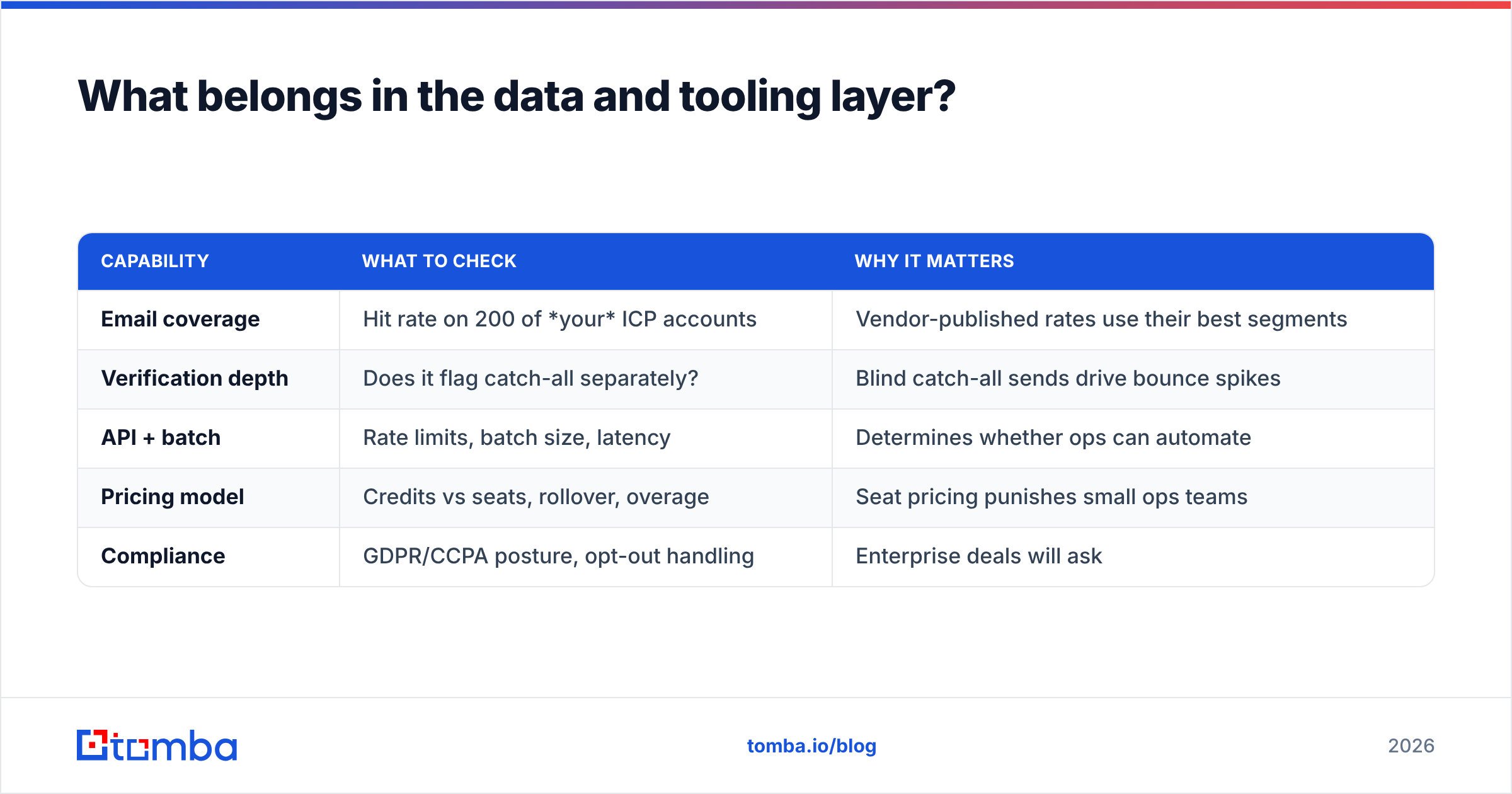
| Capability | What to check | Why it matters |
|---|---|---|
| Email coverage | Hit rate on 200 of your ICP accounts | Vendor-published rates use their best segments |
| Verification depth | Does it flag catch-all separately? | Blind catch-all sends drive bounce spikes |
| API + batch | Rate limits, batch size, latency | Determines whether ops can automate |
| Pricing model | Credits vs seats, rollover, overage | Seat pricing punishes small ops teams |
| Compliance | GDPR/CCPA posture, opt-out handling | Enterprise deals will ask |
Run the same 200-account test list against every vendor on your shortlist. Vendor-reported accuracy is measured on the segments where they're strongest; your ICP is not that segment unless you get lucky. Public review data on G2 is useful for narrowing the shortlist but not for accuracy claims — run your own test.
For cost planning: Tomba pricing starts with a free tier at 25 searches a month for testing, then $49/mo Starter, $99/mo Growth, and $249/mo Pro, with credit-based rather than seat-based billing — which matters when a two-person RevOps team needs to run a 40,000-record enrichment job.

How do you sequence the first 90 days?#
A plan without a calendar is a hope. Here's the sequence that works for most B2B teams launching or relaunching a motion.
Days 1–15 — Define and measure. Lock the ICP with written disqualifiers. Build the first 300-account list manually. Run the vendor bake-off on those accounts. Set up CRM fields for source attribution before any lead enters the system, because retrofitting attribution is miserable.
Days 16–45 — One channel, hard. Launch your primary motion only. For outbound, that means verified lists, warmed domains, and a single message hypothesis. Resist the urge to A/B five variables — you don't have the volume for statistical significance and you'll learn nothing.
Days 46–75 — Read the signal. You now have enough data for the first honest read. Look at reply rate by segment, not in aggregate. Almost always, one sub-segment is carrying the whole average. That sub-segment is your real ICP and the plan should be rewritten around it.
Days 76–90 — Cut and double. Kill what missed the pre-committed threshold. Move that budget into the sub-segment that worked. Only now do you add the supporting motion.
The discipline that makes this work is writing kill criteria before launch. "We stop outbound to the sub-500-employee segment if reply rate is under 3% after 2,000 sends" is a decision made when you're calm. The same decision made in week ten, with a rep's job attached to it, is made emotionally.
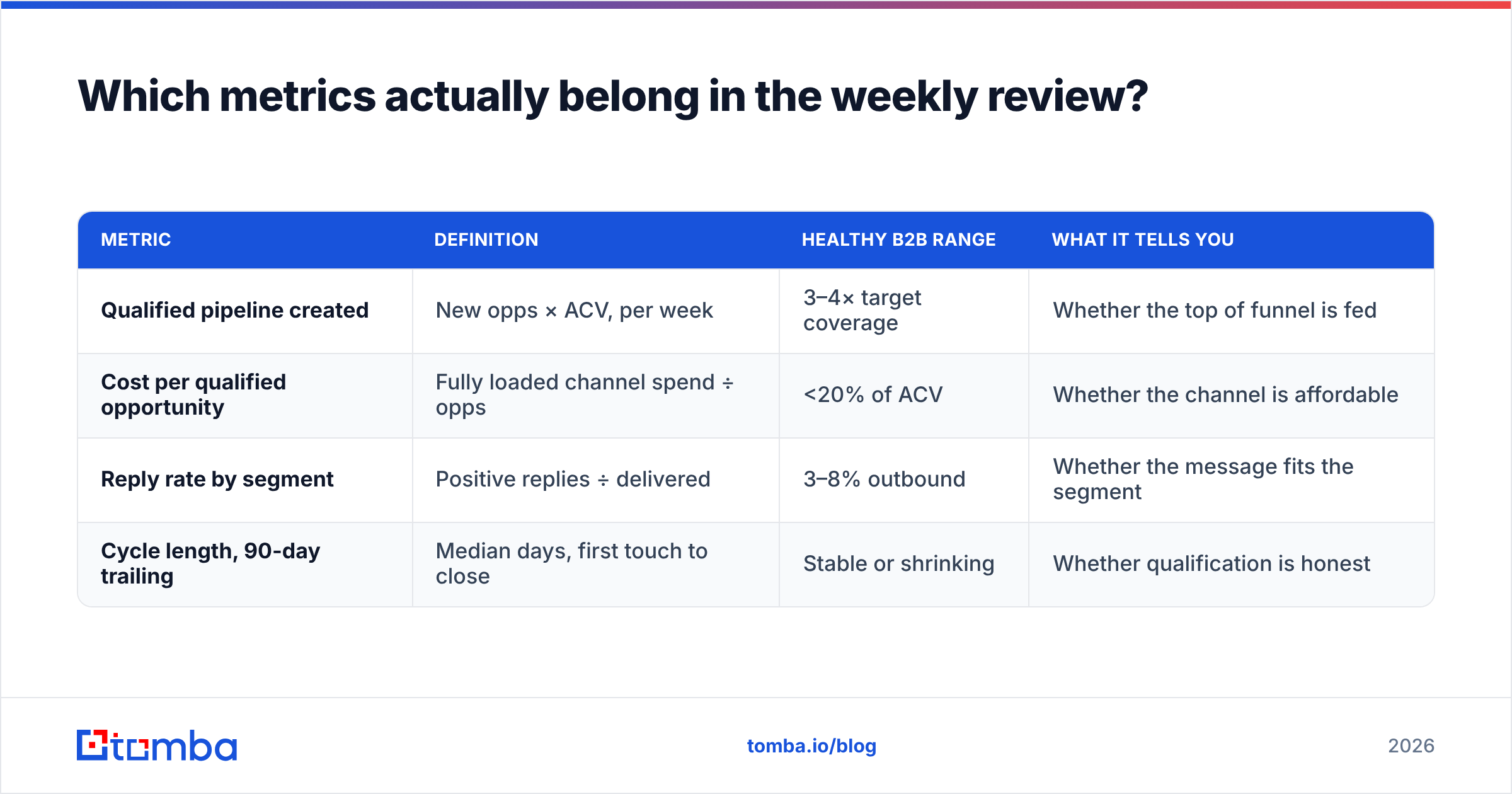
Which metrics actually belong in the weekly review?#
Four. More than four and the review becomes a status report instead of a decision meeting.
| Metric | Definition | Healthy B2B range | What it tells you |
|---|---|---|---|
| Qualified pipeline created | New opps × ACV, per week | 3–4× target coverage | Whether the top of funnel is fed |
| Cost per qualified opportunity | Fully loaded channel spend ÷ opps | <20% of ACV | Whether the channel is affordable |
| Reply rate by segment | Positive replies ÷ delivered | 3–8% outbound | Whether the message fits the segment |
| Cycle length, 90-day trailing | Median days, first touch to close | Stable or shrinking | Whether qualification is honest |
Note what's absent: emails sent, calls made, and activity counts generally. Activity metrics are useful for coaching an individual rep, and actively harmful in a GTM review, because they can be moved without moving revenue. If your win rate is falling while activity climbs, you have a qualification problem, and no amount of extra sends will fix it.
One more nuance on cost per qualified opportunity: include the data cost. Teams routinely count SDR salary and sequencing software but leave out the $400/month they spend on contact data, then wonder why the model doesn't reconcile with the bank account.
What separates the plans that survive contact with reality?#
Three habits, in order of impact.
They narrow faster than feels comfortable. The teams that hit their number in year one usually served a segment so specific it looked like a mistake at the time — "Shopify Plus stores doing $5M–$40M GMV with an in-house CX team." Narrow segments make messaging obvious, referrals compounding, and list-building cheap.
They treat the plan as a rolling document. Quarterly rewrite, not annual. The version of the plan you write in January will be wrong by March, and that's fine — being wrong on a 90-day cycle costs one quarter. Being wrong on an annual cycle costs a year and usually a headcount plan built on the wrong assumption.
They instrument before they scale. Attribution, verified contact data, and CRM hygiene are boring in month one and decisive in month nine. You cannot double down on what worked if you can't tell what worked.
For teams comparing broader data providers, it's worth noting that vendors like BookYourData, Apollo, and Clearbit each solve slightly different slices — prebuilt list purchase, all-in-one engagement, and enrichment-first respectively. Most mature GTM stacks end up combining a primary finder with a secondary source for coverage gaps rather than betting everything on one vendor. If you're evaluating that landscape, our breakdowns of Apollo alternatives and Clearbit alternatives cover the tradeoffs in more depth. HubSpot's go-to-market research library is also a reasonable free benchmark for conversion-rate assumptions if you don't yet have your own historical data.
Where should you start this week?#
Pick one segment. Write 20 accounts on a page. Find the three right people at each of them. Send a message that names the specific problem those 60 people have, and see what comes back.
That's a go to market plan in miniature, and it will teach you more in ten days than another month of planning. The plan document exists to scale what that experiment proves — not to replace running it.
When you get to the point of turning a target account list into contactable people, the Tomba Email Finder handles the resolution step: give it a domain and a name, or a domain and a role, and it returns verified professional addresses with confidence scores and source attribution. Start on the free tier with 25 searches to run your own accuracy test against your ICP before committing to a plan — then scale up once the numbers in your channel math check out.
Related guides#
Ready to find emails that actually work?
Join 150,000+ professionals who stopped guessing and started sending. Free credits on signup — no credit card required.
Get the Tomba newsletter
Practical outbound tactics and product updates — once every two weeks.
About the author